
2027 Best Medical Transcription Courses Online

Co-Founder and Chief Data Scientist
Choosing an online medical transcription course in 2027 is not just about finding the fastest certificate. It is about deciding whether healthcare documentation fits your skills, schedule, income goals, and tolerance for a changing job market. Medical transcription still supports clinical recordkeeping, but the field is being reshaped by speech recognition software, electronic health records, outsourcing, and employer demand for workers who can edit, verify, and manage documentation accurately.
This guide is for students, career changers, healthcare administrative workers, and remote-job seekers comparing online medical transcription programs. You will learn what these courses teach, how long they take, what they cost, which schools offer relevant training, how online programs compare with campus options, and what career paths may be realistic after graduation.
The key decision is simple: medical transcription can be a practical entry point into healthcare documentation if you are detail-oriented, comfortable working independently, and willing to keep up with technology. It may not be the best choice if your main goal is rapid wage growth or a high-demand clinical career.
Quick answer: Are online medical transcription courses worth considering?
Online medical transcription courses can be worth considering for learners who want flexible healthcare training without direct patient care. Most certificate programs focus on medical terminology, anatomy, transcription practice, grammar, editing, healthcare documentation, and privacy rules. Many can be completed remotely and may support work-from-home roles.
However, students should compare costs carefully because the Bureau of Labor Statistics projects a 5% employment decline for medical transcriptionists from 2023 to 2033, even though about 9,600 openings are expected each year due to workers leaving the occupation or retiring. The field is not disappearing, but it is becoming more selective. Graduates who understand medical language, can edit speech-recognition output, and know electronic health record workflows may be better positioned than those trained only in traditional dictation typing.
Who is a good fit for medical transcription training?
- Strong fit: You type accurately, notice small errors, enjoy language, and want a healthcare support role that may offer remote work.
- Possible fit: You already work in a clinic, front office, billing office, or administrative role and want to add documentation skills.
- Weak fit: You want a high-growth occupation, frequent patient interaction, or a clinical license.
- Alternative path: If you want broader administrative options, compare transcription with coding, billing, health information technology, or medical assisting before enrolling.
What are the main benefits of online medical transcription training?
- Healthcare access without clinical training. Medical transcription introduces students to medical language, anatomy, diagnostic reports, discharge summaries, and documentation standards without requiring bedside care.
- Flexible study format. Many courses are self-paced, which can help working adults, caregivers, and learners in rural areas study around existing responsibilities.
- Remote-work potential. Hospitals, physician practices, transcription vendors, and independent clients may use remote transcription or editing support, although remote jobs are not guaranteed.
- Transferable administrative skills. Training in medical terminology, electronic records, grammar, quality review, confidentiality, and document formatting can support roles such as medical receptionist, unit clerk, patient care coordinator, healthcare documentation specialist, or quality assurance editor.
- Manageable training length. Many certificate options are shorter than associate degree programs, making them easier to complete for learners testing whether healthcare documentation is a good long-term fit.
| Decision factor | What it means for students | Best next step |
| Job outlook | The occupation faces a projected 5% employment decline from 2023 to 2033, but about 9,600 openings are expected annually from replacement needs. | Choose training that includes editing, EHR exposure, and speech-recognition workflows, not only typing practice. |
| Salary expectations | Reported pay varies by source, location, employer, specialization, and experience; national averages cited for this field range from about $30,100 to $42,085 annually. | Compare local job postings before committing to tuition. |
| Learning format | Online programs can be convenient, but self-paced study requires discipline and regular practice. | Ask whether the course includes instructor feedback on real transcription exercises. |
| Career flexibility | Medical transcription can lead to documentation, records, front-office, scribe, editing, or billing-related roles. | Look for programs with career services and practical assignments aligned with your target role. |
What can I expect from online medical transcription courses?
Online medical transcription courses teach students how to convert healthcare dictation and clinical information into accurate written documentation. A strong course should train you to understand medical language, recognize context, follow formatting rules, protect patient information, and produce records that are clear enough for clinicians, insurers, and health information teams to use.
Most programs include medical terminology, anatomy and physiology, pharmacology basics, grammar, punctuation, report formatting, transcription software, and document editing. You should also expect repeated practice with medical audio files, including common report types such as patient histories, consultation notes, operative reports, discharge summaries, diagnostic reports, and specialty-specific dictations.
Modern training increasingly emphasizes editing as much as typing. Many healthcare organizations use speech-recognition tools, so transcriptionists may review draft text, correct errors, verify terminology, and ensure that the final document matches the provider’s intended meaning. Programs that include proofreading, quality assurance, EHR concepts, and HIPAA-related privacy practices are generally more useful than programs built only around old-style dictation.
Some programs may prepare learners for credentials such as Registered Healthcare Documentation Specialist (RHDS) or Certified Medical Transcriptionist (CMT). Before choosing a course for certification preparation, verify the current exam status, eligibility rules, costs, and employer demand for that credential in your area.
Where can I work after completing an online medical transcription course?
Graduates may look for work anywhere healthcare documentation is created, reviewed, stored, or used. The most direct jobs are medical transcriptionist or healthcare documentation specialist roles, but the same training can also support adjacent administrative positions.
- Hospitals and health systems. Large facilities may need documentation support for discharge summaries, operative notes, emergency reports, diagnostic reports, and specialty services. Some roles may be remote, while others may be tied to facility systems and schedules.
- Physician offices and outpatient clinics. Primary care offices, specialty practices, dental offices, and small clinics may need help with chart documentation, provider notes, referrals, and patient records.
- Medical transcription service companies. These vendors provide transcription, editing, and documentation support to healthcare clients. They may hire employees or contractors, including remote workers.
- Health insurance organizations. Documentation knowledge can be useful in claims-related work, medical record review, and administrative processing.
- Freelance and contract work. Some transcriptionists serve multiple clients independently, although freelancing requires business skills, client management, secure data handling, and careful attention to confidentiality.
- Legal and court-related settings. Medical records may be transcribed, summarized, or reviewed for personal injury, disability, workers’ compensation, or malpractice-related matters.
How much can I make working as a medical transcriptionist?
Medical transcription pay depends heavily on employer type, location, productivity expectations, specialty knowledge, remote or on-site status, and whether the role is employee-based or contract-based. ZipRecruiter reported pay ranging from $11.06 to $28.61 per hour, with an average annual salary of about $42,722. It also reported that workers in the 25th percentile earn approximately $36,500, while those in the 75th percentile earn about $47,500.
General medical transcriptionists may work across many report types and specialties. Specialized transcriptionists, such as those focused on radiology, pathology, cardiology, or surgical documentation, may have stronger earning potential when employers value that expertise. Still, students should not assume that completing a course automatically leads to higher pay. Local employer demand, accuracy, speed, software skills, and experience usually matter.
| Salary factor | Why it matters |
| Experience | New transcriptionists often need time to build speed, accuracy, specialty vocabulary, and employer trust. |
| Specialty | Radiology, cardiology, pathology, and surgical documentation may require more technical knowledge. |
| Work arrangement | Contract roles may offer flexibility but can lack benefits, guaranteed hours, or paid training time. |
| Location | Pay can vary by city, state, cost of living, and healthcare employer concentration. |
| Technology skills | Employers may prefer applicants who can edit speech-recognition output and use EHR systems accurately. |
- Best Online Medical Transcription Courses & Programs for 2027
- How long does it take to complete an online medical transcription course?
- How does an online medical transcription course compare to an on-campus program?
- What is the average cost of an online medical transcription course?
- What financial aid options are for students enrolling in an online medical transcription course?
- What are the prerequisites for enrolling in an online medical transcription program?
- What courses are typically in an online medical transcription program?
- Are online medical transcription courses accredited?
- What emerging trends are shaping online medical transcription education?
- What types of specializations are available in online medical transcription programs?
- Can online medical transcription be a gateway to advanced healthcare degrees?
- How to choose the best online medical transcription program?
- What ongoing career support and professional development resources are available?
- What are the alumni outcomes and success rates for online medical transcription courses?
- What practical training and experience opportunities do online medical transcription courses offer?
- What career paths are available for graduates of online medical transcription courses?
- How do online medical transcription courses address regulatory compliance and data security?
- What is the job market for graduates of online medical transcription courses?
- What is the return on investment for online medical transcription courses?
Best Online Medical Transcription Courses & Programs for 2027
How do we rank schools?
Because even a short career program can affect your budget and employment options, this ranking emphasizes practical program information students can compare before enrolling. Our team reviews objective education data from sources such as the IPEDS database, Peterson’s database, College Scorecard database, and the National Center for Education Statistics. Research.com’s ranking methodology is designed to make school comparisons clearer, more consistent, and more transparent.
Students should use this list as a starting point, not the final decision. Contact each school directly to confirm tuition, program availability, software requirements, certification preparation, refund policies, and whether the curriculum still matches current healthcare documentation workflows.
1. Ashworth College
Ashworth College offers an online Medical Transcription Career Diploma focused on healthcare documentation skills. The program introduces students to medical terminology, anatomy, transcription tools, documentation systems, and the practical knowledge needed to prepare medical records accurately. Its self-paced structure may appeal to learners who need to study around work or family obligations.
- Program Length: Self-paced, typically completed in 6-9 months
- Cost per Credit: $79 per month
- Required Credits to Graduate: 60-90 hours of coursework
- Accreditation: DEAC
2. Antelope Valley College
Antelope Valley College partners with CareerStep to provide an online Medical Assistant program that includes medical transcription training. Because the curriculum also covers administrative healthcare preparation, it may suit students who want a wider entry-level healthcare office skill set rather than a transcription-only program.
- Program Length: Self-paced, typically completed in 12-18 months
- Tracks/concentrations: Medical Assistant with Medical Transcription training
- Cost per Credit: $139 per credit
- Required Credits to Graduate: 60 credits
- Accreditation: Accrediting Commission for Community and Junior Colleges (ACCJC)
3. Mississippi State University Extension
Mississippi State University Extension provides medical transcription training intended to build healthcare documentation and transcription competence. Its self-paced format may work well for students who want a flexible option connected to a university extension setting.
- Program Length: Self-paced
- Cost per Credit: Varies
- Required Credits to Graduate: 60-80 credits
- Accreditation: Southern Association of Colleges and Schools (SACS)
4. Normandale Community College
Normandale Community College offers health information technology programs that include medical transcription-related coursework. Students can expect a broader academic path that connects transcription with medical records, patient histories, EHR systems, and health information processes.
- Program Length: 2 years (part-time or full-time options available)
- Tracks/concentrations: Health Information Technology with Medical Transcription elements
- Cost per Credit: $198 per credit
- Required Credits to Graduate: 60-70 credits
- Accreditation: Higher Learning Commission (HLC)
5. Southern Technical College
Southern Technical College offers a Medical Billing and Coding program that includes transcription-related training. The program may be a better fit for students who want to combine medical terminology and documentation skills with billing and coding concepts.
- Program Length: Typically 12-18 months
- Tracks/concentrations: Medical Billing and Coding with Transcription elements
- Cost per Credit: Varies by program
- Required Credits to Graduate: 60-80 credits
- Accreditation: Accrediting Commission of Career Schools and Colleges (ACCSC)
| Program | Best for | Important question to ask |
| Ashworth College | Students seeking a self-paced career diploma focused on transcription. | Does the program include current speech-recognition editing practice? |
| Antelope Valley College | Learners who want medical assisting and administrative healthcare skills with transcription exposure. | How much of the curriculum is dedicated specifically to transcription? |
| Mississippi State University Extension | Students who prefer flexible extension-based professional training. | What software, audio practice, and career support are included? |
| Normandale Community College | Students interested in broader health information technology education. | Can credits transfer toward additional health information credentials? |
| Southern Technical College | Students comparing transcription with medical billing and coding pathways. | What roles are graduates most commonly prepared to pursue? |
How long does it take to complete an online medical transcription course?
Most online medical transcription certificate programs take about 6 months to 1 year, depending on the school, curriculum depth, and how many hours you can study each week. These programs usually concentrate on job-focused skills such as medical terminology, anatomy, grammar, transcription formatting, dictation practice, and healthcare documentation standards. They are generally longer and more specialized than some short medical billing and coding course options.
An associate degree path takes longer because it includes general education and broader health information coursework. An Associate of Applied Science (AAS) in Medical Transcription or an Associate of Science in Health Information Technology with a transcription focus usually takes around 2 years. Students looking for a very compressed credential should understand that this is different from an accelerated online associate degree and may not be realistic in 6 months.
Your timeline also depends on pacing. Self-paced programs can be completed faster by disciplined students who practice consistently, but they can stretch longer for learners balancing work, caregiving, or inconsistent study time.
| Training option | Typical completion time | Best for |
| Career certificate or diploma | 6 months to 1 year | Students seeking focused entry-level transcription training. |
| Medical assistant or billing/coding program with transcription elements | Typically 12-18 months | Learners who want broader healthcare administrative preparation. |
| Associate degree in health information technology or related field | Around 2 years | Students who want transferable credits and a wider health records career path. |
How does an online medical transcription course compare to an on-campus program?
Online medical transcription courses are usually the better choice for students who need schedule flexibility, already have basic computer skills, and can practice independently. You can often review lectures, complete assignments, and repeat audio exercises at your own pace. This is useful for working adults and students who do not live near a campus offering healthcare documentation training.
The trade-off is accountability. Online students must manage deadlines, ask for help when confused, and practice transcription regularly. A low-cost online course without instructor feedback may save money upfront but leave students underprepared for real employer expectations.
On-campus programs offer more structure. Students may benefit from scheduled labs, instructor demonstrations, peer interaction, and faster feedback on difficult dictation, formatting, or medical terminology questions. The drawbacks are fixed class times, commuting costs, less scheduling flexibility, and limited availability in some areas.
| Format | Advantages | Drawbacks | Best match |
| Online | Flexible scheduling, remote access, self-paced study options, convenient for working adults. | Requires discipline; quality varies; hands-on feedback may be limited. | Independent learners who need flexibility. |
| On-campus | Structured classes, direct instructor access, lab-style practice, peer support. | Less flexible; may require commuting and fixed attendance. | Students who learn best with routine and in-person support. |
| Hybrid | Combines online coursework with scheduled support or labs. | May still require local attendance or set meeting times. | Learners who want flexibility but also need some structure. |
If you prefer direct patient care rather than documentation, compare transcription with clinical support roles. For example, Research.com’s guide on how to get a CNA certificate explains a more hands-on route into healthcare environments.
What is the average cost of an online medical transcription course?
Online medical transcription costs vary by credential level, school type, included materials, and whether certification preparation or software access is bundled into tuition. Certificate programs commonly cost between $1,000 and $5,000. Associate-level options, such as an AAS in Medical Transcription or an Associate of Science in Health Information Technology, may cost between $7,560 and $12,000 per year.
When comparing prices, do not look only at advertised tuition. Ask whether the total includes digital textbooks, transcription software, audio files, foot pedal requirements, headset requirements, exam preparation, certification exam fees, technology fees, application fees, and graduation fees. A program that appears cheaper can become more expensive if essential tools are billed separately.
Students thinking beyond transcription may also consider how documentation and healthcare technology skills could support later technical roles. For example, a long-term path toward an information systems manager career would require much broader technology and management education than a transcription certificate alone.
Location can also influence earnings. ZipRecruiter reported that medical transcriptionists in Nome, AK ($52,996) and Cupertino, CA ($52,707) have higher salaries than many other regions. Use this type of location data carefully, because local salaries can reflect employer concentration, living costs, sample size, and job mix.
What financial aid options are for students enrolling in an online medical transcription course?
Financial aid depends on the school, credential type, accreditation status, and whether the program is eligible for federal aid. Short career courses may not always qualify for the same aid as degree programs, so students should confirm eligibility before enrolling.
- Employer tuition reimbursement. If you already work for a healthcare provider, insurer, administrative office, or hospital system, ask HR whether documentation training qualifies for reimbursement or professional development funding.
- Healthcare scholarships and grants. Some organizations fund students preparing for healthcare careers. The Edith Nourse Rogers STEM Scholarship provides up to $30,000 for veterans and their dependents pursuing STEM studies.
- Federal financial aid. Completing the FAFSA can help determine eligibility for federal grants and loans, but eligibility depends on the institution and program. Verify that the specific online medical transcription option qualifies.
- Professional association support. As with financial aid for medical billing and coding schools, healthcare documentation students may find support through professional groups. The Association for Healthcare Documentation Integrity (AHDI) offers membership scholarships awarded by lottery/random drawing.
- Community and nonprofit scholarships. Local foundations may support students entering healthcare. The Pioneers Healthcare Foundation provides scholarships for healthcare career students, with awards from $1000 to $4000.
- Payment plans. Some career schools offer monthly payment options. Compare total cost, fees, refund terms, and interest or financing charges before choosing this route.
What are the prerequisites for enrolling in an online medical transcription program?
Most online medical transcription programs are designed for beginners, so admissions requirements are usually modest. Still, successful students need more than a desire to work remotely. They need language accuracy, patience, and comfort with technology.
- High school diploma or GED. Most programs expect applicants to have completed secondary education or an equivalent credential.
- Basic computer ability. Online coursework requires email, internet navigation, document editing, file submission, and sometimes specialized transcription platforms.
- Typing readiness. A typing speed of at least 40-50 words per minute is often recommended, even if not required at admission. Accuracy matters as much as speed.
- English grammar and punctuation skills. Medical transcription requires careful listening, spelling, punctuation, and sentence structure.
- Medical terminology interest. Prior knowledge may help, but most programs introduce terminology from the beginning.
- Required technology access. Students may need a reliable computer, stable internet, headset, word processing software, transcription software, and possibly a foot pedal.
If your interests are outside healthcare administration, compare prerequisites carefully. For example, the steps to become an ICE agent involve a different mix of education, training, background qualifications, and professional preparation.
What courses are typically in an online medical transcription program?
A well-designed medical transcription curriculum should move from medical language fundamentals to realistic documentation practice. The best programs do not simply ask students to type what they hear; they teach students to understand context, recognize errors, use reference tools, and produce records that meet professional standards.
- Medical terminology. Students learn prefixes, suffixes, root words, body systems, procedures, diagnoses, and common healthcare abbreviations.
- Anatomy and physiology. This course explains body structures and functions so students can understand dictated clinical information rather than transcribing unfamiliar words blindly.
- Medical transcription fundamentals. Students learn report formats, dictation workflow, listening strategies, document standards, and professional expectations.
- Transcription practice. Learners work with sample dictations from different specialties and report types, building accuracy and confidence over time.
- Grammar, punctuation, and style. Students strengthen editing, proofreading, capitalization, punctuation, and healthcare documentation style conventions, including references such as American Medical Association (AMA) style.
- Health information management. Coursework introduces medical records organization, legal and ethical duties, confidentiality, and HIPAA-related privacy requirements.
- Pharmacology basics. Students study common medications, drug classes, dosage references, and terms that often appear in provider dictation.
- Advanced or specialty transcription. Programs may include cardiology, radiology, pathology, surgical, emergency medicine, or other specialty reports.
- Technology for transcription. Students may learn transcription software, audio controls, foot pedal use, document templates, speech-recognition editing, and EHR concepts.
- Certification or final assessment preparation. Some programs include review materials or final exams aligned with RHDS, CMT, or other healthcare documentation expectations.
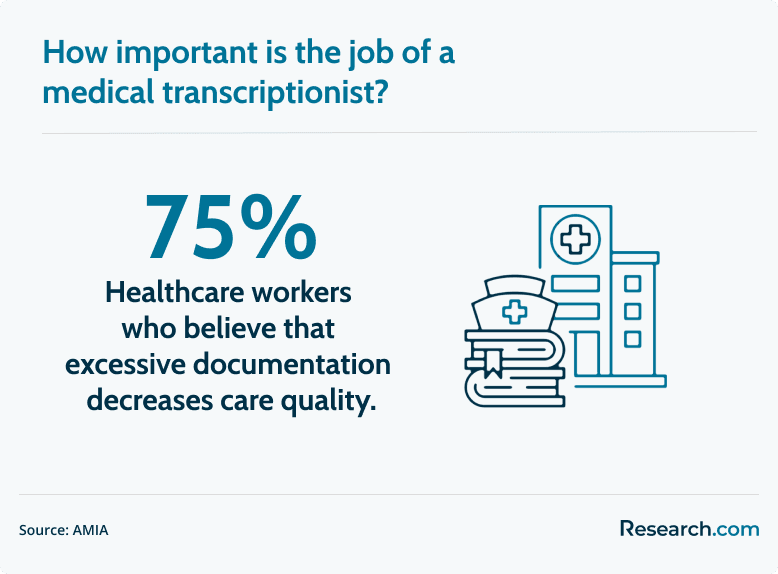
Documentation quality matters because healthcare workers already face heavy recordkeeping demands. In a survey cited by the American Medical Informatics Association, approximately 75% of healthcare workers said excessive documentation negatively affects patient care quality. Skilled documentation support can help reduce avoidable errors and allow clinicians to spend more attention on patients, although transcriptionists are only one part of the broader documentation workflow.
Are online medical transcription courses accredited?
Some online medical transcription courses are offered by accredited institutions, while others are noncredit career training programs. Accreditation does not guarantee a job, but it helps students verify that a school has been reviewed by a recognized quality-assurance body. It can also affect transfer credit, employer recognition, and federal financial aid eligibility.
Before enrolling, confirm both institutional accreditation and the nature of the credential. A school may be accredited while a short certificate is noncredit or not eligible for federal aid. Ask whether credits transfer, whether the program is reviewed by healthcare documentation professionals, and whether the curriculum reflects current transcription and editing practices. If you are comparing healthcare documentation options, Research.com’s guide to affordable online medical billing and coding courses can help you evaluate cost and credential differences across related programs.
What emerging trends are shaping online medical transcription education?
Medical transcription education is shifting from pure typing to documentation quality, editing, data security, and technology-supported workflows. Speech recognition and artificial intelligence tools can draft text quickly, but they can also mishear medications, procedures, names, measurements, and clinical meaning. That creates demand for workers who can review documentation critically rather than simply type fast.
Online programs are increasingly valuable when they teach students how to edit machine-generated drafts, work with electronic health records, protect patient information, and understand the limits of automation. Students may also benefit from learning how documentation connects with coding, billing, compliance, and analytics. Learners comparing broader allied health options may also explore fields such as an online ultrasound tech program, which leads toward a different healthcare role with more direct technical and patient-facing responsibilities.
What types of specializations are available in online medical transcription programs?
Specializations can help students build vocabulary and confidence in specific areas of medicine. They are especially useful when employers need documentation workers who understand a specialty’s procedures, tests, report formats, and terminology. Not every program offers formal concentrations, so students should ask whether specialty practice is included.
- Radiology transcription. Focuses on reports related to imaging, including X-rays, MRIs, and CT scans.
- Cardiology transcription. Covers cardiovascular language, ECGs, echocardiograms, stress tests, procedures, and heart-related conditions.
- Pathology transcription. Emphasizes laboratory, biopsy, autopsy, diagnostic, and disease-process terminology.
- Neuropsychiatry transcription. Includes psychiatric evaluations, therapy documentation, neurological assessments, and mental health terminology.
- Pediatrics transcription. Covers children’s health, development, pediatric illnesses, and age-specific documentation concerns.
- Surgical transcription. Focuses on operative reports, surgical instruments, procedural steps, and post-operative documentation.
- Obstetrics and gynecology transcription. Includes pregnancy, childbirth, reproductive health, gynecologic procedures, and women’s health terminology.
- Emergency medicine transcription. Prepares students for urgent, fast-paced reports involving trauma, accidents, acute symptoms, and emergency department encounters.
- Gastroenterology transcription. Covers digestive system terminology, endoscopy, colonoscopy, gastrointestinal procedures, and related conditions.
- General medical transcription. Provides broad exposure across specialties and may be suitable for students who want flexible entry-level options.
Specialization may improve competitiveness, but it should be evaluated realistically. Medical transcription is not generally one of the highest-paying medical careers, so students should weigh the cost of additional specialty training against actual job postings and employer requirements.
Can online medical transcription be a gateway to advanced healthcare degrees?
Medical transcription can be an entry point into the healthcare system, especially for students who later want to move into health information management, healthcare administration, public health, medical coding, or compliance. The training builds familiarity with medical language, records, privacy, documentation quality, and healthcare workflows.
It is not, by itself, a substitute for a clinical degree or an advanced healthcare credential. Students who want leadership, policy, public health, or administrative roles will usually need additional education. For example, those interested in population health or policy may compare transcription experience with more advanced options such as the cheapest online MPH programs.
How to choose the best online medical transcription program?
The best program is the one that prepares you for the work you actually want, at a price that makes sense for your likely earnings. Do not choose based only on speed, advertising claims, or the promise of remote work.
- Verify accreditation and school legitimacy. Check whether the institution is accredited by a recognized agency, such as ACCSC, DEAC, ACCJC, HLC, or SACS, depending on the school.
- Review the full curriculum. Look for medical terminology, anatomy, pharmacology, grammar, transcription practice, editing, HIPAA, healthcare documentation standards, software training, and EHR exposure.
- Confirm practical training. Ask how many audio files, report types, specialties, and graded practice assignments are included.
- Check technology requirements. Find out whether the school provides transcription software, practice files, a foot pedal, headset guidance, or access to learning platforms.
- Evaluate certification preparation. If a program advertises RHDS or CMT preparation, ask what is included, whether exam fees are covered, and whether employers in your target market request those credentials.
- Compare total cost. Include tuition, fees, equipment, software, textbooks, certification exams, and financing costs.
- Ask about career services. Useful support may include resume help, interview preparation, job boards, employer connections, and guidance for freelance or contract work.
- Read outcomes carefully. Job placement rates and testimonials can be helpful, but ask how outcomes are measured and whether they apply to the exact program you are considering.
Questions to ask before enrolling
| Question | Why it matters |
| Is the school accredited, and is this specific program credit-bearing or noncredit? | This affects aid eligibility, transfer options, and credential recognition. |
| How much hands-on transcription and editing practice is included? | Employers value accuracy with real documentation tasks, not just theory. |
| Does the program teach speech-recognition editing? | Technology has changed the role, and editing skills are increasingly important. |
| What are the total costs beyond tuition? | Equipment, fees, software, and exams can change the true price. |
| What jobs do graduates actually obtain? | Graduate outcomes help you judge whether the course aligns with your goals. |
| Does the school offer job search support? | Resume guidance, employer contacts, and interview help can be valuable for new entrants. |
The largest employers of medical transcriptionists are administrative and support services (37%) and physicians' offices (35%), according to BLS data cited for 2023. Understanding where jobs are concentrated can help students target applications more strategically after training.
What ongoing career support and professional development resources are available?
Career support can make a major difference, particularly in a field where entry-level applicants may compete for remote roles. Strong programs may provide resume review, interview coaching, job-search workshops, employer referrals, professional association guidance, and portfolio-style samples of completed transcription work.
Professional development should continue after graduation. Healthcare documentation standards, privacy expectations, EHR systems, and speech-recognition tools change over time. Graduates may benefit from webinars, refresher modules, mentorship, continuing education, and cross-training in billing, coding, records management, or healthcare administration. Students who want broader science or healthcare preparation may also compare transcription with an accelerated online biology degree, depending on long-term goals.
What are the alumni outcomes and success rates for online medical transcription courses?
Alumni outcomes can help students judge whether a program is producing employable graduates, but the numbers must be read carefully. Ask whether the school reports job placement rates, completion rates, certification pass rates, average time to employment, and the types of jobs graduates accept. Also ask whether outcomes are verified, recent, and specific to the medical transcription program rather than the institution as a whole.
Some graduates use transcription as a first step into broader healthcare administration or health information careers. If that is your goal, compare whether the program’s credits or training can support further education, including options such as an accredited online healthcare administration degree.
What practical training and experience opportunities do online medical transcription courses offer?
Practical training is one of the most important features to compare. Students should not graduate after only reading about medical terminology. They need repeated exposure to real or realistic dictation, different accents and speaking speeds, background noise, specialty vocabulary, report formatting, and editing challenges.
Look for courses that include graded transcription assignments, instructor comments, timed practice, proofreading exercises, speech-recognition editing, and specialty report samples. Some programs may also offer virtual workshops, mentoring sessions, or capstone-style final assessments. If you are comparing related documentation careers, reviewing the best accredited online medical billing and coding schools can help you see how practical training differs across healthcare administrative fields.
What career paths are available for graduates of online medical transcription courses?
Medical transcription training can lead to direct transcription work or related healthcare documentation roles. The best path depends on whether you prefer typing, editing, records management, live documentation, billing, or technology support.
- Medical transcriptionist. Transcribes provider dictation into medical reports, histories, discharge summaries, consultation notes, and other clinical documents.
- Medical scribe. Documents patient encounters in real time, usually while working with physicians or other clinicians in clinical settings.
- Medical records specialist. Organizes, updates, reviews, and maintains patient records while following privacy and documentation rules.
- Healthcare documentation specialist. Reviews and improves medical documentation for clarity, completeness, accuracy, and compliance.
- Medical coding and billing specialist. Uses medical terminology knowledge to support coding, claims, and reimbursement work. Students interested in this route can compare online medical billing and coding certificate programs.
- Quality assurance editor. Reviews transcribed or speech-generated documents for accuracy, formatting, terminology, and consistency.
- Freelance medical transcriptionist. Provides transcription or editing services independently, which requires client management and secure handling of health information.
- Medical transcription trainer. Experienced professionals may teach or mentor new transcription students or employees.
- Healthcare IT support role. Workers who add technical training may support EHR systems, documentation workflows, or health information technology operations.
BLS data cited for 2023 reported top-paying industries for transcriptionists including Home Health Care Services with an average salary of $52,590, Medical and Diagnostic Laboratories at $51,000, and Management, Scientific, and Technical Consulting Services at $47,860. These figures can help with career planning, but job availability and hiring requirements vary by region and employer.
Students comparing public service careers outside healthcare may also review Research.com’s FBI agent career guide to understand how dramatically education, screening, training, and job expectations differ across fields.
How do online medical transcription courses address regulatory compliance and data security?
Medical transcriptionists work with sensitive health information, so compliance and data security should be part of every credible program. Students should learn HIPAA-related privacy duties, secure file handling, authorized access, password practices, confidentiality expectations, and the risks of using unsecured devices or networks.
Courses should also explain why accuracy is a compliance issue. A wrong medication, incorrect diagnosis, missing word, or formatting error can affect care, billing, legal records, or insurance processes. Graduates who understand privacy, documentation standards, and healthcare administration may later pursue broader roles, including some of the highest-paying healthcare administration jobs, though those positions typically require additional education and experience.
What is the job market for graduates of online medical transcription courses?
The job market for medical transcription graduates is mixed. On one hand, healthcare still produces enormous amounts of documentation, and employers need accurate records. On the other hand, automation, speech recognition, outsourcing, and workflow changes have reduced demand for traditional transcription-only roles. Compared with the medical coder career path, medical transcription may offer fewer openings and lower earnings potential in many markets.
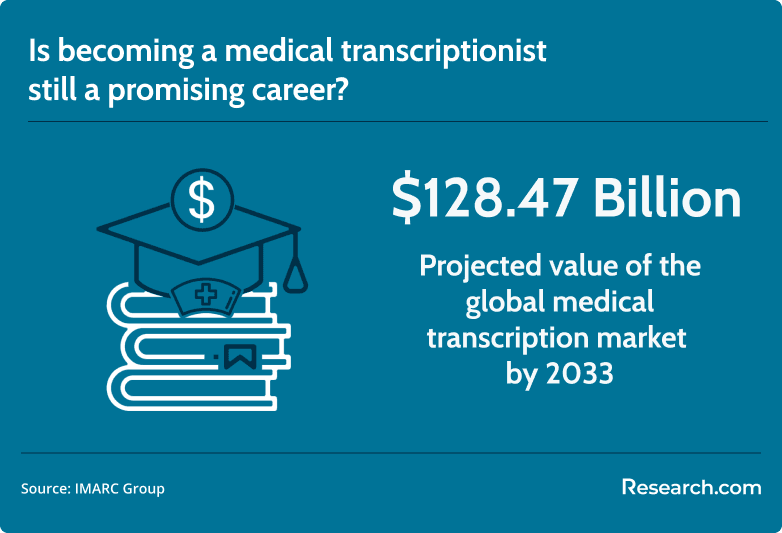
Industry revenue can still grow even when U.S. occupational employment declines. A cited report valued the global medical transcription market at $79.35 billion in 2024 and projected it to reach $128.47 billion by 2033, with a compound annual growth rate (CAGR) of 5.22%. The same discussion connects demand to long-term disease documentation needs and the rising use of transcription services across healthcare settings.
The medical tourism industry is also described as expanding from $144.5 billion to $704.8 billion by 2033, which may contribute to global documentation demand. Students should interpret this carefully: global market growth does not automatically mean more local entry-level jobs. The strongest candidates will likely be those who can combine medical terminology, documentation accuracy, editing, privacy awareness, and software skills.
What is the return on investment for online medical transcription courses?
ROI depends on how much you spend, how quickly you finish, whether you find paid work, and whether the training helps you move into related healthcare administrative roles. A low-cost certificate may be reasonable if it leads to entry-level work or strengthens your current healthcare job. A more expensive program needs stronger justification, especially given the projected 5% employment decline from 2023 to 2033.
Before enrolling, compare total program cost against realistic salary ranges, local job postings, remote-work competition, and the possibility of needing additional training in coding, billing, health information technology, or healthcare administration. If your long-term goal is a science-heavy or broader healthcare pathway, compare transcription with alternatives such as the best online biology degree programs.
| Common mistake | Why it can hurt you | Better approach |
| Choosing only the cheapest course | A low price may mean little feedback, outdated software, or limited practice. | Compare curriculum, hands-on assignments, instructor support, and outcomes. |
| Assuming remote work is guaranteed | Remote transcription jobs can be competitive and may require experience. | Build accuracy, editing skills, and a strong application portfolio. |
| Ignoring accreditation | Unverified schools may limit aid eligibility, transfer credit, or employer confidence. | Confirm institutional accreditation and program status before paying. |
| Overlooking technology trends | Traditional typing-only training may not match modern employer needs. | Choose programs with speech-recognition editing and EHR concepts. |
| Focusing only on completion time | Fast programs may not provide enough practice for job readiness. | Prioritize competence, feedback, and realistic dictation exercises. |
| Assuming salary outcomes are guaranteed | Pay varies by location, experience, specialty, and employer type. | Check local postings and compare wages before enrolling. |
Key Insights
- Online medical transcription courses are best for detail-oriented learners who want flexible healthcare documentation training without direct patient care.
- The field still has annual openings, but BLS projects a 5% employment decline from 2023 to 2033, so students should choose programs that teach editing, EHR concepts, privacy, and modern documentation workflows.
- Certificate programs commonly take 6 months to 1 year, while associate-level health information paths usually take around 2 years.
- Certificate tuition often ranges from $1,000 to $5,000, while associate-level programs may cost $7,560 to $12,000 per year; always calculate fees, equipment, software, and exam costs.
- Accreditation, hands-on transcription practice, instructor feedback, and career support matter more than advertising claims about speed or remote work.
- Medical transcription can lead to roles in transcription, healthcare documentation, medical records, scribing, quality assurance editing, billing and coding, or health information support, but additional training may be needed for advancement.
- The strongest ROI comes when the program cost is modest, the curriculum is current, and the student uses transcription training as part of a broader healthcare documentation or administrative career plan.
References:
- AHDI Online. (n.d.). Scholarships. https://ahdionline.org/scholarships/
- Bureau of Labor Statistics. (2023, March 31). Medical transcriptionists. U.S. Department of Labor. https://www.bls.gov/ooh/healthcare/medical-transcriptionists.htm
- Bureau of Labor Statistics. (2023, May). Occupational employment and wages, May 2023: 319094 - Medical records specialists. https://www.b롤s.gov/oes/2023/may/oes319094.htm
- Pioneers Health Foundation. (n.d.). Scholarships. https://pioneershealthfoundation.org/scholarships/
- U.S. Department of Veterans Affairs. (n.d.). STEM scholarship. https://www.va.gov/education/other-va-education-benefits/stem-scholarship/
- ZipRecruiter. (2025, March 30). Highest paying medical transcription jobs. https://www.ziprecruiter.com/g/Highest-Paying-Medical-Transcription-Jobs
- ZipRecruiter. (2025, March 30). Medical transcription salary. https://www.ziprecruiter.com/Salaries/Medical-Transcription-Salary
Other Things You Need to Know About Online Medical Transcription Courses
Proficiency in typing, voice recognition software, and medical terminology is essential. Mastery of these skills helps students accurately transcribe medical documents. Most courses expect about 70 words per minute typing speed and provide training in relevant technology.
Completing medical transcription courses online in 2027 can prepare you for certifications like Certified Medical Transcriptionist (CMT) and Registered Healthcare Documentation Specialist (RHDS). These certifications are offered by the Association for Healthcare Documentation Integrity (AHDI) and enhance professional credibility.
Most online medical transcription courses expect at least 35 to 45 words per minute for entry, and many employers prefer 60 words per minute or higher for live work. Accuracy matters more than speed, with 95% or better typing accuracy commonly required.


