2027 Fastest Online Medical Billing and Coding Certificate Programs

Co-Founder and Chief Data Scientist
Choosing an online medical billing and coding certificate is usually a speed-versus-quality decision. Many students want training that can lead to entry-level healthcare administration work quickly, but the shortest program is not always the strongest option if it lacks certification preparation, employer recognition, student support, or credible accreditation.
This guide explains how fast online medical billing and coding certificate programs work, what they cost, how long they take, which programs are among the fastest available, and how to compare them before enrolling. It is designed for students who want a practical path into medical billing, medical coding, insurance claims, medical records, or revenue cycle support without committing to a full degree first.
Accuracy matters in this field. Errors in medical bills and health records can create financial problems for providers, claim denials for patients, compliance risks, and poor patient experiences. Research states that nearly 80% of medical bills contain errors, which is one reason healthcare organizations depend on trained medical records specialists to code services correctly, prepare claims, and maintain reliable documentation.
Quick Answer: Is an Online Medical Billing and Coding Certificate Worth It?
An online medical billing and coding certificate can be worth it for students who want a short, career-focused credential for entry-level healthcare administration roles. Graduates may qualify for jobs such as medical biller, medical coder, medical records technician, billing and coding specialist, patient account representative, or insurance claims analyst. The strongest programs teach ICD-10, CPT, HCPCS, medical terminology, healthcare reimbursement, HIPAA, and certification exam preparation.
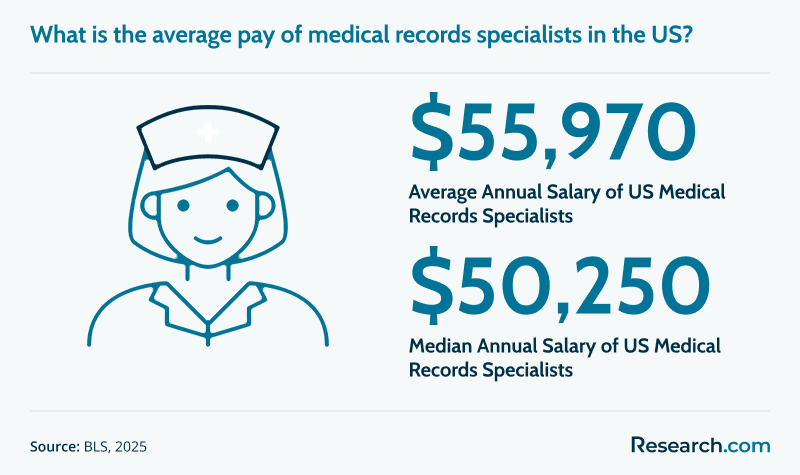
The average annual salary of medical records specialists is $55,970, while their median annual salary is $50,250. Programs commonly take 6 to 18 months, although some accelerated options can be completed in weeks or a few months. Before enrolling, students should verify accreditation, total cost, included exam fees, transfer-credit options, and whether the program prepares them for a recognized credential such as CPC, CCA, or CBCS.
What are the benefits of getting an online medical billing and coding certificate?
- Faster entry into healthcare administration: A certificate can prepare students for entry-level work without requiring a two-year or four-year degree.
- Several career options: Graduates may pursue roles as medical billers, medical coders, medical records technicians, insurance claims analysts, revenue cycle assistants, or patient account representatives.
- Flexible learning: Online programs can be easier to fit around work, caregiving, or other responsibilities than fixed on-campus schedules.
- Potentially lower total cost: Students may avoid commuting, parking, housing, and some campus-based fees.
- Certification preparation: Many programs include coursework aligned with industry exams, which can strengthen a graduate’s job search.
What can I expect from an online medical billing and coding certificate program?
An online medical billing and coding certificate is a career-training program focused on the administrative and documentation side of healthcare. Students learn how to read clinical documentation, assign standardized codes, prepare insurance claims, understand reimbursement rules, and maintain patient information in compliance with healthcare regulations.
Most programs use a learning management system where students watch lectures, complete assignments, practice coding cases, take quizzes, and communicate with instructors. Depending on the provider, courses may be self-paced, live online, or delivered in a cohort format with weekly deadlines.
Core topics usually include medical terminology, anatomy and physiology, ICD-10 coding, CPT coding, HCPCS coding, medical billing, health insurance, HIPAA, electronic health records, and revenue cycle management. Some programs also include virtual labs, coding software, case studies, exam-prep modules, or an externship.
| Program component | What students usually learn | Why it matters for employment |
| Medical terminology | Healthcare language, abbreviations, disease terms, and procedure terms | Coders must understand clinical notes before assigning codes. |
| ICD-10, CPT, and HCPCS coding | Diagnosis, procedure, supply, and service code systems | These code sets are central to reimbursement and claims processing. |
| Billing and reimbursement | Insurance claims, payer rules, denials, payments, and collections | Billing staff help providers receive accurate and timely payment. |
| Healthcare compliance | HIPAA, privacy, documentation standards, and ethical billing | Incorrect billing can create legal, financial, and audit risks. |
| Certification preparation | Practice exams, coding guidelines, and test strategies | Credentials can help new graduates compete for entry-level roles. |
Where can I work with an online medical billing and coding certificate?
Medical billing and coding certificate graduates can work anywhere healthcare documentation, reimbursement, claims review, and patient records are handled. Some roles are fully in office, some are hybrid, and some may become remote after a worker gains experience and demonstrates accuracy.
- Hospitals: Large facilities need coders and billing staff for inpatient, outpatient, emergency, and specialty-care documentation.
- Physician offices and clinics: Smaller practices often hire billing and coding staff to submit claims, correct denials, and maintain patient accounts.
- Insurance companies: Claims teams review codes, verify coverage, investigate discrepancies, and support reimbursement decisions.
- Medical billing companies: Third-party billing vendors support healthcare providers that outsource coding, claims, and payment follow-up.
- Long-term care facilities: Skilled nursing, rehabilitation, and residential care organizations need accurate records for services and reimbursement.
- Government agencies: Medicare, Medicaid, public health departments, and related agencies use coding and records knowledge for audits, compliance, and claims review.
- Remote billing and coding teams: Some employers offer work-from-home positions, especially for experienced or certified professionals who can meet productivity and accuracy standards.
How much can I make with an online medical billing and coding certificate program?
Medical billers and coders are generally classified under medical records specialists. According to the United States Bureau of Labor Statistics (BLS), the average annual salary of medical records specialists is $55,970, while their median annual salary is $50,250. That median is slightly above the collective median yearly salary of all professions in the United States, $49,500.
Medical records specialists can earn from $35,780 to $80,950 yearly. New workers commonly start closer to the lower end of the range, while experienced specialists, certified professionals, auditors, revenue cycle staff, and workers in higher-paying locations may earn more.
Salary should not be treated as guaranteed. Pay depends on location, employer type, certification, experience, productivity requirements, specialty coding knowledge, and whether the role is entry-level or advanced.
- Fastest Online Medical Billing and Coding Certificate Programs for 2027
- How long does it take to complete an online medical billing and coding certificate program?
- How does an online medical billing and coding certificate program compare to an on-campus program?
- What is the average cost of an online medical billing and coding certificate program?
- What are the financial aid options for students enrolling in an online medical billing and coding certificate program?
- What are the prerequisites for enrolling in an online medical billing and coding certificate program?
- What courses are typically in an online medical billing and coding certificate program?
- What are the essential skills needed to become successful medical billers and coders?
- How to choose the best online medical billing and coding certificate program?
- What are the emerging industry trends and challenges in online medical billing and coding?
- What career paths are available for graduates of online medical billing and coding certificate programs?
- What is the job market for graduates with an online medical billing and coding certificate program?
- How Can I Transition from a Certificate Program to Higher Education?
- How Do These Certificate Programs Compare to Other Online Healthcare Training Options?
- How Can I Verify Program Accreditation and Quality Assurance?
Fastest Online Medical Billing and Coding Certificate Programs for 2027
The fastest medical billing and coding programs are best for students who can study consistently, already have strong reading and computer skills, and want job-focused training rather than a broader degree. A short certificate can be useful, but students should compare speed with certification preparation, curriculum depth, academic support, and employer recognition. Speed alone should not drive the decision.
Students comparing accelerated healthcare credentials may also look at other fast online pathways, including a fast-track online masters degree in clinical mental health counseling, but medical billing and coding certificates are distinct because they focus on healthcare documentation, claims, and reimbursement rather than clinical care.
How do we rank schools?
Fast online certificate programs still require time, money, and disciplined study. To make program comparisons more transparent, our research process draws on credible education and institutional data sources.
Data sources include the IPEDS database, College Scorecard, Peterson's database, and the National Center for Education Statistics. Readers can review the broader ranking approach on our methodology page.
| Rank | Program | Program length | Cost | Accreditation listed |
| 1 | Southern New Hampshire University Online Medical Billing and Coding Course | 8 weeks | $1,026 | New England Commission of Higher Education |
| 2 | Thomas Jefferson University Medical Billing & Coding Certificate | 2 to 6 semesters | $663 per credit | Middle States Commission on Higher Education |
| 3 | Franklin University Medical Billing Specialist Certificate Online | 2 to 3 months | $2,500 | Higher Learning Commission |
| 4 | CALRegional Online Medical Billing & Coding Program | 11 weeks | $1,995 | None |
| 5 | Ohio State Career Training Center Medical Billing & Coding Specialist | 4 weeks (day class) to 8 weeks (evening class) | N/A | None |
| 6 | Oklahoma State University-Oklahoma City Online Medical Billing and Coding Course | 1 year | $3,295 | Higher Learning Commission |
| 7 | U.S. Career Institute Online Medical Billing Course | 7 months | $1,239 | Distance Education Accrediting Commission |
| 8 | University of Tennessee at Chattanooga Online Medical Billing and Coding Program | 20 weeks | $3,245 | Southern Association of Colleges and Schools Commission on Colleges |
| 9 | Kilgore College Medical Coding | 21 weeks | $2,100 | Southern Association of Colleges and Schools Commission on Colleges |
| 10 | Davenport University Instructor-led Medical Coding Certification | 16 weeks | $2,995 | Higher Learning Commission |
1. Southern New Hampshire University Online Medical Billing and Coding Course
Southern New Hampshire University offers an Online Coding and Classification Systems course for students who want a short, focused introduction to core coding systems. The 8-week, 3-credit course covers ICD-10, CPT, HCPCS, and electronic code validation. It is offered online for $1,026 and is connected to SNHU’s CAHIIM-accredited health information management program.
- Program Length: 8 weeks
- Required Credits to Graduate: 3
- Cost: $1,026
- Accreditation: New England Commission of Higher Education
2. Thomas Jefferson University Medical Billing & Coding Certificate
The Medical Billing & Coding Certificate from Thomas Jefferson University is a 24-credit online certificate for students who want a more extensive academic program. The curriculum includes hands-on training, industry-standard coding software, a virtual lab environment, and exposure to artificial intelligence tools such as natural language processing and machine learning.
- Program Length: 2 to 6 semesters
- Required Credits to Graduate: 24
- Cost per Credit: $663
- Accreditation: Middle States Commission on Higher Education
3. Franklin University Medical Billing Specialist Certificate Online
The Franklin University Medical Billing Specialist Certificate is a beginner-friendly online option that can be completed in 2 to 3 months. It prepares students for the Medical Coder & Biller Certification (MCBC) exam and uses interactive learning tools such as 3D animations, simulations, and practical billing scenarios. Coursework covers insurance billing, diagnostic and procedural coding, claims auditing, and fraud prevention.
- Program Length: 2 to 3 months
- Required Credits to Graduate: 13
- Cost: $2,500
- Accreditation: Higher Learning Commission
4. CALRegional Online Medical Billing & Coding Program
The Online Medical Billing & Coding Program from CALRegional is an 11-week, fully online program that combines live instruction with self-paced coursework. Students prepare for the Certified Billing & Coding Specialist (CBCS) exam while studying ICD-10, CPT, HCPCS, billing, transcription, data processing, and records management through the Schoology platform.
- Program Length: 11 weeks
- Required Credits to Graduate: N/A
- Cost: $1,995
- Accreditation: None
5. Ohio State Career Training Center Medical Billing & Coding Specialist
The Medical Billing & Coding Specialist program at Ohio State Career Training Center is an accelerated certificate course that can be completed in as little as 4 weeks through day classes or 8 weeks through evening classes. The curriculum includes medical terminology, anatomy, CPT coding, ICD-10-CM coding, HIPAA regulations, and coding guidelines. It prepares students for the National Certification Examination through the National Healthcareer Association.
- Program Length: 4 weeks (day class) to 8 weeks (evening class)
- Required Credits to Graduate: N/A
- Cost: N/A
- Accreditation: None
6. Oklahoma State University-Oklahoma City Online Medical Billing and Coding Course
The Oklahoma State University-Oklahoma City Online Medical Billing and Coding Course is a flexible, fully online program that prepares students for national certification exams such as CPC, CCA, or CBCS. Students study medical terminology, healthcare law, insurance claims, ICD-10 coding, CPT coding, and electronic billing systems.
- Program Length: 1 year
- Required Credits to Graduate: N/A
- Cost: $3,295
- Accreditation: Higher Learning Commission
7. U.S. Career Institute Online Medical Billing Course
The U.S. Career Institute Online Medical Billing Course is a self-paced, fully online program for students without previous healthcare experience. The curriculum emphasizes practical billing tasks, including coding basics, insurance claims, CMS-1500 forms, anatomy, and medical terminology.
- Program Length: 7 months
- Required Credits to Graduate: N/A
- Cost: $1,239
- Accreditation: Distance Education Accrediting Commission
8. University of Tennessee at Chattanooga Online Medical Billing and Coding Program
The University of Tennessee at Chattanooga offers a 20-week online Medical Billing and Coding Academy that prepares students for the AAPC Certified Professional Coder (CPC) certification exam. The program includes 80 hours of instruction, course materials, the CPC exam fee with a free retake, and a one-year AAPC membership. Students learn ICD-10-CM, CPT, HCPCS, insurance billing, and claims management, and there are no prerequisites or prior experience requirements.
- Program Length: 20 weeks
- Required Credits to Graduate: 80 hours
- Cost: $3,245
- Accreditation: Southern Association of Colleges and Schools Commission on Colleges
9. Kilgore College Medical Coding
Kilgore College offers a 21-week online Medical Coding program designed for students preparing for the AAPC Certified Professional Coder (CPC) exam. The 80-hour course covers CPT, ICD-10-CM, and HCPCS Level II coding and includes practice with redacted medical records. Applicants must be at least 18 years old, hold a high school diploma or GED, and complete basic anatomy and medical terminology courses before enrolling.
- Program Length: 21 weeks
- Required Credits to Graduate: 80 hours
- Cost: $2,100
- Accreditation: Southern Association of Colleges and Schools Commission on Colleges
10. Davenport University Instructor-led Medical Coding Certification
Davenport University offers an Instructor-led Medical Coding Certification (CPC®) program for students who want structured online preparation for the AAPC Certified Professional Coder exam. The 16-week curriculum includes CPT, HCPCS Level II, ICD-10-CM, chart coding practice, and official AAPC-approved exam-prep materials.
- Program Length: 16 weeks
- Required Credits to Graduate: N/A
- Cost: $2,995
- Accreditation: Higher Learning Commission
How long does it take to complete an online medical billing and coding certificate program?
An online medical billing and coding certificate program typically takes 6 to 18 months to complete. The exact timeline depends on whether the program is self-paced or instructor-led, how many courses are required, whether an externship is included, and how many hours a student can study each week.
Some accelerated options can be finished in 3–4 months or less, while broader certificate programs may take a year or longer. Students comparing healthcare training timelines may also review shorter clinical support options, such as the cheapest CNA programs online, but billing and coding is usually a documentation and reimbursement pathway rather than direct patient care.
| Timeline | Best fit | Trade-off to consider |
| 4 to 11 weeks | Students with strong study availability who want very fast exam preparation | May provide less time for practice, remediation, or career support |
| 2 to 7 months | Working adults who want a manageable pace with focused training | Requires consistent weekly study and self-discipline |
| 1 year to 18 months | Students who want deeper coursework, externship options, or broader academic credit | Longer time before job searching and potentially higher total cost |
Key factors that affect completion time include:
- Delivery format: Self-paced programs let motivated students move quickly, while cohort-based programs follow fixed deadlines.
- Curriculum depth: Programs that include anatomy, terminology, compliance, reimbursement, and intensive coding practice usually take longer.
- Weekly study time: Students balancing full-time work or family responsibilities may need a longer schedule.
- Externship requirements: Practical placements or supervised experiences can extend the completion timeline.
- Certification preparation: Programs that include exam review, practice tests, and vouchers may add time but can improve readiness.
According to Zippia, 90% of medical billers and coders in the United States are women, and only 10% are men.
How does an online medical billing and coding certificate program compare to an on-campus program?
Online and on-campus medical billing and coding certificates usually cover similar technical content: medical terminology, billing, reimbursement, ICD-10, CPT, HCPCS, EHR systems, and compliance. The main differences are schedule structure, instructor access, networking, cost, and how much independence the student needs.
Online learning can be attractive to students who want the flexibility seen in other accelerated online credentials, including a fast track master's in gifted education online. However, students who prefer real-time accountability may be better served by an on-campus or live online format.
| Factor | Online certificate | On-campus certificate |
| Schedule | Often asynchronous, self-paced, or evening-friendly | Usually fixed class times and in-person attendance |
| Learning style | Best for independent learners who can manage deadlines | Best for students who want face-to-face structure |
| Practice tools | May include virtual labs, coding simulations, and online case studies | May include classroom labs and supervised software practice |
| Support | Online tutoring, discussion boards, email support, and virtual advising | In-person tutoring, office hours, labs, and campus services |
| Networking | Virtual peer groups, webinars, and online career resources | Campus career fairs, local employer events, and student organizations |
| Total cost | May reduce commuting, parking, and campus-related expenses | May include transportation, campus fees, and possible housing costs |
Who should choose an online program?
- Students who need flexible study hours
- Working adults or parents who cannot attend daytime classes
- Students who are comfortable learning through videos, readings, quizzes, and online labs
- Students who want to compare programs outside their local area
Who may prefer an on-campus program?
- Students who learn better through in-person instruction
- Students who need frequent real-time feedback
- Students who want local employer networking opportunities
- Students who struggle with self-paced learning or online deadlines
What is the average cost of an online medical billing and coding certificate program?
The average cost of online medical billing and coding certificate programs typically falls between $1,500 and $7,000. The final price depends on the provider, program length, tuition model, included materials, software access, certification exam fees, and whether the certificate is offered through a college, university, private provider, or workforce training organization.
Students used to comparing short career credentials, including a fast-track online microsoft azure dual certification boot camp, should look beyond advertised tuition. A low base price may not include textbooks, coding manuals, exam vouchers, membership fees, technology requirements, or retake costs.
| Cost factor | What to check before enrolling |
| Tuition | Is pricing listed per course, per credit, or for the full program? |
| Books and coding manuals | Are ICD-10, CPT, and HCPCS resources included or purchased separately? |
| Certification exam fees | Does the program include CPC, CCA, CBCS, or another exam voucher? |
| Software and lab access | Will students use coding simulations, EHR tools, or billing software? |
| Career services | Are resume help, job boards, mock interviews, or employer connections included? |
| Retake or extension fees | What happens if the student needs more time to finish? |
Landing a decent-paying job can help graduates recover training costs over time, but return on investment depends on local wages, job availability, certification, and the student’s ability to complete the program and secure employment. As reflected by the chart below, the US states that offer the highest average yearly salaries to medical records specialists are the District of Columbia ($70,900), Washington ($64,250), and California ($64,070).
What are the financial aid options for students enrolling in an online medical billing and coding certificate program?
Financial aid depends heavily on the school, accreditation status, program length, and whether the certificate is eligible under federal or state rules. Students should confirm aid eligibility directly with the institution before assuming a certificate qualifies.
Students in short online credentials, including fast-track esl graduate certificate programs online, often compare several funding options before enrolling. Medical billing and coding students can consider the following:
- Federal financial aid: Some accredited college or university programs may qualify for Pell Grants, Direct Subsidized/Unsubsidized Loans, or work-study. Students must complete the FAFSA (Free Application for Federal Student Aid) to determine eligibility.
- Scholarships: Schools, healthcare organizations, private foundations, and professional groups may offer awards for students in health information or healthcare administration fields.
- Payment plans: Many providers allow monthly payments instead of requiring full tuition upfront.
- Employer tuition assistance: Healthcare employers may reimburse training costs for employees moving into billing, coding, compliance, or revenue cycle roles.
- State and workforce funding: Workforce development agencies may support career-training programs for eligible unemployed or underemployed students.
- Private loans: These may be available, but students should compare interest rates, repayment terms, and borrower protections carefully.
- Military and veteran benefits: Eligible service members, veterans, and family members may use GI Bill® benefits or military tuition assistance for approved programs.
Questions to ask about financial aid
- Is this specific certificate eligible for federal financial aid?
- Are certification exam fees included in tuition?
- Will I owe additional fees for books, coding manuals, software, or extensions?
- Can I use employer reimbursement, workforce funding, or veteran benefits?
- What is the refund policy if I withdraw?
What are the prerequisites for enrolling in an online medical billing and coding certificate program?
Most online medical billing and coding certificates are designed for beginners, but students still need basic academic, computer, and communication skills. Because the work involves detailed reading, code selection, documentation review, and software use, preparation matters.
As with many short online credentials, including fast-track graduate certificate early childhood education online options, entry requirements vary by institution.
- High school diploma or GED: Most programs require proof of high school completion or an equivalent credential.
- Basic computer ability: Students should be comfortable using online learning platforms, email, word processing tools, spreadsheets, and web-based software.
- English reading and writing skills: Medical documentation, payer rules, and coding guidelines require careful reading comprehension.
- Typing proficiency: Efficient typing helps with data entry, claims work, and record updates.
- Minimum age requirement: Many programs require students to be at least 18 years old by enrollment or program start.
- Placement test: Some schools assess readiness in reading, writing, or math before admission.
- Prerequisite coursework: Certain programs require medical terminology or anatomy before advanced coding courses.
As seen in the chart below, data from Zippia shows that 30% of medical billers and coders in the United States earned an associate degree, 21% completed a certificate program, 16% hold a bachelor's degree, and 11% have a high school diploma.
What courses are typically in an online medical billing and coding certificate program?
A strong online medical billing and coding certificate should teach both the language of healthcare and the practical steps used to move a claim from clinical service to reimbursement. Students should look for programs that include coding practice, payer rules, compliance, and current code sets rather than only general healthcare administration topics.
Focused online programs can prepare students efficiently when the curriculum is well aligned with career outcomes, similar to how an fast track online master's degree in educational leadership is structured around a specialized professional goal.
- Medical terminology: Introduces the words, abbreviations, prefixes, suffixes, and terms used in clinical documentation.
- Anatomy and physiology: Helps students understand body systems, conditions, and procedures referenced in medical records.
- Healthcare law and ethics: Covers patient privacy, HIPAA, confidentiality, ethical billing, and documentation responsibilities.
- ICD Coding (ICD-10-CM/PCS): Teaches diagnosis coding and, where applicable, inpatient procedure coding.
- CPT/HCPCS Coding: Focuses on procedure, service, supply, and outpatient professional coding.
- Medical billing and reimbursement: Explains claims submission, payer requirements, denials, appeals, and payment posting.
- Electronic Health Records (EHR): Introduces digital patient record systems used in healthcare settings.
- Revenue cycle management: Covers the financial workflow from patient registration through final payment.
- Coding practice and lab: Gives students hands-on experience applying codes to case studies, charts, or simulated records.
What are the essential skills needed to become a successful medical biller and coder?
Successful medical billers and coders combine technical knowledge with precision, consistency, and professional judgment. The job is not simply data entry. It requires reading medical documentation, applying payer and coding rules, detecting errors, protecting patient information, and communicating clearly when claims or records need correction.
Students in technical online programs, including a fast track master's in science education online, often need structured attention to detail. Medical billing and coding requires the same discipline, but in a healthcare reimbursement environment.
| Skill | Why it matters |
| Medical terminology and anatomy | Coders must understand what the provider documented before selecting codes. |
| ICD-10, CPT, and HCPCS knowledge | Accurate coding depends on knowing current code sets and guidelines. |
| Attention to detail | Small errors can cause claim denials, payment delays, or compliance problems. |
| Analytical thinking | Coders must interpret records and connect documentation to the correct billing codes. |
| Software proficiency | Most employers use EHR, billing, claims, and coding platforms. |
| Regulatory awareness | HIPAA, payer rules, and reimbursement policies shape daily work. |
| Organization | Billing and coding staff manage multiple claims, deadlines, records, and follow-ups. |
| Communication | Professionals may work with providers, insurers, patients, auditors, and billing teams. |
| Problem-solving | Denied or rejected claims often require investigation and correction. |
| Continuing education | Codes, payer rules, and compliance expectations change regularly. |
According to Zippia, the skills that most frequently appear on the CVs of medical coders in the United States are CPC (11.3%), medical terminology (8%), ICD-10-CM (7.4%), AHIMA (6.7%), patients (6.6%), clinical documentation (5.1%), and AAPC (4.6%).
How to choose the best online medical billing and coding certificate program?
The best program is not always the fastest or cheapest. It is the one that fits your schedule, prepares you for the credential you want, provides enough coding practice, and gives you a realistic path toward entry-level employment. Students comparing career-focused online programs, including fast track online UX design bootcamps, should use a practical checklist rather than relying only on advertising claims.
Program selection checklist
- Verify accreditation: Check whether the institution is regionally or nationally accredited and whether that affects financial aid or transfer credit.
- Match the program to a certification exam: Confirm whether the coursework prepares students for CPC, CCA, CBCS, or another relevant credential.
- Review the curriculum: Look for ICD-10, CPT, HCPCS, medical terminology, billing, reimbursement, HIPAA, EHR, and hands-on coding practice.
- Compare total cost: Include tuition, books, manuals, exam fees, software, memberships, technology, payment-plan fees, and retake costs.
- Check learning format: Decide whether you need self-paced flexibility, live instruction, weekly deadlines, or instructor-led accountability.
- Ask about career support: Strong programs may offer resume help, job-search coaching, mock interviews, externships, or employer connections.
- Review outcomes carefully: If a school publishes job placement rates, ask how they are calculated and which graduates are included.
- Confirm transfer options: If you may pursue a degree later, ask whether credits can apply toward an associate or bachelor’s program.
Common mistakes to avoid
| Mistake | Better approach |
| Choosing only the shortest program | Make sure the program includes enough coding practice and certification preparation. |
| Looking only at tuition | Compare total cost, including books, exam fees, software, and extension fees. |
| Ignoring accreditation | Verify the institution and understand how accreditation affects aid and transfer credits. |
| Assuming online means easy | Plan weekly study time and choose a format that matches your learning style. |
| Assuming a certificate guarantees a job | Build a resume, prepare for certification, practice coding, and apply broadly. |
| Skipping employer research | Review job postings in your area to see which credentials and skills employers request. |
What are the emerging industry trends and challenges in online medical billing and coding?
Medical billing and coding is being reshaped by electronic health records, payer automation, artificial intelligence, changing reimbursement models, cybersecurity concerns, and ongoing updates to coding and compliance rules. These changes do not remove the need for trained professionals, but they do raise expectations for accuracy, technology fluency, and continuous learning.
AI-enabled tools, natural language processing, and automated claim checks can help flag documentation gaps or coding inconsistencies. However, human review remains important because coding decisions depend on clinical context, payer rules, compliance standards, and documentation quality. Students should look for programs that acknowledge technology changes instead of teaching billing and coding as a purely manual process.
Cost-conscious students who want continuing education or targeted skill updates may compare the cheapest medical billing and coding courses online, but they should still confirm that any course uses current coding systems and offers enough practice to be useful.
Current challenges students should prepare for
- Frequent coding updates: Professionals must keep up with code revisions and payer-specific requirements.
- Documentation quality: Coders often need to identify incomplete or unclear provider notes.
- Claim denials: Billing staff must understand why claims are rejected and how to correct them.
- Compliance pressure: Healthcare organizations must avoid inaccurate, unsupported, or unethical billing.
- Technology expectations: Employers increasingly value workers who are comfortable with EHRs, billing platforms, and digital workflows.
- Remote-work competition: Remote coding and billing jobs can attract many applicants, especially for entry-level roles.
What career paths are available for graduates of online medical billing and coding certificate programs?
Graduates can pursue administrative healthcare roles focused on patient records, claims, reimbursement, and documentation quality. These positions differ from direct patient-care roles, but they are still part of the healthcare system’s day-to-day operations. Students comparing healthcare support credentials may also explore CCMA jobs to understand how clinical assistant paths differ from billing and coding roles.
| Career path | Typical responsibilities | Good fit for students who... |
| Medical Biller | Prepares claims, submits bills, follows up on unpaid claims, and helps resolve payment issues | Like payer rules, account follow-up, and revenue cycle work |
| Medical Coder | Reviews clinical documentation and assigns ICD-10, CPT, and HCPCS codes | Enjoy detailed reading, classification systems, and accuracy-focused work |
| Medical Billing and Coding Specialist | Handles both coding and billing tasks from documentation review through claim submission | Want a blended role in smaller practices or billing teams |
| Insurance Claims Analyst | Reviews claims, checks coding accuracy, investigates discrepancies, and supports fraud prevention | Prefer the payer or insurance side of healthcare |
| Medical Records Technician | Maintains, organizes, secures, and updates patient records | Are interested in health information management and documentation quality |
| Revenue Cycle Specialist | Supports the financial process from scheduling and registration through billing and collections | Want a broader view of healthcare finance operations |
| Patient Account Representative | Helps patients understand bills, verify insurance, and resolve account issues | Have strong communication and customer-service skills |
| Compliance Auditor (Entry-Level) | Assists with reviews of coding and billing practices for policy and regulatory alignment | Are interested in compliance, auditing, and documentation standards |
Medical billers and coders who later want to move into more care-oriented careers can compare the differences in requirements for ADN, AAD, and AAS degrees before choosing a future academic path.
What is the job market for graduates with an online medical billing and coding certificate program?
The job market for medical records specialists, including medical billers and coders, is supported by continued demand for accurate healthcare documentation, insurance claims, compliance, and patient record management. According to the BLS, the employment of medical records specialists from 2023 to 2033 is expected to grow by 9%, considerably faster than the national average (4%). As a result, the number of these specialists will increase from 191,500 in 2023 to an estimated 208,200 by 2033.
During that period, aspirants can expect around 15,000 for medical records specialists each year. The job portal Indeed lists even more immediate openings. According to the website, there are currently over 19,000 job openings for medical coding and more than 10,000 openings for medical billing in the country.
The sectors that employ the most medical records specialists are general medical and surgical hospitals (47,530), physicians' offices (35,910), and the management of companies and enterprises (18,930). Meanwhile, the US states with the highest employment levels, as shown by the visual below, are California (20,000), Texas (19,870), and Florida (16,470).
Students who want to move from billing, coding, or records work into care coordination later can review care case manager requirements early so they understand future degree, experience, or certification expectations.
How Can I Transition from a Certificate Program to Higher Education?
A medical billing and coding certificate can be a first step toward broader health information, healthcare administration, business, or management education. However, not every certificate carries transferable academic credit. Students who want to continue into a degree should ask about transfer policies before enrolling.
Some institutions may apply certificate credits toward an associate or bachelor’s program through articulation agreements or internal transfer pathways. This can reduce duplicated coursework and shorten the time needed for a future degree. Students interested in management roles may eventually compare options such as an affordable bachelor's degree in healthcare administration.
Before enrolling, ask these transfer-credit questions
- Is this certificate credit-bearing or noncredit workforce training?
- Can credits transfer into an associate or bachelor’s degree at the same institution?
- Are credits accepted by other colleges?
- Does the program have any articulation agreements?
- Will the certificate help meet prerequisites for health information or healthcare administration programs?
How Do These Certificate Programs Compare to Other Online Healthcare Training Options?
Online medical billing and coding certificates are best for students who want administrative healthcare work rather than direct patient care. The work is centered on records, claims, coding systems, billing rules, reimbursement, and compliance. Other healthcare training options may focus on clinical skills, patient support, rehabilitation, health promotion, management, or exercise science.
For example, online kinesiology degrees usually emphasize movement, exercise science, injury prevention, and human performance, while medical billing and coding programs focus on documentation and payment systems. Neither path is automatically better; the right choice depends on whether the student wants to work with records and claims or in a more patient-facing or science-focused role.
| Training option | Main focus | Best for students who want... |
| Medical billing and coding certificate | Coding, claims, reimbursement, records, and compliance | Administrative healthcare roles with strong detail and computer work |
| Medical assistant certificate | Clinical and administrative support in clinics or physician offices | Patient-facing work with basic clinical tasks |
| Healthcare administration degree | Operations, management, finance, policy, and leadership | Longer-term advancement into supervisory or administrative roles |
| Kinesiology degree | Movement science, exercise, wellness, and injury prevention | Fitness, rehabilitation support, wellness, or graduate health pathways |
How Can I Verify Program Accreditation and Quality Assurance?
Accreditation is one of the most important checks before choosing an online medical billing and coding certificate. It can affect financial aid eligibility, credit transfer, institutional credibility, and how employers view the training. Accreditation does not guarantee a job, but it helps students avoid low-quality or misleading programs.
Students planning to continue their education should be especially careful. Accreditation and credit status can influence whether certificate coursework can apply toward future study, such as a healthcare administration degree online.
How to verify quality before enrolling
- Check the school’s accreditation through official accreditor or government-recognized sources.
- Confirm whether the certificate is credit-bearing or noncredit.
- Ask which certification exam the program prepares students for.
- Review the curriculum for ICD-10, CPT, HCPCS, billing, reimbursement, compliance, and practical coding exercises.
- Ask whether instructors have current coding, billing, or health information experience.
- Request information on student support, tutoring, technical help, and career services.
- Read the refund policy, completion policy, extension rules, and exam retake terms.
- Look for transparent pricing rather than vague “starting at” costs.
Key Insights
- An online medical billing and coding certificate is a practical option for students who want entry-level healthcare administration work without first completing a full degree.
- Program length varies widely. Many certificates take 6 to 18 months, but accelerated options may be completed in weeks or a few months.
- The average cost of online medical billing and coding certificate programs typically falls between $1,500 and $7,000, but students should also budget for books, software, coding manuals, exam fees, and extension costs.
- The average annual salary of medical records specialists is $55,970, while the median annual salary is $50,250. Actual earnings depend on experience, location, certification, employer, and role.
- The employment of medical records specialists from 2023 to 2033 is expected to grow by 9%, and there are currently over 19,000 job openings for medical coding and more than 10,000 openings for medical billing in the country.
- Accreditation, certification preparation, hands-on coding practice, and career support are more important than program speed alone.
- 30% of medical billers and coders in the United States earned an associate degree, 21% completed a certificate program, 16% hold a bachelor's degree, and 11% have a high school diploma.
- The US states that offer the highest average yearly salaries to medical records specialists are the District of Columbia ($70,900), Washington ($64,250), and California ($64,070).
- Students who want long-term advancement should ask whether certificate credits can transfer into a degree in health information management, healthcare administration, or a related field.
References:
- BLS (2024, April 3). 29-2072 Medical Records Specialists. BLS
- BLS (2025, June 30). Industry: Cross-industry, Private, Federal, State, and Local Government Period: May 2024. BLS
- BLS (2025, April 18). Medical Records Specialists. BLS
- Oliver (2024, September 27). Medical Billing Errors Statistics: Impact on Patient Trust – A Complete Analysis. MedCare MSO
- Zippia (2025, January 8). Medical Biller Coder Education Requirements. Zippia
- Zippia (2025, January 8). Medical Coder skills for your resume and career. Zippia
Other Things You Should Know About Online Medical Billing and Coding Certificate Programs
Graduates can prepare for the AAPC Certified Professional Coder (CPC) exam and the AHIMA Certified Coding Associate (CCA) exam. CPC is the more common outpatient coding credential, while CCA is an entry-level option recognized by AHIMA. Many employers prefer candidates who pass one of these exams.
Prerequisites for 2027 online medical billing and coding certificate programs often include a high school diploma or GED. Some programs may require basic knowledge of health care terminology or computer skills. Always check specific program requirements for precise prerequisites.
Fast online medical billing and coding certificate programs in 2027 often include career services such as resume reviews, job search assistance, and networking opportunities. Some programs may partner with healthcare organizations to facilitate direct job placement after completion.