
2027 Most Affordable Online Certified Nursing Assistant (CNA) Programs

Co-Founder and Chief Data Scientist
If you want to start working in healthcare quickly, a Certified Nursing Assistant program can be one of the most direct entry points. The challenge is choosing a program that is affordable, accepted by your state, and realistic for your schedule. CNA training is not fully online in most states because students must practice hands-on patient care skills in person, but many schools now offer hybrid formats that let you complete classroom lessons online and finish labs or clinical hours locally.
This guide is for students comparing low-cost online and hybrid CNA programs, working adults who need flexible training, and future nursing students who want patient care experience before pursuing an RN, BSN, or advanced nursing degree. You will learn what online CNA training includes, how much it may cost, how long it takes, how to verify state approval, which programs are listed for 2027, and how to decide whether a CNA certificate is the right first step for your healthcare career.
Quick Answer: Are Affordable Online CNA Programs Worth It?
Affordable online CNA programs can be worth it if the program is approved by your state, includes the required in-person skills and clinical training, and prepares you for the CNA competency exam. Most programs are short, career-focused, and less expensive than degree programs, but students should confirm exam eligibility, clinical placement requirements, total fees, and whether the credential will be recognized in the state where they plan to work.
| Decision Point | What to Check Before Enrolling |
| State approval | Confirm that the program is accepted by your state nursing board, health department, or nurse aide registry. |
| Online format | Make sure “online” means hybrid training with required hands-on labs and clinical practice, not coursework only. |
| Total cost | Look beyond tuition and ask about textbooks, uniforms, background checks, immunizations, supplies, and exam fees. |
| Schedule fit | Compare daytime, evening, weekend, accelerated, and self-paced options based on your work and family commitments. |
| Career outcome | Ask whether graduates are eligible for the CNA exam and whether the school reports pass rates or job placement support. |
Why complete a certified nursing assistant program online or in a hybrid format?
- More schedule control: Online CNA coursework can make it easier to study around work, caregiving, or transportation limits, especially when lectures and assignments are asynchronous.
- Lower indirect costs: Hybrid training may reduce commuting, parking, and time-away-from-work expenses, although students still need to attend in-person labs and clinicals.
- Faster entry into patient care: Many CNA programs are designed to be completed in weeks or a few months, giving students a relatively quick route into healthcare employment.
What should I expect from an online nursing assistant certification program?
An online nursing assistant certification program usually blends digital classroom instruction with required in-person training. Students commonly study patient hygiene, infection prevention, vital signs, mobility support, communication, resident rights, safety procedures, and basic nursing care. The online portion may include recorded lectures, readings, quizzes, simulations, and skills demonstrations.
The hands-on portion is just as important. CNA students generally complete skills labs and supervised clinical hours at an approved healthcare site because state certification rules require students to demonstrate safe patient care in person. A credible program should clearly explain where clinical training happens, who arranges it, what health documents are required, and whether completion makes you eligible for the state CNA exam.
Where can I work after earning an online nursing assistant certification?
After completing an approved CNA program and passing the required certification exam, nursing assistants may work in settings that need direct patient care support. Common employers include nursing homes, assisted living communities, hospitals, rehabilitation centers, home health agencies, hospice providers, and some specialty clinics. The best work setting depends on your interests, physical stamina, preferred schedule, and comfort level with different patient populations.
| Work Setting | Typical CNA Duties | Best Fit For |
| Nursing homes and long-term care facilities | Assisting with bathing, dressing, feeding, mobility, toileting, and daily monitoring | Students interested in older adult care and consistent patient relationships |
| Hospitals | Supporting nurses with vital signs, patient transport, hygiene, documentation, and basic bedside care | CNAs who want exposure to acute care and varied medical conditions |
| Home healthcare | Helping clients with personal care, mobility, meal routines, safety, and daily living activities | Workers who prefer one-on-one care and more independent assignments |
| Rehabilitation centers | Supporting patients recovering from illness, injury, or surgery while following care plans | CNAs interested in recovery, mobility, and restorative care |
| Hospice care | Providing comfort-focused care, personal support, and compassionate assistance to patients and families | Students with strong emotional resilience and interest in end-of-life care |
How much can I make as a CNA?
Certified Nursing Assistants generally earn an average annual salary ranging from $30,000 to $38,000, with pay influenced by location, employer type, shifts, experience, and local demand. Hospital and government roles may pay closer to the higher end, while some home care and long-term care positions may begin near the lower end. Overtime, weekend shifts, night differentials, union contracts, and additional skills can also affect total earnings.
CNA work is often viewed as both an immediate job path and a foundation for future healthcare roles. Students who plan to move into licensed practical nursing, registered nursing, patient care technician work, or specialized elder care should consider how each program’s clinical training and employer connections fit their longer-term goals.
- Most Affordable Online and Hybrid Certified Nursing Assistant Programs for 2027
- How long does an online CNA program take?
- Online CNA vs. on-campus CNA programs: what is different?
- How much does an online CNA program cost?
- What financial aid can CNA students use?
- What are the usual prerequisites for CNA training?
- What do students study in an online CNA program?
- What CNA focus areas or care settings can students prepare for?
- Can a CNA program lead to advanced nursing degrees?
- How should I choose the best online CNA program?
- What jobs can online CNA program graduates pursue?
- What is the labor market like for nursing assistants?
- How can CNA training support future nursing education?
- How do I confirm that an online CNA program is legitimate?
- How should I study for the CNA certification exam?
Most Affordable Online and Hybrid Certified Nursing Assistant Programs for 2027
How does Research.com evaluate schools?
Research.com uses a structured review process to help students compare programs with more confidence. Through our methodology, we focus on information that is relevant to cost, access, program quality, and student decision-making. For school and program research, we also refer to established education data sources, including:
- IPEDS database
- Peterson's database, including their Distance Learning Licensed Data Set
- College Scorecard database
- National Center for Education Statistics
Because CNA approval is handled at the state level, students should not rely on rankings alone. Before enrolling, verify that the program meets the nurse aide training requirements for the state where you plan to test and work.
| Program | Format | Program Length | Listed Tuition or Cost | Approval or Accreditation Listed |
| Carolinas College of Health Sciences Nurse Aide I Program | Online asynchronous coursework with in-person labs and clinicals | Three months | $880 total | Approved by the North Carolina Division of Health Services Regulation |
| Bismarck State College Certified Nurse Assistant Program | Evening or online hybrid option | Approximately 1 month | $689 for non-credit evening course; $719 for online hybrid course | Approved by the North Dakota Department of Health |
| Florida State College at Jacksonville Nursing Assistant Workforce Certificate | Classroom and hybrid online options | Two to three months | $308 per credit | Southern Association of Colleges and Schools Commission on Colleges (SACSCOC) |
| Southeast Technical College Certified Nurse Assistant Program | Hybrid online coursework, lab, and clinical training | Two to three months | $255 per credit hour, totaling $765 for the program | Higher Learning Commission |
| Dutchess Community College Certified Nurse Assistant Program | Evening and online classes with clinical experience | Two to three months | $1,595 | Middle States Commission on Higher Education |
| Quincy College Certified Nurse Assistant Program | Hybrid coursework with in-person lab and clinical training | Four to seven weeks | Tuition details are not specified | New England Commission of Higher Education (NECHE) |
| Johnson County Community College Certified Nurse Aide Certificate Program | Hybrid options with in-person labs and clinicals | Four to sixteen weeks | $1,235 | Approved by the Kansas Department for Aging and Disability Services |
| Truckee Meadows Community College Certified Nurse Assistant Skills Certificate Program | Coursework, skills laboratory, and clinical experiences | Four months | $127 per credit for residents | Northwest Commission on Colleges and Universities |
| Elite Medical Academy Certified Nursing Assistant Prep Course | Self-paced online preparation | Self-paced | $89 for the base course; $249 for the full Elite Silver Package | Licensed and approved by the Florida Board of Nursing Assistants |
| Lehman College Certified Nursing Assistant Hybrid Program | Online didactic instruction with in-person skills and clinical rotations | Three to four months | Tuition details are not specified | Approved by the New York State Education Department |
1. Carolinas College of Health Sciences Nurse Aide I Program
Carolinas College of Health Sciences offers a Nurse Aide I pathway for students preparing for CNA credentialing in North Carolina. The program is built for flexibility, using asynchronous online instruction alongside required in-person skills labs and clinical experiences. Scheduling options include weekday, evening, and weekend formats. Students can complete the training and pursue credentialing within 2–3 months, with 120 hours required for weekday courses and 136 hours for Friday and Saturday sessions.
- Program Length: Three months
- Tracks/concentrations: Nurse Aide I
- Cost per Credit/Tuition: $880 total
- Accreditation: Approved by the North Carolina Division of Health Services Regulation
2. Bismarck State College Certified Nurse Assistant Program
Bismarck State College (BSC) provides CNA training for students preparing to work in skilled nursing facilities, acute care environments, and home health care. The program includes 76 hours of instruction across classroom learning, supervised practical training, and clinical practice. Students may choose a for-credit or non-credit option, and course formats include evening classes and a hybrid online course.
- Program Length: Approximately 1 month
- Tracks/concentrations: N/A
- Cost per Credit/Tuition: $689 for non-credit evening course; $719 for online hybrid course (includes textbooks)
- Accreditation: Approved by the North Dakota Department of Health
3. Florida State College at Jacksonville Nursing Assistant Workforce Certificate
Florida State College at Jacksonville (FSCJ) offers a Nursing Assistant Workforce Certificate that prepares students for the Florida Board of Nursing CNA Certification exam. Students complete two courses: Basic Healthcare Worker and Nursing Assistant. The program can be finished in approximately 2 to 3 months, with classroom and hybrid online options available. Students may also combine classroom and online hybrid classes for additional scheduling flexibility.
- Program Length: Two to three months
- Tracks/concentrations: Basic Healthcare Worker, Nursing Assistant
- Cost per Credit/Tuition: $308 per credit
- Accreditation: Southern Association of Colleges and Schools Commission on Colleges (SACSCOC)
4. Southeast Technical College Certified Nurse Assistant Program
Southeast Technical College (STC) in Sioux Falls, South Dakota, offers a CNA program for students seeking entry-level healthcare roles. The 3-credit program uses a hybrid structure with 40 hours of online coursework, 35 hours of on-campus lab instruction, and 16 hours of clinical experience at local healthcare facilities. Coursework emphasizes infection control, communication, safety practices, and personal care. Graduates who complete the program are eligible to take the South Dakota Board of Nursing's CNA certification exam.
- Program Length: Two to three months
- Tracks/concentrations: N/A
- Cost per Credit/Tuition: $255 per credit hour, totaling $765 for the program
- Accreditation: Higher Learning Commission
5. Dutchess Community College Certified Nurse Assistant Program
The Certified Nurse Assistant program at Dutchess Community College (DCC) prepares students for beginning patient care roles. The program totals 120 hours and includes classroom instruction plus a 30-hour clinical experience at a local nursing home. After completion, students may sit for the New York State Department of Health CNA certification exam. The program also offers evening and online class options at the Family Partnership Center in downtown Poughkeepsie.
- Program Length: Two to three months
- Tracks/concentrations: N/A
- Cost per Credit/Tuition: $1,595
- Accreditation: Middle States Commission on Higher Education
6. Quincy College Certified Nurse Assistant Program
Quincy College offers CNA training for students preparing for the Massachusetts state competency exam. The program runs 4 to 7 weeks and uses a hybrid format that combines online coursework with in-person skills lab training and clinical practice in a skilled nursing facility. Students receive job placement assistance after completion. Applicants must provide immunization records, a TB test, and a physical exam. The program is offered at the Quincy and Plymouth campuses.
- Program Length: Four to seven weeks
- Tracks/concentrations: N/A
- Cost per Credit/Tuition: Tuition details are not specified
- Accreditation: New England Commission of Higher Education (NECHE)
7. Johnson County Community College Certified Nurse Aide (CNA) Certificate Program
The Johnson County Community College (JCCC) Certified Nurse Aide Certificate program offers several scheduling choices, including 4-week, 8-week, and 16-week formats. Classes may be available during the day, afternoon, evening, and some weekends. Hybrid sections combine online coursework with required in-person labs and clinicals. Students complete 96 hours of instruction focused on basic patient care skills.
- Program Length: Four to sixteen weeks
- Tracks/concentrations: N/A
- Cost per Credit/Tuition: $1,235
- Accreditation: Approved by the Kansas Department for Aging and Disability Services
8. Truckee Meadows Community College Certified Nurse Assistant Skills Certificate Program
Truckee Meadows Community College (TMCC) offers a CNA Skills Certificate that prepares students for Nevada State Board of Nursing certification exams. Training includes classroom instruction, skills lab practice, and clinical experiences within one 6-credit course, NURS 130. Students can typically finish in one semester, or about 4 months. The program is designed to prepare students to assist professional nurses with direct client care. Although the program is not eligible for federal financial aid, students may be considered for scholarships.
- Program Length: Four months
- Tracks/concentrations: Certified Nursing Assistant (NURS 130)
- Cost per Credit/Tuition: $127 per credit for residents
- Accreditation: Northwest Commission on Colleges and Universities
9. Elite Medical Academy Certified Nursing Assistant Prep Course
Elite Medical Academy provides a self-paced online CNA Prep Course with unlimited access to instructional videos on core CNA skills, including hand washing, feeding, ambulation, and catheter care. The course also explains exam registration, test-day procedures, and background check requirements. Students may buy a CNA Practice Kit for additional hands-on preparation. Professional nurse support is available 24/7 for course-related questions.
- Program Length: Self-paced
- Tracks/concentrations: CNA prep with optional additional certifications
- Cost per Credit/Tuition: $89 for the base course; $249 for the full Elite Silver Package
- Accreditation: Licensed and approved by the Florida Board of Nursing Assistants
10. Lehman College Certified Nursing Assistant (CNA) Hybrid Program
Lehman College's CNA Hybrid program is approved by the New York State Education Department and combines online didactic learning with in-person skills instruction and clinical rotations. The program totals 127 hours, including 97 hours of coursework and 30 hours of clinical experience. Students complete Anatomy/Physiology and Fundamentals of Patient Care before supervised clinical practice. The schedule is designed for working adults, with online classes typically held two evenings per week and clinicals scheduled during the week or on weekends.
- Program Length: Three to four months
- Tracks/concentrations: Anatomy/Physiology, Fundamentals of Patient Care, Clinical Practice
- Cost per Credit/Tuition: Tuition details are not specified
- Accreditation: Approved by the New York State Education Department
How long does it take to complete an online CNA program?
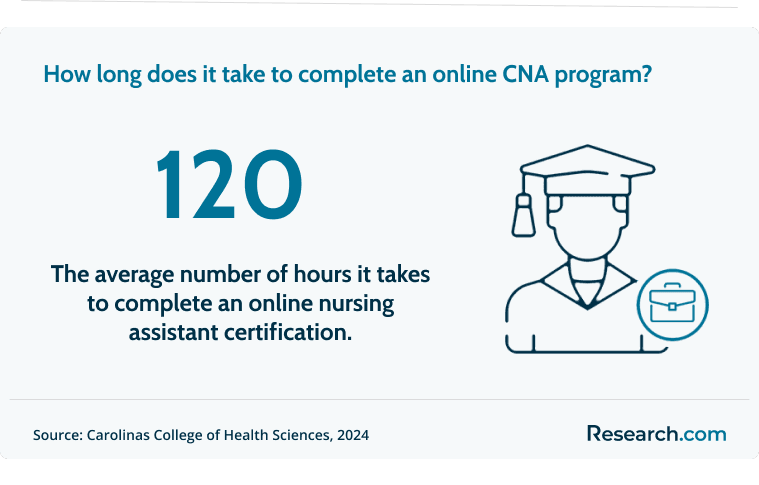
Many online and hybrid CNA programs require about 120 total hours of training, although the exact requirement depends on the state and school. Those hours usually include online theory lessons, skills lab practice, and supervised clinical experience. This mix is necessary because nursing assistants must be able to apply classroom concepts safely in real patient care settings.
Students commonly finish the required 120 hours within 2 to 3 months, depending on whether the program is full-time, part-time, evening-based, weekend-based, or accelerated. Some programs can be completed faster, while others extend the schedule to support working adults. Like sonography programs online, CNA training can offer a relatively structured healthcare pathway, but CNA programs are usually shorter and focused on entry-level bedside care.
| Program Pace | Typical Completion Time | Who It May Fit |
| Accelerated | Four to seven weeks or about 1 month | Students who can attend frequent labs or clinical shifts and complete coursework quickly |
| Standard | Two to three months | Students who want a balanced schedule with steady weekly progress |
| Part-time or extended | Three to four months or up to sixteen weeks | Working adults, parents, or students with limited weekly availability |
| Self-paced prep | Self-paced | Students reviewing for an exam or supplementing required state-approved training |
Online CNA vs. on-campus CNA programs: what is different?
Online and on-campus CNA programs should lead to the same practical outcome: preparation for CNA certification and basic patient care work. The main difference is how the classroom portion is delivered. Online programs usually move lectures, readings, quizzes, and videos to a digital platform, while labs and clinicals still happen face to face. Campus programs typically require students to attend most instruction in person.
| Factor | Online or Hybrid CNA Program | On-Campus CNA Program |
| Flexibility | Often better for students who need to study at night, around shifts, or during limited free time | Usually follows a fixed classroom schedule |
| Access | Can reduce travel for lecture content, especially for students far from campus | Requires regular travel to campus or a training site |
| Hands-on training | Still requires in-person labs and clinical experience | Labs and clinical preparation are built into the campus schedule |
| Learning style | Works well for independent students who can manage deadlines and online modules | May be better for students who prefer immediate face-to-face instruction |
| Cost considerations | May lower transportation and campus-related expenses; similar to how a nutritionist online degree may reduce some location-based costs | May include commuting, parking, and time-related costs |
| Student support | May include virtual advising, message boards, tutoring, and instructor email access | Often provides direct classroom interaction and in-person peer support |
Choose an online or hybrid CNA option if you are disciplined, comfortable using learning technology, and able to attend required in-person sessions. Choose an on-campus program if you want more immediate instructor feedback, structured classroom time, or easier access to skills practice.
What is the average cost of an online CNA program?
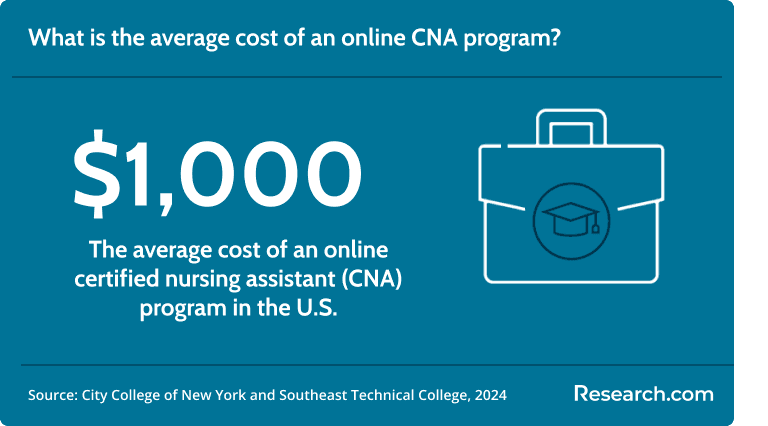
The average cost of an online Certified Nursing Assistant program is around $1,000, but the final price can vary widely by school, state, and format. Southeast Technical College lists a CNA program cost of approximately $765, including tuition and essential fees. The City College of New York (CCNY) lists $1,235 for its 130-hour hybrid CNA program with online instruction and in-person clinical experience.
Students should budget for more than tuition. Programs may charge separately for textbooks, uniforms, CPR certification, background checks, drug screening, health records, immunizations, supplies, transportation to clinical sites, and certification exam fees. Some schools, including Southeast Technical College, may offer financial aid options or payment plans that help students manage upfront costs.
If affordability is your top priority, compare the total cost of attendance rather than the advertised tuition alone. This same cost-comparison approach is useful when reviewing other low-cost online programs, including the cheapest online bachelor's in emergency management, where fees and required materials can change the real price of enrollment.
| Cost Category | Why It Matters |
| Tuition | The base program charge, often the largest cost. |
| Books and learning materials | May or may not be included in the listed tuition. |
| Uniforms and supplies | Clinical sites may require scrubs, shoes, gait belts, or other items. |
| Health and background requirements | TB tests, physical exams, immunization records, drug screens, and background checks may add costs. |
| Certification exam fees | Some programs include exam costs, while others require students to pay separately. |
| Transportation | Online students still need to travel for labs, clinicals, and possibly testing. |
What are the financial aid options for students enrolling in an online CNA program?
Financial aid for CNA training depends on the school, program type, length, and eligibility rules. Because many CNA programs are short non-degree certificates, they may not qualify for all forms of federal aid. However, students may still find help through community colleges, workforce agencies, employers, state programs, scholarships, and military education benefits.
- Federal Financial Aid (FAFSA): Some eligible programs at accredited institutions may qualify for federal aid, including Pell Grants or subsidized student loans. Completing the FAFSA is the usual first step, but students should confirm that their specific CNA program participates.
- State and Local Workforce Grants: Workforce development programs may help pay for CNA training because nursing assistants support essential healthcare services. Eligibility often depends on income, residency, employment status, or participation in approved job training initiatives.
- Employer Tuition Reimbursement: Some nursing homes, hospitals, home health agencies, and long-term care providers may cover part or all of CNA training if students agree to work for the organization after certification.
- Scholarships and Private Grants: Community foundations, nonprofits, healthcare associations, and school-based scholarship funds may offer awards for students entering healthcare support roles. These awards generally do not need to be repaid.
- Military and Veteran Benefits: Active-duty service members, veterans, and eligible spouses may be able to use education benefits for approved training. Students can review eligibility information through the official Military OneSource website.
What are the prerequisites for enrolling in an online CNA program?
CNA training is not a master’s degree. It is an entry-level certificate or training program for students preparing for nurse aide certification. Most CNA programs have accessible admissions requirements, but students must still meet academic, health, legal, and technical standards before clinical placement.
- High School Diploma or Equivalent: Many programs require a high school diploma or GED, although exact requirements can vary by state and school.
- Basic Academic Readiness: Students may need enough English, reading, and math proficiency to understand care plans, safety instructions, documentation, and medical terminology.
- Health Documentation: Programs often require immunization records, a TB test, and a physical exam before students enter clinical settings.
- Background Check and Screening: Because CNA students work with vulnerable patients, schools and clinical partners may require criminal background checks, drug screening, or both.
- Technical Requirements: Online coursework requires reliable internet access, a computer or compatible device, and basic ability to use learning platforms, email, and file submission tools.
Students who later want to move beyond CNA work can use the experience as a starting point for nursing education. For example, some career changers review online direct entry MSN programs when they already hold a bachelor’s degree in another field and want a graduate-level nursing route. Others compare affordable emt to rn programs online when they have emergency care experience and want to build toward registered nursing.
What courses are typically in an online CNA program?
Online CNA programs focus on the knowledge and skills needed for safe basic care. Students learn how to support daily living activities, observe changes in patient condition, communicate with nurses, follow infection control rules, and protect patient rights. Even when lectures are online, students must practice many of these skills in a lab or clinical setting before certification.
| Course or Topic | What Students Learn |
| Basic Nursing Skills | Vital signs, hygiene assistance, feeding, positioning, transfers, and documentation basics |
| Anatomy and Physiology | Introductory structure and function of the human body, especially as it relates to patient care |
| Infection Control | Hand hygiene, personal protective equipment, standard precautions, and reducing disease transmission |
| Patient Rights and Ethics | Privacy, dignity, informed care, abuse prevention, resident rights, and professional conduct |
| Communication Skills | Working with patients, families, nurses, and care teams while reporting observations clearly |
| Safety and Emergency Procedures | Fall prevention, body mechanics, environmental safety, and responding to urgent situations |
| Clinical Practicum | Supervised hands-on care in an approved healthcare environment |
Students who discover an interest in specialized patient-centered care may later explore broader nursing paths, such as this career guide to becoming a holistic nurse practitioner. CNA training can also be useful for students considering healthcare operations, facilities, or administrative roles, although technical programs such as affordable autocad certificate courses online are separate from CNA certification and do not replace nurse aide training.
What types of specializations are available in an online CNA program?
Most CNA programs do not offer formal specializations in the same way degree programs do. However, some programs or continuing education options may introduce care settings or patient populations that help students prepare for specific work environments.
- Geriatric Care: Training may emphasize older adult needs, dementia awareness, mobility support, fall prevention, chronic condition support, and preserving dignity in long-term care. Students interested in end-of-life support may also review the hospice nurse career path to understand how nursing roles progress beyond CNA work.
- Pediatric Care: Some students seek experience with infants, children, or adolescents. This area requires age-appropriate communication, patience, and awareness of developmental needs.
- Home Health Care: CNAs who work in private homes support daily living activities, home safety, mobility, hygiene, and communication with family caregivers and supervising clinicians.
- Hospice and Palliative Care: This focus centers on comfort, emotional support, symptom awareness, dignity, and compassionate assistance for patients with serious or life-limiting illness.
- Mental Health Support: CNAs in behavioral health or psychiatric settings may need stronger skills in de-escalation, observation, calm communication, and team-based safety procedures.
Specialized experience can help CNAs decide whether to remain in direct support work, move into a more focused care environment, or continue toward licensed nursing. Students comparing future nursing credentials can review the differences between ADN, AAD, and AAS nursing degrees before choosing the next academic step.
Can completing an online CNA program pave the way to advanced nursing degrees?
CNA certification can be a practical first step toward nursing because it gives students direct patient care exposure before they invest in a longer program. Working as a CNA can help you confirm whether healthcare is a good fit, build confidence with patients, and understand how nurses coordinate care. It does not replace RN, BSN, MSN, or DNP requirements, but it can strengthen your readiness for more advanced training. Students already planning a long-term advanced practice route may eventually compare options such as the fastest online MSN to DNP program.
How do I choose the best online CNA program?
The best online CNA program is the one that is approved for certification in your state, fits your schedule, provides required hands-on training, and has transparent costs. Do not choose based only on the word “online” or the lowest advertised tuition.
- Confirm state approval first: Check your state nurse aide registry, board of nursing, health department, or other regulatory body. If the program is not approved, you may not be eligible for the CNA exam.
- Review the clinical plan: Ask whether the school arranges clinical placements or whether you must find your own approved site. This is especially important for online students outside the school’s immediate area.
- Compare total program cost: Add tuition, fees, books, uniforms, health documents, background checks, drug screening, supplies, transportation, and exam fees.
- Match the schedule to your life: Accelerated programs can be efficient, but they may be difficult if you work full time or have caregiving responsibilities.
- Ask about outcomes: Strong programs should be willing to discuss certification exam preparation, graduate support, and any available pass-rate or job placement information.
- Evaluate student support: Online students should have access to instructors, technical support, advising, and clear communication about deadlines and clinical requirements.
| Question to Ask | Why It Matters |
| Is this program approved in the state where I want to work? | State approval affects exam eligibility and employability. |
| Where will I complete labs and clinicals? | CNA training cannot be completed through online theory alone. |
| Are exam fees included? | Separate testing costs can change your total budget. |
| What happens if I miss a clinical day? | Attendance rules are often strict, and make-up options may be limited. |
| Does the school help with job placement? | Employer relationships can make the transition into CNA work easier. |
| Will this training transfer if I move? | CNA rules vary by state, so relocation can affect certification requirements. |
What career paths are available for graduates of online CNA programs?
Graduates of approved online or hybrid CNA programs typically pursue entry-level patient care positions. These roles can provide stable healthcare experience, but duties, pay, and advancement options vary by employer and state rules. CNA work can also help students decide whether to pursue nursing, rehabilitation support, home health, or long-term care leadership.
- Certified Nursing Assistant ($39,430/year): CNAs assist with bathing, dressing, feeding, mobility, vital signs, and daily care under nurse supervision. They commonly work in hospitals, nursing homes, assisted living facilities, and home healthcare settings.
- Home Health Aide ($34,900/year): Home health aides support clients in private homes with hygiene, movement, routines, and daily living needs. This role may offer more one-on-one interaction and a less institutional care environment.
- Patient Care Technician ($44,315/year): Patient care technicians may perform CNA-related duties plus additional tasks such as drawing blood or using medical equipment, depending on training, employer policy, and state regulations.
- Restorative Aide ($41,069/year): Restorative aides help patients maintain or regain mobility and daily function, often working with nursing, physical therapy, or occupational therapy teams.
- Geriatric Nursing Assistant ($38,527/year): GNAs focus on older adults, especially in long-term care and assisted living settings. Duties may include dementia support, fall prevention, personal care, and dignity-centered assistance.
Some CNA graduates remain in direct patient care, while others combine healthcare experience with other skills. For example, technology-minded students may separately explore affordable cisco ccna training programs online, but networking credentials are not a substitute for CNA certification and are more relevant to IT or digital infrastructure roles.
CNA work can also serve as a launch point for licensed nursing. Students who want to move quickly into advanced nursing roles may eventually compare accelerated nurse practitioner programs, though those programs require additional nursing education and licensure beyond CNA certification. The chart below summarizes common CNA-related roles, salary figures, and responsibilities.
What is the job market for graduates with an online nursing assistant certification?
The labor market for nursing assistants is steady, especially in long-term care, rehabilitation, and facilities serving older adults. According to the U.S. Bureau of Labor Statistics, employment for nursing assistants and orderlies is projected to grow by 4% from 2023 to 2033, which is about as fast as the average for all occupations. Separately, job growth is projected at 5% for orderlies and 4% for nursing assistants. Home health and personal care aides, who often work in related care environments, are projected to grow by 16% over the same period.
These projections suggest that CNA roles remain important but may not grow as quickly as some other healthcare support occupations. Demand is tied to aging populations, chronic health conditions, long-term care needs, and turnover in physically demanding care jobs. The chart below shows the projected percent change in employment from 2023 to 2033.
What do nursing assistants say about online CNA programs?
-
: "
Completing CNA coursework online made training possible while I was working and caring for my family. I studied at night, finished within a few months, and moved into a long-term care role where I use those skills every day. — Annabelle
"
-
: "
The online lessons helped me understand the basics before clinical training. By the time I practiced skills in person, I felt more prepared to focus on patient care instead of trying to learn everything at once. — Jason
"
-
: "
I was anxious about returning to school, but the hybrid format felt manageable. The coursework was clear, support was available when I needed it, and I was able to move from training into certification and employment quickly. — Tasha
"
How can my online CNA program pave the way to advanced nursing degrees?
CNA training can help future nursing students build practical confidence before entering more demanding academic programs. It introduces bedside communication, infection control, documentation habits, patient mobility support, and the realities of shift-based healthcare work. Those experiences can make later nursing coursework feel more connected to real clinical practice.
However, CNA certification does not automatically shorten every nursing program. Students should ask advisors whether CNA experience affects admissions, prerequisites, clinical placement, or credit transfer. If your long-term plan includes registered nursing, you may want to compare bridge and completion options, including What is the easiest online RN to BSN program?, after you understand the RN requirements in your state.
How can I verify the accreditation and quality of my online CNA program?
Start with state approval. For CNA training, state recognition is more important than marketing language on a school website. Contact the state board of nursing, health department, nurse aide registry, or other official agency responsible for nurse aide training. Confirm that the program is approved for certification eligibility in your state and ask whether online or hybrid delivery is accepted.
Next, review the provider’s institutional accreditation if the program is offered by a college, but remember that institutional accreditation alone may not prove CNA exam eligibility. Ask for the curriculum outline, clinical hour requirements, certification exam preparation process, student support services, and any available pass-rate or job placement information. Students comparing later nursing pathways may also look at standards used by top 6-month LPN to RN bridge programs online, but CNA approval should always be checked separately.
How can I prepare for my CNA certification exam effectively?
Effective CNA exam preparation should include both written review and hands-on skills practice. Start by using the exam blueprint or candidate handbook for your state. Build a study schedule that covers patient safety, infection control, communication, resident rights, vital signs, body mechanics, nutrition, hygiene, and emergency procedures.
- Practice skills out loud: During the skills exam, you may need to explain steps while performing them. Practice hand hygiene, privacy, safety checks, and closing procedures until they become automatic.
- Use practice questions carefully: Practice exams can reveal weak areas, but do not memorize answers without understanding the care principle behind them.
- Review common errors: Missed handwashing, poor body mechanics, failure to identify the patient, skipped privacy steps, and incomplete documentation can reduce exam performance.
- Study with classmates: Peer practice can help with timing, recall, and confidence, especially for skills that require sequencing.
- Ask instructors for feedback: Before test day, request specific comments on your weakest skills rather than general reassurance.
Passing the CNA exam can open the door to entry-level healthcare work and later nursing education. Students thinking far ahead may also compare broader nursing compensation and location trends, such as which states pay nurses the most, but early career decisions should focus first on certification eligibility, clinical readiness, and local job opportunities.
Common Mistakes to Avoid When Choosing an Online CNA Program
| Mistake | Why It Can Hurt You | Better Approach |
| Assuming a fully online CNA course is enough | Most states require in-person skills and clinical training. | Choose a state-approved hybrid program with documented hands-on requirements. |
| Checking only institutional accreditation | A college may be accredited, but the CNA program still must meet state nurse aide rules. | Verify program approval with the state agency that controls CNA certification. |
| Comparing tuition only | Uniforms, exams, health records, and background checks can raise the final cost. | Request a full fee list before enrolling. |
| Ignoring clinical location | A program may require travel to specific labs or facilities. | Confirm exact clinical sites, schedules, transportation needs, and make-up policies. |
| Choosing the fastest program without checking workload | Accelerated formats can be difficult if you work full time. | Select a pace that you can realistically complete without missing required hours. |
| Assuming certification transfers easily between states | Nurse aide rules differ by state. | Check reciprocity or transfer requirements before moving or enrolling out of state. |
Key Insights
- Online CNA programs are usually hybrid programs: theory may be online, but labs and clinical care must be completed in person.
- State approval is the most important quality check because it determines whether you can sit for the CNA certification exam.
- Online CNA programs commonly require around 120 hours of training and can often be completed in about 4 months, with some programs offering shorter or longer schedules.
- The average cost of an online CNA program ranges between $700 and $1,000, but students should budget for supplies, health requirements, background checks, transportation, and exam fees.
- CNA graduates can expect an average salary of approximately $30,000 to $35,000 per year, although actual pay depends on location, employer, shift, and experience.
- The nursing assistant job market is projected to grow by about 4% through 2033, while related home health and personal care aide roles are projected to grow faster at 16%.
- CNA training can be a smart first step for students considering nursing, but it does not replace the education and licensure required for LPN, RN, BSN, MSN, or advanced practice roles.
References:
- Carolinas College of Health Sciences. (2024). Nurse Aide: CNA Program. CCHS
- City College of New York. (n.d.). Certified Nursing Assistant (CNA). CCNY
- Glassdoor. (2025). Salary: Patient Care Technician in the United States. Glassdoor
- Salary.com. (2025). Geriatric Nursing Assistant Salary. Salary.com
- Southeast Technical College. (2024). ESTIMATED TOTAL COLLEGE COSTS: 2024-2025. STC
- ZipRecruiter. (2025). What Is the Average Restorative Aide Salary by State? ZipRecruiter
Other Things You Should Know About Online Certified Nursing Assistant (CNA) Programs
To enroll in an online CNA program in 2027, applicants typically need to have a high school diploma or GED. Some programs may require a background check and proof of immunizations. Always check individual program requirements for specific enrollment criteria.
Online CNA students complete clinical hours in person at an approved nursing home, hospital, or skills lab. Most state CNA programs require about 40 to 60 supervised clinical hours before eligibility for the state competency exam administered by the state nurse aide registry.


