
2027 Most Affordable LVN to RN Online Bridge Programs

Co-Founder and Chief Data Scientist
For many LVNs and LPNs, becoming a registered nurse is the clearest next step toward a wider scope of practice, more job settings, and stronger income potential. The challenge is choosing a bridge program that is not only affordable, but also approved for licensure, realistic for a working nurse’s schedule, and clear about clinical placement requirements.
This guide is designed for licensed vocational nurses and licensed practical nurses who are comparing online or hybrid LVN to RN bridge programs in the United States. You will learn how these programs work, what “online” really means in nursing education, how to evaluate total cost, what admissions requirements are common, how clinical rotations are handled, and what to ask before committing to a school. You will also find affordable program options, salary and labor market data, advancement routes, and mistakes that can increase cost or delay RN licensure.
Quick Answer: Are Online LVN to RN Bridge Programs Worth It?
An online LVN to RN bridge program can be a strong investment when it is approved by the correct state nursing board, supported by recognized institutional or nursing accreditation, built around NCLEX-RN preparation, and transparent about required in-person labs and clinical experiences. These programs let licensed practical or vocational nurses use their prior education instead of repeating an entire entry-level nursing sequence.
The lowest advertised tuition is not automatically the best deal. The better-value program is usually the one that offers a reasonable total cost, clear clinical placement support, acceptable transfer policies, strong exam preparation, and eligibility for RN licensure in the state where you intend to practice.
What are the main advantages of completing an online LVN to RN bridge program?
- More RN career opportunities: A bridge program can prepare you for registered nurse roles in hospitals, clinics, rehabilitation centers, long-term care facilities, home health, public health, and specialty departments. With experience, it may also support movement into charge nurse or management responsibilities.
- Greater earning potential: Registered nurses report higher earnings than LVNs. The RN median salary is approximately $86,070 annually, compared with an LVN median salary of around $59,730.
- Flexible course delivery: Online nursing theory courses can make school more manageable for working nurses. Still, legitimate RN bridge programs require in-person clinical rotations, skills labs, simulations, or competency check-offs.
What should I expect from an online LVN to RN bridge program?
Most online LVN to RN programs are better described as hybrid programs. Lectures, quizzes, assignments, discussion activities, and some exams may be delivered online, but RN preparation requires supervised hands-on practice that cannot be completed entirely at home.
| Program feature | What it means for LVN/LPN students |
| Bridge-based curriculum | The program gives credit or advanced standing for prior LVN/LPN preparation. ADN bridge options often take 12-24 months, while BSN pathways may take 3-4 years. |
| Hybrid format | Academic nursing courses may be online, while labs, simulations, skills validation, and clinical practice take place in person. |
| RN-level coursework | Students usually study advanced assessment, pharmacology, medical-surgical nursing, mental health, maternal-child care, leadership, and professional nursing practice. |
| NCLEX-RN preparation | Effective programs include exam-style questions, readiness testing, review resources, remediation, and faculty guidance before graduation. |
| Online student services | Distance learners should have access to advising, tutoring, technology support, library resources, faculty contact, and academic planning. |
| Clinical placement process | Some schools coordinate placements, while others require students to identify potential local sites for approval. This can determine whether a program is feasible for you. |
Where can I work after completing an online LVN to RN bridge program?
After you finish the program, pass the NCLEX-RN, and receive RN licensure, you can apply for a broader range of nursing positions than those typically available to LVNs or LPNs. Common settings include:
- Hospitals: RNs provide care in medical-surgical units, emergency departments, intensive care, pediatrics, obstetrics, perioperative services, and other clinical areas.
- Outpatient care: Primary care practices, specialty clinics, urgent care centers, and ambulatory surgery centers use RNs for triage, assessment, patient education, and care coordination.
- Long-term care and rehab: RNs often supervise care teams, manage complex conditions, monitor changes in status, and coordinate services in nursing homes, assisted living communities, and rehabilitation facilities.
- Home healthcare: RNs deliver skilled care in patients’ homes, frequently with more independence and schedule variation than facility-based positions.
- Community and public health: Schools, community clinics, government agencies, and nonprofit organizations hire RNs for screenings, prevention, health education, immunization support, and outreach.
- Specialized nursing paths: Experienced RNs may move into case management, quality improvement, informatics, research support, or specialty practice areas.
How much can I make after an online LVN to RN bridge program?
Your earnings will depend on your license, degree level, specialty, employer, location, shift differential, and years of experience. Completing a bridge program does not guarantee a specific salary, but RN licensure generally opens access to better-paid roles than LVN/LPN practice.
- Entry-level RN salary: New graduate registered nurses with an ADN can expect an average annual salary around $73,873, according to Salary.com, with a typical range from $65,706 to $79,729.
- Experienced RN salary: With more clinical experience, specialty skills, and favorable location factors, RN salaries may rise to $90,000 to over $100,000 annually.
- BSN advantage: A BSN may help with access to leadership roles, specialty units, magnet hospital employment, and advancement opportunities compared with an ADN alone.
- Specialty pay differences: Emergency, operating room, critical care, and other high-acuity roles may pay more because they require specialized competencies and strong clinical judgment.
- Most Affordable LVN to RN Online Bridge Programs for 2027
- How to Choose the Right Online LVN to RN Bridge Program
- Prerequisites and Application Requirements
- Skills You Build in an LVN to RN Bridge Program
- Career Options After an LVN to RN Bridge Program
- Program Costs and Financing Options
- LVN vs. RN Salary Expectations
- Online vs. In-Person LVN to RN Programs
- How LVN to RN Graduates Can Continue Their Education
- RN Specialties and Advancement Paths
- Job Market for LVN to RN Graduates
- Questions to Ask Before Enrolling
- Nursing Trends Affecting LVN to RN Graduates
- Common Challenges in Online LVN to RN Programs
- Can an LVN to RN Bridge Lead to Nurse Practitioner Roles?
Most Affordable LVN to RN Online Bridge Programs for 2027
How do we rank schools?
An LVN to RN bridge program affects your licensing path, finances, and long-term career options, so affordability should be reviewed together with program quality and transparency. Our methodology uses consistent data sources to help students compare schools more fairly.
Data sources used in the review include:
- the IPEDS database
- Peterson's database, including the Distance Learning Licensed Data Set
- the College Scorecard database
- the National Center for Education Statistics
The programs below are affordable LVN/LPN to RN bridge options worth reviewing. Before applying, confirm current tuition, fees, admission rules, clinical locations, state authorization, accreditation status, and licensure eligibility directly with the school.
1. Coastal Bend College
Coastal Bend College offers an LVN to RN Bridge program for licensed vocational nurses who hold an unencumbered LVN license from the Texas Board of Nursing or a compact state. The program recognizes prior LVN education toward an Associate of Applied Science degree and prepares students to take the NCLEX-RN. Its hybrid structure includes online coursework, in-person lectures and labs at the Beeville Campus two to three days per week, and clinical experiences at approved facilities within the college district. Admission is competitive and uses a scoring system that considers prerequisite GPA, TEAS performance, and completed coursework. Required prerequisites include anatomy and physiology, microbiology, composition, psychology, and growth and development. Students must also meet background check, immunization, and American Heart Association Healthcare Provider CPR requirements.
- Program Length: Approximately 3 semesters (pending approval)
- Tracks/Concentrations: LVN to RN Bridge
- Tuition Cost (Total): In-District Students: $11,635; Out-of-District Students: $14,859; Out-of-State Students: $15,254.
- Required Credits to Graduate: 60 semester hours
- Accreditation: Texas Board of Nursing; Institutional accreditation by Southern Association of Colleges and Schools Commission on Colleges (SACSCOC)
2. Collin College
Collin College offers an LVN to RN Bridge program that supports vocational nurses as they move into registered nursing through classroom instruction, clinical learning, and NCLEX-RN preparation. The program builds skills in evidence-based practice, clinical reasoning, leadership, and RN-level professional judgment. Students complete supervised clinical experiences in regional healthcare settings where they apply nursing concepts in patient care. Applicants should be prepared to submit prerequisite coursework, TEAS scores, immunization documentation, CPR certification, and background check clearance.
- Program Length: Typically 3 semesters (varies)
- Tracks/Concentrations: LVN to RN Bridge
- Tuition Cost: In-State: $67.00/credit hour; Out-of-State: $202.00/credit hour
- Required Credits to Graduate: 60 credits
- Accreditation: Approved by Texas Board of Nursing; Accreditation Commission for Education in Nursing (ACEN); Institutional accreditation by SACSCOC
3. Excelsior University
Excelsior University is a not-for-profit institution with an LPN to BSN bridge pathway that allows licensed practical nurses to pursue both an Associate of Applied Science in Nursing and a Bachelor of Science in Nursing. The program is suited to self-directed learners and uses primarily online coursework, with clinical experiences arranged locally. Students may transfer up to 31 credits into the 121-credit BSN curriculum. Courses address professional nursing practice, health assessment, community health, leadership, and research. Graduates are prepared for the NCLEX-RN and continued nursing advancement.
- Program Length: Self-paced; varies by student
- Tracks/Concentrations: LPN to BSN Bridge
- Tuition Cost: Online Course Tuition: $550/credit.
- Required Credits to Graduate: 121 total (including transfer credits)
- Accreditation: Accreditation Commission for Education in Nursing (ACEN), Middle States Commission on Higher Education (MSCHE)
4. Galen College of Nursing
Galen College provides an LPN/LVN to ADN bridge program in an 18-month hybrid format. Students complete online academic coursework and participate in required in-person clinical rotations at approved healthcare sites. The curriculum focuses on patient-centered care, evidence-based nursing, leadership, and clinical readiness in areas such as medical-surgical, maternal-child, mental health, and community health nursing. Typical admission requirements include an active LPN/LVN license, prerequisite courses, TEAS scores, background clearance, and immunization compliance.
- Program Length: 18 months
- Tracks/Concentrations: LPN/LVN to ADN Bridge
- Tuition Cost: Not explicitly stated online; contact the college
- Required Credits to Graduate: Not explicitly stated online
- Accreditation: ACEN, State Board of Nursing approvals, Institutional accreditation by SACSCOC
5. Gavilan College
Gavilan College offers a full-time LVN to RN route that can be finished in one year and leads to an Associate of Science Degree in Nursing. Students complete classroom learning and clinical practice at local hospitals and healthcare facilities. Admission requires prerequisites such as anatomy and physiology, microbiology, and psychology. The program is approved by the California Board of Registered Nursing and prepares graduates for the NCLEX-RN. Applicants must also satisfy TEAS, LVN licensure, and CPR certification requirements.
- Program Length: 1 year
- Tracks/Concentrations: LVN to RN Bridge
- Tuition Cost: $250.00 per course
- Required Credits to Graduate: 96 credits
- Accreditation: California Board of Registered Nursing (BRN), Institutional accreditation by WASC Senior College and University Commission (WSCUC)
6. Herzing University
Herzing University offers LPN to RN bridge options at both the ASN and BSN levels. Didactic courses are delivered 100% online with flexible scheduling, while labs and clinical requirements occur at Herzing campuses or approved partner locations. Students develop nursing leadership, clinical judgment, and evidence-based care skills. Admission generally requires an active LPN license, prerequisite coursework, and completion of clinical compliance requirements. The BSN program is accredited by the Commission on Collegiate Nursing Education (CCNE), and the university holds regional accreditation from the Higher Learning Commission (HLC).
- Program Length: Varies; 16-28 months
- Tracks/Concentrations: LPN to ASN, LPN to BSN Bridge
- Tuition Cost: Not explicitly stated online; contact the university
- Required Credits to Graduate: 72-120
- Accreditation: CCNE, Higher Learning Commission (HLC)
7. Mission College
Mission College offers an LVN to RN Bridge program that combines classroom instruction with clinical practice to prepare students for RN licensure. The program is approved by the California Board of Registered Nursing. Its curriculum highlights critical thinking, culturally responsive care, and professional nursing expectations. Students complete prerequisites before admission and participate in clinical rotations at local healthcare facilities. An Advisory Committee also helps keep the program aligned with nursing practice needs.
- Program Length: Varies; typically 1 year
- Tracks/Concentrations: LVN to RN Bridge
- Tuition Cost: Some may be eligible for free tuition; amounts not explicitly stated online; contact the college
- Required Credits to Graduate: Total 73 - 74 credits
- Accreditation: California Board of Registered Nursing (BRN), Institutional accreditation by WASC Senior College and University Commission (WSCUC)
8. Navarro College
Navarro College offers an LVN to RN Bridge program that can be completed in one year by LVNs with at least six months of work experience. The curriculum includes nursing theory, pharmacology, clinical practice, and leadership. The program is ACEN-accredited and approved by the Texas Board of Nursing. Admission requirements include an active LVN license, prerequisite coursework, TEAS scores, immunizations, and background check completion. Graduates earn an Associate of Applied Science degree and may sit for the NCLEX-RN.
- Program Length: Approximately 1 year
- Tracks/Concentrations: LVN to RN Bridge
- Tuition Cost: In-district: $ 825; out-of-district: $1,435; out-of-state: $1,993/credit
- Required Credits to Graduate: 60 credit hours total
- Accreditation: Accreditation Commission for Education in Nursing, Inc. (ACEN), Texas Board of Nursing (TBON), Institutional accreditation by SACSCOC
9. Pasadena City College (PCC)
Pasadena City College (PCC) provides a three-semester LVN to RN Career Ladder program that prepares students for RN licensure and an Associate Degree in Nursing. The program is approved by the California Board of Registered Nursing and has ACEN candidate status through March 2026. Students study pharmacology, professional nursing competencies, ethics, clinical skills, and lifespan growth and development. Admission requires prerequisites, TEAS scores, background checks, and current CPR certification. After completing the LVN to RN curriculum, students earn a Certificate of Achievement and an Associate of Science Degree and become eligible to take the NCLEX-RN for licensure as a registered nurse in California.
- Program Length: Three semesters
- Tracks/Concentrations: LVN to RN Career Ladder
- Tuition Cost: Not explicitly stated online; contact college
- Required Credits to Graduate: Not explicitly stated online
- Accreditation: California Board of Registered Nursing (BRN), ACEN candidate status, Institutional accreditation by WASC Senior College and University Commission (WSCUC)
10. San Joaquin Valley College (SJVC)
San Joaquin Valley College (SJVC) offers an LVN to RN Bridge program that can lead to an Associate of Science in Registered Nursing in as few as 11 months. The program combines online coursework with in-person clinical experiences and prepares students for the NCLEX-RN. It is approved by the California Board of Registered Nursing and covers nursing fundamentals, health promotion, mental health, and leadership. Applicants should expect prerequisite, TEAS, immunization, and background check requirements.
- Program Length: As few as 11 months
- Tracks/Concentrations: LVN to RN Bridge
- Tuition Cost: Not explicitly stated online; contact college
- Required Credits to Graduate: Not explicitly stated online
- Accreditation: California Board of Registered Nursing (BRN), Institutional accreditation by WASC Senior College and University Commission (WSCUC)
How do I choose the best online LVN to RN bridge program for my goals?
The best program is the one that fits your licensure state, clinical location, work schedule, budget, learning preferences, and long-term nursing plan. Before you compare price, confirm that the program can actually make you eligible for RN licensure where you want to work.
| Decision factor | Why it matters | What to confirm before applying |
| State approval and accreditation | State boards, employers, and future schools may require completion of an approved or accredited nursing program. | Check state board approval and recognized nursing accreditation such as ACEN or CCNE when relevant. |
| Degree awarded | An ADN bridge may get you to RN licensure sooner, while a BSN route may offer stronger long-term mobility. | Decide whether a 12-24 month ADN bridge or 3-4 year BSN route better matches your timeline and career goals. |
| Total program cost | Tuition does not capture the full cost of nursing school. | Ask about fees, books, uniforms, technology, testing, travel, background checks, and NCLEX-RN expenses. If you prefer a bachelor’s pathway, compare affordable LVN to BSN programs online. |
| Clinical placement support | If you cannot secure approved clinical hours, you cannot complete the program on time. | Find out whether the school places students, permits student-arranged sites, or restricts clinicals to certain regions. |
| Schedule requirements | Working nurses need flexibility, but clinicals and labs often follow fixed schedules. | Review live class times, assignment deadlines, lab dates, exam windows, and clinical shift expectations. |
| NCLEX-RN performance | Pass rates can help you judge how well the program prepares students for licensure. | Request recent National Council Licensure Examination for Registered Nurses (NCLEX-RN) pass rates and ask how the school supports students who need remediation. |
A simple screening rule can save time: eliminate any program that cannot clearly explain whether it qualifies you for licensure in your state, where you will complete clinicals, and what the full cost will be from enrollment through graduation.
What prerequisites and application requirements do online LVN to RN bridge programs have?
Admission can be competitive because nursing programs are limited by clinical site capacity, faculty availability, and state approval rules. Requirements differ by school, but applicants are usually expected to prove both academic readiness and eligibility for clinical participation.
- Active LVN/LPN license: Most programs require a current, unencumbered Licensed Vocational Nurse or Licensed Practical Nurse license.
- High school diploma or GED: Schools typically require proof of high school completion or an equivalent credential.
- Prerequisite courses: Common prerequisites include anatomy, physiology, microbiology, psychology, and general education courses, often with minimum grade requirements.
- Minimum GPA: Many programs expect prior coursework GPAs in the 2.5 to 3.0 range.
- Entrance exam: Some schools require the ATI TEAS or another nursing admissions test.
- Work experience: Certain bridge programs prefer or require LVN/LPN experience, often 6+ months.
- Application materials: You may need official transcripts, proof of licensure, test scores, identification, a resume, or a personal statement.
- Clinical compliance: Before entering clinical sites, students generally complete a background check, drug screen, immunization review, CPR certification, and health documentation.
If you are not currently an LVN, LPN, or nurse, this type of bridge program is usually not the right entry point. Review an online nursing degree for non nurses if you need an initial pathway into nursing.
Begin gathering materials well before the deadline. Transcripts, prerequisite verification, immunization records, entrance exams, and license documentation can take time, and one missing item may push your application into a later cycle.
What skills will I build in a strong online LVN to RN bridge program?
An LVN to RN bridge program should move you beyond task-based practical nursing and into RN-level assessment, planning, delegation, advocacy, and clinical judgment. The purpose is not to repeat what you already learned as an LVN or LPN; it is to prepare you for the broader responsibilities of registered nursing.
- Fuller patient assessment: Students learn to conduct more comprehensive head-to-toe assessments and recognize complex clinical findings.
- Individualized care planning: RN training includes developing, updating, and evaluating care plans based on patient needs and evidence-based standards.
- Medication and IV knowledge: Programs deepen pharmacology preparation and expand medication administration responsibilities within the RN scope.
- Clinical decision-making: Students practice prioritizing care, escalating concerns, delegating safely, and responding to changes in patient condition.
- Leadership and delegation: Coursework often covers team communication, coordination of care, and appropriate delegation to LVNs/LPNs and nursing assistants.
- Patient and family education: RNs are expected to teach patients about conditions, medications, discharge instructions, prevention, and self-care.
- Interprofessional teamwork: Registered nurses coordinate with physicians, pharmacists, therapists, social workers, and other healthcare professionals.
- Evidence-based practice: Students learn to use research, quality data, nursing standards, and clinical guidelines to improve outcomes.
If you are still researching practical nursing entry routes, Fast track medical LPN programs may be similar to LVN programs depending on your state’s terminology and licensure rules.
As of 2025, NCLEX-RN pass rate data from January through March, which also represents the year-to-date total, shows notable differences by candidate type and education background. First-time, U.S.-educated candidates had strong outcomes: diploma graduates had an 87.30% pass rate, baccalaureate graduates had an 88.52% pass rate, and associate degree candidates had an 88.41% pass rate. The overall pass rate for first-time, U.S.-educated candidates was 88.37%. Candidates with invalid or special program codes had a lower pass rate of 46.39%.
Repeat candidates and internationally educated candidates had lower pass rates. Repeat U.S.-educated candidates passed at 51.44%, first-time internationally educated candidates passed at 46.55%, and repeat internationally educated candidates passed at 30.15%. Across all candidates, the overall NCLEX-RN pass rate was 71.59%. The graph below reinforces why program quality, structured exam support, and first-attempt readiness should be major selection factors.
What career options are available after an online LVN to RN bridge program?
Completing a bridge program can significantly broaden your job options because RN licensure carries a wider scope of practice and is commonly required for hospital, specialty, leadership, and care coordination roles.
- Registered Nurse: Many graduates work as RNs in hospitals, clinics, home health, long-term care, rehabilitation, or community health.
- Charge Nurse: Experienced RNs may coordinate shifts, assign staff, support patient flow, and assist with unit operations.
- Nurse Manager: Management positions can involve staffing, budgets, compliance, quality improvement, and team supervision.
- Nurse Educator: Some RNs move into staff training, clinical instruction, precepting, or student mentoring after gaining experience.
- Specialty Nurse: RNs may specialize in emergency nursing, critical care, oncology, geriatrics, pediatrics, or other clinical areas.
- Case Manager: Case managers coordinate care plans, services, benefits, discharge needs, and follow-up resources.
- Public Health Nurse: Public health nursing focuses on health promotion, prevention, screening, education, and community outreach.
If your background is in medical assisting rather than practical or vocational nursing, medical assistant to LPN online programs may be a more logical first step.
RN licensure can also support later bachelor’s and graduate-level study. Nurses interested in advanced specialties, including adult gerontology primary care nurse practitioner practice, can eventually compare options such as affordable online AGPCNP graduate certificate programs after meeting the necessary education and licensure requirements.
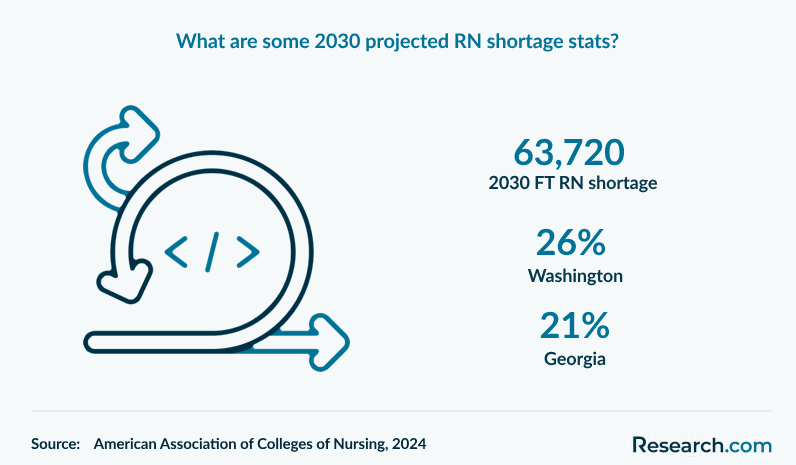
According to a Health Workforce Analysis from the Health Resources and Services Administration (HRSA), federal authorities project a shortage of 78,610 full-time RNs in 2025, declining to 63,720 full-time RNs by 2030. By 2035, the analysis identifies ten states with the largest projected nursing shortages: Washington at a 26% deficit, Georgia at 21%, California at 18%, Oregon at 16%, Michigan at 15%, Idaho at 15%, Louisiana at 13%, North Carolina at 13%, New Jersey at 12%, and South Carolina at 11%. The graphic below shows how projected RN shortages differ across states.
How much do online LVN to RN bridge programs cost, and how can I pay for one?
Program costs vary by school type, residency status, degree level, credit requirements, fees, and the distance you must travel for labs or clinicals. A program with low tuition can still be expensive if it charges high fees, requires long-distance clinical travel, or does not accept your prior credits.
| Cost category | What to include when estimating total cost |
| Tuition | Online LPN to RN degree programs typically range from $6,000 to $15,000 for ADN programs, while BSN programs can be higher. |
| Program and course fees | Include lab, simulation, technology, testing, graduation, and clinical compliance fees. |
| Books and supplies | Plan for textbooks, online access codes, uniforms, shoes, stethoscope, supplies, and other nursing equipment. |
| Clinical-related expenses | Travel, parking, CPR certification, background checks, drug screens, health records, and possible lodging may be required. |
| Licensure costs | Budget for NCLEX-RN registration, state board application fees, fingerprinting, and related licensing expenses where applicable. |
| Reduced work income | Labs and clinical rotations may conflict with paid shifts, so include possible lost wages in your planning. |
Common funding sources include federal and state financial aid, Pell Grants, federal student loans, nursing scholarships, school payment plans, workforce development programs, and employer tuition reimbursement. Some healthcare employers may support LVNs/LPNs who plan to advance into RN positions.
If you are considering a lower-cost healthcare credential before nursing, you can also compare cheapest online home health aide certification programs as an earlier entry option.
How much can you earn after completing an online LVN to RN bridge program?
The return on an LVN to RN bridge program depends on the total price you pay, how quickly you graduate, whether you pass the NCLEX-RN, the RN market in your state, and the roles you pursue after licensure. Treat salary figures as planning information, not promised outcomes.
- LVN median annual salary: Approximately $59,730 nationwide as of May 2023.
- RN median annual salary: Approximately $86,070 nationwide as of May 2022.
- Entry-level RN salary: New ADN-prepared graduates can expect an average annual salary around $73,873, with a typical range from $65,706 to $79,729.
- BSN salary difference: RNs with a BSN often earn $4,000 to $9,000 more annually than ADN-prepared RNs and may have more advancement opportunities.
- State variation: RN salaries differ substantially by location. In California, RNs have a median of $140,330.
- Experience and specialization: Pay may increase with years of practice, certifications, specialty skills, leadership duties, and high-demand care settings.
PayScale data from 2025, shown in the graph below, shows a compensation ladder across nursing roles. Nurse Practitioners have an average salary of $115,000, followed by Clinical Nurse Specialists at $93,000. Registered Nurses average $73,700, while the general Licensed Vocational Nurse average is $57,956. Associate Degree Nursing graduates average $79,000.
LVN pay also differs by state. California reports the highest average among the selected states at $65,376, while Texas reports $54,000 and Florida reports $46,000. Alabama and Mississippi are lower at $40,000 and $38,000, respectively. The pattern is clear: moving from LVN to RN, and later into advanced practice when desired, is associated with higher average earnings.
To estimate ROI, compare the full program cost with the likely salary increase in your target region. A quicker, lower-cost ADN bridge may create a faster payoff, while a BSN pathway may provide stronger long-term flexibility.
Online vs. in-person LVN to RN programs: Which format is better?
Both online/hybrid and campus-based LVN to RN programs can lead to licensure if they meet state approval and accreditation requirements. The better choice depends on how you learn, how much structure you need, where clinicals are located, and whether your work schedule can accommodate in-person requirements.
| Program format | Advantages | Potential drawbacks |
| Online or hybrid | Offers more schedule flexibility, reduces routine commuting, may expand school options beyond your immediate area, and can make it easier to keep working during theory courses. | Requires strong time management, reliable technology, independent study habits, and careful planning for clinical placements. Placement support may be limited at some schools. |
| In-person | Provides a more structured schedule, easier access to faculty and campus labs, and more direct peer interaction. | May be harder for working nurses, can require commuting or relocation, and limits choices to programs within reachable distance. |
The key detail is that “online” does not mean “fully remote.” RN skills validation and clinical hours must occur in person, so verify the schedule, location, and approval process before you enroll.
How can LVN to RN graduates continue their education?
After earning RN licensure, graduates can move into RN to BSN, MSN, post-master’s certificate, or doctoral programs depending on their goals. Many nurses complete an ADN bridge first so they can start RN practice, then earn a BSN while employed. Others choose an LPN/LVN to BSN pathway from the beginning if they want the bachelor’s credential sooner.
An RN to BSN program can deepen skills in leadership, evidence-based practice, care coordination, and population health. Students comparing flexible bachelor’s completion programs may review options such as RN to BSN no prerequisites programs, while still confirming admissions requirements, transfer credit rules, practicum expectations, and employer recognition.
What RN specialties and advancement paths can LVN to RN graduates pursue?
RN licensure can open specialty areas that may not be available to LVNs or LPNs. Some specialties require work experience, employer training, continuing education, or professional certification after licensure.
- Medical-surgical nursing: Care for adult patients with diverse acute and chronic conditions.
- Critical care or emergency nursing: Treat unstable or high-acuity patients in intensive care units or emergency departments.
- Pediatric nursing: Provide care for infants, children, and adolescents.
- Maternal-child nursing: Support patients during pregnancy, labor, delivery, postpartum recovery, and newborn care.
- Psychiatric and mental health nursing: Care for patients with behavioral health or mental health needs.
- Oncology nursing: Support patients through cancer diagnosis, treatment, symptom management, and education.
- Geriatric nursing: Focus on older adults with complex medical, functional, and social needs.
- Perioperative nursing: Work with surgical patients before, during, and after procedures.
- Public health nursing: Promote community wellness through screening, education, prevention, and outreach.
- Nurse informatics: Combine clinical knowledge with information systems to improve documentation, workflows, and data use. Students interested in data-focused careers can also explore cheap MS in data science courses in USA universities.
- Case management: Coordinate services, benefits, transitions, and care plans for patients with complex needs.
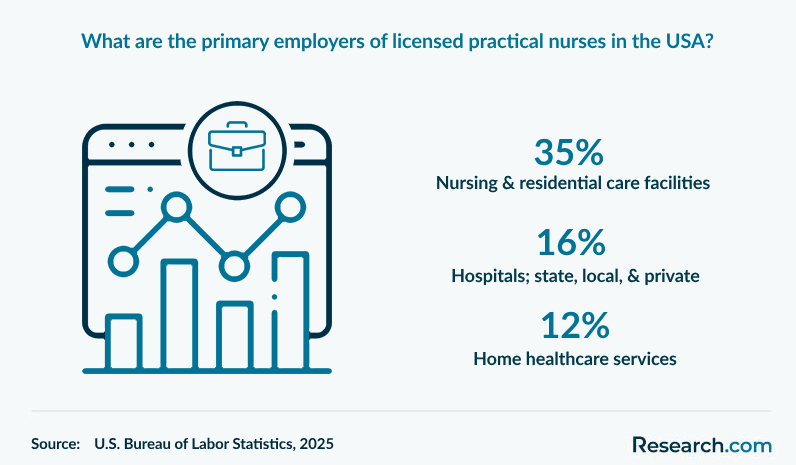
In 2023, licensed practical nurses and licensed vocational nurses held approximately 657,800 jobs. Nursing and residential care facilities employed 35% of these workers. Hospitals, including state, local, and private facilities, employed 16%. Home healthcare services and offices of physicians each employed 12%, while government roles accounted for 6%.
The graphic below shows how LPN/LVN jobs are distributed across care settings. These positions are concentrated in direct patient care environments, while home health and travel assignments may provide more flexible models for some nurses.
What is the job market like for LVN to RN bridge graduates?
The registered nursing labor market is larger and has stronger projected growth than the LPN/LVN market. That difference is one reason many vocational and practical nurses pursue RN bridge programs.
- RN growth projection: The Bureau of Labor Statistics projects 6% growth for registered nurses from 2022 to 2032, which is about as fast as the average for all occupations.
- Replacement needs: Employers must fill positions as nurses retire, leave bedside care, change specialties, or exit the workforce.
- Healthcare demand: Aging populations, chronic disease management, outpatient services, and long-term care needs continue to support demand for nurses.
- Wide employment range: RNs work in hospitals, clinics, home health, schools, public health, long-term care, and specialty practices.
- Regional differences: Local shortages vary by state and metro area, which can affect hiring incentives, openings, and pay levels.
- Advanced practice potential: Nurses who later complete graduate education may compare accelerated NP programs after satisfying RN, BSN, experience, and admissions requirements.
For licensed practical nurses and licensed vocational nurses, the median pay in 2024 was $62,340 per year, or $29.97 per hour. The typical entry-level education is a postsecondary nondegree award, and no prior related work experience or on-the-job training is usually required. In 2023, there were 657,800 LPN/LVN jobs.
LPN/LVN employment from 2023 to 2033 is projected to grow by 3%, about as fast as the average for all occupations, with an expected increase of 16,900 jobs. This points to steady demand, but the growth projection is lower than the projection for registered nurses.
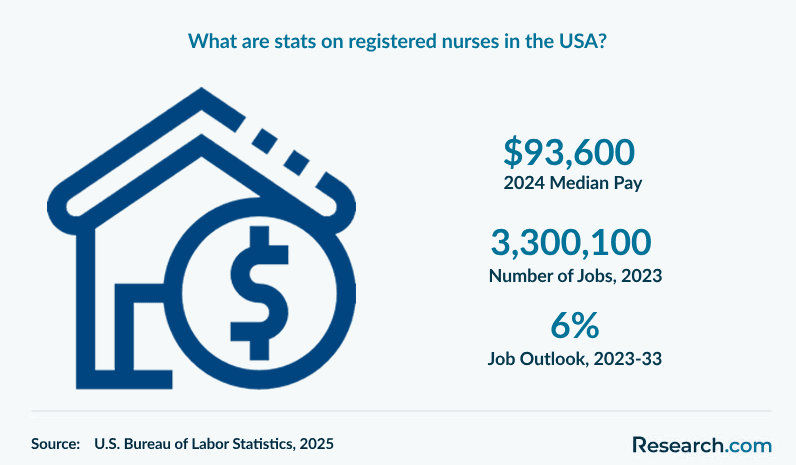
For registered nurses, the median pay in 2024 was $93,600 per year, equal to $45.00 per hour. A typical entry-level RN has a Bachelor's degree and does not need prior related work experience or on-the-job training. In 2023, there were 3,300,100 RN jobs.
RN employment from 2023 to 2033 is projected to grow by 6%, faster than the average for all occupations, with an expected gain of 197,200 jobs. The graphic below compares the stronger employment outlook and higher median pay associated with registered nursing roles.
If you are an LVN considering a non-nursing side-income or career alternative, you may also review cheapest CDL training programs online, though that is a separate career path rather than a nursing advancement route.
What questions should I ask before enrolling in an online LVN to RN bridge program?
Ask specific questions before you apply, and request written confirmation whenever possible. Licensure eligibility, clinical placement, accreditation, and financial aid are too important to rely on informal verbal assurances.
| Question to ask | Why the answer matters |
| Is the program approved by the nursing board in the state where I plan to seek RN licensure? | State approval is critical for NCLEX-RN eligibility and licensing. |
| Does the program have ACEN, CCNE, or other relevant accreditation? | Accreditation can influence employment, credit transfer, graduate school admission, and employer tuition benefits. |
| Who is responsible for arranging clinical placements? | If students must locate their own sites, you need to know the approval process and whether suitable facilities exist near you. |
| What are the latest NCLEX-RN pass rates? | Pass rates help you evaluate the program’s licensure preparation strength. |
| What is the total cost, including fees, travel, and clinical expenses? | Total cost provides a more accurate affordability comparison than tuition alone. |
| Can I continue working while enrolled? | Some bridge programs are too intensive for full-time employment, especially during clinical terms. |
| Will my credits apply toward a future BSN or MSN? | Transfer policies matter if you plan to continue your nursing education. |
| What support services are available to online students? | Advising, tutoring, technology help, faculty access, and career services can affect your ability to finish. |
If your eventual goal is advanced practice and you are comparing nontraditional nursing routes, you may later review the best direct entry nurse practitioner programs for non nurses. Keep in mind that an LVN to RN bridge is not the same as a direct-entry nurse practitioner pathway.
What nursing trends affect LVN to RN bridge graduates?
Several healthcare and workforce trends shape the value of LVN to RN bridge programs. Choosing a program that prepares you for current RN practice, not just the licensure exam, can improve your readiness after graduation.
- More value placed on BSN preparation: Many employers increasingly prefer BSN education for leadership, quality improvement, and broader clinical preparation.
- Telehealth and remote monitoring: RNs need confidence with patient portals, virtual communication, remote monitoring tools, and digital care workflows.
- Preventive and chronic care needs: More nursing work involves education, care coordination, and long-term management of chronic conditions.
- Aging population: Older adults often require complex and coordinated care, supporting demand for skilled RNs.
- Technology-heavy practice: Electronic health records, medication systems, decision-support tools, and clinical data platforms require digital comfort.
- Team-based care models: RNs are expected to collaborate with interdisciplinary teams and coordinate patient-centered plans.
- Specialty career growth: Gerontology, oncology, informatics, critical care, and community health remain important advancement areas.
- RN to BSN progression: Nurses planning bachelor’s completion can compare cheapest RN to BSN program options after becoming licensed RNs.
Look for bridge programs that teach clinical judgment, evidence-based practice, informatics, leadership, and patient education. Those skills are valuable for the NCLEX-RN and for modern RN practice.
What do graduates say about online LVN to RN programs?
-
: "
An affordable bridge program made RN school realistic while I continued working. The online classes helped with flexibility, but the clinical schedule still required serious planning and family support. Ellie
"
-
: "
I appreciated that the program recognized my LVN experience instead of starting from zero. It used what I already knew and challenged me to develop RN-level thinking. Juliana
"
-
: "
I thought online learning might feel disconnected, but faculty contact and peer discussions helped. Balancing work, studying, and clinical days was the toughest part, but the career payoff made it worthwhile. Serena
"
What challenges should I expect in an online LVN to RN bridge program?
Online bridge programs can be flexible, but they are not easier than campus-based nursing programs. You still need strong time management, clinical readiness, and the ability to learn independently.
- Clinical placement uncertainty: Students sometimes underestimate how hard it can be to secure approved clinical sites close to home.
- Work and school conflicts: Online lectures may be flexible, but labs and clinical rotations often occur on fixed days and shifts.
- Technology requirements: You may need reliable internet, an updated computer, testing software, learning platforms, and virtual simulation tools.
- Fast pacing: Asynchronous courses still include deadlines, exams, care plans, competencies, and clinical paperwork.
- State authorization limits: Not every online nursing program can enroll students in every state or qualify graduates for licensure in every jurisdiction.
- Unexpected expenses: Travel, testing, uniforms, background checks, health documentation, and missed work can raise your true cost.
Reduce risk by reviewing student support, clinical placement rules, technology expectations, and full costs before applying. If you are still deciding which nursing pathway fits your finances, compare broader affordable nursing programs online.
Can an online LVN to RN bridge program lead directly to nurse practitioner roles?
No. An online LVN to RN bridge program does not directly prepare you to become a nurse practitioner. Its primary purpose is to move you toward RN licensure, which may become one step in a longer advanced practice pathway.
To become a nurse practitioner, nurses typically need additional education beyond RN preparation, such as a BSN and graduate-level nurse practitioner training, plus advanced clinical hours and state-specific licensure requirements. If nurse practitioner practice is your long-term plan, compare RN bridge programs based on how well credits transfer into future BSN and graduate programs. You can also review the best direct entry nurse practitioner programs to understand other advanced practice pathways.
Common Mistakes to Avoid When Choosing an LVN to RN Bridge Program
- Picking a program based only on tuition: A low-cost option can become expensive if clinical sites are far away, credits do not transfer, or NCLEX-RN preparation is weak.
- Skipping state licensure verification: Always confirm that the program meets requirements in the state where you plan to become licensed.
- Assuming online means fully remote: RN education requires in-person clinical learning even when academic courses are online.
- Failing to ask about clinical placement: Clinical placement problems are a common reason online nursing students face delays.
- Overlooking accreditation: Lack of recognized accreditation can affect jobs, transfer credit, employer reimbursement, and future graduate study.
- Underestimating the workload: Bridge programs are accelerated and clinically demanding. Full-time work may be difficult during some terms.
- Relying only on rankings: Rankings can help you start your search, but your best-fit school depends on licensure eligibility, clinical access, schedule, cost, and support.
Key Insights
- Online LVN to RN programs are usually hybrid. Nursing theory may be online, but labs, skills validation, simulations, and clinical rotations must be completed in person.
- Licensure eligibility comes first. A program is not a good value if it does not meet state board requirements for NCLEX-RN eligibility where you plan to practice.
- Accreditation matters for more than school quality. Recognized nursing or institutional accreditation can affect employment, credit transfer, employer tuition assistance, and graduate school options.
- RN licensure is linked to higher pay and stronger growth than LVN/LPN practice. Registered nurses had 2024 median pay of $93,600 per year, or $45.00 per hour, while licensed practical and vocational nurses had 2024 median pay of $62,340 per year, or $29.97 per hour.
- The RN outlook is stronger. RN employment from 2023 to 2033 is projected to grow by 6%, adding 197,200 jobs, while LPN/LVN employment is projected to grow by 3%, adding 16,900 jobs.
- NCLEX-RN preparation should be a deciding factor. In 2025, first-time, U.S.-educated baccalaureate candidates had an 88.52% pass rate, associate degree candidates had an 88.41% pass rate, and diploma graduates had an 87.30% pass rate.
- Repeat and internationally educated candidates have lower pass rates. Repeat U.S.-educated candidates passed at 51.44%, first-time internationally educated candidates passed at 46.55%, and repeat internationally educated candidates passed at 30.15%.
- RN shortages remain a workforce issue. HRSA analysis projects a shortage of 78,610 full-time registered nurses in 2025 and 63,720 by 2030.
- Location strongly affects earnings. PayScale data shows California LVNs averaging $65,376, while Alabama and Mississippi report $40,000 and $38,000, respectively.
- Clinical placement can make or break your plan. Before applying, confirm who arranges clinicals, where they occur, and whether your location is eligible.
References:
- American Association of Colleges of Nursing. (2024, May). Nursing shortage fact sheet. American Association of Colleges of Nursing.
- Bureau of Labor Statistics, U.S. Department of Labor. (2025, April 18). Registered nurses. Occupational Outlook Handbook. Bureau of Labor Statistics.
- Bureau of Labor Statistics, U.S. Department of Labor. (2025, April 18). Licensed practical and licensed vocational nurses. Occupational Outlook Handbook. Bureau of Labor Statistics.
- National Council of State Boards of Nursing. (2025). 2025 NCLEX pass rates. National Council of State Boards of Nursing.
- PayScale. (2024, December 30). Salary for Certification: Licensed Vocational Nurse (LVN). PayScale.
- PayScale. (2025, April 23). Licensed Vocational Nurse (LVN) Hourly Pay in 2025. PayScale.
- PayScale. (2025, May 14). Registered Nurse (RN) Hourly Pay in 2025. PayScale.
- PayScale. (2024, February 27). Licensed Vocational Nurse (LVN) with Emergency Room (ER) Skills. PayScale.
Other Things You Should Know About the Most Affordable Online EMT to RN Online Bridge Programs
Typically, the admission requirements for LVN to RN online bridge programs include a valid LVN license, completion of prerequisite courses like anatomy and physiology, a minimum GPA of 2.5, and sometimes a background check. Meeting these ensures eligibility for affordable programs in 2027.
Yes. Most 2027 LVN to RN bridge programs require an unrestricted LVN license, a current CPR certification, and recent work experience or clinical hours, often 1,000 to 2,000 hours within the past 2 to 3 years. Some also require TEAS or HESI scores.


