
2027 Best LPN Programs in Minnesota – Accredited Online LPN Programs

Co-Founder and Chief Data Scientist
Choosing an online LPN program in Minnesota is really a decision about licensure, clinical access, cost, and schedule fit. Practical nursing is a hands-on healthcare role, so even programs advertised as online usually combine remote coursework with campus labs, simulations, and in-person clinical rotations. For working adults, parents, career changers, and current healthcare workers, that hybrid structure can make nursing education more manageable without removing the supervised patient-care training required for licensure.
This guide explains what online and hybrid LPN programs in Minnesota involve, how long they take, what they cost, how licensure works, and which schools stand out for 2027. It also covers admissions requirements, financial aid, NCLEX-PN preparation, career paths, advancement options, and common mistakes to avoid before enrolling.
Quick answer: Are online LPN programs in Minnesota worth considering?
Yes, online LPN programs in Minnesota can be a practical option if you need schedule flexibility and can still attend required labs and clinical placements. These programs are not fully online because Minnesota LPN licensure requires supervised hands-on training and successful completion of the NCLEX-PN. The best choice is a state-approved, properly accredited program with strong NCLEX-PN outcomes, convenient clinical sites, transparent costs, and support for working students.
| Decision factor | What it means for LPN students in Minnesota |
| Program format | Most online LPN options are hybrid, with online theory courses plus in-person labs and clinical rotations. |
| Typical timeline | LPN programs typically last 12-18 months. However, some schools offer a six-month LPN program online. |
| Licensure step | Graduates must pass the NCLEX-PN to become licensed in Minnesota. |
| Salary context | Minnesota's median annual wage for licensed practical and licensed vocational nurses is $54,092 in February 2024. |
| Labor market | The U.S. Bureau of Labor Statistics projects a 6.6% employment growth for local LPNs through 2030. |
Why pursue practical nursing in Minnesota?
Licensed practical nurses are part of the frontline nursing workforce. They provide direct care, monitor patients, administer medications within their scope of practice, document changes, and communicate with registered nurses, physicians, patients, and families. In Minnesota, LPNs can work in hospitals, clinics, long-term care facilities, rehabilitation centers, assisted living communities, schools, and home healthcare.
What are the benefits of getting a practical nursing credential?
- A defined path into nursing: LPN programs are shorter than RN degree programs and are designed to prepare students for entry-level practical nursing roles.
- Flexible study options: Online LPN programs in Minnesota can help students balance school with employment, caregiving, or a career change, although clinical attendance is still required.
- Multiple work settings: LPNs in Minnesota may work in hospitals, nursing homes, clinics, home health, rehabilitation, and community healthcare settings.
- Career mobility: With additional education, an LPN can pursue RN, BSN, leadership, specialty, or advanced nursing pathways.
What can I expect from an LPN degree in Minnesota?
An LPN program in Minnesota prepares students to deliver basic nursing care under the supervision of registered nurses, physicians, and other licensed healthcare professionals. Coursework usually covers nursing fundamentals, pharmacology, medical-surgical care, maternal-child care, mental health concepts, communication, ethics, and patient safety. Clinical training is a core requirement because students must demonstrate practical skills in real healthcare environments.
After completing an approved practical nursing program, graduates must pass the National Council Licensure Examination for Practical Nurses (NCLEX-PN) to qualify for licensure in Minnesota. Once licensed, LPNs can begin direct-care roles and later build toward higher-level credentials such as RN licensure, nurse management, or specialized certifications.
Where can I work with an LPN degree in Minnesota?
LPNs are employed across many healthcare environments. In hospitals, they may assist in acute care, rehabilitation, pediatrics, geriatrics, and other departments by taking vital signs, helping with medications, documenting patient information, and supporting care plans. In clinics, LPNs often assist with immunizations, screenings, patient intake, minor procedures, and follow-up instructions.
Long-term care and assisted living facilities are also major employment settings for practical nurses. In these roles, LPNs may monitor chronic conditions, coordinate with families, administer medications, and support residents with daily care needs. Home healthcare can provide a more independent work environment, but it also requires strong judgment, time management, and communication skills.
How much can I make with an LPN degree in Minnesota?
The median annual wage for LPNs in Minnesota was $54,092. Pay varies by employer, location, shift, experience, and work setting. Urban areas such as Minneapolis and St. Paul generally offer higher wages than many rural areas, and the Minneapolis-St. Paul-Bloomington area is the highest-paying location for LPNs in Minnesota.
Compensation may also differ by healthcare setting. Hospital-based LPN roles may pay differently than home health, long-term care, school nursing, or clinic roles. Night, weekend, holiday, and overtime shifts may increase earnings, but students should avoid assuming that any program guarantees a specific salary after graduation.
- Best online LPN programs in Minnesota for 2027
- How long does an online LPN program in Minnesota take?
- Online vs. on-campus LPN programs in Minnesota
- Average cost of online LPN programs in Minnesota
- Financial aid for Minnesota online LPN students
- Common prerequisites for online LPN programs in Minnesota
- Typical courses in an online LPN program
- LPN specialization and certification options
- How to choose the best online LPN program in Minnesota
- Career paths after an online LPN program
- Career advancement options for Minnesota LPNs
- Career support services for online LPN students
- Healthcare technology in online LPN programs
- Alternative allied healthcare roles for LPNs
- Minnesota job market for online LPN graduates
- Minnesota nursing license requirements
- Continuing education benefits for LPNs
- Specialized certifications for LPN career growth
- How LPNs can become RNs in Minnesota
- Can LPNs become nurse midwives in Minnesota?
- Post-pandemic changes in Minnesota LPN programs
- Advanced nursing degree options for LPNs
- How online programs handle hands-on clinical training
- Cultural competence and community engagement
- NCLEX-PN preparation and certification success
- Challenges faced by LPN students in Minnesota
List of the Best Online LPN Programs in Minnesota for 2027
Research.com reviewed current public datasets from credible education sources to identify Minnesota LPN programs with strong indicators in academic quality, accessibility, affordability, and accreditation. Because practical nursing requires clinical training, the programs below should be understood as online, hybrid, or online-enhanced options rather than fully remote nursing programs.
How do we rank schools?
Finding the right LPN program requires more than scanning tuition rates or choosing the closest campus. Research.com uses a validated ranking approach designed to help prospective students compare programs using transparent education data and practical decision factors. Our review considers sources such as:
- Integrated Postsecondary Education Data System (IPEDS database)
- Peterson’s database, including their Distance Learning Licensed Data Set
- College Scorecard database
- National Center for Education Statistics
| School | Program length | Required credits | Cost per credit | Accreditation |
| Northland Community and Technical College | Three semesters | 42 | $188 | National League for Nursing Commission for Nursing Education Accreditation (NLN CNEA) |
| Minnesota North College | Three semesters | 45 | $226 | National League for Nursing Commission for Nursing Education Accreditation (NLN CNEA) |
| Northwest Technical College | One year | 39 | $164 | Accreditation Commission for Education in Nursing (ACEN) |
| Rasmussen University | One year | 56 | $397 | Accreditation Commission for Education in Nursing (ACEN) |
| Saint Paul College | Three semesters | 40 | $231 | Accreditation Commission for Education in Nursing (ACEN) |
| Pine Technical and Community College | Two years | 44 | $199 | Accreditation Commission for Education in Nursing |
| St. Cloud Technical and Community College | Two years | 40 | $405 | Accreditation Commission for Education in Nursing |
| Hennepin Technical College | One year | 40 | $178 | Accreditation Commission for Education in Nursing |
| Riverland Community College | One year | 39 | $183 | Accreditation Commission for Education in Nursing |
| Alexandria Technical and Community College | One year | 39 | $183 | Accreditation Commission for Education in Nursing |
1. Northland Community and Technical College
Northland Community and Technical College offers a Practical Nursing program delivered over three semesters. Students complete general education courses online while nursing courses use a mix of online and on-campus learning. This structure may appeal to students who want remote flexibility but can still attend required practical components.
- Program Length: Three semesters
- Tracks/concentrations: Practical Nursing
- Cost per Credit: $188
- Required Credits to Graduate: 42
- Accreditation: National League for Nursing Commission for Nursing Education Accreditation (NLN CNEA)
2. Minnesota North College
Minnesota North College offers a Practical Nursing (Distance) diploma through the Rainy River campus. The three-semester format combines online coursework with clinical rotations across the state, making clinical placement planning especially important for applicants who live far from campus or major healthcare hubs.
- Program Length: Three semesters
- Tracks/concentrations: Practical Nursing
- Cost per Credit: $226
- Required Credits to Graduate: 45
- Accreditation: National League for Nursing Commission for Nursing Education Accreditation (NLN CNEA)
3. Northwest Technical College
Northwest Technical College offers a 39-credit Practical Nurse diploma that emphasizes bedside care, patient interaction, simulation, and clinical experiences in local healthcare facilities. Graduates are prepared for entry-level practical nursing tasks such as first aid support, charting, lab assistance, and patient care within the LPN scope of practice.
- Program Length: One year
- Tracks/concentrations: Practical Nursing
- Cost per Credit: $164
- Required Credits to Graduate: 39
- Accreditation: Accreditation Commission for Education in Nursing (ACEN)
4. Rasmussen University
Rasmussen University offers a hybrid practical nursing program that combines on-campus learning, online coursework, and supervised clinical experiences. The program can prepare students for licensure in as few as 12 months and includes content in maternal-child nursing, gerontological nursing, mental health nursing, and care across the lifespan.
- Program Length: One year
- Tracks/concentrations: Practical Nursing
- Cost per Credit: $397
- Required Credits to Graduate: 56
- Accreditation: Accreditation Commission for Education in Nursing (ACEN)
5. Saint Paul College
Saint Paul College offers Practical Nursing Diploma options in online, hybrid, and traditional campus formats in St. Paul, MN. Students learn to care for patients of different ages while working under registered nurses and physicians. Clinical rotations in the Twin Cities area provide direct exposure to healthcare settings.
- Program Length: Three semesters
- Tracks/concentrations: Practical Nursing
- Cost per Credit: $231
- Required Credits to Graduate: 40
- Accreditation: Accreditation Commission for Education in Nursing (ACEN)
6. Pine Technical and Community College
Pine Technical and Community College’s Practical Nursing program focuses on clinical judgment, ethical care, and foundational nursing practice under licensed supervision. Its blend of online and on-campus instruction can be useful for students who need flexibility while still developing hands-on nursing skills.
- Program Length: Two years
- Tracks/concentrations: Practical Nursing
- Cost per Credit: $199
- Required Credits to Graduate: 44
- Accreditation: Accreditation Commission for Education in Nursing
7. St. Cloud Technical and Community College
St. Cloud Technical and Community College offers a Practical Nursing program designed to support both entry-level employment and future academic mobility into associate or baccalaureate RN programs. Students build professionalism, leadership, clinical reasoning, and ethical decision-making while gaining experience in nursing practice settings.
- Program Length: Two years
- Tracks/concentrations: Practical Nursing
- Cost per Credit: $405
- Required Credits to Graduate: 40
- Accreditation: Accreditation Commission for Education in Nursing
8. Hennepin Technical College
Hennepin Technical College’s Practical Nursing program combines classroom theory, lab practice, and clinical learning in areas such as basic nursing skills, psychosocial nursing, and pharmacology. The college also offers a Nursing Mobility option for LPNs pursuing an Associate of Science (A.S.) Degree in Nursing and eligibility for the NCLEX-RN.
- Program Length: One year
- Tracks/concentrations: Practical Nursing
- Cost per Credit: $178
- Required Credits to Graduate: 40
- Accreditation: Accreditation Commission for Education in Nursing
9. Riverland Community College
Riverland Community College’s Practical Nursing program prepares students for entry-level PN practice by developing nursing knowledge, patient-care skills, professional values, and clinical readiness. Students have access to faculty, advisors, tutors, financial aid staff, and technical support while progressing through the program.
- Program Length: One year
- Tracks/concentrations: Practical Nursing
- Cost per Credit: $183
- Required Credits to Graduate: 39
- Accreditation: Accreditation Commission for Education in Nursing
10. Alexandria Technical and Community College
Alexandria Technical and Community College offers a Practical Nursing program that blends classroom instruction, simulation labs, and clinical experiences. The program prepares students to take the NCLEX-PN® licensure exam and pursue licensure as an LPN after completing the examination.
- Program Length: One year
- Tracks/concentrations: Practical Nursing
- Cost per Credit: $183
- Required Credits to Graduate: 39
- Accreditation: Accreditation Commission for Education in Nursing
What graduates say about earning an LPN degree
“Earning my LPN degree in Minnesota was the best decision I ever made. The hands-on clinical experience gave me the confidence I needed to step into a hospital setting right after graduation. Seeing the impact I have on patients' lives every day makes all the late nights and challenging exams worth it.” - Marisha
“Balancing work and family while studying wasn't easy, but the flexibility of Minnesota's LPN programs made it possible. The online courses allowed me to fit my studies around my schedule, and the supportive instructors were always there to answer my questions. Now, I have a fulfilling career, a great work-life balance, and the satisfaction of knowing I'm helping others.” - Jim
“I never expected to find a career that was both intellectually stimulating and emotionally rewarding. My LPN program in Minnesota opened my eyes to the complex world of healthcare and the incredible connection you build with patients. The supportive community of instructors and classmates made the journey even more meaningful. Today, I'm proud to be a part of the healthcare team, making a difference in my community.” - Moira
Key findings for Minnesota LPN students
- Students in top online LPN programs in Minnesota can expect to pay between $188 and $397 per credit.
- The median annual wage for LPNs in Minnesota was $54,092.
- The Minneapolis-St. Paul-Bloomington area is the highest-paying location for LPNs in Minnesota.
- LPN programs typically last 12-18 months. However, some schools offer a six-month LPN program online.
- 74% of Illinois LPNs said they provide direct patient care in their day-to-day work (Illinois Nursing Workforce Center, 2024). This figure is not Minnesota-specific, but it reinforces how central direct patient care is to practical nursing work.
How long does it take to complete an online LPN program in Minnesota?
Most Minnesota LPN programs take 12 to 18 months and include both classroom instruction and clinical experience. Some one-year diploma options are designed for full-time students, while three-semester formats may offer a more balanced pace. Two-year options may work better for students who need a slower schedule or are completing prerequisites alongside nursing coursework.
Students searching for a fully online LPN program should be careful. Practical nursing cannot be completed entirely online because licensure preparation includes hands-on skills training, simulation, and supervised clinical hours. If a school advertises online learning, ask exactly which courses are online, where labs meet, how clinical sites are assigned, and whether evening or weekend clinicals are available.
How does an online LPN program in Minnesota compare to an on-campus program?
Online and on-campus LPN programs generally teach the same core nursing content, but they deliver it differently. Online or hybrid programs may allow students to complete lectures, assignments, discussions, and some exams remotely. On-campus programs usually provide more face-to-face structure and may be better for students who prefer in-person instruction and immediate access to labs and faculty.
Partially online options can still prepare students well for licensure when they are properly approved and include strong clinical training. For example, two partially online programs offered by Minnesota North College and Rasmussen College achieved some of the highest NCLEX-PN pass rates among state-approved LPN programs. This suggests that online pre licensure nursing programs can be effective when the program design, clinical support, and student preparation are strong.
| School | Program Type | NCLEX-PN Pass Rate |
| Lake Superior College | On-Campus | 100% |
| Minnesota North College | Partially-Online | 100% |
| Minnesota West Community and Technical College | On-Campus | 100% |
| Pine Technical & Community College | On-Campus | 93.33% |
| Rasmussen University - Mankato | Partially-Online | 92.31% |
| Format | Best for | Trade-offs |
| Online or hybrid LPN program | Students who need flexibility for work, family, or commuting | Still requires in-person clinicals and strong self-discipline |
| On-campus LPN program | Students who want structured face-to-face instruction and frequent lab access | Less scheduling flexibility and more commuting |
| Fast-track LPN option | Students who can manage a compressed academic schedule | Higher weekly workload and less time to absorb difficult material |
What is the average cost of an online LPN program in Minnesota?
Students in top online LPN programs in Minnesota can expect to pay between $188 and $397 per credit. Total cost depends on the number of required credits, program format, residency rules, fees, books, uniforms, supplies, background checks, immunizations, transportation, and exam-related expenses.
Costs can also differ between online and campus formats. The cost of the program may change when schools charge different online rates, technology fees, or program-specific fees. For example, Minnesota North College charges $200 per credit for its on-campus programs, versus $226 for its online programs. Meanwhile, on-campus learning at Saint Paul College costs between $211 and $305 per credit depending on the program, compared to $231 per credit for all online programs.
Cost questions to ask before enrolling
- Is the quoted tuition rate the full program cost or only the per-credit charge?
- Are online course fees, lab fees, simulation fees, uniforms, supplies, and testing fees included?
- Will I need to travel for labs or clinical rotations, and how often?
- Can I use transfer credits to reduce the total number of credits I must complete?
- Does the school publish NCLEX-PN pass rates and completion outcomes?
What are the financial aid options for students enrolling in an online LPN program in Minnesota?
Students entering an online LPN program in Minnesota may be eligible for grants, scholarships, loans, and work-study depending on the school, program length, enrollment status, financial need, and federal aid eligibility. The first step for most students is completing the Free Application for Federal Student Aid (FAFSA).
- Minnesota State Grant: This grant supports eligible students attending public colleges and universities in Minnesota.
- Minnesota GI Bill: This program provides tuition assistance for veterans and their dependents.
- College-specific aid: Schools may offer merit-based, need-based, or program-specific scholarships through the financial aid office or foundation.
- Federal aid: Federal support may include grants, loans, scholarships, and work-study. Students generally apply by submitting the FAFSA.
Ways to reduce LPN program costs
- Compare total program cost, not only tuition per credit.
- Ask whether prerequisite courses can be completed at a lower-cost institution and transferred.
- Check employer tuition assistance if you already work in healthcare.
- Apply early for school-based nursing scholarships, which may have separate deadlines.
- Budget for transportation to clinical sites, especially if you live outside a metro area.
What are the prerequisites for enrolling in an online LPN program in Minnesota?
Admissions rules vary by college, but most Minnesota LPN programs expect applicants to show academic readiness, meet health and safety requirements, and qualify for clinical placement. These requirements are different from nurse practitioner education requirements, which apply to advanced practice nursing after RN education and graduate study.
- High school diploma: Applicants usually need a high school diploma or an equivalent credential such as a GED.
- TEAS examination: Many nursing programs use the Test of Essential Academic Skills to evaluate readiness in reading, math, science, and English.
- CPR certification: Programs may require CPR certification before students begin clinical training.
- Health screening: Students commonly submit immunization records, health history forms, and documentation showing they can participate safely in clinical experiences.
- Criminal background check: Background checks are commonly required for clinical placement and may also affect eligibility for nursing licensure.
What courses are typically in an online LPN program in Minnesota?
LPN coursework focuses on direct patient care, safe medication practices, clinical reasoning, documentation, and communication. Although some theory courses may be online, skills practice and clinical learning are completed in person. Unlike healthcare administration programs, practical nursing programs are built around bedside care and licensure preparation.
- Medical terminology: Students learn common medical terms, abbreviations, body systems language, and documentation vocabulary used in healthcare settings.
- Clinical pharmacology: This course introduces medication categories, actions, side effects, interactions, dosage safety, and the LPN’s role in medication administration.
- Foundations of nursing: Students build core nursing skills such as vital signs, hygiene care, wound care, communication, infection control, and patient safety.
- Medical-surgical nursing: Students study care for adults with common acute and chronic conditions.
- Maternal-child nursing: Coursework introduces care concepts for pregnancy, newborns, children, and families.
- Mental health nursing: Students learn communication strategies, behavioral health concepts, and safe care approaches for patients with mental health needs.
What types of specializations are available in an online LPN program in Minnesota?
Most Minnesota LPN programs prepare students for general practical nursing rather than formal in-program specializations. In 2024, approximately 92% of U.S. LPNs said they provide direct patient care in their day-to-day work, so the typical curriculum emphasizes broad patient-care competence. After licensure, LPNs can pursue focused experience or certifications in specific areas.
- Wound care: Certified Wound Ostomy Continence Nurse (CWOCN) certification can support specialization in complex wound management.
- Geriatrics: Certified Nursing Assistant (CNA) - Gerontological Nursing certification can strengthen skills for working with older adults.
- Pediatrics: Certified Pediatric Nurse (CPN) certification focuses on care for children and adolescents.
- Other specialty areas: LPNs may also explore IV therapy, dialysis, infection control, or other focused training depending on employer needs and state scope-of-practice rules.
How to choose the best online LPN programs in Minnesota?
The best online LPN program is the one that prepares you for licensure, fits your schedule, gives you access to clinical training, and makes financial sense. High NCLEX-PN pass rates are important because they show how well graduates perform on the licensure exam, but they should not be the only factor.
1. Verify approval, accreditation, and licensure alignment
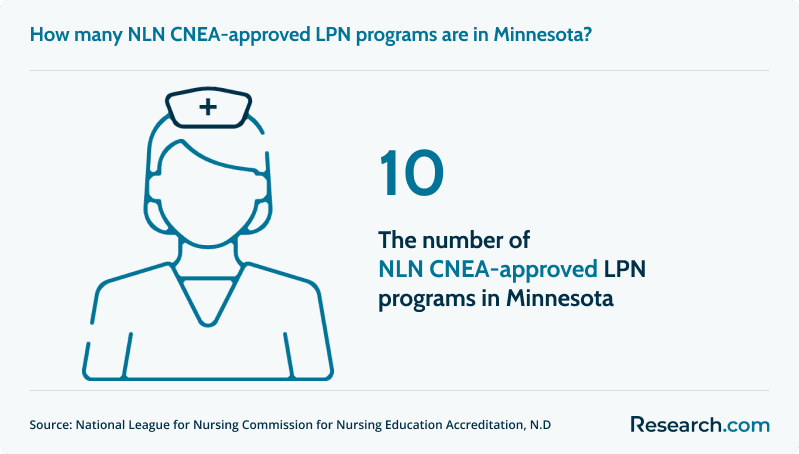
Your nurse preparation program must be nationally or regionally accredited to count towards NCLEX-PN exam requirements. The National League for Nursing Commission for Nursing Education Accreditation (NLN CNEA), one of the most widely recognized accreditors of LPN programs in the country, has accredited ten Minnesota-based LPN programs as of 2024. Students should also confirm that the program is accepted for Minnesota LPN licensure before enrolling.
2. Compare schedule and program duration
Consider whether you can realistically handle a one-year, three-semester, two-year, or accelerated schedule. A shorter timeline may get you to the workforce sooner, but it can also require more weekly study time, less flexibility, and greater stress during clinical terms.
3. Confirm clinical placement logistics
Online LPN programs rely on healthcare partnerships for required clinical experience. Ask where clinicals are located, whether students can request sites near home, how placements are assigned, and what happens if a clinical site is unavailable.
4. Review NCLEX-PN support
Strong programs usually build exam readiness into the curriculum through practice questions, standardized testing, review sessions, faculty feedback, and remediation plans. Ask how the school supports students who are struggling before the licensure exam.
5. Calculate total cost and return on investment
Do not choose based on tuition alone. Add fees, supplies, commuting, lost work hours, childcare, and exam expenses. Then compare that total to the wage data and job market in the area where you plan to work.
| Program feature | Why it matters | Question to ask |
| Accreditation and approval | Protects licensure eligibility and transfer value | Is this program accepted for Minnesota LPN licensure? |
| NCLEX-PN outcomes | Shows how graduates perform on the licensing exam | What are the most recent pass rates? |
| Clinical sites | Determines travel time and hands-on training access | Where will I complete clinical rotations? |
| Schedule format | Affects ability to work while enrolled | Are labs or clinicals offered evenings or weekends? |
| Total cost | Helps avoid underestimating expenses | What fees and supplies are not included in tuition? |
What career paths are available for graduates of an online LPN program in Minnesota?
Graduates of online or hybrid LPN programs in Minnesota can pursue practical nursing roles in several care environments. The LPN credential can also support future study in nursing, allied health, or healthcare operations, including pathways that may eventually lead to senior roles in medical office management.
- Licensed Practical Nurse (LPN): LPNs provide basic nursing care under RN or physician supervision, including vital signs, medication administration, documentation, activities of daily living, and patient education.
- Home Health Aide: Some LPNs work in home-based care, supporting patients with chronic conditions, medication routines, monitoring, and daily needs.
- School Nurse: LPNs may support student health services by assisting with chronic condition management, medications, screenings, and urgent health needs.
- Geriatric Nurse: LPNs can build expertise in older-adult care through long-term care experience, assisted living roles, and relevant certifications.
What are the career advancement opportunities for LPNs in Minnesota?
LPNs can advance by adding education, experience, certifications, or leadership responsibilities. The right path depends on whether you want more clinical responsibility, higher earning potential, schedule flexibility, or a move into education or management.
- Transition to Registered Nurse (RN): Many LPNs enter LPN-to-RN bridge programs, which can often be completed in about 18 to 24 months. RN roles generally involve a broader scope of practice and more responsibility.
- Specialized certifications: LPNs may pursue credentials in areas such as wound care, IV therapy, or gerontology to qualify for more focused clinical roles.
- Nurse leadership or management roles: Experienced LPNs may supervise nursing assistants or other LPNs in clinics, long-term care facilities, or similar settings.
- LPN to BSN: A Bachelor of Science in Nursing can support movement into more advanced nursing, leadership, or specialty roles after RN licensure.
- Healthcare education or training: Some LPNs become staff trainers, preceptors, or educators for entry-level healthcare workers.
- Home health care or private duty nursing: LPNs who want more individualized patient care may pursue home health or private duty roles.
What career support services enhance success for online LPN students in Minnesota?
Career services can make a major difference for online LPN students because many are balancing school with work and may be entering healthcare for the first time. Useful support includes resume help, interview coaching, job-search guidance, employer networking, clinical placement assistance, tutoring, and faculty mentoring.
Programs with strong healthcare partnerships may connect students to externships, job fairs, and local employers before graduation. Students comparing nursing with allied health options may also find it useful to review the best medical assistant programs in Minnesota to understand alternative healthcare training routes.
How are online LPN programs in Minnesota integrating modern healthcare technologies?
Modern LPN programs increasingly use digital learning platforms, simulation labs, electronic health record practice, and telehealth-related instruction. These tools help students practice clinical decision-making before working with patients and prepare them for healthcare workplaces where documentation, remote communication, and digital workflows are routine.
Technology does not replace clinical training, but it can strengthen preparation for patient scenarios, medication safety, charting, and communication. Students interested in more advanced technology-enabled nursing pathways can also explore BSN to FNP programs online.
What alternative allied healthcare roles can LPNs pursue in Minnesota?
An LPN background can open doors beyond traditional practical nursing, especially for professionals who want to combine clinical experience with coordination, patient education, or specialized support roles. Some LPNs move into medical assisting, care coordination, clinic operations, patient navigation, long-term care supervision, or health education.
Additional training may be required for some allied health paths. For example, LPNs interested in diet, wellness, and patient education can review guidance on how to become a nutritionist in Minnesota to compare credential expectations.
What is the job market for graduates with an online LPN degree in Minnesota?
Graduates with an online LPN degree in Minnesota can expect a positive job market outlook, as the employment growth rate for Licensed Practical Nurses (LPNs) in Minnesota is projected to grow by 3.5% through 2032. This growth is higher than the national average, indicating a strong demand for LPNs in the state.
The chart details the highest paying locations for LPNs in Minnesota. The median annual wage for LPNs in Minnesota was $54,092 and the Minneapolis-St. Paul-Bloomington area has the highest-paying location for LPNs in the state.
What are the Minnesota nursing license requirements?
To become an LPN in Minnesota, students generally need to complete an approved practical nursing program, apply for licensure, satisfy background check requirements, and pass the NCLEX-PN. Applicants may also need to provide required health and immunization documentation for clinical participation and meet renewal expectations after licensure.
Because licensure rules can change, students should confirm the current process before enrolling and again before graduation. Research.com provides a detailed overview of Minnesota nursing license requirements for students who want a step-by-step licensing reference.
What are the benefits of continuing education for LPNs in Minnesota?
Continuing education can help LPNs stay current, qualify for new responsibilities, and prepare for RN or advanced nursing pathways. It can also make a nurse more competitive for specialized units, supervisory roles, or employer-sponsored advancement opportunities.
- Higher earning potential: Additional education, including pathways such as RN to BSN no clinicals, can support access to roles with broader responsibility and potentially higher pay.
- Career advancement: Employers may prefer candidates with additional credentials for leadership, administration, or specialty nursing positions.
- Career flexibility: More education can help nurses adapt as healthcare delivery, technology, and employer expectations change.
What role do specialized certifications play in advancing LPN careers in Minnesota?
Specialized certifications help LPNs document focused expertise without immediately becoming an RN. Credentials in IV therapy, geriatric care, wound management, dialysis, or infection control may help practical nurses qualify for specialized assignments, employer advancement, or higher-responsibility clinical work within their legal scope of practice.
Certifications can also help LPNs decide whether they want to pursue advanced roles later. Those considering graduate-level nursing careers can review how to become a nurse practitioner in Minnesota to understand the longer academic path required for advanced practice.
How can LPNs transition to becoming RNs in Minnesota?
LPNs who want a broader scope of practice often pursue RN licensure through an LPN-to-RN bridge program. These programs typically build on prior practical nursing education and may lead to an Associate Degree in Nursing or a Bachelor of Science in Nursing.
Many bridge programs are designed for working LPNs and may include flexible scheduling, online coursework, and accelerated nursing classes. However, RN preparation still requires clinical education and successful completion of the NCLEX-RN.
Prospective bridge students should compare prerequisites, transfer credit policies, clinical requirements, cost, and licensure outcomes. A helpful next step is reviewing how to become a registered nurse in Minnesota, including education and licensing steps.
Can LPNs progress into nurse midwife roles in Minnesota?
Yes, but not directly from LPN practice alone. Nurse midwifery is an advanced nursing role that requires additional nursing education, RN preparation, graduate-level training, supervised clinical experience, and certification aligned with maternal and newborn care. LPNs interested in this path should plan for multiple education stages, beginning with RN licensure.
Students considering this long-term route can review the nurse midwife education requirements in Minnesota to understand the academic and credentialing expectations.
How are Minnesota LPN programs adapting to the post-pandemic healthcare landscape?
Minnesota LPN programs are placing more emphasis on flexible learning, simulation, digital documentation, infection control, telehealth exposure, and updated clinical protocols. These changes reflect the realities of modern healthcare, where nurses must be prepared for changing patient needs, remote communication tools, and complex care environments.
Programs with strong clinical partnerships can expose students to current care models and workplace expectations. Students who want broader nursing program options in the state can compare the best online nursing programs in Minnesota.
What are the options for LPNs in Minnesota who want to pursue advanced nursing degrees?
LPNs who want advanced nursing roles usually follow a step-by-step pathway: practical nursing, RN licensure, BSN completion, and then graduate nursing education if required for the target role. Depending on the career goal, options may include LPN-to-RN, RN-to-BSN, BSN-to-MSN, direct-entry graduate nursing, or nurse practitioner programs.
For LPNs who eventually want advanced practice, reviewing the best nurse practitioner programs in Minnesota can clarify what graduate-level nursing education involves after RN and bachelor’s-level preparation.
How do online LPN programs balance virtual learning with hands-on clinical training?
Online LPN programs separate what can be learned remotely from what must be practiced in person. Lectures, readings, quizzes, care planning, and discussion activities may be online. Skills labs, simulation, check-offs, and clinical rotations are completed in person under faculty or preceptor oversight.
This balance is essential because LPNs must be able to perform safe patient care, not simply understand nursing concepts. Programs may use simulation technology to prepare students for real patient scenarios before they enter clinical sites. Graduates who want to continue into higher-level nursing education can compare the best direct-entry MSN programs as part of long-term planning.
How do Minnesota LPN programs promote cultural competence and community engagement?
Practical nurses care for patients from many cultural, linguistic, socioeconomic, and age groups. Minnesota LPN programs may address cultural competence through communication training, community health content, service learning, clinical exposure, and instruction on patient-centered care.
Students should ask how a program prepares them to work with diverse communities, address language barriers, respect patient preferences, and communicate with families. Those comparing broader nursing education options can explore the best nursing schools in Minnesota.
How can LPN students optimize exam preparation and certification success in Minnesota?
NCLEX-PN preparation should begin early, not after graduation. Strong students build weekly review habits, complete practice questions, use diagnostic exams, seek faculty feedback, and remediate weak areas before they become major gaps. Simulation-based practice and study groups can also improve readiness by connecting textbook knowledge with clinical judgment.
Students should ask each program how it tracks NCLEX readiness, what review resources are included, and what support is available for students who struggle. For a focused licensing roadmap, see Research.com’s guide on how to become a certified LPN in Minnesota.
What are the challenges faced by LPN students in Minnesota?
LPN programs are short, but they are not easy. Students must learn a large amount of clinical content while also completing labs, clinical rotations, exams, and professional requirements. Online flexibility can help, but it does not reduce the seriousness of the workload.
- Time management: Students must balance lectures, assignments, clinical shifts, study time, work, and personal responsibilities.
- Demanding coursework: Anatomy, pharmacology, nursing fundamentals, and medical-surgical nursing can be difficult, especially for students without a science background.
- Clinical requirements: Online students still need in-person clinical hours, and placement logistics can be harder for students in rural or underserved areas.
- Technical skill development: Procedures such as medication administration, wound care, documentation, and patient assessment require repeated practice.
- Financial pressure: Tuition is only part of the cost; students may also pay for books, uniforms, supplies, screenings, transportation, and exams.
- Emotional and physical stress: Nursing school can involve long days, high expectations, patient-care pressure, and exposure to difficult healthcare situations.
Common mistakes to avoid
| Mistake | Why it can hurt you | Better approach |
| Assuming “online” means no campus visits | LPN training requires labs and clinical rotations | Ask for a full schedule of in-person requirements before applying |
| Choosing only by tuition | Fees, supplies, travel, and lost work time can change affordability | Compare total program cost and financial aid options |
| Ignoring accreditation and approval | Licensure eligibility may be affected | Confirm approval and accreditation directly with the school and state board |
| Overlooking NCLEX-PN support | Graduation alone does not make you licensed | Review pass rates, remediation policies, and exam preparation tools |
| Not planning for clinical travel | Clinical sites may be far from home or scheduled at fixed times | Ask where clinical placements occur and whether preferences are considered |
Students who need a shorter route should still evaluate workload carefully. Fast track LPN programs online may be useful for motivated learners, but compressed programs can be intense and require strong preparation.
Related Articles for Nearby States
- 2027 Best LPN Programs in Wisconsin – Accredited Online LPN Programs
- 2027 Best LPN Programs in Iowa – Accredited Online LPN Programs
- 2027 Best LPN Programs in North Dakota – Accredited Online LPN Programs
- 2027 Best LPN Programs in South Dakota – Accredited Online LPN Programs
- 2027 Best LPN Programs in Nebraska – Accredited Online LPN Programs
- 2027 Best LPN Programs in Illinois – Accredited Online LPN Programs
- 2027 Best LPN Programs in Missouri – Accredited Online LPN Programs
- 2027 Best LPN Programs in Michigan – Accredited Online LPN Programs
- 2027 Best LPN Programs in Kansas – Accredited Online LPN Programs
- 2027 Best LPN Programs in Indiana – Accredited Online LPN Programs
References:
- Minnesota Board of Nursing. (2022). Annual Licensure Report Fiscal Year 2022 [PDF]. Minnesota Board of Nursing. Retrieved October 18, 2023, from https://mn.gov/boards/assets/Annual_Licensure_Rpt_2022_tcm21-322613.pdf
- Minnesota State (N.D). Licensed Practical Nurses: Wages and Outlook. Retrieved from: https://careerwise.minnstate.edu/careers/careerDetail?id=1&oc=292061#outlook
- NurseJournal.org. (N.D.). The U.S. Nursing Shortage: A State-by-State Breakdown. NurseJournal.org. https://nursejournal.org/articles/the-us-nursing-shortage-state-by-state-breakdown
- O*NET. (N.D.). Minnesota Wages: 29-2061.00 Licensed Practical and Licensed Vocational Nurses. O*NET. https://www.onetonline.org/link/localwages/29-2061.00?st=MN
- Projections Central. (N.D.). Long-Term Occupational Projections https://projectionscentral.org/Projections/LongTerm?AreaName=minnesota%2C+%22united+states%22&Name=licensed+practical&items_per_page=1000
Key Insights
- Online LPN programs in Minnesota are usually hybrid, not fully remote. Expect online coursework plus in-person labs, simulations, and clinical rotations.
- Licensure is the central goal. Before enrolling, confirm that the program prepares graduates for the NCLEX-PN and meets Minnesota nursing licensure expectations.
- Program length varies, but many LPN options take 12 to 18 months. Faster programs can be useful, but they require a heavier weekly commitment.
- Cost comparisons should include tuition, fees, supplies, background checks, clinical travel, and exam expenses—not just the advertised per-credit rate.
- NCLEX-PN pass rates, accreditation, clinical placement quality, and student support are stronger decision factors than convenience alone.
- The LPN credential can lead directly to practical nursing roles and can also serve as a stepping stone toward RN, BSN, specialty, leadership, or advanced nursing pathways.
Other Things You Should Know About Online LPN Programs in Minnesota
Institutions like Minnesota State Community and Technical College offer online LPN programs with flexible start dates in 2027, allowing students to begin their studies at multiple points throughout the year. This flexibility may cater to non-traditional students or those balancing other commitments.
An online LPN program in Minnesota should hold approval from the Minnesota Board of Nursing and institutional accreditation from a recognized agency such as the Higher Learning Commission. These credentials help ensure the program meets state standards and that graduates are eligible to sit for the NCLEX-PN exam.
In 2027, students enrolling in accredited online LPN programs in Minnesota can explore various financial aid options, including federal student loans, state grants, and scholarship opportunities specific to nursing programs. Checking with individual schools is advisable for specific aid information, as availability may vary.


