2027 Best Online BSN to FNP Programs

Co-Founder and Chief Data Scientist
Choosing an online BSN to FNP program is not just a school search; it is a licensure, clinical training, cost, and career decision. Registered nurses who already hold a BSN often look for this pathway because it can lead to advanced practice roles in primary care, family health, telehealth, community clinics, and other settings where nurse practitioners help diagnose, treat, prescribe, educate, and manage patient care across the lifespan.
The challenge is that online BSN to FNP programs can look similar on the surface while differing sharply in accreditation, clinical placement support, state authorization, tuition, campus visit requirements, certification preparation, and flexibility for working nurses. This guide explains what to expect from online BSN to FNP programs for 2027, how to compare your options, what costs and prerequisites to plan for, and which questions to ask before enrolling.
Quick Answer: Is an Online BSN to FNP Program Worth Considering?
An online BSN to FNP program can be a strong option for licensed registered nurses with a BSN who want to move into family nurse practitioner practice while continuing to work. Most programs combine online graduate coursework with supervised in-person clinical hours arranged in an approved healthcare setting. The path is best suited for nurses who want advanced clinical responsibility, can manage a demanding graduate schedule, and are willing to verify that the program meets certification and state licensure requirements before enrolling.
What are the main benefits of earning an online BSN to FNP degree?
- Broader career options: A BSN to FNP degree can prepare nurses for advanced practice roles in physician offices, hospitals, outpatient centers, community health settings, telehealth, and other primary care environments.
- Flexibility for working nurses: Online delivery can make it easier to keep working while completing graduate-level coursework, although clinical hours still require in-person participation.
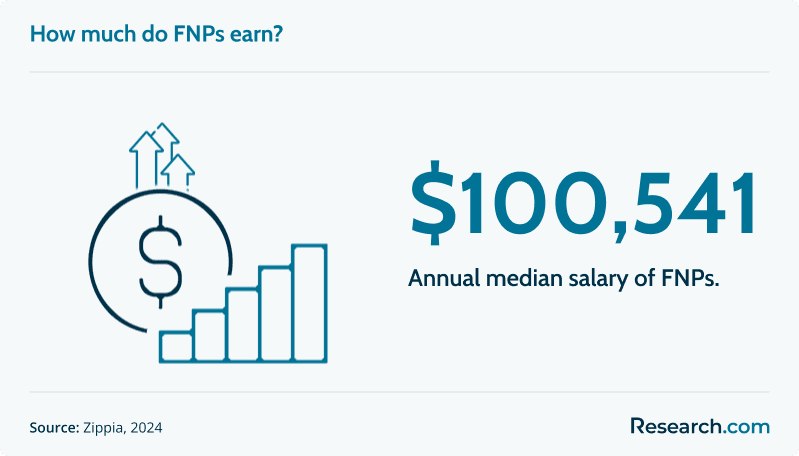
- Higher earning potential: Family nurse practitioners earn an annual median salary of $100,541, with pay affected by experience, region, employer type, and scope of practice.
- Strong occupational demand: More than 211,000 family nurse practitioners are employed in the US in 2024, and FNP remains the most common nurse practitioner certification area.
What can I expect from an online BSN to FNP program?
An online BSN to FNP program builds on undergraduate nursing preparation and RN experience. Students typically study advanced pathophysiology, pharmacology, health assessment, family primary care, evidence-based practice, healthcare policy, and patient management. The goal is to prepare nurses to evaluate patients, develop treatment plans, manage acute and chronic conditions, and provide preventive care for children, adults, and older adults.
The “online” format usually applies to didactic coursework. Clinical training is still completed in person under approved supervision, often in a healthcare site near the student. Many programs also use online case discussions, simulation, virtual patient scenarios, group projects, and synchronous or asynchronous class sessions to reinforce diagnostic reasoning and clinical decision-making.
| Program component | What it usually involves | Why it matters |
| Graduate nursing coursework | Advanced assessment, pharmacology, pathophysiology, primary care, ethics, policy, and evidence-based practice | Develops the clinical foundation needed for advanced practice and certification preparation |
| Clinical hours | Supervised, in-person practice with approved preceptors and patient populations | Helps students demonstrate hands-on competence and meet program and licensure expectations |
| Online learning activities | Discussion boards, live classes, case analyses, simulations, exams, papers, and projects | Connects theory with clinical judgment and patient care planning |
| Certification preparation | Review content, practice questions, faculty guidance, and clinical competency evaluation | Supports readiness for national FNP certification exams after graduation |
Where can I work with an online BSN to FNP degree?
Graduates of online BSN to FNP programs may pursue family nurse practitioner roles in primary care and related settings, depending on certification, licensure, state scope-of-practice rules, and employer requirements. Common workplaces include physician offices, hospitals, outpatient care centers, private practices, home health services, community health organizations, schools, public health agencies, and telehealth providers.
According to BLS data published in 2024, the industries with the highest employment levels for nurse practitioners are:
- Offices of Physicians
- General Medical and Surgical Hospitals
- Outpatient Care Centers
- Offices of Other Health Practitioners
- Home Health Care Services
How much can I make with an online BSN to FNP degree?
Family nurse practitioners earn an annual median salary of $100,541. Actual earnings can differ by state, years of experience, clinical setting, employer, patient population, and whether the role is in primary care, specialty care, home health, or another practice environment. Some FNPs in hospitals or specialized clinics may earn more, often exceeding $110,000 annually, while compensation in rural or underserved areas may include additional incentives depending on employer and location.
BLS data published in 2024 listed the following as the top-paying industries for nurse practitioners by annual salary:
- Business Support Services ($180,570)
- Residential Intellectual and Developmental Disability, Mental Health, and Substance Abuse Facilities ($158,140)
- Business, Professional, Labor, Political, and Similar Organizations ($153,580)
- Home Health Care Services ($146,850)
- Other Ambulatory Health Care Services ($144,570)
- Best Online BSN to FNP Programs for 2027
- How long does an online BSN to FNP program take?
- Online vs. on-campus BSN to FNP programs
- Average cost of an online BSN to FNP program
- Financial aid options for BSN to FNP students
- Common admission prerequisites
- Typical BSN to FNP courses
- Available FNP specializations and focus areas
- How to choose the right online BSN to FNP program
- Why accreditation matters
- Ways to accelerate an online BSN to FNP degree
- Career paths after graduation
- Financial factors to compare before enrolling
- Geriatric care as an FNP career advantage
- BSN to FNP vs. MSN direct entry pathways
- BSN to FNP vs. RN to MSN bridge programs
- BSN to FNP vs. fast track RN to BSN programs
- Job market for online BSN to FNP graduates
- Graduation and certification success rates
- MBA/MSN dual degree career value
- Patient safety and ethics preparation
- Mental health and technology training
- State licensure and regulatory issues
- Preparation for changing healthcare needs
- ROI factors for online BSN to FNP programs
- Diversity, equity, and inclusion in FNP training
- FNP compared with other advanced nursing specialties
- Whether prior clinical experience can reduce required hours
- Skills needed for success
- Post-graduation career support
- Challenges in online BSN to FNP programs
- How clinical competency is assessed
Best Online BSN to FNP Programs for 2027
How do we rank our schools?
Our ranking process is designed to help prospective students compare programs using transparent educational data rather than marketing claims. Research.com reviews information from sources such as the IPEDS database, Peterson's database, the College Scorecard, and the National Center for Education Statistics. These resources support comparisons of online BSN to FNP programs using available institutional and program data. For details on how Research.com evaluates schools, visit our methodology page.
1. University of Texas Medical Branch
The University of Texas Medical Branch has offered its online BSN to FNP program since 1988. The program is designed for nurses preparing for primary care practice and emphasizes leadership, collaborative care, patient outcomes, simulation-based learning, clinical reasoning, and community health. Coursework is delivered online, while students attend short on-campus sessions for several days each semester and complete clinical practicums.
- Required Credits to Graduate: 49 credits
- Tracks/concentrations: FNP
- Cost: $1,555.14 per credit hour for Texas residents; $2,031.14 for non-residents
- Accreditation: Commission on Collegiate Nursing Education (CCNE)
2. The Ohio State University
The Ohio State University offers a BSN to FNP pathway that prepares nurses for advanced practice across varied clinical environments. Students may choose an on-campus option or a distance-enhanced format with limited campus visits. The curriculum combines online learning with clinical experiences, interdisciplinary learning opportunities, research exposure, and preparation for national FNP certification.
- Required Credits to Graduate: 96 - 116 credits
- Tracks/concentrations: FNP
- Cost: $9,682 per semester for Ohio residents; $22,982 for non-residents
- Accreditation: CCNE
3. Duke University
Duke University offers an online BSN to FNP program focused on comprehensive primary care for patients across the lifespan. The program emphasizes nurse-led care, health equity, policy awareness, and evidence-based practice. Students learn through a hybrid structure that supports working nurses while providing access to faculty expertise, clinical networks, and Duke’s broader health system resources.
- Required Credits to Graduate: 49 credits
- Tracks/concentrations: Cardiology, Endocrinology, HIV, Oncology, Orthopedics, Palliative, Veterans’ Health, Pediatric Behavioral Mental Health
- Cost: $2,166 per credit hour
- Accreditation: CCNE
4. Georgetown University
Georgetown University delivers an online BSN to FNP program that combines asynchronous coursework, live online class sessions, and in-person clinical intensives. Grounded in Jesuit educational values, the curriculum approaches family care through physical, emotional, mental, and spiritual dimensions. The program requires 44 credits and 650 clinical hours and is intended for RNs with a BSN who want to enter primary care-focused family practice.
- Required Credits to Graduate: 44 credits
- Tracks/concentrations: FNP
- Cost: $2,550 per credit hour
- Accreditation: CCNE
5. Vanderbilt University
Vanderbilt University offers an online BSN to FNP program that integrates nursing theory, clinical assessment, disease prevention, health promotion, and evidence-based care. Its modified distance learning model is structured for students who need flexibility while completing graduate study. Students receive clinical training, simulation experiences, and faculty support designed to prepare them for advanced practice roles.
- Required Credits to Graduate: 36 credits
- Tracks/concentrations: FNP
- Cost: $1,997 per credit hour
- Accreditation: CCNE
What Graduates Say About Online BSN to FNP Programs
-
: "
"Balancing work, family, and school was tough, but the flexibility of an online BSN to FNP program made it possible. I could study at my own pace, which allowed me to keep working and applying what I learned in real-time. The support from my professors and peers was incredible. It's been an empowering experience." — Jaira
"
-
: "
"Studying online allowed me to learn from anywhere without compromising my career. The interactive coursework and virtual clinical simulations were so well-designed that I felt fully prepared when it was time for my real-world clinical rotations. I'm confident in my skills and excited about my future as a family nurse practitioner." — Michelis
"
-
: "
"As a busy mom and nurse, I needed a program that fit my life, not the other way around. The online BSN to FNP program offered just that. The content was challenging, but the convenience and support made all the difference. I've grown so much personally and professionally through this experience." — Eroll
"
Key Findings Before You Compare Programs
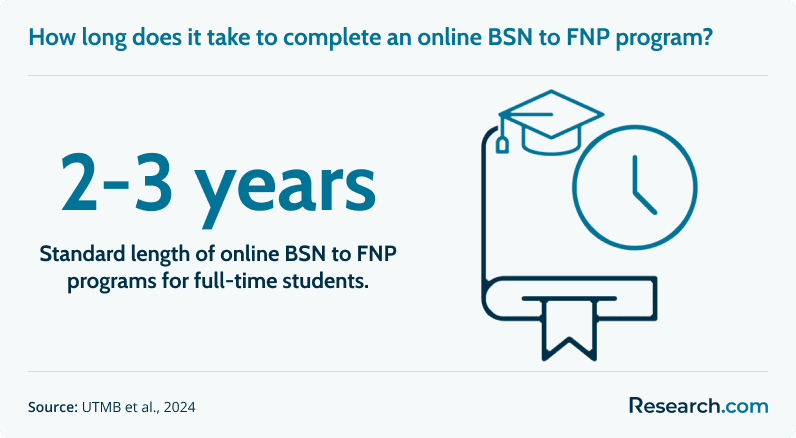
- Most online BSN to FNP programs take about 2 to 3 years to complete.
- The average cost of an online BSN to FNP program ranges from $20,000 to $50,000.
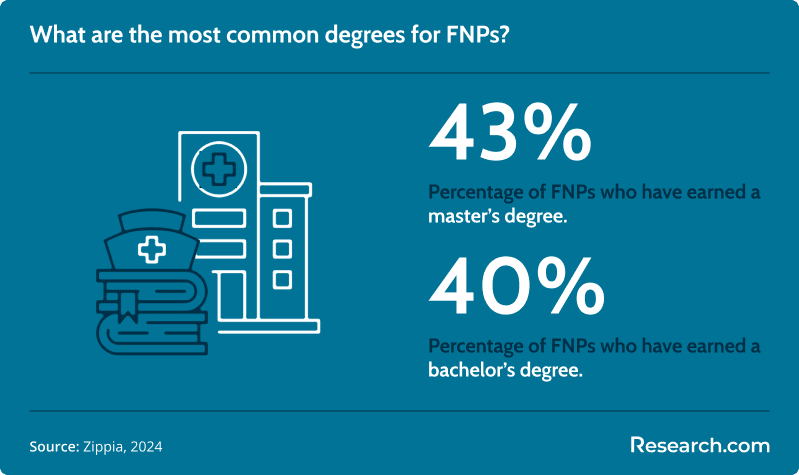
- Around 43% of Family Nurse Practitioners (FNPs) hold a master’s degree.
- FNP is the most common certification area for nurse practitioners, with 70.9% holding this certification.
- The job outlook for nurse practitioners, including FNPs, is expected to grow by 45% from 2022 to 2032.
How long does it take to complete an online BSN to FNP program?
Most BSN to FNP programs take about two to three years, depending on whether you enroll full time or part time, how the curriculum is sequenced, and how quickly you complete clinical requirements. Many programs require 45 to 60 credit hours, including graduate coursework and supervised clinical practice. A full-time student may finish closer to two years, while a working nurse taking a lighter course load may need three years or more.
| Enrollment pace | Typical timeline | Best for |
| Full time | About 2 years | Nurses who can reduce work hours or manage an intensive academic and clinical schedule |
| Part time | About 3 years or more | Working nurses balancing shifts, family obligations, and clinical placement logistics |
| Accelerated options | Varies by program | Highly organized students who can handle heavier course loads and tightly scheduled clinical hours |
How does an online BSN to FNP program compare to an on-campus program?
Online and on-campus BSN to FNP programs can lead to the same advanced practice goal, but the learning experience differs. The biggest trade-off is flexibility versus in-person structure. Online programs are often better for working nurses, while campus programs may appeal to students who prefer face-to-face interaction and a more fixed weekly schedule.
| Factor | Online BSN to FNP program | On-campus BSN to FNP program |
| Schedule flexibility | Often offers asynchronous or hybrid coursework that can fit around work shifts | Usually has fixed class meeting times and campus-based activities |
| Location | Coursework can be completed remotely, though clinicals are in person | Requires commuting or relocation for classes and campus requirements |
| Costs beyond tuition | May reduce commuting, housing, and relocation expenses; students can also compare affordable online FNP programs | May involve transportation, parking, housing, and more frequent campus fees |
| Accountability | Requires strong self-direction, planning, and comfort with technology | Provides more in-person routines and immediate peer/faculty interaction |
| Clinical training | Completed at approved local or regional healthcare sites when available | May use school-affiliated clinical networks near campus |
| Accreditation expectations | Should meet the same accreditation and professional standards as campus formats | Should meet the same accreditation and professional standards as online formats |
What is the average cost of an online BSN to FNP program?
The average cost of online BSN to FNP programs ranges from $20,000 to $50,000, although total price depends on tuition rates, credit requirements, institution type, residency status, fees, books, travel for intensives, certification preparation, and clinical-related expenses. Some of the cheapest online nursing master's programs may cost less than that range, while private universities or programs with higher per-credit tuition may exceed it.
When comparing costs, do not look only at tuition. A lower per-credit rate can still be expensive if the program requires more credits, and a higher tuition program may offer stronger clinical placement support or faster completion. The chart below shows average graduate tuition in degree-granting institutions, as reported by the NCES.
What are the financial aid options for students enrolling in an online BSN to FNP program?
Online BSN to FNP students may use several funding sources, but eligibility depends on the institution, enrollment status, citizenship or residency status, employer policy, military status, and program accreditation. Start by asking each school’s financial aid office whether the program qualifies for federal aid and what institutional scholarships are available to online graduate nursing students.
- Federal Student Loans: Many graduate students begin with the Free Application for Federal Student Aid (FAFSA) to determine federal loan eligibility.
- Scholarships: Nursing associations and organizations such as the American Association of Nurse Practitioners (AANP) and the National Health Service Corps (NHSC) may offer scholarship opportunities for eligible students.
- Grants: Some students may qualify for need-based or institutional grant aid, depending on the program and student profile.
- Employer Tuition Reimbursement: Hospitals, health systems, and clinics may help cover part of tuition for nurses pursuing graduate credentials, often with service commitments or grade requirements.
- Private Student Loans: Private loans can help fill funding gaps, but they may involve credit checks, variable rates, and fewer repayment protections than federal loans.
- Military Benefits: Eligible veterans, service members, and military-connected students may be able to use GI Bill benefits or school-specific military discounts.
- Work-Study Programs: Some schools offer work-study or student employment options, although availability may be limited for online graduate nursing students.
- State-Specific Aid: States may offer grants, scholarships, or loan repayment programs for nurses, and the Nurse Corps Loan Repayment Program provides financial assistance to nurses working in underserved areas.
What are the prerequisites for enrolling in an online BSN to FNP program?
Most online BSN to FNP programs are designed for licensed registered nurses who already hold a BSN. Admission requirements vary, but applicants commonly need evidence of academic readiness, clinical experience, professional licensure, and a clear reason for pursuing advanced practice.
- Bachelor of Science in Nursing (BSN): Applicants usually need a BSN from an accredited institution. Nurses who completed one of the cheapest RN to BSN online pathways should confirm that the degree meets graduate admission requirements.
- Active RN License: Programs generally require an active, unencumbered RN license. Applicants who are not yet RNs may need another route first, such as a medical assistant to RN bridge program if they are transitioning from medical assisting.
- Clinical Experience: Many programs prefer or require one to two years of RN clinical experience because FNP coursework assumes familiarity with patient care, documentation, and healthcare team communication.
- GPA Requirements: A minimum GPA is often required, commonly around 3.0, although schools may consider the full application.
- Letters of Recommendation: Applicants may need two to three references from supervisors, faculty, or clinical colleagues who can speak to readiness for graduate nursing study.
- Personal Statement or Essay: A written statement usually explains career goals, interest in family practice, and preparation for advanced clinical responsibility.
- GRE or MAT Scores: Some programs may request standardized test scores, though many have removed or waived this requirement.
What courses are typically in an online BSN to FNP program?
Online BSN to FNP curricula vary by school, but most include the advanced practice “three Ps” of pathophysiology, pharmacology, and physical assessment, along with family primary care courses and clinical seminars. The coursework is designed to help students move from RN-level care coordination into advanced diagnostic and treatment planning.
- Advanced Pathophysiology: Students examine disease processes and how physiologic changes influence symptoms, diagnosis, and treatment decisions.
- Pharmacology for Advanced Practice Nurses: This course focuses on medication selection, patient safety, therapeutic effects, contraindications, and prescribing considerations. It is not the same as a traditional or online doctor of pharmacy program, which covers pharmacy practice and drug expertise in greater depth.
- Advanced Health Assessment: Students learn to perform comprehensive exams, interpret findings, and document clinical assessments.
- Primary Care of Families: This course addresses acute and chronic care across the lifespan and helps students build individualized treatment plans. Related clinical content may also appear in some of the best acute care NP programs, though acute care and family practice have different scopes.
- Pediatric and Adult-Gerontology Care: These courses cover age-specific assessment, prevention, diagnosis, and management for children, adults, and older adults.
- Evidence-Based Practice: Students learn to apply research findings and clinical data to improve patient care decisions.
- Healthcare Policy and Ethics: This content addresses regulatory issues, professional responsibilities, scope of practice, and ethical decision-making in advanced nursing roles.
What types of specializations are available in online BSN to FNP programs?
Because FNP education already covers care across the lifespan, many programs offer focus areas or electives rather than a separate formal specialization. These options can help students tailor clinical experience toward specific populations or practice settings.
- Pediatrics: Focuses on growth, development, preventive care, pediatric illness, and communication with children and families.
- Women’s Health: Covers reproductive health, pregnancy-related care, gynecologic concerns, menopause, and preventive services.
- Gerontology: Emphasizes chronic disease management, healthy aging, polypharmacy concerns, care coordination, and end-of-life issues for older adults.
- Mental Health: Introduces assessment and management of common behavioral health concerns in primary care. Students interested in deeper counseling preparation may also compare the most affordable online masters in mental health counseling.
- Rural Health: Prepares students to consider access barriers, broad primary care needs, and resource limitations in underserved communities.
The chart below shows the distribution of NP specializations, according to data published by AANP in 2024.
How to choose the best online BSN to FNP program?
The best online BSN to FNP program is the one that meets professional standards, fits your state requirements, supports clinical placement, aligns with your schedule, and makes financial sense. Rankings can help you build a shortlist, but your final decision should be based on licensure fit, accreditation, total cost, and the quality of clinical training.
| Question to ask | Why it matters | What to look for |
| Is the program accredited? | Accreditation can affect certification eligibility, employer acceptance, and licensure pathways | Recognized accreditation such as CCNE or ACEN |
| Does the program meet my state’s requirements? | Online programs may not be authorized or sufficient for every state | Written confirmation from the school and your state board of nursing |
| Who finds clinical placements? | Clinical placement delays can extend your graduation timeline | Clear placement support, preceptor approval process, and local site guidance |
| What is the full cost? | Fees, travel, books, and clinical expenses can change the real price | Total program cost estimate, financial aid availability, and payment options |
| How flexible is the schedule? | Working nurses need to know live class times, deadlines, and clinical expectations | Part-time options, asynchronous coursework, predictable intensives, and leave policies |
| What support do online students receive? | Advising, technology help, library access, tutoring, and career services affect completion | Dedicated online student services and faculty availability |
- Accreditation: Confirm accreditation through an accepted body such as the Commission on Collegiate Nursing Education (CCNE).
- Flexibility: Compare synchronous class requirements, part-time pacing, campus visits, and how clinical schedules are handled.
- Clinical Placement Support: Ask whether the school secures placements, helps locate preceptors, or leaves the search primarily to students.
- Faculty Expertise: Review whether faculty have advanced practice, primary care, telehealth, research, or specialty experience relevant to your goals.
- Cost and Financial Aid: Compare the full cost of attendance and available aid. The same value-based thinking applies across healthcare education, whether you are comparing FNP programs or researching the cheapest online pharmacy school.
- Student Support Services: Look for advising, certification exam support, writing help, technology support, and career services for online students.
- Reputation and Outcomes: Ask for graduation rates, certification pass rates, clinical placement information, and job support data when available.
Why Accreditation Matters in Online BSN to FNP Programs
Accreditation should be one of your first screening criteria. It signals that a nursing program has undergone review for curriculum quality, faculty qualifications, student support, clinical learning, and academic standards. For FNP students, accreditation can also influence whether graduates are eligible for national certification, state licensure, and employer consideration.
Programs accredited by recognized bodies such as the Commission on Collegiate Nursing Education (CCNE) or the Accreditation Commission for Education in Nursing (ACEN) are generally designed to meet professional nursing education standards. Before applying, verify accreditation directly with the accreditor and ask the school whether its online FNP pathway meets requirements in your state.
Accreditation does not guarantee a specific job, salary, or certification result. It does, however, reduce the risk of enrolling in a program that may not be recognized by boards of nursing, certification organizations, or healthcare employers. Students comparing nursing pathways can also review LPN to BSN online programs to see how accreditation and academic standards matter at earlier stages of nursing education.
How can you accelerate your online BSN to FNP degree?
You may be able to shorten your BSN to FNP timeline, but speed should not come at the expense of clinical readiness, accreditation, or licensure fit. Accelerated options work best for nurses with strong time management, predictable work schedules, and access to approved clinical sites.
Options that may shorten the timeline
- Full-Time Enrollment: Taking a heavier course load can reduce time to graduation if you can manage coursework and clinical expectations.
- Summer Sessions: Enrolling year-round may help you complete required credits sooner.
- Transfer Credits: Some programs accept eligible graduate credits, although policies vary and clinical requirements are usually closely controlled.
- Concurrent Clinical Hours: Programs that align clinical hours with coursework can create a more efficient path, but placement timing must be realistic.
- Asynchronous Classes: Flexible coursework may help disciplined students move through weekly assignments while working.
- Modular Courses: Block-style formats can allow students to focus on fewer subjects at once.
Acceleration strategies to evaluate carefully
- Prior Learning Assessments: Some schools may review prior learning through exams, portfolios, or transcript evaluation, but advanced practice clinical competency usually cannot be assumed.
- Higher Course Loads: A faster schedule can increase stress and reduce study time for certification preparation.
- Technology-Based Learning: Online platforms, simulations, flashcards, videos, and virtual study groups can improve efficiency when used consistently.
- Program Structure: Nurses specifically looking for faster options can compare the shortest online nurse practitioner program, while still checking accreditation and licensure alignment.
What career paths are available for graduates of online BSN to FNP programs?
Most BSN to FNP graduates pursue family nurse practitioner roles, but the degree can also support work with specific populations, underserved communities, education, and leadership depending on experience, certification, and employer needs.
- Family Nurse Practitioner: Provides primary care for patients across the lifespan in clinics, physician offices, hospitals, community settings, or private practices.
- Pediatric Nurse Practitioner: Focuses on infants, children, and adolescents in pediatric clinics, hospitals, school settings, or specialty practices.
- Women’s Health Nurse Practitioner: Works in women’s health clinics, OB-GYN practices, and related settings with a focus on reproductive and gynecologic care.
- Geriatric Nurse Practitioner: Cares for older adults in long-term care, geriatric clinics, nursing homes, or community-based programs.
- Rural Health Practitioner: Serves communities where access to healthcare providers is limited and broad primary care skills are especially valuable.
- Nurse Educator: Uses advanced clinical knowledge to teach students or train practicing nurses. Nurses interested in formal teaching preparation may also compare affordable online master's programs for teachers.
What financial considerations should I take into account when choosing an online BSN to FNP program?
Compare total cost, not just tuition. Include per-credit tuition, required credits, fees, books, technology costs, background checks, immunizations, clinical onboarding expenses, travel for campus intensives, certification exam fees, and the possibility of reducing work hours during clinical terms. Students focused on price can start with the cheapest online FNP programs, then evaluate whether each lower-cost option provides accreditation, state authorization, and clinical support.
Is specializing in geriatric care a strategic advantage for FNP graduates?
Geriatric care can be a valuable focus for FNP students who want to work with older adults, chronic disease management, long-term care, home health, or community health programs. Training in geriatric assessment, medication review, interdisciplinary care, and functional status evaluation can strengthen an FNP’s ability to serve aging patients. Students considering this direction may also explore broader gerontology careers.
How do BSN to FNP programs compare to MSN direct entry options?
Online BSN to FNP programs are for licensed RNs who already have a BSN and want advanced family practice preparation. MSN direct entry options are built for students without a nursing background and combine foundational nursing education with graduate study. If you are already an RN with a BSN, a BSN to FNP pathway is usually the more direct match. If you do not hold an RN license, MSN direct entry programs online may be worth reviewing.
Is an online BSN to FNP program the right pathway compared to RN to MSN bridge programs?
An online BSN to FNP program is generally intended for nurses who already completed a BSN and want to specialize in family practice. RN to MSN bridge programs nurse practitioner online may be more appropriate for RNs who do not yet hold a BSN and want a bridge into graduate nursing study. The better choice depends on your current degree, licensure status, desired specialty, and how each program structures undergraduate and graduate requirements.
How do online BSN to FNP programs differ from fast track RN to BSN programs?
Online BSN to FNP programs are graduate-level advanced practice programs that prepare nurses for diagnosis, treatment planning, prescribing responsibilities where allowed, and family primary care. Fast track RN to BSN programs are bachelor’s completion programs for registered nurses who need the BSN credential before graduate study. In short, RN to BSN programs help nurses reach the bachelor’s level, while BSN to FNP programs prepare qualified BSN-prepared RNs for advanced practice.
What is the job market for graduates with an online BSN to FNP degree?
The job market for nurse practitioners, including family nurse practitioners, remains strong. Demand is influenced by preventive care needs, provider shortages, chronic disease management, and healthcare access challenges in both urban and rural communities.
The BLS reports a projected 45% job growth for nurse practitioners from 2022 to 2032, which is much faster than the average for all occupations. This does not guarantee employment for every graduate, but it does indicate broad labor market demand for advanced practice nursing roles.
FNP graduates may find opportunities in physician offices, hospitals, outpatient centers, community clinics, home health, and telehealth settings. Employment outcomes still depend on certification, state licensure, clinical experience, local demand, and professional networking.
What are the graduation and certification success rates for online BSN to FNP programs?
Graduation rates, certification pass rates, and clinical placement completion data can reveal whether a program effectively supports students through a demanding advanced practice curriculum. Reputable programs may publish student outcomes, certification preparation resources, and clinical support processes. Ask admissions representatives for recent outcome data and compare the level of transparency with other nursing pathways, including the best online ABSN programs.
How can an MBA/MSN dual degree enhance my career prospects?
An MBA/MSN dual degree may appeal to nurses who want to combine clinical expertise with healthcare leadership, operations, finance, strategy, or administration. MBA MSN dual degree programs online can be useful for nurses who see themselves moving into executive, management, consulting, or healthcare systems roles rather than focusing only on direct primary care practice.
How do online BSN to FNP programs ensure patient safety and ethical care?
Online BSN to FNP programs typically address patient safety and ethics through coursework, case analysis, simulation, clinical supervision, and policy content. Students examine confidentiality, informed consent, scope of practice, documentation, infection control, emergency response, interprofessional communication, and legal responsibilities. Applicants comparing nursing entry routes may also read about the easiest state to get into nursing school, but FNP students should prioritize advanced practice standards over admissions convenience.
How do online BSN to FNP programs integrate mental health and technology training?
Many FNP programs include behavioral health assessment, screening, crisis recognition, referral coordination, and telehealth-related skills because primary care increasingly involves mental health concerns and digital care delivery. Students may work through virtual simulations, telehealth scenarios, and case studies involving psychiatric symptoms, chronic disease, family dynamics, and access barriers. Nurses who want deeper psychiatric specialization can compare cheap psych NP programs.
How do online BSN to FNP programs address state-specific licensure and regulatory requirements?
State rules matter. Online BSN to FNP students should confirm whether a program is authorized to enroll students in their state and whether its curriculum and clinical hours satisfy state board of nursing requirements. Programs may provide guidance on scope of practice, certification exams, prescriptive authority, and compliance obligations, but students are responsible for verifying requirements with their state board. Nurses considering doctoral pathways can also review cheap online DNP programs as part of long-term planning.
How do online BSN to FNP programs prepare you for evolving healthcare challenges?
Current FNP education increasingly emphasizes telehealth, simulation, evidence-based practice, population health, care coordination, health equity, and adaptation to changing clinical protocols. Programs may use virtual patient encounters, interdisciplinary projects, and digital learning tools to help students develop flexible clinical judgment. Nurses considering a broader terminal degree route may compare cheap online BSN to DNP programs.
What factors determine the ROI of an online BSN to FNP program?
Return on investment depends on total program cost, time to completion, lost income if you reduce work hours, certification success, local job availability, salary growth, employer tuition support, and whether the program helps you secure clinical hours on time. Do not assume that a higher-cost program automatically produces better outcomes or that a lower-cost program is the best value. For comparison, students evaluating accelerated nursing education can also review the top 6-month RN to BSN program online.
How do online BSN to FNP programs promote diversity, equity, and inclusion?
FNP programs may address diversity, equity, and inclusion through cultural humility training, case studies involving health disparities, community-based clinical experiences, implicit bias discussions, and curriculum content on social determinants of health. These topics matter because family nurse practitioners often serve patients across age groups, cultures, languages, income levels, and access barriers. Students interested in a population-specific advanced practice pathway can also compare the cheapest WHNP program.
How do online BSN to FNP programs compare with other advanced nursing specialties?
FNP programs are broad primary care pathways covering patients across the lifespan. Other advanced practice specialties are more focused. For example, psychiatric-mental health NP programs concentrate on mental health diagnosis and treatment, while women’s health, acute care, pediatric, and adult-gerontology tracks focus on specific settings or populations. If your strongest interest is psychiatric care, compare FNP curricula with the fastest online MSN-PMHNP program before committing.
Can my clinical experience offset additional clinical hours in online BSN to FNP programs?
Prior RN experience can strengthen your application and clinical confidence, but it may not reduce required advanced practice clinical hours. Some schools may review previous coursework or experience for transfer or advanced standing, but programs must still ensure students meet clinical competency standards and regulatory expectations. Nurses looking for less clinically intensive bachelor’s completion options can compare RN to BSN programs no clinicals, but FNP programs generally require supervised advanced practice clinical training.
What skills are essential for success in an online BSN to FNP program?
Success in an online BSN to FNP program requires more than strong nursing experience. Students must manage graduate coursework, clinical requirements, technology, patient care responsibilities, and certification preparation at the same time.
- Time Management: You need a realistic weekly schedule for readings, assignments, exams, clinical hours, work shifts, and family obligations.
- Self-Motivation: Online students must keep up with deadlines without relying on daily in-person reminders.
- Critical Thinking and Problem-Solving: FNP students must analyze symptoms, histories, risk factors, diagnostic data, and treatment options.
- Communication Skills: Clear communication is essential for patient education, clinical documentation, preceptor feedback, team collaboration, and online discussions.
- Clinical Competence: Students must translate classroom knowledge into safe, supervised patient care during clinical rotations.
- Adaptability and Tech-Savviness: Online learning platforms, telehealth tools, electronic records, and digital simulations require comfort with technology.
- Leadership and Management: FNPs often coordinate care, guide patients, collaborate with interdisciplinary teams, and manage competing clinical priorities.
- Empathy and Emotional Intelligence: Advanced practice nurses must understand patient concerns, family dynamics, and emotional needs. Nurses still exploring the profession can read about how to be a nurse before planning an advanced route.
What Post-Graduation Career Support Do Online BSN to FNP Programs Offer?
Career support can vary widely. Strong programs may offer resume feedback, interview preparation, certification exam guidance, job search resources, alumni networking, employer connections, and mentorship from practicing nurse practitioners. Students considering accelerated options such as 12 month nurse practitioner programs should pay close attention to whether career and certification support are compressed or still robust.
What challenges might I face in an online BSN to FNP program?
Common challenges include balancing work with graduate study, locating clinical placements, adapting to online learning platforms, managing live class times across time zones, meeting documentation requirements, and preparing for certification while completing clinical hours. Students looking at fast graduate options should also review the structure of the shortest MSN to DNP program to understand how intensive advanced nursing pathways can become.
| Common mistake | Why it can cause problems | Better approach |
| Choosing a program before checking accreditation | It may affect certification, licensure, and employer acceptance | Verify accreditation directly with CCNE, ACEN, or the listed accreditor |
| Assuming “online” means no in-person requirements | FNP clinical hours must be completed in approved healthcare settings | Ask about clinical hours, intensives, travel, and preceptor expectations before applying |
| Comparing only tuition | Fees, travel, books, and lost work time can change total cost | Request a full cost-of-attendance estimate |
| Ignoring state authorization | The program may not meet requirements where you plan to practice | Confirm state eligibility with both the school and your board of nursing |
| Assuming salary outcomes are guaranteed | Pay varies by employer, state, experience, and setting | Research local FNP jobs and salary ranges before borrowing heavily |
How are clinical competencies assessed in online BSN to FNP programs?
Online BSN to FNP programs assess clinical competence through a mix of simulation, faculty evaluation, objective structured clinical examinations (OSCEs), written case analyses, preceptor feedback, direct clinical performance reviews, and documentation of required patient care experiences. These assessments are intended to verify that students can apply diagnostic reasoning, communicate effectively, practice safely, and manage patient care under supervision. Similar competency-focused approaches may appear in accelerated NP programs online, although the exact format varies by school.
Key Insights
- An online BSN to FNP program is best for licensed RNs with a BSN who want to move into family primary care while maintaining more schedule flexibility than a traditional campus program.
- Clinical training is still in person. Before enrolling, ask exactly who finds clinical sites, how preceptors are approved, and what happens if a placement falls through.
- Accreditation and state authorization are non-negotiable. Verify both before paying application fees or accepting admission.
- Most programs take about 2 to 3 years, but full-time, part-time, and accelerated formats create very different workload expectations.
- Total cost can range from $20,000 to $50,000 on average, but the real price also includes fees, books, travel, clinical onboarding, certification costs, and possible lost income.
- The FNP job outlook is strong, with BLS projecting 45% growth for nurse practitioners from 2022 to 2032, but individual outcomes depend on certification, licensure, local demand, experience, and employer needs.
- The strongest program choice is not always the cheapest or highest-ranked option. The best fit is accredited, affordable for your situation, authorized in your state, realistic for your schedule, and strong in clinical support.
References:
- American Association of Nurse Practitioners (AANP). (2024). NP Fact Sheet. AANP.
- Bureau of Labor Statistics (BLS). (2024a). 29-1171 Nurse Practitioners. Occupational Employment and Wage Statistics. BLS.
- Bureau of Labor Statistics (BLS). (2024b). Nurse Anesthetists, Nurse Midwives, and Nurse Practitioners. Occupational Outlook Handbook. BLS.
- National Center for Education Statistics. (2023). Average and percentiles of graduate tuition and required fees in degree-granting postsecondary institutions, by control of institution: Academic year 1989-90 through 2021-22. Digest of Education Statistics. NCES.
- Zippia. (2024a). Family Nurse Practitioner Demographics and Statistics in the US. Zippia.
- Zippia. (2024b). Family Nurse Practitioner Salary. Zippia.
Other Things You Need to Know About Online BSN to FNP Programs
In 2027, most online BSN to FNP programs require students to complete approximately 500-700 clinical hours. These hours are often completed in healthcare settings local to the student, ensuring hands-on experience alongside the online coursework to fulfill program requirements.
Admission requirements for 2027 online BSN to FNP programs typically include a BSN degree from an accredited institution, a current RN license, a minimum GPA of 3.0, and completion of prerequisite courses in advanced health assessment, pathophysiology, and pharmacology. Specific schools may have additional criteria.
Yes. A reputable online BSN to FNP program should hold accreditation from the Commission on Collegiate Nursing Education (CCNE) or the Accreditation Commission for Education in Nursing (ACEN). Accreditation affects federal aid eligibility, employer recognition, and whether graduates can pursue state licensure and certification.