
2027 Project Management Degree vs. Certification: Which Path Should You Pursue

Co-Founder and Chief Data Scientist
With 426,229 project managers currently employed in the US, the demand for skilled professionals continues to rise across industries (Zippia, 2025). As businesses increasingly rely on structured leadership and strategic execution, students must decide whether to pursue a project management degree or a project management certification to build their credentials and gain a competitive advantage in this evolving field.
In this article, I will help future professionals navigate that choice by comparing both academic and certification paths. I will also share how each option differs in time, skills, and career impact to help aspiring project professionals choose what fits their goals.
Key Things You Should Know About Project Management Degrees and Certifications
- Project management degrees provide a strong academic foundation in leadership, strategy, and project execution, ideal for those pursuing management or executive roles.
- Meanwhile, project management certifications focus on validating specific, job-ready skills through shorter training, perfect for professionals seeking quick advancement or specialization.
- Both options require thoughtful consideration of time, cost, renewal, and career goals to ensure alignment with long-term professional growth.
- What is the main difference between a project management degree and a project management certification? Degree vs. Certification
- How do a project management degree and a project management certification compare in what they teach? How do a project management degree and a project management certification compare in what they teach?
- How long does it take to finish a project management degree versus a project management certification? Program Length
- Can I complete a project management degree or a project management certification faster online? Can I complete a project management degree or a project management certification faster online?
- Can a project management certification count toward a project management degree? Can a project management certification count toward a project management degree?
- What jobs can I get with a project management degree or a project management certification? Job Options
- How does salary differ between professionals with a project management degree and those with a project management certification? Salary Difference
- Is the financial investment in project management education justified? Is the financial investment in project management education justified?
- What are the requirements to get a project management degree or a project management certification? Common Requirements
- Which industries can I enter with a project management degree or a project management certification? Work Industries
- How do I choose between a project management degree and a project management certification? How do I choose between a project management degree and a project management certification?
Project Management Degree vs Certification: What Is the Real Difference?
If you want to move into project management, you will quickly face a practical decision: should you earn a full project management degree, pursue a professional certification, or eventually do both? The right answer depends on your current education, work experience, budget, timeline, and the type of project leadership role you want.
Project management matters because organizations need people who can turn strategy into finished work: launching products, implementing technology, managing construction schedules, improving operations, and coordinating teams across departments. According to the World Economic Forum’s Future of Jobs Report 2025, project managers are among the top 15 fastest-growing professions globally and are central to business transformation.
This guide explains how a project management degree and a project management certification differ, what each option teaches, how long each takes, what jobs they can support, how salaries compare, and how to choose the path that fits your career goals.
Quick answer: degree or certification?
A project management degree is broader, more academic, and better suited for people who want a long-term foundation in business, leadership, strategy, and organizational management. A project management certification is narrower, faster, and designed to prove that you can apply recognized project management methods such as PMP®, CAPM®, PRINCE2®, Agile, or related frameworks.
| Option | Best for | Main value | Typical time commitment |
| Project management degree | Students, career changers, and professionals targeting broader leadership roles | Builds business, strategy, communication, analytics, and management depth | Bachelor’s degree: 3 to 4 years; master’s degree: 1 to 2 years |
| Project management certification | Working professionals who need a recognized credential tied to applied methods | Validates practical project management knowledge and exam-based competence | Professional certifications generally take 3 to 6 months, plus 100 to 200 study hours |
| Both degree and certification | Professionals who want stronger mobility, specialization, and leadership credibility | Combines academic depth with industry-recognized proof of applied skill | Usually completed in stages as career needs evolve |
A useful comparison is the difference between a construction management certificate vs degree: a certificate is usually faster and skill-specific, while a degree offers broader preparation for long-term leadership. Project management follows a similar pattern.
What Do Project Management Degrees and Certifications Teach?
A project management degree and a certification both help professionals plan work, coordinate people, manage risk, communicate with stakeholders, and deliver results. The difference is depth. Degrees teach project management inside a wider business and leadership context, while certifications concentrate on defined frameworks, terminology, tools, and exam-ready application.
This distinction matters because project leaders need more than scheduling knowledge. PMI reported that only 18% of project professionals demonstrate high business acumen, while 66% show a moderate level (PMI, 2025). That gap helps explain why many professionals benefit from combining formal education with targeted credentials.
| Learning area | Project management degree | Project management certification |
| Business foundation | Covers topics such as budgeting, analytics, organizational behavior, communication, strategy, and leadership | Focuses mainly on project delivery concepts, terminology, process groups, Agile practices, or methodology-specific standards |
| Skill development | Builds analytical thinking, cross-functional leadership, research ability, and long-term decision-making | Strengthens applied skills such as risk tracking, stakeholder mapping, scheduling, scope control, and exam-based methodology use |
| Learning format | Uses coursework, research assignments, case analysis, group projects, presentations, and sometimes internships | Uses focused training, practice exams, simulations, workshops, and structured exam preparation |
| Outcome | Prepares graduates for broader management, operations, program, and strategic roles | Signals competence in recognized project management practices and can support faster advancement in applied roles |
| Typical learner | Students, early-career professionals, career changers, and workers seeking a formal academic credential | Professionals with experience who want to validate skills, qualify for roles, or specialize in a framework |
The chart below from PMI shows business acumen proficiency among project management professionals.
How Long Does a Project Management Degree Take Compared With a Certification?
The timeline is one of the clearest differences. A degree takes longer because it includes general education, business coursework, leadership development, and often capstone or applied projects. A certification is shorter because it is built around a defined body of knowledge and an exam or assessment.
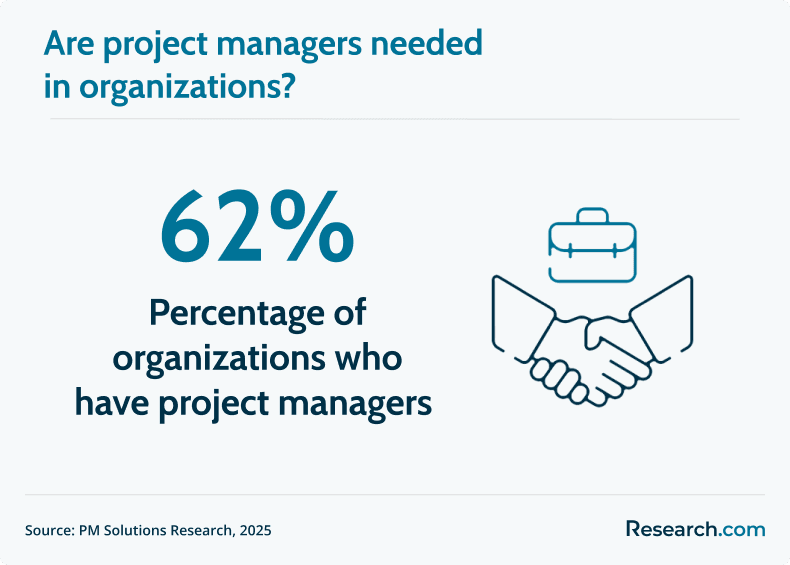
This matters for career planning. With 62% of organizations employing project managers (PM Solutions Research, 2025), some learners want the fastest route to workplace credibility, while others want a credential that supports broader advancement over time.
Project management degree timeline
- Bachelor’s degree: Usually takes 3 to 4 years of full-time study and combines management theory, business fundamentals, applied projects, and sometimes internship experience.
- Master’s degree: Commonly takes 1 to 2 years and is designed for advanced study in project strategy, leadership, research, and organizational decision-making. Many working professionals choose a masters in project management online to keep working while earning the degree.
- Accelerated or part-time formats: Some universities offer condensed calendars, evening courses, asynchronous classes, or part-time enrollment for learners balancing school with work and family responsibilities.
Project management certification timeline
- Professional certifications such as PMP®, CAPM®, and PRINCE2®: These are generally completed in 3 to 6 months, depending on the candidate’s background, exam schedule, and study pace.
- Preparation time: Candidates often spend an additional 100 to 200 study hours reviewing terminology, project frameworks, practice questions, and exam materials.
| Path | Typical pace | When it makes sense |
| Bachelor’s in project management | 3 to 4 years full time | You need an undergraduate degree and want a broad foundation for management roles |
| Master’s in project management | 1 to 2 years | You already have a bachelor’s degree and want advanced leadership, strategy, or program-level preparation |
| Certification | 3 to 6 months, often with 100 to 200 study hours | You already have some background and need a faster credential tied to recognized professional standards |
Can Online Study Help You Finish a Project Management Degree or Certification Faster?
Online project management programs can make the path more flexible, but they do not automatically make every credential faster. The biggest advantage is scheduling control. Students can often take asynchronous courses, study while employed, and avoid commuting. Certification candidates can use online exam prep, virtual boot camps, and self-paced modules to prepare more efficiently.
Currently, 68% of project managers hold a bachelor’s degree, while 14% possess a master’s (Zippia, 2025), and over 1.5 million professionals worldwide hold a PMP certification (PMI, n.d.). Those figures show that both academic degrees and professional credentials remain common in the field.
A cheap project management degree online may offer part-time, accelerated, or transfer-friendly options, which can reduce the time and cost required to finish. However, students should verify accreditation, credit transfer rules, faculty experience, project-based learning opportunities, and whether the program includes preparation for industry credentials.
Online certification programs can be even faster because they usually focus on a specific exam. PMP®, CAPM®, and related preparation courses may be completed in weeks or months, but candidates still need to meet eligibility rules and study enough to pass the exam. Convenience should not replace quality. A low-cost or fast option is only useful if it prepares you for the credential or career outcome you actually need.
| Online option | Potential advantages | Risks to check before enrolling |
| Online degree | Flexible scheduling, possible accelerated terms, transfer credit opportunities, and access to schools outside your region | Unclear accreditation, weak career services, limited faculty interaction, or credits that do not transfer elsewhere |
| Online certification prep | Fast exam preparation, lower commuting costs, self-paced study, and access to global training providers | Training that does not match the current exam, insufficient practice materials, or unclear eligibility guidance |
Can a Project Management Certification Count Toward a Degree?
Sometimes. A project management certification may count toward a degree if the university accepts professional credentials as prior learning, transfer credit, or elective credit. Policies vary widely, so students should never assume that a PMP®, PRINCE2®, CAPM®, or other credential will automatically reduce degree requirements.
Some schools review certifications to determine whether they overlap with introductory coursework. Others may award elective credit, waive a foundation course, or offer no credit at all. A few programs build certification preparation into the curriculum, which can help students graduate with both academic knowledge and readiness for a professional credential.
Before enrolling, ask the admissions or registrar’s office for a written evaluation of your certification. The issue is similar to comparing paralegal certificate vs degree options: some learning may transfer, but the decision depends on the school’s policy, documentation requirements, and how closely the credential matches the curriculum.
Questions to ask before expecting credit
- Does the school award credit for professional project management certifications?
- Will the credit apply to required courses, electives, or only general credit?
- Do I need to submit exam results, training-hour records, syllabi, or proof of active certification?
- Is there a maximum number of credits I can earn through prior learning?
- Will certification credit affect financial aid, graduation timelines, or transfer options later?
What Jobs Can You Get With a Project Management Degree or Certification?
A project management degree or certification can support many roles across business, technology, construction, finance, healthcare, manufacturing, and other fields. The best fit depends on your experience level and whether the employer wants broad management education, a specific certification, or both. For many professionals, the strongest project management career path combines work experience, formal education, and at least one respected credential.
Roles often aligned with a project management degree
Degree holders are often prepared for roles that require coordination, planning, leadership, and business judgment. Common options include:
- Project coordinator: Helps maintain schedules, meeting notes, task documentation, and communication between team members and managers.
- Program manager: Oversees a group of related projects and keeps them aligned with larger business goals.
- Portfolio manager: Supports enterprise-level decisions about which projects should be funded, prioritized, paused, or retired.
- Operations manager: Uses project management methods to improve workflows, reduce delays, and coordinate organizational processes.
- Project director: Leads project teams across departments and ensures that major initiatives support organizational strategy.
Roles often aligned with project management certifications
Certification holders often move into roles that emphasize delivery methods, standards, execution, compliance, or Agile practices. Some employers may still require a degree or a specific amount of experience.
- Project manager: Manages schedules, budgets, scope, risks, deliverables, stakeholder expectations, and team communication.
- Agile coach or Scrum Master: Guides Agile ceremonies, team collaboration, iterative delivery, and continuous improvement.
- Project analyst: Tracks project metrics, prepares reports, monitors progress, and helps teams follow frameworks such as PMBOK® or PRINCE2®.
- Risk manager: Identifies possible threats to project success and develops mitigation plans before issues become costly.
- Consultant or trainer: Advises organizations on project management practices, tools, governance, or team capability building.
| If your goal is... | Stronger starting point | Why |
| Entry-level coordination or analyst work | Degree, CAPM®, or both | Employers may value foundational education, communication skills, and evidence of basic project knowledge |
| Mid-career project manager roles | Certification plus experience | Credentials can validate applied knowledge when you already manage work or teams |
| Senior program, portfolio, or operations leadership | Degree plus certification | Higher-level roles often require both strategic judgment and proof of project management competence |
| Agile delivery roles | Certification or specialized training | Employers may look for hands-on knowledge of Agile practices, facilitation, and iterative delivery |
How Do Salaries Compare for Degree Holders and Certification Holders?
Salary depends on experience, industry, location, company size, project complexity, and the credential mix a professional brings. A degree can support long-term advancement into leadership, while a certification may help professionals qualify for specific roles or demonstrate readiness for project delivery responsibilities.
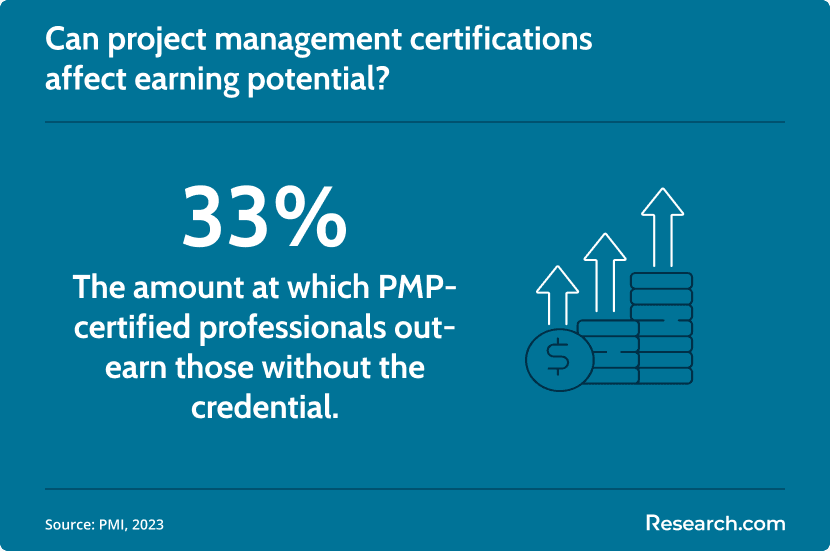
Professionals with a project management degree typically earn $102,682 annually, especially as they progress into leadership or executive roles (ZipRecruiter, 2025). Certified project managers earn 33% more than non-certified peers on average, especially in fields where project standards and formal delivery methods are heavily used, such as IT, construction, and finance.
The strongest salary position often comes from combining credentials with experience. A degree can raise the long-term ceiling by supporting management and strategy roles, while certification can improve credibility for immediate project execution. A similar pattern appears in cybersecurity when professionals ask is CISSP certification worth it: a respected certification may create a faster earnings boost, but pairing it with broader education and experience often strengthens long-term opportunities.
| Credential profile | Salary impact described in available data | Important caution |
| Project management degree | Professionals with a project management degree typically earn $102,682 annually (ZipRecruiter, 2025) | A degree does not guarantee a specific salary; role level, experience, and industry matter |
| Project management certification | Certified project managers earn 33% more than non-certified peers on average | The value of a certification is strongest when it matches employer expectations and is backed by relevant experience |
| Degree plus certification | Often supports stronger mobility into specialized and leadership roles | The return depends on cost, timing, employer demand, and whether the credentials align with your target role |
Is a Project Management Degree or Certification Worth the Cost?
The financial value depends on what you need the credential to do. A degree usually costs more and takes longer, but it can provide broader preparation for leadership, operations, business strategy, and graduate-level advancement. A certification is usually faster and more focused, which may make it a better short-term investment for professionals who already have experience and need a recognized credential to qualify for project manager roles.
Do not judge affordability by tuition or exam fees alone. Consider books, technology fees, exam prep, retake fees, commuting, lost work time, and how long it may take to see career benefits. Also compare the credential against realistic job postings in your target industry. If most roles you want require a bachelor’s degree, a certification alone may not be enough. If you already have a degree and employers ask for PMP® or Agile experience, a certification may produce a faster return.
Professionals comparing graduate business options can also review broader affordability benchmarks, such as the cheapest MBA program online, to understand how project management education fits within the larger market for business and management credentials.
Cost and ROI questions to ask
- What credential do employers in my target role actually request?
- Will the program or certification help me qualify for roles I cannot access now?
- How much time will I need before I can finish and apply the credential?
- Does my employer offer tuition assistance, reimbursement, training funds, or paid study time?
- Will credits transfer if I later pursue a higher degree?
- Does the school or training provider publish outcomes, exam pass support, or career services information?
What Are the Admission and Eligibility Requirements?
Degree programs and certifications evaluate applicants differently. Colleges look at academic readiness and admissions materials. Certification bodies focus on project experience, training hours, and passing an exam. The better path depends on where you are now: still building your educational foundation, already managing projects, or trying to document experience you have gained informally.
Project management degree requirements
- Bachelor’s degree: Applicants usually need a high school diploma or equivalent. Programs may also request entrance exam scores, language proficiency documentation for non-native speakers, personal statements, or portfolios.
- Master’s degree: Applicants generally need a relevant undergraduate degree, professional experience, letters of recommendation, and a statement of purpose that explains their career goals.
Project management certification requirements
- PMP® certification: Requires 36 to 60 months of project management experience within the last eight years, depending on academic background, plus 35 hours of formal project management training.
- CAPM® certification: Does not require prior project management experience, making it an option for students or early-career professionals, but applicants must complete 23 hours of project management education.
- Other certifications such as PRINCE2® and PMI-ACP®: Requirements differ by credential and may include project work, approved training, and passing the relevant exam.
This distinction is similar to the difference between license vs. certification for massage therapists: academic programs set admissions requirements, while professional credentials usually verify training, applied experience, and exam-based competence.
| Path | What is usually reviewed | Best fit |
| Bachelor’s degree | Prior schooling, admissions materials, possible test scores, and language proficiency if required | Learners who need an undergraduate credential and broad preparation |
| Master’s degree | Undergraduate degree, work experience, recommendations, and statement of purpose | Professionals seeking advanced management or leadership preparation |
| PMP® | 36 to 60 months of project management experience within the last eight years and 35 hours of formal training | Experienced professionals ready to validate applied project leadership |
| CAPM® | 23 hours of project management education | Students and early-career professionals without extensive project experience |
Which Industries Hire Professionals With Project Management Credentials?
Project management is portable because nearly every organization runs projects. A degree or certification can be useful in any setting where teams must manage scope, budgets, deadlines, stakeholders, risk, and change. The most common industries for project managers include Fortune 500 companies (26%) and technology (18%), among others.
- Technology: Project managers coordinate product launches, software implementation, infrastructure upgrades, and cross-functional delivery work in fast-changing environments.
- Finance: Project professionals support compliance initiatives, process improvement, risk management, system upgrades, and regulatory projects.
- Construction and engineering: Professionals with a construction project management degree online may manage schedules, budgets, subcontractors, safety requirements, and stakeholder expectations on complex builds.
- Healthcare: Project managers help implement technology, improve workflows, support patient-care initiatives, and coordinate operational changes.
- Manufacturing: Project leaders work on production improvements, supply chain projects, quality initiatives, cost reduction, and process redesign.
- Energy: Project managers coordinate renewable and traditional energy work, regulatory requirements, infrastructure projects, and sustainability-related initiatives.
- Retail: Project professionals support supply chain upgrades, store operations, customer experience improvements, and technology rollouts.
- Telecommunications: Project managers guide network expansion, infrastructure development, system upgrades, and service delivery improvements.
The chart below from Zippia shows where project managers are most commonly employed by industry.
How Should You Choose Between a Project Management Degree and Certification?
Choose based on your gap. If your biggest barrier is not having a degree, academic study may be the better first step. If your biggest barrier is proving project management competence to employers, a certification may be the faster move. If you want senior leadership, consulting, or cross-industry mobility, combining both may be the strongest long-term strategy.
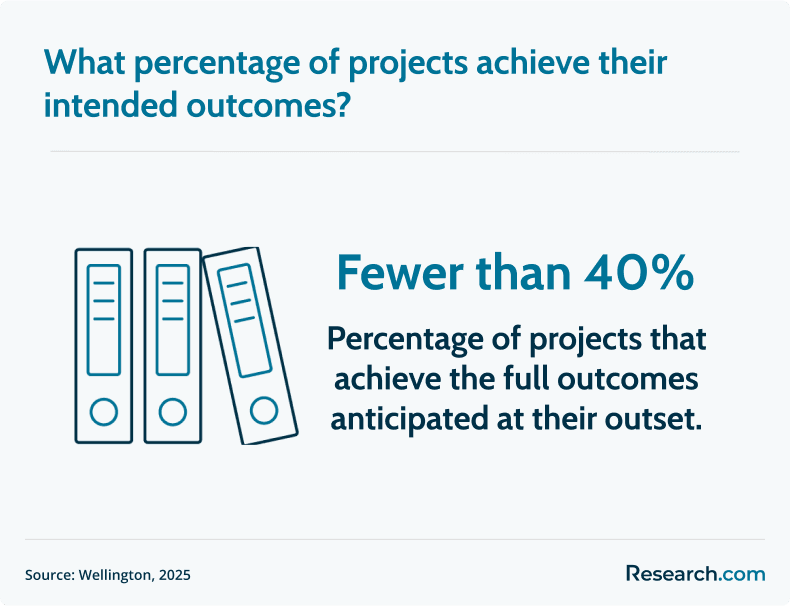
The stakes are real because fewer than 40% of projects achieve their intended outcomes. Employers value people who can plan realistically, communicate clearly, manage risk, adapt to change, and keep teams aligned.
| Your situation | Recommended path | Reason |
| You do not yet have a bachelor’s degree | Start with a degree or a degree program that includes project management coursework | Many employers use a degree as a baseline requirement for management-track roles |
| You already manage projects but lack a formal credential | Consider PMP®, PRINCE2®, CAPM®, or another relevant certification | A certification can validate experience and show knowledge of recognized frameworks |
| You want a senior leadership, program, or portfolio role | Consider a degree plus certification | These roles often require strategic judgment, business fluency, and applied project credibility |
| You need the fastest possible skill signal | Start with certification preparation | Certifications can usually be completed faster than degrees and may support near-term advancement |
| You are changing careers with limited project experience | Consider a degree, CAPM®, internships, or project-based volunteer work | You may need both foundational learning and evidence of practical exposure |
Common mistakes to avoid
- Choosing only by speed: A fast credential is not useful if employers in your target role require a degree or substantial experience.
- Ignoring accreditation: Before enrolling in a degree program, confirm that the institution is properly accredited and that credits can transfer if needed.
- Assuming every certification has the same market value: Research job postings in your industry to see which credentials employers actually mention.
- Looking only at tuition or exam fees: Include books, technology costs, exam prep, retake fees, travel, and lost work time.
- Expecting guaranteed salary results: Credentials can improve competitiveness, but pay still depends on role, location, experience, industry, and performance.
- Skipping hands-on experience: Project management is practice-based. Employers want evidence that you can manage people, risk, deadlines, budgets, and change.
Practical next steps
- Collect five to ten job postings for roles you want and list the degree, certification, and experience requirements they mention.
- Compare your current background against those requirements to identify the biggest gap.
- If the gap is academic, research accredited degree programs and ask about transfer credit, online flexibility, cost, and career support.
- If the gap is credential-based, choose the certification that appears most often in your target industry and confirm eligibility rules before paying for training.
- If possible, seek employer reimbursement, mentorship, stretch assignments, or internal project work while completing the credential.
What Graduates Say About Project Management Degrees and Certifications
- Mara: "My project management degree changed the way I lead complicated work. The mix of theory, case studies, budgeting, scheduling, and team-based assignments helped me manage people and deadlines with much more confidence."
- Safhia: "Earning a project management certification helped me move faster in my career. The focused preparation around Agile practices and PMI standards gave me a clearer structure for handling pressure, expectations, and delivery challenges."
- Luc: "The degree gave me more than technical project tools. It improved how I think strategically, communicate with stakeholders, and lead across cultures. The group work and mentorship were especially valuable for preparing me for larger responsibilities."
Key Insights
- A degree and a certification solve different problems. A project management degree builds broad academic and leadership capability; a certification validates applied knowledge of recognized project management methods.
- Time commitment is a major decision factor. Bachelor’s degrees typically take 3 to 4 years, master’s degrees usually take 1 to 2 years, and professional certifications generally take 3 to 6 months plus 100 to 200 study hours.
- Online options can improve flexibility, not automatically quality. Check accreditation, transfer policies, certification alignment, exam preparation, and student support before choosing an online program.
- Certifications may count toward a degree, but only if the school allows it. Ask for written confirmation before assuming PMP®, PRINCE2®, CAPM®, or similar credentials will reduce your required coursework.
- Career goals should drive the choice. Degrees are useful for broader management and leadership paths; certifications are useful for proving applied project delivery skills; both together can support stronger long-term mobility.
- Salary outcomes are not guaranteed. Available data shows that project management degree holders typically earn $102,682 annually and certified project managers earn 33% more than non-certified peers on average, but actual pay depends on experience, industry, role, and location.
- The best next step is to audit job postings. Look at real requirements for the roles you want, then choose the credential that closes the most important gap in your background.
References:
- PM Solutions Research (2025). The 2025 State of the PMO. Retrieved from https://www.pmsolutions.com/reports/State_of_the_PMO_2025_Research_Report_and_Data.pdf
- PMI (2025). Pulse of the Profession 2025. Retrieved from https://www.pmi.org/-/media/pmi/documents/public/pdf/learning/thought-leadership/pulse/pulse_of_the_profession_2025-1.pdf
- PMI (n.d.). Project Management Professional. Retrieved from https://www.pmi.org/certifications/project-management-pmp
- Wellington (2025). The State of Project Management Report. Retrieved from https://wellingtone.co.uk/publications/state-of-project-management-research/
- Zippia (2025). Project Manager Demographics and Statistics in the US. Retrieved from https://www.zippia.com/project-manager-jobs/demographics/
- ZipRecruiter (2025). Project Manager Salary. Retrieved from https://www.ziprecruiter.com/Salaries/Project-Manager-Salary
Other Things You Should Know About Project Management Degrees and Certifications
Employers in sectors with complex, large-scale projects, such as construction or IT, often prefer candidates with degrees in 2027. These degrees provide comprehensive training in strategic planning and leadership, skills essential for managing extensive projects successfully.
Yes. PMI allows candidates without a four-year degree to qualify with 60 months of project leadership experience and 35 hours of project management education, or the CAPM as a lower-level option. A degree is not required for the PMP exam, but experience is.


