2027 Best Online Entertainment Business Degree Programs

Co-Founder and Chief Data Scientist
The business side of entertainment is often swept under the rug, but in order to thrive in this industry, commercial acumen is just as crucial as talent. From licensing and marketing to finance and talent management, the real engine behind the spotlight is strategic know-how.
The good news? You don’t need to take the traditional on-campus route to learn all the ropes. That’s where online entertainment business degree programs come in. These programs make it possible to study this fast-paced field from anywhere, while gaining insights from industry professionals and real-world case studies.
In this guide, I rounded up the best online entertainment business degrees available. I looked at curriculum depth, industry relevance, and alumni outcomes to spotlight programs that don’t just follow trends but help shape them.
What are the benefits of getting an online entertainment business degree?
- Entertainment business graduates earn an average annual salary of $77,274, making it a lucrative path for creative professionals with strong commercial instincts (ZipRecruiter, n.d.).
- Job opportunities are expanding rapidly, with employment for entertainment managers expected to grow 11% from 2023 to 2033 (BLS, 2025).
- Online entertainment business degree programs offer the flexibility to balance coursework with gigs, productions, or internships in the fast-moving entertainment industry.
What can I expect from an online entertainment business degree?
An online entertainment business degree combines the creativity of the arts with the technicality of commerce. These programs are designed to help students navigate the complex world behind the scenes, from negotiating contracts to developing revenue strategies.
Here’s a look at what you can expect these programs:
- Business Fundamentals: Courses in marketing, finance, and management tailored to the unique demands of entertainment.
- Industry Internships or Capstone Projects: Hands-on experience with real clients, productions, or agencies to build your portfolio and network.
- Flexible Scheduling: Attend live virtual classes or watch recordings around your production schedule, auditions, or travel.
- Remote Collaboration Tools: Work with classmates on marketing plans, pitch decks, or media strategies using platforms common in the entertainment industry.
- Access to Industry Professionals: Join guest lectures and Q&As via livestream with producers, managers, and executives working in film, music, and media.
Where can I work with an online entertainment business degree?
An online entertainment business degree opens doors across multiple sectors. Graduates are equipped to step into roles that shape the industry from behind the scenes, leveraging both strategic thinking and industry insight.
Here are some common workplaces for degree holders:
- Record Labels: Manage artist development, contracts, and promotional campaigns.
- Film and Television Studios: Oversee production budgets, distribution deals, and marketing strategies.
- Talent Agencies: Represent artists, negotiate deals, and build career roadmaps.
- Streaming Platforms: Curate content, analyze audience data, and develop acquisition strategies.
- Live Event Companies: Plan concerts, festivals, and tours from logistics to ticketing.
- Gaming Studios: Handle licensing, partnerships, and in-game monetization strategies.
- Media and Marketing Firms: Build cross-platform campaigns and brand collaborations for entertainment clients.
How much can I make with an online entertainment business degree?
Salaries in the entertainment business field can vary based on experience, location, and industry focus, but there's strong potential for growth. Many graduates start in entry-level roles and move into higher-paying positions as they build their network and expertise.
Here’s a breakdown of what you can expect to earn:
- Top Earners - $122,000 per year: Senior executives, high-level producers, and seasoned managers at major studios or agencies often reach this range.
- 75th Percentile - $97,000 per year: Experienced professionals in mid-to-senior roles, such as marketing directors or production managers, typically earn this amount.
- Average Salary - $77,274 per year: Most degree holders with a few years of experience earn a solid mid-career income across various entertainment sectors.
- 25th Percentile - $53,000 per year: Entry-level roles like coordinator, assistant, or junior analyst usually fall within this starting salary range.
- List of the Best Universities for Online Entertainment Business Degree Programs for 2027 List of Programs
- How long does it take to complete an online entertainment business degree program? Completion Time
- How does an online entertainment business degree program compare to an on-campus program? How does an online entertainment business degree program compare to an on-campus program?
- What is the average cost of an online entertainment business degree program? Average Cost
- What are the financial aid options for students enrolling in an online entertainment business degree program? Financial Aid
- What are the prerequisites for enrolling in an online entertainment business degree program? Prerequisites
- What courses are typically in an online entertainment business degree program? What courses are typically in an online entertainment business degree program?
- What types of specializations are available in online entertainment business degree programs? Specializations
- How to choose the best online entertainment business degree program? How to choose the best online entertainment business degree program?
- What career paths are available for graduates of online entertainment business degree programs? Career Paths
- What is the job outlook for graduates with an online entertainment business degree program? Job Outlook
- Could an Advanced Business Degree Elevate My Career in Entertainment? Could an Advanced Business Degree Elevate My Career in Entertainment?
- Is Accreditation Crucial for My Online Entertainment Business Degree? Is Accreditation Crucial for My Online Entertainment Business Degree?
Best Online Entertainment Business Degree Programs for 2027
An online entertainment business degree is for students who want to work behind the scenes in music, film, television, gaming, live events, sports entertainment, streaming, or digital media. Instead of training you primarily as a performer or producer, these programs focus on the business decisions that make entertainment projects possible: budgeting, marketing, licensing, talent management, event operations, sponsorship, contracts, distribution, and audience strategy.
This guide is designed to help you compare online entertainment business programs by cost, format, accreditation, curriculum, career fit, and return on investment. It also explains how online programs compare with campus programs, what admissions requirements to expect, which specializations are available, and what career paths graduates commonly pursue. If you are also considering adjacent fields, such as competitive gaming and digital fan engagement, Research.com’s guide to the best online esports business programs can help you compare related options.
Quick Answer: What Is the Best Online Entertainment Business Degree?
The best online entertainment business degree is the one that matches your intended sector, budget, schedule, and career goal. Students who want broad entertainment training may prefer a BS in Entertainment Business or Entertainment Management. Students focused on music may prefer a music business degree, while those aiming for concerts, venues, or festivals may benefit from a live entertainment or event management program. Always confirm accreditation, total cost, transfer credit policies, internship options, and career support before enrolling.
| Best fit | Program type to consider | Why it may work |
| First-time college students | Online bachelor’s degree | Provides a full business foundation plus entertainment-focused coursework. |
| Working professionals with a bachelor’s degree | Online master’s degree | Builds advanced management, strategy, leadership, and industry-specific expertise. |
| Career changers or professionals seeking targeted skills | Online certificate | Can be shorter and less expensive than a full degree, especially for focused entertainment business training. |
| Students focused on music, sports, gaming, or live events | Specialized entertainment business program | Aligns coursework with a specific part of the entertainment economy. |
How Research.com Ranked These Programs
Online degree rankings should help students make practical decisions, not just compare brand names. Research.com reviewed available program information using a student-centered lens that considers academic quality, affordability, accessibility, graduation outcomes, and online learning options.
Our evaluation draws on authoritative education data sources, including the Integrated Postsecondary Education Data System, Peterson’s database, the College Scorecard, and the National Center for Education Statistics. We also reviewed program details published by schools and compared factors such as accreditation, cost, credit requirements, degree level, flexibility, and relevance to entertainment business careers.
For a fuller explanation of our ranking process, see Research.com’s ranking methodology.
Top Online Entertainment Business Degree Programs
| Rank | School | Program | Length | Credits | Cost | Accreditation |
| 1 | The Los Angeles Film School | BS in Entertainment Business | 29 months | 120 | $64,300 | Accrediting Commission of Career Schools and Colleges (ACCSC) |
| 2 | University of Central Florida | BS in Entertainment Management | 4 years | 120 | $179.19 (In-State); $715.80 (Out-of-State) | Southern Association of Colleges and Schools Commission on Colleges (SACSCOC) |
| 3 | Full Sail University | BS in Entertainment Business | 2-3 years | 120 | $12,000–$30,000 | Accrediting Commission of Career Schools and Colleges (ACCSC) |
| 4 | Berklee College of Music | BS in Music Business | 4 years | 120 | $62,150 | New England Commission of Higher Education (NECHE) |
| 5 | University of California - Los Angeles Extension | Certificate in Business and Management of Entertainment | 9 months (full-time); 3 years (part-time) | 36 | $6,705 | WASC Senior College and University Commission (WSCUC) |
| 6 | Grand Canyon University | BS in Sports and Entertainment Management | 4 years | 120 | $485 | Higher Learning Commission (HLC) |
| 7 | Johnson & Wales University | BS in Sports, Entertainment, and Event Management | 4 years | 120 | $43,872 | New England Commission of Higher Education (NECHE) |
| 8 | Florida International University | BS in Event and Entertainment Management | 4 years | 120 | $435 (In-State); $648 (Out-of-State) | Southern Association of Colleges and Schools Commission on Colleges (SACSCOC) |
| 9 | University of South Carolina | Master of Sport and Entertainment Management | 1–2 years | 36 | $572.25 | Southern Association of Colleges and Schools Commission on Colleges (SACSCOC) |
| 10 | University of Miami | MA in Live Entertainment Management | 18 months | 30 | $47,592 | Southern Association of Colleges and Schools Commission on Colleges (SACSCOC) |
1. The Los Angeles Film School
The Los Angeles Film School offers an online BS in Entertainment Business for students who want a business-focused entry point into creative industries. The curriculum connects management, administration, and applied entertainment coursework, with an emphasis on how film, music, gaming, and media organizations operate in practice.
- Program Length: 29 months
- Tracks/concentrations: Entertainment Business
- Estimated Cost: $64,300
- Required Credits to Graduate: 120
- Accreditation: Accrediting Commission of Career Schools and Colleges (ACCSC)
2. University of Central Florida
The University of Central Florida offers an online BS in Entertainment Management that combines business coursework with training related to live events, media, and performance operations. The program is a strong option for students who want a public university pathway and a curriculum tied to entertainment management careers. The school reports a 97% placement rate.
- Program Length: 4 years
- Tracks/concentrations: Entertainment Management
- Cost per Credit: $179.19 (In-State); $715.80 (Out-of-State)
- Required Credits to Graduate: 120
- Accreditation: Southern Association of Colleges and Schools Commission on Colleges (SACSCOC)
3. Full Sail University
Full Sail University provides an online BS in Entertainment Business that emphasizes project-based learning and industry scenarios. Students study areas such as marketing, global media management, event planning, sales, and the business structures behind film, music, and sports entertainment.
- Program Length: 2-3 years
- Tracks/concentrations: Entertainment Business
- Estimated Annual Cost: $12,000–$30,000
- Required Credits to Graduate: 120
- Accreditation: Accrediting Commission of Career Schools and Colleges (ACCSC)
4. Berklee College of Music
Berklee College of Music offers an online BS in Music Business for students who want to focus on the commercial side of the music industry. The program covers topics such as streaming, publishing, touring, licensing, artist management, music law, marketing, and entrepreneurship.
- Program Length: 4 years
- Tracks/concentrations: Music Business
- Estimated Total Cost: $62,150
- Required Credits to Graduate: 120
- Accreditation: New England Commission of Higher Education (NECHE)
5. University of California - Los Angeles Extension
University of California - Los Angeles Extension offers an online certificate in Business and Management of Entertainment. This option may suit students or professionals who want targeted training in entertainment operations without committing to a full bachelor’s or graduate degree. Coursework addresses pre-production, production, post-production, business affairs, finance, and marketing.
- Program Length: 9 months (full-time); 3 years (part-time)
- Tracks/concentrations: Business and Management of Entertainment
- Estimated Total Cost: $6,705
- Required Credits to Graduate: 36
- Accreditation: WASC Senior College and University Commission (WSCUC)
6. Grand Canyon University
Grand Canyon University offers an online BS in Sports and Entertainment Management through the Colangelo College of Business. Students study topics such as marketing, talent management, event operations, and revenue generation. The curriculum is also shaped by GCU’s Christian mission and includes an emphasis on ethical leadership.
- Program Length: 4 years
- Tracks/concentrations: Sports and Entertainment Management
- Cost per Credit: $485
- Required Credits to Graduate: 120
- Accreditation: Higher Learning Commission (HLC)
7. Johnson & Wales University
Johnson & Wales University offers an online BS in Sports, Entertainment, and Event Management. The program is built for students interested in event logistics, guest experience, venue operations, sporting events, concerts, and large-scale entertainment experiences.
- Program Length: 4 years
- Tracks/concentrations: Sports, Entertainment, and Event Management
- Estimated Cost: $43,872
- Required Credits to Graduate: 120
- Accreditation: New England Commission of Higher Education (NECHE)
8. Florida International University
Florida International University offers an online BS in Event and Entertainment Management through its Chaplin School of Hospitality & Tourism Management. The program emphasizes business, logistics, operations, hospitality, tourism, and entertainment management, making it a practical choice for students interested in event-driven careers.
- Program Length: 4 years
- Tracks/concentrations: Event and Entertainment Management
- Cost per Credit: $435 (In-State); $648 (Out-of-State)
- Required Credits to Graduate: 120
- Accreditation: Southern Association of Colleges and Schools Commission on Colleges (SACSCOC)
9. University of South Carolina
The University of South Carolina offers an online Master of Sport and Entertainment Management for professionals who want graduate-level training with flexible scheduling. Coursework includes marketing, sponsorship, revenue generation, and global leadership. Students also have access to the SEVT conference, which connects participants with sports and entertainment industry professionals.
- Program Length: 1–2 years
- Tracks/concentrations: Sport and Entertainment Management
- Cost per Credit: $572.25
- Required Credits to Graduate: 36
- Accreditation: Southern Association of Colleges and Schools Commission on Colleges (SACSCOC)
10. University of Miami
The University of Miami offers an online MA in Live Entertainment Management for students interested in commercial music, performing arts, concerts, and live events. The program focuses on marketing, operations, finance, entertainment law, applied projects, and real-world case studies.
- Program Length: 18 months
- Tracks/concentrations: Music Business
- Estimated Total Cost: $47,592
- Required Credits to Graduate: 30
- Accreditation: Southern Association of Colleges and Schools Commission on Colleges (SACSCOC)
How Long Does an Online Entertainment Business Degree Take?
Most online bachelor’s degrees in entertainment business require 120 credits and take 4 years when completed on a traditional full-time schedule. Some programs use accelerated formats, which can shorten the timeline for students who can handle a heavier course load. For example, the Los Angeles Film School lists a 29 months program length, while Full Sail University lists 2-3 years.
Graduate programs are typically shorter because they require fewer credits and assume students already have undergraduate preparation. In this ranking, the University of South Carolina’s master’s program lists 1–2 years, and the University of Miami’s online MA lists 18 months. Certificate programs can be shorter still; UCLA Extension lists 9 months (full-time) or 3 years (part-time).
If speed is a top priority, compare course load, start dates, transfer credit policies, and whether the program runs year-round. Research.com’s guide to the fastest online entertainment business degree programs can help you evaluate accelerated options without overlooking cost or accreditation.
| Credential | Typical student | Examples from this list | Best for |
| Bachelor’s degree | First-time college students or transfer students | 120-credit programs such as UCF, GCU, FIU, Berklee, JWU, Full Sail, and The Los Angeles Film School | Building broad business and entertainment industry foundations. |
| Master’s degree | Professionals with a bachelor’s degree | University of South Carolina and University of Miami | Moving toward leadership, strategy, management, or specialized live entertainment roles. |
| Certificate | Career changers or professionals adding focused skills | UCLA Extension | Studying entertainment business without committing to a full degree program. |
Online vs. On-Campus Entertainment Business Programs
Online and campus entertainment business programs often cover similar academic subjects, but the experience can differ significantly. Online programs are usually better for students who need schedule flexibility, already work in the industry, or cannot relocate. Campus programs may offer easier access to in-person events, studios, faculty, classmates, and local entertainment networks.
| Factor | Online program | On-campus program |
| Flexibility | Often better for students balancing work, internships, gigs, family responsibilities, or travel. | More structured and often tied to fixed class schedules. |
| Networking | May include virtual panels, online guest speakers, remote group projects, and digital career events. | Can make face-to-face networking easier through campus events and local industry connections. |
| Hands-on learning | May use simulations, digital collaboration, case studies, remote projects, and virtual production planning. | May offer access to campus venues, production labs, student-run events, and live productions. |
| Location | Allows students to study without relocating to an entertainment hub. | Can be valuable if the campus is near studios, venues, agencies, labels, or sports organizations. |
| Best fit | Self-directed students who can manage deadlines and communicate well online. | Students who prefer in-person interaction, fixed routines, and campus-based experiences. |
Industry change is another reason to compare formats carefully. Entertainment business increasingly depends on remote collaboration, digital marketing, streaming platforms, rights management, social media, audience data, and online fan communities. At the same time, live events and production work still reward in-person relationship-building and practical operations experience.
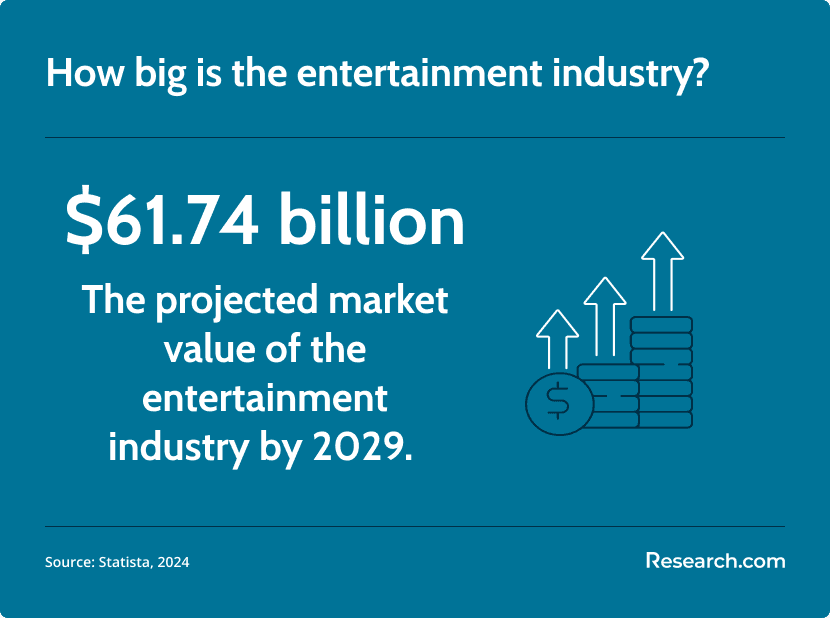
According to Statista, the entertainment industry has a projected annual growth rate of 8.53% and is expected to reach $61.74 billion by 2029. That growth does not guarantee employment for any individual graduate, but it does show why business skills tied to entertainment platforms, events, audiences, and revenue models remain relevant.
How Much Does an Online Entertainment Business Degree Cost?
The cost of an online entertainment business degree varies widely by school, credential level, residency status, credit requirements, and program structure. Some schools publish a total program cost, while others publish a per-credit rate. Students should calculate the full cost before enrolling, including tuition, fees, books, technology requirements, portfolio tools, travel for optional events, and any required subscriptions or software.
Based on the programs listed in this guide, published costs include examples such as $64,300 at The Los Angeles Film School, $62,150 at Berklee College of Music, $43,872 at Johnson & Wales University, $47,592 at the University of Miami, and $6,705 for UCLA Extension’s certificate. Per-credit examples include $179.19 (In-State); $715.80 (Out-of-State) at UCF, $485 at GCU, $435 (In-State); $648 (Out-of-State) at FIU, and $572.25 at the University of South Carolina.
| Cost factor | Why it matters | Question to ask |
| Tuition structure | Total program prices and per-credit prices are not the same thing. | What will I pay from start to graduation if I take the expected course load? |
| Residency | Public universities may charge different rates for in-state and out-of-state students. | Do online students receive a different tuition rate? |
| Transfer credits | Accepted transfer credits can reduce both time and cost. | How many prior credits will the school accept, and how will they apply to my major? |
| Fees and materials | Technology, books, software, and graduation fees can raise the final price. | Which costs are not included in the tuition estimate? |
| Credential type | A certificate may cost less than a full degree but may not carry the same academic weight. | Do my target employers prefer a degree, certificate, portfolio, or experience? |
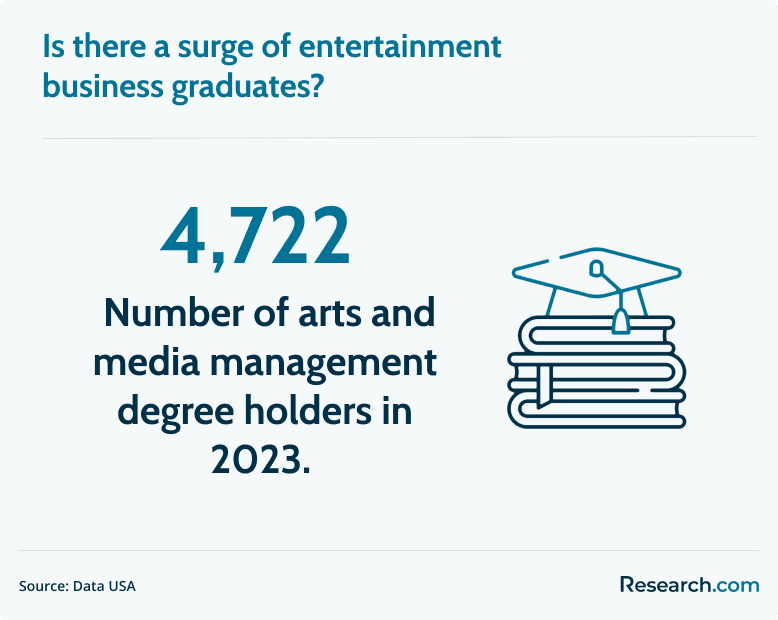
In 2023, 4,722 students graduated with degrees in arts, entertainment, and media management. That figure reflects sustained interest in this area of study, but students should still compare cost against realistic career goals, local opportunities, and their ability to gain experience while enrolled.
The same cost-comparison logic applies across online degrees: look beyond advertised tuition, calculate total attendance cost, and compare time-to-completion. For example, students researching unrelated accelerated programs such as fast track online biochemistry degree programs face similar questions about pace, transfer credits, and total cost. Entertainment business students can also start with Research.com’s list of affordable online entertainment business degree programs if keeping expenses low is the main priority.
Financial Aid and Scholarships for Online Entertainment Business Students
Students in online entertainment business programs may qualify for federal financial aid, institutional aid, private scholarships, employer tuition assistance, payment plans, and industry-specific awards. Eligibility depends on the school, program type, enrollment status, accreditation, citizenship or residency rules, financial need, academic record, and scholarship criteria.
Start by confirming whether the school participates in federal student aid programs and whether your specific online program is eligible. Then look for scholarships connected to media, communications, journalism, arts, entertainment, marketing, music, film, public relations, and diversity in media.
| Aid option | Amount listed | Who it may help |
| New York Women in Communications (NYWICI) Scholarship Program | $1,000 | Students preparing for communications careers who may benefit from NYWICI events, Matrix Awards access, media contribution opportunities, and ambassador roles. |
| Islamic Scholarship Fund (ISF) Media Scholarship | $3,000–$5,000 | Juniors, seniors, and graduate students in media-related fields, with a focus on Muslim representation in media and policymaking. |
| East Rock Films Scholarship | $500 | Students in arts, humanities, or social sciences who can write about a historical figure who inspires them. |
| Chronicle Diversity in Media Scholarship | $10,000 | Students with newsroom experience and a commitment to covering how race and identity shape U.S. institutions; includes a summer internship and requires verification of financial aid eligibility. |
| DigitalWise Media College Scholarship | $1,000 | Students interested in marketing, public relations, or communications; awarded twice a year for Fall and Spring semesters and open to residents of the USA or Canada. |
Ways to Reduce the Cost of an Online Entertainment Business Degree
- File financial aid forms early: Missing deadlines can reduce access to grants, loans, and institutional aid.
- Ask about transfer credits: Prior college credits, military training, or approved exams may shorten your program.
- Compare total cost, not only tuition: Fees, software, equipment, and course materials can change the real price.
- Use employer benefits: Students already working in media, hospitality, venues, sports, marketing, or communications should ask about tuition reimbursement.
- Apply for smaller scholarships: Awards like $500 or $1,000 can still offset books, software, or fees.
- Avoid borrowing more than needed: Entertainment careers can be competitive, so debt should be weighed against realistic early-career earnings.
Admission Requirements for Online Entertainment Business Programs
Admission requirements vary by school and credential level, but most online bachelor’s programs expect applicants to show academic readiness, basic technology skills, and a clear interest in business or entertainment. Master’s programs usually require a completed bachelor’s degree, while certificate programs may have more flexible entry requirements.
- High school diploma or equivalent: Bachelor’s programs commonly require official high school transcripts or GED documentation.
- Minimum GPA: Some schools may use a GPA threshold of 2.5 or higher when reviewing applicants.
- Personal statement or essay: Applicants may be asked to explain career goals, creative interests, leadership experience, or reasons for choosing entertainment business.
- Technology readiness: Online students need reliable internet access and comfort using learning platforms, video meetings, collaboration tools, and digital submission systems.
- Creative or professional portfolio: Some programs may allow or request examples of event planning, music projects, production work, social media campaigns, writing, marketing, or entrepreneurial experience.
- Industry awareness: Applicants can strengthen their case by showing familiarity with streaming, licensing, distribution, creator economies, live events, sponsorship, or talent management.
- Business preparation: Prior coursework or experience in marketing, management, accounting, communication, or entrepreneurship may be useful.
- Evidence of motivation: Schools may look for signs that the applicant understands the difference between enjoying entertainment and managing entertainment as a business.
Students interested in entertainment careers tied to gaming, tournaments, sponsorships, and online communities can also compare accelerated online esports business management degree programs.
Common Courses in an Online Entertainment Business Degree
Entertainment business coursework usually blends traditional business subjects with industry-specific applications. The goal is to teach students how entertainment products, talent, venues, rights, audiences, and revenue streams are managed.
| Course area | What students learn | Career relevance |
| Entertainment Law | Intellectual property, contracts, licensing, rights, and legal issues in creative industries. | Useful for talent representation, rights management, licensing, production, and business affairs. Students who want deeper legal training may later explore fast-track online master’s in legal studies programs. |
| Marketing and Promotion | Brand strategy, campaign planning, digital promotion, audience engagement, and fan loyalty. | Prepares students for publicity, social media, entertainment marketing, and brand partnership roles. |
| Media Distribution | How content reaches audiences through streaming, theaters, broadcast, digital platforms, and other channels. | Supports roles in distribution, platform strategy, content monetization, and media operations. |
| Business Fundamentals | Accounting, finance, management, entrepreneurship, budgeting, and forecasting. | Helps students understand how entertainment organizations make financial and operational decisions. |
| Social Media Strategy | Audience growth, community engagement, analytics, campaign design, and brand management. | Valuable for music, gaming, film, influencer, sports, and live event marketing. |
| Production Management | Scheduling, budgeting, staffing, vendor coordination, permits, and problem-solving during production. | Applies to film, television, live events, digital media, and venue-based productions. |
The strongest programs connect coursework to applied projects. Look for assignments that require students to build campaign plans, budget events, analyze licensing issues, pitch business ideas, evaluate audience data, or manage simulated entertainment projects.
Entertainment Business Specializations to Consider
Entertainment business is broad, so specialization matters. A student who wants to manage concert tours needs a different skill mix than someone who wants to work in music licensing, gaming communities, streaming strategy, or talent representation.
| Specialization | Main focus | Good fit for students interested in |
| Music Industry Management | Artist development, record labels, publishing, marketing, touring, and revenue streams. | Artist management, label operations, music marketing, and publishing. Students focused on sound, music production, or music careers may also compare the fastest online audio and music degree programs. |
| Film and TV Production Business | Financing, budgeting, pitching, scheduling, production logistics, and distribution. | Production coordination, studio operations, development, and business affairs. |
| Live Event and Festival Management | Concerts, tours, festivals, venues, guest experience, staffing, safety, and logistics. | Event coordination, tour operations, venue management, and festival planning. |
| eSports Management | Competitive gaming, sponsorship, tournaments, team branding, fan communities, and digital events. | Gaming organizations, tournament production, esports marketing, and community management. |
| Digital Media and Streaming | Platform economics, content monetization, analytics, subscriptions, advertising, and creator strategy. | Streaming platforms, creator partnerships, digital distribution, and audience analytics. |
| Talent Representation | Client management, negotiation, contracts, booking, brand partnerships, and career strategy. | Talent agencies, management firms, influencer representation, and artist relations. |
| Entertainment Marketing and PR | Publicity, media relations, branding, social strategy, and campaign analytics. | Public relations, digital marketing, brand partnerships, and audience development. |
Choose a specialization based on the work you want to do, not only the entertainment sector you enjoy. For example, a music fan may still prefer marketing, licensing, analytics, or operations depending on strengths and career goals.
Research.com also tracks related skill-building paths. Students interested in the sports side of entertainment may compare business programs with online master’s degrees in sports analytics, while students interested in venues, public event infrastructure, or city-level event planning may find useful context in fast track online urban planning degree programs.
The chart below summarizes common entertainment manager skills using information from Zippia (2025).
How to Choose the Best Online Entertainment Business Degree Program
The right program should connect your career target with credible academics, manageable cost, useful experience, and strong industry relevance. A famous school name can help in some situations, but it should not outweigh accreditation, curriculum fit, affordability, and access to practical projects.
Program Selection Checklist
- Confirm accreditation: Accreditation affects academic credibility, federal financial aid eligibility, credit transfer, and graduate school options.
- Match the curriculum to your goal: A program focused on live events will not serve the same purpose as one centered on music business, sports entertainment, or digital media.
- Review the business core: Look for finance, accounting, marketing, management, entrepreneurship, analytics, law, and operations, not only creative production courses.
- Check faculty experience: Instructors with relevant entertainment, media, sports, music, legal, or business backgrounds can add practical context.
- Ask about applied projects: Case studies, campaign plans, budgets, pitch decks, event simulations, and licensing exercises can strengthen your portfolio.
- Evaluate career services: Entertainment-specific advising, alumni networks, internship support, resume reviews, and industry events can matter more than generic career counseling.
- Compare flexibility: Full-time, part-time, asynchronous, synchronous, and accelerated formats serve different student needs.
- Calculate total cost: Include tuition, fees, materials, software, travel, transfer credits, and opportunity cost.
- Ask about internships: Online students should know whether the school helps with remote, local, or industry-based experience.
- Look for alumni outcomes: Ask where graduates work, what roles they hold, and whether outcomes are specific to entertainment business students.
Questions to Ask Before You Enroll
| Question | Why it matters |
| Is this institution accredited by a recognized accreditor? | Accreditation affects aid, transferability, and employer confidence. |
| What is the total estimated cost from admission to graduation? | Per-credit rates do not always show the full financial commitment. |
| Will my prior credits transfer? | Transfer credits can shorten your timeline and reduce debt. |
| Does the curriculum include business law, finance, marketing, and management? | Entertainment business careers require business competence, not only industry enthusiasm. |
| What practical projects will I complete? | Employers often value evidence of applied skills and portfolio-ready work. |
| How does the program support online students with internships or networking? | Online learners need intentional ways to build industry relationships. |
| Are career outcomes published for this specific program? | Schoolwide outcomes may not reflect the results of entertainment business graduates. |
Students who want to move into higher-level management later may also compare entertainment business degrees with leadership-focused graduate programs, including the fastest online master’s programs in organizational leadership.
Career Paths With an Online Entertainment Business Degree
Entertainment business graduates can pursue roles across music, film, television, sports entertainment, gaming, live events, digital media, venue operations, licensing, marketing, and talent management. Entry-level roles often involve coordination, marketing support, operations, assistant-level talent work, or production administration. With experience, graduates may move into management, strategy, partnerships, business affairs, or executive roles.
| Career path | What the role does | Skills that matter |
| Talent Agent | Represents performers, musicians, artists, creators, or athletes; helps negotiate contracts, book opportunities, and build partnerships. | Negotiation, networking, communication, market awareness, and client management. |
| Music Licensing Manager | Works with publishers, labels, platforms, brands, and productions to secure rights for music use in television, film, games, ads, and digital content. | Licensing knowledge, contract awareness, attention to detail, and relationship management. |
| Production Coordinator | Supports film, television, digital media, or live event productions through scheduling, logistics, permits, payroll, vendors, and communication. | Organization, budgeting, scheduling, problem-solving, and calm execution under pressure. |
| Entertainment Marketing Manager | Develops campaigns for films, shows, artists, events, brands, games, or content releases. | Digital marketing, audience research, campaign planning, analytics, and creativity. |
| Gaming Community Manager | Manages communication between game studios, esports brands, and player communities. | Community moderation, social media, brand voice, event planning, and audience engagement. |
| Tour Manager | Coordinates travel, venue logistics, schedules, accommodations, staffing, and day-to-day tour operations. | Logistics, stamina, communication, crisis management, and budgeting. |
| Rights and Clearances Specialist | Verifies that music, images, footage, trademarks, and other materials are legally cleared for use. | Research, documentation, legal coordination, and precision. |
| Venue Operations Manager | Oversees staff, vendors, scheduling, safety, guest experience, and operations for concerts, sporting events, and live shows. | Leadership, operations management, budgeting, safety awareness, and quick decision-making. |
| Content Development Executive | Reviews concepts, scripts, pitches, talent packages, and market potential to help decide which projects move forward. | Creative judgment, business strategy, communication, leadership, and market analysis. |
The chart below shows where entertainment business graduates may find demand, based on the latest information from BLS (2024).
Job Outlook for Entertainment Business Graduates
The entertainment economy is changing as audiences spend more time across streaming platforms, social media, gaming spaces, live events, digital communities, and hybrid experiences. Employers increasingly need professionals who can connect creative products with sustainable revenue, legal rights, audience growth, sponsorships, and operational execution.
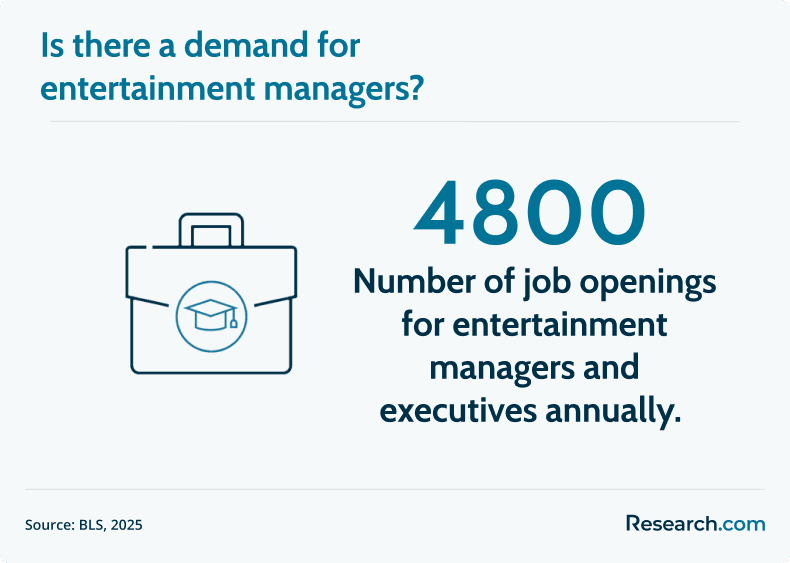
- Growth forecast: Employment for entertainment and recreation managers is expected to grow 11% over the next decade.
- Projected openings: Around 4,800 job openings are projected each year.
- Work settings: Roles may be available in country clubs, sports facilities, parks, and entertainment venues, along with related media, event, and recreation organizations.
- Drivers of demand: Wellness, lifestyle, recreation, live experiences, and audience engagement trends continue to shape management needs.
- Transferable skills: Budgeting, marketing, event management, content strategy, rights coordination, and leadership can apply across multiple entertainment-related sectors.
Students should interpret job outlook data carefully. A degree can help build relevant knowledge, but entertainment careers often depend on internships, networking, location, portfolio quality, persistence, and willingness to start in assistant or coordinator roles.
Can an Advanced Business Degree Help in Entertainment?
An advanced business degree can help entertainment professionals who want to move into leadership, finance, strategy, entrepreneurship, partnerships, or executive decision-making. It is not always necessary for entry-level entertainment roles, but it may be useful for professionals who already have industry experience and want stronger management credentials.
For example, an MBA can strengthen skills in negotiation, revenue strategy, operations, analytics, finance, and organizational leadership. Students comparing cost-sensitive graduate business options can review Research.com’s guide to the most affordable online MBA programs. Those who want a broader comparison of accredited graduate business options can also explore the best accredited online MBA programs.
Why Accreditation Matters for Online Entertainment Business Degrees
Accreditation is one of the first items students should verify. It shows that a school or program has been reviewed against recognized academic standards. Accreditation can affect financial aid eligibility, credit transfer, graduate school admission, and how employers evaluate your credential.
Do not assume that every online program is accredited in the same way. Check the school’s accreditation page, verify the accreditor, and confirm that your specific degree or certificate is covered. If you plan to pursue graduate study later, ask whether credits from the program are commonly accepted by other institutions.
Common Mistakes to Avoid When Choosing a Program
- Choosing based only on entertainment appeal: A program should teach business skills, not just offer exciting industry branding.
- Ignoring accreditation: Lack of recognized accreditation can create problems with aid, transfer credits, and graduate study.
- Comparing tuition without calculating total cost: Fees, materials, software, and extra credits can change affordability.
- Assuming online means easier: Online programs require discipline, time management, and proactive communication.
- Overlooking internships and networking: Entertainment hiring is relationship-driven, so experience and connections matter.
- Choosing a specialization too early: Explore coursework and entry-level roles before narrowing your focus too much.
- Expecting a guaranteed salary outcome: Job titles, pay, and advancement vary by location, employer, experience, and portfolio.
- Relying only on rankings: Rankings are useful starting points, but your best program depends on your goals and constraints.
What Graduates Say About Online Entertainment Business Programs
- Freddie: "The online format let me keep an internship at a record label while I studied. I was learning about contracts and marketing in class, then seeing those same ideas show up at work the same week."
- Tatiana: "I expected online learning to feel distant, but the program brought in producers and working professionals for live discussions. Getting feedback from people active in the industry made the coursework feel much more practical."
- Julio: "My classmates were based in different countries, and that changed how I thought about entertainment strategy. We built pitch decks and streaming plans together, and some of those connections continued after the course ended."
References
- Berklee Online. (n.d.). Bachelor of Professional Studies in Music Business. Berklee Online program page. Retrieved 29 July 2025.
- DigitalWise Media. (n.d.). DigitalWise Media college scholarship. DigitalWise Media scholarship page. Retrieved 29 July 2025.
- Florida International University. (n.d.). B.S. in Hospitality Management: Entertainment Management Track. FIU hospitality program page. Retrieved 29 July 2025.
- Full Sail University. (n.d.). Entertainment business bachelor’s degree program. Full Sail program page. Retrieved 29 July 2025.
- Grand Canyon University. (n.d.). Bachelor's in Entertainment and Sports Management. GCU program page. Retrieved 29 July 2025.
- Islamic Scholarship Fund. (n.d.). Media scholarship. Islamic Scholarship Fund media scholarship page. Retrieved 29 July 2025.
- L.A. Film School. (n.d.). Entertainment business online: Film business. L.A. Film School program page. Retrieved 29 July 2025.
- Miami University. (n.d.). Live Entertainment Management M.A. (Online). University of Miami bulletin page. Retrieved 29 July 2025.
- New York Women in Communications. (n.d.). Eligibility and qualifications. NYWICI scholarship eligibility page. Retrieved 29 July 2025.
- NYU Stern School of Business. (n.d.). Entertainment, media and technology program. NYU Stern entertainment, media, and technology page. Retrieved 29 July 2025.
- The Chronicle of Higher Education. (n.d.). Chronicle scholarship: Diversity in media. Chronicle Diversity in Media Scholarship page. Retrieved 29 July 2025.
- University of California, Los Angeles Extension. (n.d.). Business and Management of Entertainment Certificate. UCLA Extension certificate page. Retrieved 29 July 2025.
- University of Central Florida. (n.d.). B.S. in Entertainment Management. UCF Online program page. Retrieved 29 July 2025.
- University of South Carolina. (n.d.). M.S. in Sport and Entertainment Management (Online). University of South Carolina program page. Retrieved 29 July 2025.
- US Bureau of Labor Statistics. (2024). Entertainment and recreation managers. BLS occupational information. Retrieved 29 July 2025.
- US Bureau of Labor Statistics. (2024). Occupational employment and wages, May 2023: Arts, design, entertainment, sports, and media occupations. BLS occupational wage data. Retrieved 29 July 2025.
- Zippia. (n.d.). Entertainment manager skills. Zippia entertainment manager skills page. Retrieved 29 July 2025.
- ZipRecruiter. (n.d.). Entertainment business management salary. ZipRecruiter salary page. Retrieved 29 July 2025.
Key Insights
- Entertainment business degrees are business degrees with industry context. The strongest programs teach finance, marketing, law, management, operations, and strategy through music, film, gaming, live event, sports, or media examples.
- Program fit matters more than name recognition alone. Choose based on your target sector, cost, accreditation, schedule, specialization, applied projects, and access to networking or internships.
- Online programs can work well for motivated students. They are especially useful for learners balancing work, internships, gigs, travel, or location constraints, but they require strong self-management.
- Costs vary substantially. Compare total program price, per-credit tuition, fees, residency rates, transfer credits, and financial aid before deciding.
- Career outcomes depend on more than the degree. Internships, portfolios, assistant-level experience, local industry access, professional relationships, and demonstrated business skills are critical in entertainment careers.
- Accreditation is non-negotiable. Verify accreditation before enrolling because it can affect financial aid, credit transfer, graduate school options, and employer trust.
- Specialization should follow career intent. Music business, live event management, sports entertainment, esports, streaming, talent representation, and marketing all require different skill sets.
Other Things You Need to Know About Online Entertainment Business Degree Programs
Look for regional accreditation from an agency recognized by the U.S. Department of Education or CHEA, plus business accreditation such as AACSB, ACBSP, or IACBE when available. These accreditations confirm the program meets accepted academic standards and can affect credit transfer and graduate school admissions.
In 2027, universities such as the University of Southern California, Full Sail University, and Berklee College of Music offer online entertainment business degrees. Each provides a unique curriculum focusing on current industry trends and skills necessary for a career in entertainment business.
Admission requirements typically include a high school diploma or GED, official transcripts, and sometimes a minimum GPA or SAT/ACT scores. Some programs may also require a personal statement or letters of recommendation to assess candidates in 2027.