
2027 Best Online Master’s Degree in Sports Analytics Programs

Co-Founder and Chief Data Scientist
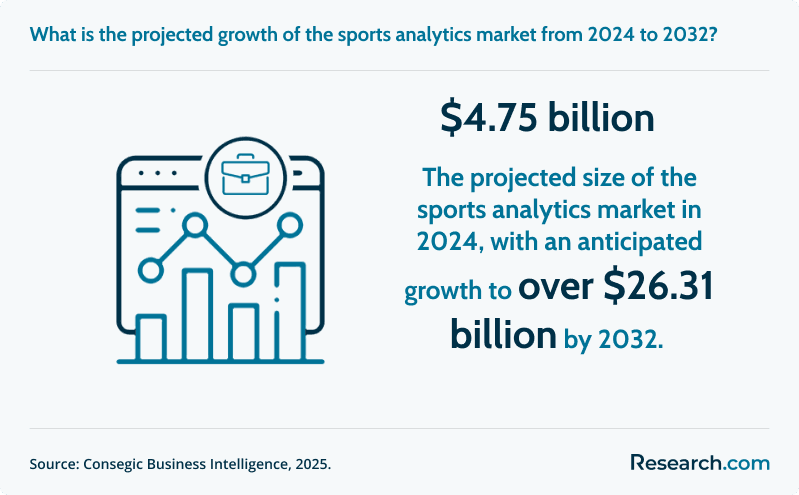
Many individuals who consider a master's degree in sports analytics often wonder about its true value and impact on career stability, especially when balancing busy schedules with online versus on-campus options. This field offers significant opportunities. In fact, the market is projected to grow from $4.75 billion in 2024 to over $26.31 billion by 2032, highlighting a clear and increasing demand for skilled professionals.
To help you navigate this exciting landscape, the Research.com team, leveraging over a decade of career planning expertise and credible sources, developed this guide. It will help you understand the benefits of a master's in sports analytics, its impact on job prospects, and provide clear insights into effective online program options.
What are the benefits of getting an online master’s degree in sports analytics?
- An online master’s degree in sports analytics opens doors to diverse and rewarding careers, including roles as a sports analyst or performance data specialist. You'll find opportunities with professional sports teams, collegiate athletic departments, sports marketing agencies, and sports science organizations.
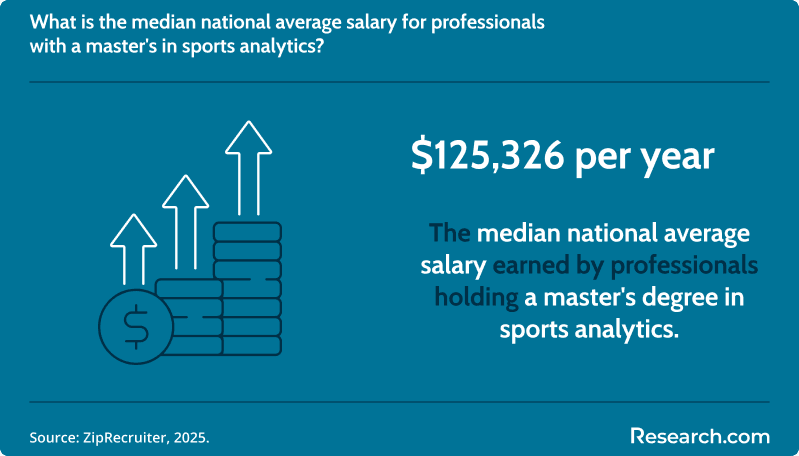
- Median salaries with a master’s in sports analytics are highly competitive, with national averages of about $125,326 per year.
- An online master’s degree in sports analytics offers flexibility, allowing you to advance your career or switch industries without sacrificing current commitments or needing to relocate.
What can I expect from an online master’s degree in sports analytics?
An online master’s degree in sports analytics offers a blend of technical skills and sports industry knowledge. You can expect a core curriculum covering statistics, predictive analytics, data visualization, and programming languages like R and Python.
Many programs include a capstone project where you apply what you've learned to real-world sports data, plus internship hours to gain practical experience. Tuition typically ranges from $15,000 to $40,000, depending on the program and institution.
Online sport analytics degree classes are usually delivered through a mix of pre-recorded lectures, live virtual sessions, interactive assignments, and discussion forums, providing flexibility to study from anywhere while staying engaged with instructors and peers. This structure helps you balance learning with other commitments effectively.
Where can I work with an online master’s degree in sports analytics?
An online master’s degree in sports analytics opens doors to diverse career opportunities across many industries. Graduates can work with professional sports teams, media companies, or in roles like data analyst, sports statistician, consultant, or data journalist. Many find positions in corporate firms, government agencies, nonprofit organizations, or even launch their analytics-driven businesses.
The growing analytics field means demand extends to management, research, consulting, and specialized roles, with the U.S. Bureau of Labor Statistics reporting a 27% projected job growth for data analyst positions—over double the national average. Some programs also enable careers in education, technology, or healthcare.
How much can I make with an online master’s degree in sports analytics?
Professionals with an advanced online sport analytics degree typically earn an average salary of $125,326 per year in the United States. Entry-level positions usually pay between $50,000 and $60,000, while mid-level roles reach $65,000–$75,000.
Experienced analysts or those in director and management positions can see salaries of $100,000 to $150,000 or more, especially in major cities or with professional teams. Industry and location matter—a data analyst for media companies or technology firms often earns higher pay compared to traditional sports organizations, and cities like San Francisco, New York, or Los Angeles typically offer above-average wages.
Having a master’s degree or advanced certifications can boost earning potential by up to 20% compared to holding only a bachelor’s degree. Entry-level roles pay less, but experienced professionals with specialized skills and advanced education see significant salary growth as they move into senior or managerial positions.
- List of the Best Online Master’s Degree in Sports Analytics Programs for 2027 List of Programs
- How long does it take to complete an online master’s degree in sports analytics program? Completion Time
- How does an online master’s degree in sports analytics program compare to an on-campus program? How does an online master’s degree in sports analytics program compare to an on-campus program?
- What is the average cost of an online master’s degree in sports analytics program? Average Cost
- What are the financial aid options for students enrolling in an online master’s degree in sports analytics program? Financial Aid
- What are the prerequisites for enrolling in an online master’s degree in sports analytics program? Requirements
- What courses are typically in an online master’s degree in sports analytics program? What courses are typically in an online master’s degree in sports analytics program?
- What types of specializations are available in an online master’s degree in sports analytics program? What types of specializations are available in an online master’s degree in sports analytics program?
- How to Choose the Best Online Master’s Degree in Sports Analytics Program How to Choose the Best Online Master’s Degree in Sports Analytics Program
- What career paths are available for graduates of an online master’s degree in sports analytics program? Career Paths
- What is the job market for graduates with an online master’s degree in sports analytics? Job Market
- How can interdisciplinary skills enhance career opportunities? How can interdisciplinary skills enhance career opportunities?
- How does an online master’s in sports analytics differ from an online MBA? How does an online master’s in sports analytics differ from an online MBA?
- What are the quality indicators of top online master’s in sports analytics programs? What are the quality indicators of top online master’s in sports analytics programs?
Best Online Master’s Degree in Sports Analytics Programs for 2027
Choosing an online master’s degree in sports analytics is a high-stakes decision because the field sits between two competitive areas: sports and data science. The right program can help you build skills in statistics, coding, visualization, performance analysis, fan behavior, and sport business strategy; the wrong program may leave you with high tuition costs and a credential that does not match your career target.
This guide is for working professionals, recent graduates, coaches, analysts, sport business employees, and career changers comparing online and hybrid graduate options. You will learn which programs stand out, how long they take, what they cost, what courses and specializations to expect, how online study compares with campus-based learning, and how to judge whether a sports analytics master’s degree fits your goals. If you are weighing broader sport business training, you may also want to compare these programs with the fastest online MBA sports management programs.
Quick Answer: Is an Online Master’s in Sports Analytics Worth Considering?
An online master’s in sports analytics can be a strong option if you want to use data to improve player evaluation, team performance, sport business operations, fan engagement, sponsorship strategy, or sports media analysis. Most programs take about one to two years, commonly require 30 to 36 credits, and combine analytics coursework with sport-specific applications. The best fit depends on whether you want a technical analytics role, a sport business role, or a performance science role.
Before enrolling, compare accreditation, total cost, coding and statistics depth, access to real sport datasets, capstone or internship options, faculty experience, and whether the program’s focus matches your intended job path.
How We Rank Online Master’s in Sports Analytics Programs
Graduate tuition is a major investment, so rankings should be transparent and based on credible data rather than marketing claims. Our evaluation considers academic quality, affordability, institutional credibility, online learning structure, and the usefulness of each program for sports analytics career preparation.
Research.com draws on established data sources, including the IPEDS database, Peterson's database, the College Scorecard database, and the National Center for Education Statistics. You can learn more about our evaluation process on our methodology page.
Best Online Master’s Degree in Sports Analytics Programs
The programs below include fully online and hybrid options. Some are analytics-heavy and emphasize coding, statistics, machine learning, and data visualization. Others are broader sport business or sport leadership programs with analytics coursework or concentrations. Use the list as a starting point, then verify current tuition, admissions policies, and course availability directly with each university.
| Rank | School and Program | Format or Focus | Program Length | Credits | Cost |
| 1 | American University — Online Master of Science in Sports Analytics and Management | Sports analytics, management, leadership, marketing, and revenue strategy | 20 months | 30 | $2,080 per credit |
| 2 | Drexel University — Master of Science in Sport Business | Sport business with finance, marketing, compliance, and analytics | As little as 12 months | 45 | $1,265 per credit |
| 3 | Indiana University Indianapolis — Master of Science in Applied Data Science with a Sports Analytics Specialization | Applied data science with sport analytics specialization | 18-24 months | 30 | $490 per credit for Indiana residents and $812.50 per credit for non-residents |
| 4 | Lasell University — MS Applied Sports Science Analytics | Sports science, exercise science, statistics, and performance analytics | 12 months | 36 | $675 per credit |
| 5 | Linfield University — M.S. in Sports Science & Analytics | Hybrid sports science and analytics program | 16 months | 33-35 | $790 per credit |
| 6 | Marquette University — Master of Science in Sports and Exercise Data Analytics | Hybrid sports performance, exercise science, biomechanics, and data analytics | 2 years | 33 | $1,400.00 per credit |
| 7 | Northeastern University — Master of Sports Leadership | Sport leadership with experiential learning and a Boston summer institute | 12-18 months | 45 | $41,355 total tuition |
| 8 | Syracuse University — Master of Science in Sport Analytics | 100% online sport analytics with R, Python, SQL, visualization, regression, and machine learning | 18–24 months | 36 | $2,015 per credit |
| 9 | Temple University — Master of Science in Sport Business, Sport Analytics Concentration | Sport business with analytics concentration | 2 years | 36 | $993 per credit for Pennsylvania residents and $1,143 per credit for out-of-state students |
| 10 | University of Mississippi — Online Master of Science in Sport Analytics | Fully online sport analytics with Sport Performance or Sport Business specialization | 1-2 years | 30 | Approximately $484.40 per credit |
1. American University - Online Master of Science in Sports Analytics and Management
American University offers an online Master of Science in Sports Analytics and Management built for professionals who want to connect data analysis with strategic decision-making in the sports industry. The program emphasizes analytics, leadership, marketing, revenue generation, and applied business strategy. Students can benefit from industry perspectives, practicum-based learning, and an optional D.C. residency that connects coursework to the region’s sports environment.
- Program length: 20 months
- Cost per credit: $2,080
- Total credits: 30
- Accreditation: Middle States Commission on Higher Education (MSCHE)
2. Drexel University - Master of Science in Sport Business
Drexel University provides an online Master of Science in Sport Business for students seeking management and leadership roles across sport organizations. The curriculum blends finance, marketing, compliance, sport operations, and analytics, making it a practical choice for students who want a broader sport business credential rather than a narrowly technical data science degree. Hands-on projects, industry relationships, and career support add applied value.
- Program length: As little as 12 months
- Cost per credit: $1,265
- Total credits: 45
- Accreditation: Association to Advance Collegiate Schools of Business (AACSB)
3. Indiana University - Purdue University Indianapolis - Master of Science in Applied Data Science with a Sports Analytics Specialization
The Indiana University Indianapolis Master of Science in Applied Data Science with a Sports Analytics Specialization is designed for students who want strong technical preparation with sport-focused application. The program develops skills in data interpretation, data management, statistics, ethical project work, and applied analytics. Its Indianapolis location may be especially relevant for students interested in a city with a significant sports presence.
- Program length: 18-24 months
- Cost per credit: $490 per credit for Indiana residents and $812.50 per credit for non-residents
- Total credits: 30
- Accreditation: Higher Learning Commission (HLC)
4. Lasell University - MS Applied Sports Science Analytics
Lasell University offers a fully online Master of Science in Applied Sports Science Analytics for students interested in athlete performance, human performance, and sports science data. Coursework combines exercise science, statistics, and data science, with attention to collecting and interpreting performance-related information. A capstone research project helps students apply their skills to athletic data analytics, performance management, and sports science questions.
- Program length: 12 months
- Cost per credit: $675
- Total credits: 36
- Accreditation: New England Commission of Higher Education (NECHE)
5. Linfield University - M.S. in Sports Science & Analytics
Linfield University delivers a hybrid M.S. in Sports Science & Analytics for students who want a science-based view of performance and movement. The curriculum includes experimental design, biomechanics, physiology, data analysis, movement control, cardiorespiratory systems, and motor skill learning. This may appeal to students whose career goals are closer to performance science than front-office analytics.
- Program length: 16 months
- Cost per credit: $790
- Total credits: 33-35
- Accreditation: Northwest Commission on Colleges and Universities
6. Marquette University - Master of Science in Sports and Exercise Data Analytics
Marquette University offers a hybrid Master of Science in Sports and Exercise Data Analytics that connects physiology, biomechanics, and data science. Students work with athletic data and performance systems while learning to analyze complex human performance datasets. The program can support career goals involving professional teams, wearable technology companies, performance laboratories, and sport science analytics roles.
- Program length: 2 years
- Cost per credit: $1,400.00
- Total credits: 33
- Accreditation: Higher Learning Commission (HLC)
7. Northeastern University - Master of Sports Leadership
Northeastern University offers an online Master of Sports Leadership for coaches, athletic administrators, and professionals who want leadership training in sport settings. The program includes a one-week summer institute in Boston and was developed with the Center for the Study of Sport in Society. Internships, hands-on learning, and a capstone support students preparing for varied roles in sport organizations.
- Program length: 12-18 months
- Cost per credit: $41,355 (total tuition)
- Total credits: 45
- Accreditation: Commission on Sport Management Accreditation (COSMA)
8. Syracuse University - Master of Science in Sport Analytics
Syracuse University offers a 100% online Master of Science in Sport Analytics in an asynchronous format. The curriculum covers data visualization, R and Python programming, SQL databases, linear regression, machine learning, and sport-specific analytics applications. Students interested in both team and player analysis as well as the business side of sports may find the curriculum especially aligned with technical analytics goals.
- Program length: 18–24 months
- Cost per credit: $2,015
- Total credits: 36
- Accreditation: MSCHE
9. Temple University - Master of Science in Sport Business (Sport Analytics Concentration)
Temple University offers a Master of Science in Sport Business with a Sport Analytics Concentration for students who want to apply quantitative decision-making in sport organizations. The concentration includes statistical analysis, predictive modeling, and quantitative methods used in player evaluation and sport business decisions. Practical work and industry connections help students prepare for analytics and management roles.
- Program length: 2 years
- Cost per credit: $993 per credit for Pennsylvania residents and $1,143 per credit for out-of-state students
- Total credits: 36
- Accreditation: MSCHE
10. University of Mississippi - Online Master of Science in Sport Analytics
The University of Mississippi offers a fully online Master of Science in Sport Analytics delivered in accelerated eight-week courses. Students study measurement, evaluation, applied statistics, and data visualization, with specialization options in Sport Performance or Sport Business. The program also exposes students to software used in sports marketing, media, betting, and team management contexts.
- Program length: 1-2 years
- Cost per credit: Approximately $484.40
- Total credits: 30
- Accreditation: Southern Association of Colleges and Schools Commission on Colleges (SACSCOC)
How Long Does an Online Master’s in Sports Analytics Take?
Most online master’s programs in sports analytics take about one to two years to complete. Many programs require around 30 to 36 credit hours, although some require more. A typical student completes about ten to 12 courses, depending on the school’s calendar and credit structure.
| Enrollment Pace | Typical Timeline | Best For | Trade-Off |
| Full-time | About one year in accelerated or intensive formats | Students who can commit significant weekly time to coursework | Heavier workload and less flexibility for work or family obligations |
| Part-time | Two years or longer | Working professionals, coaches, parents, and career changers | Longer time before graduation and possible term-based fees |
| Accelerated sessions | Often eight-week or ten-week terms | Students who prefer focusing on fewer courses at a time | Fast pacing can be demanding, especially in statistics or programming courses |
Capstones, internships, thesis projects, and practicum requirements can also affect completion time. If your goal is to enter a sports-related field quickly, compare course sequencing carefully and ask whether every required course is offered each term.
Students interested in a faster route into competitive gaming and sport-adjacent business roles may also compare sports analytics degrees with the fastest online esports business degree programs.
 What is the projected growth of the sports analytics market from 2024 to 2032? " width="799" height="495" loading="lazy">
Online vs. On-Campus Master’s in Sports Analytics: Which Format Fits You?
An online sports analytics master’s degree usually offers more scheduling and location flexibility than a campus program. However, campus and hybrid programs may provide easier access to in-person labs, local sport organizations, faculty meetings, and networking events. The better option depends on your schedule, learning style, budget, and career goals.
| Factor | Online Program | On-Campus or Hybrid Program | Decision Tip |
| Flexibility | Often designed for remote study, part-time enrollment, and multiple start dates | Usually follows a more fixed academic calendar | Choose online if you need to keep working or cannot relocate. |
| Networking | May include virtual cohorts, online discussions, remote projects, and live sessions | Can offer more face-to-face access to classmates, faculty, and local sports partners | Ask how the online program builds professional relationships, not just academic interaction. |
| Hands-on learning | May use virtual datasets, remote analytics projects, and capstones | May provide in-person labs, fieldwork, or sports organization access | Performance-focused students should verify access to real data and tools. |
| Cost | Can reduce commuting, relocation, and housing expenses | May involve campus fees, travel, or relocation | Compare total cost, not tuition alone. |
| Learning experience | Best for independent learners comfortable with digital tools | Best for students who prefer in-person structure and immediate feedback | Choose the format that matches how you actually study. |
Strong online programs often try to recreate cohort interaction through virtual teams, faculty meetings, and live sessions. This structure can resemble the collaborative approach found in the best online sports management bachelor’s degree programs, though graduate-level analytics work is typically more specialized and technical.
How Much Does an Online Master’s in Sports Analytics Cost?
The total tuition for an online master’s degree in sports analytics generally ranges between $15,000 and $45,000. Actual cost varies by school type, credit requirement, residency status, program length, and whether tuition is charged per credit or as a flat program amount.
Many programs require around 30 credit hours, but tuition per credit varies widely, from a few hundred dollars to nearly $1,500 in many cases. Some programs in this ranking cost more per credit, while others may be more affordable for in-state students.
Cost Factors to Check Before Enrolling
- Tuition model: Confirm whether the school charges per credit, per term, or by total program cost.
- Residency pricing: Public universities may charge different rates for in-state and out-of-state students.
- Technology and online fees: Ask whether distance learning fees, software fees, or course material costs are added.
- Course load: Part-time study can be easier to manage but may extend enrollment and related fees.
- Travel requirements: Hybrid programs or optional residencies may add transportation and lodging costs.
- Software access: Analytics work may require access to statistical, visualization, or database tools.
If speed and cost control are both priorities, compare standard programs with the shortest online master’s programs in sports analytics, since a focused and shorter curriculum may reduce time away from career advancement.
Financial Aid for Online Sports Analytics Master’s Students
Online graduate students may be eligible for several types of funding, but aid availability depends on the school, enrollment status, citizenship or residency rules, and whether the program meets federal aid requirements. Always confirm eligibility with the university’s financial aid office before committing.
- Federal financial aid: Many students begin by completing the Free Application for Federal Student Aid (FAFSA). Graduate students can often borrow up to $20,500 per year in federal Direct Unsubsidized Loans.
- Institutional scholarships and grants: Some graduate schools and sport management or analytics departments offer merit-based or need-based support, although sports analytics-specific scholarships may be limited.
- Military and veteran benefits: Eligible service members, veterans, and dependents should ask whether the program accepts applicable military education benefits.
- Private education loans: Private lenders such as Sallie Mae may provide supplemental loans, but repayment terms, interest rates, and borrower protections differ from federal loans.
- Employer tuition assistance: If you already work in sports, education, analytics, media, or a related field, ask your employer whether tuition reimbursement is available.
Admissions Requirements for an Online Master’s in Sports Analytics
Admissions requirements vary by university, but most online sports analytics master’s programs expect applicants to show both graduate-level readiness and the ability to handle quantitative coursework.
- A bachelor’s degree from an accredited college or university is typically required.
- Programs may prefer a minimum GPA, such as 3.0 on a 4.0 scale in the last 60 hours of undergraduate coursework.
- Some schools require GRE scores, while others waive testing for applicants with relevant professional experience, strong academic records, or recommendation letters.
- Common application materials include a resume, statement of interest, transcripts, and letters of recommendation.
- Some programs do not require specific undergraduate majors, but coursework or experience in statistics, mathematics, data analysis, business, computer science, exercise science, or sports management can help.
- Applicants may need to complete foundational coursework in areas such as applied statistics early in the program.
- Professional experience in sports, coaching, athletics, business operations, or analytics can strengthen an application.
If you need stronger quantitative preparation before graduate study, an accelerated online bachelor's in mathematics may help build the statistics and problem-solving foundation expected in analytics-heavy programs.
Common Courses in an Online Master’s in Sports Analytics
Sports analytics curricula usually combine statistics, data management, programming, visualization, machine learning, and sport-specific applications. Programs differ in emphasis: some focus on team and player performance, while others emphasize sport business, fan behavior, marketing, media, or operations.
| Course Area | What Students Learn | Career Relevance |
| Sports Data and Statistical Analysis | Regression, hypothesis testing, predictive modeling, statistical reasoning, and interpretation of sport datasets | Useful for scouting, player evaluation, forecasting, and decision support |
| Sports Performance Analytics | Methods for evaluating athlete performance, training load, injury risk, biometric information, GPS data, and video-based performance data | Relevant for performance analysts, strength and conditioning teams, and sport science units |
| Data Management and Visualization | Data cleaning, organization, SQL, Python, Tableau, Power BI, dashboards, and communication of findings | Important for presenting insights to coaches, executives, scouts, and business leaders |
| Sports Business and Decision Making | Ticketing, sponsorship, fan engagement, marketing, finance, and revenue strategy supported by data | Supports roles in front offices, sport marketing, sales analytics, and business intelligence |
| Machine Learning in Sports | Supervised and unsupervised learning, classification, prediction, player grouping, and game outcome modeling | Helpful for advanced analytics, forecasting, recruitment, and tactical analysis |
Because analytics professionals must explain results clearly to nontechnical audiences, communication skills matter. Students who want to improve technical writing, visualization narratives, and stakeholder reporting may also review the best online technical communication degree programs.
Sports Analytics Specializations: Business vs. Performance
Most online sports analytics master’s programs fit into two broad categories: sport business analytics and sport performance analytics. Choosing the right specialization is one of the most important decisions because it affects your courses, portfolio projects, networking opportunities, and target employers.
| Specialization | Main Focus | Best For | Common Projects |
| Sport Business Analytics | Marketing, ticketing, sponsorship, finance, fan engagement, revenue strategy, and organizational decision-making | Students aiming for front-office, marketing, sales, revenue, media, or management analytics roles | Ticket demand models, fan segmentation, sponsorship valuation, pricing analysis, and campaign performance dashboards |
| Sport Performance Analytics | Athlete performance, player evaluation, training load, injury prevention, game strategy, biomechanics, and strength and conditioning data | Students interested in team operations, performance departments, coaching support, player development, or sport science roles | Player projection models, workload analysis, injury trend reports, tactical breakdowns, and performance dashboards |
Students leaning toward performance analytics should make sure the program includes enough human performance, biomechanics, physiology, and measurement coursework. Comparing sports analytics programs with the best online exercise science degree programs can help clarify whether you need more data science, more sport science, or both.
Meanwhile, the chart below shows the percentage of arts, design, entertainment, sports, and media workers by strength level requirements in 2024.
How to Choose the Best Online Master’s in Sports Analytics Program
The best program is not necessarily the highest-ranked or most expensive one. It is the program that matches your target role, technical background, schedule, and budget. Use the steps below to evaluate each option before applying.
1. Define the Job You Want
Start by deciding whether your main goal is sport business analytics, team and player analytics, performance science, sport leadership, media analysis, or a broader sport management role. A program built around sponsorship analytics will not prepare you the same way as a program centered on biomechanics and player tracking.
2. Audit the Curriculum for Technical Depth
Look for coursework in statistics, programming, data visualization, database management, machine learning, predictive modeling, and applied sport datasets. If a program uses the word “analytics” but offers limited quantitative training, ask for syllabi before applying.
3. Verify Accreditation
At minimum, confirm institutional accreditation from a recognized accreditor. Some sport management programs may also have programmatic accreditation. Accreditation can affect credit transfer, employer recognition, and financial aid eligibility.
4. Compare Format and Weekly Workload
Ask whether classes are asynchronous, synchronous, hybrid, or residency-based. Then estimate the weekly workload for quantitative courses. Coding and statistics classes can require more time than discussion-based management courses.
5. Review Capstone, Internship, and Portfolio Options
In sports analytics, employers often care about proof of skills. Strong programs help students build dashboards, models, reports, code samples, and sport-specific projects that can be shown during job searches.
6. Ask About Data, Tools, and Software
Find out whether students use real or realistic sport datasets, industry tools, statistical software, visualization platforms, and programming languages such as R, Python, and SQL. The more applied the work, the easier it is to translate coursework into a portfolio.
7. Calculate ROI Carefully
Compare tuition, fees, lost work time, employer reimbursement, expected career value, and the strength of the alumni network. Do not assume a master’s degree automatically leads to a specific salary or job title.
Questions to Ask Admissions Advisors
- Which courses require programming, statistics, or machine learning?
- Are students required to complete a capstone, practicum, internship, thesis, or portfolio?
- What software and data tools are used in the program?
- Are courses taught by faculty with current sports analytics or sport business experience?
- Can online students access career services, alumni networks, and industry events?
- How many start dates are available each year?
- Are any campus visits, residencies, or travel experiences required?
- What is the total estimated cost, including fees and required materials?
Career Paths with an Online Master’s in Sports Analytics
Graduates can pursue roles inside teams, leagues, athletic departments, sport agencies, media companies, technology vendors, health and performance organizations, betting-related employers, and sport business operations. Job titles vary widely because sports analytics overlaps with business intelligence, data science, scouting, marketing, performance science, and media analysis.
| Career Path | What the Role Involves | Useful Program Focus |
| Sports Data Analyst | Collecting, cleaning, modeling, and interpreting data related to players, teams, games, scouting, strategy, or operations | Statistics, Python or R, SQL, visualization, predictive modeling, and sport-specific datasets |
| Performance Analyst | Using athlete data, video, GPS, biometric information, and training metrics to support performance decisions | Sports science, biomechanics, physiology, performance analytics, and data visualization |
| Sports Business Analyst | Analyzing ticket sales, sponsorships, fan engagement, pricing, attendance patterns, and revenue opportunities | Sport business analytics, marketing analytics, finance, and dashboard reporting |
| Sports Marketing Analyst | Measuring campaign performance, segmenting fans, studying digital behavior, and supporting sponsorship strategy | Marketing analytics, consumer behavior, data visualization, and sport business strategy |
| Sports Agent or Athlete Representative | Using data to support contract strategy, endorsement positioning, athlete value, and career planning | Sport business, negotiation, analytics literacy, and market analysis |
| Event Coordinator or Manager | Planning sport events while using data to improve scheduling, logistics, safety, ticketing, and audience experience | Operations analytics, sport management, business intelligence, and event planning |
| Sports Technology or Research Professional | Supporting software, tools, platforms, or research methods for sport data collection and analysis | Machine learning, data systems, research methods, and product-oriented analytics |
| Sports Media or Broadcast Analyst | Explaining statistics, trends, player performance, and team strategy to public audiences | Analytics, storytelling, visualization, and sports communication |
Students who want to focus on digital engagement, fan communities, and brand growth may also explore the shortest online social media marketing programs as a more direct path into marketing-focused sport roles.
Meanwhile, the chart below shows the top industries for sports analysts.
Sports Analytics Job Market and Industry Trends
The sports analytics job market is shaped by the growing use of data across player performance, fan engagement, broadcasting, sport marketing, betting, and business operations. The global sports analytics market size is estimated to grow from about USD 4.75 billion in 2024 to over USD 26.31 billion by 2032. It is expected to increase by USD 5.80 billion in 2025 alone and grow at a compound annual growth rate (CAGR) of approximately 23.9% from 2025 to 2032.
This growth is connected to wider adoption of big data, AI, cloud computing, IoT, and machine learning in sports management, athlete performance analysis, fan behavior modeling, broadcasting, and marketing. However, a growing market does not guarantee an easy job search. Sports roles are competitive, and employers often look for candidates who can show practical work through projects, internships, dashboards, models, or code samples.
How AI Is Changing Sports Analytics
AI and machine learning are expanding what teams and organizations can analyze, from player classification and game prediction to ticket demand and fan segmentation. For students, this means technical literacy is becoming more valuable. You do not necessarily need to become a machine learning engineer, but you should understand model limitations, bias, data quality, explainability, and how to communicate findings responsibly.
Students who want deeper technical preparation may compare sports analytics programs with a fast-track online artificial intelligence degree, especially if their long-term goal is advanced predictive modeling or sports technology development.
Meanwhile, the chart below shows the most common states for sports analysts.
Why Interdisciplinary Skills Matter in Sports Analytics
Sports analytics is rarely just about running models. Analysts often work with coaches, executives, athletes, medical staff, scouts, sponsors, media teams, and technology vendors. That makes interdisciplinary skill valuable. A graduate who understands statistics, sport operations, communication, project management, and stakeholder decision-making is often better prepared to turn analysis into action.
Depending on your career direction, useful complementary knowledge may include exercise science, business intelligence, marketing, facility operations, contract negotiation, sport law, or product management. For professionals involved in venue planning or sports facility projects, related management training such as the quickest online construction management programs may add practical context.
Online Master’s in Sports Analytics vs. Online MBA: Which Should You Choose?
An online master’s in sports analytics is usually the better fit if you want technical preparation in statistics, programming, data modeling, visualization, and sport-specific analytics. An online MBA is typically broader, with more emphasis on management, leadership, finance, operations, and executive decision-making.
| Degree Option | Best For | Strengths | Possible Limitation |
| Online Master’s in Sports Analytics | Students targeting analytics, data science, performance analysis, sport business intelligence, or technical sport roles | Deeper analytics training and sport-specific datasets or case studies | May be narrower than an MBA for general management careers |
| Online MBA | Professionals seeking leadership, management, finance, operations, or executive roles across industries | Broad business preparation and management versatility | May not include enough technical analytics depth for specialized sport data roles |
If cost is a major factor, compare specialized analytics degrees with affordable online MBA programs. If you want a wider view of graduate business options, review online MBA programs and compare curriculum depth, career outcomes, and total cost.
Quality Indicators of Top Online Sports Analytics Master’s Programs
High-quality programs usually share several traits: recognized accreditation, rigorous analytics coursework, applied projects, faculty with relevant expertise, responsive student support, credible career services, and meaningful industry connections. Do not rely only on rankings or brand recognition; examine the learning experience in detail.
- Accreditation: Confirm institutional accreditation and any relevant programmatic accreditation.
- Technical rigor: Look for statistics, coding, databases, visualization, machine learning, and applied modeling.
- Sport-specific application: Coursework should connect analytics methods to real sport problems.
- Portfolio development: Capstones and applied projects help translate coursework into job-search evidence.
- Faculty expertise: Review faculty backgrounds in analytics, sport management, data science, sport science, or industry practice.
- Career support: Online students should receive access to advising, networking, resume help, and alumni resources.
- Transparency: Schools should clearly publish tuition, fees, course requirements, graduation timelines, and admissions expectations.
Common Mistakes to Avoid When Choosing a Sports Analytics Master’s Program
| Mistake | Why It Can Hurt You | Better Approach |
| Choosing based only on ranking | A ranked program may not match your career goal, budget, or technical level. | Use rankings as a shortlist, then compare curriculum, projects, cost, and outcomes. |
| Ignoring accreditation | Accreditation can affect aid eligibility, transfer options, and employer confidence. | Verify accreditation before applying. |
| Focusing only on tuition per credit | Total cost may include fees, residencies, materials, software, and added terms. | Ask for the full estimated cost of attendance. |
| Assuming “sports analytics” means advanced data science | Some programs are more sport management-focused and may offer limited coding or modeling. | Review syllabi and required technical courses. |
| Overlooking portfolio value | Sports employers may want proof that you can solve real problems with data. | Prioritize programs with capstones, datasets, dashboards, and applied projects. |
| Choosing performance analytics without sport science preparation | Athlete data roles often require understanding of physiology, training, and biomechanics. | Look for coursework in sports science or performance measurement. |
| Assuming salary outcomes are guaranteed | Pay depends on role, employer, location, experience, and technical skills. | Evaluate the degree as one part of a broader career strategy. |
Here’s What Graduates Say About Online Master’s in Sports Analytics Programs
- Reggie: "Studying online let me keep building my career while adding stronger statistical modeling and visualization skills. I was able to apply what I learned to team strategy almost immediately."
- Mina: "The program helped me connect my interest in sports with practical data work. Remote study gave me the flexibility I needed, and the predictive analytics courses changed how I evaluate player performance."
- Conrad: "Moving into sports analytics felt much more realistic because the coursework included applied projects. The asynchronous format helped me balance school with family responsibilities while building confidence in data interpretation."
Key Insights
- An online master’s in sports analytics is best for students who want to apply data to team performance, player evaluation, sport business, fan engagement, media, or sport technology.
- Most programs take about one to two years and commonly require 30 to 36 credits, though some programs require 45 credits or offer hybrid components.
- Total tuition often ranges between $15,000 and $45,000, but the real cost depends on credit requirements, residency rates, fees, technology expenses, and program length.
- The most important program decision is focus: sport business analytics and sport performance analytics lead to different courses, projects, and job targets.
- Technical depth matters. Look for statistics, programming, SQL, data visualization, predictive modeling, and machine learning if you want analytics-heavy roles.
- Accreditation, applied projects, capstones, internships, and access to real or realistic sport datasets are stronger quality indicators than marketing language alone.
- AI and machine learning are becoming more important in sports analytics, but employers still value analysts who can communicate findings clearly and understand the sport context.
- A master’s degree can strengthen your profile, but it does not guarantee a specific job or salary. Build a portfolio, network intentionally, and choose a program that supports your target role.
References:
- Consegic Business Intelligence. (2025, March 24). Sports Analytics Market Size, Share - Growth Analysis Report, 2025 - 2032. https://www.consegicbusinessintelligence.com/sports-analytics-market
- Sports Analyst Demographics and Statistics [2025]: Number of sports analysts in the US. (2025, January 8). https://www.zippia.com/sports-analyst-jobs/demographics
- Sports Analyst Trends. (n.d.). https://www.zippia.com/sports-analyst-jobs/trends
- Sports Analytics Salary. (2025). ZipRecruiter. Retrieved July 28, 2025, from https://www.ziprecruiter.com/Salaries/Sports-Analytics-Salary
- U.S. Bureau of Labor Statistics. (2024). Occupational Requirements Survey [Report]. https://www.bls.gov/ors/factsheet/pdf/arts-design-entertainment-sports-and-media-occupations.pdf
Other Things You Should Know About Online Master’s Degree in Sports Analytics Programs
Most online sports analytics master’s programs require a minimum undergraduate GPA of 3.0 on a 4.0 scale. Some schools accept a 2.75 GPA with strong GRE scores, relevant coursework, or professional experience, while a few waive test requirements entirely for qualified applicants.
Technical skills crucial for a sports analytics master's program in 2027 include proficiency in statistical software like R or Python, data visualization tools such as Tableau, and a solid grasp of machine learning algorithms applicable to sports data analysis.


