
2027 What Can You Do With a Master’s in Risk Management?

Co-Founder and Chief Data Scientist
A master’s in risk management is for professionals who want to move beyond identifying problems after they happen and instead help organizations prevent, measure, finance, and respond to uncertainty. The degree is especially relevant now because employers are dealing with overlapping risks: cyberattacks, regulatory scrutiny, market volatility, geopolitical conflict, climate exposure, third-party failures, misinformation, and operational disruption.
This guide is designed for working professionals, recent business graduates, finance and insurance employees, compliance staff, analysts, and managers who are deciding whether a graduate risk management degree fits their career plan. You will learn what jobs the degree can support, how salaries vary by role and industry, how it compares with an MBA, which specializations and certifications matter, how online programs work, and what questions to ask before enrolling.
The goal is not to tell every reader that a master’s in risk management is automatically worth it. Instead, this guide explains when the degree makes strategic sense, when another path may be better, and how to choose a program that supports your long-term return on investment.
Quick Answer: Is a Master’s in Risk Management Worth It?
A master’s in risk management can be worth it if you want specialized roles in enterprise risk, financial risk, compliance, insurance, cyber risk, model risk, or executive risk leadership. It is most valuable for professionals who already have some business, finance, analytics, insurance, cybersecurity, or operations experience and want to qualify for senior or specialized positions.
It may be less useful if you want a broad management credential with flexibility across many business functions. In that case, an MBA with risk-related electives may be a better fit. The strongest outcome usually comes from combining graduate study with work experience, certifications, technical skills, and a clear target role.
Key Things You Should Know About Getting a Master’s in Risk Management
- A master’s in risk management can lead to roles in finance, insurance, healthcare, technology, consulting, government, and corporate governance, including positions such as risk analyst, compliance officer, cyber risk analyst, financial risk manager, and risk manager.
- Demand is being shaped by financial volatility, cybersecurity threats, regulatory complexity, climate-related exposure, geopolitical instability, and the need for stronger organizational resilience.
- Compensation can be strong at the senior level. Chief Risk Officers and Chief Information Security Officers can earn more than $170,000 annually, although salary depends heavily on role, industry, location, credentials, and experience.
- What jobs can I get with a master’s in risk management for 2027?
- Is a master’s in risk management worth it for career advancement?
- How much can I earn with a master’s degree in risk management?
- Is a Master’s in Risk Management better than an MBA?
- What specializations can I choose for a master’s in risk management program?
- How long does it take to complete a master’s in risk management?
- What certifications can I pursue after completing a master’s in risk management?
- How Do Accreditation and Rankings Influence Program Quality?
- What are the admission requirements for a master’s in risk management?
- How Does Curriculum Innovation Impact Your Master’s in Risk Management Program?
- How Can Interdisciplinary Collaboration Enhance Risk Management Outcomes?
- How Do I Choose the Best Master’s in Risk Management Program?
- What emerging trends are shaping risk management?
- What role do foundational credentials play in your risk management journey?
- What factors should you consider when selecting an online master’s in risk management program?
- Should I pursue further doctoral studies after earning a master’s in risk management?
- What are the advantages of an online master’s in risk management?
- What financial aid options are available for risk management graduate students?
- What is the job outlook for risk managers?
What jobs can I get with a master’s in risk management for 2027?
Graduates with a master’s in risk management often pursue roles that combine analysis, governance, regulation, strategy, and communication. These jobs exist in banks, insurers, investment firms, hospitals, manufacturing companies, technology organizations, government agencies, energy companies, and consulting firms.
The degree can be especially useful when the role requires more than general business knowledge. Employers may look for candidates who understand risk models, internal controls, regulatory frameworks, data interpretation, scenario planning, and board-level reporting.
Common Career Paths for Risk Management Graduates
| Role | What the work usually involves | Best fit for |
| Risk Manager | Builds risk policies, monitors exposures, coordinates controls, supports audits, and helps leadership prepare for operational, financial, compliance, and strategic threats. | Professionals who want a broad organizational role with cross-functional responsibilities. |
| Financial Risk Analyst | Studies market risk, credit risk, investment exposure, liquidity concerns, and potential financial losses using data, models, and historical trends. | Analytical candidates interested in banking, investment management, insurance, or corporate finance. |
| Chief Risk Officer | Leads the organization’s risk framework, reports to executive leadership or the board, and aligns enterprise risk strategy with business objectives and regulatory expectations. | Experienced professionals aiming for executive risk leadership. This role can overlap with some of the highest paying MBA career paths. |
| Compliance Officer | Helps organizations follow laws, regulations, internal policies, and industry standards through monitoring, training, documentation, testing, and audit preparation. | Detail-oriented professionals who enjoy regulatory work and policy implementation. |
| Insurance Underwriter | Evaluates whether applicants, businesses, or assets should be insured and determines coverage terms, pricing, and risk transfer conditions. | Students interested in insurance, actuarial-adjacent work, brokerage, or risk financing. |
| Cyber Risk Analyst | Assesses cybersecurity exposure, evaluates controls, supports incident planning, and translates technical risks into business consequences. | Professionals with interest or experience in information security, technology governance, or IT audit. |
| Model Risk Specialist | Reviews financial, operational, or predictive models to test whether they are reliable, accurate, properly governed, and compliant with regulatory expectations. | Quantitative professionals comfortable with statistics, modeling, validation, and documentation. |
What risk professionals do day to day
Daily responsibilities vary by industry, but most risk management jobs involve identifying threats, estimating likelihood and impact, recommending controls, documenting decisions, and communicating findings to leaders who may not have technical expertise. A risk manager may spend one week preparing a board report, the next testing vendor controls, and the next coordinating a response plan for a regulatory or operational issue.
Risk management is also not limited to avoiding losses. Strong risk professionals help organizations decide which risks are acceptable, which should be reduced, which can be transferred through insurance or contracts, and which opportunities are worth pursuing.
Is a master’s in risk management worth it for career advancement?
A master’s in risk management is most likely to pay off when it helps you move into a more specialized, senior, or regulated role. The degree can strengthen your ability to evaluate complex uncertainty, design mitigation strategies, interpret regulations, use quantitative tools, and communicate risk information to executives.
The case for advanced risk education has become stronger as organizations face interconnected global threats. According to the World Economic Forum’s Global Risks Report (Elsner et al., 2025), 23% of respondents identified state-armed conflict as the risk most likely to create a material global crisis, followed by extreme weather events at 14% and geoeconomic confrontation at 8%. The report also points to misinformation and disinformation, extreme weather, and state-based armed conflicts as major concerns over the next two years.
A graduate program can help students develop the structured thinking needed to evaluate these types of risks. Coursework often covers quantitative analysis, financial risk modeling, compliance, crisis management, enterprise risk management, and operational resilience. These topics matter because employers increasingly need professionals who can connect risk signals to business decisions.
When the degree is worth considering
- You already work in finance, insurance, compliance, cybersecurity, operations, audit, analytics, or consulting and want a more senior risk-focused role.
- You want deeper technical preparation than a general business degree usually provides.
- Your target employers value graduate-level risk education or specialized credentials.
- You plan to pursue certifications such as FRM, PRM, CRISC, CRM, CERA, or CRMP after building academic depth.
- You want to move toward leadership in enterprise risk, financial risk, cyber risk, regulatory risk, or business continuity.
When another path may be better
- You want maximum flexibility across marketing, operations, entrepreneurship, leadership, and general management rather than risk specialization.
- You do not yet know whether you want to work in risk management, finance, compliance, or analytics.
- The program is expensive, lacks recognized accreditation, offers weak career support, or does not align with your target industry.
- You can reach your goal faster through a certification, employer training, or targeted analytics coursework.
This chart displays the current risk landscape of the world.
How much can I earn with a master’s degree in risk management?
Earnings in risk management depend on seniority, industry, location, technical expertise, certifications, and whether the role is individual contributor, management, or executive level. A master’s degree may help you qualify for higher-level roles, but it does not guarantee a specific salary.
Several risk-related roles offer strong compensation. A Chief Risk Officer can earn as much as $173,194 or more each year. Financial risk specialists earn $118,950, while Chief Information Security Officers can earn slightly higher wages at $178,231. Actuaries, whose work relies heavily on statistics and risk assessment, earn $132,500. Other common paths include financial risk managers at $95,815 and compliance officers at $79,767.
| Role or category | Reported salary figure | What can affect pay |
| Chief Risk Officer | $173,194 or more each year | Executive scope, company size, industry, regulatory exposure, and years of leadership experience. |
| Chief Information Security Officer | $178,231 | Cybersecurity complexity, organizational risk exposure, technical background, and leadership responsibilities. |
| Actuary | $132,500 | Exam progress, actuarial specialty, insurance sector, analytics skills, and seniority. |
| Financial risk specialist | $118,950 | Industry, quantitative modeling skills, financial markets knowledge, and location. |
| Financial risk manager | $95,815 | Experience level, certification, employer type, and risk specialty. |
| Compliance officer | $79,767 | Regulatory environment, industry, audit duties, and level of responsibility. |
Industry and geography can change salary expectations substantially. Financial risk specialists employed by monetary authorities or central banking earn some of the highest wages, averaging $163,510 yearly. Location also matters: professionals in New York receive the highest compensation, with an average annual salary of $159,350.
Students focused on return on investment should compare total program cost, expected career path, employer tuition benefits, and opportunity cost. Some professionals first complete the most affordable online finance degree options to build a lower-cost foundation before moving into graduate risk education. That approach can make sense for students who want to reduce debt while gaining relevant experience.
This chart illustrates the average wages of professionals in risk management.
Is a Master’s in Risk Management better than an MBA?
A master’s in risk management is not universally better than an MBA. The better choice depends on whether you want deep risk expertise or broader business leadership training.
A risk management master’s typically focuses on risk assessment, financial risk, enterprise risk, regulatory compliance, data analysis, governance, insurance, operational resilience, and specialized risk tools. It is a strong fit for professionals who want to be known as risk specialists.
An MBA with a risk management focus offers a wider business education. Students usually study leadership, strategy, finance, operations, marketing, organizational behavior, and decision-making while adding some risk-related coursework. This path may be better for professionals who want to manage teams, lead business units, or keep career options broad.
| Decision factor | Master’s in Risk Management | MBA with Risk Management Focus |
| Main purpose | Build specialized expertise in identifying, measuring, mitigating, and governing risk. | Develop broad management capability with some risk-related training. |
| Best for | Risk analysts, compliance professionals, insurance specialists, cyber risk staff, financial risk professionals, and future CRO-track candidates. | Managers, executives, entrepreneurs, consultants, and professionals who want flexibility across business functions. |
| Typical curriculum emphasis | Risk modeling, regulation, ERM, operational risk, financial risk, insurance, cyber risk, and governance. | Leadership, strategy, finance, operations, marketing, people management, and business analytics. |
| Trade-off | More depth in risk but less broad business coverage. | More general management breadth but usually less technical risk depth. |
Choose the specialized master’s if your target job title includes risk, compliance, insurance, audit, cybersecurity governance, or financial risk. Choose the MBA if your goal is broader executive leadership and you want risk management to be one component of a larger business toolkit.
What specializations can I choose for a master’s in risk management program?
Specializations help align the degree with a specific career market. Because “risk management” is a broad field, choosing the right concentration can affect your coursework, internship options, certification strategy, and job prospects.
| Specialization | What you study | Career direction |
| Financial Risk Management | Market risk, credit risk, liquidity risk, portfolio exposure, financial modeling, and data-driven loss forecasting. | Financial risk analyst, portfolio risk professional, credit risk officer, or banking risk specialist. |
| Enterprise Risk Management | Organization-wide risk frameworks, strategic risk, operational risk, compliance risk, governance, and board reporting. | Risk manager, ERM analyst, risk consultant, or director of risk management. |
| Cybersecurity and IT Risk Management | Data protection, cyber controls, IT governance, technology risk assessments, incident planning, and cybersecurity compliance. | Cyber risk analyst, IT risk manager, information security governance specialist, or technology risk consultant. |
| Operational Risk Management | Process failures, supply chain disruption, business continuity, human error, internal controls, and resilience planning. | Operational risk analyst, business continuity professional, operations risk manager, or control testing specialist. |
| Insurance Risk Management | Underwriting, claims, liability, risk transfer, insurance markets, and policyholder and insurer exposure. | Insurance underwriter, risk financing specialist, broker, claims risk analyst, or insurance risk manager. |
| Market Risk Management | Interest rates, commodity prices, foreign exchange exposure, hedging tools, market volatility, and forecasting methods. | Market risk analyst, trading risk professional, treasury risk analyst, or investment risk specialist. |
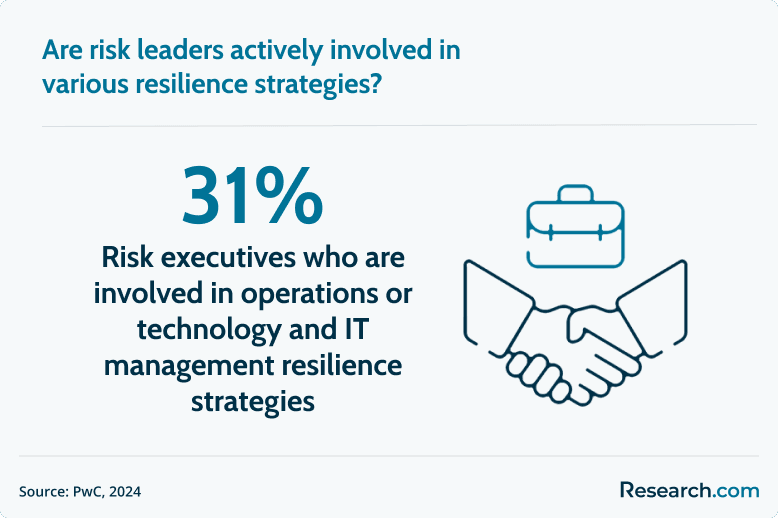
Cybersecurity and IT risk have become particularly important because risk and technology functions are often closely connected. According to PwC (2024), only 31% of risk executives actively participate in shaping resilience strategies for operations, technology, and IT management. That gap suggests a need for professionals who can translate technical risk into business strategy.
Some students also combine risk management with accounting or investigations. For example, a forensic accounting degree pathway can complement risk management training for students interested in fraud detection, financial investigations, audit risk, and litigation support.
How long does it take to complete a master’s in risk management?
Most full-time students finish a master’s in risk management in about two years. Part-time students often need more time, and completion can extend to three and a half years depending on course load, program structure, work schedule, and transfer policies.
Some schools offer accelerated formats that resemble the pacing of the fastest online business degree programs. These options may allow students to complete the degree in about 12 to 18 months, but they usually require a heavier workload and strong time management.
| Format | Typical completion time | Best for |
| Full-time | About two years | Students who can prioritize graduate study and want a traditional pace. |
| Part-time | Can extend to three and a half years | Working professionals who need to balance coursework with career and family responsibilities. |
| Accelerated | About 12 to 18 months | Students who can manage intensive coursework and want to finish quickly. |
| Online flexible format | Often similar to campus-based timelines | Professionals who need location flexibility and may want asynchronous coursework. |
Before choosing a faster program, ask whether you will have enough time for quantitative assignments, group projects, case analysis, internships, networking, and certification preparation. Finishing quickly is helpful only if the pace does not weaken learning outcomes or professional connections.
What certifications can I pursue after completing a master’s in risk management?
Certifications can help validate specialized risk skills after graduation. They are not interchangeable, so the best credential depends on your target role. Some financial services jobs may also require or prefer Financial Industry Regulatory Authority licensing, depending on job duties and employer requirements.
| Certification | Issuing organization | Best aligned roles |
| Financial Risk Manager | Global Association of Risk Professionals | Financial Risk Analyst, Portfolio Manager, Credit Risk Officer, and banking risk roles. |
| Certified Risk Manager | The National Alliance for Insurance Education and Research | Insurance risk, corporate risk, consulting, and risk management roles across sectors. |
| Professional Risk Manager | Professional Risk Managers’ International Association | Financial risk leadership, global banking, asset management, and regulatory risk positions. |
| Chartered Enterprise Risk Analyst | Society of Actuaries | Enterprise risk management, actuarial consulting, insurance, corporate risk, and public-sector risk roles. |
| Certified in Risk and Information Systems Control | Information Systems Audit and Control Association | IT risk manager, information security analyst, cyber risk, and technology governance roles. |
| Certified Risk Management Professional | Risk Management Society | Risk manager, compliance officer, director of risk management, and broad-based enterprise risk roles. |
Credentials can be especially useful in areas where employers need proof of current technical knowledge. GARP’s 2024 Second Global Risk Careers Survey found substantial knowledge gaps among risk professionals: 74% lack expertise in cryptocurrencies and decentralized finance, 68% report gaps in technology risk and cyber threats, 64% have limited knowledge in AI, and 57% report limited knowledge in sustainability and climate risk.
Those figures show why certification planning should be tied to emerging risk areas, not just traditional finance or insurance topics. The right credential can help you signal competence in the type of risk work employers are actively trying to strengthen.
This chart shows the knowledge area gaps among risk professionals.
How Do Accreditation and Rankings Influence Program Quality?
Accreditation is one of the first quality checks prospective students should complete. A recognized accreditation process helps confirm that a school meets established academic standards, supports appropriate faculty qualifications, and follows basic expectations for curriculum quality and student services.
Rankings can be useful, but they should not be the only basis for choosing a program. A highly ranked program may not be the best fit if it lacks your preferred specialization, offers limited flexibility, has weak career support, or costs more than you can reasonably justify. Accreditation helps answer whether the institution meets baseline quality expectations; rankings may help you compare reputation, selectivity, visibility, or outcomes.
Students comparing risk programs with broader business options may also want to review an affordable online MBA pathway to understand the trade-off between specialized risk training and general business management education.
What are the admission requirements for a master’s in risk management?
Admission requirements vary by school, but most programs expect applicants to hold a bachelor’s degree from an accredited institution. Preferred academic backgrounds often include finance, business, economics, accounting, mathematics, analytics, computer science, insurance, or another related field.
Common application materials include official transcripts, a resume, letters of recommendation, a statement of purpose, and sometimes GMAT or GRE scores. Some programs waive standardized tests for applicants with substantial professional experience or strong academic records.
How to strengthen your application
- Explain why risk management is the right next step, not just why you want a graduate degree.
- Connect your work experience to risk-related responsibilities such as analysis, controls, compliance, audit, insurance, finance, cybersecurity, or operations.
- Highlight quantitative readiness through coursework, analytics projects, certifications, or professional tasks.
- Show that you understand the program’s curriculum and how it supports your target role.
- Compare related options such as online MBA education if you are still deciding between specialization and broader management training.
How Does Curriculum Innovation Impact Your Master’s in Risk Management Program?
A strong risk management curriculum should not rely only on theory. Current programs increasingly use simulations, case studies, scenario analysis, data tools, and applied projects to help students practice decision-making under uncertainty.
Look for courses that address digital transformation, cyber risk, model risk, climate and sustainability concerns, enterprise risk governance, and analytics. These topics matter because risk professionals are often expected to explain emerging threats in business terms and help leaders make timely decisions.
Industry partnerships can also improve the learning experience by connecting students with guest speakers, real-world cases, applied projects, and networking opportunities. Students comparing pace and format may find it useful to look at structures similar to a fast online MBA, especially if they are balancing graduate study with full-time work.
How Can Interdisciplinary Collaboration Enhance Risk Management Outcomes?
Risk management works best when it brings together multiple viewpoints. Financial analysts, cybersecurity teams, legal departments, operations leaders, data scientists, auditors, sustainability teams, and executives often see different parts of the same risk picture.
A program that encourages interdisciplinary work can help students practice translating technical findings into decisions that non-specialists can understand. This matters in real organizations, where risk recommendations often involve trade-offs among cost, compliance, growth, security, and reputation.
Professionals interested in research, executive consulting, or long-term academic development may later consider advanced doctoral study. Comparing options such as the most affordable DBA programs can help experienced practitioners think about how doctoral-level business research differs from master’s-level professional preparation.
How Do I Choose the Best Master’s in Risk Management Program?
The best program is the one that fits your career target, budget, schedule, and preferred risk specialty. A strong program should make it clear what students learn, who teaches the courses, what practical experiences are available, and how graduates use the degree.
Questions to ask before enrolling
| Question | Why it matters |
| Is the institution properly accredited? | Accreditation affects academic credibility, transferability, employer confidence, and eligibility for many forms of financial aid. |
| Does the curriculum match my target role? | A student aiming for cyber risk needs different preparation than one targeting insurance, ERM, or market risk. |
| Who teaches the courses? | Faculty with industry experience, research expertise, or active professional networks can improve practical relevance. |
| Are there applied projects, simulations, internships, or industry partnerships? | Risk management is practice-oriented, so applied learning can help build job-ready evidence of skill. |
| What career support is available for graduate students? | Career coaching, employer connections, alumni networks, and resume support can influence job outcomes. |
| What is the total cost after fees, books, travel, and lost work time? | Tuition alone does not show the full investment required. |
| Can I study while working? | Working professionals should confirm scheduling flexibility, asynchronous options, and workload expectations. |
If flexibility and speed are important, compare risk management programs with other online degree programs that may offer faster or more affordable routes to career advancement. However, do not choose speed over quality, accreditation, or relevance to your target job.
What emerging trends are shaping risk management?
Risk management is expanding beyond traditional financial and insurance concerns. Employers increasingly expect risk professionals to understand digital disruption, artificial intelligence, cyber threats, climate exposure, ESG expectations, geopolitical uncertainty, supply chain weakness, third-party risk, and misinformation.
Artificial intelligence and big data are changing how organizations identify patterns, monitor exposures, and predict future losses. At the same time, these tools introduce new risks related to model reliability, bias, governance, privacy, and accountability.
Climate change and sustainability are also reshaping risk work. Organizations must assess physical climate risks, transition risks, regulatory expectations, investor concerns, and reputational exposure. For students evaluating long-term earning potential, risk management can be compared with other fields listed among high-paying master’s degree options, but career value will still depend on specialization, experience, and market demand.
What role do foundational credentials play in your risk management journey?
Your undergraduate background can influence both admissions and graduate-level success. Programs with quantitative coursework may be easier for students who already have preparation in statistics, finance, economics, accounting, mathematics, analytics, or technology.
If your academic foundation is weak in business or quantitative topics, consider filling gaps before applying. Relevant coursework, professional certificates, employer training, analytics projects, or earlier credentials can help demonstrate readiness.
Students who are still building toward bachelor’s or graduate study may compare preparatory options such as accelerated associate degree pathways. The key is to build skills that support later graduate work rather than choosing a credential only because it is fast.
What factors should you consider when selecting an online master’s in risk management program?
An online master’s in risk management can be a strong choice for working professionals, but quality varies. The best online program should offer more than recorded lectures. It should provide rigorous coursework, faculty access, technical support, career resources, and meaningful interaction with classmates and industry professionals.
| Online program factor | What to check |
| Accreditation | Confirm institutional accreditation and any relevant business-school recognition before applying. |
| Course delivery | Ask whether courses are asynchronous, synchronous, or blended, and whether live attendance is required. |
| Curriculum relevance | Look for current coverage of analytics, cyber risk, ERM, financial risk, climate risk, compliance, and applied casework. |
| Faculty access | Verify whether online students receive office hours, advising, mentoring, and timely feedback. |
| Career support | Check whether online students have access to internships, employer events, alumni networks, and career coaching. |
| Technology support | Make sure the learning platform, software tools, library access, and tech help are adequate for graduate work. |
Do not assume that an online program is easier or less rigorous. When comparing accessibility, it may be helpful to review broader lists such as the easiest degrees to get online, but a graduate risk management program should still challenge students with quantitative, analytical, and strategic work.
Should I pursue further doctoral studies after earning a master’s in risk management?
Most students who earn a master’s in risk management move into industry roles rather than doctoral study. A doctorate may be worth considering if your goal is academic research, teaching, policy work, high-level consulting, or advanced thought leadership in risk governance.
Doctoral programs usually emphasize research methods, theory development, data analysis, and original scholarship. That makes them different from professional master’s programs, which are typically designed around applied decision-making and career advancement.
If you are considering doctoral study, evaluate program rigor, dissertation expectations, faculty research alignment, time commitment, and credibility. Some professionals explore 2 year PhD programs online, but speed should not be the only factor. Research quality, supervision, accreditation, and career fit matter more than the shortest advertised timeline.
What are the advantages of an online master’s in risk management?
An online master’s in risk management can help working professionals build advanced skills without relocating or leaving their jobs. The format is especially useful for students who need scheduling flexibility, live far from campus, or want to apply coursework directly to their current workplace.
| Advantage | How it helps | What to watch for |
| Flexible scheduling | Asynchronous or hybrid courses can make it easier to study around work and family obligations. | Flexibility still requires discipline, especially in quantitative or project-heavy courses. |
| Broader peer network | Online cohorts may include students from different regions, industries, and career stages. | Networking may require more intentional participation than in a campus setting. |
| Convenience and potential cost savings | Students can avoid relocation and commuting costs, and some online programs may offer lower tuition than campus options. | Always compare total cost, including fees, books, software, and residency requirements. |
| Career continuity | Students can keep earning income while completing the degree. | Balancing full-time work and graduate study can extend the timeline. |
| Possible STEM designation or eligibility | Some programs may offer STEM-related benefits or technical training, depending on institutional classification and curriculum. | Confirm details directly with the school rather than assuming all risk programs qualify. |
Students comparing online graduate risk programs with business pathways may also review an online business administration degree as part of a longer educational plan. The right choice depends on your current credential level, professional experience, and target role.
What financial aid options are available for risk management graduate students?
Graduate school can be expensive, so students should compare funding options before committing to a program. The best approach is usually to combine several sources, such as scholarships, employer support, federal loans, assistantships, and personal savings.
| Financial aid option | What it offers | Who should consider it |
| Spencer Scholarship | The Spencer Educational Foundation awards full- and part-time master’s scholarships amounting to $10,000 for students majoring in risk management, insurance, or a related field. | Graduate students pursuing risk management or insurance-related study. |
| Association of Insurance Compliance Professionals Scholarship | AICP offers a $2,000 award and a one-year AICP membership for undergraduate and graduate students studying risk management and insurance. | Students interested in insurance compliance, regulation, and risk careers. |
| Securities and Insurance Licensing Association Foundation Scholarship | The SILA Foundation awards 12 $1,250 scholarships to undergraduate and graduate students interested in insurance and risk management careers. | Students planning to enter insurance, licensing, compliance, or risk management roles. |
| Student loans | Federal student loans may offer competitive interest rates and flexible repayment options; private loans may offer higher borrowing limits but can involve stricter credit requirements and higher interest rates. | Students who need to finance remaining costs after grants, scholarships, and employer aid. |
| Employer tuition assistance | Employers may pay part of tuition in exchange for GPA requirements, continued employment, or role-related study. | Working professionals whose employers benefit from stronger risk management skills. |
| Graduate assistantships | Some universities provide stipends and tuition waivers in exchange for part-time academic or research work. | Students who can contribute to research, teaching support, or administrative projects while studying. |
When comparing affordability, look beyond tuition. Include fees, books, travel, technology requirements, lost income, and the time required to finish. Students comparing business-related graduate costs may also review the cost of online MBA programs to benchmark how risk management pricing compares with other graduate business options.
What is the job outlook for risk managers?
The outlook for risk management professionals is favorable because organizations need people who can identify threats, reduce losses, improve compliance, and support resilient decision-making. Demand is especially relevant in finance, insurance, healthcare, technology, manufacturing, government, and consulting.
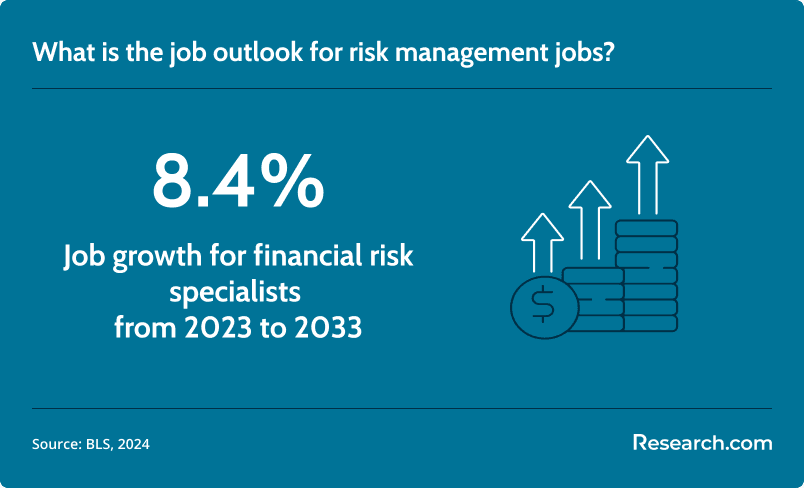
According to the U.S. Bureau of Labor Statistics, employment for financial risk specialists is expected to grow by 8.4% from 2023 to 2033, producing approximately 4,600 job openings each year over the next decade. A 2024 GARP survey also found that 73% of its members expect career opportunities in the field to increase.
The work is also expanding into newer areas. The Federation of European Risk Management Association’s Global Risk Manager Survey Report (2024) found that 81% of risk managers are addressing ESG risks and 60% are incorporating climate change risks into their strategies. These figures show that risk management is no longer limited to financial loss prevention; it increasingly includes sustainability, climate, technology, governance, and reputation.
Students who want the strongest job prospects should build a profile that combines graduate education with practical experience, data literacy, communication skills, certification planning, and knowledge of emerging risk areas.
Common Mistakes to Avoid When Choosing a Master’s in Risk Management
| Mistake | Why it can hurt you | Better approach |
| Choosing a program without checking accreditation | A weak or unrecognized institution can limit employer confidence and financial aid options. | Verify institutional accreditation before applying. |
| Looking only at tuition | Fees, books, software, travel, and lost work time can change the true cost. | Calculate total cost of attendance and compare it with likely career benefits. |
| Assuming all risk degrees lead to the same jobs | Financial risk, cyber risk, insurance, ERM, and compliance require different skills. | Choose a specialization based on your target role. |
| Ignoring technical skills | Many risk roles require data analysis, modeling, systems knowledge, or regulatory documentation. | Prioritize programs with quantitative work, analytics, simulations, and applied projects. |
| Relying only on rankings | A ranked program may not fit your schedule, budget, location, or specialty. | Use rankings as one input, not the deciding factor. |
| Assuming salary outcomes are guaranteed | Pay varies by role, industry, location, experience, and credentials. | Review job postings and talk with alumni in your target market. |
| Overlooking certification alignment | A degree may not fully prepare you for every credential or licensing requirement. | Map coursework to certifications such as FRM, PRM, CRISC, CRM, CERA, or CRMP. |
Here’s What Graduates Have to Say About Their Master’s in Risk Management
- “Completing my master’s in risk management online worked well with my schedule. I could keep working while moving through the coursework, and the case studies made the material feel connected to real business problems. The simulations helped me practice applying concepts instead of only reading about them. I also valued the chance to meet classmates working in different industries. The program gave me more confidence about pursuing advancement in my field.” - Jonah
- “The online format allowed me to continue handling my personal and professional responsibilities while earning the degree. I appreciated that the program covered risk across multiple sectors rather than treating it as one narrow topic. Discussions with faculty and classmates helped me see how other organizations approach similar challenges. Because I was already working in corporate risk management, I could connect assignments to my current job. I finished feeling better prepared for complex risk decisions.” - Arianne
- “I chose an online master’s in risk management because I wanted to focus on enterprise risk. Studying from home removed the commute and made the program easier to manage with work. The classes were demanding, but I could use what I learned almost immediately in my consulting role. The online system was straightforward, and I felt supported by instructors and peers. The degree helped me feel more ready to compete for senior risk roles.” - Dean
Key Insights
- A master’s in risk management is best for students who want specialized roles in enterprise risk, financial risk, cyber risk, compliance, insurance, model risk, or executive risk leadership.
- The degree is not automatically better than an MBA. Choose risk management for depth; choose an MBA if you want broader business leadership flexibility.
- Salary potential can be strong, especially in senior and technical roles. Financial risk specialists in monetary authorities or central banking average $163,510 yearly, and professionals in New York average $159,350 annually.
- Risk work is expanding into cybersecurity, AI, ESG, climate risk, geopolitical risk, and technology governance. Only 31% of risk executives actively participate in shaping resilience strategies for operations, technology, and IT management, creating room for professionals who can bridge those gaps.
- Knowledge gaps are a career opportunity. GARP reported that 74% of risk professionals lack expertise in cryptocurrencies and decentralized finance, 68% have gaps in technology risk and cyber threats, 64% have limited AI knowledge, and 57% have limited sustainability and climate risk knowledge.
- The job outlook is positive. Employment for financial risk specialists is expected to grow by 8.4% from 2023 to 2033, with about 4,600 job openings each year over the decade.
- Program choice matters. Before enrolling, check accreditation, specialization options, faculty expertise, applied learning, career support, total cost, and whether the format fits your work schedule.
- Certifications can strengthen the degree’s value. FRM, PRM, CRM, CERA, CRISC, and CRMP each support different risk career paths, so choose based on your target role rather than name recognition alone.
- Risk management is increasingly strategic. FERMA reported that 81% of risk managers are addressing ESG risks and 60% are incorporating climate change risks into their strategies.
References:
- Elsner, M., Atkinson, G., Zahidi, S. (2025, January 15). Global Risks Report 2025. World Economic Forum. https://www.weforum.org/publications/global-risks-report-2025
- Global Association of Risk Professionals. (2024). Second Global Risk Careers Survey 2024. https://www.garp.org/white-paper/2024-risk-careers-survey
- PayScale. (2025). Average Chief Risk Officer (CRO) Salary. Retrieved February 12, 2025, from https://www.payscale.com/research/US/Job=Chief_Risk_Officer_(CRO)/Salary
- U.S. Bureau of Labor Statistics. (2024, April 3). Occupational Employment and Wages, May 2023 - Financial Risk Specialists. Occupational Outlook Handbook. https://www.bls.gov/oes/2023/may/oes132054.htm
- U.S. Bureau of Labor Statistics. (2024, August 29). Occupational projections, 2023–33, and worker characteristics, 2023 (Numbers in thousands). Employment Projections. https://www.bls.gov/emp/tables/occupational-projections-and-characteristics.htm
Other Things You Should Know About Getting a Master’s in Risk Management
In 2027, the earning potential for someone with a master’s in risk management can vary widely based on industry and location. Generally, salaries range from $70,000 to over $120,000 annually, with higher figures in sectors like finance and insurance. Experienced professionals may earn significantly more.
A master's in risk management is a graduate program that equips students with the knowledge and skills to identify, assess, and mitigate risks in various sectors. This program often covers finance, insurance, operational, and strategic risk management, preparing graduates for roles such as risk managers, compliance officers, and insurance analysts.


