
2027 Where Can You Earn an Online Master’s in Real Estate?

Co-Founder and Chief Data Scientist
Choosing an online master’s in real estate is a career and financial decision, not just an academic one. The right program can help you move into real estate development, investment analysis, asset management, brokerage leadership, corporate real estate, or property management. The wrong program may leave you with debt, limited networking access, or coursework that does not match the roles you want.
This guide is for working professionals, career changers, recent graduates, and real estate practitioners comparing online graduate programs for 2026 planning. It explains what these programs teach, what they cost, how long they take, which schools are listed, how online learning works, and how to judge whether the degree is worth the investment for your goals.
Real estate remains a relationship-driven and market-sensitive field, but employers increasingly value professionals who can interpret financial models, assess risk, understand zoning and development rules, evaluate market data, and manage complex property portfolios. In 2024, reports showed that about 46,000 new real estate jobs will open annually until 2033, which means graduate-level training may help experienced professionals compete for more advanced opportunities.
Quick answer: Is an online master’s in real estate worth considering?
An online master’s in real estate can be worthwhile if you want specialized graduate training in development, real estate finance, investment strategy, valuation, market analysis, or property portfolio management. It is most useful for students who already know they want to work in real estate or an adjacent field. If you want broader management flexibility across industries, an MBA may be a better fit.
What are the main benefits of earning an online master’s in real estate?
- Graduates can prepare for roles in brokerage management, commercial property development, real estate investment, corporate real estate, consulting, and portfolio management.
- Coursework typically emphasizes real estate finance, market research, valuation, property law, development strategy, and applied projects based on real market conditions.
- The degree may support advancement into higher-responsibility roles. Real estate brokers earned a median salary of $63,060, while professionals in asset management or development can earn $100,000 or more annually, depending on role, market, experience, and deal flow.
What can I expect from an online master’s in real estate?
An online master’s in real estate is a graduate program focused on the business, legal, financial, and development sides of property markets. Unlike a general business degree, it concentrates on how real estate assets are acquired, financed, built, valued, leased, sold, and managed.
Most programs include courses in real estate finance, investment analysis, market research, property law, urban development, valuation, and project management. Some programs also offer electives or concentrations in sustainable development, commercial real estate, international real estate, asset management, or real estate technology.
Students should expect applied assignments rather than purely theoretical work. Common projects include financial modeling, feasibility studies, site analysis, property valuation, investment memos, zoning reviews, and development proposals. These projects are important because real estate employers often look for candidates who can evaluate deals, communicate risk, and support investment decisions with data.
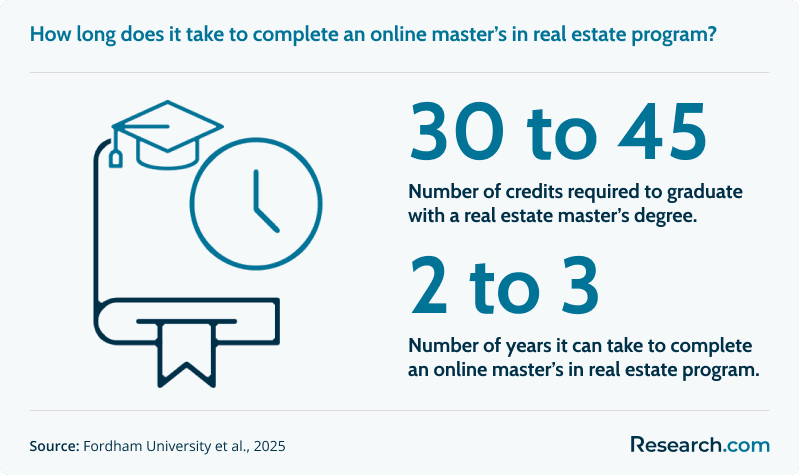
Tuition differs widely by institution. Many programs charge between $500 and $1,500 per credit hour. A full program commonly requires 30 to 45 credit hours, which places total tuition between $15,000 and $67,500 before fees, books, travel, software, or other costs. Students should confirm the current tuition directly with each school because online rates can change by academic year.
Most students finish in 12 to 24 months, though part-time students may take longer. Accelerated formats may allow completion in as little as a year, while students balancing work, family, licensing preparation, or internships may prefer a slower pace.
| Program feature | What it usually means for students | Why it matters |
| Credit load | Often 30 to 45 credit hours | Affects total tuition, workload, and time to graduation |
| Course format | Asynchronous, live online, or a mix of both | Determines how easily you can study around work obligations |
| Applied projects | Capstones, case studies, market analyses, and investment models | Helps build portfolio-ready evidence of your skills |
| Specializations | Finance, development, sustainability, valuation, management, or international real estate | Allows you to align coursework with a target career path |
| Networking access | Mentorship, alumni events, virtual panels, site visits, or employer partnerships | Real estate hiring often depends heavily on relationships and market knowledge |
Where can I work with an online master’s in real estate?
Graduates can pursue work in commercial real estate, residential brokerage leadership, development firms, REITs, investment companies, banks, consulting firms, corporate real estate departments, property management companies, and public-sector housing or planning agencies.
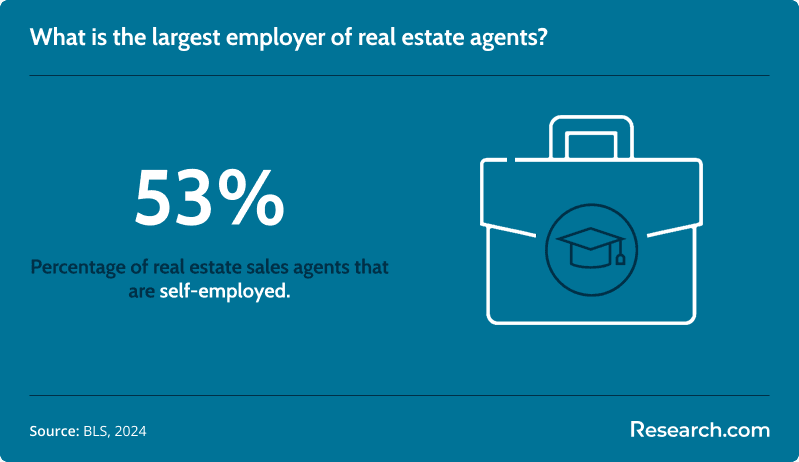
Many real estate professionals work independently or operate their own firms. Data published in 2024 found that 54% of real estate brokers and sales agents are self-employed. A graduate degree does not replace licensure where required, but it can deepen expertise in valuation, investment analysis, financing, market strategy, and deal evaluation.
Students interested in commercial real estate often target roles in asset management, acquisition analysis, development, investment underwriting, or portfolio strategy. Others may work in government or nonprofit settings on housing, redevelopment, land use, urban planning, or community development projects.
Newer career paths also include prop-tech, sustainability-focused development, data-driven market analysis, and real estate consulting. These areas reward professionals who understand both the physical property market and the financial or technological systems behind it.
How much can I make with an online master’s in real estate?
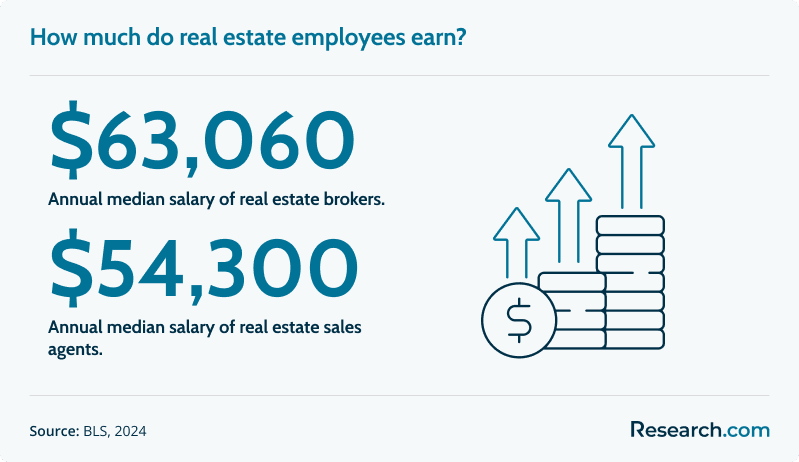
Salary depends heavily on location, property type, market cycle, compensation structure, licensure, experience, and whether the role includes commissions or bonuses. According to data published by the BLS in 2024, real estate brokers earned a median annual wage of $63,060, while real estate sales agents earned a median salary of $54,300.
Compensation may be higher in commercial real estate, investment, development, and corporate portfolio roles. Real estate analysts earn between $70,000 and $100,000 annually, while asset managers can make $80,000 to $120,000 based on experience. Senior roles such as real estate development manager or director can reach $150,000 or more, often with performance-based bonuses.
Self-employed brokers, developers, and investors may earn substantially more or less depending on transactions, capital access, local demand, and client base. The degree can improve your skill set, but it does not guarantee a specific salary. Real estate income is often cyclical and can change quickly with interest rates, lending conditions, supply, and local market demand.
- List of the Best Online Master’s in Real Estate for 2027
- How long does it take to complete an online master's in real estate program?
- What is the learning experience like in an online real estate master’s program?
- Are there affordable online master’s in real estate programs?
- What are the financial aid options for students enrolling in an online master’s in real estate program?
- Can I apply for an online real estate program without a background in real estate?
- How does an online master’s in real estate compare with an MBA?
- What accreditation and industry certifications should I verify for an online master’s in real estate program?
- Can combining an online master’s in real estate with business administration accelerate my career?
- How do online master’s programs adapt to evolving industry trends?
- How do online master’s programs foster professional networking and industry partnerships?
- Can pursuing a complementary business degree enhance my real estate career?
- What support services are available to help online real estate students succeed?
- What criteria should I use to evaluate an online master’s in real estate program?
- How can an online master’s in real estate foster entrepreneurial success?
- How do online master’s programs integrate advanced finance strategies into the real estate curriculum?
- How can online students gain practical experience in real estate development?
- What types of specializations are available in an online master’s in real estate program?
- What outcomes can I expect after completing an online master’s in real estate program?
- How long does it typically take to see a return on investment from an online real estate degree?
- What is the job market for graduates with an online master’s in real estate degree?
List of the Best Online Master’s in Real Estate for 2027
How do we rank schools?
Selecting a real estate graduate program requires more than comparing tuition. You also need to look at academic quality, institutional data, program structure, and student outcomes. Research.com uses information from sources such as IPEDS, Peterson’s, the College Scorecard, and the National Center for Education Statistics to support ranking decisions. Readers can review the process on Research.com’s methodology page.
The programs below differ in cost, credit requirements, delivery model, and career emphasis. Use the list as a starting point, then verify current tuition, admissions policies, transfer rules, course availability, and any residency or site-visit expectations with each institution.
| School | Program focus | Credits | Cost listed | Accreditation |
| Fordham University | Real estate development, law, finance, construction, and project management | 36 | $1,610 per credit hour | Middle States Commission on Higher Education (MSCHE) |
| Georgetown University | Finance, sustainability, development, management, and ethical leadership | 33 | $51,909 total tuition | MSCHE |
| University of Arizona | Online real estate development with financial analysis, forecasting, and applied projects | 30 | $850 per credit hour | WASC Senior College and University Commission (WSCUC) |
| Florida International University | International real estate, technology tools, finance, law, and market analysis | 30 | $28,000 for residents, $30,000 for non-residents | Southern Association of Colleges and Schools Commission on Colleges (SACSCOC) |
| Liberty University | MBA in real estate development combining business administration and real estate operations | 45 | $565 per credit hour for full-time students, $615 per credit hour for part-time students | SACSCOC |
Fordham University
Fordham University offers a Master of Science in Real Estate Development (MSRED) designed for students who want structured preparation in development leadership. The curriculum addresses real estate law, finance, construction, project management, zoning, market analysis, and investment strategy. Students complete 27 core credits, 6 elective credits, and a 3-credit capstone project. Its New York City setting supports site visits and mentoring opportunities, which may be valuable for students interested in urban development and complex property markets.
- Required Credits to Graduate: 36
- Cost: $1,610 per credit hour
- Accreditation: Middle States Commission on Higher Education (MSCHE)
Georgetown University
Georgetown University offers an online Master of Professional Studies in Real Estate for students seeking advanced training in finance, sustainability, development, and management. The program emphasizes ethical decision-making and leadership in real estate practice. Courses are asynchronous, but students may also access live events, networking options, and the opportunity to attend campus classes. This format may work well for professionals who need flexibility but still want access to a university network.
- Required Credits to Graduate: 33
- Cost: $51,909 total tuition
- Accreditation: MSCHE
University of Arizona
The University of Arizona offers a 100% online Master of Real Estate Development (MRED) built around a three-phase curriculum. Students begin with real estate fundamentals, then move into financial analysis, market forecasting, investment analysis, project management, and socially responsible development. The final phase asks students to apply these concepts to real development challenges, making the program relevant for careers in development, real estate law, and market analysis.
- Required Credits to Graduate: 30
- Cost: $850 per credit hour
- Accreditation: WASC Senior College and University Commission (WSCUC)
Florida International University
Florida International University offers a Master of Science in International Real Estate (MSIRE) with a global and technology-oriented focus. Students study real estate finance, law, development, market analysis, and industry tools such as ARGUS and GIS. The curriculum also supports preparation for real estate licensing exams and industry designations. Networking, property tours, and industry events can help students connect classroom learning with the professional market.
- Required Credits to Graduate: 30
- Cost: $28,000 for residents, $30,000 for non-residents
- Accreditation: Southern Association of Colleges and Schools Commission on Colleges (SACSCOC)
Liberty University
Liberty University offers a Master of Business Administration in Real Estate Development for students who want a real estate concentration within a broader business degree. The 100% online MBA includes real estate operations, investment analysis, property law, finance, marketing, and management coursework. Multiple start dates and online delivery may appeal to working adults who want both business administration training and real estate-specific knowledge.
- Required Credits to Graduate: 45
- Cost: $565 per credit hour for full-time students, $615 per credit hour for part-time students
- Accreditation: SACSCOC
How long does it take to complete an online master's in real estate program?
A full-time online master’s in real estate often takes about two years, but program length depends on credit requirements, course sequencing, enrollment pace, and whether the school offers accelerated terms. Part-time students may need three years or longer, especially if they take one course at a time while working.
Accelerated options can shorten the timeline. Some students finish in as little as 18 months by taking heavier course loads, enrolling year-round, or completing intensive sessions. This can reduce time away from career advancement, but it also increases weekly workload.
Capstones, internships, practicums, thesis options, and fieldwork can also affect completion time. These requirements may add scheduling complexity, but they can be valuable if they help you build a portfolio, make employer connections, or test a career direction before graduation.
| Enrollment path | Typical timeline | Best for | Trade-off |
| Accelerated | As little as 18 months | Students with strong time management and clear career goals | Higher weekly workload and less scheduling flexibility |
| Full-time | About two years | Students who can prioritize graduate study | May be harder to balance with demanding employment |
| Part-time | Three years or longer | Working professionals, parents, and career changers | Slower graduation and potentially longer time to career payoff |
If you are still comparing fields, the best online criminology programs may be worth reviewing for careers tied to law enforcement, compliance, corporate investigations, or security-focused work.
What is the learning experience like in an online real estate master’s program?
Online real estate master’s programs are usually built for adults who need flexibility without giving up applied learning. Courses may be asynchronous, live online, or blended. The strongest programs do more than post lectures; they use deal analysis, financial modeling, property research, group projects, and instructor feedback to simulate professional decision-making.
Students commonly encounter the following learning elements:
- Applied coursework: Assignments may involve market studies, pro forma analysis, valuation exercises, development proposals, or investment recommendations.
- Live and recorded instruction: Some classes require scheduled discussions, while others let students complete lectures and modules on their own time.
- Peer and alumni interaction: Many programs use virtual networking events, alumni panels, team projects, and mentorship to help students build industry contacts.
- Industry software exposure: Depending on the program, students may work with tools such as ARGUS, GIS mapping, spreadsheets, and financial analysis platforms.
- Capstone work: Final projects often ask students to evaluate a development opportunity, analyze a market, or create an investment strategy using real-world assumptions.
Students comparing institutions can use Research.com’s guide to the best online colleges to understand what quality online education, student support, and institutional credibility can look like across program types.
Cost-conscious applicants should also ask, “Is it cheaper to go to college online?” The answer depends on tuition structure, fees, residency rules, commuting costs, housing savings, and whether the school charges online students differently from campus students.
Are there affordable online master’s in real estate programs?
Yes. Affordable online master’s in real estate programs are available, but students need to compare total cost rather than tuition alone. In the 2023-24 academic year, full-time graduate students at public universities paid an average of $11,827 in tuition and fees, while private universities charged around $20,515. Public universities, in-state rates, flat-rate online tuition, and transfer-friendly policies may reduce the final cost.
An online real estate master’s can be a cost-effective alternative to some broader graduate business programs if your goals are concentrated in development, investment, management, or real estate finance. Students comparing business-focused pathways may also want to review options for an affordable business management degree online, especially if they want broader management training.
To estimate affordability, calculate the full price of attendance. Include tuition, technology fees, books, software, travel for residencies or site visits, graduation fees, and the opportunity cost of reducing work hours. Also ask whether the program accepts transfer credits or prior graduate coursework, because reducing even a few credits can lower the total bill.
| Cost factor | Question to ask | Why it affects affordability |
| Tuition model | Is tuition charged per credit, per term, or as a flat online rate? | The pricing model can change the cost of full-time versus part-time study |
| Residency status | Do online students qualify for in-state or resident pricing? | Some public universities charge different rates by residency |
| Transfer credits | Can prior graduate coursework reduce required credits? | Accepted credits can shorten the program and lower tuition |
| Fees and software | Are technology, platform, or industry tool fees separate? | Extra charges can raise the total cost beyond listed tuition |
| Time to completion | Can I graduate faster without overloading myself? | A shorter timeline may reduce indirect costs but can increase workload |
Students interested in related finance and risk fields may also ask, “What can I do with bachelors in a risk management?” Risk management can lead to insurance, corporate risk, financial analysis, and compliance roles that overlap with real estate finance and investment decision-making.
Professionals in other industries often look for flexible advancement routes as well. For example, nurses considering graduate study may search, “What is the easiest RN to MSN program online?” The comparison is different, but the decision logic is similar: verify admissions requirements, accreditation, cost, career outcomes, and support before enrolling.
The chart below illustrates the education level of most realtors, as reported by the NAR in 2024.
What are the financial aid options for students enrolling in an online master’s in real estate program?
Graduate students in online real estate programs may qualify for several types of aid. Availability depends on citizenship or eligible non-citizen status, school participation, enrollment intensity, academic progress, employer policies, military status, and scholarship criteria.
- Federal financial aid: U.S. citizens and eligible non-citizens can complete the Free Application for Federal Student Aid (FAFSA). Graduate students may be eligible for federal loans such as Direct Unsubsidized Loans and Direct PLUS Loans.
- Institutional scholarships: Universities may offer merit-based, need-based, or program-specific scholarships for real estate, business, or graduate students. Some awards target women, veterans, first-generation students, or underrepresented groups in the industry.
- Real estate industry scholarships: Professional organizations, including the National Association of Realtors (NAR), may offer scholarship opportunities for students pursuing real estate education.
- Employer tuition assistance: If you work for a real estate firm, bank, developer, construction company, government agency, or corporate real estate department, ask whether tuition reimbursement is available and whether you must remain employed for a certain period after receiving support.
- Private student loans: Banks, credit unions, and private lenders may offer graduate student loans. Compare them carefully with federal loans because repayment protections, rates, and deferment options may differ.
- Veterans' benefits: Veterans and active-duty service members may be able to use GI Bill benefits or other education benefits through the U.S. Department of Veterans Affairs (VA).
Can I apply for an online real estate program without a background in real estate?
Yes. Many online master’s in real estate programs admit students who do not have direct real estate experience. Career changers often come from finance, construction, architecture, law, public administration, planning, sales, banking, or general business. Some programs may offer foundation courses for students who need preparation before advanced real estate coursework.
Admissions requirements commonly include:
- A bachelor’s degree: A real estate bachelor's degree can be helpful, but many programs also consider applicants with degrees in business, finance, economics, construction, architecture, public policy, or related areas.
- Professional experience: Some programs prefer applicants with work experience, although it may not always be required.
- Test scores: GRE or GMAT requirements vary. Many schools have made standardized tests optional or do not require them, but applicants should check each program.
- Recommendations: Schools often ask for academic or professional references who can speak to your readiness for graduate study.
- Statement of purpose: Applicants usually explain why they want to study real estate, what roles they are targeting, and how the degree fits their career plan.
If you lack industry experience, strengthen your application by learning basic real estate terminology, completing introductory finance or Excel coursework, attending local real estate association events, or speaking with professionals in your target sector. A clear career rationale can matter as much as prior exposure.
How does an online master’s in real estate compare with an MBA?
An online master’s in real estate is specialized. It is designed for students who want deep training in property markets, development, investment analysis, valuation, land use, and real estate finance. An MBA is broader and usually covers leadership, accounting, finance, operations, marketing, strategy, and organizational management across many industries.
The better choice depends on your target role. If you want to underwrite real estate deals, manage development projects, work in acquisitions, or build expertise in commercial property, the real estate master’s may be more direct. If you want flexible leadership options in multiple industries, a broader MBA may offer more mobility. Students still deciding between degree types can read more in Is an MBA worth it?.
| Degree option | Best fit | Core advantage | Possible limitation |
| Online master’s in real estate | Students focused on development, investment, brokerage leadership, or property markets | Direct industry relevance and specialized real estate coursework | Less flexible outside real estate and adjacent fields |
| MBA | Students seeking broad management, consulting, finance, or executive roles | Transferable business training across industries | May include limited real estate coursework unless a concentration is available |
| MBA with real estate concentration | Students wanting business breadth plus some real estate specialization | Balances management education with property-market exposure | May not go as deep into development, valuation, or real estate law as a dedicated degree |
What accreditation and industry certifications should I verify for an online master’s in real estate program?
Accreditation should be one of your first checks. A regionally accredited institution is more likely to be recognized by employers, licensing boards, transfer institutions, and financial aid systems. For the programs listed above, accreditors include MSCHE, WSCUC, and SACSCOC.
Also ask whether the curriculum aligns with industry designations, licensing preparation, or professional tools relevant to your goals. Some programs may support preparation for real estate licensing exams, appraisal pathways, ARGUS training, GIS skills, or sustainability credentials. Do not assume a degree automatically qualifies you for state licensure; real estate licensing rules are state-specific and may require separate coursework, exams, experience, or continuing education.
Students comparing quality assurance across business programs may find it useful to review options such as an affordable MBA online, especially when evaluating accreditation, cost, academic support, and career services.
Can combining an online master’s in real estate with business administration accelerate my career?
Combining real estate specialization with business administration can be valuable if your goals include executive leadership, entrepreneurship, investment strategy, or cross-functional management. Real estate professionals often need to understand finance, negotiation, operations, marketing, risk, legal constraints, and team leadership. Business coursework can strengthen those broader capabilities.
Some students pursue an MBA with a real estate concentration, while others complete a real estate master’s and add certificates or electives in finance, accounting, analytics, or management. Comparing curricula from the best online MBA programs can help you decide whether you need a specialized degree, a broader MBA, or a hybrid path.
How do online master’s programs adapt to evolving industry trends?
Real estate graduate programs are adjusting to a market shaped by technology, sustainability expectations, changing work patterns, affordability pressures, and data-driven investment decisions. Strong online programs update coursework to include topics such as prop-tech, data analytics, sustainable development, market forecasting, risk assessment, and digital collaboration.
Students should look for evidence that a program keeps pace with the field. Useful signs include industry advisory boards, faculty with current professional experience, case studies based on recent market conditions, exposure to real estate software, and projects tied to active development or investment questions. If you are comparing cost across related business options, Research.com’s resource on business degree online cost can provide another benchmark.
How do online master’s programs foster professional networking and industry partnerships?
Networking matters in real estate because many roles are filled through referrals, local market relationships, alumni connections, and professional associations. Online programs can support networking through virtual employer panels, alumni events, mentorship programs, group projects, site visits, internship referrals, and access to career services.
Before enrolling, ask how often students interact with employers and alumni, whether virtual students receive the same career support as campus students, and whether the school has relationships with developers, brokerages, lenders, REITs, public agencies, or consulting firms. Students exploring advanced business credentials may also compare related doctoral options such as cheap DBA online programs if long-term goals include consulting, teaching, or executive research-focused work.
Can pursuing a complementary business degree enhance my real estate career?
Business coursework can strengthen a real estate career when it fills a specific skills gap. For example, finance courses can improve underwriting and investment analysis, management courses can support team leadership, and strategy courses can help with market positioning or business development.
A complementary credential is most useful when it supports a defined career move. If you want to launch a brokerage, lead a development company, manage acquisitions, or move into corporate real estate leadership, additional business training may help. Students who need a faster route to broader business skills can compare options such as a business degree online fast.
What support services are available to help online real estate students succeed?
Support services can make a major difference in an online graduate program, especially for students returning to school while working full time. Look for academic advising, tutoring, technical support, library access, writing support, career coaching, resume reviews, mock interviews, employer events, and alumni mentoring.
Career services are especially important in real estate because students may need help translating coursework into a portfolio, finding internships, preparing for interviews, or identifying local market opportunities. Some programs also give students access to supplemental business resources similar to those promoted by the quickest MBA programs.
What criteria should I use to evaluate an online master’s in real estate program?
Do not choose a program based only on ranking or brand name. The best program is the one that fits your target role, budget, learning style, and professional network needs.
| Evaluation factor | What to verify | Red flag |
| Accreditation | Institutional accreditation and recognition by relevant education authorities | The school is unclear about accreditation or uses vague language |
| Curriculum fit | Courses in your target area, such as finance, development, valuation, or management | The curriculum is too general for your real estate goals |
| Faculty experience | Academic credentials and current or recent real estate industry involvement | Faculty profiles do not show relevant expertise |
| Applied learning | Capstones, deal analysis, internships, software tools, and case-based assignments | The program relies mainly on lecture and discussion without practical projects |
| Career support | Employer connections, alumni network, mentorship, and job search assistance | Online students receive limited access to career services |
| Total cost | Tuition, fees, software, books, travel, and financing terms | The school promotes tuition but does not clearly explain total expenses |
| Flexibility | Course timing, asynchronous options, part-time policies, and leave options | Required meeting times conflict with your work schedule |
Students comparing executive or management-focused alternatives can also review the cheapest executive MBA online programs to understand how price, experience level, and leadership focus differ across graduate business options.
How can an online master’s in real estate foster entrepreneurial success?
Real estate entrepreneurship requires more than sales ability. Entrepreneurs must evaluate market demand, secure financing, understand legal constraints, manage risk, negotiate with partners, and build a pipeline of profitable opportunities. A strong online master’s program can help students practice these skills through feasibility studies, business plans, development proposals, investment pitches, and market-entry strategies.
This training may benefit students who want to start a brokerage, launch a development firm, invest in property, build a consulting practice, or create a prop-tech venture. Students exploring entrepreneurial careers more broadly can compare outcomes in Research.com’s guide to what jobs can you get with entrepreneurship degree.
How do online master’s programs integrate advanced finance strategies into the real estate curriculum?
Finance is central to graduate real estate education because most real estate decisions involve capital structure, risk, projected income, debt, equity, market timing, and asset valuation. Advanced programs often teach students to evaluate cash flows, model investment scenarios, assess feasibility, compare financing strategies, and understand how market changes affect property performance.
Coursework may use case studies, spreadsheets, simulations, and investment memos to help students connect theory to deal-level analysis. Students who want additional finance training may also review finance online programs fast completion as a complementary or alternative route.
How can online students gain practical experience in real estate development?
Online students can gain practical experience if they choose programs that intentionally connect coursework to real property decisions. Because real estate is applied and local, students should look for projects that require market research, financial modeling, zoning analysis, stakeholder communication, and professional presentation.
- Capstone projects: These may require students to evaluate a site, prepare a development plan, analyze market demand, or present an investment strategy.
- Internships: Some schools help students find virtual or in-person placements with developers, brokerages, property firms, investment companies, or public agencies.
- Case studies and simulations: Students may analyze actual or realistic transactions to practice valuation, underwriting, legal review, and risk analysis.
- Mentorship and networking: Alumni, faculty, and industry professionals can help students understand local market dynamics and career pathways.
- Short intensive formats: Some 1 year graduate programs combine accelerated coursework with applied projects, consulting assignments, fieldwork, or site visits.
What types of specializations are available in an online master’s in real estate program?
Specializations help students build depth in a particular segment of the real estate industry. The right concentration depends on whether you want to analyze deals, manage assets, develop property, oversee buildings, value property, or focus on sustainability.
| Specialization | Common topics | Career direction |
| Real Estate Development | Land acquisition, zoning, construction management, project finance, feasibility, and public approvals | Developer, development analyst, project manager, redevelopment specialist |
| Real Estate Finance and Investment | Financial modeling, risk assessment, lending, capital markets, acquisitions, and portfolio analysis | Investment analyst, acquisitions associate, asset manager, commercial lending professional |
| Property Management | Lease administration, tenant relations, maintenance planning, operations, budgeting, and property law | Property manager, portfolio manager, community association manager |
| Real Estate Valuation and Appraisal | Market trends, appraisal methods, valuation models, and property assessment | Appraisal, valuation consulting, banking, government assessment, investment support |
| Sustainable Real Estate and Green Development | Energy-efficient design, environmental regulation, green building practices, and LEED-related concepts | Sustainability-focused development, ESG property strategy, green building consulting |
The chart below lists the largest employers of property, real estate, and community association managers, as reported by the BLS in 2024.
What outcomes can I expect after completing an online master’s in real estate program?
Graduates can expect stronger technical knowledge, a broader professional network, and preparation for more specialized real estate roles. Outcomes vary by prior experience, local market conditions, school reputation, networking effort, and the student’s ability to apply coursework to real deals.
- Career mobility: Graduates may move into roles such as development analyst, real estate investment analyst, property manager, asset manager, corporate real estate advisor, or development manager.
- Potential salary growth: Professionals who move from entry-level work into commercial real estate, asset management, investment, or development may see higher compensation, though earnings are not guaranteed.
- Expanded network: Alumni groups, faculty contacts, real estate associations, mentorship programs, and employer events can support career searches and deal opportunities.
- Specialized expertise: Students build skills in finance, valuation, sustainable development, market analysis, legal issues, and risk assessment.
- Additional education options: Some graduates pursue certificates, licenses, designations, or broader management training such as accelerated MBA programs online.
How long does it typically take to see a return on investment from an online real estate degree?
The ROI timeline for an online master’s in real estate depends on tuition, debt, current income, salary growth, job placement, market conditions, and whether the student already has industry experience. Professionals already working in real estate may see benefits sooner because they can apply new skills directly to promotions, deals, or internal role changes.
- Salary movement: Graduates entering commercial real estate investment, development, asset management, or property management may see compensation gains if the degree helps them move into higher-responsibility roles.
- Market conditions: The health of the real estate and housing market can affect hiring, deal volume, commissions, and development activity.
- Prior experience: Students already in real estate may convert the degree into advancement faster than career changers who still need to build contacts and experience.
- Total education cost: Graduates who secure roles with strong earning potential, such as real estate development managers or asset managers, often recoup their tuition within 3 to 5 years.
Common mistakes when evaluating ROI
- Counting only tuition: Fees, books, software, travel, and loan interest can materially change the true cost.
- Assuming a degree guarantees a salary increase: Real estate compensation depends on role, market, performance, licensing, and experience.
- Ignoring local market strength: A strong program cannot fully offset weak local hiring or limited deal activity.
- Overlooking networking value: In real estate, relationships may influence ROI as much as coursework.
- Choosing the fastest program automatically: Speed helps only if the program still provides applied learning, support, and credibility.
What is the job market for graduates with an online master’s in real estate degree?
The job market for real estate graduates is steady but competitive. Employment of real estate brokers and sales agents is expected to grow by 2% from 2023 to 2033, with about 46,000 job openings annually. Many openings come from workers changing occupations or leaving the labor force, rather than rapid new-job growth.
Property, real estate, and community association management has a slightly higher projected growth rate of 3% over the same period, with approximately 37,800 annual job openings. Demand is influenced by housing needs, urban development, property investment activity, and the ongoing need to manage residential, commercial, and community properties.
Graduates with advanced skills in finance, development, sustainability, data analysis, valuation, or asset management may be better positioned for specialized roles than candidates with only general real estate experience. However, the market can vary sharply by region and property sector. Commercial office, multifamily housing, industrial property, retail, hospitality, and residential brokerage do not always move in the same direction at the same time.
Who should choose an online master’s in real estate?
- Professionals already working in real estate who want to move into development, investment, management, or leadership roles.
- Career changers from finance, construction, law, architecture, planning, or business who want a structured path into property markets.
- Students who want applied training in valuation, underwriting, land use, development, and market analysis.
- Entrepreneurs who want to launch a real estate business, development venture, brokerage, consulting practice, or investment strategy.
Who may want a different graduate degree?
- Students who want broad career flexibility outside real estate may prefer an MBA.
- Applicants primarily interested in public policy, zoning, or city planning may want an urban planning or public administration degree.
- Students focused on accounting, banking, or corporate finance may be better served by a finance degree.
- People who only need a sales license should not assume they need a master’s degree; state licensing coursework may be enough for entry-level brokerage work.
Questions to ask before applying
- Is the institution accredited, and is that accreditation recognized by employers and financial aid systems?
- Does the curriculum match my target role: development, finance, management, brokerage, valuation, or sustainability?
- Will online students receive the same career services and networking access as campus students?
- Are there required live sessions, residencies, site visits, or internship hours?
- What is the total cost after fees, software, books, and travel?
- Can I transfer credits or receive credit for prior graduate coursework?
- Does the program prepare students for any licensing exams, designations, or software tools?
- What kinds of employers recruit graduates, and where do alumni work?
- How current is the curriculum in areas such as prop-tech, data analytics, sustainable development, and financing strategy?
- What evidence do students produce by graduation, such as a capstone, portfolio, feasibility study, or investment model?
Key Insights
- An online master’s in real estate is best for students who want focused graduate training in property development, finance, investment, valuation, market analysis, or management.
- Program costs vary widely. Many programs charge between $500 and $1,500 per credit hour, and a 30 to 45 credit program can total $15,000 to $67,500 before additional costs.
- Completion time commonly ranges from 12 to 24 months, but accelerated students may finish faster and part-time students may need three years or longer.
- Career outcomes depend on experience, market conditions, networking, licensure, and specialization. The degree can support advancement, but it does not guarantee a specific salary.
- Always verify accreditation, total cost, curriculum relevance, online student support, career services, and licensing implications before applying.
- Choose a specialized real estate master’s if your career goals are clearly property-focused. Consider an MBA or another business degree if you want broader management flexibility across industries.
References:
- Bureau of Labor Statistics (BLS). (2024a). Property, Real Estate, and Community Association Managers. Occupational Outlook Handbook. BLS.
- Bureau of Labor Statistics (BLS). (2024b). Real Estate Brokers and Sales Agents. Occupational Outlook Handbook. BLS.
- Bureau of Labor Statistics (BLS). (2025). Real Estate: NAICS 531. Industries at a Glance. BLS.
- National Association of Realtors (NAR). (2024). Quick Real Estate Statistics. Research and Statistics. NAR.
- National Center for Education Statistics (NCES). (2024a). Student Charges: What is the average amount of tuition and required fees for graduate students at public postsecondary institutions operating on an academic year calendar system?. IPEDS. NCES.
- National Center for Education Statistics (NCES). (2024b). Student Charges: What is the average amount of tuition and required fees for full-time graduate students at private postsecondary institutions operating on an academic year calendar system?. IPEDS. NCES.
Other Things You Should Know About Online Master’s in Real Estate Programs
In 2027, top universities offering an Online Master’s in Real Estate include Georgetown University, University of Southern California, and New York University. These institutions provide comprehensive programs that cover aspects like real estate finance, development, and investment analysis.
In 2027, top universities offering an Online Master’s in Real Estate include the University of Southern California, Georgetown University, and Florida International University. These programs combine rigorous academic training with flexibility, catering to professionals aiming to advance their careers in real estate.


