2027 Best Online Criminology Degree Programs

Co-Founder and Chief Data Scientist
Choosing an online criminology degree is not just a question of convenience. It is a decision about cost, accreditation, career fit, field experience, and whether the program will help you compete for jobs in law enforcement, courts, corrections, investigations, victim services, cybersecurity, policy, or graduate study. This guide is designed for students comparing online criminology and criminal justice programs in the United States, including working adults, transfer students, first-time college students, and career changers who need a flexible route into the justice field.
You will learn what online criminology programs typically include, how long they take, what they cost, how online study compares with campus-based learning, which careers may be available, and how to evaluate whether a program is worth the investment. The goal is to help you choose a credible program that fits your schedule, budget, and career direction—not simply the one with the most appealing marketing language.
Quick answer: Is an online criminology degree worth considering?
An online criminology degree can be a practical option if you want a flexible bachelor’s-level education in crime, justice systems, law, research, corrections, policing, victimology, or public safety. The best programs are regionally accredited, provide strong advising and career support, offer relevant electives or concentrations, and include opportunities for internships, applied projects, simulations, or local field experience. An online format works especially well for students who are employed, live far from campus, or need asynchronous coursework, but it requires strong time management and careful verification that the program meets employer, graduate school, or agency requirements.
What are the benefits of getting an online criminology degree?
- Flexible scheduling: Online criminology programs can make it easier to study while working, caring for family, serving in the military, or managing other obligations.
- Career-relevant preparation: Coursework can build knowledge in criminal behavior, courts, law enforcement, corrections, research methods, criminal law, public policy, and justice administration.
- Potential time savings: Some accelerated formats allow motivated students to finish faster than the traditional four-year schedule, although the pace can be demanding.
- Broader school choice: Online study lets students compare programs beyond their local area, including public universities, private institutions, and transfer-friendly programs.
- Lower indirect expenses: Students may reduce commuting, relocation, parking, and campus housing costs, though online fees and technology expenses should still be reviewed.
What can I expect from an online criminology degree?
An online criminology degree usually combines social science, law, criminal justice systems, research, and applied analysis. While criminology focuses heavily on why crime occurs and how society responds, many programs also include criminal justice courses that examine policing, courts, corrections, and public safety operations.
| Program feature | What it usually means for students | What to check before enrolling |
| Core criminology coursework | Students study crime theory, criminal behavior, criminal justice institutions, law, corrections, courts, and public policy. | Review the catalog to confirm the program has enough criminology-specific courses, not only general criminal justice classes. |
| Research and statistics | Many programs require research methods and statistics because criminology relies on data, evidence, and policy analysis. | Ask whether students use real datasets, crime trend reports, policy briefs, or applied research projects. |
| Online delivery | Courses may include recorded lectures, live sessions, online discussions, case studies, exams, simulations, and writing assignments. | Confirm whether classes are asynchronous, synchronous, or a mix, and whether attendance at specific times is required. |
| Specialized electives | Students may be able to focus on forensic science, cybersecurity, homeland security, victimology, juvenile justice, corrections, or law enforcement. | Make sure the specialization is actually available online and offered often enough to graduate on time. |
| Applied learning | Internships, practicum placements, capstones, virtual labs, or local fieldwork can help connect theory to practice. | Ask whether online students receive help securing placements near where they live. |
| Career preparation | Programs may support resumes, interview preparation, graduate school planning, and agency-specific career guidance. | Look for services tailored to criminal justice, public safety, law, policy, or federal career paths. |
Students should also expect a high level of independent work. Online criminology courses often require weekly reading, written analysis, discussion participation, exams, and projects. The format is flexible, but it is not necessarily easier than campus-based study.
Where can I work with an online criminology degree?
Graduates may work in public agencies, nonprofit organizations, private security, courts, corrections, research, compliance, investigations, or community-based services. The exact options depend on the degree level, state requirements, agency hiring standards, physical fitness or background requirements, and whether the student has internships or related experience.
- Courts and legal settings: Possible roles include court clerk, paralegal, legal assistant, victim advocate, or case support specialist.
- Law enforcement: Graduates may pursue police officer, detective, investigator, or federal agency pathways, although these often require academy training, background checks, and additional hiring steps.
- Corrections and community supervision: Positions may include correctional officer, probation officer, parole officer, or case manager.
- Homeland security and cybersecurity: Students with technology-related electives may pursue roles connected to security analysis, cybercrime, emergency preparedness, intelligence, or risk assessment.
- Research and policy: Criminology training can support work in crime analysis, public policy research, program evaluation, or graduate study.
- Forensic and investigative environments: Some graduates work toward crime scene investigation or forensic support roles, though forensic scientist roles often require specific science coursework.
- Nonprofit and advocacy organizations: Graduates may support victim services, reentry programs, youth intervention, community outreach, or criminal justice reform initiatives.
How much can I make with an online criminology degree?
Salary outcomes vary widely by job title, location, employer, seniority, union status, overtime, academy completion, graduate education, certifications, and prior experience. An online degree from an accredited institution is generally evaluated by the credential and school reputation rather than the delivery format, but employers may still require specific training or licensure for certain roles.
| Example role | General salary range or figure cited | Important qualification note |
| Police Officer | $50,000 - $80,000 per year | Usually requires academy training, background screening, physical standards, and local or state hiring requirements. |
| Probation Officer | $45,000 - $70,000 per year | May require a bachelor’s degree, case management skills, and agency-specific training. |
| Correctional Officer | $40,000 - $60,000 per year | Entry requirements vary by jurisdiction and facility type. |
| Forensic Scientist | $60,000 - $90,000 per year | Often requires science-intensive coursework beyond a general criminology curriculum. |
| Criminal Justice Analyst | $55,000 - $85,000 per year | Data analysis, statistics, report writing, and research skills are especially valuable. |
- Best Online Criminology Degree Programs for 2027
- How long does it take to complete an online criminology degree program?
- How does an online criminology degree compare to an on-campus program?
- What is the average cost of a criminology degree program?
- What are the financial aid options for students enrolling in a criminology degree program?
- What are the prerequisites for enrolling in a criminology degree program?
- What courses are typically in a criminology degree program?
- What types of specializations are available in criminology degree programs?
- Is an Online Criminology Degree Accredited and Recognized?
- What is the return on investment of an online criminology degree?
- Are some online criminology programs more accessible than others?
- How does one choose the best criminology degree program?
- What career paths are available for graduates of criminology degree programs?
- What is the job market for graduates with a criminology degree?
- Could an Associate's Degree in Legal Studies Enhance Your Criminology Career?
- What student support and career services are offered in online criminology programs?
- Would Pursuing an Advanced Specialization Strengthen Career Prospects?
- How are emerging trends shaping online criminology education?
- How can online criminology programs ensure practical, hands-on learning experiences?
- How Can Technology-Driven Specializations Bolster Criminology Careers?
- Can an Online Criminology Degree Propel Your Career into Elite Federal Agencies?
Best Online Criminology Degree Programs for 2027
How do we rank schools?
Because a degree is a major financial and time commitment, program comparisons should be based on transparent information rather than advertising claims. Research.com evaluates online criminology programs using publicly available education data, institutional information, and program characteristics that matter to students, such as accreditation, cost, degree requirements, online availability, curriculum structure, and student support.
Sources used in the evaluation process include:
- the IPEDS database
- Peterson's database and its Distance Learning Licensed Data Set
- the College Scorecard database
- the National Center for Education Statistics.
The following schools offer notable online criminology, criminal justice, or closely related bachelor’s programs for 2027. Use the list as a starting point, then confirm current tuition, online course availability, transfer policies, and internship requirements directly with each institution.
1. University of Florida
The University of Florida offers a criminology degree through the Department of Sociology and Criminology. The program approaches crime, law, and justice through legal, social, political, historical, and psychological perspectives. Students complete a 120-credit Bachelor of Arts in Criminology, including 34 credits in the major. Required study includes criminal justice, criminology, statistics, advanced criminal justice principles, research methods, criminological theory, and law and society. At least 22 credits must be completed at UF. Electives allow interdisciplinary exploration, with up to 9 credits from outside the department. Students may pursue independent study, internships, and honors research, and the program includes an exit exam covering crime, criminal justice, law, and criminological theory.
- Program Length: 4 years
- Tracks/Concentrations: None specified
- Tuition Cost: $6,380 (in-state), $28,659 (out-of-state)
- Required Credits to Graduate: 120 credits
- Accreditation: Southern Association of Colleges and Schools Commission on Colleges (SACSCOC)
2. University of South Florida
The University of South Florida offers a Criminology B.A. designed for students preparing for criminal justice careers or graduate study. The 120-credit hour program includes 42 credit hours of criminology coursework and emphasizes theory, research, critical thinking, and analysis of crime and justice systems. Core requirements include Survey of the Criminal Justice System, Theories of Criminal Behavior, Research Methods in Criminal Justice, and a Seminar in Criminology. Students may use electives to study topics such as cybercrime, victimology, and forensic psychology. The program requires a minimum GPA of 2.0 and includes a foreign language requirement. Internship options with over 100 agencies and undergraduate research opportunities help students connect academic learning with professional practice.
- Program Length: 4 years
- Tracks/Concentrations: None specified
- Tuition Cost: $6,410 (in-state), $17,324 (out-of-state)
- Required Credits to Graduate: 120 credits
- Accreditation: Southern Association of Colleges and Schools Commission on Colleges (SACSCOC)
3. University of North Carolina Wilmington
The University of North Carolina Wilmington offers a Criminology B.A. that examines crime, justice, and social responses to crime through a social science lens. Students may choose from three concentrations: Criminology, Criminal Justice, and Public Criminology. Core courses include Introduction to Criminal Justice, Criminology, Methods of Social Research, and Criminological Theory. Electives such as Victimology, White Collar Crime, and Restorative Justice allow students to tailor the degree to specific interests. The curriculum supports preparation for law enforcement, corrections, probation, parole, graduate school, and law school. Students are encouraged to complete a practicum in a criminal justice agency for practical experience.
- Program Length: 4 years
- Tracks/Concentrations: Criminology, Criminal Justice, Public Criminology,
- Tuition Cost: $4,443 (in-state), $19,063 (out-of-state)
- Required Credits to Graduate: 120 credits
- Accreditation: Southern Association of Colleges and Schools Commission on Colleges (SACSCOC)
4. Texas Tech University
Texas Tech University offers an online Bachelor of Arts in Criminology centered on the sociological study of crime, justice, and social control. The degree can support pathways in law enforcement, government, social services, international development, and graduate education. Students complete 36 credit hours in sociology or criminology, including at least 24 upper-division hours at the 3000 or 4000 level. Coursework combines sociology foundations with criminology electives such as Homicide, White Collar Crime, Victimization, and Crime Data Analysis. The program emphasizes ethical inquiry, research proficiency, critical thinking, and faculty mentorship while giving students flexibility to shape their studies around career interests.
- Program Length: 4 years
- Tracks/Concentrations: General Criminology, Online Criminology
- Tuition Cost: $11,852 (in-state), $24,092 (out-of-state)
- Required Credits to Graduate: 120 credits
- Accreditation: Southern Association of Colleges and Schools Commission on Colleges (SACSCOC)
5. Maryville University of Saint Louis
Maryville University offers an online Bachelor’s in Criminal Justice for students seeking flexible preparation for law enforcement, corrections, and related justice careers. The 128-credit hour curriculum includes Introduction to Criminal Justice, Criminological Theory, Criminal Law and Procedure, a social science research sequence, and electives such as Domestic and International Terrorism and Family Violence Through the Lifespan. Students select either a police academy track or a non-police academy track. The program is 100% online and highlights practical skills, ethical standards, and critical thinking. Maryville’s Early Access Program gives eligible undergraduates the opportunity to earn graduate-level credits, and the program has no application fees or entrance exams and accepts transfer credits.
- Program Length: 4 years
- Tracks/Concentrations: Police Academy, Non-Police Academy
- Tuition Cost: $26,070 (in-state and out-of-state)
- Required Credits to Graduate: 128 credits
- Accreditation: Higher Learning Commission (HLC)
6. University of Missouri – St. Louis
The University of Missouri–St. Louis offers a Bachelor of Science in Criminology and Criminal Justice that blends criminology, social science, law, public administration, and corrections. Students study the causes of crime and the systems used to respond to it through coursework in crime theory, criminal law, criminal justice policy, research methods, and statistics. Electives may focus on policing, courts, or corrections. UMSL also offers an accelerated dual degree option that allows students to earn both a BS and MS with fewer credit hours than completing the degrees separately. The program is available on campus or 100% online, and certified law enforcement officers may receive credit.
- Program Length: 4 years
- Tracks/Concentrations: General Criminology, Accelerated BS/MS Program
- Tuition Cost: $11,079 (in-state), $27,240 (out-of-state)
- Required Credits to Graduate: 120 credits
- Accreditation: Higher Learning Commission (HLC)
7. SUNY College of Technology at Canton
SUNY Canton offers a Criminal Justice: Law Enforcement Leadership - B. Tech program for students interested in supervisory law enforcement roles, current officers seeking advancement, and students continuing criminal justice education. The 100% online format supports learners with professional responsibilities. Coursework combines criminal justice, law enforcement, and management, with classes such as Introduction to Criminal Justice, Criminal Law & Procedure, Managing Patrol Function, and Leadership and Decision Making. Students complete either an internship or additional coursework as a culminating experience. Graduates may pursue local, state, and federal law enforcement, probation and parole, security consulting, or campus security roles. Employment in the field is projected to grow by 7% (Bureau of Labor Statistics). Admission requires readiness for college-level math and English, while transfer students must meet re-registration standards.
- Program Length: 4 years
- Tracks/Concentrations: Law Enforcement Leadership
- Tuition Cost: $7,070 (in-state), $16,980 (out-of-state)
- Required Credits to Graduate: 120 credits
- Accreditation: Middle States Commission on Higher Education (MSCHE)
8. Arkansas State University
Arkansas State University offers an online Bachelor of Arts in Criminology that studies crime as a social phenomenon. The 120-credit hour program draws from criminology, sociology, and political science to examine the causes of crime, social inequality, and crime’s effects on communities. Compared with criminal justice programs that concentrate more heavily on agencies and procedures, this degree emphasizes crime prevention, social forces, and research methodology. Students may combine the program with other A-State online degrees, including Communication Studies, Political Science, Sociology, or Business Administration, as a double major. The program is 100% online, costs $282 per credit hour, offers multiple start dates, accepts transfer credits, and has financial aid available.
- Program Length: 4 years
- Tracks/Concentrations: General Criminology
- Tuition Cost: $282/ credit hour
- Required Credits to Graduate: 120 credits
- Accreditation: Higher Learning Commission (HLC)
9. Northwest Missouri State University
Northwest Missouri State University offers an online Bachelor of Science in Criminology that explores psychological, sociological, and legal influences on criminal behavior. The 120-credit hour curriculum combines criminology, political science, and criminal justice coursework. Students build knowledge of crime causation, social impact, ethical decision-making, and practical approaches for interacting with offenders and victims. Career preparation may support roles such as criminologist, probation officer, forensic scientist, and private investigator. The program is 100% online, charges $334 per credit hour, offers multiple start dates, accepts transfer credits, and provides financial aid options.
- Program Length: 4 years
- Tracks/Concentrations: General Criminology
- Tuition Cost: $334/credit hour
- Required Credits to Graduate: 120 credits
- Accreditation: Higher Learning Commission (HLC)
10. National Louis University
National Louis University offers a Bachelor of Arts in Criminology and Criminal Justice that examines crime and justice through social, cultural, political, and economic perspectives. The interdisciplinary curriculum includes Criminal Law and Procedure, Punishment and Corrections, Victimology, Constitutional Law, internships, and case studies. Students can study fully online or on campus. The program emphasizes ethical decision-making, social justice, theory, and practical skill development for careers in law enforcement, corrections, probation, advocacy, or further education in law or criminology. The degree requires 180 quarter hours, including 60 hours of general education, and the university also offers a Criminal Justice minor.
- Program Length: 4 years
- Tracks/Concentrations: General Criminology and Criminal Justice
- Tuition Cost: $490/credit (in-state and out-of-state)
- Required Credits to Graduate: 180 quarter credits (equivalent to 120 semester credits)
- Accreditation: Higher Learning Commission (HLC)
How long does it take to complete an online criminology degree program?
Most online bachelor’s degrees in criminology are designed to take about the same time as campus programs. The actual timeline depends on whether you study full time or part time, how many credits you transfer, whether the school uses accelerated terms, and whether the program requires internships, practicum work, or a capstone.
| Enrollment path | Typical completion time | Best for | Trade-off |
| Full-time study | Most full-time students finish a bachelor’s in criminology in four years. | Students who can carry a standard course load each term. | Less schedule flexibility than part-time study. |
| Part-time study | Part-time students often need six to eight years. | Working adults, caregivers, military students, or students managing financial limits. | Longer time to graduation can increase total costs and delay career advancement. |
| Accelerated study | Some accelerated programs can be completed in three years or less. | Highly organized students with time for intensive coursework. | Condensed terms can be stressful and may not leave much room for work or internships. |
| Transfer-friendly study | Completion time depends on accepted credits. | Students with prior college coursework, associate degrees, military training, or professional experience. | Transfer policies vary significantly by school. |
If affordability and speed are both priorities, compare degree plans carefully and review related options such as affordable online criminal justice degree programs. Students who want to combine criminology with another field may also ask, how do online dual degree programs work? Dual degree pathways may save time in some cases, but they can also add complexity if course sequencing is tight.
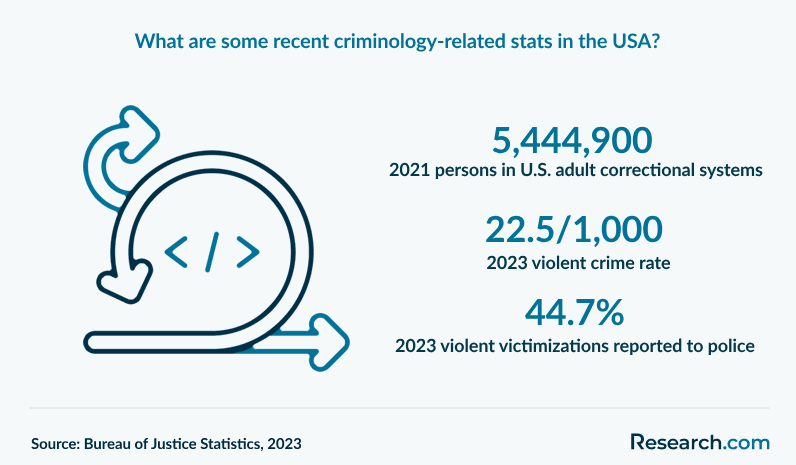
At the end of 2021, an estimated 5,444,900 persons were under the supervision of adult correctional systems in the United States. In 2023, the violent crime rate in the United States was recorded at 22.5 per 1,000 people. The percentage of violent victimizations reported to police also increased from 41.5% in 2022 to 44.7% in 2023.
These figures provide context for why criminology remains a relevant field of study. Students are not only learning about police, courts, and corrections; they are also studying how crime data is collected, how reporting changes affect interpretation, and how policy decisions influence public safety systems.
How does an online criminology degree compare to an on-campus program?
Online and campus-based criminology programs often cover similar academic material, especially when offered by the same accredited institution. The main differences involve scheduling, access to campus resources, networking style, internship logistics, and how students interact with faculty and peers.
| Factor | Online criminology degree | On-campus criminology degree | Decision guidance |
| Schedule | Often more flexible, especially when courses are asynchronous. | Usually follows fixed class meeting times. | Online study is better for students balancing work or family responsibilities. |
| Cost | May reduce commuting and housing expenses; tuition varies by school. | May include campus housing, transportation, and in-person fees. | Compare total cost of attendance, not tuition alone. |
| Interaction | Relies on discussion boards, video meetings, email, and virtual advising. | Offers face-to-face faculty access and informal peer networking. | Campus may suit students who learn best through in-person engagement. |
| Resources | Digital libraries, online tutoring, virtual career services, and remote advising may be available. | Students may have easier access to campus labs, events, and local agency relationships. | Ask whether online students get equal access to advising and career support. |
| Field experience | May require students to arrange internships in their local communities. | May use established local partnerships near campus. | Online students should ask who helps secure placements and whether background checks are required. |
Criminology also overlaps with adjacent fields. For example, students comparing justice and security-related careers may find it useful to ask, what can a risk management bachelor’s degree lead to? Risk management programs may connect to fraud prevention, compliance, security analysis, and corporate investigations, while criminology programs focus more directly on crime, justice, and social response.
A criminology degree may support career paths such as Criminologists, with a median salary of $48,012, or Criminal Investigators, earning a median of $85,400. Other cited possibilities include Forensic Science Technicians ($58,066), Probation Officers ($53,838), and Correctional Officers ($48,012). Students drawn to psychology and behavior-focused work may also compare affordable online master's programs in forensic psychology when planning long-term graduate study.
Additional roles cited for criminology graduates include Police Officers ($68,670), Crime Scene Investigators ($53,872), Juvenile Counselors ($48,012), Victim Advocates ($43,200), Intelligence Analysts ($72,880), Fraud Investigators ($72,880), Security Managers ($85,400), Compliance Officers ($85,400), Emergency Management Directors ($85,400), and Loss Prevention Specialists ($43,200).
The degree can provide a broad foundation, but students should not assume the degree alone guarantees a specific job title. Many positions require agency testing, background checks, academy completion, specialized science courses, professional certifications, graduate education, or prior experience.
What is the average cost of a criminology degree program?
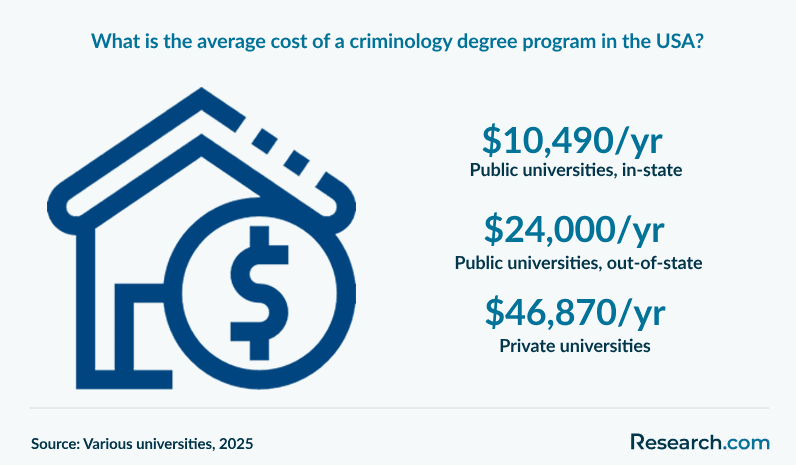
Costs vary by institution type, residency status, online fee structure, transfer credit acceptance, and how long a student takes to finish. According to the National Center for Education Statistics, the average cost of tuition and fees for a bachelor's in criminology was $12,815 in 2020.
| Cost category | Figures cited | What students should verify |
| Public universities, in-state | $10,490 per year; in-state tuition often ranges from $200 to $500 per credit hour. | Confirm whether online students receive in-state rates or a separate online tuition rate. |
| Public universities, out-of-state | $24,000 per year | Ask whether online programs waive or reduce out-of-state tuition differences. |
| Private universities | $46,870 per year; private tuition often exceeds $500 per credit hour. | Compare institutional scholarships, transfer policies, and total program cost. |
| Online programs | Range from $10,000 to $30,000 total program cost | Check technology fees, course fees, proctoring fees, books, and graduation fees. |
Students comparing criminology with other online degrees should consider career alignment as much as cost. For example, the best online MIS degree programs may be more appropriate for students interested in cybersecurity, business analytics, or information systems management, while the easiest women’s health nurse practitioner online programs may fit students pursuing nursing and healthcare pathways rather than justice-related work.
Beyond tuition, calculate books, software, exam proctoring, technology, application fees, graduation fees, travel for any required campus sessions, and unpaid internship time. A lower tuition rate is helpful only if the program also accepts transfer credits, offers courses when you need them, and supports your career plan.
What are the financial aid options for students enrolling in a criminology degree program?
Criminology students may qualify for the same major categories of financial aid available to other eligible college students. The right mix of aid depends on income, dependency status, school cost, enrollment intensity, academic performance, residency, and institutional policies.
- Federal grants: Need-based grants such as the Pell Grant do not have to be repaid if eligibility and enrollment conditions are met.
- Federal student loans: Federal loans can offer borrower protections and repayment options, but they must be repaid with interest.
- State grants and scholarships: Many states fund aid programs for residents attending eligible colleges.
- Institutional aid: Colleges may provide scholarships, grants, tuition discounts, work-study, or transfer awards.
- Private scholarships: Nonprofits, professional associations, foundations, and community organizations may offer scholarships based on merit, need, public service goals, or field of study.
- Employer or agency support: Students already working in law enforcement, corrections, security, public service, or government may be able to ask about tuition assistance or reimbursement.
Students should complete the Free Application for Federal Student Aid (FAFSA) as early as possible and then compare aid packages by net price, not just the scholarship amount. Loans can make a program accessible, but they should be weighed against realistic salary expectations and career requirements.
What are the prerequisites for enrolling in a criminology degree program?
Admission requirements depend on degree level, school selectivity, transfer status, and whether the program is a criminology, criminal justice, forensic science, or public safety degree.
| Program level | Common admission requirements | What to ask admissions |
| Undergraduate bachelor’s programs | Most require a high school diploma or equivalent. Some schools review GPA, transcripts, and SAT or ACT scores. | Ask whether test scores are required, optional, or waived for online students. |
| Transfer students | Prior college transcripts, minimum GPA requirements, and course equivalency reviews are common. | Request a written transfer credit evaluation before committing. |
| Graduate criminology programs | Graduate programs typically require a bachelor’s degree, often in criminology, sociology, psychology, or a related field. Some may require GRE scores and letters of recommendation. | Ask whether professional experience can strengthen an application if your bachelor’s degree is in another field. |
| Students combining related disciplines | Additional prerequisites may apply if pairing criminology with psychology, forensic science, cybersecurity, or legal studies. | Students interested in behavioral science can compare affordable online master's programs in psychology for future graduate planning. |
Some justice-related careers also have hiring requirements outside the university’s control, including age minimums, citizenship status, driver’s license rules, background checks, physical fitness tests, drug screening, psychological evaluations, or academy completion. Always verify these requirements with the employer or licensing authority for your target role.
What courses are typically in a criminology degree program?
Criminology programs usually combine theory, law, criminal justice systems, research, statistics, ethics, and electives. A strong curriculum should help students understand both crime causation and how institutions respond to crime.
Core courses
- Introduction to Criminology: Introduces crime definitions, crime patterns, theories of crime, and the role of criminology as a social science.
- Criminal Justice System: Examines policing, courts, corrections, and the relationships among justice agencies. Students interested in legal support roles may also compare an affordable paralegal certificate as a complementary credential.
- Criminal Law: Covers legal elements of crimes, criminal liability, defenses, and the structure of criminal offenses.
- Research Methods in Criminology: Teaches how criminologists collect, evaluate, and interpret evidence about crime and justice policy.
- Statistics for Criminology: Builds quantitative skills for analyzing crime data, victimization trends, program outcomes, and policy claims.
Major courses
- Criminological Theory: Studies explanations of criminal behavior, including social learning, strain, labeling, control, and other theoretical approaches.
- Juvenile Delinquency: Focuses on youth offending, prevention, intervention, family influences, peer influences, and juvenile justice systems.
- Victimology: Examines the impact of crime on victims and how systems respond to trauma, safety, restitution, and advocacy needs.
- White-Collar Crime: Looks at fraud, corporate misconduct, occupational crime, financial crime, and regulatory violations.
- Organized Crime: Studies criminal networks, illicit markets, group structures, and enforcement challenges.
Electives
- Forensic Science: Introduces scientific approaches used in investigations, though laboratory careers may require deeper science preparation.
- Cybercrime: Covers computer-enabled crime, online fraud, data breaches, digital evidence, and investigative challenges. Students seeking stronger technical preparation can compare affordable online cybersecurity degree programs.
- Terrorism: Examines motivations, organizations, tactics, prevention, and policy responses.
- Homeland Security: Focuses on emergency preparedness, terrorism prevention, infrastructure protection, and national security systems.
- Criminal Justice Ethics: Explores discretion, use of authority, due process, corruption, bias, confidentiality, and professional accountability.
What types of specializations are available in criminology degree programs?
Specializations help students align the degree with a specific career direction. Not every program offers every concentration online, so students should confirm course availability and sequencing before enrolling.
| Specialization | Best fit for students interested in | Important caution |
| Criminal Justice | Police, courts, corrections, agency administration, and justice systems. | Make sure the curriculum includes criminology theory if you want a social science foundation. |
| Law Enforcement | Policing, investigations, public safety, patrol operations, and leadership. | Academy and agency hiring requirements are separate from degree completion. |
| Corrections | Prisons, jails, probation, parole, rehabilitation, reentry, and case management. | Work environments can be demanding; seek field experience before committing. |
| Forensic Science | Evidence analysis, crime scene work, laboratory methods, and scientific investigation. | Advanced forensic jobs may require chemistry, biology, or laboratory-intensive degrees. Students can research forensic science colleges for deeper preparation. |
| Cybercrime | Digital evidence, online fraud, cyber investigations, security analysis, and technology-enabled crime. | Technical skills, certifications, and hands-on labs may be essential for competitive roles. |
| Homeland Security and Terrorism | Threat assessment, emergency preparedness, intelligence, counterterrorism, and public safety planning. | Federal roles can require extensive background checks and specialized experience. |
| Victimology | Victim advocacy, trauma-informed services, nonprofit work, and community programs. | Look for internships or supervised service-learning opportunities. |
| Juvenile Delinquency | Youth services, juvenile justice, prevention programs, schools, and community intervention. | Roles may require additional counseling, social work, or case management training. |
| White-Collar Crime and Organized Crime | Fraud investigation, compliance, financial crime, intelligence, and regulatory enforcement. | Business, accounting, data analysis, or legal coursework can strengthen preparation. |
| Criminal Psychology and Sociology of Crime | Behavioral analysis, research, social inequality, crime patterns, and graduate study. | Clinical psychology careers require separate graduate training and licensure. |
| Criminological Theory and Policy | Research, policy analysis, program evaluation, academia, and public administration. | Strong writing, statistics, and research methods are important for advancement. |
Is an online criminology degree accredited and recognized?
Accreditation is one of the most important checks before enrolling. A recognized accredited institution has been reviewed for academic quality, financial stability, student support, and institutional standards. Accreditation can affect transfer credits, graduate school admission, employer recognition, and eligibility for federal financial aid.
Students should verify institutional accreditation directly through official sources rather than relying only on a school webpage. Program-specific recognition can also matter in some fields, although many criminology and criminal justice degrees rely primarily on institutional accreditation. When comparing programs, ask whether graduates have successfully entered relevant criminology degree jobs, graduate schools, law schools, public agencies, or private-sector roles.
What is the return on investment of an online criminology degree?
The return on investment of an online criminology degree depends on total cost, time to completion, debt, transfer credits, salary expectations, employer requirements, and whether the program leads to the type of work you actually want. A low-cost degree can still be a poor investment if it lacks accreditation or career support; a higher-cost program may be reasonable if it offers strong transfer credit, internship access, a relevant concentration, and a clear path to advancement.
| ROI question | Why it matters | How to evaluate it |
| What will I pay out of pocket? | Sticker price is not the same as net cost. | Compare tuition, fees, books, technology costs, aid, scholarships, and transfer credit savings. |
| Will the degree qualify me for my target role? | Some jobs require academy training, certifications, scientific coursework, or graduate education. | Review actual job postings and agency requirements before choosing electives. |
| What salary range is realistic? | Published salary figures do not guarantee individual earnings. | Compare local job postings and roles listed among higher-paying criminal justice careers. |
| Can I gain experience while enrolled? | Internships and related work can improve job readiness. | Ask about placements, career fairs, alumni networks, and local agency partnerships. |
| How much debt will I carry after graduation? | Loan repayment can affect career flexibility. | Estimate monthly payments and compare them with entry-level salaries in your region. |
Are some online criminology programs more accessible than others?
Yes. Accessibility can differ significantly by admissions selectivity, transfer credit policies, course scheduling, technology requirements, advising availability, disability services, and whether courses are offered asynchronously. A program that is academically strong but rigidly scheduled may not work for a student with rotating shifts, caregiving duties, or unreliable daytime availability.
Students who need a more manageable entry point should compare features such as open or transfer-friendly admissions, multiple start dates, part-time pacing, clear degree maps, responsive faculty, tutoring, and online library access. Researching options related to the most accessible criminal justice degree programs can help identify programs designed for flexibility, but students should still confirm accreditation and academic quality.
How does one choose the best criminology degree program?
The best criminology degree program is the one that is accredited, affordable for your situation, aligned with your career goal, realistic for your schedule, and strong enough to support employment or further education. Rankings can help narrow the field, but they should not replace a personal fit analysis.
| Selection factor | Questions to ask | Red flags |
| Accreditation | Is the institution accredited by a recognized accreditor? Is the status current? | Vague claims, unrecognized accrediting bodies, or difficulty finding verification. |
| Curriculum | Does the program include theory, research methods, statistics, law, and applied justice topics? | Too many generic electives and too few major-specific courses. |
| Career alignment | Does the program prepare students for your target role or graduate pathway? | No evidence of internship support, career outcomes, or employer connections. |
| Faculty expertise | Do faculty members have criminology, criminal justice, legal, policy, research, or field experience? | No faculty profiles or little evidence of subject expertise. |
| Online format | Are classes asynchronous, synchronous, accelerated, or self-paced? | Required live sessions that conflict with work or time zone needs. |
| Cost | What is the total cost after aid and transfer credits? | Unclear fees, high loan dependence, or pressure to enroll quickly. |
| Student support | Are tutoring, advising, library access, disability services, and technical support available online? | Support services limited to campus students. |
| Internships and applied learning | Can online students complete local internships or applied projects? | No guidance on field placement, background checks, or agency requirements. |
Before enrolling, request a sample degree plan, transfer credit evaluation, tuition estimate, graduation timeline, and written explanation of online student services. This prevents common surprises after the first term begins.
What career paths are available for graduates of criminology degree programs?
Criminology graduates can pursue many justice, safety, research, legal, and community-service roles. Some are accessible with a bachelor’s degree, while others require training academies, certifications, graduate education, licensure, or specialized technical coursework.
- Law Enforcement Officer: Enforces laws, responds to incidents, investigates violations, writes reports, and supports public safety.
- Probation Officer: Supervises people under court-ordered probation and monitors compliance with conditions.
- Correctional Officer: Maintains safety and order in jails, prisons, and detention facilities.
- Crime Scene Investigator: Documents crime scenes, collects evidence, and coordinates with investigators and laboratories.
- Forensic Scientist: Applies scientific methods to evidence analysis, often requiring specialized science preparation.
- Criminal Profiler: Uses behavioral patterns and investigative information to support complex investigations.
- Intelligence Analyst: Reviews information, identifies patterns, prepares reports, and supports law enforcement or national security decisions.
- Social Worker: Provides services to victims, families, justice-involved individuals, or community populations, often requiring additional credentials.
- Victim Advocate: Helps victims understand legal processes, safety planning, rights, and community resources.
- Policy Analyst: Studies criminal justice policies, evaluates programs, and recommends improvements.
- Researcher: Analyzes crime trends, program outcomes, victimization data, or justice practices.
- Educator: Teaches criminology or criminal justice, usually requiring graduate education for college-level roles.
- Private Investigator: Conducts investigations for individuals, law firms, businesses, or insurers, subject to state rules.
- Security Manager: Develops security policies, supervises staff, manages risk, and protects people or assets.
- Loss Prevention Specialist: Works to prevent theft, fraud, and shrinkage in retail or corporate environments.
The number of violent crimes in the United States has varied over the past six years, as shown in the graph below.
In 2018, law enforcement agencies reported 1,238,526 violent crimes. The figure declined slightly to 1,212,847 in 2019 and rose to 1,271,539 in 2020, a period that may have reflected pandemic-related social disruptions. In 2021, reported violent crimes dropped to 925,780, but that year should be interpreted cautiously because of the full transition to the National Incident-Based Reporting System (NIBRS) and incomplete reporting from agencies not yet fully integrated into the updated system.
Reported violent crime rose again to 1,251,702 in 2022 and then declined to 1,201,857 in 2023. These official figures are useful, but they do not tell the entire story because the National Crime Victimization Survey often produces higher estimates of violent victimizations than police-reported data.
For criminology students, the main lesson is that crime data requires careful interpretation. Reporting systems, agency participation, victim reporting behavior, definitions, and survey methods can all influence the numbers used in policy debates and public safety planning.
What is the job market for graduates with a criminology degree?
The job market for criminology graduates is shaped by geography, agency budgets, local crime patterns, retirement trends, specialization, background requirements, and the student’s experience. A degree can help applicants meet educational requirements, but internships, writing ability, data skills, physical readiness, clean background checks, and professional references often influence hiring outcomes.
- Law enforcement: Demand is generally stable, although hiring varies by region, agency funding, and public safety needs.
- Corrections: Correctional employment may be affected by budgets, staffing shortages, sentencing policy, facility needs, and community supervision trends.
- Forensic science: Demand is stronger for candidates with technical skills, laboratory training, and evidence-handling knowledge.
- Cybersecurity and cybercrime: Digital crime has increased the need for professionals who understand both technology and investigative processes.
- Homeland security: National security, emergency management, intelligence, and risk assessment remain important areas for specialized preparation.
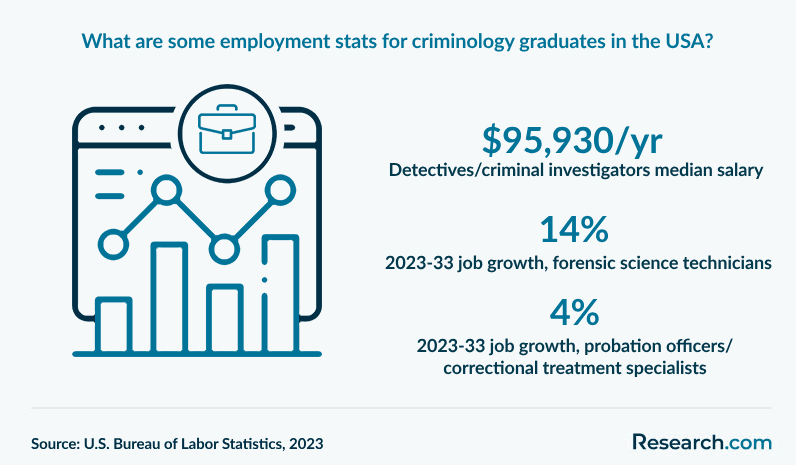
The cited median salaries for selected criminal justice-related positions include Detectives and Criminal Investigators at $95,930 per year, Forensic Science Technicians at approximately $64,940 annually, Probation Officers and Correctional Treatment Specialists at $61,800 per year, and Criminal Justice and Law Enforcement Teachers at the postsecondary level at about $82,480 annually in colleges, universities, and professional schools.
Employment projections cited for 2023 to 2033 include 14% growth for Forensic Science Technicians, which is much faster than the average for all occupations; 4% growth for Probation Officers and Correctional Treatment Specialists, which aligns with the average for all occupations; and 7% growth for Sociologists, which is faster than the average for all occupations.
Overall, criminology graduates face a competitive market. Students who complete internships, build data and writing skills, understand technology-related crime, develop professional networks, and pursue relevant certifications or graduate education may improve their employment prospects.
What do graduates say about online criminology degrees?
-
: "
Completing my criminology degree online made it possible to keep my full-time job while moving toward a justice-related career. The flexible format helped, but what mattered most was having responsive faculty, structured deadlines, and classmates with different professional backgrounds. Kieran
"
-
: "
I returned to school while raising children, so the online format was the only realistic option. I studied around my family schedule, used faculty office hours when I needed help, and found the victim advocacy coursework especially meaningful. Genevieve
"
-
: "
I was unsure whether online learning would feel practical, but case studies, simulations, and discussion-based assignments helped connect the material to real investigations and forensic questions. Asher
"
Could an associate's degree in legal studies enhance your criminology career?
An online associate's degree in legal studies can complement criminology by adding foundational knowledge of legal terminology, courtroom procedure, regulatory ethics, legal research, and the structure of the justice system. This combination may be useful for students interested in courts, victim advocacy, compliance, investigations, law school preparation, or legal support roles.
However, students should avoid earning extra credentials simply because they seem related. The better question is whether the associate degree shortens your bachelor’s timeline through transfer credits, strengthens your target career path, or provides specific skills not covered in your criminology curriculum.
What student support and career services are offered in online criminology programs?
Strong online programs provide more than course access. They help students stay enrolled, complete the degree, gain experience, and prepare for competitive hiring processes.
- Academic advising: Helps students choose courses, stay on track, understand prerequisites, and plan graduation.
- Technical support: Provides help with learning platforms, login issues, online exams, and course tools.
- Online tutoring and writing support: Supports research papers, statistics assignments, policy briefs, and citation work.
- Digital library access: Gives students access to scholarly articles, legal databases, government reports, and research guides.
- Career counseling: Assists with resumes, interviews, job search strategy, graduate school planning, and agency-specific applications.
- Internship guidance: Helps students identify placements in courts, corrections, law enforcement, nonprofits, advocacy agencies, or research settings.
- Mentoring and alumni networks: Connects students with professionals who can explain real hiring expectations and career progression.
Students exploring broad criminal justice outcomes can also review career options with a criminal justice degree to compare roles before choosing electives or internships.
Would pursuing an advanced specialization strengthen career prospects?
An advanced specialization can be valuable when it directly supports a specific career goal. For example, cybercrime coursework may help students interested in digital investigations, legal studies may help those pursuing court or compliance work, and research methods may support policy or graduate school pathways. Specialization is less useful when it adds cost without improving qualifications for a target role.
Students interested in legal and regulatory work may compare options such as affordable online master of legal studies programs. Graduate-level legal studies can be useful for compliance, policy, administration, or legal-adjacent roles, but it does not replace a Juris Doctor for becoming an attorney.
How are emerging trends shaping online criminology education?
Online criminology education is increasingly shaped by technology, data, and interdisciplinary expectations. Programs are adding digital forensics concepts, cybercrime modules, data analytics, geographic crime mapping, intelligence analysis, and policy evaluation to help students understand modern crime problems. At the same time, traditional criminology topics—such as inequality, victimization, courts, corrections, and policing—remain central.
Students should look for programs that teach both the human and technical sides of crime. A curriculum that combines theory, statistics, ethics, and technology can be stronger than one that treats crime only as an enforcement issue. Students comparing broader justice pathways may also review an online bachelor's degree in criminal justice to understand how criminal justice and criminology programs differ.
How can online criminology programs ensure practical, hands-on learning experiences?
Online criminology programs can provide practical learning when they deliberately connect coursework to real evidence, agencies, communities, and professional tasks. Hands-on learning does not always require a campus lab, but it does require structured application.
- Internships or practicums: Students may complete supervised experience with local agencies, nonprofits, courts, advocacy groups, or research organizations.
- Virtual case studies: Courses may use investigative scenarios, policy problems, mock case files, or ethical dilemmas.
- Digital labs and simulations: Cybercrime, digital forensics, and intelligence courses may use software-based exercises.
- Capstone projects: Students may analyze crime data, evaluate a policy, design a prevention program, or prepare a professional report.
- Community-based assignments: Some courses require students to examine local public safety data, court processes, reentry services, or victim support resources.
Students who want more science-focused applied training can compare options such as an affordable online forensic science degree, especially if their goal involves laboratory or evidence analysis work.
How can technology-driven specializations bolster criminology careers?
Technology-focused skills can make criminology graduates more competitive in roles involving cybercrime, intelligence analysis, fraud, digital evidence, data analytics, risk assessment, and security operations. Employers increasingly value candidates who can interpret data, write clear reports, understand privacy and ethics, and use technology responsibly in investigative or policy settings.
Relevant topics may include digital forensics, cybersecurity fundamentals, data visualization, statistical analysis, geographic information systems, open-source intelligence, and predictive tools. Students should be cautious, however, about programs that use technology buzzwords without hands-on assignments. If advanced analytics or intelligence work is the goal, compare curriculum depth with specialized options such as an online intelligence master’s program.
Can an online criminology degree propel your career into elite federal agencies?
An online criminology degree can support preparation for federal agency careers when it is accredited, academically rigorous, and paired with strong experience, writing ability, analytical skills, clean background credentials, and relevant internships or service. Federal agencies usually evaluate applicants through competitive hiring processes, and a degree alone is not enough.
Students interested in federal investigations, intelligence, or national security should build a profile that includes research skills, foreign language ability if relevant, cyber or data coursework, physical readiness for certain roles, and a strong understanding of legal and ethical standards. Networking, internships, veteran status, graduate education, and specialized certifications may also matter. For one example of an agency-specific path, students can review guidance on how to become a CIA officer.
Common mistakes to avoid when choosing an online criminology degree
| Mistake | Why it can hurt you | Better approach |
| Choosing a program without verifying accreditation | It may affect financial aid, transfer credits, graduate school admission, and employer recognition. | Confirm accreditation through official databases before applying. |
| Focusing only on tuition | Fees, books, lost transfer credits, and extra terms can raise the real cost. | Compare total cost to graduation and net price after aid. |
| Assuming online means easier | Accelerated and asynchronous courses require discipline and weekly progress. | Review workload, term length, and support services. |
| Ignoring field experience | Graduates without internships or applied projects may be less competitive. | Ask how online students gain practical experience near their location. |
| Assuming every criminology degree leads to forensic science jobs | Forensic laboratory roles may require specific biology, chemistry, or lab training. | Match electives and prerequisites to actual job postings. |
| Relying only on rankings | A highly ranked program may not fit your schedule, budget, or career goal. | Use rankings as one tool, then evaluate personal fit and outcomes. |
| Overlooking agency hiring rules | Law enforcement and federal roles often have requirements outside the degree. | Check age, citizenship, background, fitness, academy, and testing requirements early. |
Key insights
- Accreditation should be nonnegotiable: Before comparing cost or convenience, verify that the institution is properly accredited and recognized by employers and graduate schools.
- Online criminology degrees can be credible: The delivery format matters less than accreditation, curriculum quality, faculty support, applied learning, and career alignment.
- Career outcomes depend on more than the degree: Many justice-related jobs require academy training, background checks, certifications, science coursework, graduate education, or field experience.
- Cost should be evaluated as total cost to graduation: Public in-state tuition, private tuition, online fees, transfer credits, aid, books, and program length all affect affordability.
- Crime data requires careful interpretation: Figures such as 5,444,900 persons under adult correctional supervision in 2021, a 2023 violent crime rate of 22.5 per 1,000 people, and changes in reporting from 41.5% in 2022 to 44.7% in 2023 show why criminology students need strong research and data literacy.
- Technology skills are increasingly valuable: Cybercrime, digital forensics, data analytics, and intelligence analysis can strengthen a criminology background when the coursework includes practical assignments.
- Employment growth varies by occupation: Cited projections include 14% growth for Forensic Science Technicians, 4% for Probation Officers and Correctional Treatment Specialists, and 7% for Sociologists from 2023 to 2033.
- The best program is the one that fits your target role: Choose based on accreditation, curriculum, transfer policies, cost, support services, internships, and whether graduates can realistically pursue the careers you want.
References:
- Bureau of Justice Statistics. (2023). Criminal victimization, 2023. U.S. Department of Justice report.
- Bureau of Labor Statistics, U.S. Department of Labor. (2023). Detectives and Criminal Investigators. Occupational Employment and Wage Statistics. BLS occupational data.
- Bureau of Labor Statistics. (2024). Occupational outlook handbook. BLS Occupational Outlook Handbook.
- Bureau of Labor Statistics, U.S. Department of Labor. (2024). Criminal Justice and Law Enforcement Teachers, Postsecondary. Occupational Employment and Wage Statistics. BLS postsecondary teacher data.
- Bureau of Labor Statistics, U.S. Department of Labor. (2024). Forensic Science Technicians. Occupational Outlook Handbook. BLS forensic science technician profile,
- Bureau of Labor Statistics. (2024). Occupational outlook handbook: Forensic science technicians. U.S. Department of Labor forensic science profile.
- Bureau of Labor Statistics. (2024). Occupational outlook handbook: Probation officers and correctional treatment specialists. U.S. Department of Labor probation officer profile.
- Bureau of Labor Statistics, U.S. Department of Labor. (2024). Probation Officers and Correctional Treatment Specialists. Occupational Outlook Handbook. BLS probation and correctional treatment profile.
- Bureau of Labor Statistics, U.S. Department of Labor. (2023). Criminal justice and law enforcement teachers, postsecondary. Occupational Employment and Wage Statistics. BLS law enforcement teacher data.
- Bureau of Labor Statistics, U.S. Department of Labor. (2024). Police and detectives. Occupational Outlook Handbook. BLS police and detectives profile.
- Bureau of Labor Statistics, U.S. Department of Labor. (2024). Projections overview and highlights, 2023–33. Monthly Labor Review. BLS projections overview.
- Bureau of Labor Statistics, U.S. Department of Labor. (2024). Sociologists. Occupational Outlook Handbook. BLS sociologists profile.
- Data USA. (2024). Criminal justice & corrections. Data USA criminal justice and corrections profile.
- Data USA. (2024). Criminal justice - safety studies. Data USA criminal justice safety studies profile.
- Data USA. (2024). Forensic psychology. Data USA forensic psychology profile.
- Data USA. (2024). Social sciences. Data USA social sciences profile.
- Federal Bureau of Investigation. (2024). FBI Crime Data Explorer
- Federal Bureau of Investigation. (2024). 2023 hate crime statistics. U.S. Department of Justice hate crime statistics.
- Florida State University. (2024). College of criminology and criminal justice: Degrees awarded. Florida State University criminology data.
- Metropolitan Police Department. (2025). Crime statistics. District of Columbia crime data.
- National Center for Education Statistics. (2024). Integrated postsecondary education data system. NCES IPEDS.
- New York City Police Department. (2024). CompStat 2.0. NYPD CompStat 2.0.
- National Center for Education Statistics. (2024). Tuition costs of colleges and universities. NCES tuition cost tables.
- Salary.com. (2025). Criminalist salary in New York, New York. Salary.com criminalist salary data.
- Salary.com. (2025). Criminal investigator salary in New York, NY. Salary.com criminal investigator salary data.
- Salary.com. (2025). Criminologist salary in the United States. Salary.com criminologist salary data.
- University of North Carolina Wilmington. (2024). Online tuition and fees. UNCW tuition and fees.
- U.S. Bureau of Justice Statistics. (2023). Correctional populations in the United States, 2021 – Statistical tables. U.S. Department of Justice correctional population tables.
- U.S. Department of Education. (2024). College affordability and transparency center. U.S. Department of Education college cost resource.
Other Things You Should Know About Online Criminology Programs
Yes, some 2027 online criminology programs require supervised fieldwork or an internship, usually 100 to 150 hours, especially at the bachelor’s level. Schools often place students with approved agencies, and the work must be documented and evaluated by a faculty supervisor.
In 2027, several online criminology degree programs offer accelerated options, allowing students to complete their studies in as little as 18 months. These programs often require intense full-time study, including summer terms, to facilitate faster completion without compromising the curriculum.