
2027 Best Criminal Justice Certifications to Consider

Co-Founder and Chief Data Scientist
Some traditional criminal justice roles are projected to decline by 7% over the next decade. That reality can create a lot of uncertainty when you're holding a new bachelor's degree and trying to start your career. A graduate certificate offers a faster, more focused path than a full master's degree, letting you add the specialized skills employers are looking for right now.
To help you make the right choice, our career planning experts with over a decade of experience built this guide. We'll show you the best certifications for criminal justice professionals to launch a successful career.
What are the benefits of getting a criminal justice certification?
- Gain specialized skills to qualify for specific roles in government agencies, corporate security, or non-profit advocacy.
- Increase your earning potential, as a certificate can help you move into roles with salaries exceeding $80,000.
- Fit your education into your life with flexible online programs designed for working professionals and recent graduates.
What can I expect from a criminal justice certification?
You can think of a graduate certificate as a highly focused, mini-master's degree. Expect to take between four and six graduate-level courses that dive deep into a specific area of the field. Most students complete these programs online in about 6 to 18 months.
It’s important to understand the difference between a university-issued graduate certificate and a professional certification. A graduate certificate is an academic credential you earn by completing coursework. A professional certification is typically something you earn by passing a standardized exam to prove your skills.
Many universities also design their certificate programs to be "stackable." This means the credits you earn can often be applied toward a full master's degree down the road. The best certifications for criminal justice professionals often provide this kind of strategic flexibility, giving you options for your future education.
Where can I work with a criminal justice certification?
A criminal justice certificate prepares you for specialized roles across public, private, and non-profit sectors. Your specific career path is determined by the specialization you choose, which qualifies you for distinct roles. Key employment sectors for certified professionals include:
- Private and Corporate Security: This is a massive field, with 1,262,100 people employed as security guards alone. A certificate can help you move into advanced roles like corporate fraud investigator or security consultant within this large sector.
- Government and Public Safety: State and local governments are major employers, with 387,500 people working as correctional officers and jailers and another 19,000 as bailiffs.
How much can I make with a criminal justice certification?
A criminal justice certificate can increase your earning potential by equipping you with specialized, in-demand skills. Salaries vary significantly based on your chosen specialization, geographic location, and whether you work in the public or private sector.
Our 2024 data shows the following median annual wage for key roles in the field:
- Bailiffs (State Government): $74,940
- Correctional Officers and Jailers (Federal Government): $74,190
- Gambling Surveillance Officers: $50,385
- Security Guards (in top-paying states): $54,830
- Top-Earning Bailiffs (in top-paying states): $103,630
- List of the Best Criminal Justice Certification Programs for 2027 List of Programs
- How long does it take to complete a criminal justice certification program? Completion Time
- What is the average cost of a criminal justice certification program? Program Cost
- What are the financial aid options for students enrolling in a criminal justice certification program? Financial Aid
- What are the prerequisites for enrolling in a criminal justice certification program? What are the prerequisites for enrolling in a criminal justice certification program?
- What courses are typically in a criminal justice certification program? What courses are typically in a criminal justice certification program?
- What types of specializations are available in a criminal justice certification program? Specializations
- How to Choose the Best Criminal Justice Certification Program How to Choose the Best Criminal Justice Certification Program
- What career paths are available for graduates of a criminal justice certification program? Career Paths
- What is the job market for graduates of a criminal justice certification program? Job Market
Best Criminal Justice Certification Programs for 2027: What to Compare Before You Enroll
A criminal justice certificate can be a faster, lower-cost way to build job-ready skills than earning another full degree. The challenge is choosing a program that matches your career goal, transfer plans, budget, and schedule. Some certificates are designed for beginners seeking entry-level roles in law enforcement, courts, corrections, or private security. Others are graduate-level credentials for professionals who want to move into policy, intelligence analysis, cybercrime, leadership, victim advocacy, or research-focused roles.
This guide explains how criminal justice certification programs work, how long they take, what they cost, what courses and specializations to expect, and how to evaluate whether a certificate is worth the investment. It also highlights selected programs and gives you practical questions to ask before applying.
Quick Answer: Is a Criminal Justice Certificate Worth It?
A criminal justice certificate can be worth it if you need a focused credential, want to test the field before committing to a degree, or already work in public safety, security, corrections, legal services, or social services and need specialized training. It is usually not enough by itself for positions that require a police academy, a bachelor’s degree, a master’s degree, federal hiring standards, state licensure, or agency-specific training. The best programs are regionally accredited, transparent about cost, aligned with your target role, and transferable into an associate, bachelor’s, or graduate degree when possible.
| Best fit | When a certificate makes sense | What to verify first |
| Career starter | You want an introduction to policing, courts, corrections, criminology, or private security without committing to a full degree. | Check whether credits transfer into a degree and whether local employers recognize the credential. |
| Working professional | You already work in justice, security, social services, or public administration and want promotion-oriented skills. | Ask your employer whether the certificate qualifies for tuition reimbursement or advancement consideration. |
| Graduate school candidate | You want to strengthen your academic record or explore criminology before applying to a master’s program. | Confirm whether certificate credits can apply toward a related graduate degree. |
| Specialization seeker | You want targeted knowledge in cybercrime, intelligence analysis, victim advocacy, forensics, or policy. | Review course descriptions, faculty backgrounds, and hands-on learning opportunities. |
How We Rank Criminal Justice Certificate Programs
Because tuition, transferability, and career outcomes matter, our ranking process uses transparent education data and program-level information where available. Research.com reviews sources such as the IPEDS database, Peterson's database, the College Scorecard database, and The National Center for Education Statistics.
These sources help compare institutions on factors such as accreditation, affordability, student outcomes, and academic structure. You can learn more about the broader Research.com evaluation process on our methodology page.
Featured Criminal Justice Certification Programs
| School and program | Best for | Length or credits | Cost information | Accreditation |
| McHenry County College Criminal Justice Certificate | Students who want a practical community college pathway into the justice system and a stackable route toward an Associate of Applied Science degree. | 32 weeks; 30 credits | $121.50 (in-state); $514.26 (out-of-state) per credit | Higher Learning Commission (HLC) |
| Northern Virginia Community College Criminal Justice Certificate | Learners focused on law enforcement who want preparation for entry-level roles that may not require a full degree. | 1 year; 31 credits | $224.56 (in-state); $444.38 (out-of-state) per credit | Southern Association of Colleges and Schools Commission on Colleges (SACSCOC) |
| Boston University Metropolitan College Criminal Justice Graduate Certificate | Graduate-level students interested in policy, research, case-based learning, and flexible online or campus study. | 8–12 months; 16 units | $567.00 per unit | New England Commission of Higher Education (NECHE) |
| Pennsylvania Highlands Community College Criminal Justice Certificate | Students seeking a two-semester overview of law enforcement, courts, and corrections with a route into an Associate of Arts degree. | 2 semesters; 18 credits | $244.00 (in-state); $458.00 (out-of-state) per credit | Middle States Commission on Higher Education (MSCHE) |
| Black Hawk College College Credit Certificate in Criminal Justice | Learners who want a one-year credential covering law enforcement, court systems, and correctional services. | 1 year; 30 credits | $174.00 (in-state); $270.00 (out-of-state) per credit | Higher Learning Commission (HLC) |
| Portland State University Criminal Behavior & Justice Certificate | Students interested in the causes of criminal behavior, evidence-based responses, community outreach, social work, or related justice-system roles. | 24 credits | $541.63 (in-state); $1,441.63 (out-of-state) per credit | Northwest Commission on Colleges and Universities (NWCCU) |
| Southern New Hampshire University Justice Studies - Crime & Criminology Certificate | Learners who want a short, interdisciplinary credential with credits that can apply toward an associate or bachelor’s degree. | 12 credits | $793.00 per credit | New England Commission of Higher Education (NECHE) |
| University of Miami Certificate in Criminology and Criminal Justice | Graduate-level students seeking criminological theory, research methods, statistics, or preparation for the university's Master of Science program. | 15 credits | $2,644.00 per credit | Southern Association of Colleges and Schools Commission on Colleges (SACSCOC) |
Specialization Options Noted in Featured Programs
- Portland State University: Forensics; and Crime Control Strategies
- Southern New Hampshire University: Forensics; Counterterrorism; and White Collar Crime
How Long Does a Criminal Justice Certification Program Take?
Most criminal justice certificates are designed to be completed faster than a degree. A full-time graduate certificate commonly takes 9 to 12 months, while a part-time plan often takes 12 to 18 months. Undergraduate certificates at community colleges may be completed in one year, 32 weeks, two semesters, or another school-defined schedule, depending on credit load and course availability.
Your actual timeline depends on three things: the number of required credits or units, whether courses are offered every term, and how many classes you can take while managing work, family, military service, or agency training.
Full-Time vs. Part-Time Study
| Enrollment option | Typical advantage | Potential drawback | Best for |
| Full-time | Finishes the certificate more quickly and may help you move into job applications or promotions sooner. | Requires more weekly time for reading, assignments, discussions, and exams. | Students who can reduce work hours or focus heavily on school for a short period. |
| Part-time | Easier to balance with shifts, public safety work, caregiving, or another degree program. | Extends the completion date and may delay career benefits. | Working adults, military-affiliated learners, and students with unpredictable schedules. |
| Stackable certificate | Credits may apply toward a larger credential, reducing duplicated coursework later. | Not all certificates transfer cleanly, especially across institutions. | Students who may continue into an associate, bachelor’s, or graduate degree. |
Campus, Online, and Hybrid Scheduling
Campus programs can be valuable when you want direct contact with instructors, peer discussion, mock scenarios, lab-based work, or local agency connections. Online and hybrid formats may be better if you work rotating shifts or live far from campus. If your interest overlaps with emergency management or national security, comparing a certificate with an accelerated homeland security degree online can help you decide whether a short credential or a full degree better fits your goals.
What Is the Average Cost of a Criminal Justice Certification Program?
Based on our research, total tuition for an on-campus graduate certificate is typically between $8,000 and $20,000. Costs vary by school type, residency status, program level, credit requirements, and mandatory fees. Public institutions are often less expensive for in-state students, while out-of-state tuition at a public university can approach the cost of private-school tuition.
Do not compare programs by tuition alone. A lower-cost certificate may become expensive if credits do not transfer, the schedule delays completion, or the curriculum does not match your target role. A higher-cost certificate may be more defensible if it offers strong faculty access, employer recognition, internship support, or a direct path into a graduate degree.
How to Evaluate Return on Investment
A certificate should be judged by what it helps you do next. Compare the total cost with your realistic career outcome, not with a best-case salary. A full master's degree can cost anywhere from $30,000 to over $50,000, so a certificate may be a more efficient option if you need targeted skills rather than a broad advanced degree.
| Cost factor | Why it matters | Question to ask |
| Tuition per credit or unit | This is the largest visible cost, but it may not include fees. | What is the total program cost, including required fees? |
| Residency rate | In-state and out-of-state pricing can differ sharply at public colleges. | Can I qualify for in-state, district, military, or employer-partner pricing? |
| Transferability | Stackable credits can reduce the cost of a future degree. | Will every certificate credit apply toward a related degree at this institution? |
| Schedule | Delayed course rotations may increase opportunity cost. | Are all required courses offered every semester or only once per year? |
| Career services | Resume support, internships, and employer connections can improve practical value. | What job search support is available specifically for certificate students? |
Financial Aid Options for Criminal Justice Certificate Students
Funding rules for certificate programs can be more complicated than funding rules for degree programs. Some certificates qualify for federal aid, while others do not. Before enrolling, ask the financial aid office whether the exact certificate program is aid-eligible and whether you must enroll in a minimum number of credits.
Federal and Private Loans
Start with the Free Application for Federal Student Aid (FAFSA) if the school says the program is eligible for federal student aid. Federal loans may offer borrower protections that private loans do not. Private loans from banks, credit unions, or other lenders can fill gaps, but they should be compared carefully by interest rate, repayment terms, fees, and cosigner requirements.
If you plan to work in government or another qualifying public service setting, review Public Service Loan Forgiveness (PSLF) rules early. Do not assume that every role, employer, or loan type will qualify.
Scholarships and Grants
Scholarships and grants are preferable because they do not need to be repaid. Begin with the school’s financial aid office, then check criminal justice associations, local foundations, law enforcement groups, public safety organizations, and community-based scholarship programs. Ask whether certificate students are eligible, since some awards are limited to degree-seeking students.
Employer Tuition Reimbursement
If you already work in corrections, security, policing, courts, social services, compliance, or public administration, ask your HR department about tuition reimbursement. Employers may fund job-related education when the program builds skills in leadership, investigations, report writing, digital evidence, crisis response, personnel management, or policy.
| Funding source | Best use | Watch out for |
| Federal aid | Aid-eligible certificate programs at qualifying institutions. | Not all certificates qualify; confirm before enrolling. |
| Private loans | Covering remaining costs when other aid is not enough. | Interest rates and repayment protections vary widely. |
| Scholarships and grants | Reducing out-of-pocket cost without repayment. | Some awards exclude non-degree students. |
| Employer reimbursement | Upskilling while employed in a related field. | Employers may require grades, continued employment, or preapproval. |
| Payment plans | Spreading tuition over a term. | Fees and missed-payment rules can add cost. |
Admission Requirements for Criminal Justice Certification Programs
Admission requirements vary by school and program level. Undergraduate certificates may require a high school diploma, placement requirements, or college admission. Graduate certificates usually require a completed bachelor’s degree from an accredited institution.
- Accredited bachelor’s degree: Graduate-level certificates commonly require a bachelor’s degree, and the major is often flexible.
- Minimum GPA: Many programs look for an undergraduate GPA around 2.75 to 3.0.
- Statement of purpose: Some schools ask applicants to explain their career goals and why the certificate fits those goals.
- Recommendations: Programs may request one or two letters from employers, supervisors, or former instructors.
- Background considerations: Some criminal justice careers require background checks, academy admission, drug screening, citizenship requirements, physical standards, or agency-specific hiring steps even if the certificate itself does not.
The GRE is rarely required for certificate programs. Relevant professional experience can strengthen an application, especially for working adults. If you are coming from a different regulated field, such as nursing or allied health, credentials like LPN specialty certifications online may show discipline and applied training, but they do not replace criminal justice hiring or academic requirements.
Why Applicant Fit Matters Now
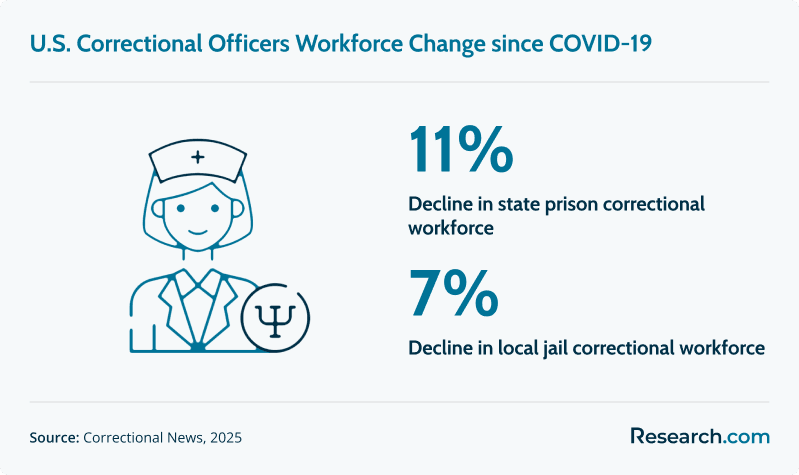
Criminal justice agencies and correctional systems face staffing and retention pressures. Since the pandemic, the state prison correctional workforce has seen an 11% decline, and local jail staff has dropped by 7%. This does not mean admission or hiring is automatic, but it does mean motivated candidates with relevant education, sound judgment, and clear career goals may be better positioned in certain public safety pipelines.
The visual below summarizes recent correctional workforce changes.
Common Courses in a Criminal Justice Certification Program
Criminal justice certificate curricula usually combine system-level knowledge with applied skills. Introductory programs often cover policing, courts, corrections, ethics, constitutional issues, and criminology. Graduate certificates may go deeper into policy analysis, research methods, leadership, crime data, or specialized topics such as cybercrime or victim services.
| Course area | What you may study | Why it matters |
| Criminological theory | Explanations of crime, criminal behavior, social conditions, deterrence, and prevention. | Helps students understand why justice policies are designed the way they are. |
| Ethics in criminal justice | Use of authority, discretion, accountability, bias, professional conduct, and public trust. | Ethical decision-making is central to policing, corrections, courts, and investigations. |
| Research methods and statistics | Data collection, evidence evaluation, program assessment, and interpretation of crime trends. | Useful for policy, intelligence, graduate study, and evidence-based practice. |
| Law enforcement and courts | Criminal procedure, investigations, prosecution, sentencing, and constitutional protections. | Provides the legal context for justice-system roles. |
| Corrections and reentry | Jails, prisons, probation, parole, rehabilitation, and community reintegration. | Prepares students for correctional, reentry, and community supervision environments. |
| Specialized electives | Digital evidence, victimology, intelligence analysis, white collar crime, forensics, or counterterrorism. | Builds career-specific skills beyond general criminal justice knowledge. |
Foundational criminal justice courses function like the core knowledge areas in other disciplines. For example, understanding the structure of the justice system is comparable to learning the major subdisciplines of geoscience before specializing in a scientific career path.
Training for Real-World Conditions
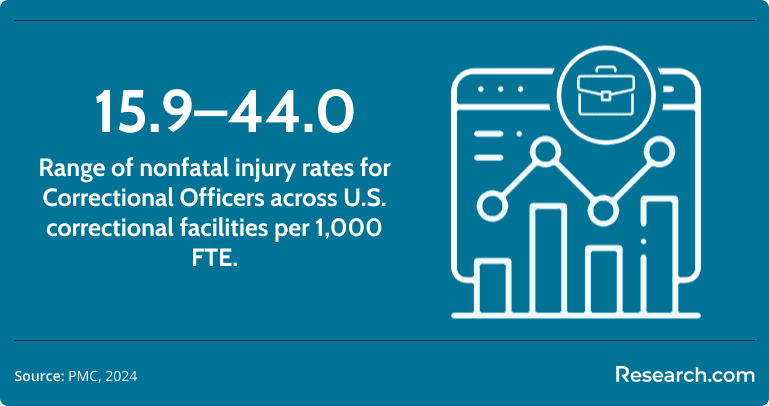
Criminal justice work can involve conflict, trauma exposure, long shifts, high-stakes decisions, and public scrutiny. The nonfatal injury rate for correctional officers ranges from 15.9 to 44.0 per 1,000 full-time workers. Because of these realities, stronger programs increasingly emphasize de-escalation, crisis intervention, communication, wellness, evidence handling, and professional judgment.
Some specialized pathways connect to very specific justice or public safety functions. For instance, students interested in K-9-related work may also research the best online dog training certification, although animal training credentials are separate from criminal justice certificates.
The visual below provides additional context on injury rates for correctional officers.
Criminal Justice Certificate Specializations to Consider
Your specialization should be chosen after you identify the role you want, not before. A general criminal justice certificate can help you understand the field, but a focused certificate may be more useful if your goal is digital investigations, victim services, intelligence, corporate security, policy, or corrections leadership.
Cybercrime and Digital Forensics
This pathway focuses on digital evidence, online crime, data recovery, device analysis, fraud patterns, and investigative technology. It may appeal to students who want technical work but still want to operate within law enforcement, compliance, security, or investigative settings. Technical specialization is valuable in many fields, including areas such as biomedical engineering careers, where applied technical knowledge shapes career options.
Criminal Intelligence Analysis
Intelligence analysis teaches students how to evaluate information, identify patterns, prepare reports, and support investigations or strategic decisions. These skills can be useful in local, state, federal, corporate, and security-related roles. If your long-term goal is federal law enforcement, reviewing the steps to become an ICE agent can help you understand how education fits into broader eligibility and hiring requirements.
Victim Advocacy
Victim advocacy prepares students to support people affected by crime as they navigate law enforcement, courts, social services, and community resources. Strong programs emphasize trauma-informed communication, crisis response, ethics, confidentiality, and referral networks. Campus-based learning can be especially useful when courses include role-playing, guided discussion, and feedback on interpersonal skills.
Corrections, Reentry, and Community Supervision
This specialization may fit students interested in jails, prisons, probation, parole, rehabilitation, reentry programs, or correctional administration. It is important to compare this path with labor market projections and agency hiring requirements because traditional correctional roles do not all have the same outlook.
Corporate Security and Fraud Investigation
Private employers need staff who can protect assets, investigate misconduct, support compliance, and reduce organizational risk. The private security sector is large, and states like California employ over 183,000 security guards. A certificate with coursework in fraud, risk assessment, investigations, cybercrime, or intelligence may help candidates pursue more specialized private-sector roles.
How to Choose the Best Criminal Justice Certification Program
The best criminal justice certificate is not automatically the cheapest, shortest, or highest-ranked option. It is the program that fits your career target, budget, schedule, academic background, and next credential. Use the checklist below before committing.
- Confirm regional accreditation. Accreditation affects transfer credit, employer recognition, and financial aid eligibility. Verify the institution through recognized accreditors such as SACSCOC, NWCCU, HLC, MSCHE, or NECHE.
- Match the curriculum to your goal. A student aiming for cybercrime should not choose a certificate built mainly around corrections policy, and a future victim advocate should not choose a program with no trauma-informed coursework.
- Check whether credits stack into a degree. If you may continue your education, ask for written confirmation that certificate credits apply to a specific associate, bachelor’s, or graduate program.
- Review faculty backgrounds. Look for instructors with relevant academic expertise, agency experience, research experience, legal knowledge, or current industry practice.
- Compare total cost, not just tuition. Include fees, books, transportation, technology requirements, lost work time, and whether out-of-state rates apply.
- Ask about career support for certificate students. Some schools provide advising, resume help, employer events, alumni connections, or internship guidance only to degree-seeking students.
- Confirm format and course rotation. A program advertised as one year may take longer if key courses are offered only once per year or conflict with your work schedule.
Common Mistakes to Avoid
| Mistake | Why it can hurt you | Better approach |
| Choosing a program without checking accreditation | Credits may not transfer, and employers may question the credential. | Verify institutional accreditation before applying. |
| Focusing only on the fastest option | A short program may lack the specialization or employer value you need. | Compare courses, outcomes, faculty, and transfer options. |
| Assuming a certificate guarantees a law enforcement job | Agencies may require academy training, background checks, physical standards, citizenship rules, exams, or experience. | Review hiring requirements for your target agency before enrolling. |
| Ignoring transfer policies | You may have to retake courses later in a degree program. | Get transfer or stackability details in writing. |
| Using rankings as the only decision tool | A well-ranked program may not fit your location, schedule, or career goal. | Use rankings as a starting point, then evaluate fit. |
| Assuming online and campus programs offer the same experience | Some specializations benefit from labs, simulations, or local networking. | Ask how skills practice, feedback, and employer connections work in each format. |
Calculating Potential ROI
Use salary information as a benchmark, not a promise. For example, the average salary for a security guard is around $39,591. A certificate may be more valuable if it helps you move beyond baseline security work into fraud analysis, corporate investigations, supervision, compliance, intelligence support, or another specialized role. Your return depends on the local labor market, your prior experience, the employer, and whether the credential is relevant to the job posting.
The chart below shows the salary range for security guards as a point of comparison.
Career Paths After a Criminal Justice Certification Program
A criminal justice certificate can support several career directions, but it should be viewed as one part of your preparation. Many jobs also require experience, background clearance, civil service testing, academy training, a degree, licensure, or employer-specific credentials.
Government and Law Enforcement Roles
Students may use a certificate to strengthen applications for local, state, or federal public safety roles, especially when the coursework adds analytical, technical, policy, or leadership skills. Possible pathways include intelligence support, law enforcement support roles, correctional supervision, court services, probation-related support, or specialized public safety units. Requirements vary widely by agency.
Private Security, Corporate Investigations, and Fraud
Private employers hire professionals to investigate incidents, protect facilities, reduce fraud, support compliance, and analyze risk. Some learners begin by researching how to become a security guard to gain entry-level experience. In that field, Black workers make up 31.3% of the workforce. A certificate can be most useful when it helps a worker move toward more specialized work such as fraud analysis, loss prevention management, corporate investigations, or security consulting.
Nonprofit, Advocacy, and Reentry Services
Students drawn to service-oriented careers may pursue victim advocacy, reentry support, restorative justice programs, youth services, community outreach, or policy advocacy. These roles often value communication skills, cultural awareness, trauma-informed practice, and knowledge of courts and corrections.
Career Path Comparison
| Career direction | Relevant certificate focus | Additional requirements to check |
| Law enforcement support | Criminal law, investigations, report writing, ethics, intelligence analysis. | Agency exams, academy requirements, background checks, age or citizenship rules. |
| Corrections or reentry | Corrections, rehabilitation, crisis intervention, reentry, leadership. | Facility training, physical requirements, shift work, state or agency hiring standards. |
| Cybercrime or digital investigations | Digital evidence, cybercrime, data analysis, fraud, computer forensics. | Technical certifications, lab experience, security clearance, employer software requirements. |
| Victim advocacy | Victimology, trauma-informed care, ethics, courts, community resources. | Advocacy training, crisis response experience, nonprofit or government hiring standards. |
| Corporate security or fraud | Risk management, investigations, white collar crime, intelligence, compliance. | Industry experience, certifications, background screening, business knowledge. |
Job Market Outlook for Criminal Justice Certificate Graduates
The criminal justice labor market is mixed. Some traditional roles face pressure, while specialized roles involving data, technology, security risk, fraud, policy, and analysis may offer different opportunities. A certificate is most valuable when it aligns with the part of the field that is actually hiring for your skills.
Specialization matters in many professions. For example, graduate-level specialization in healthcare can influence roles and compensation, as seen in discussions of DNP in health systems leadership salary. Criminal justice works similarly: broad interest is useful, but targeted skills often make a candidate easier for employers to evaluate.
Traditional Roles vs. Specialized Roles
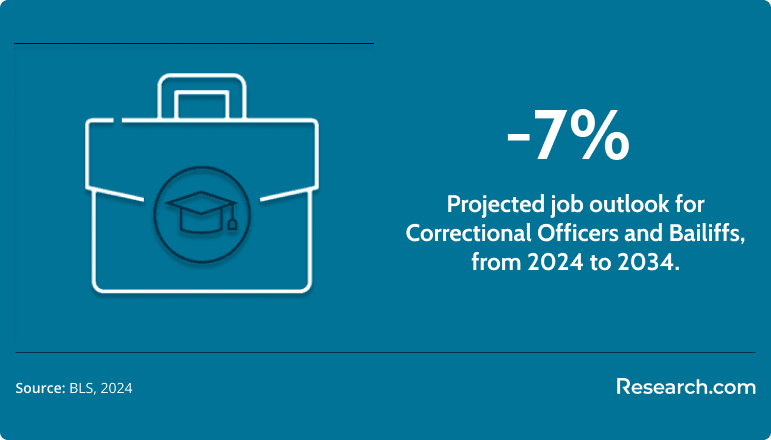
The job outlook for correctional officers and bailiffs is projected to decline by 7% over the next decade. That does not mean no one will be hired; retirements, turnover, and local staffing needs still create openings. However, students should be cautious about choosing a certificate only because it sounds related to a familiar job title.
If you are committed to corrections, compare certificate options with more focused education routes such as the shortest degree in corrections online. If you want stronger long-term flexibility, consider certificates that build transferable skills in crisis response, supervision, cybercrime, intelligence, policy analysis, or corporate security.
Current Trends Affecting Criminal Justice Education
- Technology is changing investigations. Digital evidence, cybercrime, surveillance systems, databases, and analytics are now central in many justice and security roles.
- Wellness and retention are bigger concerns. Staffing shortages, burnout, and injury risk have pushed more attention toward officer wellness, de-escalation, and leadership training.
- Employers want applied skills. Report writing, ethical judgment, communication, evidence handling, data interpretation, and scenario-based decision-making can matter as much as theory.
- Stackable credentials are increasingly useful. Certificates that connect to degrees can help students avoid losing time and money if they continue their education.
- Career outcomes vary by specialization. Students should compare local job postings before choosing a program, especially if they are targeting a narrow role.
The chart below shows the projected decline in correctional officer and bailiff roles, underscoring why specialization and career research are important.
What Graduates Say About Criminal Justice Certificate Programs
- Jessica: "My political science background gave me a broad understanding of government, but employers wanted more specific skills. The certificate helped me focus on corporate security and risk assessment. The coursework was demanding and practical, and I was able to explain my skills clearly in interviews. I accepted a fraud analyst role before finishing the final course."
- Theron: "I had years of correctional experience, but I needed a credential that showed I was ready for management. Studying policy, leadership, and personnel issues helped me prepare for a lieutenant opening. The program gave me both the confidence and the language to compete for the promotion."
- Mireille: "After college, I knew I wanted criminal justice but did not know which direction to take. A cybercrime certificate gave me a defined path. The digital forensics coursework was challenging, and the instructors connected the material to real investigations. It helped me move from general interest to a specific career target."
Questions to Ask Before Applying
- Is the institution regionally accredited?
- Is the certificate undergraduate, graduate, professional, or continuing education?
- Does the program qualify for federal financial aid?
- Will certificate credits transfer into a specific degree?
- Are courses offered online, on campus, hybrid, in the evening, or on weekends?
- Who teaches the courses, and what professional experience do they have?
- Does the curriculum match my target job postings?
- Does the school provide internships, employer contacts, or career advising for certificate students?
- What background checks, academy requirements, exams, or licensure rules apply to the career I want?
- What is the total cost after tuition, fees, books, technology, commuting, and lost work time?
Key Insights
- A criminal justice certificate is best used as a focused credential, not as a guaranteed path into every justice-related job.
- Program fit matters more than program length. Choose a certificate that matches your target role, specialization, and future degree plans.
- Regional accreditation, transferability, total cost, course rotation, and career support should be verified before enrollment.
- Graduate certificates often take 9 to 12 months full-time or 12 to 18 months part-time; undergraduate certificates vary by credit load and school structure.
- Total tuition for an on-campus graduate certificate is commonly between $8,000 and $20,000, but ROI depends on realistic career outcomes and whether the credential advances your next step.
- Traditional correctional officer and bailiff roles are projected to decline by 7%, making specialization in areas such as cybercrime, intelligence analysis, victim advocacy, leadership, or corporate security especially important.
- Before applying, compare certificate coursework with actual job postings and agency requirements. The right certificate should close a specific skills gap.
References:
- Bureau of Labor Statistics. (2023). Correctional officers and jailers: Occupational employment and wages, May 2023. U.S. Department of Labor. Retrieved October 6, 2025, from https://www.bls.gov/oes/2023/may/oes333012.htm
- Bureau of Labor Statistics. (2023). Security guards: Occupational employment and wages, May 2023. U.S. Department of Labor. Retrieved October 6, 2025, from https://www.bls.gov/oes/2023/may/oes339032.htm
- Bureau of Labor Statistics. (2023). Bailiffs: Occupational employment and wages, May 2023. U.S. Department of Labor. Retrieved October 6, 2025, from https://www.bls.gov/oes/2023/may/oes333011.htm
- Bureau of Labor Statistics. (2024). Correctional officers and bailiffs: Occupational outlook handbook. U.S. Department of Labor. Retrieved October 6, 2025, from https://www.bls.gov/ooh/protective-service/correctional-officers.htm
- Bureau of Labor Statistics. (2024). Security guards and gambling surveillance officers: Occupational outlook handbook. U.S. Department of Labor. Retrieved October 6, 2025, from https://www.bls.gov/ooh/protective-service/security-guards.htm
- Bureau of Labor Statistics. (2024, May 7). Fatal and non-fatal violence to police officers during 2012–2022. The Economics Daily. U.S. Department of Labor. Retrieved October 6, 2025, from https://www.bls.gov/opub/ted/2024/fatal-and-non-fatal-violence-to-police-officers-during-2012-2022.htm
- Center for Economic and Policy Research. (2020). Employment challenges facing security guards. CEPR. Retrieved October 6, 2025, from https://cepr.net/publications/employment-challenges-facing-security-guards/
- CLOSUP – Center for Local, State, and Urban Policy. (2023). Michigan local governments report increased challenges in law enforcement recruitment and retention. University of Michigan. Retrieved October 6, 2025, from https://closup.umich.edu/michigan-public-policy-survey/126/michigan-local-governments-report-increased-challenges-law-enforcement-recruitment-retention
- Correctional News. (2025, March 4). Correctional staff wellness: An overlooked crisis in corrections. Correctional News. Retrieved October 6, 2025, from https://correctionalnews.com/2025/03/04/correctional-staff-wellness-an-overlooked-crisis-in-corrections
- Data USA. (2024). Bailiffs. Datawheel. Retrieved October 6, 2025, from https://datausa.io/profile/soc/bailiffs
- Data USA. (2024). Correctional officers and jailers. Datawheel. Retrieved October 6, 2025, from https://datausa.io/profile/soc/correctional-officers-and-jailers
- Data USA. (2024). Security guards and gaming surveillance officers. Datawheel. Retrieved October 6, 2025, from https://datausa.io/profile/soc/security-guards-gaming-surveillance-officers
- National Center for O*NET Development. (2023). Bailiffs (33-3011.00). O*NET Online. Retrieved October 6, 2025, from https://www.onetonline.org/link/summary/33-3011.00
- National Center for O*NET Development. (2023). Correctional officers and jailers (33-3012.00). O*NET Online. Retrieved October 6, 2025, from https://www.onetonline.org/link/summary/33-3012.00
- National Center for O*NET Development. (2023). Gaming surveillance officers and gambling investigators (33-9031.00). O*NET Online. Retrieved October 6, 2025, from https://www.onetonline.org/link/summary/33-9031.00
- National Center for O*NET Development. (2023). Security guards (33-9032.00). O*NET Online. Retrieved October 6, 2025, from https://www.onetonline.org/link/summary/33-9032.00
- National Library of Medicine. (2021). COVID-19 and the impact on law enforcement mental health. Frontiers in Public Health. Retrieved October 6, 2025, from https://pmc.ncbi.nlm.nih.gov/articles/PMC8203007/
- National Library of Medicine. (2024). Police stress, burnout, and retention challenges: A systematic review. Frontiers in Psychology. Retrieved October 6, 2025, from https://pmc.ncbi.nlm.nih.gov/articles/PMC11641701/
- ZipRecruiter. (2025). Bailiff salary. ZipRecruiter. Retrieved October 6, 2025, from https://www.ziprecruiter.com/Salaries/Bailiff-Salary#TableView
- ZipRecruiter. (2025). Correctional officer salary. ZipRecruiter. Retrieved October 6, 2025, from https://www.ziprecruiter.com/Salaries/Correctional-Officer-Salary#TableView
- ZipRecruiter. (2025). Gaming surveillance officer salary. ZipRecruiter. Retrieved October 6, 2025, from https://www.ziprecruiter.com/Salaries/Gaming-Surveillance-Officer-Salary#TableView
- ZipRecruiter. (2025). Prison officer salary. ZipRecruiter. Retrieved October 6, 2025, from https://www.ziprecruiter.com/Salaries/Prison-Officer-Salary#TableView
- ZipRecruiter. (2025). Security guards salary. ZipRecruiter. Retrieved October 6, 2025, from https://www.ziprecruiter.com/Salaries/Security-Guards-Salary#TableView
Other Things You Should Know About Criminal Justice Certification Programs
Yes. Many respected certifications require a proctored final exam, often administered through Pearson VUE, PSI, or a similar testing vendor. Some also require identity verification and a passing score before the credential is issued, with recertification tied to exam-based renewal.
In 2027, prerequisites typically include a high school diploma or GED. Some programs may also require a background check or relevant coursework. Specific requirements vary by institution but often focus on basic educational qualifications and sometimes field-related experience.
Yes, many criminal justice certifications in 2027 require continuing education to maintain credentials. Typically, professionals must complete a set number of credit hours every two years, focusing on the latest legal updates and industry practices. These requirements ensure practitioners stay current in their field.


