
2027 How to Become a Program Manager: Salary & Career Paths

Co-Founder and Chief Data Scientist
Becoming a program manager is a common next step for professionals who have managed projects, led teams, or coordinated business initiatives and now want a broader strategic role. The challenge is that program management is often confused with project management, even though the work, authority, success metrics, and career preparation can be different. Program managers are expected to connect multiple related projects to business goals, manage competing stakeholders, and make decisions that affect budgets, timelines, teams, and long-term outcomes.
This guide explains what program managers do, how the role differs from project management, what education and certifications can help, where program managers work, how much they can earn, and what steps can make the career path more realistic. It is designed for project managers, operations professionals, business analysts, IT leaders, and career changers who want a practical roadmap instead of a vague job description.
Quick Answer: How do you become a program manager?
Most program managers build their careers by combining project leadership experience, industry knowledge, stakeholder management skills, and formal or informal management training. A degree is helpful in many organizations, but requirements vary: 29% of managers report that only a high school diploma or equivalent is required, while 27% indicate that a bachelor's degree is necessary and 22% say some college without a degree is sufficient. For many candidates, the strongest path is to gain project management experience first, lead cross-functional initiatives, learn budgeting and risk management, and then pursue credentials such as PgMP®, PMP, Agile, or business leadership training when they match the target industry.
| Decision point | What it means for aspiring program managers |
| Best starting roles | Project manager, business analyst, operations lead, product operations specialist, IT manager, implementation manager, or team lead |
| Common education background | Business, management, technology, engineering, healthcare administration, finance, or a field tied to the industry |
| Useful credentials | PgMP®, PMP, CSM, MSP, SPC, and leadership-focused graduate education when relevant |
| Average salary cited for 2025 | $107,460, with reported earnings ranging from $38,500 to $157,000 |
| Strong hiring areas | Technology, consulting, healthcare, finance, engineering, government, and operations-heavy organizations |
| Main career risk | Moving into the role without enough stakeholder, budget, risk, and cross-functional leadership experience |
Key Things You Should Know About Becoming a Program Manager
- Program management is broader than project management. Project managers usually deliver one defined project. Program managers coordinate several related projects and make sure they support a larger business objective.
- The role can pay well, but compensation depends heavily on industry, location, and seniority. The average salary for program managers in 2025 is $107,460, with top earners making up to $157,000 per year. Redmond, WA, has the highest average salary listed at $129,064, followed by Washington, DC, and Seattle, WA.
- Demand is especially strong in technology and consulting-related roles. Computer and information systems managers are projected to grow by 17%, with 54,700 annual job openings. Management analysts are projected to grow by 11%, with 95,700 annual openings.
- Education requirements are not uniform. Some employers prefer a bachelor’s degree or graduate business training, while others prioritize proven experience leading complex initiatives.
- The job is high-impact but demanding. Program managers must handle ambiguity, competing priorities, executive expectations, team dependencies, and shifting business goals.
- What is a program manager?
- How to Become a Program Manager in 2027?
- Are there useful certificates for program managers?
- What are the essential skills for a program manager?
- Where can I work as a program manager?
- What is a typical day like for a program manager?
- How much can I earn as a program manager?
- What are the challenges for program managers?
- How Can Continuous Education Elevate Program Management Success?
- How do program managers measure success?
- What are the current trends in program management?
- What is the job outlook for program managers?
- How Can Online Education Enhance Program Management Effectiveness?
- How Can an Accelerated Bachelor's Degree in Project Management Enhance Career Readiness?
- What are the career paths available for program managers?
- Can advanced academic programs accelerate career growth in program management?
- How Can Mentorship and Professional Networking Impact Program Management Success?
- Does an Advanced Degree Bridge the Gap Between Strategic Vision and Operational Execution?
What is a program manager?
A program manager leads a group of connected projects that together support a strategic objective. Instead of managing one project from start to finish, the program manager looks across several workstreams, resolves dependencies, allocates resources, communicates with senior stakeholders, and checks whether the combined effort is producing the intended business value.
In practice, a program manager often acts as the link between executives who define priorities and project teams that execute the work. The role requires enough operational detail to understand risks and roadblocks, but enough strategic distance to make trade-offs across the full program.
Program Manager vs. Project Manager
The two roles overlap, but they are not interchangeable. A project manager is usually accountable for delivering a specific result. A program manager is accountable for whether related projects work together and support the organization’s larger goals.
| Comparison area | Project manager | Program manager |
| Primary scope | One project with defined deliverables | Multiple related projects under one strategic initiative |
| Main focus | Schedule, budget, scope, quality, and delivery | Strategic alignment, benefits, dependencies, and business outcomes |
| Typical stakeholders | Project team, sponsor, vendors, and direct users | Executives, department leaders, project managers, finance, operations, and external partners |
| Success measure | The project is delivered according to agreed expectations | The program creates measurable value across connected projects |
| Career preparation | Project planning, scheduling, budgeting, and risk control | Portfolio thinking, leadership, negotiation, resource strategy, and change management |
Professionals who want to move from project delivery into broader program oversight often start by strengthening the fundamentals through a project management degree, especially if they need structured training in scheduling, budgeting, risk analysis, and stakeholder communication.
Core Responsibilities of a Program Manager
- Translate strategy into coordinated work. Break a business priority into related projects, milestones, responsibilities, and success measures.
- Coordinate cross-functional teams. Keep departments aligned when marketing, finance, engineering, operations, IT, or external partners must work together.
- Manage dependencies and risks. Identify which projects affect each other, where delays may occur, and which risks could damage the full program.
- Allocate resources. Help determine how budgets, staff, technology, and vendor support should be distributed across projects.
- Communicate with stakeholders. Give leaders a clear view of progress, risks, decisions needed, trade-offs, and expected outcomes.
- Track performance and benefits. Measure whether the program is delivering value, not just whether tasks are being completed.
The best program managers are not simply “senior project managers.” They are strategic operators who can connect planning, execution, people, finance, risk, and organizational goals.
How to Become a Program Manager in 2027?
There is no single required path into program management. Some professionals come from project management. Others move from operations, IT, product, consulting, finance, engineering, healthcare, or the military. What matters most is evidence that you can lead complex work across teams and make decisions beyond the boundaries of one project.
Step-by-Step Path to Program Management
- Build a strong functional base. Start in a field where you understand the work deeply, such as technology, operations, finance, healthcare, engineering, marketing, or business analysis.
- Manage projects or workstreams. Take responsibility for schedules, deliverables, budgets, vendor coordination, reporting, and team accountability.
- Lead cross-functional initiatives. Volunteer for assignments that require coordination across departments. This is where many professionals begin proving program-level ability.
- Develop financial and risk judgment. Program managers are often asked to make trade-offs involving budgets, staffing, vendor costs, timelines, and risk exposure.
- Strengthen executive communication. Learn how to summarize complex situations clearly, present options, and recommend decisions to senior leaders.
- Choose education or credentials strategically. A degree, MBA, or certification can help, but it should match your target role, industry, and experience level.
- Document measurable outcomes. Track examples of cost savings, process improvements, delivery improvements, risk reduction, customer impact, or revenue support.
Education Options: What Makes Sense for Your Career Stage?
| Career stage | Education or training to consider | When it makes sense |
| Early career | Bachelor’s-level business, management, technology, or industry-specific education | You need foundational knowledge and want access to roles that list a degree as preferred or required |
| Project manager moving up | Project management coursework, Agile training, PMP, or program-focused training | You already manage projects but need stronger evidence of structured delivery and leadership skills |
| Mid-career leader | MBA, organizational leadership, analytics, finance, or operations training | You need stronger strategic, financial, and executive decision-making skills |
| Experienced executive-track professional | Executive MBA, DBA, or advanced leadership education | You want senior leadership, consulting, transformation, or enterprise-level program responsibility |
Leadership-focused graduate study can be useful when a program manager needs to improve decision-making, organizational influence, and team leadership. For example, an online MBA in leadership may fit professionals who already have work experience and want formal training in leading people through complex change.
How Long Does It Take to Become a Program Manager?
The timeline depends on the industry, employer, and size of the programs involved. Many professionals spend several years building credibility through project management, operations, analysis, or team leadership before they are trusted with program-level accountability. The fastest route is not always the strongest one. Employers usually want proof that you can handle complexity, ambiguity, stakeholders, and business consequences.
Questions to Ask Before Pursuing This Career
- Do I enjoy coordinating work across teams, or do I prefer owning one defined deliverable?
- Can I make decisions when information is incomplete or priorities conflict?
- Am I comfortable presenting risks and trade-offs to senior leaders?
- Do I understand budgets, resource constraints, and business value well enough to influence decisions?
- Which industry do I want to specialize in, and what technical knowledge will I need there?
Are there useful certificates for program managers?
Certifications can help program managers signal credibility, but they are most valuable when they match the role’s environment. A certification will not replace experience leading complex work, but it can strengthen a resume, provide common terminology, and help candidates compete for positions that list credentials as preferred.
| Certification | Provider | Best fit |
| Program Management Professional (PgMP)® | Project Management Institute (PMI) | Experienced professionals who already manage multiple related projects and want a program-specific credential |
| Project Management Professional (PMP) | Project Management Institute | Project managers who want a widely recognized credential before moving into larger program roles |
| Certified Scrum Master (CSM) | Scrum Alliance | Professionals working with Agile teams, software delivery, product development, or iterative work environments |
| Managing Successful Programmes (MSP) | AXELOS | Program leaders working with structured transformation, public-sector initiatives, or complex organizational change |
| SAFe Program Consultant (SPC) | Scaled Agile, Inc. | Program managers involved in large-scale Agile implementation across multiple teams or business units |
Certifications are not the only way to build senior-level capability. Some professionals use a one year online MBA to add business strategy, finance, and leadership training while continuing to work. This can be useful for candidates who already understand delivery but need stronger executive-level business skills.
How to Choose the Right Certification
- Choose PgMP® if you already operate at a program level and need a credential that specifically reflects multi-project oversight.
- Choose PMP if you are still building project leadership credibility and want a foundation that employers broadly recognize.
- Choose Agile credentials if your target roles involve software, product, digital transformation, or scaled Agile teams.
- Choose business education if your main gap is strategy, finance, leadership, or organizational change rather than delivery methods.
What are the essential skills for a program manager?
Program managers need a mix of leadership, business judgment, communication, and execution discipline. Technical knowledge matters in many industries, but the defining skill is the ability to connect multiple moving parts and keep them aligned with a larger purpose.
| Skill area | Why it matters | How to demonstrate it |
| Strategic thinking | Programs exist to support business goals, not just complete tasks | Explain how your work improved a process, supported growth, reduced risk, or advanced a strategic priority |
| Stakeholder management | Program managers must align executives, teams, vendors, and users with different priorities | Show examples of negotiation, escalation management, executive updates, or conflict resolution |
| Risk management | Connected projects create dependencies that can amplify delays or costs | Describe risks you identified early and how your mitigation plan protected the project or program |
| Financial awareness | Programs require budget trade-offs and resource planning | Include experience managing budgets, vendor costs, staffing plans, or financial reporting |
| Communication | Complex work must be translated clearly for different audiences | Prepare concise status reports, decision memos, dashboards, and executive presentations |
| Adaptability | Priorities, teams, requirements, and markets change during long initiatives | Give examples of how you adjusted plans without losing sight of program goals |
Technical Skills and Tools
Program managers often work with tools that help track dependencies, budgets, capacity, risks, and reporting. Common examples include Microsoft Project, Asana, Jira, Power BI, Tableau, Slack, Microsoft Teams, and enterprise resource planning systems. The specific tools vary by employer, but the deeper skill is knowing how to use data to clarify decisions rather than simply collecting status updates.
Education vs. Experience in Program Management
Formal education can help, but it does not automatically make someone ready for program-level responsibility. The role rewards practical judgment. The reported education expectations show why: 29% of managers say a high school diploma is sufficient, 27% say a bachelor's degree is needed, and 22% point to some college without a degree. In other words, employers may value degrees, but they also look closely at leadership experience, industry knowledge, and evidence of results.
Common Skill Gaps That Hold Candidates Back
- Managing tasks well but not understanding business strategy
- Reporting status without explaining risks, decisions needed, or trade-offs
- Relying on authority instead of influence when leading teams that do not report directly to them
- Underestimating the financial side of program decisions
- Failing to build relationships with executives, finance, operations, and technical leaders
Where can I work as a program manager?
Program managers are needed wherever organizations run complex initiatives that require coordination across teams, budgets, systems, and stakeholders. The title is common in private companies, government agencies, healthcare organizations, consulting firms, nonprofits, technology companies, and financial institutions.
| Industry | How program managers contribute |
| Technology and IT | Coordinate software releases, cloud migrations, cybersecurity initiatives, platform implementations, and digital transformation programs |
| Healthcare and pharmaceuticals | Support clinical programs, operational improvements, compliance initiatives, hospital systems, or large-scale service delivery changes |
| Finance and banking | Lead compliance programs, risk management initiatives, product rollouts, digital banking upgrades, and operational change programs |
| Marketing and advertising | Coordinate multi-channel campaigns, brand initiatives, agency workstreams, customer experience programs, and analytics projects |
| Engineering and construction | Help manage infrastructure, manufacturing expansion, capital projects, vendor coordination, and long-term technical initiatives |
| Government and nonprofit | Oversee policy implementation, public programs, grants, community initiatives, and operational improvements |
Industries with Strong Management Pay Potential
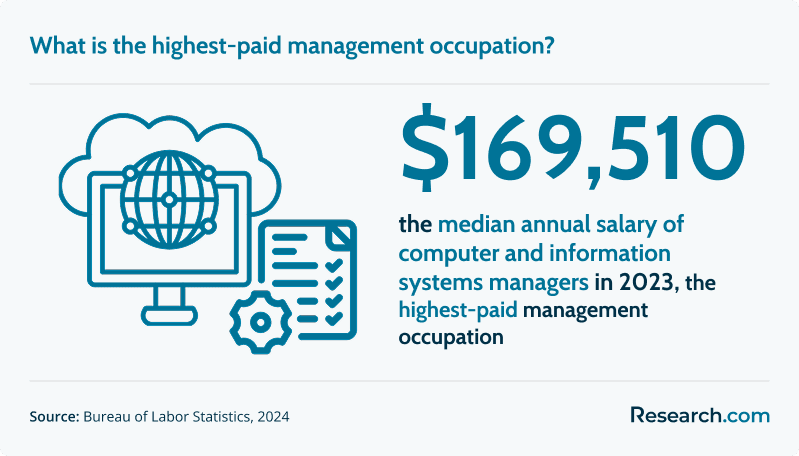
Some management occupations connected to program management offer especially strong compensation. In 2023, computer and information systems managers earned a median salary of $169,510, while architectural and engineering managers earned $165,370. Natural sciences, marketing, and financial management roles also had median salaries exceeding $150,000 per year. These figures do not guarantee program manager pay in every organization, but they show why technology, engineering, finance, and science-heavy sectors can be attractive for experienced program leaders.
How to Choose an Industry
- Choose technology if you are comfortable with fast change, technical teams, product cycles, and digital systems.
- Choose healthcare if you want mission-driven work and can handle regulation, compliance, and complex operations.
- Choose finance if you are detail-oriented and interested in risk, compliance, digital transformation, or operational efficiency.
- Choose government or nonprofit if you want public impact and can work within structured funding, policy, and reporting requirements.
- Choose consulting if you enjoy client-facing work, rapid problem-solving, and exposure to multiple industries.
What is a typical day like for a program manager?
A program manager’s day combines planning, escalation management, analysis, communication, and decision support. The work is rarely limited to one team or one timeline. A typical day may include reviewing project health, meeting with project managers, resolving resource conflicts, preparing leadership updates, analyzing risks, and making sure the program still supports the intended business outcome.
Daily Responsibilities
- Review progress across projects. Check milestone updates, dependency risks, budget concerns, and blocked workstreams.
- Coordinate with project managers and team leads. Clarify priorities, remove obstacles, and make sure teams understand how their work connects.
- Prepare stakeholder updates. Share concise information with executives, clients, department leaders, or external partners.
- Monitor resources and budgets. Identify staffing shortages, funding issues, vendor delays, and competing demands.
- Escalate risks early. Bring attention to problems before they damage timelines, costs, quality, or expected benefits.
Responsibilities by Time Horizon
| Time frame | Typical focus |
| Daily | Resolve blockers, review status, communicate updates, and manage immediate risks |
| Weekly | Assess progress against milestones, align teams, refine priorities, and review dependency health |
| Monthly | Analyze performance, review spending patterns, adjust resource plans, and improve processes |
| Quarterly | Compare program outcomes with business goals, reassess KPIs, and recommend strategic adjustments |
| Yearly | Evaluate program impact, support long-range planning, and shape future initiatives |
The role requires constant switching between detail and strategy. A program manager may spend the morning discussing a vendor delay and the afternoon explaining to executives whether the program still supports the company’s priorities.
How much can I earn as a program manager?
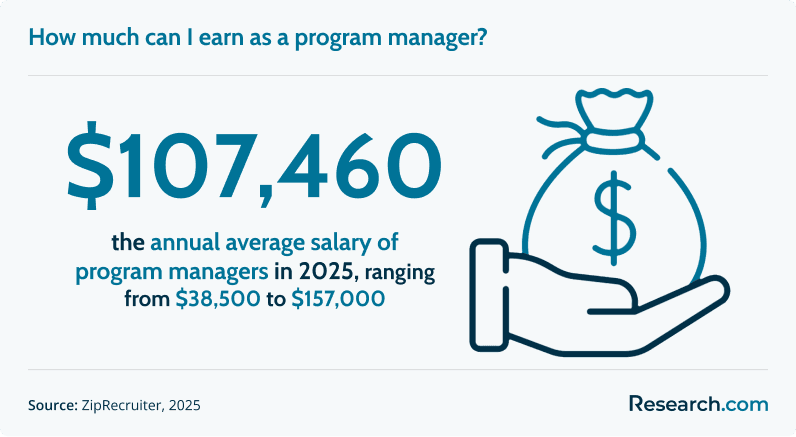
Program manager pay varies by employer, location, industry, seniority, and technical specialization. In 2025, the average annual salary for program managers is $107,460, with reported earnings ranging from $38,500 to $157,000. Program managers in technology, finance, engineering, and other complex operating environments often have stronger earning potential, especially when they manage high-value programs or lead teams across business units.
Salary Factors to Evaluate
- Industry. Technology, finance, engineering, and management-heavy sectors may offer higher compensation than smaller or lower-budget organizations.
- Experience. Senior program managers who have led complex programs, managed budgets, and influenced executives can command higher pay.
- Location. Compensation can rise in cities with strong demand and higher costs of living.
- Technical specialization. Program managers who understand cloud systems, cybersecurity, healthcare operations, compliance, or financial systems may be more competitive in specialized roles.
- Leadership scope. Managing multiple programs, large budgets, or enterprise initiatives can support advancement into director or executive roles.
| Location | Average salary cited |
| Redmond, WA | $129,064 |
| Washington, DC | $112,037 |
| Seattle, WA | $106,737 |
How to Improve Earning Potential
Program managers can improve their long-term compensation prospects by moving into higher-value industries, documenting measurable outcomes, developing financial and technical fluency, and pursuing credentials that match their goals. Some professionals also use flexible graduate options, including the easiest master’s degree online programs, to strengthen management skills while continuing to build full-time experience. The key is to choose education that improves your marketability rather than selecting a program only because it is convenient.
What are the challenges for program managers?
Program management can be rewarding, but it is not a low-pressure role. Program managers are often accountable for outcomes they cannot fully control because teams, budgets, vendors, executives, and external conditions all affect the work. The ability to manage uncertainty is central to success.
Common Challenges and Better Responses
| Challenge | Why it happens | Better response |
| Overlapping project dependencies | One delayed workstream can disrupt several others | Create dependency maps, review risks frequently, and escalate blockers before they become major delays |
| Conflicting stakeholder expectations | Executives, teams, clients, and vendors may define success differently | Document priorities, clarify decision rights, and communicate trade-offs in plain language |
| Resource and budget constraints | Programs often compete for limited staff, funding, tools, and leadership attention | Use transparent prioritization and show the business impact of different resource choices |
| Changing business priorities | Market conditions, leadership decisions, regulation, or customer needs may shift | Reassess program goals regularly and adjust plans without losing sight of strategic value |
| Team fatigue | Long programs can create burnout, confusion, and loss of momentum | Set realistic expectations, celebrate progress, remove unnecessary work, and communicate why the effort matters |
Common Mistakes to Avoid
- Assuming project success equals program success. A project can be delivered on time while the overall program fails to create business value.
- Focusing only on status reports. Executives need risks, decisions, options, and impact, not just activity updates.
- Ignoring accreditation when choosing education. If you pursue a degree, verify institutional and program quality before enrolling.
- Choosing training based only on speed or cost. A fast or cheap credential may not help if employers in your target field do not value it.
- Underestimating soft power. Program managers often lead through influence, not direct authority.
- Assuming salary outcomes are guaranteed. Published averages are useful benchmarks, but actual pay depends on your industry, location, experience, and employer.
How Can Continuous Education Elevate Program Management Success?
Continuous education can help program managers stay effective as tools, business models, workforce expectations, and compliance pressures change. The best learning plan depends on the manager’s gap. Some need analytics or finance. Others need people leadership, change management, Agile methods, or industry-specific regulation.
Professionals who manage people-heavy programs may benefit from deeper training in workforce planning, employee relations, and organizational behavior. For example, an affordable option such as the cheapest online masters in human resources may be relevant for program managers whose work depends heavily on talent strategy, staffing, performance, and organizational change.
How do program managers measure success?
Program success should be measured by business value, not only by task completion. A strong program manager defines success early, tracks progress consistently, and reports results in a way that helps leaders make decisions. Useful measures may include schedule performance, budget performance, stakeholder satisfaction, risk reduction, adoption, quality, operational improvement, and whether the program achieved the intended strategic outcome.
| Success measure | What it shows |
| Schedule performance | Whether key milestones and dependencies are moving as planned |
| Budget performance | Whether spending is aligned with approved resources and expected value |
| Stakeholder satisfaction | Whether leaders, users, clients, or partners believe the program is solving the right problem |
| Risk management | Whether major threats are identified, monitored, and reduced before they damage outcomes |
| Business impact | Whether the program improves operations, supports revenue, reduces cost, strengthens compliance, or advances strategy |
Program managers responsible for people systems, workforce transformation, or organizational change may also benefit from workforce-focused study. A human resources degree can support stronger understanding of talent planning, performance systems, compliance, and employee experience.
What are the current trends in program management?
Program management is changing as organizations use more digital tools, distribute teams across locations, and expect faster evidence of value. These trends do not remove the need for leadership judgment. They raise the standard for how clearly program managers use data, communicate decisions, and adapt to change.
Trends Shaping the Role
- AI and automation in tracking and reporting. Organizations are using AI-supported tools to reduce manual updates, identify risks, and improve visibility across workstreams.
- Remote and hybrid delivery. Program managers must build collaboration systems that work even when teams are not in the same office.
- More data-driven decision-making. Dashboards, analytics tools, and real-time performance indicators are becoming more central to program oversight.
- Agile and adaptive leadership. Many organizations expect program managers to adjust priorities quickly while maintaining accountability for outcomes.
- Sustainability and ESG-related initiatives. Some companies are integrating environmental, social, and governance considerations into strategic programs.
- Credential- and skills-based hiring. Employers may evaluate candidates through a combination of experience, certifications, technical skills, and business education rather than relying on one traditional pathway.
Professionals who need a broader business foundation may consider an online college business degree, particularly if they want structured exposure to finance, operations, strategy, and management before pursuing program leadership roles.
What is the job outlook for program managers?
Program manager is not always tracked as one single occupation across labor datasets because the role appears in technology, business operations, consulting, healthcare, government, and other sectors. The outlook is best understood by looking at related management and business roles that often include program-level responsibilities.
| Related role category | Projected growth or openings cited | Why it matters for program managers |
| Management occupations | 1.2 million annual job openings from 2023 to 2033 | Shows broad demand for leadership roles across industries |
| Computer and information systems managers | 17% growth, with 54,700 annual job openings | Relevant for program managers in IT, cybersecurity, software, infrastructure, and digital transformation |
| Management analysts | 11% growth, with 95,700 annual job openings | Relevant for consulting, process improvement, strategy, and transformation work |
| Administrative services and facilities managers | 6% job growth, with 35,200 annual job openings | Relevant for operations, facilities, corporate services, and organizational coordination roles |
The strongest candidates will usually have both delivery experience and domain knowledge. Technology, healthcare, finance, consulting, and operations-heavy organizations are likely to continue needing professionals who can connect strategy with execution across complex initiatives.
How Can Online Education Enhance Program Management Effectiveness?
Online education can be useful for working professionals because it allows them to build skills without leaving the workforce. For program managers, the best online programs are those that teach immediately applicable skills: leadership, analytics, finance, communication, operations, change management, Agile delivery, and strategic planning.
An accelerated MBA online may appeal to experienced professionals who want to strengthen business decision-making on a compressed timeline. Before enrolling, compare accreditation, curriculum, faculty experience, workload, tuition, employer tuition assistance, and whether the program’s outcomes match your target role.
How Can an Accelerated Bachelor's Degree in Project Management Enhance Career Readiness?
An accelerated bachelor’s program can help aspiring program managers build project delivery fundamentals more quickly than a traditional schedule may allow. This route can be especially useful for adults who already have work experience but need a degree to qualify for roles that screen for formal education.
An accelerated bachelor's degree in project management online can support career readiness by covering budgeting, scheduling, risk management, communication, and planning. However, students should confirm transfer credit policies, total cost, accreditation, course pacing, and whether the curriculum includes applied projects that can be discussed in interviews.
What are the career paths available for program managers?
Program management can lead to senior operational, strategic, consulting, and executive roles. The next step depends on whether the professional wants deeper specialization, broader organizational authority, or independent advisory work.
| Career path | Typical direction | Good fit for |
| Senior Program Manager | Oversees larger or more complex programs and may mentor other program or project managers | Professionals who want more responsibility but still enjoy hands-on program leadership |
| Director of Program Management | Sets program priorities, improves governance, manages leaders, and aligns initiatives with strategy | Program managers who want broader influence across departments or business units |
| Chief Operating Officer (COO) | Leads large areas of operations, execution, strategy, and organizational performance | Senior leaders who want executive responsibility beyond program delivery |
| Industry Specialist | Builds expertise in IT, healthcare, finance, marketing, engineering, or another domain | Professionals who want higher-value roles tied to specialized knowledge |
| Consultant or Trainer | Advises organizations, teaches methods, improves program governance, or supports transformations | Experienced program managers who enjoy problem-solving across organizations |
Experienced professionals who want to formalize executive-level business skills sometimes pursue an online executive MBA. This option is generally better suited to managers with substantial work experience than to candidates just entering the field.
Professional training organizations can also support career growth. For example, the American Management Association offers structured training related to program and project management. Training can be especially useful when a program manager needs a targeted skill upgrade without committing to a full degree.
Industry selection matters for long-term earnings. As noted earlier, computer and information systems managers had a median annual salary of $169,510 in 2023, making it the highest-paid management occupation cited here. Program managers who combine technical knowledge with leadership capability may be well positioned for senior roles in technology-driven organizations.
Can advanced academic programs accelerate career growth in program management?
Advanced academic programs can support career growth when they solve a specific problem: building executive credibility, strengthening research and analysis, improving strategic thinking, or preparing for consulting and senior leadership. They are less useful when chosen only for prestige or speed without a clear career purpose.
A doctoral-level business option such as a 1 year DBA program online may be relevant for professionals who want advanced analytical skills, organizational research capability, or preparation for high-level consulting and leadership work. Before choosing this path, candidates should weigh the time commitment, cost, accreditation, faculty expertise, and how employers in their target field view the credential.
How Can Mentorship and Professional Networking Impact Program Management Success?
Mentorship and networking can shorten the learning curve because program management depends heavily on judgment, influence, and context. A mentor can help a developing program manager understand how to communicate with executives, when to escalate risk, how to manage conflict, and how to position achievements for promotion.
Professional networks can also expose program managers to new tools, hiring trends, industry benchmarks, and education options. For professionals comparing business programs with a cost-conscious approach, a cheapest AACSB online MBA may be worth reviewing alongside employer requirements, accreditation expectations, and long-term career goals.
Does an Advanced Degree Bridge the Gap Between Strategic Vision and Operational Execution?
An advanced degree can help bridge strategy and execution when the curriculum teaches both business theory and practical decision-making. Program managers often know how to get work done, but senior roles require a stronger command of finance, strategy, organizational behavior, analytics, and leadership under uncertainty.
An MBA program on line can provide a structured way to develop those skills while continuing to work. Still, an MBA should be evaluated like any career investment: check accreditation, total cost, course relevance, flexibility, alumni outcomes, and whether the program helps you qualify for the roles you actually want.
Is Program Management Worth It?
Program management can be worth it for professionals who want strategic responsibility, enjoy complex coordination, and are comfortable influencing people across teams. The role can offer strong pay, mobility across industries, and a path into senior leadership. It is less ideal for people who prefer narrow technical work, dislike ambiguity, or do not want responsibility for outcomes affected by many stakeholders.
| Program management may be a good fit if... | You may prefer another path if... |
| You enjoy connecting strategy with execution | You prefer clearly defined individual tasks |
| You can communicate with both executives and technical teams | You dislike frequent meetings, negotiation, and stakeholder management |
| You are comfortable making trade-offs under uncertainty | You need stable priorities and predictable workflows |
| You want a path toward senior leadership | You prefer deep specialization without broad coordination responsibility |
| You can manage risk, budgets, timelines, and team dependencies | You do not want accountability for work performed by teams outside your direct control |
Practical Checklist Before You Apply for Program Manager Roles
- Update your resume to show program-level outcomes, not only project tasks.
- Quantify the scope of your work where possible, including teams, budgets, timelines, vendors, stakeholders, or business impact.
- Prepare interview stories about conflict, risk, executive communication, resource constraints, and changing priorities.
- Identify the industry you want to target and build the domain knowledge employers expect.
- Compare certifications carefully instead of collecting credentials without a strategy.
- If pursuing a degree, verify accreditation, total cost, transfer credit policies, course relevance, and schedule fit.
- Build relationships with senior leaders, project managers, finance partners, and operations stakeholders who can validate your leadership ability.
Key Insights
- Program managers coordinate multiple related projects and are judged by strategic outcomes, not just task completion.
- The most realistic path usually starts with project, operations, analysis, IT, consulting, or team leadership experience before moving into formal program management.
- Education requirements vary by employer: 29% of managers report that a high school diploma or equivalent is required, 27% cite a bachelor's degree, and 22% indicate some college without a degree.
- Certifications such as PgMP®, PMP, CSM, MSP, and SPC can help, but they are most valuable when aligned with your experience level and target industry.
- The average annual salary for program managers in 2025 is $107,460, with reported earnings from $38,500 to $157,000; location and industry strongly affect pay.
- Technology-related leadership roles are especially attractive: computer and information systems managers had a median salary of $169,510 in 2023 and are projected to grow by 17%, with 54,700 annual job openings.
- Strong program managers combine business judgment, risk management, financial awareness, communication, and the ability to lead without always having direct authority.
- Before investing in a degree or certification, compare accreditation, employer recognition, total cost, schedule, curriculum, and whether the credential supports your next career move.
References:
- Bureau of Labor Statistics. (2024). Administrative services and facilities managers. Retrieved March 26, 2025, from BLS.
- Bureau of Labor Statistics. (2024). Computer and information systems managers. Retrieved March 26, 2025, from BLS.
- Bureau of Labor Statistics. (2024). Management analysts. Retrieved March 26, 2025, from BLS.
- Bureau of Labor Statistics. (2024). Management occupations. Retrieved March 26, 2025, from BLS.
- Bureau of Labor Statistics. (2024). Occupational employment and wages, May 2023 - 11-3012 administrative services managers. Retrieved March 26, 2025, from BLS.
- Bureau of Labor Statistics. (2024). Occupational employment and wages, May 2023 - 11-3021 computer and information systems managers. Retrieved March 26, 2025, from BLS.
- Bureau of Labor Statistics. (2024). Occupational employment and wages, May 2023 - 13-1111 management analysts. Retrieved March 26, 2025, from BLS.
- Bureau of Labor Statistics. (2024). Project management specialists. Retrieved March 26, 2025, from BLS.
- Indeed. (2025, March 26). What is program management? Retrieved March 26, 2025, from Indeed.
- O*NET OnLine. (2025). General and operations managers. Retrieved March 26, 2025, from O*NET OnLine.
- ZipRecruiter. (2025). Program manager salary. Retrieved March 26, 2025, from ZipRecruiter.
Other Things You Should Know About How to Become a Program Manager
No, a certification is not required for every program manager role, but employers often prefer candidates with PMP, PgMP, or PRINCE2 credentials. In 2027, these certifications can strengthen applications, especially for roles asking for 5 to 10 years of leadership experience and cross-functional program oversight.
In 2027, program managers should excel in strategic planning, leadership, and communication. They need skills in risk management, financial acumen, and familiarity with project management tools like Microsoft Project or JIRA. Adaptability to emerging technologies and remote work dynamics is also crucial.
Certifications such as Project Management Professional (PMP) and Certified ScrumMaster (CSM) are pivotal for program managers in 2027, enhancing skill credibility and career prospects. These certifications validate expertise in managing complex programs and applying agile methodologies, offering a competitive edge in the industry.


