
2027 MBA Grads Reliably Earn a Six-Figure Salary in These 6 Industries

Co-Founder and Chief Data Scientist
An MBA can still be a high-ROI career move, but the payoff depends heavily on industry, school recruiting strength, work experience, geography, specialization, and how well the degree supports your next role. For professionals comparing business school options in 2026, the real question is not simply “Can an MBA lead to a six-figure salary?” It is “Which industries, roles, and program choices make that outcome most realistic?”
This guide explains where MBA graduates most often see six-figure compensation, what salary data from business schools and employer surveys shows, how to compare high-paying industries, and how to choose an MBA path that supports long-term career growth rather than short-term prestige alone.
Key Insights
- An MBA can lead to six-figure salaries, but the strongest outcomes cluster in consulting, finance, technology, healthcare/pharmaceuticals/biotech, consumer goods, and entertainment/media/sports.
- The cited 2022 MBA starting salary average was $115,000, compared with $75,000 for bachelor’s degree holders, but individual outcomes depend on program quality, industry, experience, and role.
- Consulting and finance often deliver the highest early compensation, especially when bonuses are included, but they can also involve demanding workloads and competitive recruiting.
- Technology and healthcare offer strong options for MBA graduates who can combine business strategy with digital fluency, operational insight, or regulated-industry knowledge.
- Online and accelerated MBA formats can improve access and reduce opportunity cost, but students should verify accreditation, career support, employer access, and total cost before enrolling.
- The best MBA decision starts with a target role, not a school name. Choose the program, concentration, and format that most directly support the industry and salary path you want.
Quick Answer
MBA graduates can earn six-figure salaries, especially in consulting, finance, technology, consumer packaged goods, entertainment/media/sports, and healthcare. The cited data shows an average MBA starting salary of $115,000 in 2022 compared with $75,000 for bachelor’s degree holders (THE MBA.COM TEAM, 2022). Consulting and finance often produce the highest compensation packages, but salary outcomes vary widely by employer, school, role, prior experience, and bonuses.
- Best-paying MBA industries: consulting, finance, technology, healthcare/pharmaceuticals/biotech, consumer packaged goods, and entertainment/media/sports.
- Strongest compensation upside: consulting and finance, where total compensation can rise quickly with bonuses and promotion.
- Best fit for career switchers: technology, healthcare management, consulting, and consumer goods often value transferable MBA skills.
- Most important caution: an MBA does not guarantee a six-figure role; accreditation, recruiting access, specialization, work history, and networking matter.
Online, hybrid, executive, accelerated, and traditional MBA formats now give working professionals more ways to pursue graduate business education. The right option depends on your career target, budget, timeline, and whether you need a program with strong employer connections in your preferred industry.
- Six industries where MBA graduates commonly reach six-figure salaries
- Can MBA graduates still expect six-figure salaries?
- Why employers value MBA graduates across industries
- How an MBA can affect salary growth and promotion
- How MBA skills show up in real business roles
- Emerging industries and roles for MBA graduates
- How MBA graduates can use technology trends strategically
- Technology careers for MBA graduates
- Healthcare management roles for MBA graduates
- How an MBA can support entrepreneurship
- MBA skills that help new businesses grow
- Executive MBA vs. traditional MBA
- Online MBA cost and long-term ROI
- One-year online MBA programs
- Accelerated business administration degrees
- Accelerated business degrees and career advancement
- Business law knowledge for MBA graduates
- MBA networking and career outcomes
- IT management and MBA career strategy
- How to choose an online MBA for career growth
- How to evaluate MBA fit and return on investment
- MBA concentrations with strong salary potential
- How an MBA can improve career mobility
Six Industries Where MBA Graduates Commonly Reach Six-Figure Salaries
The strongest MBA salary outcomes tend to appear in industries where employers pay for analytical ability, leadership potential, client management, financial judgment, operational discipline, and the ability to lead change. In 2022, MBA graduates had an average starting salary of $115,000, while bachelor’s degree holders averaged $75,000 (THE MBA.COM TEAM, 2022). That gap helps explain why many professionals consider an MBA when they want to move into higher-paying management, strategy, finance, or leadership roles.
The industries below are not the only paths to six-figure compensation, but they are among the most commonly cited in MBA employment reports and recruiter surveys. Compensation may include base salary, signing bonuses, performance bonuses, equity, profit sharing, or other incentives, so always compare total compensation rather than base salary alone.
| Industry | Common MBA roles | Salary evidence cited | Best fit for |
| Consulting | Management consultant, strategy consultant, technical solution consultant, project leader | Base salaries for MBA graduates in consulting were nearly $200,000 in the cited 2022 GMAC report; senior roles can range from $275,000 to as much as $700,000 (Management Consulted, 2023). | Generalists who enjoy problem-solving, client work, travel, and fast-paced promotion tracks. |
| Finance | Investment banker, financial analyst, hedge fund manager, private equity associate | Harvard Business School 2021 graduates in financial services averaged a $150,500 base salary, a $30,000 signing bonus, and a $37,000 performance bonus. | Professionals comfortable with quantitative analysis, deal work, markets, and long hours. |
| Technology | Product manager, innovation strategist, business development manager, analytics leader | Median base salaries cited include $140,354 from the University of Washington and over $180,000 from Stanford. | MBA graduates who can translate customer, data, product, and business strategy into growth. |
| Consumer packaged goods | Brand manager, marketing manager, supply chain leader, general manager | NYU Stern reported an average salary of $119,643 and an average signing bonus of $32,500 for 2022 MBA graduates in this field. | Professionals interested in brand strategy, consumer behavior, operations, and leadership pipelines. |
| Entertainment, media, and sports | Strategy manager, business development leader, partnerships manager, marketing executive | NYU Stern graduates in this sector reported an average salary of $137,500. | MBA graduates who combine business training with media, sports, gaming, streaming, or entertainment industry knowledge. |
| Healthcare, pharmaceuticals, and biotech | Healthcare administrator, healthcare consultant, pharmaceutical project manager, hospital executive | Tuck Business School reported base salaries ranging from $118,000 to $185,000 for graduates entering healthcare, pharmaceuticals, and biotech in 2022. | Professionals who want to manage complex systems where business decisions affect patient access, quality, cost, and operations. |
1. Consulting Jobs
Consulting remains one of the clearest six-figure paths for MBA graduates because firms need professionals who can diagnose business problems, build recommendations, manage clients, and communicate under pressure. The 2023 Corporate Recruiters Survey reported that consulting firms mostly preferred generalist talent, which aligns well with MBA training in finance, strategy, operations, marketing, leadership, and analytics (GMAC, 2023).
Although the cited 2023 data does not clearly isolate salary changes for consulting roles, the 2022 GMAC report showed that MBA graduates entering consulting were offered base salaries of nearly $200,000 (GMAC, 2022). Salary data also shows that many consulting roles, including information services consultant and technical solution consultant, can start at over $100,000. Management Consulted reported that the average base salary for new MBA graduates in consulting is around $190,000 and can rise to between $220,000 and $240,000 within a few years. Senior positions such as project leader or partner can range from $275,000 to as much as $700,000 (Management Consulted, 2023).
Consulting compensation can also include signing and performance bonuses. Management Consulted reported that these bonuses can add up to an additional $30,000 each to annual compensation (Management Consulted, 2023). Candidates should weigh this upside against travel expectations, demanding hours, and intense performance evaluation.
2. Finance Jobs
Finance continues to attract MBA graduates seeking high compensation, especially in investment banking, private equity, venture capital, hedge funds, asset management, corporate finance, and financial analysis. These roles reward technical modeling skills, risk judgment, market knowledge, deal execution, and strong communication with clients or senior leadership.
Harvard Business School 2021 graduates entering financial services reported an average $150,500 base salary, a $30,000 signing bonus, and a $37,000 performance bonus. Together, that equals $217,000 in base salary plus bonuses immediately after the MBA (HBS, 2021). This supports the broader point reflected in the 2023 GMAC Corporate Recruiters Survey: financial services employers continue to value graduate business talent.
Finance can be lucrative, but it is not equally suited to every MBA student. The strongest candidates usually have quantitative ability, attention to detail, stamina for long workweeks, and interest in markets, transactions, or capital allocation.
3. Technology Jobs
The technology sector remains attractive for MBA graduates even as hiring cycles shift. MBA talent is commonly used in product management, business operations, strategy, sales leadership, partnerships, innovation, and analytics-focused roles. GMAC data noted a slowdown in technology demand in 2023, but employers still look for business leaders who understand both market strategy and digital products (GMAC, 2022, 2023).
Reported MBA tech salaries can be substantial. Graduates entering technology roles reported median base salaries of $140,354 from the University of Washington and over $180,000 from Stanford (Stanford, 2023; UW Foster School of Business, 2023). Specialized roles such as innovation strategist, business development manager, and product manager can draw average salaries ranging from around $120,000 to upwards of $270,000.
For MBA students targeting tech, the best strategy is to pair business education with practical fluency in data, product thinking, AI use cases, cloud platforms, cybersecurity risk, customer discovery, and agile teams.
4. Consumer Packaged Goods Jobs
Consumer packaged goods companies often use MBA programs as leadership pipelines for brand management, marketing, operations, supply chain, pricing, category strategy, and general management. These roles may not always match the highest consulting or banking packages, but they can offer strong brand-name experience, structured development, and broad management responsibility.
NYU Stern reported that 2022 MBA graduates entering this industry received $119,643 on average, plus an average signing bonus of $32,500 (NYU Stern, 2023). MIT Sloan School of Management alumni entering consumer goods reported median salaries of around $141,000 (MIT, 2022).
This path is often a good fit for MBA graduates who want to lead teams, own a product line, understand customers, and build long-term general management skills.
5. Entertainment, Media, and Sports Jobs
Entertainment, media, gaming, streaming, and sports organizations hire MBA graduates for strategy, finance, partnerships, distribution, marketing, operations, and business development. These industries can be competitive because many candidates are drawn to the brands, creative environment, and public visibility of the work.
NYU Stern alumni have moved into roles at companies and organizations such as Hulu, PlayStation, the NBA, and the NFL (NYU Stern, 2023). The cited Stern data showed an average salary of $137,500 in this category (NYU Stern, 2023). MBA graduates from schools close to the entertainment industry also reported strong outcomes, with UCLA Anderson and USC Marshall graduates reporting average base salaries of around $120,000 (UCLA, 2023; USC, 2023).
For this sector, networking, internship access, geographic proximity, and industry-specific experience can matter as much as the MBA credential itself.
6. Healthcare Jobs
Healthcare, pharmaceuticals, and biotech offer strong MBA opportunities because the sector requires leaders who can manage cost, quality, compliance, innovation, supply chains, marketing, and patient access. MBA graduates may not conduct lab research or clinical care, but they often influence business decisions that shape how healthcare services and products reach patients.
Tuck Business School reported that 2022 graduates entering healthcare, pharmaceuticals, and biotech earned base salaries ranging from $118,000 to $185,000 (Tuck Business School, 2023). The 2023 GMAC Corporate Recruiters Survey also stated that technology and healthcare/pharmaceuticals were the only sectors to increase total hiring of graduates with a Master in Management degree from 2021 to 2022 (GMAC, 2023).
Healthcare can be especially compelling for MBA graduates who want mission-oriented work, complex operational challenges, and a sector with ongoing demand for business leadership.
Alumni Perspectives: What Graduates Say an MBA Changed
My MBA reshaped the way I analyze strategy and lead teams. The program also expanded my access to senior professionals, which helped me move into a six-figure position. - Alicia
Graduate business school gave me practice making decisions under pressure through demanding coursework and business simulations. That preparation helped me qualify for a high-paying role at a multinational company. - Ahmed
The degree was difficult, but the combination of business training and a stronger network helped me secure a six-figure opportunity that would have been harder to reach on my previous path. - Yuna
Key Salary Findings From the Cited Data
- In 2022, MBA graduates had an average starting salary of $115,000, compared with $75,000 for bachelor’s degree holders (THE MBA.COM TEAM, 2022).
- Consulting roles for MBA graduates were offered base salaries of nearly $200,000, with salaries rising to between $220,000 and $240,000 within a few years. Senior roles can range from $275,000 to as much as $700,000 (Management Consulted, 2023).
- Harvard Business School 2021 graduates entering financial services averaged $150,500 in base salary, plus a $30,000 signing bonus and a $37,000 performance bonus, for a combined $217,000 compensation figure immediately after earning the degree (HBS, 2021).
- MBA graduates in technology roles reported median base salaries of $140,354 from the University of Washington and over $180,000 from Stanford, while certain specialized roles ranged from around $120,000 to upwards of $270,000 (Stanford, 2023; UW Foster School of Business, 2023).
- Consumer packaged goods MBA graduates in the cited NYU Stern report earned an average salary of $119,643 and an average signing bonus of $32,500 (NYU Stern, 2023).
- Healthcare, pharmaceuticals, and biotech MBA graduates in the cited Tuck data reported 2022 base salaries ranging from $118,000 to $185,000 (Tuck Business School, 2023).
The following comparison summarizes the salary difference cited between MBA graduates and bachelor’s degree holders.
| Education level | Average starting salary cited | What the number suggests |
| MBA graduates | $115,000 in 2022 | The degree can support access to higher-paying management, strategy, finance, consulting, and leadership-track roles. |
| Bachelor’s degree holders | $75,000 in 2022 | Undergraduate credentials can lead to strong careers, but the cited average is lower than the MBA figure. |
Can MBA Graduates Still Expect Six-Figure Salaries?
Many MBA graduates can still target six-figure salaries, but “expect” should not mean “assume.” The best outcomes are concentrated among candidates who choose programs with strong employer relationships, complete relevant internships or projects, build a focused network, and pursue industries where MBA hiring remains active.
The National Association of Colleges and Employers (2023) forecasted that master’s degree candidates, including MBAs, would see a sizable salary increase of 13.1% that year. The World Economic Forum also identified MBAs among groups predicted to see a salary increase in 2023 (WEF, 2023). At the same time, the 2023 GMAC report showed a more mixed global picture: demand increased in Central and South Asia and East and Southeast Asia, while it decreased in the United States compared with the previous year (GMAC, 2023).
The practical takeaway is straightforward: an MBA can still be financially valuable, but candidates should build a targeted career plan instead of relying on the degree alone.
Why Employers Value MBA Graduates Across Industries
Employers hire MBA graduates because the degree is designed to build broad business judgment. A strong MBA curriculum usually blends finance, accounting, strategy, operations, marketing, organizational behavior, analytics, ethics, and leadership. That combination helps graduates move between functions and make decisions that account for revenue, cost, risk, people, customers, and market position.
Across consulting, finance, technology, healthcare, consumer goods, and media, employers often want professionals who can simplify complex problems, lead cross-functional teams, evaluate data, communicate with executives, and connect strategy to execution. The 2023 GMAC Corporate Recruiters Survey reinforces that business school graduates continue to be valued for these capabilities (GMAC, 2023).
| MBA capability | How employers use it | Industries where it matters |
| Financial analysis | Budgeting, valuation, pricing, forecasting, investment decisions | Finance, consulting, healthcare, technology, consumer goods |
| Strategy | Market entry, competitive positioning, growth planning, turnaround work | Consulting, technology, media, healthcare, entrepreneurship |
| Leadership | Managing teams, influencing stakeholders, leading change | All major MBA hiring sectors |
| Analytics and decision-making | Turning data into business recommendations | Technology, consulting, finance, operations, marketing |
| Communication | Presenting recommendations, negotiating, managing clients and executives | Consulting, finance, product management, healthcare administration |
How an MBA Can Affect Salary Growth and Promotion
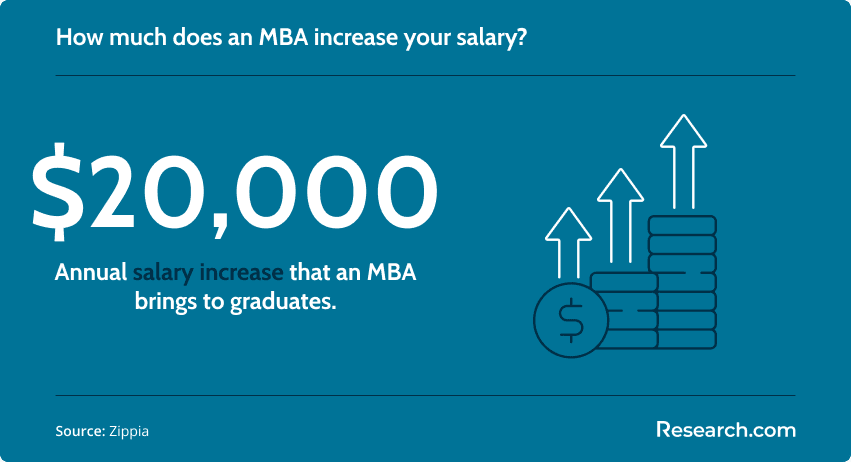
An MBA can increase earnings by helping professionals qualify for higher-level roles, switch into better-paying industries, or move from technical or individual contributor work into management. Zippia reported that an MBA typically increases earnings by at least $20,000 annually (Zippia Team, 2023). Consulting showed the highest post-MBA salary increase at $46,414 (Flynn, 2023), and the average starting salary for graduates was over $105,000 (Flynn, 2023). Consulting starting salaries were reported as high as $147,178, with salary gains reaching up to $46,414 in that field (Flynn, 2023).
These numbers are useful benchmarks, but they should not be treated as guaranteed outcomes. A graduate from a well-connected full-time program entering consulting or finance may see a different return than a part-time student remaining with the same employer. If you are comparing programs, use employment reports, alumni outcomes, and recruiting access to estimate likely value. Research.com’s guide to affordable online MBA programs can be a practical starting point if cost control is central to your ROI calculation.
How MBA Skills Show Up in Real Business Roles
MBA skills become valuable when graduates can apply them to revenue growth, operational improvement, risk management, product strategy, financial planning, or organizational change. The coursework can be demanding, which is why many candidates ask how hard an MBA is before applying. The challenge can be worthwhile when the program builds skills that employers actually reward.
In practice, MBA graduates may lead a market expansion analysis, redesign a pricing model, evaluate acquisition targets, launch a product, improve supply chain performance, build a budget, or manage a cross-functional team. The degree’s value comes less from memorizing business theory and more from learning how to make structured decisions with incomplete information.
Additional Certifications That Can Strengthen an MBA Profile
Certifications do not replace an MBA, but they can make the degree more targeted. They are most useful when they align directly with the role you want after graduation.
| Credential or skill area | Best aligned with | How it can help |
| Certified Public Accountant (CPA) | Accounting, corporate finance, controllership, audit, financial leadership | Signals technical accounting competence for finance-heavy roles. |
| Chartered Financial Analyst (CFA) | Investment management, asset management, equity research, finance | Strengthens credibility in investment and analytical finance careers. |
| Project Management Professional (PMP) | Project management, operations, consulting, technology implementation | Shows experience managing scope, timelines, stakeholders, and delivery. |
| Six Sigma certification | Operations, quality management, supply chain, process improvement | Supports roles focused on efficiency, measurement, and continuous improvement. |
| Data analytics, AI, or digital marketing training | Technology, marketing, product, strategy, analytics | Helps MBA graduates stay relevant in data-driven and digitally focused organizations. |
| Second-language proficiency | International business, global strategy, regional management | Can support cross-border roles and work with international stakeholders. |
Emerging Industries and Roles for MBA Graduates
Future MBA opportunities are increasingly shaped by technology adoption, sustainability, international business needs, media transformation, and entrepreneurship. The 2023 GMAC Corporate Recruiters Survey and the cited Zippia data point to a market where traditional business knowledge is still valuable, but employers increasingly want graduates who can connect business strategy with digital tools and changing customer behavior.
- Technology employers continue to seek MBA graduates who understand cloud-based technology, artificial intelligence, machine learning, product strategy, and digital transformation. The average starting salary in technology for MBA graduates was $128,442 (Flynn, 2023).
- Consulting remains a high-paying route, with an average starting salary of $147,178 and the highest post-MBA salary increase at $46,414 (Flynn, 2023).
- Finance remains a core MBA destination, with an average starting salary of $138,834 for MBA graduates (Flynn, 2023).
- Renewable energy and sustainability-focused organizations need business leaders who can manage growth, financing, operations, and strategy in markets shaped by environmental goals.
- International business roles increasingly value cross-cultural competence and multilingual communication.
- Startups often look for MBA graduates who can bring structure to finance, operations, go-to-market strategy, and fundraising.
- Media and communications organizations need business leaders who understand digital distribution, content strategy, audience data, and global brand management.
Professionals pursuing leadership while working may also compare traditional MBA options with online Executive MBA programs, especially if they already have substantial management experience. Zippia reported that an average MBA increases annual earnings by at least $20,000, and MBA graduates stand to earn an average salary of over $105,000 right after graduation (Flynn, 2023; Zippia, 2023).
How MBA Graduates Can Use Technology Trends Strategically
Technology fluency is now a major differentiator for MBA graduates. Employers do not necessarily expect every MBA to code, but they do expect business leaders to understand how data, AI, automation, cybersecurity, cloud systems, and digital platforms affect revenue, cost, customer experience, and risk.
MBA graduates can improve their career prospects by learning how to evaluate technology investments, lead digital transformation, ask better questions of technical teams, and turn analytics into decisions. Practical steps include completing applied analytics projects, joining technology-focused student clubs or professional associations, taking short courses in AI or data visualization, and building a portfolio of business problems solved with digital tools.
Technology Careers for MBA Graduates
MBA graduates in technology can pursue roles that sit between business strategy, customer needs, product development, operations, and data. Estimated salary ranges vary by company, market, experience, and specialization, but several roles commonly reach six figures.
| Technology role | Core responsibility | Estimated salary range cited |
| Product Manager | Guides a product from concept through development, launch, growth, and iteration. | $90,000 $140,000 |
| Technology Consultant | Helps organizations choose, implement, and use technology effectively. | $75,000 $130,000 |
| Data Analytics Manager | Uses data to shape business strategy, reporting, and decision-making. | $85,000 $135,000 |
| IT Director/Chief Technology Officer (CTO) | Leads technology strategy, infrastructure, teams, and digital priorities. | $120,000 $200,000+ |
| Project Manager, Tech | Manages technology projects, timelines, resources, vendors, and delivery risks. | $80,000 $125,000 |
| Business Development Manager, Tech | Builds partnerships, sales opportunities, and market expansion in technology businesses. | $70,000 $150,000 |
| Information Systems Manager | Oversees computer-related systems and supports technology operations. | $85,000 $140,000 |
These figures are estimates and can differ significantly by location, employer, prior experience, MBA specialization, and compensation structure. Bonuses, equity, and profit sharing may also change total earnings.
Healthcare Management Roles for MBA Graduates
MBA graduates in healthcare management help organizations balance patient care, cost control, compliance, staffing, technology, and operational efficiency. The work often requires business discipline plus sensitivity to regulation, ethics, and clinical workflows.
- Healthcare Administrator: Manages daily facility operations and supports efficient, high-quality patient care.
- Pharmaceutical Project Manager: Coordinates business, regulatory, operational, or distribution projects related to pharmaceutical products.
- Healthcare Consultant: Advises providers, payers, or healthcare companies on performance, profitability, operations, and patient services.
- Medical Practice Manager: Runs the business operations of a practice, including budgeting, staffing, scheduling, and policies.
- Hospital CFO/CEO: Leads financial strategy or overall direction for a hospital or healthcare system.
Students who want a shorter route should evaluate whether one of the fastest MBA programs still provides the healthcare coursework, accreditation, career support, and employer recognition needed for their target roles.
How an MBA Can Support Entrepreneurship
An MBA can help entrepreneurs understand finance, marketing, operations, strategy, leadership, accounting, pricing, and market analysis. These skills are useful when launching a company, raising capital, hiring a team, building a go-to-market plan, or deciding whether a business model is viable.
The degree can also provide access to classmates, professors, mentors, alumni, incubators, pitch competitions, and potential investors. However, an MBA does not guarantee a successful startup or a six-figure income. Entrepreneurship carries risk, and the value of the MBA depends on how effectively the founder applies the tools and network.
MBA Skills That Help New Businesses Grow
New businesses often need leaders who can make disciplined decisions with limited resources. MBA graduates may contribute strategic planning, financial modeling, marketing judgment, leadership, negotiation, communication, and problem-solving. They can also use market research to test customer demand before committing capital.
Even students who choose flexible or accessible options, including some of the easiest online MBA programs, should still look for rigorous coursework, applied projects, and faculty support. A business degree is most useful to entrepreneurs when it helps them make better real-world decisions, not merely when it adds a credential to a resume.
Executive MBA vs. Traditional MBA
An Executive MBA is usually designed for experienced professionals who want to continue working while strengthening executive-level leadership, strategy, and decision-making skills. A traditional MBA often serves a wider range of students, including career switchers, early-career professionals, and candidates seeking internships or full-time campus recruiting.
| Program type | Typical student | Primary advantage | Potential limitation |
| Traditional MBA | Career switchers, early-career professionals, or students seeking structured recruiting | Often provides internships, career services, and broad exploration of industries. | May require more time away from full-time work, depending on format. |
| Executive MBA | Experienced managers and leaders | Emphasizes peer learning, executive decision-making, and immediate workplace application. | May be less focused on entry-level career switching or internship recruiting. |
Cost-conscious executives can compare affordable online Executive MBA options while still checking accreditation, faculty quality, cohort strength, and employer recognition.
Online MBA Cost and Long-Term Career ROI
The cost of an online MBA affects ROI because tuition is only one part of the investment. Students should also account for fees, books, travel for residencies, technology requirements, time away from work, loan interest, and opportunity cost. On the benefit side, compare salary growth, promotion potential, career-switching value, employer tuition support, and access to alumni networks.
A practical ROI review should include current earnings, realistic post-MBA salary targets, total program cost, financing options, and how long it may take to recover the investment. For a deeper cost breakdown, review Research.com’s guide to online MBA cost.
Is a One-Year Online MBA the Right Fast-Track Option?
A one-year online MBA can be a strong fit for professionals who already have business experience, clear career goals, and the time to handle an intensive schedule. The advantage is speed: students may return to full career focus faster and potentially realize benefits sooner.
The trade-off is intensity. Accelerated formats may leave less room for internships, extended networking, career exploration, or slower skill development. Before enrolling, compare accreditation, workload, career services, employer relationships, and admissions expectations. Research.com’s guide to one-year online MBA programs can help you compare fast-track options.
Could an Accelerated Business Administration Degree Move Your Career Faster?
Accelerated business administration programs can help students complete coursework faster and apply business concepts sooner. They may be useful for working adults who want a shorter academic timeline, practical management training, or a quicker move into business roles.
Speed should not be the only criterion. Students should confirm that the curriculum is rigorous, transferable, accredited, and relevant to their goals. If you are comparing shorter undergraduate or graduate business pathways, start with accelerated online business administration degree programs.
Can an Accelerated Business Degree Fast-Track Career Advancement?
Accelerated business degrees can shorten the time required to complete a credential, which may help students pursue promotions or career changes sooner. The best programs combine speed with strong advising, practical projects, relevant business coursework, and employer-recognized quality.
Before choosing this path, ask whether the faster schedule gives you enough time to learn deeply, network, complete projects, and use career services. Research.com’s guide to accelerated online business degree programs can support side-by-side comparison.
How Important Is Business Law Knowledge for MBA Graduates?
Business law knowledge helps MBA graduates make better decisions around contracts, compliance, employment issues, intellectual property, corporate governance, risk, and ethics. Leaders do not need to become attorneys to benefit from legal awareness, but they do need to recognize when legal risk should shape strategy.
This knowledge is especially relevant in healthcare, finance, technology, entrepreneurship, international business, and heavily regulated industries. Students who want deeper legal and business training can explore online master’s in business law programs.
How MBA Networking Can Improve Career Outcomes
Networking is one of the major reasons students choose an MBA. A strong program can connect students with classmates, alumni, faculty, recruiters, executives, mentors, and industry speakers. These relationships can lead to referrals, interviews, partnerships, career advice, and access to roles that are not widely advertised.
Networking works best when students are intentional. Rather than collecting contacts, focus on building genuine relationships in your target industry. Experienced professionals who want a leadership-focused peer group may compare an online Executive MBA with a traditional MBA before applying.
How IT Management Can Complement an MBA
IT management can make an MBA more powerful because organizations increasingly need leaders who can connect technology decisions with business outcomes. Professionals who understand both executive strategy and technical implementation can help companies improve operations, manage digital transformation, reduce risk, and use data more effectively.
MBA graduates with IT management knowledge may pursue roles such as IT project manager, technology consultant, digital transformation leader, or CIO-track executive. Their value often comes from translating between technical teams and senior leadership, making sure technology investments support measurable business goals.
Students who want this combination can compare programs such as an MBA in Information Technology Management, especially if they want to work in technology strategy, systems leadership, analytics, cybersecurity governance, or enterprise transformation.
How to Choose the Right Online MBA for Career Growth
An online MBA can be a strong option for working professionals, but the best program is the one that fits your career target, budget, schedule, and preferred industry. Flexibility matters, but so do accreditation, outcomes, faculty, curriculum, and employer recognition.
Key Factors to Compare
- Accreditation: Look for recognized business accreditation such as AACSB, AMBA, or EQUIS when relevant to your goals.
- Career outcomes: Review employment reports, salary data, employer lists, and alumni career paths.
- Program format: Compare asynchronous, synchronous, hybrid, part-time, full-time, and accelerated options.
- Specializations: Choose concentrations tied to your target field, such as finance, healthcare management, technology, analytics, or entrepreneurship.
- Recruiting access: Ask whether online students receive the same career coaching, networking events, and employer access as campus students.
- Total cost: Compare tuition, fees, travel, books, lost income, and financing terms.
- Admissions requirements: Some working professionals prefer online MBA programs with no GMAT requirement, but they should still evaluate academic quality and outcomes.
How to Select an MBA Program That Fits Your Goals and ROI
The best MBA program is not always the most famous or the cheapest. It is the program that gives you the highest probability of reaching your specific career goal at a cost you can justify. Start by identifying your target role, industry, geography, and timeline. Then compare programs based on accreditation, curriculum, faculty expertise, career services, alumni network, employer relationships, and total cost.
Acceptance rate can also matter if you need a more accessible admissions path. Students who want a broader starting list can review MBA programs with high acceptance rates, then narrow options by quality indicators and career fit.
Questions to Ask Before Enrolling
- Is the business school accredited by a recognized accreditor?
- Do graduates enter the industries and roles I want?
- Are online students included in recruiting, networking, and career coaching?
- What is the total program cost after fees, books, travel, and financing?
- Can I keep working while completing the program?
- Does the curriculum include applied projects, leadership development, and industry-relevant electives?
- Will the program help me switch industries, or is it better for advancement in my current field?
What MBA Concentration Offers Strong Salary Prospects?
MBA concentration choice can influence salary because specialized skills may align with higher-paying roles. Finance, technology management, analytics, strategy, and global business can be strong options for students targeting compensation growth, but the best concentration depends on your background and intended role.
Do not choose a concentration based only on salary rankings. A finance concentration may not help if you dislike financial modeling, and a technology concentration may be less useful if you have no interest in product, data, or systems work. For more detail, compare salary patterns in Research.com’s guide to the highest-paying MBA concentrations.
How an MBA Can Improve Career Mobility Across Industries
An MBA can support career mobility because it teaches business concepts that apply across sectors. A professional may use the degree to move from engineering to product management, from sales to strategy, from finance to healthcare leadership, or from operations to consulting. The degree is especially useful when the candidate can connect prior experience to the new industry’s needs.
Career switching is easier when students choose programs with strong advising, internships or experiential projects, alumni in the target sector, and coursework aligned with the intended move. Online programs can support mobility for working adults because they allow students to build new credentials without leaving their current jobs. Candidates who want accredited, cost-conscious options can compare AACSB online MBA programs.
Common Mistakes to Avoid When Pursuing an MBA for Salary Growth
| Mistake | Why it can hurt ROI | Better approach |
| Choosing a program without checking accreditation | Some employers may discount degrees from schools without recognized quality assurance. | Verify institutional and business-school accreditation before applying. |
| Focusing only on tuition | A cheap program with weak outcomes may deliver poor value. | Compare total cost against career services, alumni network, employer access, and salary outcomes. |
| Assuming every MBA leads to a six-figure salary | Salary depends on industry, school, role, location, experience, and performance. | Use employment reports and realistic role targets to estimate outcomes. |
| Ignoring online student support | Some online students receive fewer networking or recruiting opportunities. | Ask whether online MBA students get full access to career coaching and employer events. |
| Choosing a concentration only because it sounds lucrative | A high-paying field may be a poor fit for your strengths or interests. | Select a specialization that matches both market demand and your capabilities. |
| Relying only on rankings | Rankings may not reflect your target industry, location, cost limits, or learning style. | Use rankings as one input, not the final decision-maker. |
References
- Flynn, J. (2023, March 28). 25 Educational MBA Statistics [2023]: Average Age, Cost, And Salary For MBA Graduates. Zippia.
- GMAC. (2022). 2022 GMA Corporate Recruiters Survey Summary Report. Graduate Management Admission Council.
- GMAC. (2023). Corporate Recruiters Survey—2023 Summary Report. Graduate Management Admission Council.
- HBS. (2021). Employment Data—Recruiting—Harvard Business School. Harvard Business School.
- Management Consulted. (2023, December 9). Management Consultant Salary Report | 2023 Consultant Salary. Management Consulted.
- MIT. (2022, November 7). 2022-2023 MBA Employment Report by MITSloanCDO. MIT.
- NYU Stern. (2023). NYU Stern MBA Employment Report 2022-2023. NYU Stern.
- Stanford. (2023). Full-Time Employment for MBA Graduates | Stanford Graduate School of Business.
- THE MBA.COM TEAM. (2022, August 1). Guide To Your Average MBA Salary | mba.com. MBA.Com.
- Tuck. (2023). Tuck School of Business | Employment Statistics. Tuck School of Business at Dartmouth.
- UCLA. (2023). 2022 FTMBA EMPLOYMENT REPORT SUMMARY. UCLA Anderson School of Management.
- USC. (2023). USC-Marshall-2022-Employment-Report-All-Grad-Programs-9-13.pdf. USC Marshall School of Business.
- UW Foster School of Business. (2023). MBA Employment Statistics. Foster School of Business.
- WEF. (2023). The Future of Jobs Report 2023. World Economic Forum.
- Zippia Team. (2023, July 31). How much does an MBA increase your salary? Zippia.
Other Things You Should Know About MBA Grads Salary
Most employers in consulting, investment banking, and corporate strategy expect 2 to 5 years of full-time pre-MBA experience. Top-paying roles in 2027 also favor candidates with internships, leadership in student organizations, and strong analytical skills measured through case interviews or technical assessments.
To excel, 2027 MBA grads should possess strong analytical skills, industry-specific knowledge, and leadership abilities. Relevant certifications and experience in strategic decision-making are also crucial, along with proficiency in using advanced tools like data analytics software and financial modeling techniques.


