
2027 What Are the Highest-Paid MBA Concentrations?

Co-Founder and Chief Data Scientist
Choosing an MBA concentration is not just a course-selection decision. It can shape the roles you qualify for, the industries that value your background, the professional network you build, and the return you may get from a costly graduate degree. For working professionals, career changers, and recent graduates comparing MBA options, the central question is practical: which specialization is most likely to support stronger earnings, better job mobility, and long-term advancement?
This guide explains the highest-paying MBA concentrations, what students usually study in each track, how online and campus formats compare, what an MBA may cost, how financial aid works, and how to choose a concentration based on your goals rather than rankings alone. It also covers accreditation, job placement, career outcomes, common mistakes, and when another path may be a better fit.
Quick Answer: Which MBA Concentrations Pay the Most?
The MBA concentrations most often linked with high-paying leadership roles include finance, business analytics, information technology, healthcare management, marketing, international business, project management, human resources, entrepreneurship or corporate strategy, and supply chain management. The best-paying option for you depends on your prior experience, technical strengths, industry access, and whether the concentration leads to roles with budget ownership, revenue responsibility, data leadership, or operational authority.
According to the Graduate Management Admission Council's 2023 Corporate Recruiter's Survey, the median annual starting salary for MBA graduates is $125,000. That figure does not guarantee individual earnings, but it shows why many professionals still view the MBA as a serious career investment when the program, concentration, and target role are chosen carefully.
What are the benefits of getting an MBA concentration?
- Sharper career positioning: A concentration helps employers understand the business function or industry where you bring deeper preparation, such as finance, marketing, healthcare, analytics, or operations.
- Access to management-track roles: Specialized MBA coursework can support moves into positions such as marketing manager, brand manager, operations manager, project manager, HR manager, financial manager, or healthcare administrator.
- Stronger salary potential: The median starting salary of MBA graduates is around $125,000, and some concentrations connect to roles with higher compensation ceilings.
- More flexible study options: Online MBA concentrations can make graduate business education more manageable for working adults by reducing relocation, commuting, and scheduling barriers.
What can I expect from an MBA concentration?
An MBA concentration combines broad management training with a focused set of courses in one business area. Students usually begin with core MBA topics such as accounting, finance, marketing, operations, economics, leadership, organizational behavior, analytics, and strategy. After that foundation, concentration courses build more specific expertise in fields such as finance, healthcare management, data analytics, supply chain management, information technology, or human resources.
The strongest programs do more than assign readings. They use case studies, simulations, consulting-style projects, group work, capstone experiences, and industry problems so students can practice applying business concepts under realistic constraints. This matters because employers often want MBA graduates who can analyze data, lead teams, communicate across departments, and make decisions with incomplete information.
Students should also expect the concentration to influence their network. A finance track may connect students with investment, banking, corporate finance, and risk management contacts. A healthcare management track may offer access to hospital, insurance, policy, or pharmaceutical networks. A business analytics track may attract classmates and faculty working with data, AI tools, forecasting, and business intelligence.
| What an MBA concentration adds | Why it matters for students |
| Specialized coursework | Builds knowledge beyond general management and supports targeted job searches. |
| Applied projects | Helps students demonstrate practical skills to employers through real or simulated business problems. |
| Industry-focused network | Connects students with peers, faculty, alumni, and employers in a specific business field. |
| Career branding | Makes a resume easier to position for roles in finance, analytics, healthcare, marketing, IT, HR, or operations. |
| Leadership preparation | Develops decision-making, communication, and strategic thinking for advancement into management roles. |
Where can I work with an MBA concentration?
MBA concentrations are useful across many sectors because organizations need managers who understand finance, people, operations, customers, technology, data, and strategy. The right workplace depends on the concentration and the student's previous professional background.
- Corporations: MBA graduates often move into finance, accounting, marketing, human resources, strategy, product, or operations teams. Finance and accounting students may work on budgets, investments, reporting, and capital planning, while marketing students may manage brands, campaigns, market research, or product positioning.
- Consulting firms: Concentrations in strategy, business analytics, project management, and supply chain management can lead to consulting roles where graduates help organizations solve operational, financial, technology, or growth problems.
- Healthcare and pharmaceuticals: Healthcare management graduates may work for hospitals, health systems, insurance companies, pharmaceutical firms, biotech companies, or policy organizations in administration, operations, compliance, finance, or consulting roles.
- Technology and data-focused employers: Students specializing in information technology, business analytics, or digital marketing may work in software companies, startups, enterprise IT departments, cybersecurity teams, digital transformation offices, or business intelligence units.
- Financial services: Banks, investment firms, insurance companies, asset managers, and corporate finance departments frequently recruit MBA graduates with finance, risk, accounting, analytics, or strategy training.
- Startups and entrepreneurial ventures: Entrepreneurship and corporate strategy concentrations can support founders, product leaders, business development managers, innovation teams, and venture-backed growth roles.
How much can I make with an MBA concentration?
MBA earnings vary widely by role, location, school reputation, prior experience, industry, and individual performance. Still, the degree is associated with higher starting salaries than many other graduate business credentials. According to the Graduate Management Admission Council's 2023 Corporate Recruiter's Survey, the median annual starting salary of MBA graduates is $125,000, an increase of $10,000 from 2022.
Education level also affects earnings across the labor market. Recent United States Bureau of Labor Statistics data shows median usual weekly earnings of $1,737 for master's degree holders, compared with $1,493 for bachelor's degree holders and $1,058 for associate degree holders. These figures are broad averages, not MBA-specific guarantees, but they help explain why graduate education is often evaluated as a long-term earnings decision.
- Highest-paying MBA concentrations
- Time to complete an MBA concentration
- Online MBA concentration vs. campus MBA concentration
- Average MBA concentration cost
- Financial aid for MBA students
- Admission requirements for MBA concentrations
- Common MBA concentration courses
- Affordable online MBA concentration options
- How to choose the right MBA concentration
- Accelerated MBA concentrations
- Career paths after MBA concentrations
- Online DBA options after an MBA
- Preparing for emerging business challenges
- Job market for MBA concentration graduates
- Job placement and career growth
- Affordable executive MBA concentrations
- How undergraduate background affects concentration choice
- MBA concentrations and economic change
- MBA concentration return on investment
- Accreditation standards for MBA programs
- How to compare MBA concentration costs
- Certifications that can strengthen an MBA concentration
Highest Paying MBA Concentrations
Most MBA concentrations can lead to management roles, but some are more closely tied to high-responsibility positions in finance, technology, healthcare, analytics, global operations, and revenue growth. The list below uses the salary figures provided in the original source material and should be read as role-specific examples rather than guaranteed outcomes for every graduate.
| MBA concentration | Strong fit for students interested in | Example roles and listed salaries |
| Human Resources | Workforce strategy, compensation, employee relations, talent development | Human Resources Manager: $154,740; Compensation and Benefits Manager: $150,940 |
| Project Management | Project delivery, operations, budgets, timelines, risk management | Director of Operations: $157,294; Regional Manager: $146,012 |
| Business Analytics | Data-driven decision-making, forecasting, BI, machine learning applications | Chief Executive Officer: $413,316; Analytics Manager: $181,174 |
| International Business | Global markets, cross-cultural leadership, international sales and expansion | Global Program Director: $227,418; Global Sales Manager: $171,973; Global Account Manager: $127,840 |
| Healthcare Management | Hospital operations, healthcare policy, quality improvement, health finance | Medical Director: $327,267; Hospital Administrator: $108,088; Chief Nursing Officer: $253,998; Medical and Health Services Manager: $134,440 |
| Finance | Investments, corporate finance, financial planning, risk, capital strategy | Chief Financial Officer: $330,191; Controller: $172,942; Accounting Senior Manager: $143,389; Financial Manager: $174,820; Senior Financial Analyst: $152,150 |
| Marketing | Brand growth, customer strategy, product positioning, market research | Vice President of Marketing: $262,203; Market Research Director: $152,598; Marketing Director: $190,479; Product/Brand Manager: $196,595 |
| Entrepreneurship, Corporate Strategy | Startups, innovation, product leadership, venture growth, consulting | Senior Product Manager: $261,560; Management Consultant: $184,200 |
| Information Technology | Digital transformation, IT strategy, cybersecurity, systems leadership | Vice President of IT: $277,552; IT Director: $267,159; Senior Project Manager: $159,398 |
| Supply Chain Management | Logistics, procurement, global trade, operations, process improvement | Supply Chain Manager: Up to $125,000; Operations Manager: Up to $120,000; Global Trade Compliance Manager: Up to $130,000 |
1. Human Resources
An MBA in Human Resources prepares students to manage the people side of business at a strategic level. Coursework often covers recruiting systems, employee development, compensation, benefits, labor relations, workforce analytics, and organizational change. This concentration is a strong match for professionals who want to move beyond administrative HR work into talent strategy, executive advising, or people operations leadership.
Possible careers include:
- Human Resources Manager: $154,740
- Compensation and Benefits Manager: $150,940
2. Project Management
A Project Management MBA concentration focuses on planning, leading, budgeting, monitoring, and completing complex initiatives. Students study topics such as risk management, scheduling, stakeholder communication, resource allocation, procurement, quality control, and team coordination. This path is especially useful for professionals who want to lead cross-functional work in technology, construction, healthcare, operations, consulting, or corporate transformation.
Possible careers include:
- Director of Operations: $157,294
- Regional Manager: $146,012
3. Business Analytics
A Business Analytics MBA concentration trains students to translate data into business decisions. Programs may include statistics, SQL, Python, data visualization, predictive modeling, dashboards, machine learning concepts, and analytics strategy. This concentration can be valuable for students who want to work at the intersection of management, technology, and evidence-based decision-making.
Possible careers include:
- Chief Executive Officer: $413,316
- Analytics Manager: $181,174
4. International Business
An International Business concentration prepares students for companies operating across borders. Students usually examine global trade, international finance, emerging markets, global marketing, cross-cultural management, international regulations, and multinational strategy. This concentration is best suited for professionals who want to work with global clients, distributed teams, international expansion, or cross-border operations.
Possible careers include:
- Global Program Director: $227,418
- Global Sales Manager: $171,973
- Global Account Manager: $127,840
5. Healthcare Management
A Healthcare Management MBA concentration applies business training to hospitals, clinics, health systems, insurers, pharmaceutical firms, public health organizations, and healthcare technology companies. Students may study healthcare policy, finance, compliance, ethics, operations, quality improvement, hospital administration, and healthcare economics. This track is strongest for students who understand or want to enter a highly regulated, service-focused industry.
Possible careers include:
- Medical Director: $327,267
- Hospital Administrator: $108,088
- Chief Nursing Officer: $253,998
- Medical and Health Services Manager: $134,440
6. Finance
A Finance MBA concentration develops advanced skills in capital allocation, investment analysis, corporate finance, financial reporting, valuation, markets, risk management, and portfolio strategy. It is one of the most traditional MBA specializations and is often chosen by students targeting banking, investment management, corporate finance, private equity, financial planning, or executive finance roles.
Possible careers include:
- Chief Financial Officer: $330,191
- Controller: $172,942
- Accounting Senior Manager: $143,389
- Financial Manager: $174,820
- Senior Financial Analyst: $152,150
7. Marketing
A Marketing MBA concentration focuses on how organizations understand customers, build brands, position products, set pricing, manage campaigns, and measure demand. Students often study consumer behavior, digital marketing, marketing analytics, brand management, market research, product development, and growth strategy. This path is a strong fit for students who want to connect creativity with data, revenue, and customer insight.
Possible careers include:
- Vice President of Marketing: $262,203
- Market Research Director: $152,598
- Marketing Director: $190,479
- Product/Brand Manager: $196,595
8. Entrepreneurship, Corporate Strategy
An Entrepreneurship or Corporate Strategy concentration helps students evaluate new opportunities, build business models, raise capital, manage innovation, assess markets, and scale organizations. It is useful not only for startup founders but also for product leaders, internal innovation teams, corporate development professionals, and consultants who advise companies on growth.
Possible careers include:
- Senior Product Manager: $261,560
- Management Consultant: $184,200
9. Information Technology
An Information Technology MBA concentration blends business leadership with digital systems, cybersecurity, data governance, IT project management, and technology strategy. Students learn how technology investments support productivity, innovation, security, and competitive advantage. This concentration is valuable for professionals aiming to lead digital transformation or manage technology-enabled business functions.
Possible careers include:
- Vice President of IT: $277,552
- IT Director: $267,159
- Senior Project Manager: $159,398
10. Supply Chain Management
A Supply Chain Management MBA concentration focuses on how goods, services, data, suppliers, transportation, inventory, and customer demand move through an organization. Students may study logistics, procurement, operations planning, warehouse management, global trade, lean systems, and process improvement. This concentration is especially relevant for students interested in manufacturing, retail, distribution, ecommerce, healthcare supply chains, and global operations.
Possible careers include:
- Supply Chain Manager: Up to $125,000
- Operations Manager: Up to $120,000
- Global Trade Compliance Manager: Up to $130,000
How long does it take to complete an MBA concentration?
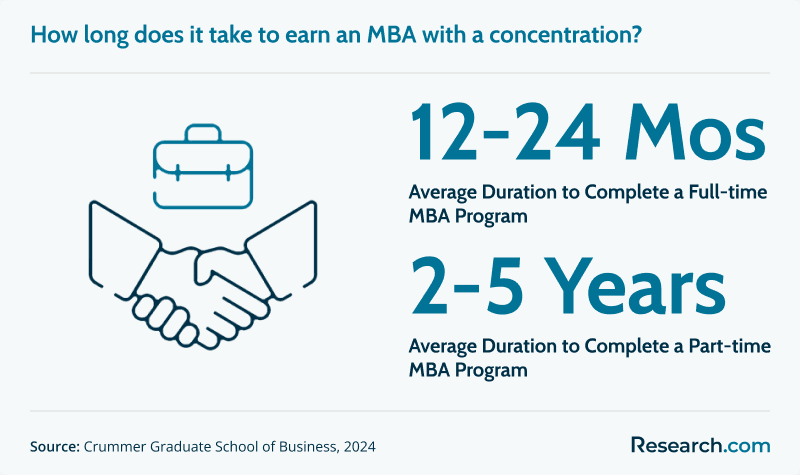
An MBA concentration usually requires around 30 to 72 credits. Full-time students often finish in 18 to 24 months, while part-time students may take 2 to 5 years. Some fast programs offered can be completed in as little as a year, but that schedule is typically demanding and may not be realistic for every working adult.
Online and part-time students often extend the timeline to balance coursework with employment, caregiving, travel, or other responsibilities. Many online options, including affordable healthcare MBA programs, allow students to vary their course load by term, which can make the degree easier to complete without pausing a career.
Before choosing a timeline, compare your target field with the highest paying MBA concentrations and ask whether speed, cost, internship access, networking, or career switching matters most for your situation.
| MBA format | Typical timeline | Best for | Main trade-off |
| Full-time MBA | 18 to 24 months | Students who can study intensively and want a structured career pivot | Higher opportunity cost if you leave full-time work |
| Part-time MBA | 2 to 5 years | Working professionals who want to keep earning while studying | Slower completion and longer workload balance |
| Accelerated MBA | As little as a year | Students who can handle a compressed academic pace | Less time for internships, reflection, and networking |
| Online MBA | Often two to three years for part-time learners | Students who need geographic and scheduling flexibility | Networking quality depends heavily on program design |
How does an online MBA concentration compare to an on-campus MBA concentration?
Online and campus MBA concentrations often cover similar academic content, but they differ in schedule, cost structure, classroom experience, and networking format. The better option depends on how you learn, whether you can relocate or commute, how important in-person recruiting is, and how much flexibility you need.
| Factor | Online MBA concentration | On-campus MBA concentration |
| Scheduling | Often designed for working adults, with asynchronous or hybrid coursework in many programs. | Usually follows fixed class times and campus-based academic calendars. |
| Learning environment | Uses video lectures, virtual discussions, online teams, digital simulations, and remote advising. | Provides face-to-face classroom discussion, in-person group work, and direct campus access. |
| Cost profile | May reduce housing, relocation, commuting, and some campus-related expenses. | Can include higher living and transportation costs, especially for residential programs. |
| Networking | Works best when programs include live sessions, residencies, active alumni networks, and employer events. | Often offers easier access to in-person recruiting, student clubs, faculty meetings, and campus events. |
| Best fit | Professionals who want to remain employed or cannot move for school. | Students seeking immersive networking, structured recruiting, and a traditional graduate experience. |
Flexibility and Scheduling
- Online MBA: This format usually gives students more control over when and where they study. Asynchronous courses can be useful for professionals managing full-time jobs, travel, or family responsibilities.
- On-campus MBA: Campus programs provide a clearer weekly structure, but scheduled classes can be difficult for students who need maximum flexibility.
Learning Environment
- Online MBA: Virtual classrooms, discussion boards, video meetings, and collaborative software can create strong interaction, but students must be proactive about participation.
- On-campus MBA: In-person courses make it easier to build quick relationships with classmates, professors, advisors, and visiting employers.
Cost Considerations
- Online MBA: Students may save on commuting, relocation, housing, and some campus expenses, although tuition policies vary by school.
- On-campus MBA: Campus-based programs may cost more overall, but some students value the immersive environment and recruiting access enough to justify the added expense.
Networking Opportunities
- Online MBA: Networking can be strong if the program intentionally builds cohorts, residencies, mentoring, alumni access, and live employer engagement.
- On-campus MBA: Students often benefit from in-person events, clubs, career fairs, alumni panels, and informal relationship-building.
If a full MBA does not match your goals, it can help to compare it with shorter career training. For example, students asking what is vocational school may be exploring a more direct, hands-on route into healthcare, technology, or skilled trades rather than a graduate business degree.
What is the average cost of an MBA concentration?
According to the Education Data Initiative, the average annual cost of an MBA is $56,850. Bankrate estimates MBA costs from around $20,000 to over $80,000, while highly prestigious programs are known to have total costs above $150,000. Those figures show why students should compare total cost, not only advertised tuition.
Common additional annual expenses include:
- Room and Board: $10,000 to $30,000
- Textbooks and School Supplies: $1,000 to $4,000
- Transportation: Approximately $1,750
Cost should be evaluated against realistic career outcomes, employer support, scholarship opportunities, loan repayment obligations, and the income you may give up while studying. Students considering a different professional direction may also ask what jobs can I get with a master's in elementary education, since education-focused graduate programs can lead to different career paths such as instructional coordination, curriculum work, school administration, or specialized teaching roles.
What are the financial aid options for students enrolling in an MBA concentration?
MBA programs can be expensive, particularly at highly selective institutions. Financial aid can reduce the net price, but students should understand which forms of aid require repayment and which do not. About 85% of business schools offer merit-based scholarships. In addition, 22% of school funding comes from grants, fellowships, and scholarships, while 16% comes from loans.
MBA students and students in related programs, such as cheap online HR masters degree options, commonly use the following funding sources:
Grants, Fellowships, and Scholarships
These are usually the best first sources of funding because they do not have to be repaid. Business schools may award fellowships or scholarships based on academic record, professional achievement, leadership potential, financial need, career goals, or diversity-related criteria. Some awards cover part of tuition, while others may provide more substantial support.
Students should also search for state programs, employer-linked awards, professional association scholarships, and private scholarships. The most competitive applicants typically prepare early, tailor essays carefully, and apply before priority deadlines.
Employer-Sponsored Aid
Some companies help employees pay for an MBA through tuition reimbursement, sponsorship, or education benefits. Employers such as Deloitte, Apple, and Intel have offered programs that partially or fully cover tuition costs. These benefits may require continued employment after graduation, minimum grades, manager approval, or annual funding limits.
Federal Financial Aid
Students seeking federal aid must complete the Free Application for Federal Student Aid (FAFSA). Schools may also use FAFSA information to determine eligibility for institutional aid. Federal options can include loans and work-study, depending on the student's circumstances and program eligibility.
Student Loans
Loans can help cover remaining costs after scholarships, grants, employer support, and savings. Federal Direct Unsubsidized Loans and Grad PLUS loans are common graduate borrowing options and include federal borrower protections such as fixed interest rates and income-driven repayment plans.
Private loans may be available to students with strong credit, but they typically do not offer the same protections as federal loans. Borrow only after estimating monthly payments, likely salary, job market risk, and the total cost with interest. Students who want a faster healthcare entry route instead of a business degree may compare options such as what are the easiest LPN programs to get into before committing to an MBA.
What are the prerequisites for enrolling in an MBA concentration?
MBA admissions requirements vary by school, but applicants usually need a bachelor's degree from an accredited or reputable institution. A GPA of 3.0 or higher is often preferred, although admissions committees may also weigh work history, leadership, quantitative readiness, recommendations, and career direction. A business major is helpful for some applicants but is not always required. For example, a candidate with a project management bachelor degree online may already have relevant planning and operations experience for an MBA concentration in project management.
Some programs require GMAT or GRE scores, while others offer test waivers for applicants with strong academic, professional, or quantitative backgrounds. Many MBA programs prefer at least two to three years of relevant work experience because classroom discussions often rely on real business context.
Typical application materials include a resume, personal statement, letters of recommendation, transcripts, and sometimes an interview. International applicants may also need to submit proof of English language proficiency.
| Requirement | What admissions teams usually look for | How applicants can prepare |
| Bachelor's degree | Completion of undergraduate study from a credible institution | Request transcripts early and confirm degree equivalency if educated outside the United States. |
| Academic record | Often a GPA of 3.0 or higher, depending on the program | Use optional essays to explain academic weaknesses and highlight later success. |
| Work experience | Often at least two to three years of relevant experience | Show measurable impact, leadership, promotions, projects, or cross-functional work. |
| Test scores | GMAT or GRE scores in programs that require them | Check waiver policies before paying for test prep or registration. |
| Career goals | A clear reason for the MBA and concentration choice | Connect your target concentration to specific roles, industries, and skills. |
What courses are typically in an MBA concentration?
MBA programs usually begin with core business courses that help students understand how organizations make money, allocate resources, compete, manage people, and make decisions. Concentration courses then add depth in a specific function or industry.
Core Courses
- Financial Accounting: Reading financial statements, applying accounting principles, and understanding financial reporting.
- Managerial Accounting: Using accounting information for budgeting, internal planning, performance tracking, and decision support.
- Finance: Studying corporate finance, capital markets, investment decisions, and financial strategy.
- Marketing Management: Understanding customers, markets, branding, positioning, pricing, and demand generation.
- Operations Management: Managing production, logistics, processes, quality systems, and supply chains.
- Organizational Behavior: Examining leadership, communication, motivation, teams, culture, and change.
- Economics for Managers: Applying microeconomic and macroeconomic thinking to business decisions.
- Business Ethics: Evaluating responsible decision-making and the social impact of business activity.
- Strategic Management: Building competitive strategy, assessing markets, and planning for long-term performance.
- Business Analytics: Using data, statistics, and analytical tools to support better management decisions.
Finance Concentration
- Corporate Finance
- Investment Analysis and Portfolio Management
- Financial Statement Analysis
- Derivatives and Risk Management
- Mergers and Acquisitions
Marketing
- Consumer Behavior
- Digital Marketing
- Brand Management
- Market Research and Analytics
- Product Development and Innovation
Entrepreneurship
- New Venture Creation
- Entrepreneurial Finance
- Social Entrepreneurship
- Business Model Innovation
- Managing Growth and Scalability
Human Resource Management (HRM)
- Strategic HR Management
- Talent Management and Acquisition
- Employment Law and Labor Relations
- Compensation and Benefits
- Leadership Development and Coaching
Data Analytics
- Predictive Modeling and Forecasting
- Data Visualization and Storytelling
- Big Data Management
- Machine Learning for Business
- Statistics and Quantitative Analysis
Healthcare Management
- Healthcare Economics
- Healthcare Policy and Regulations
- Quality Improvement in Healthcare
- Strategic Healthcare Management
- Public Health and Epidemiology
Supply Chain Management
- Logistics and Transportation Management
- Procurement and Sourcing
- Inventory and Warehouse Management
- Global Supply Chain Management
- Lean and Six Sigma
International Business
- International Marketing
- Global Trade and Policy
- Cross-Cultural Management
- International Finance and Economics
- Emerging Markets
Information Technology Management
- IT Strategy and Innovation
- Cybersecurity Management
- Digital Transformation
- IT Project Management
- Business Intelligence Systems
Project Management
- Project Planning and Control
- Risk Management
- Agile and Scrum Methodologies
- Budgeting and Resource Allocation
- Quality Management in Projects
Can I Access an Affordable Online MBA Concentration?
Yes, many students can find online MBA concentrations designed to lower total cost while preserving graduate-level business training. The key is to compare net price, accreditation, curriculum depth, faculty access, student support, employer connections, and career outcomes rather than choosing only the lowest tuition. Online delivery may reduce relocation, commuting, and some campus-related costs, but students should still review technology fees, residency requirements, textbooks, and graduation charges.
Students comparing budget-conscious options can start with affordable online mba programs and then narrow the list by concentration, accreditation, transfer policies, financial aid, and employer recognition.
How to choose the best MBA concentration?
The best MBA concentration is the one that strengthens your target career, builds on your existing experience, and gives you marketable skills employers actually use. Salary matters, but it should not be the only factor. A concentration that pays well on paper may still be a poor choice if you dislike the work, lack the prerequisites, or cannot access the relevant industry network.
Professionals with an MBA can potentially earn an increase of up to $85,000, but that type of return depends on program quality, career fit, timing, location, and the graduate's ability to convert the degree into stronger roles.
| If your goal is... | Consider these concentrations | Be careful if... |
| Move into executive finance or investment-related roles | Finance, Business Analytics | You do not want quantitatively demanding coursework or high-pressure financial decision-making. |
| Lead technology or digital transformation | Information Technology, Business Analytics, Project Management | The program does not include current technology strategy, data, cybersecurity, or systems coursework. |
| Work in hospitals, health systems, or healthcare operations | Healthcare Management, Finance, Operations | You have not checked whether the curriculum covers healthcare regulation, policy, and quality improvement. |
| Build brands, products, or revenue growth | Marketing, Entrepreneurship, Corporate Strategy | The program lacks analytics, digital marketing, or product strategy content. |
| Improve operational performance | Supply Chain Management, Project Management, Operations | You want a mostly theoretical program without applied process or logistics work. |
| Manage people and organizational change | Human Resources, Organizational Leadership, Strategy | You are not interested in employment law, compensation, employee relations, or culture change. |
Questions to ask before choosing a concentration
- Which job titles do I want within two years of graduation?
- Which industries recruit from this program and concentration?
- Do alumni from this track work in the roles I want?
- Does the curriculum teach tools and methods currently used by employers?
- Will I need a certification, license, portfolio, internship, or technical skill in addition to the MBA?
- How much debt would I take on, and what salary would I realistically need after graduation?
- Is the program accredited by a recognized business accreditor?
Are accelerated MBA concentrations right for rapid career advancement?
Accelerated MBA concentrations can work well for focused professionals who already know their target field and can manage an intense schedule. These programs compress core business and concentration coursework into a shorter format, which may reduce time away from career advancement and help students finish sooner.
The trade-off is pace. Accelerated programs may leave less time for internships, networking, career exploration, and deep skill development. Before enrolling, review accreditation, faculty access, career services, alumni outcomes, workload expectations, and whether the concentration offers enough depth. Students comparing faster options can review accelerated MBA programs online.
What career paths are available for graduates of MBA concentrations?
Career options after an MBA concentration depend heavily on the specialization, prior work experience, industry connections, and job market. A concentration functions like a focused business pathway, similar in spirit to how an accelerated finance degree online provides targeted finance preparation, but within a broader MBA framework.
Information Technology
- Roles: Product Manager, IT Consultant, Project Manager
- Career direction: Graduates may lead technology projects, support digital transformation, manage product roadmaps, or advise organizations on systems and IT strategy.
Healthcare and Pharmaceuticals
- Roles: Healthcare Administrator, Policy Analyst, Operations Manager
- Career direction: Healthcare management graduates may work in hospitals, insurers, biotech firms, health systems, or consulting roles focused on cost, quality, access, compliance, and operations.
Finance and Banking
- Roles: Investment Banker, Financial Analyst, Chief Financial Officer (CFO)
- Career direction: Finance graduates often pursue corporate finance, investment management, banking, accounting leadership, risk management, or executive finance roles.
Consulting
- Roles: Management Consultant, Strategy Consultant
- Career direction: Consulting allows MBA graduates to solve business problems across industries, often using strategy, analytics, operations, finance, and change management skills.
Education
- Roles: Education Policy Analyst, Program Manager
- Career direction: MBA graduates may work in education technology, nonprofit leadership, school operations, policy organizations, or program management roles focused on educational improvement.
Government
- Roles: Policy Advisor, Program Manager
- Career direction: Public-sector opportunities may involve budgeting, procurement, operations, policy implementation, or large-scale program oversight.
Entrepreneurship
- Roles: Startup Founder, Business Development Manager
- Career direction: Entrepreneurship graduates may launch ventures, join startups, build partnerships, raise funding, or work in innovation teams within established companies.
Marketing
- Roles: Marketing Manager, Brand Strategist
- Career direction: Marketing graduates may manage campaigns, customer insights, brand strategy, product marketing, market research, and revenue growth initiatives.
Human Resources
- Roles: HR Manager, Talent Acquisition Specialist
- Career direction: HR graduates may lead hiring strategy, employee engagement, workforce planning, compensation programs, training, and organizational development.
Project Management
- Roles: Project Manager, Operations Director
- Career direction: Project management graduates coordinate teams, budgets, schedules, vendors, risks, and outcomes across industries.
Is an Online DBA a Valuable Next Step After an MBA Concentration?
An online Doctor of Business Administration can be useful for MBA graduates who want to move beyond applied management into advanced research, executive consulting, teaching, policy work, or thought leadership. An MBA concentration usually focuses on practical business leadership in a specific field, while an online DBA emphasizes doctoral-level inquiry, applied research, organizational theory, and evidence-based strategy.
This path is not necessary for every MBA graduate. It is most relevant for professionals pursuing senior advisory roles, academic positions, research-driven leadership, or specialized consulting where doctoral credibility adds value.
How can an MBA concentration prepare you for emerging industry challenges?
Modern MBA concentrations increasingly address digital transformation, analytics, automation, sustainability, global risk, and changing employer expectations. Students should look for programs that teach not only traditional management theory but also how to lead teams through uncertainty, use data responsibly, evaluate technology investments, and adapt strategy as markets shift.
For professionals who want to build these skills quickly, accelerated MBA options may shorten the path. However, speed should not come at the expense of accreditation, career support, or concentration depth.
What is the job market for graduates with an MBA concentration?
According to recent Graduate Management Admission Council data, 91% of MBA graduates were hired by global employers. That rate is higher than the reported hiring outcomes for graduates of master's programs in accounting (72%), finance (74%), and management (78%), as well as professionals with industry experience (88%).
The same data reports hiring rates of 91% for MBA graduates in consulting and 89% in technology, higher than related master's degrees in those fields. MBA graduates who want to build additional leadership depth may also compare affordable doctoral programs in leadership, especially if their long-term goals include executive, academic, or organizational development roles.
Broader BLS data also supports the value of advanced education. Employment of master's degree holders from 2023 to 2033 is projected to increase by 12.1%, higher than any other degree level. Professionals with advanced degrees had an average usual weekly salary of $1,916 as of the third quarter of 2024, compared with $1,533 for bachelor's degree holders and $1,053 for associate degree holders or those with some college experience.
How Do MBA Concentrations Influence Job Placement and Career Growth?
An MBA concentration can affect job placement by making a graduate more competitive for specific roles. Employers may value a candidate who combines general management training with focused skills in finance, analytics, healthcare, IT, HR, marketing, or operations. Still, concentration choice is only one factor. Career services, internships, alumni networks, employer partnerships, location, prior experience, and interview performance also matter.
Before enrolling, ask each school for concentration-level outcomes when available: placement rates, common employers, average time to employment, internship access, alumni job titles, and salary ranges. Students looking for flexible accredited programs can compare an online MBA AACSB pathway, especially if accreditation and career support are priorities.
How can I access an affordable executive MBA concentration?
Executive MBA concentrations are designed for experienced professionals who want advanced leadership education without stepping away from senior responsibilities. These programs often emphasize strategic management, organizational transformation, executive decision-making, finance, leadership, and industry-specific challenges.
To reduce cost, compare employer sponsorship, tuition reimbursement, scholarships, online or hybrid delivery, residency costs, and schedule length. An affordable executive MBA can be a practical option for senior professionals who need flexibility but still want executive-level training.
How Does Your Undergraduate Background Influence Your MBA Concentration Choice?
Your bachelor's degree can make some MBA concentrations easier to enter and more valuable to your career. Students with quantitative training may be well prepared for finance, analytics, economics, or supply chain coursework. Students from communication, psychology, or social science backgrounds may bring useful strengths to marketing, HR, consulting, or organizational leadership. Technical undergraduates may find strong alignment with IT management, business analytics, product management, or operations.
For example, someone with a bachelor of science in finance may already have the accounting, markets, and quantitative foundation needed for a finance MBA concentration. The best choice usually combines academic preparation, work experience, and future job goals.
How Can MBA Concentrations Adapt to Evolving Economic Trends?
MBA concentrations remain useful only if they evolve with the economy. Programs should help students understand market volatility, digital disruption, global supply chain risk, sustainability pressures, inflation, labor shifts, and data-driven competition. Strong schools refresh curricula with industry input, applied projects, current case studies, analytics tools, and leadership frameworks that reflect changing business conditions.
Students who want deeper context on markets and policy may also compare complementary study options such as an affordable master's in economics online, particularly if their goals involve forecasting, policy analysis, financial strategy, or economic research.
Is an MBA Concentration Worth the Investment?
An MBA concentration can be worth the investment when it leads to clearer career positioning, stronger management opportunities, higher earning potential, and access to a useful professional network. It may not be worth it if the program is poorly accredited, too expensive for your expected salary, weak in career services, or unrelated to your goals.
Evaluate return on investment using both financial and nonfinancial factors: tuition, fees, living expenses, interest, lost income, scholarship aid, employer support, expected salary, promotion potential, network value, and career-switching benefits. For a broader decision framework, review is MBA worth it.
Which accreditation standards matter most when evaluating an MBA concentration?
Accreditation is one of the first quality checks students should make. For business schools, recognized accreditation bodies include AACSB, ACBSP, and EQUIS. Accreditation indicates that a program has gone through an external review process related to curriculum quality, faculty qualifications, academic standards, and continuous improvement.
Employers may not always require a specific accreditor, but graduating from an accredited program can improve credibility and reduce the risk of choosing a weak or unrecognized degree. Online learners comparing flexible programs should still verify quality carefully, even when considering an easy online MBA.
What factors should I consider when comparing the costs of MBA concentrations?
The stated tuition price is only part of the MBA cost. Students should compare total attendance costs and long-term debt burden. Online programs may reduce some expenses, but they can still include technology fees, course materials, residencies, application fees, graduation fees, and travel for optional networking or required intensives.
| Cost factor | Why it matters | Question to ask |
| Tuition | Largest direct program expense for most students | Is tuition charged per credit, per course, per term, or as a flat program rate? |
| Fees | Can materially increase the final bill | Are there technology, student services, residency, graduation, or course-specific fees? |
| Living and travel costs | Can make campus or hybrid formats more expensive | Will I need to relocate, commute, travel, or attend in-person sessions? |
| Books and materials | May vary by course and concentration | Are digital resources included, or are materials billed separately? |
| Opportunity cost | Full-time study may reduce earnings while enrolled | Can I keep working, and how will the schedule affect my income? |
| Financial aid | Net price matters more than sticker price | What scholarships, fellowships, employer benefits, or loan options are available? |
Students comparing formats can also review MBA cost online to understand how online pricing may differ from campus-based study.
Can additional certifications boost my MBA concentration's effectiveness?
Yes, certifications can strengthen an MBA concentration when they match the target role. A finance MBA graduate may benefit from finance-related credentials, a project management student may pursue recognized project credentials, and an analytics student may need technical certificates in data tools. The certification should add proof of practical skill rather than duplicate what the MBA already covers.
Students interested in project leadership can compare focused training such as an accelerated project management degree, especially if they want additional preparation in project execution, scheduling, risk management, and team coordination.
Common Mistakes to Avoid When Choosing an MBA Concentration
- Choosing only by salary: High-paying roles often require specific experience, technical skill, industry access, and strong performance. Salary lists should guide research, not replace career planning.
- Ignoring accreditation: A low-cost MBA is risky if the school lacks credible accreditation or employer recognition.
- Assuming online means lower quality: Some online MBA programs are rigorous and well connected, while some campus programs are weak. Compare outcomes, faculty, curriculum, and student support.
- Focusing only on tuition: Fees, travel, materials, residency requirements, interest, and lost income can change the real cost.
- Overlooking career services: Strong advising, employer access, alumni networks, and internship support can be especially important for career changers.
- Picking a concentration that does not fit your background: A student with no interest in quantitative work may struggle in finance or analytics, while a student seeking technical leadership may find a general management track too broad.
- Assuming the MBA alone guarantees promotion: The degree can help, but career growth also depends on experience, leadership results, networking, and market conditions.
Key Insights
- An MBA concentration helps convert a general management degree into a clearer career signal for employers.
- The highest-paying concentrations commonly include finance, business analytics, information technology, healthcare management, marketing, international business, project management, human resources, entrepreneurship or corporate strategy, and supply chain management.
- An MBA, including a concentration, is typically composed of 30 to 72 credits.
- MBA programs are usually completed in around 12 to 24 months, but part-time students may take 2 to 5 years.
- The average annual cost of an MBA is $56,850, so students should compare net price, debt, employer aid, and likely career outcomes before enrolling.
- 85% of business schools offer merit-based scholarships, making scholarship research an important part of the MBA planning process.
- Professionals with an MBA can potentially earn an increase of up to $85,000, but outcomes depend on program quality, specialization, experience, and career execution.
- 91% of MBA graduates were hired by global employers, according to recent Graduate Management Admission Council data.
- Accreditation from recognized bodies such as AACSB, ACBSP, or EQUIS is one of the most important quality checks when comparing MBA programs.
- The best concentration is not automatically the one with the highest salary figure; it is the one that fits your skills, target industry, cost tolerance, and long-term career plan.
References:
- BLS (2024, April). Education pays, 2023. BLS
- BLS (2024, October 25). Median weekly earnings $946 for workers with high school diploma, $1,533 for bachelor's degree. BLS
- BLS (2024, August 29). Occupations that Need More Education for Entry are Projected to Grow Faster Than Average. BLS
- Coursera (2024, February 3). MBA Degree Salary: 2024 Guide. Coursera
- Crummer Graduate School of Business (2024). How Long Does It Take to Get an MBA in 2024? Crummer Graduate School of Business
- Dellinger, A. (2023, August 22). How much does an MBA cost? Bankrate
- Garner, B. (2022, February 8). MBA Scholarship Opportunities to Explore. MBA.com
- Graduate Management Admission Council (2022). Corporate Recruiters Survey 2022. Graduate Management Admission Council
- Graduate Management Admission Council (2023, July). Corporate Recruiters Survey 2023 Summary Report. Graduate Management Admission Council
- Hanson, M. (2024, February 27). Average Cost of a Master’s Degree. Education Data Initiative
- MBA.com (2021, April 20). How Does the Average Applicant Plan to Pay for Business School? MBA.com
- ZipRecruiter (2024). What Is the Average Mba Salary by State. ZipRecruiter
Other Things You Should Know About MBA Concentrations
In 2027, the MBA concentration in Financial Services often leads to the highest salaries. Graduates specializing in this area have strong prospects in investment banking, asset management, and hedge funds, where demand for skilled professionals continues to drive high compensation packages.
In 2027, the highest-paid MBA concentrations include finance, technology management, and healthcare management. These fields often offer lucrative positions for MBA graduates due to their demand for skilled professionals and the competitive nature of the industries.
Finance remains the most consistently valued MBA concentration for employers in 2027, especially for roles in investment banking, corporate finance, and private equity. Consulting and business analytics also rank highly because they support revenue growth, cost control, and data-driven decision-making.


