
2027 Specialized MBA vs. General MBA Degree Programs: Explaining The Difference

Co-Founder and Chief Data Scientist
Choosing an MBA is not just a question of school brand or tuition. One of the most important decisions is whether to pursue a specialized MBA that concentrates on a field such as finance, healthcare, technology, data science, or marketing, or a general MBA that builds broad leadership and management skills across business functions. The better option depends on where you are in your career, how clearly you have defined your target industry, how much flexibility you want after graduation, and whether the program’s cost is justified by realistic career outcomes.
This guide compares specialized MBA and general MBA degree programs from a practical decision-making perspective. You will learn how the curricula differ, what admissions committees usually expect, how costs and financial aid compare, which career paths each degree supports, and what questions to ask before applying. The goal is to help you choose an MBA format that fits your professional goals rather than simply selecting the program that sounds most impressive.
Quick Answer: Specialized MBA vs. General MBA
A specialized MBA is usually the better fit if you already know the industry or business function you want to enter and need targeted expertise to move into a more advanced role. A general MBA is usually stronger if you want broad management training, career flexibility, leadership mobility, or the option to move across industries. Neither option is automatically better; the right choice depends on your career direction, work experience, budget, preferred learning format, and the employer expectations in your target field.
Key Things You Should Know About Specialized MBA vs. General MBA Degree Programs
- A specialized MBA focuses on one industry, discipline, or function, while a general MBA emphasizes broad business management, leadership, strategy, finance, marketing, operations, and organizational decision-making.
- Specialized MBA programs can be useful for professionals targeting defined roles in healthcare, finance, technology, data analytics, sustainability, sports management, or other niche sectors.
- General MBA degree programs tend to offer wider career flexibility and broader networking across industries, while specialized MBA programs often connect students with employers, faculty, projects, and alumni tied to a specific field.
- The ROI of either MBA depends less on the label of the degree and more on accreditation, school reputation, employer recognition, career services, tuition, opportunity cost, and how closely the curriculum matches your goals.
- What is the difference between a specialized MBA and a general MBA?
- How do specialized MBA and general MBA course structures differ?
- What are the prerequisites for a specialized MBA degree program?
- What are the prerequisites for a general MBA degree program?
- How much does a specialized MBA vs. a general MBA degree program cost for 2027?
- Financial aid availability for specialized MBA vs. general MBA programs
- What career paths are available for specialized MBA vs. general MBA graduates?
- Can an online MBA match traditional program outcomes?
- How does accreditation impact the value of an MBA degree?
- Which MBA program offers a higher return on investment?
- How do technological innovations shape the future of MBA programs?
- Are fast MBA programs online a credible alternative for working professionals?
- Can supplementary certifications boost your MBA career?
- What are the potential drawbacks of specialized vs. general MBA programs?
- What career support services do MBA programs offer?
- Which industries are actively hiring specialized MBA vs. general MBA graduates?
- Earning potential for specialized MBA vs. general MBA graduates
- How do you choose between a specialized MBA and a general MBA?
What is the difference between a specialized MBA and a general MBA?
A specialized MBA combines core business education with deeper study in a defined area such as healthcare administration, finance, analytics, technology management, supply chain, marketing, accounting, or entrepreneurship. For example, students interested in analytics-heavy leadership roles may compare the top MBA in data science degree programs, while nurses or healthcare professionals who want both clinical and business leadership training may consider the best online MSN/MBA programs.
A general MBA, by contrast, is designed to develop broad managerial capability. Students typically study accounting, economics, finance, marketing, operations, business analytics, organizational behavior, strategy, leadership, and ethics. This format can be valuable for professionals who want to move into management, consulting, entrepreneurship, corporate leadership, or cross-functional roles without being locked into one sector.
The difference is not that one degree is “practical” and the other is “theoretical.” Both can include case studies, team projects, simulations, internships, consulting projects, and capstone work. The distinction is focus. A specialized MBA narrows the curriculum toward a target field, while a general MBA keeps the curriculum intentionally broad.
| Decision Factor | Specialized MBA | General MBA |
| Best for | Professionals with a clear industry or functional target | Professionals seeking leadership flexibility across sectors |
| Curriculum focus | Core business courses plus concentrated electives in one field | Broad business foundation across multiple management areas |
| Networking | More concentrated industry-specific peer and alumni connections | Wider network across industries, functions, and employers |
| Career flexibility | Strong within the chosen specialization but potentially narrower | Stronger for career pivots and general leadership roles |
| Common concern | The specialization may become limiting if goals change | The degree may not provide enough depth for technical or niche roles |
A specialized MBA may make sense if you already have work experience in a target area and want to add managerial authority to technical expertise. For example, an analyst who wants to supervise analytics teams may use a business-focused graduate degree alongside the skills described in data analytics manager career requirements. A general MBA may be better if you are still deciding between industries or want a broader leadership credential before narrowing your direction.
Before applying, review how each program evaluates applicants, essays, recommendations, test scores, interviews, and work history. Understanding the MBA application process can help you choose programs where your goals and background will be a strong fit.
How do specialized MBA and general MBA course structures differ?
Most MBA programs begin with core business requirements, but they diverge in how much room they give to electives, concentrations, applied projects, and industry-specific content. Specialized MBA programs typically use electives and applied experiences to build depth in one field. General MBA programs usually distribute coursework across multiple business disciplines so students can lead teams, evaluate strategy, manage budgets, and make decisions across functions.
In a specialized MBA, assignments may use sector-specific cases, industry datasets, compliance issues, product strategy problems, or technical management challenges. In a healthcare MBA, for instance, students may examine health systems, payer models, healthcare operations, or regulatory environments. In a finance MBA, coursework may emphasize valuation, risk, capital markets, or corporate finance. In a technology or data-focused MBA, students may work on digital transformation, analytics strategy, or product innovation.
A general MBA usually emphasizes the full business operating system: how organizations make money, manage people, compete, market products, control costs, analyze data, and execute strategy. Students who need flexibility because of demanding work schedules may also compare options such as an executive online MBA, especially if they already hold significant professional experience.
Specialized learning is not limited to business degrees. For instance, students exploring careers in political science may also find that focused knowledge in policy, government, or advocacy can shape career options. The same logic applies to MBA selection: the narrower the curriculum, the more important it is to know where you plan to use it.
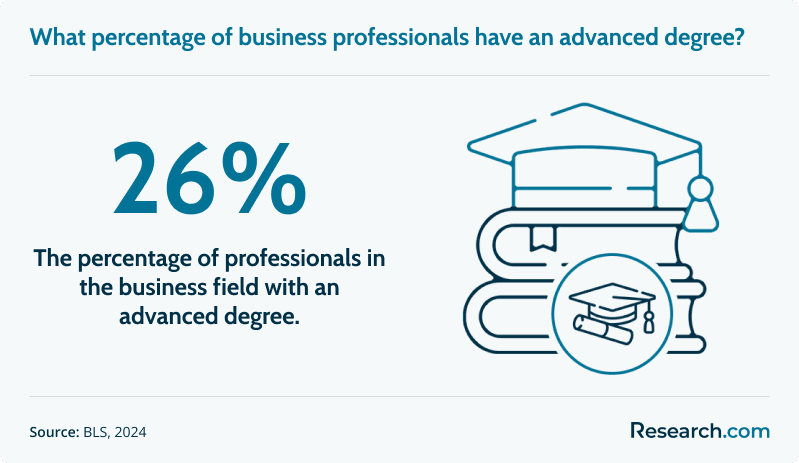
A closer look at industry trends reveals that a significant percentage of business professionals hold an advanced degree (26% in 2024), highlighting the growing importance of postgraduate education in career advancement.
Common MBA Course Structure Comparison
| Program Element | Specialized MBA | General MBA |
| Core courses | Usually includes foundational MBA subjects, then applies them to a specialty | Usually covers finance, marketing, operations, analytics, leadership, strategy, and organizational behavior |
| Electives | Concentrated in one discipline or industry | Spread across several business areas or selected based on career goals |
| Capstone or project work | Often tied to a specialized business problem | Often focused on strategy, consulting, entrepreneurship, or cross-functional management |
| Peer group | May include students with similar industry interests | May include a more varied mix of functions and industries |
| Career positioning | Signals targeted expertise | Signals broad managerial readiness |
What are the prerequisites for a specialized MBA degree program?
Specialized MBA admissions committees often want evidence that the applicant understands the target field and can contribute relevant professional insight. Many programs require applicants to have relevant work experience, particularly when the specialization is technical, regulated, or designed for mid-career professionals.
- Relevant professional background: Many programs expect two to five years in the field or in a closely related function so students can connect coursework to real business problems.
- Undergraduate preparation: A bachelor’s degree is typically required, and some specialized tracks may prefer academic or professional exposure related to the concentration.
- GMAT or GRE scores: Some schools request standardized test results, while others offer waivers based on professional experience, prior academic performance, or other admissions criteria.
- Recommendations and essays: Strong applications usually explain why the specialization fits the applicant’s career path, not simply why the applicant wants an MBA.
- Evidence of commitment: Projects, certifications, promotions, leadership responsibilities, or industry involvement can help show that the applicant is serious about the field.
The most competitive specialized MBA applicants usually show a clear connection between their past experience, the program’s concentration, and their next career step. If your background does not yet align with the specialization, consider whether a general MBA with electives may offer more room to explore.
What are the prerequisites for a general MBA degree program?
General MBA programs also evaluate academic ability, professional maturity, and leadership potential, but they may be more open to applicants from varied undergraduate majors and industries. Because the curriculum is broad, admissions teams often value transferable skills such as problem-solving, communication, initiative, teamwork, and evidence of career progression.
- Work experience: Many programs prefer at least two years of professional experience so students can contribute to discussion-based learning and team projects.
- Academic background: A bachelor’s degree is typically required, but the major may be less important than performance, readiness for quantitative coursework, and professional goals.
- Standardized testing: GMAT or GRE results may be required, optional, or waived depending on the school and applicant profile.
- Essays and recommendations: Admissions committees look for leadership potential, career clarity, self-awareness, and evidence that the applicant can benefit from the MBA format.
- Readiness for accelerated study: Applicants considering a 12 month MBA online should be prepared for a compressed workload, limited breaks, and disciplined time management.
How much does a specialized MBA vs. a general MBA degree program cost for 2027?
MBA cost varies widely by school, delivery format, residency requirements, program length, and reputation. Recent data shows that specialized MBA programs cost typically ranges from approximately $40,000 to $80,000, while general MBA programs can cost anywhere from $50,000 to over $100,000. Those figures do not always include books, technology fees, travel, campus residencies, international immersion experiences, lost income, or reduced work hours.
The listed tuition is only one part of the financial decision. A lower-priced program can become expensive if it lacks career support, employer recognition, or a flexible schedule. A higher-priced program may be more defensible if it offers strong recruiting access, meaningful alumni connections, strong outcomes in your target field, and a format that allows you to keep earning while enrolled.
Specialized MBA programs may charge for industry-specific resources, labs, simulations, field experiences, or small-cohort access to specialized faculty and employers. General MBA programs may carry higher costs because of broader alumni networks, larger recruiting operations, global learning options, and brand recognition. If you are comparing premium formats, reviewing executive MBA cost can help you understand how pricing may differ for programs aimed at experienced professionals.
| Cost Category | Why It Matters | Questions to Ask |
| Tuition and mandatory fees | This is the headline cost, but not always the full cost of attendance | Is tuition charged by credit, semester, year, or full program? |
| Books, software, and technology | Online and analytics-heavy programs may require platforms, tools, or subscriptions | Are technology fees included in tuition or billed separately? |
| Residencies and travel | Hybrid, executive, and global programs may require travel and lodging | How many in-person sessions are required, and where are they held? |
| Opportunity cost | Full-time study can reduce income or delay promotions | Can I continue working while enrolled? |
| Career return | The cheapest program is not always the best value | What outcomes do graduates in my target role report? |
Below is a chart that outlines the overall cost of tuition and fees at some of the highest-ranked business schools in the US according to Statista. This chart provides a visual comparison of the financial investment required by leading institutions.
Financial aid availability for specialized MBA vs. general MBA programs
Financial aid can significantly change the actual cost of an MBA, but aid policies differ by school, program format, enrollment status, and student profile. MBA students may use scholarships, grants, assistantships, employer tuition assistance, military benefits, loans, payment plans, or sponsorship arrangements depending on eligibility.
Specialized MBA programs may offer awards connected to a field, employer partnership, professional association, or diversity initiative. General MBA programs may have larger scholarship pools because of broader enrollment and more established recruiting networks. However, availability varies widely, so students should not assume that one MBA type automatically provides better aid.
Employer sponsorship can be especially important for working professionals. Some employers pay part of the tuition in exchange for continued employment after graduation, while others reimburse courses only after successful completion. Read the policy carefully before enrolling because repayment obligations, grade requirements, annual caps, and eligible schools can affect the real value of the benefit.
Financial Aid Checklist for MBA Applicants
- Ask whether scholarships are automatic, competitive, need-based, merit-based, or tied to early application deadlines.
- Confirm whether part-time, online, executive, and accelerated students qualify for the same aid as full-time students.
- Calculate the total cost after scholarships, not just the advertised tuition discount.
- Review loan terms and repayment expectations before borrowing.
- Check whether your employer offers tuition reimbursement, tuition assistance, or cohort partnerships with specific universities.
- Ask whether aid is renewable each term or awarded only for the first year.
What career paths are available for specialized MBA vs. general MBA graduates?
Career outcomes are one of the main reasons students compare specialized and general MBA programs. A specialized MBA can help position you for roles where industry knowledge matters. A general MBA can support roles that require broad leadership, strategy, operations, and team management. The best program is the one that aligns with your target job descriptions, not just your preferred academic topic.
Specialized MBA Career Paths
- Healthcare management: Graduates may pursue roles such as hospital administrator, healthcare consultant, clinical operations manager, or health services leader. Because healthcare is highly regulated and operationally complex, industry-specific coursework can be helpful. Students exploring this path can review healthcare MBA jobs.
- Technology management: Common pathways include IT director, product leader, innovation manager, digital transformation manager, or technology entrepreneur, especially for students who combine technical literacy with strategy and leadership.
- Financial services: Graduates may pursue investment banking, corporate finance, risk management, financial planning and analysis, portfolio management, or fintech roles that require advanced financial reasoning.
- Marketing and digital media: Specialized programs in marketing, analytics, or digital strategy may support roles such as brand strategist, growth marketing manager, customer insights manager, or digital campaign leader.
General MBA Career Paths
- General management: Graduates often pursue operations manager, general manager, business unit leader, or business development director roles where cross-functional business judgment matters.
- Consulting: A general MBA can prepare graduates to analyze business problems, advise clients, build recommendations, and work across industries.
- Entrepreneurship: Students planning to launch or scale a company may benefit from broad coursework in finance, marketing, operations, strategy, and leadership.
- Human resources and organizational leadership: MBA graduates may move into talent strategy, HR leadership, organizational development, change management, or leadership training roles.
| If Your Goal Is... | Consider This MBA Format | Why |
| Move up in the industry where you already work | Specialized MBA | The degree can add business leadership to your existing sector experience |
| Change industries but remain in management | General MBA | Broad coursework may make it easier to reposition your skills |
| Enter a technical or regulated field | Specialized MBA | Employers may value focused coursework and industry fluency |
| Build a consulting or executive leadership profile | General MBA | Cross-functional decision-making is central to these roles |
| Start a business in a specific sector | Either, depending on the business | A specialized MBA can deepen market knowledge; a general MBA can strengthen broad business execution |
Each path has its unique advantages, and your choice should align with your career goals and industry interests. For insights into the job outlook for various MBA career paths, the chart below presents the projected growth rates for these roles from 2023 to 2033, based on data from the US Bureau of Labor Statistics (BLS).
Can an online MBA match traditional program outcomes?
An online MBA can produce strong outcomes when the program is accredited, academically rigorous, well supported, and respected by employers in your target market. The format itself is not the only issue. What matters is whether the program offers qualified faculty, meaningful interaction, applied projects, career support, recruiting access, alumni engagement, and a schedule that helps you finish without sacrificing work performance.
Online programs can be especially useful for working professionals who cannot relocate or pause their careers. Some also reduce indirect costs by limiting commuting, housing changes, or lost income. Students comparing cost-conscious options may want to review cheapest online MBA programs, but affordability should be weighed alongside accreditation, employer recognition, and student support.
| Factor | Online MBA | Campus MBA |
| Flexibility | Often stronger for working adults and students outside major metro areas | Usually requires fixed class times, commuting, or relocation |
| Networking | Can be strong if the program offers live sessions, residencies, cohorts, and active alumni groups | Often easier to build through in-person events, clubs, and recruiting activities |
| Cost structure | May reduce relocation and commuting costs | May include additional living, travel, or opportunity costs |
| Employer perception | Depends heavily on accreditation, university reputation, and program quality | Also depends on accreditation, reputation, selectivity, and outcomes |
How does accreditation impact the value of an MBA degree?
Accreditation is one of the clearest quality signals in MBA education. It indicates that a school or program has undergone external review for areas such as curriculum, faculty qualifications, learning outcomes, governance, student support, and continuous improvement. Employers, licensing bodies, doctoral programs, and transfer institutions may look more favorably on degrees from properly accredited institutions.
When comparing specialized and general MBA programs, do not rely only on marketing language. Verify institutional accreditation, business school accreditation where applicable, and whether the program’s format is covered by the accreditor. This is especially important for online and accelerated programs. Students comparing online options can review MBA programs online as a starting point for evaluating reputable choices.
Accreditation Questions to Ask Before Enrolling
- Is the university institutionally accredited by a recognized accrediting body?
- Does the business school or MBA program hold specialized business accreditation?
- Does accreditation apply to the online, hybrid, executive, or accelerated version of the program?
- Will credits transfer if I change schools?
- Do employers in my target field recognize this degree?
- Are graduation, retention, and career outcome data available?
Which MBA program offers a higher return on investment?
The higher-ROI MBA is the one that helps you reach a realistic career outcome at a cost you can justify. A specialized MBA may deliver stronger ROI if it leads directly to a higher-paying or more senior role in a field where specialized knowledge is rewarded. A general MBA may deliver stronger ROI if it gives you access to broader leadership positions, consulting opportunities, internal promotions, or entrepreneurship skills across industries.
ROI should include tuition, fees, interest, lost income, relocation, travel, time to completion, and the likelihood that you will actually finish the program. It should also include less obvious benefits, such as a stronger network, better confidence in decision-making, access to recruiters, and a clearer leadership path. Reviewing the average MBA cost can help you benchmark your options before committing.
| ROI Question | Why It Matters |
| What jobs do graduates from this specific program obtain? | Overall MBA averages may not reflect your school, specialization, location, or experience level |
| How much debt will I carry after graduation? | Loan payments can reduce the value of salary gains |
| Can I keep working while enrolled? | Maintaining income can improve ROI even if the program takes longer |
| Does the school have employer relationships in my target field? | Recruiting access can be as important as coursework |
| Will this degree help me change jobs, earn a promotion, or build a business? | ROI depends on a specific career use case, not the credential alone |
How do technological innovations shape the future of MBA programs?
Technology is changing both what MBA students learn and how they learn it. Business schools are increasingly using virtual collaboration tools, analytics platforms, simulations, hybrid classrooms, and data-informed case work. Employers also expect managers to understand digital transformation, automation, analytics, cybersecurity risk, and AI-assisted decision-making, even when the role is not purely technical.
This trend affects specialized and general MBA programs differently. Specialized MBAs may go deeper into tools and industry applications, while general MBAs may emphasize how technology affects strategy, operations, workforce planning, customer behavior, and competitive advantage. Students who want online flexibility and a recognized quality standard may compare online MBA AACSB accredited programs.
Current Technology-Related Skills MBA Students Should Watch
- Data literacy and dashboard-based decision-making
- AI governance, ethical use of automation, and risk management
- Digital transformation strategy
- Cybersecurity awareness for business leaders
- Remote and hybrid team leadership
- Technology-enabled customer experience and operations improvement
Are fast MBA programs online a credible alternative for working professionals?
Fast online MBA programs can be credible if they maintain appropriate admissions standards, accreditation, faculty quality, academic rigor, and student support. Speed alone should not be the selling point. A shorter program may be useful for experienced professionals who already understand business basics and can handle an intensive schedule, but it can be overwhelming for students who need more time for networking, internships, career exploration, or foundational coursework.
Accelerated programs often require disciplined time management because courses may move quickly and overlap with work responsibilities. Before enrolling, review the weekly workload, course sequencing, refund rules, residency requirements, group project expectations, and whether the school provides advising and career services for accelerated students. You can explore fast MBA programs online to compare streamlined options, but credibility should always come before speed.
| A Fast Online MBA May Work If... | It May Not Be Ideal If... |
| You have several years of business or management experience | You need internships, extensive career exploration, or a slower academic pace |
| Your employer supports your schedule or tuition | Your job schedule is unpredictable or regularly exceeds normal work hours |
| You are comfortable learning independently online | You need frequent in-person interaction to stay engaged |
| You have a clear post-MBA goal | You are using the MBA mainly to figure out what career you want |
Can supplementary certifications boost your MBA career?
Certifications can strengthen an MBA when they add evidence of a specific technical or professional skill. They are most valuable when they complement your target role. For example, a general MBA graduate moving into project-based leadership may benefit from project management training, while a specialized MBA student in finance, analytics, or healthcare may pursue credentials recognized in that field.
Certifications should not be used to compensate for a weak MBA program, poor accreditation, or unclear goals. They work best as targeted additions to a strong degree and relevant experience. Professionals who want to build project leadership skills in a shorter academic format may compare accelerated online project management degree programs.
When an Additional Credential Makes Sense
- You can identify job postings that request or prefer the credential.
- The certification builds a skill not covered deeply in your MBA curriculum.
- The credential is respected in your target industry.
- The cost and time commitment are reasonable compared with the expected benefit.
- You can apply the credential through projects, work experience, or portfolio examples.
What are the potential drawbacks of specialized vs. general MBA programs?
Both MBA types involve trade-offs. A specialized MBA can create a strong career signal, but it may also narrow your positioning if your goals change or if your target industry slows hiring. A general MBA can offer flexibility, but it may not provide enough depth for employers seeking specialized knowledge, technical fluency, or industry-specific experience.
The risk is highest when students choose a program based on trendiness rather than a clear career plan. For example, a niche MBA in an area such as sports management may be useful for students with relevant goals and industry access, but applicants should examine hiring pathways, alumni outcomes, and employer connections before committing. Students focused on that area can compare the best MBA programs for sports management to evaluate fit.
| Common Mistake | Why It Can Hurt You | Better Approach |
| Choosing a specialization because it sounds high-paying | Salary outcomes depend on experience, location, employer, and role | Compare actual job postings and graduate outcomes in your target market |
| Ignoring accreditation | A poorly recognized program can weaken employer confidence | Verify institutional and business accreditation before applying |
| Looking only at tuition | Fees, travel, lost income, and weak career services can change the total value | Calculate full cost of attendance and expected career benefit |
| Assuming online programs are all the same | Quality, support, networking, and rigor vary widely | Compare live interaction, faculty access, career services, and outcomes |
| Using rankings as the only decision tool | A highly ranked program may not fit your goals, schedule, or budget | Use rankings as one input alongside curriculum, cost, accreditation, and placement data |
What career support services do MBA programs offer?
Career services can be a major difference-maker, especially when two MBA programs appear similar on paper. Strong MBA career support may include one-on-one coaching, resume and LinkedIn reviews, mock interviews, networking events, employer panels, internship support, alumni mentoring, salary negotiation guidance, and access to recruiting platforms.
Specialized MBA programs may offer targeted employer connections, industry speakers, field-specific capstones, and networking with professionals in the concentration area. General MBA programs may provide broader recruiting options across consulting, finance, operations, technology, consumer products, entrepreneurship, and management. Students interested in healthcare leadership may also review related academic routes such as an online healthcare administration degree.
Questions to Ask Career Services Before Enrolling
- Which employers recruit from this MBA program?
- Are career services available to online, part-time, executive, and accelerated students?
- What percentage of students use career coaching?
- Are outcomes reported by specialization, format, and student experience level?
- Does the school support career changers, or mainly students seeking promotion in their current field?
- How active is the alumni network in my target industry?
Which industries are actively hiring specialized MBA vs. general MBA graduates?
Hiring demand varies by economic conditions, region, employer needs, and candidate experience. Specialized MBA graduates often pursue sectors where industry knowledge matters, while general MBA graduates may enter industries that value broad leadership, analysis, operations, and strategy.
Specialized MBA Industries
- Healthcare: Hospitals, health systems, consulting firms, insurers, and healthcare technology companies may value leaders who understand both business operations and healthcare complexity.
- Technology: Technology companies often need managers who can connect product, data, engineering, operations, finance, and market strategy.
- Financial services: Banks, investment firms, insurance companies, fintech employers, and corporate finance teams may seek candidates with strong finance and risk expertise.
- Energy and sustainability: Organizations focused on renewable energy, energy management, ESG strategy, and sustainability initiatives may look for leaders with specialized business knowledge.
General MBA Industries
- Consulting: Consulting firms often recruit MBA graduates who can solve ambiguous problems, communicate recommendations, and work across client industries.
- Manufacturing and retail: These employers often need leaders who understand operations, supply chain, pricing, staffing, customer behavior, and cost control.
- Technology in broad business roles: Tech employers also hire generalists for strategy, business operations, partnerships, program management, and people leadership roles.
- Nonprofits and government: Public-sector and nonprofit organizations may value MBA graduates who can manage budgets, teams, programs, stakeholders, and organizational change.
Understanding which industries are actively recruiting can help you tailor your education and career search to align with market demands. The chart below displays the projected annual job openings from 2023 to 2033 in management, business, financial, and technology fields, based on data from BLS. This data highlights trends across various positions to help you make informed career decisions.
Earning potential for specialized MBA vs. general MBA graduates
Salary comparisons between specialized and general MBA graduates should be interpreted carefully. Compensation depends on prior experience, school reputation, geography, industry, job function, employer size, performance bonuses, equity, and whether the graduate changed careers or advanced within an existing field. An MBA can support higher earnings, but it does not guarantee a specific salary.
Specialized MBA Earning Potential
Specialized MBA graduates may command strong compensation in fields where advanced business knowledge and sector expertise are both valued. Finance, healthcare, accounting, technology, and analytics are examples where targeted preparation can help candidates compete for specialized leadership or managerial roles.
Data from BLS indicates that professionals with a specialized MBA in sectors such as finance or healthcare may see starting salaries that surpass those of general MBA graduates. Moreover, additional industry-specific bonuses and incentives can further boost overall compensation. Students considering finance or accounting-related pathways can review MBA in accounting salary information for additional benchmarking context.
General MBA Earning Potential
General MBA graduates also pursue competitive compensation, especially when they move into management, consulting, operations leadership, business development, entrepreneurship, or executive-track roles. Their advantage is versatility: they can often reposition across functions and sectors more easily than graduates whose training is narrowly tied to one field.
Starting salaries in general MBA paths may be lower than some specialized tracks, but long-term earning potential can remain strong for graduates who build leadership experience, manage larger teams, own revenue or cost outcomes, or move into senior decision-making positions.
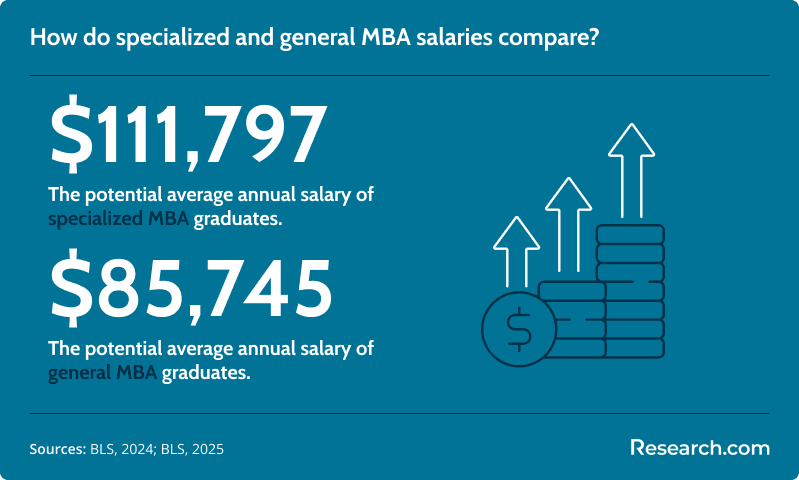
The decision between a specialized and a general MBA should consider not only immediate earning potential but also long-term career growth and advancement opportunities. With that in mind, here is a comparison of the potential average annual salaries for specialized MBA and general MBA degree holders.
How do you choose between a specialized MBA and a general MBA?
Start with the job, not the degree. Identify the roles you want after graduation, read current job postings, review required skills, and look at the backgrounds of professionals already in those roles. Then compare MBA programs based on whether their curriculum, network, career support, and employer relationships help you close the gap between where you are now and where you want to go.
If you have a defined career path in a sector such as healthcare, finance, analytics, technology, sports management, or sustainability, a specialized MBA may be the stronger choice. If you want to move into leadership but are still deciding between industries, want consulting opportunities, or expect to pivot over time, a general MBA may provide more room to maneuver.
Delivery format also matters. The difference between a strong MBA and a poor fit is often schedule, interaction, and support. Before applying, compare the difference between online and on campus MBA programs so you understand how format affects networking, recruiting, flexibility, cost, and learning style.
Step-by-Step MBA Decision Process
- Define your target outcome. Write down the role, industry, location, and salary range you are pursuing.
- Audit your current profile. Identify gaps in leadership, finance, analytics, communication, industry knowledge, or management experience.
- Compare curricula. Look beyond program titles and review required courses, electives, capstones, internships, and concentrations.
- Verify accreditation. Confirm that the institution and business program meet recognized quality standards.
- Calculate full cost. Include tuition, fees, travel, books, technology, lost income, and loan interest.
- Evaluate career services. Ask for employer lists, alumni outcomes, coaching availability, and recruiting support for your program format.
- Talk to students and alumni. Ask whether the program delivered the network, skills, and career momentum they expected.
- Compare ROI realistically. Do not assume salary increases are guaranteed; base your decision on evidence from your target field and experience level.
Who Should Choose a Specialized MBA?
- You already know the industry or function you want to pursue.
- You have relevant work experience and want to move into leadership within that area.
- Your target employers value specialized knowledge or industry fluency.
- You want a peer and alumni network concentrated in one sector.
- You are comfortable with a narrower career signal after graduation.
Who Should Choose a General MBA?
- You want broad leadership training rather than deep specialization.
- You may change industries or functions after graduation.
- You are interested in consulting, entrepreneurship, general management, or executive leadership.
- You want a larger and more diverse professional network.
- You value flexibility more than a tightly focused curriculum.
What do specialized and general MBA graduates say about their degree?
-
: "
Choosing a healthcare management MBA helped me move from clinical work into hospital leadership. The specialized courses, healthcare-focused cases, and industry connections gave me the business language and strategic perspective I needed for executive-track opportunities. Sally
"
-
: "
My general MBA gave me a wider business foundation than I expected. Because the coursework covered finance, marketing, leadership, and strategy, I felt prepared to move between functions and evaluate opportunities outside my original industry. Kyle
"
-
: "
A finance-focused MBA helped me build deeper skills in modeling, risk analysis, and financial decision-making. Within a year of graduating, I moved into a senior analyst role with a salary increase of over 30%, and the specialized training made me more confident in competitive interviews. Diane
"
Key Insights
- A specialized MBA is best when your career target is specific and your chosen industry rewards focused expertise; a general MBA is stronger when you want broad leadership mobility.
- Specialized MBA tuition typically ranges from $40,000 to $80,000, while general MBAs cost $50,000 to over $100,000 depending on the institution.
- 26% of business professionals hold an advanced degree, indicating the growing value of postgraduate education.
- Careers in financial management, a common path for MBA graduates, are projected to grow by 17% from 2023 to 2033.
- Specialized MBA graduates earn an average salary of $111,797, while general MBA graduates earn $85,745 annually, but individual outcomes depend on experience, school quality, location, employer, and role.
- The top industries for specialized MBAs include healthcare, technology, and finance, whereas general MBA graduates frequently find opportunities in consulting, management, and entrepreneurship.
- Accreditation, total cost, employer recognition, career services, and graduate outcomes should carry more weight than program title alone.
- The most common mistake is choosing an MBA before defining the job you want. Start with your target role, then choose the program that provides the clearest path to it.
References:
- BLS. (2024, August 29). Accountants and auditors. BLS.
- BLS. (2024, August 29). Computer and Information Technology occupations. BLS.
- BLS. (2024, August 29). Field of degree: Business. BLS.
- BLS. (2024, August 29). Financial Managers. BLS.
- BLS. (2024, August 29). Management Analysts. BLS.
- BLS. (2024, August 29). Management occupations. BLS.
- BLS. (2024, August 29). Top executives. BLS.
- BLS. (2025, January 17). Business and financial occupations. BLS.
- BLS. (2025, February 12). Human resources specialists. BLS.
- Korhonen, V. (2024, July 5). Tuition and fees for the top business schools in the United States 2023. Statista.
Other Things You Should Know About Specialized MBA vs. General MBA Degree Programs
In 2027, a general MBA typically provides broader networking opportunities due to its diverse curriculum and cohort. This attracts students from varied industries, facilitating interactions across multiple sectors. In contrast, a specialized MBA focuses on specific industries, drawing like-minded professionals, which may limit networking to that field.
In 2027, general MBA programs often feature larger and more diverse alumni networks due to the broader range of industries represented. Specialized MBA programs, conversely, offer more targeted networks within specific fields, providing focused connections that can lead to niche opportunities.


