2027 Online Electrical Engineering Degrees That Help Build Electronics Skills

Co-Founder and Chief Data Scientist
Choosing an online electrical engineering degree is really a question of proof: will the program teach real electronics skills, not just theory? The need is timely because the U. S. Bureau of Labor Statistics projects 9% growth for electrical and electronics engineers from 2023 to 2033, faster than the average for all occupations.
This guide is for working adults, transfer students, military learners, and engineering graduates comparing flexible programs. You will learn how online labs work, which credentials matter, what costs to expect, and how to choose a program that supports electronics-focused careers.
Key Things You Should Know
- For U.S. engineering roles, ABET accreditation is the strongest quality signal for online bachelor's programs in electrical engineering, especially if you may later pursue Professional Engineer licensure.
- Electrical and electronics engineers had a May 2024 median annual wage of $118,780, but outcomes vary by industry, region, degree level, experience, and whether the role involves design, testing, embedded systems, or manufacturing.
- Online electronics training can be credible when it includes shipped lab kits, circuit simulation, instrumentation practice, design reviews, and a capstone project rather than lecture-only coursework.
What is an online electrical engineering degree and how does it build electronics skills?
An online electrical engineering degree is a college program that teaches the theory, math, design methods, and lab practices used to develop electrical and electronic systems. In an electronics-focused pathway, students usually study circuits, semiconductor devices, digital logic, microcontrollers, signal processing, embedded systems, control systems, and power conversion. The "online" part usually refers to how lectures, assignments, exams, advising, and collaboration happen; strong programs still require structured hands-on work.
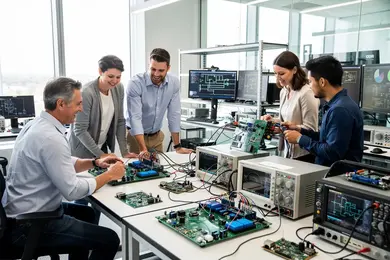
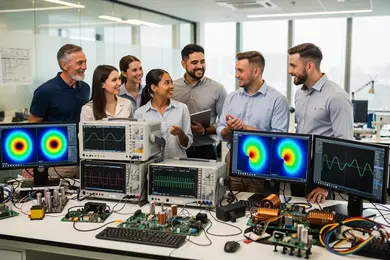
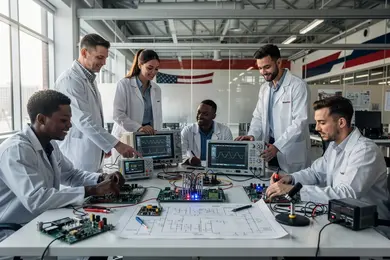
Electronics skills are built through repeated design-and-test cycles. A student might model a filter in simulation software, assemble the circuit with a lab kit, measure the waveform with an oscilloscope, revise component values, and explain the trade-offs in a lab report. That process is what turns theory into employable skill.
The table below summarizes common degree levels and how each one fits different electronics goals. Use it to avoid over-enrolling in a program that is either too broad or too advanced for your current objective.
| Program type | Typical student | Electronics skill focus | Best fit |
| Associate degree or transfer pathway | Students building prerequisites or moving toward a bachelor's degree | DC/AC circuits, basic electronics, programming, calculus, physics | Learners who want an affordable start before transferring |
| Bachelor's in electrical engineering | First-time engineering students and career changers | Circuit analysis, electronics design, electromagnetics, digital systems, signals, controls, capstone design | Most entry-level electrical engineering and electronics engineering roles |
| Master's in electrical engineering | Engineers or STEM graduates seeking specialization | Advanced electronics, VLSI, embedded systems, communications, power electronics, RF, signal processing | Specialized design, R&D, technical leadership, or advancement |
| Graduate certificate | Professionals who already have a related degree | Focused skill upgrade in areas such as embedded systems, controls, or semiconductor devices | Targeted reskilling without committing to a full degree |
A bachelor's degree is usually the main credential for becoming an electrical engineer. A certificate can be valuable, but it normally does not replace an engineering degree for roles that require ABET-accredited preparation, deep math, or eligibility for licensure.
Are online electrical engineering degrees respected and properly accredited in the United States?
Online electrical engineering degrees can be respected when they come from institutionally accredited colleges and, for bachelor's programs, preferably from programs accredited by ABET's Engineering Accreditation Commission. Employers generally care more about the school's legitimacy, curriculum quality, lab rigor, projects, and student capabilities than whether lectures were watched on campus or online.
ABET accreditation matters because it signals that the program has met engineering-specific standards for curriculum, faculty, facilities, student outcomes, continuous improvement, and institutional support. It can also matter later for the Fundamentals of Engineering exam, Professional Engineer licensure, federal roles, defense contractors, and employers with formal engineering hiring requirements. State licensing rules vary, so students who may pursue PE licensure should check their state board before enrolling.
Students should distinguish between three separate quality checks. These are not interchangeable, and missing one can create problems after graduation.
- Institutional accreditation: Confirms that the college or university is recognized by an accrediting agency accepted by the U.S. Department of Education or the Council for Higher Education Accreditation.
- Programmatic ABET accreditation: Confirms that the specific electrical engineering program meets engineering education standards; this is especially important for bachelor's programs.
- State authorization and professional requirements: Confirms that the school can enroll online students in your state and that the degree supports any licensing path you may want later.
A common mistake is assuming that "online" automatically means less respected. A better question is whether the program has the same faculty standards, learning outcomes, lab expectations, exams, and capstone requirements as the campus version. If the answer is yes, the format itself is usually less important than the quality controls behind it.
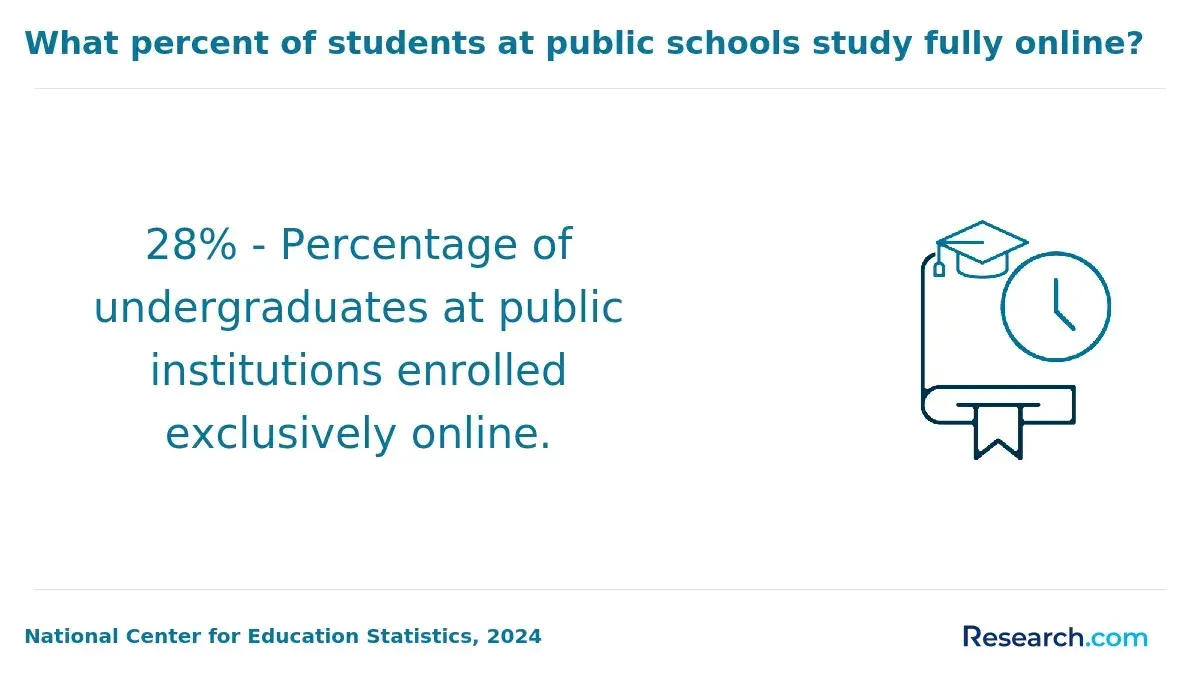
How does an online electrical engineering program compare to a campus-based program for electronics training?
The biggest difference is not the engineering content; it is how students access labs, instructors, peers, and equipment. Campus programs make it easier to use shared lab benches and attend in-person design sessions. Online programs make it easier to study while working, serving in the military, parenting, or living far from a university with an engineering department.
The comparison below shows where each format tends to be stronger. The best choice depends on your schedule, learning style, access to equipment, and need for in-person mentoring.
| Factor | Online electrical engineering | Campus-based electrical engineering | Decision point |
| Electronics labs | May use shipped kits, remote labs, simulation tools, video demonstrations, and occasional residencies | Typically uses on-campus benches, instruments, and supervised lab spaces | Ask whether students use real components and measurement tools, not only simulations |
| Flexibility | Often better for working adults and part-time students | Often better for students who can attend full-time in a fixed schedule | Choose the format you can sustain through calculus, physics, and design courses |
| Peer collaboration | Depends on online discussion, project platforms, video meetings, and team design tools | Happens more naturally through labs, study groups, and campus clubs | Look for required team projects and instructor feedback, not isolated self-study |
| Equipment access | Can be strong if the school provides modern kits and remote instrumentation | Usually broader for specialized equipment such as RF, power, and semiconductor labs | Students targeting hardware-intensive specialties may benefit from hybrid options |
| Career networking | Depends on virtual career services, employer projects, alumni access, and internships near the student | May offer easier access to campus recruiting and labs | Ask how online students find internships, co-ops, and capstone sponsors |
Online programs are often a good fit for students who are self-directed, comfortable troubleshooting independently, and able to set up a small electronics workspace at home. Campus programs may be better for students who want daily access to faculty, clubs, robotics teams, machine shops, and advanced lab equipment.
If your main interest is software, algorithms, or computing rather than hardware, it may also be worth comparing an electrical engineering path with a computer science degree online. Electrical engineering is usually stronger for circuits, signals, devices, embedded hardware, and physical systems; computer science is usually stronger for software architecture, data structures, operating systems, and application development.
What courses and hands-on projects in online electrical engineering programs strengthen electronics design skills?
The strongest electronics preparation comes from a sequence of courses that moves from fundamentals to design. Students should look for programs where electronics is not treated as a single course, but as a thread running through labs, simulations, embedded projects, and a senior or graduate capstone.
The table below connects common courses to the practical electronics skills they should develop. When comparing programs, look beyond course titles and read syllabi, lab descriptions, and capstone examples.
| Course or project area | Skills students should build | Signs of strong hands-on learning |
| Circuit analysis | Modeling voltage, current, impedance, frequency response, and transient behavior | Students solve circuits analytically, simulate them, and verify results with measurements |
| Electronics and semiconductor devices | Using diodes, BJTs, MOSFETs, op-amps, regulators, and amplifiers | Labs require breadboarding, biasing, waveform measurement, and design revisions |
| Digital logic and microcontrollers | Designing logic circuits, writing firmware, reading sensors, and controlling actuators | Projects integrate hardware, code, debugging, and documentation |
| Signals and systems | Understanding filtering, sampling, transforms, modulation, and noise | Students analyze real or simulated signals and explain performance limits |
| PCB or electronics design project | Creating schematics, selecting components, laying out boards, and testing prototypes | Students produce design files, test plans, failure analysis, and final documentation |
| Capstone design | Combining technical, economic, ethical, safety, and communication skills | Teams build or validate a system for a real-world problem or sponsor |
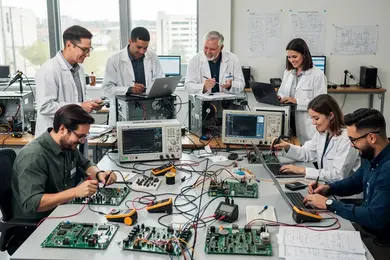
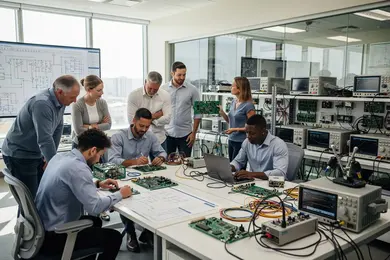
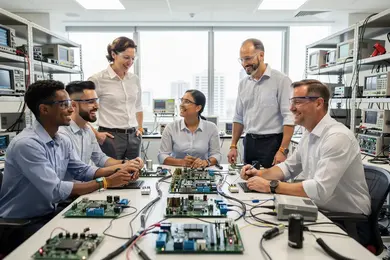
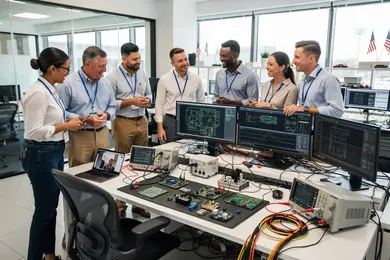
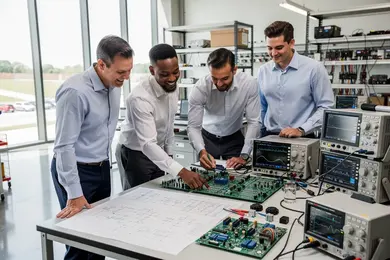
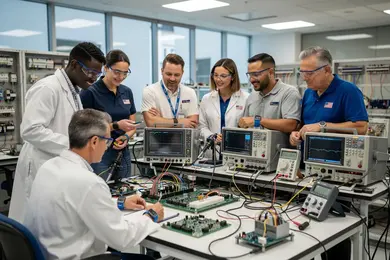
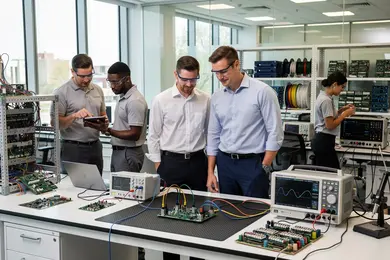
Before enrolling, ask how the program handles lab equipment. A credible online electronics program should be able to explain exactly what students receive, what they must buy, what software is required, and how instructors verify that students performed the work. Strong hands-on components often include the following:
- Electronics lab kits: Breadboards, resistors, capacitors, inductors, diodes, transistors, op-amps, sensors, microcontroller boards, wiring, and safety instructions.
- Measurement practice: Use of digital multimeters, oscilloscopes, logic analyzers, function generators, or remote equivalents to confirm circuit behavior.
- Simulation and design tools: Circuit simulation, HDL tools, MATLAB-style environments, PCB layout software, and version-controlled project files.
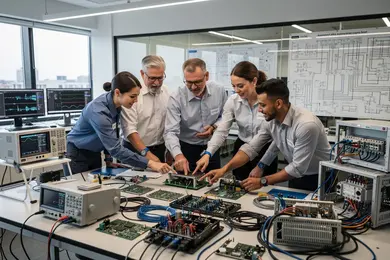
- Design reviews: Instructor or peer review of schematics, calculations, prototype choices, test results, and documentation.
- Failure analysis: Required troubleshooting when circuits do not behave as expected, because debugging is one of the most valuable electronics skills.
AI and data-driven design are also changing electronics work. Engineers increasingly use simulation automation, signal-processing tools, machine-learning-assisted testing, and digital twins. Students who want to move toward advanced analytics, intelligent sensors, or research roles may eventually compare electrical engineering graduate study with an online PhD in data science, but the right foundation depends on whether the career goal is physical hardware, computational modeling, or both.
What prerequisites and admission requirements do online electrical engineering bachelor's and master's programs have?
Electrical engineering is math-intensive, so admissions requirements usually focus on readiness for calculus, physics, programming, and college-level problem solving. Bachelor's applicants are often admitted as first-year students, transfer students, or degree-completion students. Master's applicants usually need a bachelor's degree in electrical engineering, computer engineering, physics, or a closely related STEM field, though some programs offer bridge courses.
Requirements vary by school, but the table below shows the admissions items students commonly encounter. Use it to estimate how much preparation you may need before applying.
| Program level | Common academic expectations | Application materials | Potential gaps to fix |
| Online bachelor's in electrical engineering | High school diploma or equivalent; readiness for calculus; lab science background; placement testing or prior college credit | Transcripts, application form, test scores if required, transfer-credit review, residency or state authorization confirmation | Precalculus, calculus I, physics, chemistry, or introductory programming |
| Transfer or degree-completion pathway | Prior college credits, often including calculus, physics, and general education courses | Official transcripts, course descriptions, syllabi for engineering transfer review | Courses that do not match the receiving school's engineering sequence |
| Online master's in electrical engineering | Bachelor's degree in electrical engineering or related STEM field; strong math and engineering fundamentals | Transcripts, resume, statement of purpose, recommendations, and sometimes GRE scores or proof of prerequisite coursework | Signals, circuits, electronics, probability, control systems, or programming depending on specialization |
| Graduate certificate | STEM bachelor's degree or equivalent preparation | Short application, transcripts, resume, and prerequisite review | Missing undergraduate engineering fundamentals for advanced technical courses |
Students coming from another major should not underestimate the prerequisite chain. Calculus leads into physics and circuit analysis; circuit analysis leads into electronics and signals; those courses support advanced design. Skipping foundations can make later courses frustrating and expensive.
A practical way to prepare is to map your current background against the first four semesters of a bachelor's electrical engineering plan. If you are still exploring STEM and health-technology pathways, comparing engineering with options such as the best exercise science degree online can clarify whether you prefer device design, human performance, biomechanics, clinical applications, or a combination of these fields.

How long do online electrical engineering degrees take and what do they typically cost?
An online bachelor's degree in electrical engineering usually takes about four years of full-time study for first-time students, while transfer students may finish faster depending on accepted credits and course sequencing. Part-time students often take longer because engineering courses build on one another and are not always offered every term. Online master's programs commonly take one to three years, depending on whether the student enrolls full time, part time, or in an accelerated format.
Cost depends on residency, institution type, transfer credits, technology fees, lab kits, software, textbooks, and how long it takes to complete prerequisites. The College Board reported that published tuition and fees for in-state students at public four-year institutions averaged $11,610 for 2024-25, while private nonprofit four-year institutions averaged $43,350. Those figures are sticker-price benchmarks, not online electrical engineering prices, but they help students understand the scale of the tuition decision before aid, employer benefits, or transfer savings.
When comparing affordability, separate tuition from total cost. Electrical engineering students may face expenses that do not appear in a simple per-credit quote.
- Published tuition and fees benchmark: $11,610 for in-state public four-year institutions in 2024-25.
- Published tuition and fees benchmark: $43,350 for private nonprofit four-year institutions in 2024-25.
- Possible added costs: lab kits, required tools, proctored exams, software licenses, textbooks, shipping, travel for residencies, and repeated courses if prerequisites are not sequenced well.
To reduce cost, students should maximize transferable calculus, physics, general education, and introductory programming credits before entering a higher-cost engineering sequence. However, be careful with transfer credits in core engineering courses. A cheap circuits course that does not transfer into the required major sequence may delay graduation rather than save money.
Financial aid can also change the equation. Eligible students should complete the FAFSA, ask about scholarships for engineering or transfer students, check employer tuition assistance, and compare payment plans. The lowest tuition is not always the best value if the program lacks ABET accreditation, lab support, advising, or a clear path to completion.
What entry-level and advanced careers can online electrical engineering graduates pursue in electronics fields?
Online electrical engineering graduates can pursue many of the same electronics-related roles as campus graduates if their program is rigorous and their portfolio shows real design work. Employers often look for evidence that candidates can analyze circuits, use instruments, write technical documentation, collaborate with teams, and troubleshoot under constraints.
The table below outlines common electronics-focused career paths. Actual titles vary by employer, and some advanced roles may require a master's degree, security clearance, industry experience, or specialized tools.
| Career path | Typical responsibilities | Helpful preparation | Career stage |
| Electrical engineer | Designing, testing, and improving electrical systems, components, or equipment | ABET-accredited bachelor's degree, circuits, electronics, signals, capstone project | Entry-level to advanced |
| Electronics engineer | Developing electronic devices, control boards, instrumentation, communications systems, or embedded hardware | Electronics labs, PCB design, microcontrollers, testing, documentation | Entry-level to advanced |
| Embedded systems engineer | Integrating hardware and firmware for sensors, controllers, robotics, automotive systems, medical devices, or IoT products | C/C++, microcontrollers, digital logic, real-time systems, debugging tools | Entry-level with strong projects; advanced with experience |
| Test engineer | Creating test plans, validating hardware, analyzing failures, automating measurements, and improving reliability | Instrumentation, statistics, scripting, lab reports, quality systems | Entry-level to mid-career |
| Power electronics engineer | Designing converters, inverters, motor drives, chargers, renewable-energy interfaces, and energy-storage systems | Power systems, controls, semiconductor devices, thermal design, safety standards | Often mid-career or graduate-level specialization |
| RF or communications engineer | Working with antennas, wireless systems, filters, modulation, spectrum, and high-frequency design | Electromagnetics, signals, RF labs, simulation tools, communications theory | Often advanced or specialized |
| Hardware design engineer | Developing boards, selecting components, reviewing layouts, and coordinating manufacturing constraints | PCB tools, signal integrity basics, documentation, prototype testing | Entry-level with strong portfolio; advanced with product experience |
Students can improve employability by building a portfolio before graduation. Useful portfolio artifacts include schematics, PCB layouts, firmware repositories, test videos, lab reports, design trade-off memos, and capstone documentation. Do not publish confidential employer or sponsor materials, but do show enough technical depth that a hiring manager can see how you think.
Electrical engineering also overlaps with environmental monitoring, renewable energy, water systems, and resilient infrastructure. Students who are drawn more to sustainability systems than circuit-level design may want to compare electronics-focused EE programs with environmental engineering schools online before choosing a major.
What salaries can electrical engineers with strong electronics skills expect in different U.S. industries?
Salary expectations should be treated as a planning tool, not a promise. The U.S. Bureau of Labor Statistics reported a May 2024 median annual wage of $118,780 for electrical and electronics engineers. That median blends many industries, locations, degree levels, and experience bands, so a new graduate in a lower-cost region may see a different offer than an experienced engineer in semiconductors, aerospace, or advanced manufacturing.
The table below explains how electronics skills tend to map to salary context across U.S. industries. Use it to identify where your technical interests may have stronger compensation potential, then verify current wages in your target state and metro area.
| Industry area | Why electronics skills matter | Salary context | What can raise earning potential |
| Semiconductor and electronic component manufacturing | Engineers work on devices, fabrication support, testing, packaging, and process-adjacent hardware | Often competitive because employers need specialized electronics and manufacturing knowledge | Semiconductor devices, cleanroom exposure, test automation, reliability, graduate coursework |
| Aerospace and defense | Roles may involve avionics, sensors, communications, navigation, control systems, and mission hardware | Can be strong, especially for specialized systems roles or positions requiring clearance | RF, embedded systems, controls, documentation discipline, security clearance eligibility |
| Engineering services | Engineers design or validate systems for clients across buildings, products, utilities, and industrial settings | Varies widely by client base, region, and licensure requirements | PE pathway, client communication, CAD tools, power systems, project experience |
| Medical devices and instrumentation | Electronics skills support sensors, imaging equipment, test systems, wearable devices, and regulated hardware | Can be attractive for engineers with both design and compliance awareness | Analog electronics, signal processing, quality systems, human-safety considerations |
| Utilities, energy, and power electronics | Roles may involve grid equipment, protection systems, converters, renewable integration, and controls | Often stable, with compensation influenced by region, utility type, and licensure | Power systems, power electronics, controls, safety standards, PE licensure |
| Consumer electronics and IoT | Engineers help design connected devices, boards, sensors, firmware, and product testing systems | Can vary significantly by company size, product cycle, and location | PCB design, embedded firmware, wireless basics, rapid prototyping, manufacturing handoff |
For ROI decisions, compare expected salary against total debt, time to completion, and opportunity cost. A more expensive program may be reasonable if it has strong accreditation, labs, employer connections, and completion support. A lower-cost program may be better if it is accredited, accepts transfer credit, and helps you graduate without delaying core engineering courses.
What professional certifications or licenses matter for electrical engineers working with electronics?
Electrical engineers do not always need a license to work in electronics, especially in product design, embedded systems, testing, semiconductors, or manufacturing. However, licensure and certifications can matter in regulated fields, public-facing engineering services, power systems, construction, utilities, government contracts, and leadership roles.
The credentials below are worth understanding before choosing a program. They have different purposes, so students should not collect credentials randomly.
| Credential | Who it is for | Why it matters | Important limitation |
| Fundamentals of Engineering exam | Engineering students or recent graduates starting the PE pathway | Often the first step toward Engineer-in-Training or Engineer Intern status | Eligibility rules vary by state, and ABET accreditation may matter |
| Professional Engineer license | Engineers who offer services to the public or take legal responsibility for engineering work | Important in power, facilities, consulting, utilities, and public infrastructure | Usually requires education, exam passage, supervised experience, and state board approval |
| IPC electronics manufacturing credentials | Professionals working with PCB assembly, soldering, inspection, or electronics manufacturing standards | Useful for manufacturing, quality, and hardware production environments | Not a substitute for an engineering degree |
| Certified LabVIEW Developer or similar tool credentials | Engineers focused on automated testing, measurement, and instrumentation | Can support test engineering and validation roles | Tool-specific value depends on employer needs |
| Project Management Professional | Experienced engineers moving into project leadership | Can help with schedule, budget, stakeholder, and risk management responsibilities | Usually more relevant after technical experience |
| Security clearance | Engineers working in defense, aerospace, intelligence, or certain federal contractor roles | Can expand access to specialized electronics and systems roles | Not a certification students can simply buy or self-award |
A common mistake is choosing a non-ABET online degree and later discovering it complicates the PE pathway. If you might ever work in power, consulting, infrastructure, or public-sector engineering, ask the admissions office and your state licensing board how the degree is treated. If you are aiming for embedded systems or consumer electronics, ABET is still valuable, but portfolio quality and technical interviews may carry more weight.
How can students evaluate and choose a reputable online electrical engineering program focused on electronics?
The best online electrical engineering program is not simply the cheapest, fastest, or highest-ranked option. It is the program that matches your career goal, gives you credible electronics labs, fits your schedule, supports transfer or graduate progression, and leaves you with a degree employers and licensing boards can understand.
Use the following steps before applying. They are designed to help you avoid expensive mistakes and compare programs on evidence rather than marketing language.
- Verify institutional accreditation and ABET status: Confirm both the university's accreditation and the specific electrical engineering program's ABET status, especially for bachelor's programs.
- Review electronics-related coursework: Look for multiple courses in circuits, electronics, digital systems, signals, embedded systems, controls, and a capstone project.
- Ask how labs work online: Request details about shipped kits, required equipment, remote labs, simulations, safety policies, instructor feedback, and lab verification.
- Compare total cost, not just tuition: Include fees, tools, software, textbooks, travel, transfer-credit loss, and the cost of taking longer than planned.
- Check transfer-credit policies early: Send syllabi for calculus, physics, circuits, programming, and general education courses before assuming they will count.
- Evaluate student support: Ask about tutoring for calculus and physics, faculty office hours, career services for online students, internship support, and capstone mentoring.
- Look for career evidence: Review employer partnerships, alumni outcomes, project examples, internship access, and whether graduates enter electronics-related roles.
- Test the learning platform: If possible, attend an online information session or sample class to see how lectures, labs, exams, and collaboration are handled.
Red flags include vague lab descriptions, no clear ABET information, pressure to enroll before transfer evaluation, unclear state authorization, limited faculty access, no capstone evidence, and promises of guaranteed salary outcomes. Strong programs are transparent about workload, prerequisites, lab expectations, and what online students must do to succeed.
Students should also think carefully about fit. Choose online electrical engineering if you want to design, analyze, test, or improve electrical and electronic systems. Consider a different path if you mainly want software development, IT administration, construction management, or a less math-intensive technology credential. A good decision is not just about getting admitted; it is about choosing a program you can finish and use.
Other Things You Should Know About Electrical Engineering
Yes, but they do not need to start as expert programmers. Electrical engineering students commonly use coding for simulations, data analysis, microcontrollers, embedded systems, test automation, and signal processing. C, C++, Python, MATLAB-style tools, and hardware description languages may appear depending on the program.
Calculus, differential equations, linear algebra, complex numbers, probability, and Fourier analysis are especially important. These topics support circuits, signals, controls, electromagnetics, communications, and power systems. Students who are rusty in algebra or trigonometry should review those skills before taking calculus.
Yes. Robotics often combines electrical engineering, mechanical engineering, computer science, controls, sensors, power electronics, and embedded systems. Electrical engineering is a strong route for students interested in motor control, sensor integration, circuit boards, real-time control, and robot hardware.
Most programs require access to an IEEE 488 or USB digital multimeter, an oscilloscope, and circuit simulation software such as LTspice or Multisim. Some courses also require a breadboard, bench power supply, and a webcam for remote lab checkoffs and proctored practical exams.
References
- Inside the Best Online Bachelor's in Electrical Engineering Degrees https://www.onlinecolleges.me/engineering-degrees/bachelors/electrical-engineering/
- The Significance of Electrical Engineering Certification for Professional Advancement - CertLibrary Blog https://www.certlibrary.com/blog/the-significance-of-electrical-engineering-certification-for-professional-advancement/
- Electrical Engineering Job Market: 2026 Outlook & Pay https://pathwise.io/electrical-engineering-job-market/
- Electrical Engineer Salary in the United States 2026 | Cake https://www.cake.me/resources/industry-job-overview/electrical-engineer-salary
- 72. The Best Online Courses for Aspiring Electrical Engineers - Doyen Engineering https://doyenengineering.ca/72-the-best-online-courses-for-aspiring-electrical-engineers-3/