
2027 How to Become a Licensed Therapist (LPC) in Charlotte, NC

Co-Founder and Chief Data Scientist
Becoming a licensed counselor in Charlotte is not just a school choice—it is a multi-step professional licensing decision. You need the right graduate program, supervised clinical experience, board approval, exams, and a realistic plan for employment after licensure. The process can feel confusing because counseling programs, job titles, supervision rules, and employer expectations do not always use the same language.
This guide explains how the LPC path works for people planning to practice in Charlotte, North Carolina. It covers education, licensure, supervision, local graduate programs, internships, salary expectations, major employers, specialization options, and practical mistakes to avoid. It is designed for prospective graduate students, career changers, counseling students, and early-career clinicians who want a clear path from interest to independent practice.
Charlotte is also a timely market to evaluate. The metro area has seen a 19% increase in mental health counseling job postings since last year, and demand is being shaped by population growth, integrated behavioral health, school-based counseling needs, and broader public awareness of mental health care.
Quick Answer: How do you become an LPC in Charlotte, NC?
To become an LPC in Charlotte, you generally need to earn a qualifying master’s degree in counseling or a closely related field, complete required practicum and internship training, document 3,000 hours of supervised clinical experience over at least 24 months, pass an approved national counseling exam, complete the North Carolina Jurisprudence Exam, and receive approval from the state licensing board before practicing independently.
| Step | What it means for Charlotte applicants | Why it matters |
| Graduate education | Complete a regionally accredited master’s program that meets North Carolina counseling education standards. | Your degree determines whether you can move forward with licensure. |
| Practicum and internship | Gain supervised clinical training through your graduate program. | These experiences help you build counseling skills before post-degree supervision. |
| Supervised experience | Complete 3,000 hours over at least 24 months under approved supervision. | This is the main bridge between graduation and independent practice. |
| Exams | Pass the NCE or NCMHCE and the North Carolina Jurisprudence Exam. | Exams confirm professional knowledge and familiarity with state rules and ethics. |
| Board approval | Submit documentation, fees, exam results, and supervision records for review. | You cannot practice independently until the state approves your license. |
Key Things to Know About Becoming an LPC in Charlotte, NC
- Charlotte’s expanding population and growing mental health service needs create steady opportunities for licensed counselors in health systems, schools, outpatient clinics, nonprofits, and private practice settings.
- The average salary for LPCs in Charlotte is approximately $55,000 to $65,000 annually, although actual pay depends on employer type, specialization, experience, supervision status, and caseload model.
- Common employers include Novant Health, Atrium Health, and Charlotte-Mecklenburg Schools, along with counseling centers, group practices, community agencies, and family service organizations.
- North Carolina licensing language and employer job postings may not always use identical terminology. Applicants should verify current credential names, forms, and rules directly with the state board before applying.
- What are the educational requirements to become an LPC in Charlotte, NC?
- How do you apply for licensure as a counselor in Charlotte, NC?
- Which schools in Charlotte, NC offer programs for aspiring LPCs?
- Are there internship or practicum opportunities for counseling students in Charlotte, NC?
- How much do LPCs make in Charlotte, NC?
- What are the supervision requirements for LPCs in Charlotte, NC?
- How can I specialize in substance abuse counseling in Charlotte, NC?
- How do LPCs maintain and advance their professional credentials in Charlotte, NC?
- Can LPC credentials facilitate a transition into teaching roles in Charlotte, NC?
- What are the opportunities for career growth and further specialization for LPCs in Charlotte, NC?
- How can LPCs transition to becoming BCBA certified in Charlotte, NC?
- Is Charlotte, NC a good place to work as an LPC?
- How competitive is the job market for LPCs in Charlotte, NC?
- Are there counseling associations in Charlotte, NC?
- Which are the most popular employers of LPCs in Charlotte, NC?
What are the educational requirements to become an LPC in Charlotte, NC?
Charlotte does not set a separate local education rule for counselors. Applicants must meet North Carolina’s statewide counseling licensure standards, which center on graduate-level preparation, supervised clinical training, and coursework that supports competent mental health practice.
The most direct route is a master’s degree in counseling from a regionally accredited university. Before enrolling, confirm that the program is designed for professional counseling licensure in North Carolina, not only for general psychology, human services, coaching, or student affairs work.
- Earn a master’s degree from a regionally accredited institution in counseling or a closely related field that aligns with North Carolina licensing expectations.
- Complete graduate coursework in areas such as human development, counseling theories, helping relationships, assessment, diagnosis-related concepts, professional ethics, and multicultural practice.
- Choose a program with supervised practicum and internship requirements, because these experiences are central to licensure preparation.
- Ask whether clinical placements are available in settings such as community agencies, hospitals, schools, group practices, or substance use treatment programs.
- Consider Charlotte-area options such as Queens University of Charlotte and the University of North Carolina at Charlotte if you want local placements and regional employer connections.
- Verify program fit with the state board before committing, especially if you are considering an online, hybrid, out-of-state, or non-CACREP program.
How to evaluate a counseling master’s program
| Factor to check | What to ask | Why it affects licensure or career options |
| Accreditation and state alignment | Does the program meet North Carolina counselor licensing education requirements? | A degree that does not align with licensure rules can delay or block your application. |
| Clinical training | How are practicum and internship sites assigned or approved? | Strong placement support can make it easier to gain relevant experience in Charlotte. |
| Faculty background | Do faculty members have counseling licensure, clinical experience, or specialty expertise? | Faculty experience can influence mentoring, supervision preparation, and professional networking. |
| Format | Is the program campus-based, online, hybrid, full-time, or part-time? | Format affects scheduling, cost, commute, and access to local clinical placements. |
| Career support | Does the school help students find internships, supervisors, or post-graduate roles? | Career support can reduce uncertainty during the transition from school to supervised practice. |
How do you apply for licensure as a counselor in Charlotte, NC?
The counseling license application is handled at the state level, not by the City of Charlotte. You will need to submit a complete application, provide proof of education and supervised experience, pass required exams, and wait for board review before you can practice independently.
Applicants must document at least 3,000 hours of supervised clinical experience completed over a minimum of 24 months. These hours must be properly supervised, recorded, and submitted in the format required by the state board. Incomplete logs, unapproved supervision arrangements, or missing documentation can slow down approval.
You must also pass either the National Counselor Examination (NCE) or the National Clinical Mental Health Counseling Examination (NCMHCE). In addition, applicants complete the North Carolina Jurisprudence Exam, which focuses on state laws, professional obligations, and ethical practice rules.
If you are comparing counseling with adjacent mental health professions, the path to become a licensed counselor is different from the route described in guides on the career path for counseling psychologists. Counseling psychology typically involves different graduate training and credentialing expectations.
In practical terms, applicants planning to apply for licensure should prepare for these steps:
- Submit the state licensure application and required fees to the appropriate North Carolina counseling board.
- Provide transcripts showing completion of a qualifying graduate counseling degree.
- Document 3,000 supervised clinical hours completed over at least 24 months.
- Confirm that supervision was provided by an approved or qualified supervisor under state rules.
- Pass either the NCE or the NCMHCE.
- Pass the North Carolina Jurisprudence Exam.
- Wait for board review and approval before practicing independently.
Licensure application checklist
| Requirement | Applicant action | Common risk |
| Graduate transcript | Request official documentation from your university. | Assuming an unofficial transcript is enough. |
| Supervision records | Keep signed logs, evaluations, and dates organized from the start. | Trying to reconstruct hours after supervision ends. |
| Exam results | Schedule and complete an approved national exam and the state jurisprudence exam. | Waiting too long and delaying licensure review. |
| Fees and forms | Submit the current application package exactly as required. | Using outdated forms or missing a required signature. |
| Board approval | Do not represent yourself as independently licensed until approval is granted. | Starting independent practice before authorization. |
Which schools in Charlotte, NC offer programs for aspiring LPCs?
Prospective counselors in Charlotte can choose from local and nearby graduate programs that combine counseling theory, ethics, assessment, clinical skills, and supervised fieldwork. The strongest choice is not always the closest campus; it is the program that best fits your licensure goal, schedule, cost tolerance, and preferred client population.
- University of North Carolina at Charlotte (UNCC) – Offers a Master of Arts in Counseling with a clinical mental health concentration and CACREP accreditation. Students study counseling foundations, ethics, assessment, and supervised clinical practice tied to licensure preparation.
- Queens University of Charlotte – Provides a Master of Arts in Clinical Mental Health Counseling with CACREP accreditation and an emphasis on clinical training through internship experiences in community settings.
- Gardner-Webb University in Boiling Springs – Offers a nearby CACREP-accredited Master of Arts in Clinical Mental Health Counseling intended to support North Carolina counseling licensure preparation.
Students interested in specialized counseling fields should make sure they are researching the correct profession. For example, genetic counseling has a different academic and professional pathway than mental health counseling; Research.com’s guide to the best master’s programs in genetic counseling explains that separate route.
How to choose among Charlotte-area counseling programs
| Program decision | Best fit | Watch out for |
| Local campus program | Students who want in-person faculty access, local peers, and Charlotte-area internship connections. | Commuting demands, fixed class times, and limited flexibility for full-time workers. |
| Hybrid program | Working adults who still want some face-to-face clinical training or campus engagement. | Travel requirements, evening intensives, and placement rules. |
| Online program | Students who need schedule flexibility or live outside easy commuting distance. | Whether the program meets North Carolina licensure standards and supports local field placement. |
| CACREP-accredited program | Applicants who want a program built around recognized counseling education standards. | Assuming accreditation alone guarantees licensure without checking all state requirements. |
Are there internship or practicum opportunities for counseling students in Charlotte, NC?
Yes. Counseling students in Charlotte can pursue practicum and internship placements in schools, health systems, behavioral health programs, prevention agencies, and community counseling settings. These experiences are important because they help students move from classroom knowledge to supervised client-facing practice.
Your school typically determines how placements are approved, what documentation is required, and whether a site meets program standards. Do not assume every counseling-related workplace qualifies for academic credit or future licensure preparation.
- Charlotte-Mecklenburg Schools (CMS) Counseling Internship Program: Students may work with school counseling teams supporting academic planning, social-emotional development, family communication, student assessment, and intervention planning.
- Center for Prevention Services: Placements may involve prevention work, substance use counseling exposure, mental health support, group services, outreach, and treatment planning under supervision.
- Novant Health's Behavioral Health Services: Interns may gain experience with adults or adolescents through intake-related work, therapeutic groups, interdisciplinary collaboration, and behavioral health service delivery.
How to make an internship count
- Confirm that the site is approved by your graduate program before accepting the placement.
- Ask who will supervise you and whether that person’s credentials meet school and licensure expectations.
- Clarify the client populations you will serve, such as children, adults, families, trauma clients, or people with substance use concerns.
- Keep detailed records of hours, supervision meetings, client contact, and learning activities.
- Use the placement to test your specialty interests before committing to a long-term career niche.
One of the hardest parts of training is learning to balance empathy, documentation, ethical boundaries, and self-reflection at the same time. Strong supervision can turn that early uncertainty into better clinical judgment.
How much do LPCs make in Charlotte, NC?
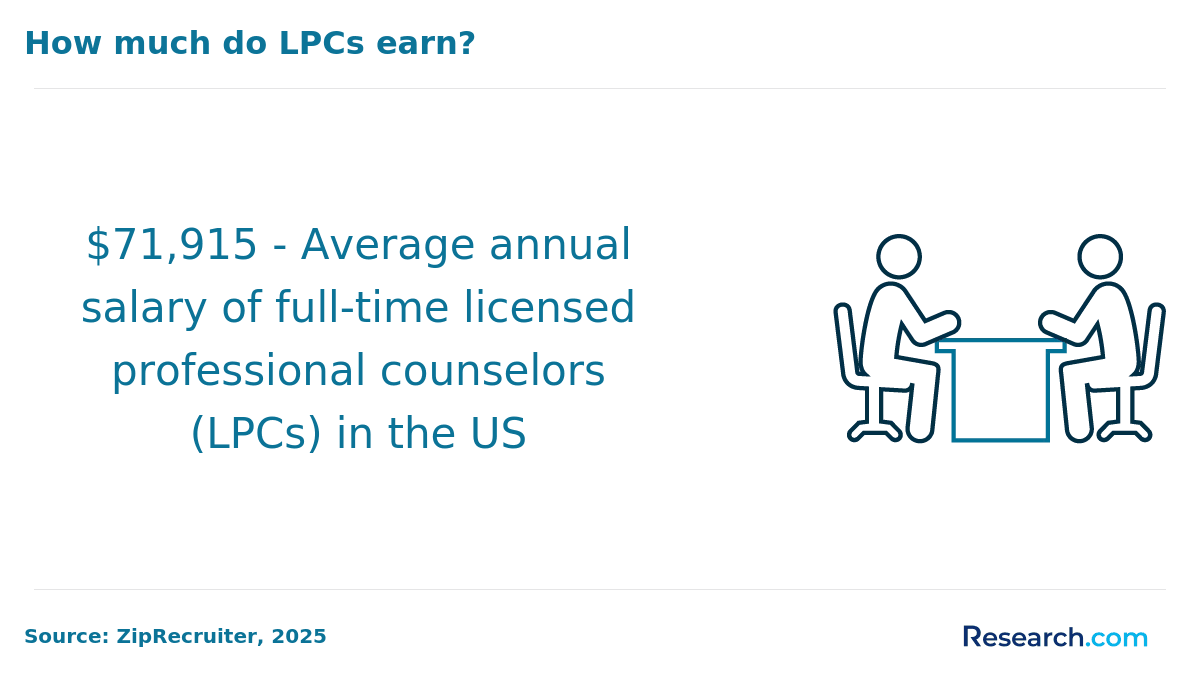
LPC earnings in Charlotte vary widely by setting. On average, LPCs in Charlotte earn between $45,000 and $65,000 annually. Entry-level clinicians often start closer to the lower end of that range, while experienced counselors, private practice clinicians, supervisors, and professionals with specialized credentials can exceed $70,000.
The earlier summary range of approximately $55,000 to $65,000 annually is a useful planning benchmark for licensed counselors in the area, but it should not be treated as a guaranteed outcome. Pay depends on experience, caseload, benefits, payer mix, work setting, specialty, and whether the counselor is fully licensed or still completing supervision.
| Work setting | Typical compensation pattern | Trade-off to consider |
| Private practice or group practice | Can offer higher earning potential, especially with a stable caseload. | Income may depend on referrals, insurance reimbursement, cancellations, and business expenses. |
| Hospitals and integrated health systems | May provide steadier benefits and interdisciplinary team experience. | Base pay may be less flexible than private practice income. |
| Community mental health and nonprofits | Often provide broad clinical exposure and mission-driven work. | Pay may be lower and caseloads may be demanding. |
| Schools and educational settings | Can offer structured schedules and student-focused work. | Roles may require school-specific credentials or have different responsibilities than clinical counseling. |
| Specialized clinics | May reward expertise in trauma, substance use, family therapy, crisis care, or adolescent counseling. | Specialization often requires extra training and experience. |
If you are still deciding between social work, counseling, and psychology graduate programs, compare training scope and likely outcomes carefully. Research.com’s guide to MSW, counseling, and psychology degree differences can help you understand how degree choice may shape salary options and career flexibility.
What are the supervision requirements for LPCs in Charlotte, NC?
Supervision is the required post-graduate training period that prepares new counselors for independent practice. In Charlotte, the requirement follows North Carolina rules: applicants must complete at least 3,000 hours of supervised professional experience after earning the qualifying master’s degree.
Those hours must be completed over at least 24 months. The actual timeline can be longer if you work part time, change jobs, pause your supervision arrangement, or need time to find an approved supervisor.
Supervision should happen in counseling-relevant settings such as mental health agencies, hospitals, schools, private practices, outpatient programs, or community organizations. The supervisor must meet board requirements, and the supervisee should maintain careful documentation throughout the entire process.
What good supervision should include
- Regular review of counseling cases, treatment planning, documentation, and ethical concerns.
- Feedback on assessment, diagnosis-related thinking, intervention selection, and professional boundaries.
- Discussion of cultural responsiveness, risk assessment, crisis situations, and mandated reporting obligations.
- Support for developing a professional identity, specialty direction, and long-term career plan.
- Clear records of supervision dates, hours, supervisor signatures, and evaluations.
| Supervision issue | Better approach | Why it matters |
| Choosing a supervisor only because they are available | Confirm that the supervisor is qualified, accessible, ethical, and familiar with state requirements. | Poor supervision can delay licensure and weaken clinical development. |
| Tracking hours casually | Update logs consistently and keep backup copies. | Missing records can create problems during application review. |
| Staying in a poor-fit setting too long | Evaluate whether the role provides appropriate client contact, learning, and supervision. | Not all counseling-adjacent jobs provide the experience you need. |
| Ignoring ethical uncertainty | Bring unclear situations to supervision early. | Ethical decision-making is one of the core purposes of supervised practice. |
How can I specialize in substance abuse counseling in Charlotte, NC?
Substance abuse counseling is a practical specialization for Charlotte LPCs who want to work with addiction, co-occurring disorders, prevention, relapse planning, and recovery support. The strongest path usually combines counseling licensure, targeted addiction training, supervised experience with substance use populations, and familiarity with community treatment resources.
This specialty can be a good fit if you are comfortable with motivational interviewing, crisis planning, group work, family dynamics, and clients who may need coordinated care across medical, legal, social service, and behavioral health systems. For a more focused pathway, review Research.com’s guide on how to become a substance abuse counselor in Charlotte.
How do LPCs maintain and advance their professional credentials in Charlotte, NC?
Licensure is not a one-time milestone. Counselors must keep up with renewal requirements, continuing education, ethics updates, and changes in state practice rules. Professional development also helps LPCs stay competitive as employers look for clinicians who can handle complex cases, documentation standards, telehealth workflows, and evidence-based treatment models.
Career advancement may involve training in areas such as trauma-informed care, couples counseling, adolescent counseling, substance use treatment, crisis intervention, assessment, supervision, or integrated behavioral health. LPCs who want to broaden their family-systems expertise may also compare their options with the pathway described in Research.com’s guide on becoming a marriage and family therapist in Charlotte.
Can LPC credentials facilitate a transition into teaching roles in Charlotte, NC?
Counseling experience can support education-related careers, especially roles focused on student support, social-emotional learning, advising, wellness programming, and school-based mental health collaboration. However, counseling licensure does not automatically qualify someone for a classroom teaching license.
If your goal is to move into teaching, ask whether the role requires a teaching credential, school counseling credential, graduate education coursework, or district-specific approval. Career changers can review Research.com’s guide to the lowest-cost teaching credential routes in Charlotte to compare potential next steps.
What are the opportunities for career growth and further specialization for LPCs in Charlotte, NC?
Charlotte LPCs can grow by deepening a clinical specialty, moving into supervision, joining a multidisciplinary health system, developing a private practice, working in schools, or building expertise with a defined population. Career growth is strongest when specialization is tied to real community demand and not just personal interest.
- Clinical specialization: Trauma, grief, anxiety, depression, addiction, adolescent counseling, couples work, family therapy, or crisis response.
- Leadership: Clinical supervision, program management, quality assurance, training, or behavioral health administration.
- Private practice: Individual therapy, group practice ownership, niche services, consultation, or telehealth-based care.
- Integrated care: Collaboration with primary care, hospitals, schools, and community agencies.
- Related mental health paths: Professionals comparing roles can use Research.com’s guide on how to become a mental health counselor in Charlotte for additional context.
How can LPCs transition to becoming BCBA certified in Charlotte, NC?
Some LPCs consider behavior analysis because it can complement work with children, families, autism-related services, behavioral assessment, and intervention planning. The BCBA route is distinct from counseling licensure, so LPCs should not assume their current credential automatically satisfies behavior analyst requirements.
Before changing direction, compare coursework, supervised fieldwork, exam expectations, client populations, and day-to-day responsibilities. Research.com’s overview of BCBA certification requirements in Charlotte explains the separate pathway for professionals considering this transition.
Is Charlotte, NC a good place to work as an LPC?
Charlotte can be a strong market for LPCs, especially for counselors who want access to large health systems, schools, outpatient clinics, group practices, and a growing client base. It is not a perfect market, though. Counselors should weigh demand against licensing timelines, reimbursement challenges, affordability concerns, and caseload expectations.
- Population growth and economic activity: Charlotte’s growth supports demand for counseling services as more residents seek care for stress, transitions, family concerns, workplace pressure, and mental health conditions.
- Diverse client needs: The metro area includes clients from many cultural, economic, and family backgrounds, making cultural competence essential rather than optional.
- Healthcare access barriers: Insurance limitations and affordability issues can affect client access, provider reimbursement, and the financial model for private practice.
- Licensure complexity: The path is structured but time-intensive, especially during the supervised experience phase.
- Public and nonprofit constraints: Mission-driven roles can be meaningful, but funding limitations may influence staffing, salaries, and caseloads.
Who should consider practicing in Charlotte?
| Good fit | Why Charlotte may work | What to prepare for |
| New graduates | Large systems and community agencies may offer early-career clinical exposure. | Finding qualified supervision and managing demanding caseloads. |
| Specialists | Demand exists across family counseling, addiction, trauma, adolescent mental health, and integrated care. | Building evidence of specialty training and referral relationships. |
| Private practice-minded clinicians | A growing metro area can support niche services and referral networks. | Insurance contracting, marketing, business operations, and inconsistent early income. |
| School-focused counselors | Large education systems create student mental health and support needs. | Understanding credential differences between clinical counseling and school roles. |
How competitive is the job market for LPCs in Charlotte, NC?
The Charlotte counseling job market is competitive, but licensed professionals are generally in a stronger position than unlicensed applicants. Employers often prefer candidates who can provide clinical services independently, bill for services where applicable, document appropriately, and work within ethical and regulatory standards.
Demand is supported by population growth, mental health awareness, outpatient care, school needs, and integrated behavioral health. At the same time, job seekers still need to compete on specialization, supervision status, experience with specific populations, and comfort with documentation systems.
- Charlotte may be less saturated than larger metropolitan markets such as New York or Los Angeles, which can help early-career counselors enter the field.
- Statewide efforts to improve access to mental health services can support demand for licensed clinicians.
- Therapists without full licensure may have fewer options and lower pay than LPCs who can practice with greater independence.
- Specialized experience in areas such as substance use, trauma, child and adolescent counseling, crisis intervention, or family therapy can improve competitiveness.
If you are still deciding whether graduate counseling education is worth the investment, Research.com’s guide on whether a master’s in counseling is worth it can help you evaluate cost, licensure, career fit, and likely return on effort.
Current trends affecting LPCs in Charlotte
- Integrated behavioral health: More employers are placing mental health professionals alongside medical providers, schools, and community support teams.
- Telehealth expectations: Many clients now expect flexible service options, so counselors need to understand telehealth ethics, documentation, privacy, and state practice rules.
- Specialization matters: Employers and clients increasingly look for clinicians with focused experience rather than only a general counseling background.
- Documentation and outcomes: Counselors must be prepared for treatment planning, risk assessment, insurance documentation, and measurable care goals.
- AI and technology: Scheduling tools, documentation platforms, and digital mental health resources can support practice operations, but they do not replace clinical judgment, ethical responsibility, or licensure requirements.
Are there counseling associations in Charlotte, NC?
Professional associations can help Charlotte counselors find continuing education, peer consultation, advocacy updates, referrals, and ethical guidance. They are especially useful during graduate school, supervised practice, private practice development, and specialty training.
- North Carolina Counseling Association (NCCA): A statewide organization serving counselors across North Carolina, including professionals in Charlotte. Membership can support continuing education, advocacy awareness, and peer connection.
- Charlotte Association for Counseling and Therapy (CACT): A local professional network focused on the Charlotte area, with potential value for workshops, referrals, community engagement, and regional practice updates.
- American Psychological Association (APA) – North Carolina Chapter: Although psychology and counseling are distinct professions, research-oriented clinicians may find value in psychological science, conferences, publications, and advocacy resources.
Associations can also help counselors explore specialty areas. If addiction counseling is your goal, Research.com’s guide to a substance abuse counseling degree explains education routes and related career considerations.
Questions to ask before joining a professional association
- Does the association offer continuing education that counts toward my renewal needs?
- Are there local networking events or only statewide communications?
- Does membership include ethics consultation, job boards, referral opportunities, or supervision resources?
- Is the group focused on counselors specifically, or does it mainly serve another profession?
- Will the membership help with my specialty area, such as addiction, trauma, family work, or school-based services?
Which are the most popular employers of LPCs in Charlotte, NC?
LPCs in Charlotte work across health care, education, private practice, family services, and community agencies. Large employers may provide structure, benefits, and interdisciplinary teams, while smaller practices may offer more clinical independence or specialization.
- Novant Health: LPCs may work in outpatient behavioral health or integrated care settings, supporting clients with concerns such as anxiety, depression, trauma, and related mental health needs.
- Atrium Health: Counselors may provide individual therapy, group services, crisis support, treatment planning, and referrals within hospital-linked or community-based behavioral health programs.
- Center for Family Counseling: LPCs may serve individuals, couples, families, children, adolescents, and clients dealing with addiction, relationship stress, or developmental concerns.
- Charlotte-Mecklenburg Schools: School-based opportunities can involve student support, crisis response, family communication, and collaboration with educators, though credential expectations may differ by role.
- Group practices and private clinics: These settings may appeal to counselors who want niche services, flexible scheduling, or long-term private practice growth.
Common mistakes to avoid when pursuing LPC licensure in Charlotte
| Mistake | Why it causes problems | Better decision |
| Choosing a program without checking licensure fit | A degree may sound counseling-related but still fail to meet state requirements. | Confirm state alignment before enrolling. |
| Looking only at tuition | Fees, commuting, books, unpaid internship time, and delayed income can change total cost. | Compare the full cost of attendance and your likely timeline to licensure. |
| Assuming online programs automatically qualify | Online and out-of-state programs may have different coursework or field placement rules. | Ask the program and the state board how graduates qualify in North Carolina. |
| Waiting to plan supervision | Finding an approved supervisor can take time after graduation. | Start researching supervision options before finishing your degree. |
| Relying only on school rankings | A highly visible program may not be the best fit for your schedule, specialty, or licensing needs. | Use rankings as one data point, not the whole decision. |
| Assuming salary is guaranteed | Income depends on setting, licensure status, caseload, specialty, and employer model. | Compare real job postings, benefits, supervision support, and career mobility. |
Questions to ask schools, supervisors, and employers
- Does this graduate program meet North Carolina counseling licensure education requirements?
- What percentage of students secure approved practicum and internship placements in the Charlotte area?
- Who helps students find placements, and what happens if a placement falls through?
- What documentation will I need for supervised hours after graduation?
- Does this employer provide supervision toward licensure, or must I pay for outside supervision?
- What populations will I serve, and will that experience support my intended specialty?
- How are productivity expectations, documentation time, crisis responsibilities, and after-hours work handled?
- What benefits, training, consultation, and advancement paths are available?
References:
- American Counseling Association. (n.d.). Licensure requirements. American Counseling Association licensure resources.
- Counseling Compact. (n.d.). Compact license application. Counseling Compact FAQ.
- Data USA. (2025). Counselors. Data USA counselor profile.
- U.S. Bureau of Labor Statistics. (2024). Occupational employment and wage statistics: 29-1129 therapists, all other. U.S. Bureau of Labor Statistics occupational wage data.
Related Articles for Nearby Cities
- 2027 How to Become a Licensed Therapist (LPC) in Winston-Salem, NC
- 2027 How to Become a Licensed Therapist (LPC) in Greensboro, NC
- 2027 How to Become a Licensed Therapist (LPC) in Durham, NC: Counselor License Requirements
- 2027 How to Become a Licensed Therapist (PC) in Raleigh, NC: Counselor License Requirements
- 2027 How to Become a Licensed Therapist (LPC) in Atlanta, GA: Counselor License Requirements
- 2027 How to Become a Licensed Therapist (LPC) in Richmond, VA
- 2027 How to Become a Licensed Therapist (LPC) in Norfolk, VA
- 2027 How to Become a Licensed Therapist (LPC) in Chesapeake, VA
- 2027 How to Become a Licensed Therapist (LPC) in Lexington, KY
- 2027 How to Become a Licensed Therapist (LPC) in Virginia Beach, VA
Key Insights
- Becoming an LPC in Charlotte requires more than earning a counseling degree; you must complete supervised experience, pass required exams, and receive state approval before independent practice.
- The core post-degree requirement is 3,000 hours of supervised clinical experience completed over at least 24 months, so supervision planning should begin before graduation.
- Charlotte offers meaningful opportunities through health systems, schools, community agencies, family counseling organizations, and private practices, but pay and job quality vary by setting.
- LPC salaries in Charlotte commonly fall between $45,000 and $65,000 annually, with some experienced or specialized counselors exceeding $70,000.
- Program choice matters. Before enrolling, verify accreditation, state licensure alignment, practicum support, internship access, and whether the format fits your work and family responsibilities.
- Specialization can improve career mobility. Substance abuse counseling, trauma care, family therapy, adolescent counseling, crisis work, and integrated behavioral health are practical paths to consider.
- The most avoidable mistakes are choosing a program without checking licensure fit, underestimating the supervision timeline, tracking hours poorly, and assuming salary outcomes are automatic.
Other Things You Should Know About Becoming an LPC in Charlotte, NC
Charlotte LPC applicants must pass the National Counselor Examination (NCE) or, in some cases, the National Clinical Mental Health Counseling Examination (NCMHCE), both approved by the North Carolina Board of Licensed Clinical Mental Health Counselors. The board requires this exam before full LPC licensure.
To become an LPC in Charlotte, NC, candidates need 3,000 hours of supervised work experience, including at least 1,500 hours of direct client contact. This experience must be completed under the supervision of a qualified licensed professional and is crucial for practical training.


