2027 How to Become a Licensed Counselor (LPC) in Massachusetts

Co-Founder and Chief Data Scientist
Becoming a licensed counselor in Massachusetts is a high-investment decision: you need the right graduate degree, supervised clinical hours, exam preparation, and a clear plan for where you want to practice. In Massachusetts, the professional counseling license is called the Licensed Mental Health Counselor, or LMHC, although many students search for it as an LPC license. This guide explains what the Massachusetts counseling pathway requires, how long it can take, where counselors work, what salaries look like, how to compare counseling programs, and what trends may affect your career in 2026 and beyond.
Massachusetts is an attractive state for counseling students because it has nationally known healthcare institutions such as McLean Hospital, Brigham and Women’s Hospital, and the Austen Riggs Center, along with many respected colleges and universities. It is also a costly state to live and study in, so choosing a program without checking licensure fit, total cost, supervised placement support, and career outcomes can be an expensive mistake. If you are still exploring the profession broadly, this guide can be read alongside Research.com’s overview of how to become a counselor.
According to the U.S. Bureau of Labor Statistics (BLS), some counselors in Massachusetts can earn a yearly mean wage of $68,410 (U.S. BLS, 2025). Salary potential, however, varies by counseling specialty, work setting, reimbursement conditions, experience, and whether you work in outpatient care, schools, hospitals, community agencies, or private practice.
Licensed Counselor in Massachusetts: Quick Navigation
- Massachusetts counseling industry overview
- Education and supervised experience requirements
- Licensure application, exam, renewal, and reciprocity
- Counseling programs in Massachusetts for 2027
- Professional organizations for Massachusetts counselors
- Online counseling programs for Massachusetts LMHC candidates
- Counseling specializations in Massachusetts
- Psychology licensure and counseling career mobility
- LMFTA and LMFT differences
- Technology and telehealth in counseling practice
- Substance use and mental health needs in Massachusetts
- Steps for starting a counseling career in Massachusetts
- Fastest realistic route to becoming a counselor
- Moving into school counseling
- Licensing exam preparation
- Specialized substance abuse counseling training
- Legal and ethical requirements in Massachusetts practice
- Dual licensure in social work and counseling
- Mentorship and networking for counseling careersDual-licensure planningEthics planningAddiction trainingCareer launch stepsSubstance use and mental healthOnline program decisionProfessional organizationsProgram comparison
Quick Answer: How Do You Become an LPC or LMHC in Massachusetts?
To become a licensed counselor in Massachusetts, you generally need a qualifying master’s degree in mental health counseling or a closely related field, required graduate coursework, 700 hours of pre-master’s practicum and internship experience, 3,360 hours of post-master’s supervised clinical experience, a passing score on the National Clinical Mental Health Counseling Examination (NCMHCE), and approval from the Board of Registration of Allied Mental Health and Human Services Professions.
| Requirement | Massachusetts LMHC pathway | Decision point for applicants |
| Professional title | Licensed Mental Health Counselor (LMHC); often searched as LPC | Use “LMHC” when reviewing Massachusetts Board rules and applications. |
| Graduate education | Master’s degree in mental health counseling or a related field | Confirm that the degree includes the required credit hours and coursework before enrolling. |
| Pre-master’s fieldwork | 700 hours total, including practicum and internship | Ask programs how they place students and document field experience. |
| Post-master’s experience | 3,360 hours of supervised clinical mental health counseling | Choose jobs that provide approved supervision and direct client-contact opportunities. |
| Exam | National Clinical Mental Health Counseling Examination (NCMHCE) | Begin exam preparation while clinical concepts are still fresh. |
| Renewal | Every two years by the 31st of December every odd year | Plan early for 30 credits of continuing education each license cycle. |
Overview of the Counseling Industry in Massachusetts
Massachusetts uses the LMHC credential for what many states and searchers call a licensed professional counselor, or LPC. In this article, LPC and LMHC refer to the Massachusetts mental health counseling license unless a different credential is named.
The state offers strong clinical training environments, but the market is not simple. Licensed counselors may find opportunities in hospitals, treatment centers, community mental health agencies, schools, rehabilitation programs, correctional settings, private practices, integrated care clinics, and telehealth organizations. At the same time, many employers face staffing shortages, reimbursement pressures, and retention challenges.
Current reports show a significant access problem. Data from the National Alliance on Mental Illness shows that 829,045 people in the state live in communities that do not have enough mental health professionals as of February 2025 (NAMI, 2025). That shortage helps explain why counseling, psychology, social work, school-based mental health, and substance use treatment remain important workforce areas. It also connects to broader student stress and mental health statistics, which show why schools and colleges increasingly need trained mental health professionals.
Where Licensed Counselors Work in Massachusetts
Licensed counselors in Massachusetts are commonly hired by hospitals, outpatient clinics, inpatient treatment facilities, substance use programs, rehabilitation centers, schools, college counseling centers, private practices, and community-based agencies. The U.S. BLS predicts a 19% growth in the employment of substance abuse, behavioral disorder, and mental health counselors by 2034 (getlicensemap.com, 2026).
Massachusetts also has unusually broad health insurance coverage. Only 2.1% of residents in the Bay State are uninsured (Massachusetts Health Insurance Survey, 2025), which can support demand for covered mental health services. Coverage, however, does not automatically mean strong provider compensation. Reimbursement rates, administrative burden, claim delays, and payer requirements can affect whether outpatient counseling work is financially sustainable.
Industry reports identify low reimbursement rates as one reason mental and behavioral health clinicians leave some outpatient settings, especially when inpatient or hospital-based positions offer more predictable compensation (KFF, 2025). Local leaders and professional advocates have supported state legislation addressing reimbursement, wages, and benefits. Massachusetts has also expanded access through policies such as telehealth coverage requirements since 2020 and private health plan coverage for annual mental health wellness exams.
LPC and LMHC Salaries in Massachusetts
Licensed counselors generally earn more than Massachusetts’ minimum wage of $15 per hour (Paper Trails, 2026), but salary should be evaluated against the state’s high cost of living. Massachusetts has a cost of living index of 149.7, currently the second highest in the country (Wisevoter, n.d.). The living wage for a single adult with no dependents is $21.35 per hour (Living Wage Calculator, n.d.).
Based from U.S. BLS, Educational, Guidance, and Career Counselors and Advisors earned a mean annual wage of $76,860 ($36.95 per hour) while Marriage and Family Therapists made $55,460 ($26.66 per hour). Rehabilitation Counselors got $54,020 ($25.97 per hour), Substance Abuse, Behavioral Disorder, and Mental Health Counselors received $59,190 ($28.46 per hour), and all other types of counselors pocketed $52,360 ($25.17 per hour).
| Counseling occupation in Massachusetts | Mean annual wage | Mean hourly wage | What to consider |
| Educational, Guidance, and Career Counselors and Advisors | $76,860 | $36.95 | Often tied to school, college, advising, and student-support roles. |
| Marriage and Family Therapists | $55,460 | $26.66 | Requires attention to MFT-specific education, supervision, and licensure rules. |
| Rehabilitation Counselors | $54,020 | $25.97 | May involve disability services, vocational support, and rehabilitation systems. |
| Substance Abuse, Behavioral Disorder, and Mental Health Counselors | $59,190 | $28.46 | Relevant for addiction treatment, community agencies, and clinical mental health settings. |
| All other types of counselors | $52,360 | $25.17 | Includes counseling roles not classified in the categories above. |
Educational Requirements for Counselors in Massachusetts
The most important academic decision is choosing a graduate program that matches Massachusetts LMHC licensure requirements. A counseling degree may sound relevant but still fall short if it lacks required credit hours, required subject areas, approved fieldwork, or documentation needed by the Board. Before applying, compare programs against the official Massachusetts application guide and ask each school direct questions about LMHC eligibility.
If you are comparing broader degree options, Research.com’s guide to what you can do with a counseling degree can help you understand how counseling education connects to clinical, school, rehabilitation, addiction, and community roles.
Graduate Degree Requirements
The Board of Allied Mental Health and Human Services Professions in Massachusetts requires LMHC applicants to complete a master’s degree in mental health counseling or a related field. The exact credit-hour rule depends on when the student began the first class in the qualifying graduate program or certificate.
- If the first class in the degree program started before the applicable threshold: The applicant must complete at least 60 semester credit hours of graduate coursework in mental health counseling or a related field. At least 48 semester credit hours must come from a master’s degree. If the master’s degree does not include at least 48 hours, the applicant must reach at least 60 semester credit hours through additional graduate study such as an advanced certificate, second master’s degree, or doctoral degree.
- If the first class in the degree program started after the applicable threshold: The applicant must complete a master’s degree with at least 60 semester credit hours in mental health counseling or a related field.
Choose a regionally accredited institution and confirm that the program meets regional standards for master’s and doctoral education. Also verify that the curriculum includes at least 10 graduate courses, each worth at least three semester credit hours, in required content areas.
| Required graduate content area | Why it matters for LMHC practice |
| Appraisal | Builds assessment and evaluation skills used in clinical decision-making. |
| Clinical Skills | Develops the core interviewing, treatment, and client-engagement skills counselors use daily. |
| Counseling Theory | Provides the models that guide case conceptualization and intervention planning. |
| Group Work | Prepares students for group counseling, psychoeducation, and treatment groups. |
| Human Growth and Development | Explains lifespan development and how age, context, and identity affect mental health. |
| Professional Orientation | Covers the role, ethics, history, and standards of the counseling profession. |
| Psychopathology | Supports diagnosis-informed treatment planning and referral decisions. |
| Research and Evaluation | Helps counselors interpret evidence, outcomes, and program effectiveness. |
| Social and Cultural foundations | Strengthens culturally responsive and equitable counseling practice. |
| Special Treatment Issues | Addresses complex clinical topics that may arise in specialized care. |
| Electives Areas | These must be graduate courses beyond the required areas that develop knowledge and skills for mental health counseling practice. |
Massachusetts institutions continue to graduate students in mental and behavioral health fields, but the pipeline remains a workforce concern. According to the state’s Health Policy Commission, 842 advanced degrees or certificates and 134 baccalaureate degrees in mental and behavioral health studies were awarded. In comparison, 688 advanced degrees or certificates and 92 baccalaureate degrees in the same area of study were awarded (HPC, 2025).
Because graduate education can be expensive, students should compare institutional scholarships, employer tuition support, state aid, and professional association awards before committing. Massachusetts students may qualify for state financial aid programs for eligible students. Counseling students can also look for targeted awards such as the Haberman-Williams MaMHCA Scholarship from the Massachusetts Mental Health Counselors Association.
| Mental and Behavioral Health Studies Awards in Massachusetts | Reported count | Comparison count | Decision note | Applicant takeaway |
| Advanced Degree/Certificate | 760 | 616 | Graduate-level preparation is the key category for LMHC eligibility. | |
| Baccalaureate Degree | 64 | 101 | A bachelor’s degree can support entry-level work but is not enough for LMHC licensure. | |
| Associate Degree | 65 | 55 | Associate-level education may support human services roles but not independent clinical licensure. | |
| Other Cert/Awards (>4years) | 158 | 163 | Certificates may help fill prerequisite or specialization gaps. | |
| TOTAL | 1,047 | 935 | Workforce planning depends on how many graduates continue into supervised licensure pathways. |
Pre-Licensure Experience Requirements
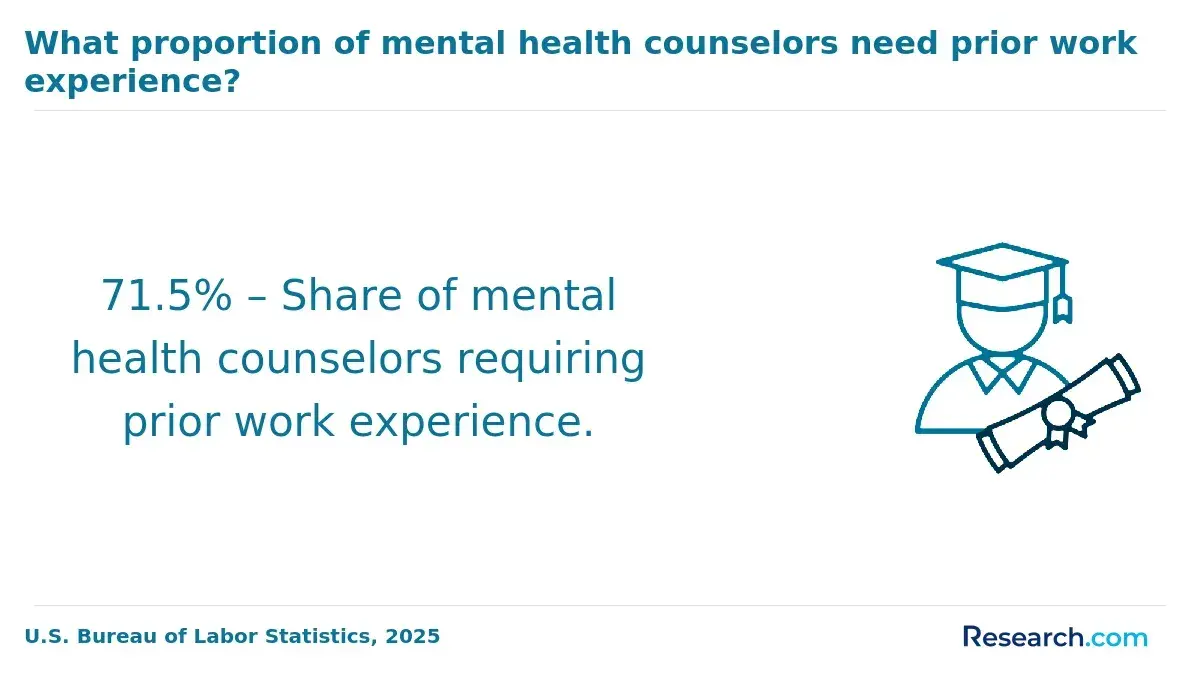
Massachusetts LMHC applicants must complete at least 700 hours of pre-master’s degree experience and 3,360 hours of post-master’s degree experience (Board of Registration of Allied Mental Health and Human Services Professions, n.d.). These hours are not just formalities. They determine whether your education translates into approved clinical eligibility.
| Experience stage | Required hours | Minimum direct or clinical component | Supervision requirement |
| Practicum | 100 hours | 40 hours of laboratory experience in individual, group, couple, and family interactions and direct client experience or peer role-plays | 25 supervisory contact hours, including at least five hours of group supervision, 20 hours of individual supervision, and 10 additional hours of individual or group supervision |
| Internship | 600 hours | 240 hours of direct client contact experience at a clinical field experience site in mental health counseling | 45 supervisory contact hours, including at least 15 hours of individual supervision, 15 hours of group supervision, and 15 additional hours of individual or group supervision |
| Post-master’s supervised experience | 3,360 hours | 960 hours of direct, face-to-face, clinical mental health counseling | 130 supervisory contact hours, including 75 hours of individual supervision |
Practicum Requirement
The practicum is the first supervised field experience and must total 100 hours. It may take place at a clinical field site or on the academic campus. At least 40 hours must involve laboratory experience in individual, group, couple, and family interactions and direct client experience or peer role-plays. The practicum must also include 25 supervisory contact hours, with at least five hours of group supervision, 20 hours of individual supervision, and 10 additional hours of individual or group supervision.
Internship Requirement
The internship follows practicum and must total 600 hours. At least 240 hours must involve direct client contact experience at a clinical field site in mental health counseling. Academic guidance, vocational guidance, teaching, research, and industrial or organizational consulting do not count as qualifying mental health counseling fieldwork for this requirement. The internship must include 45 supervisory contact hours, with at least 15 hours of individual supervision, 15 hours of group supervision, and 15 additional hours of individual or group supervision.
Massachusetts Licensure Application and Renewal Process
The Board of Registration of Allied Mental Health and Human Services Professions, which operates within the Massachusetts Department of Public Health, regulates LMHC licensure. The Board also oversees several related licenses, so applicants must use the correct application materials for their intended credential.
- Mental Health Counselor
- Rehabilitation Counselor
- Marriage and Family Therapist
- Educational Psychologist
- Applied Behavior Analyst
- Assistant Applied Behavior Analyst
Always verify requirements through the Board before submitting an application because forms, documentation rules, and supervised-experience interpretations can change.
Post-Master’s Supervised Clinical Experience
After completing the required graduate education, LMHC candidates must complete 3,360 hours of full-time supervised mental health counseling experience, or the part-time equivalent. This experience must be completed in not less than two years and not more than eight years.
- 960 hours must consist of direct, face-to-face, clinical mental health counseling with individuals, groups, couples, or families.
- No more than 350 hours may be counted from group counseling.
- 130 hours must be completed under supervisory contact hours.
- 75 hours must be individual supervision.
- There must be at least one hour of supervision for every 16 hours of direct client contact.
- Part-time candidates must receive at least one hour of supervision every two weeks.
Steps to Become a Licensed Counselor in Massachusetts
- Complete the required graduate education in mental health counseling or a related field.
- Document the required 700 hours of pre-master’s practicum and internship experience.
- Complete 3,360 hours of post-master’s supervised clinical mental health counseling experience.
- Pass the National Clinical Mental Health Counseling Examination (NCMHCE) from the National Board of Certified Counselors (NBCC). If you passed the NCMHCE in another state, contact NBCC and request that your official score report be sent to the Massachusetts Board.
- Ask your graduate school to send official transcripts for the qualifying graduate education used in your license application. Applicants educated outside the United States should contact the Board for foreign education evaluation instructions.
- Submit a completed and notarized Criminal Offender Record Information (CORI) form.
- Complete the Pre-Master’s Degree Experience and Education Form and the Post-Master’s Degree Clinical Experience Form.
- Apply through the Massachusetts Department of Public Health’s Health Professions Licensing System if you are a first-time applicant.
- Pay the non-refundable application fee by credit card or checking account.
Review supervision rules carefully before assuming that a placement or job will count. Massachusetts has different conditions depending on when supervised experiences were arranged. At least 75 of 200 total required supervision hours for pre-master’s and post-master’s experiences must be supervised by a mental health counselor licensed in Massachusetts or the equivalent in another jurisdiction.
Renewal and Continuing Education
Massachusetts counselor licenses must be renewed every two years by the 31st of December every odd year. Renewal requires a fee and 30 credits of continuing education during each license cycle. Do not wait until the final months of the cycle to find continuing education, especially if you need ethics, telehealth, trauma, substance use, or specialty-specific training.
The Board also handles license renewals and applications for Massachusetts LPC reciprocity licensure. If you are licensed in another jurisdiction, compare your education, exam, supervision, and practice history with Massachusetts standards before assuming reciprocity will be automatic.
Workforce conditions make new licensees important to employers. A 2025 report from the Association for Behavioral Healthcare presents that more clinicians with master’s degree training are leaving compared to the number of MA-holding clinicians who are entering the workforce in Massachusetts. There were only 9 clinicians hired for every 14 clinicians who left (ABH, 2025).
List of Top Counseling Programs in Massachusetts for 2027
Massachusetts has several counseling and counseling-adjacent programs that may support licensure, specialization, or advanced clinical study. The right program depends on your credential goal. A bachelor’s program may help you enter the field or prepare for graduate school, but LMHC licensure requires qualifying graduate education. A doctoral psychology program may support a different licensure path, not an LMHC path. If your long-term goal involves addiction work, compare programs with Research.com’s guide to careers connected to addiction counseling education.
Use the following program details as a starting point, not as a final decision. Tuition, accreditation, admissions requirements, field placement rules, and licensure alignment can change, so verify every item directly with the school and the Massachusetts Board.
| School | Program option | Length | Credits and cost information | Accreditation listed |
| Boston University | Master of Arts in Mental Health Counseling and Behavioral Medicine (MHCBM) | Two years | 60 credits; $1,994 per credit for part-time enrollees and $31,899 per semester for full-time students taking 12 credits or more | Council for Accreditation of Counseling & Related Educational Programs (CACREP) |
| Bridgewater State University | MEd in Mental Health Counseling and MEd in Mental Health Counseling Dual License | Approximately two years | $502.25 per credit hour; 60 credits including 700 hours of fieldwork for the MHC concentration and 66 credits including 1,000 hours of fieldwork for the Dual License concentration | Council for Accreditation of Counseling & Related Educational Programs (CACREP) |
| Lesley University | BS in Counseling; BS with a minor or second major; Dual Degree in Counseling (BS + MA) with no concentration, Holistic Studies, Trauma Studies, or School & Community Counseling | Four years for the BS program; six years for the dual degree in counseling | 120 credits; $15,945 per semester for undergraduate full-time enrollees taking 12-18 credits, $1,063 per credit for undergraduate part-time students, and $1,300 per credit for graduate studies courses | New England Commission of Higher Education (NECHE) |
| Gordon-Conwell Theological Seminary | MA in Counseling (MACO); dual enrollment in MACO and Master of Divinity program | Approximately two to three years | 81 credit hours including 60 counseling credits; $800 per credit hour with a Trustee Scholarship discount of $540 per course for students who do not receive any other scholarship and discounted tuition rates for members of partner ministries | Council for Accreditation of Counseling & Related Educational Programs (CACREP) |
| University of Massachusetts Boston | PhD in Counseling Psychology | Approximately five years with up to eight years to complete | 73 credits; graduate tuition is $832.16 per credit for in-state students, $1.600.29 per credit for non-residents, and $1,437.37 per credit for learners from member-states of the New England Regional Program | Commission on Accreditation of the American Psychological Association (APA) |
How to Compare Massachusetts Counseling Programs
- Licensure alignment: Ask whether the program is designed to meet Massachusetts LMHC educational requirements and whether graduates commonly pursue LMHC licensure.
- Accreditation: Confirm institutional accreditation and, where relevant, programmatic accreditation such as CACREP or APA.
- Field placement support: Ask whether the school secures practicum and internship sites or requires students to find their own.
- Supervision documentation: Make sure the program helps students document hours in the format the Board expects.
- Total cost: Compare tuition, fees, transportation, technology, health insurance, lost wages, and cost of living, not just the advertised per-credit price.
- Schedule format: Decide whether full-time, part-time, evening, hybrid, or online study fits your work and family obligations.
- Specialization fit: Look for coursework and placements in trauma, addiction, child and adolescent counseling, family therapy, rehabilitation, school settings, or integrated behavioral health if those match your goals.
What are the benefits of joining professional organizations for licensed counselors in Massachusetts?
Professional associations can be especially useful in Massachusetts because licensure rules, reimbursement debates, telehealth practice, ethics requirements, and workforce conditions continue to evolve. Membership is not a substitute for Board guidance, but it can help counselors stay informed and connected.
- Continuing education: Organizations such as the Massachusetts Mental Health Counselors Association (MaMHCA) may offer workshops, conferences, and trainings that help counselors meet continuing education requirements.
- Professional networking: Local and national associations can connect new counselors with supervisors, practice owners, agency leaders, specialty groups, and peers who understand the Massachusetts job market.
- Advocacy: Groups such as the American Counseling Association (ACA) and MaMHCA monitor policy proposals, licensure issues, reimbursement concerns, and workforce challenges that affect counseling practice.
- Ethics and practice resources: Members may gain access to practice guidelines, ethics resources, consultation opportunities, research updates, and legal or risk-management materials.
- Cost savings: Some associations offer discounts on liability insurance, conferences, certification preparation, software, and professional development resources.
Are online counseling programs a good option for Massachusetts LPC candidates?
Online counseling programs can be a practical option for Massachusetts LMHC candidates if they meet the state’s education and fieldwork requirements. The critical question is not whether the coursework is online; it is whether the program is accredited, includes the required graduate content areas, supports approved practicum and internship experiences, and prepares graduates for Massachusetts licensure documentation.
| Online counseling program advantage | Risk to check before enrolling | Best question to ask the school |
| More schedule flexibility for working adults and caregivers | Some live classes, residencies, or fieldwork requirements may still occur at fixed times | What parts of the program require synchronous attendance, campus visits, or local placement? |
| Potential cost savings compared with relocation or commuting | Tuition is only one part of total cost | What is the full program cost, including fees, technology, travel, and fieldwork expenses? |
| Access to programs outside your immediate city | Out-of-state programs may not be designed around Massachusetts LMHC rules | Can you provide written confirmation of how the curriculum maps to Massachusetts LMHC requirements? |
| Classmates and faculty from different regions | Field placement support may be weaker for students far from campus | Who is responsible for finding Massachusetts-approved practicum and internship sites? |
Students comparing online options may also want to review related affordability guides, such as Research.com’s list of affordable online marriage and family therapy degree programs, while remembering that MFT and LMHC licensure requirements are not identical.
Navigating Career Specializations in Massachusetts Counseling
Specialization can shape where you work, which clients you serve, what supervision you seek, and what continuing education you prioritize. Massachusetts counselors often build focused experience in family systems, school mental health, addiction treatment, trauma care, rehabilitation, community mental health, or integrated behavioral health.
| Specialization | Common work settings | When it may be a good fit |
| Marriage and family therapy | Family clinics, private practices, community agencies, outpatient centers | You want to work with couples, families, parenting concerns, relationship patterns, and systemic issues. Review the pathway for becoming a marriage and family therapist in Massachusetts. |
| School and youth counseling | K-12 schools, student support programs, community youth agencies | You want to support students’ academic, developmental, social, and emotional needs. |
| Substance abuse counseling | Rehabilitation centers, hospitals, outpatient clinics, recovery programs, community health organizations | You want to work with addiction, relapse prevention, co-occurring disorders, and recovery planning. |
| Trauma-focused counseling | Hospitals, veterans’ services, crisis programs, private practices, community agencies | You want advanced training in trauma-informed care and evidence-based trauma interventions. |
| Rehabilitation counseling | Vocational rehabilitation programs, disability services, healthcare organizations | You want to help clients navigate disability, employment, independence, and functional recovery. |
Specialization should follow evidence of demand, your clinical strengths, and the supervision opportunities available to you. Do not choose a specialty only because it sounds marketable; choose one you can support with coursework, fieldwork, supervision, continuing education, and ethical competence.
Could pursuing psychology licensure benefit my counseling career in Massachusetts?
Psychology licensure can expand career options for professionals interested in psychological assessment, doctoral-level clinical practice, research, teaching, or specialized intervention. It is not a shortcut to LMHC licensure, and it usually requires a different educational and supervised-training pathway. Counselors considering this move should compare the scope of practice, degree level, internship expectations, exam requirements, and time investment before enrolling in a doctoral program. Research.com’s guide to psychology licensure requirements in Massachusetts explains that separate pathway in more detail.
What distinguishes LMFTA from LMFT in Massachusetts counseling careers?
LMFTA and LMFT designations matter for professionals pursuing marriage and family therapy rather than general LMHC practice. The associate-level credential typically reflects a supervised, pre-independent practice stage, while the full LMFT credential reflects completion of required education, clinical hours, supervision, and licensure conditions. Because each designation can affect supervision, allowable work, employer expectations, and career mobility, applicants should review the exact credential rules before choosing an MFT program. For a broader explanation, see Research.com’s comparison of LMFTA vs LMFT.
How is Technology Transforming Counseling Practices in Massachusetts?
Technology is changing counseling work through telehealth platforms, electronic health records, online scheduling, secure messaging, digital intake forms, and measurement-based care tools. For Massachusetts counselors, technology can improve access for clients who face transportation, disability, schedule, or regional barriers. It can also create new responsibilities around privacy, informed consent, documentation, emergency planning, and cross-jurisdiction practice.
Students preparing for a technology-enabled mental health field should seek programs that address telehealth ethics, digital recordkeeping, data privacy, and evidence-based use of online tools. Those exploring broader psychology training may also compare psychology schools in Massachusetts as part of long-term academic planning.
Impact of Substance Abuse on Mental Health in Massachusetts: Addressing the Crisis
Substance use remains one of the most important behavioral health issues affecting Massachusetts communities. The opioid crisis has increased demand for clinicians who understand addiction, trauma, co-occurring disorders, relapse prevention, harm reduction, family impact, and coordinated care. Counselors who want to work in this area should prepare for emotionally demanding work that often involves complex medical, social, legal, and mental health needs.
The Link Between Substance Use and Mental Health Disorders
Substance use and mental health conditions frequently occur together. A client may use alcohol or drugs to cope with anxiety, depression, trauma, or stress, while long-term substance use can worsen mood, cognition, relationships, employment, and safety. This combination is often described as a co-occurring disorder.
Substance abuse counselors and mental health counselors play a key role in assessment, treatment planning, individual and group counseling, relapse-prevention support, referral coordination, and recovery-focused care. The strongest preparation usually includes training in both addiction treatment and broader mental health practice.
The Growing Need for Substance Abuse Counselors in Massachusetts
The U.S. Bureau of Labor Statistics states that employment for substance abuse counselors is expected to grow by 18% BY 2032, much faster than the average for all professions. In Massachusetts, demand is connected to addiction treatment needs, the opioid crisis, and the wider recognition that recovery often requires mental health support.
Substance abuse counselors may work in rehabilitation centers, hospitals, outpatient clinics, community programs, recovery organizations, and private practices. Their responsibilities can include intake assessment, group counseling, individual counseling, substance use history review, treatment planning, relapse-prevention work, and care coordination.
How to Prepare for Substance Abuse Counseling
Students interested in addiction counseling should choose coursework and field placements that cover addiction theory, behavioral interventions, co-occurring disorders, ethics, crisis response, family systems, trauma, and culturally responsive care. A dedicated substance abuse counseling degree can help students understand education options connected to this field.
What steps should I take to launch a successful counseling career in Massachusetts?
A successful counseling career in Massachusetts starts before licensure. Students who plan early are better positioned to avoid program mismatches, missing hours, weak supervision, and avoidable debt. If your specific goal is mental health counseling, review the full pathway for becoming a licensed mental health counselor in Massachusetts.
- Clarify your target credential: Decide whether you are pursuing LMHC, LMFT, school counseling, psychology, social work, addiction counseling, or another related license.
- Choose a qualifying program: Confirm accreditation, credit hours, required coursework, fieldwork structure, and Massachusetts licensure alignment.
- Plan your finances: Compare total cost, scholarships, graduate assistantships, employer support, public-service options, and part-time study feasibility.
- Build relevant experience early: Volunteer, work in human services, seek crisis-line or peer-support roles, and pursue placements aligned with your goals.
- Track every hour carefully: Keep supervision, practicum, internship, and post-master’s records organized from the beginning.
- Prepare for the NCMHCE strategically: Use official exam resources, practice cases, and supervisor feedback to strengthen clinical reasoning.
- Network locally: Join professional organizations, attend Massachusetts-focused trainings, and seek mentors who understand the state’s employment market.
- Choose early jobs for supervision quality: A first post-master’s role should help you meet licensure requirements, not just provide a paycheck.
What is the fastest way to become a counselor in Massachusetts?
The fastest realistic route is not skipping requirements; it is avoiding delays. Choose a graduate program that already fits Massachusetts LMHC rules, take a full-time course load if financially and personally possible, secure practicum and internship placements on schedule, pass the NCMHCE without repeated attempts, and accept post-master’s employment that provides approved supervision and enough direct client-contact hours. For a focused pathway comparison, see Research.com’s guide to the fastest way to become a counselor in Massachusetts.
How can transitioning to school counseling enhance my practice in Massachusetts?
School counseling can expand your impact from individual clinical treatment to student development, prevention, academic support, crisis response, family collaboration, and school-wide mental health initiatives. It may be a strong fit if you enjoy working with children or adolescents and want to operate inside educational systems. However, school counseling has its own credential expectations, work calendar, documentation requirements, and role boundaries. Review the process for becoming a school counselor in Massachusetts before assuming LMHC preparation automatically transfers.
How Can I Optimize Licensing Exam Preparation in Massachusetts?
Effective NCMHCE preparation should focus on clinical reasoning, diagnosis-informed case conceptualization, treatment planning, ethical decision-making, and intervention selection. Build a study schedule that combines content review with practice cases, not just memorization. Discuss exam-style scenarios with supervisors, review weak areas after practice exams, and use official guidance to understand the exam structure. For a state-specific overview, see Research.com’s guide to Massachusetts LPC license requirements.
What additional specialized training is recommended for substance abuse counseling in Massachusetts?
Counselors who want to work in addiction treatment should pursue focused training in screening and assessment, motivational interviewing, relapse prevention, medication-assisted treatment coordination, co-occurring disorders, trauma-informed care, crisis planning, group counseling, and ethical issues in substance use treatment. Specialized training can strengthen your readiness for roles in rehabilitation centers, community health programs, hospitals, and outpatient clinics. For a more targeted pathway, review Research.com’s guide on how to become a substance abuse counselor in Massachusetts.
How Do Legal and Ethical Guidelines Impact Counseling Practices in Massachusetts?
Legal and ethical standards affect nearly every part of counseling practice in Massachusetts, including informed consent, confidentiality, mandated reporting, documentation, supervision, telehealth, record retention, professional boundaries, and emergency response. Counselors must comply with state rules as well as applicable federal privacy standards such as HIPAA.
Ethics training should be ongoing, not limited to graduate school. Counselors moving into telehealth, addiction treatment, school settings, private practice, or integrated care should seek training specific to those settings. Students exploring addiction-focused education can also compare options such as an online addiction counseling degree, while remembering that bachelor’s-level education alone does not meet LMHC requirements.
How Can Dual Licensure in Social Work and Counseling Enhance My Practice in Massachusetts?
Dual licensure can be valuable for professionals who want a broader scope across psychotherapy, case management, systems navigation, community resources, medical settings, and social-service coordination. Counseling and social work overlap in some practice areas, but they are separate licensure pathways with different educational, supervision, and exam requirements. If you are considering this route, compare costs, time, supervision availability, and career payoff before pursuing two credentials. Research.com’s guide to becoming a social worker in Massachusetts can help you evaluate the social work side of the decision.
How Can Mentorship and Networking Accelerate My Counseling Career in Massachusetts?
Mentorship can help new counselors make better decisions about graduate programs, internships, supervision, exam preparation, specialty training, first jobs, and private practice readiness. Networking also helps counselors understand which employers provide strong supervision, which settings are hiring, and how policy changes affect day-to-day practice.
Useful networking steps include joining Massachusetts-focused professional organizations, attending continuing education events, asking supervisors for career feedback, connecting with alumni from your program, and building referral relationships ethically. Counselors interested in interdisciplinary behavioral care may also explore related fields, such as how to become a behavior analyst in Massachusetts, to understand adjacent career paths and collaborative care models.
Common Mistakes to Avoid When Pursuing Counseling Licensure in Massachusetts
| Common mistake | Why it can hurt your path | Better approach |
| Choosing a program based only on reputation | A prestigious school may not be the best fit if the curriculum, fieldwork, or cost does not match your licensure goal. | Match the program to Massachusetts LMHC requirements, your budget, and your preferred specialty. |
| Looking only at tuition | Fees, commuting, relocation, unpaid fieldwork, exam costs, and lost work hours can change the real cost. | Calculate total cost of attendance and compare financial aid before enrolling. |
| Assuming all online programs qualify | Some online programs are designed for another state’s licensing rules. | Get written confirmation that coursework and field placements align with Massachusetts requirements. |
| Not tracking supervision hours from day one | Missing documentation can delay licensure even if you completed the work. | Maintain organized records and confirm forms with supervisors regularly. |
| Choosing a first job without checking supervision quality | A job may not provide enough direct client contact or approved supervision. | Ask about supervision credentials, frequency, documentation, and client-contact expectations before accepting. |
| Waiting too long to prepare for the NCMHCE | Exam delays can slow your license application and career progression. | Begin preparation during supervised practice and use case-based study materials. |
| Assuming salary outcomes are guaranteed | Pay varies by setting, employer, specialty, reimbursement model, and experience. | Compare real job postings, benefits, supervision value, and long-term advancement potential. |
Questions to Ask Before Choosing a Massachusetts Counseling Program
- Is this program designed to meet Massachusetts LMHC educational requirements?
- How many graduates pursue LMHC licensure, and what support do they receive during the process?
- Does the program include the required graduate content areas and credit hours?
- Who finds practicum and internship placements: the student, the school, or both?
- Are Massachusetts-approved field sites available near where I live?
- How are practicum, internship, and supervision hours documented?
- What is the total cost, including fees, books, technology, commuting, and fieldwork expenses?
- What scholarships, grants, discounts, assistantships, or employer partnerships are available?
- Does the program offer training in my intended specialty, such as trauma, addiction, family therapy, or school-based counseling?
- Will the schedule allow me to work while completing classes and fieldwork?
Is Becoming a Licensed Counselor in Massachusetts Worth It?
Becoming an LMHC in Massachusetts can be worth it if you are committed to graduate-level clinical training, can manage the cost of education and living expenses, and want to work in a state with strong healthcare institutions and continuing need for mental health professionals. The path is demanding: you must complete a qualifying master’s degree, extensive supervised experience, an exam, and continuing education. The payoff is broader professional mobility, eligibility for more advanced clinical roles, and the ability to serve clients in a state where access gaps remain significant.
This path may not be the best fit if you need a very short training route, cannot take on graduate education costs, prefer non-clinical human services work, or want a role that does not require ongoing supervision, documentation, and ethical accountability. In those cases, consider related careers in case management, human services, peer support, behavioral health support, school support services, social work, psychology, or applied behavior analysis.
Key Insights
- Massachusetts uses the LMHC title: Many people search for LPC requirements, but the state license for mental health counselors is the Licensed Mental Health Counselor.
- The degree choice is the biggest early decision: A qualifying master’s degree must meet credit-hour, coursework, accreditation, and fieldwork expectations. Do not enroll until you verify licensure alignment.
- Supervised hours drive the timeline: Candidates need 700 pre-master’s hours and 3,360 post-master’s supervised clinical hours before licensure.
- Demand exists, but settings differ: Hospitals, schools, outpatient clinics, rehabilitation centers, treatment programs, and private practices may hire counselors, but pay, supervision, workload, and reimbursement conditions vary.
- Cost of living matters: Massachusetts salaries should be evaluated against a high cost of living index of 149.7 and a living wage of $21.35 per hour for an adult with no dependents.
- Online programs can work if they meet Massachusetts rules: Flexibility is useful, but field placement support and state licensure compatibility are non-negotiable.
- Specialization should be strategic: Addiction, trauma, school counseling, family therapy, rehabilitation, and integrated care can strengthen career direction when supported by appropriate training and supervision.
- Licensure is not the finish line: Massachusetts counselors must renew every two years by the 31st of December every odd year and complete 30 continuing education credits per cycle.
Related Articles for Nearby States
- 2027 How to Become a Licensed Counselor (LPC) in Rhode Island
- 2027 How to Become a Licensed Counselor (LPC) in Connecticut
- 2027 How to Become a Licensed Counselor (LPC) in New Hampshire
- 2027 How to Become a Licensed Counselor (LPC) in New York
- 2027 How to Become a Licensed Counselor (LPC) in Vermont
- 2027 How to Become a Licensed Counselor (LPC) in New Jersey
- 2027 How to Become a Licensed Counselor (LPC) in Maine
- 2027 How to Become a Licensed Counselor (LPC) in Pennsylvania
- 2027 How to Become a Licensed Counselor (LPC) in Delaware
- 2027 How to Become a Licensed Counselor (LPC) in Maryland
References:
- Association for Behavioral Healthcare. (2025). Behavioral health workforce crisis: Annual 2025 trends and staffing gaps. https://www.abhmass.org/resources/workforce-reports Association for Behavioral Healthcare workforce brief
- Board of Registration of Allied Mental Health and Human Services Professions (n.d.). Licensed Mental Health Counselor Application Guide and related forms. https://www.mass.gov/doc/licensed-mental-health-counselor-application-guide-0/download
- Bureau of Labor Statistics. (2026). Occupational outlook handbook: Substance abuse, behavioral disorder, and mental health counselors. https://getlicensemap.com/states/counselor/massachusettsMassachusetts LMHC application guide
- Glasmeier, A.K. and Massachusetts Institute of Technology (n.d.). Living Wage Calculation for Massachusetts. Living Wage Calculator. https://livingwage.mit.edu/states/25
- KFF. (2025). Mental health and substance use disorder provider reimbursement and workforce challenges. http://health/issue-brief/mental-health-and-substance-use-disorder-provider-reimbursement-and-workforce-challenges/Living Wage Calculator for Massachusetts
- Massachusetts Center for Health Information, Analysis, and Research. (2025). Massachusetts health insurance survey. https://www.chiamass.gov/massachusetts-health-insurance-survey/Massachusetts living wage reference
- National Alliance on Mental Illness. (2025). Mental health in Oklahoma. https://www.nami.org/NAMI/media/NAMI-Media/StateFactSheets/OklahomaStateFactSheet.pdf
- Paper Trails. (2026). Massachusetts' minimum wage update 2026. https://papertrails.com/blog/massachusetts-minimum-wage-update
- U.S. Bureau of Labor Statistics. (2025). Occupational employment and wage statistics: Educational, guidance, and career counselors and advisors. https://www.bls.gov/oes/current/oes111021.htm
- University of Massachusetts Boston. (2025). Counseling Psychology (PhD). https://www.umb.edu/academics/cehd/counseling-school-psychology/graduate-programs/counseling-psychology-phd/Massachusetts living wage dataMassachusetts health care workforce trendsBLS Massachusetts occupational employment and wage estimatesBLS occupational outlook for substance abuse, behavioral disorder, and mental health counselorsU.S. Department of Labor state minimum wage lawsUninsured population share by state
- Wisevoter (n.d.). Cost of Living by State. https://wisevoter.com/state-rankings/cost-of-living-by-stateWisevoter cost of living by state
Other Things You Should Know About Becoming a Licensed Counselor (LPC) in Massachusetts
In 2027, to apply for licensure as an LPC in Massachusetts, candidates must submit a completed application form, official transcripts, verification of completed pre-license experience hours, examination scores, and pay the required fees. Additionally, a background check is necessary.
LPC candidates in Massachusetts must complete 3,360 hours of post-master’s supervised clinical experience, under the supervision of an approved supervisor. This experience typically spans over a period of at least two years.
Massachusetts requires a 60-semester-credit graduate degree in counseling or a closely related field from a regionally accredited institution. The program must include coursework in areas such as ethics, assessment, counseling theories, human growth and development, and diagnosis before LPC licensure can proceed.
To gain pre-licensure hours in 2027, prospective LPCs in Massachusetts must complete 3,360 hours of supervised clinical experience. This must include 960 hours of direct client contact and be under the supervision of a qualified professional. The completed experience should be accrued over a minimum of two years.
In Massachusetts, aspiring Licensed Professional Counselors must achieve a passing score on the National Counselor Examination (NCE). The minimum passing score is determined by the National Board for Certified Counselors (NBCC) and typically falls within the range of 92 to 106 questions answered correctly out of 160.
To become a Licensed Professional Counselor (LPC) in Massachusetts in 2027, you must earn a master's degree in counseling or a closely related field from an accredited institution. The program should include at least 60 graduate semester hours and cover areas specified by the Massachusetts Board of Registration of Allied Mental Health and Human Services Professionals.