
2027 LMFT vs LMFTA: Explaining The Difference

Co-Founder and Chief Data Scientist
Choosing between LMFTA and LMFT status is really a question about independence, supervision, earning potential, and how quickly you can move from graduate training into full clinical practice. The distinction matters because marriage and family therapy is a licensed mental health profession: your title determines what you can do, where you can work, whether you can practice on your own, and how you document supervised experience.
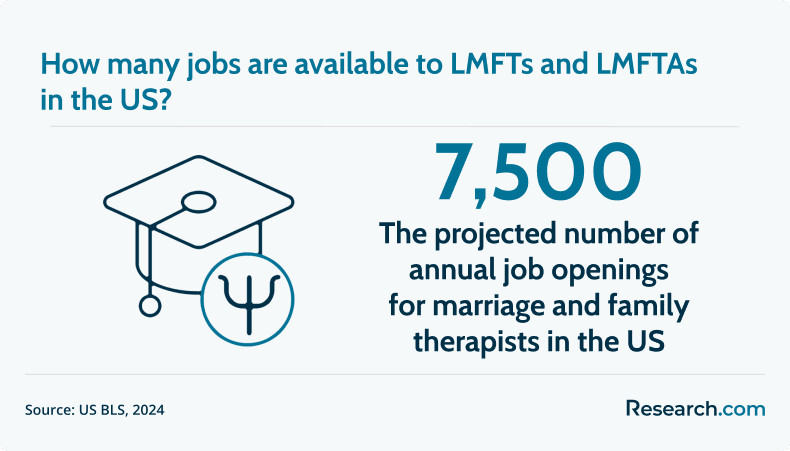
The demand for qualified mental health professionals remains significant. Employment for licensed marriage and family therapists (LMFTs) in the United States (US) is projected to grow by 16% between 2023 and 2033, a pace much faster than the average for all US occupations. That projection equals about 7,500 openings for LMFTs each year [US Bureau of Labor Statistics (BLS), 2024]. At the same time, the country needed 6,203 mental health practitioners as of February 2025 (Health Resources & Services Administration, 2025), and 60 million American adults experienced a mental illness between 2021 and 2022 (Mental Health America, 2024).
This guide explains the practical differences between an LMFTA and an LMFT, including scope of practice, education, supervised hours, licensure exams, salary, job options, renewal requirements, and long-term career decisions. It is designed for graduate students, associate-level therapists, career changers, and anyone comparing marriage and family therapy with other counseling or psychology paths.
Quick Answer: LMFT vs. LMFTA
An LMFTA is a pre-licensed marriage and family therapist who provides therapy while completing supervised clinical experience. An LMFT is fully licensed and can usually practice independently, diagnose and treat clients within state rules, bill insurance directly, supervise associates, and operate a private practice.
| Factor | LMFTA | LMFT |
| License level | Associate or provisional license | Full independent clinical license |
| Supervision | Required while completing post-graduate hours | Not required for independent practice |
| Independent practice | Generally not allowed | Allowed, subject to state law |
| Diagnosis and treatment | May provide therapy under approved supervision; authority varies by state | Can diagnose and treat within the LMFT scope of practice |
| Private practice | May work in a supervised practice setting | Can open and run an independent practice |
| Typical career stage | Post-graduate supervised training period | Fully licensed professional practice |
- What does an LMFT do?
- What does an LMFTA do?
- Can LMFTs and LMFTAs diagnose and treat clients independently?
- What education do LMFTs and LMFTAs need?
- How is LMFT licensure different from LMFTA licensure?
- How long does it take to move from LMFTA to LMFT?
- How do LMFT and LMFTA salaries compare?
- What jobs are available to LMFTs and LMFTAs?
- How can LMFTs build long-term career stability?
- When does an advanced degree make sense for LMFTs?
- How can telehealth and digital tools support LMFT practice?
- Why does accreditation matter for MFT programs?Review telehealth considerations
- Should LMFTs focus on child and adolescent therapy?
- Can online specialization broaden an LMFT’s clinical approach?
- What challenges should LMFTs and LMFTAs expect?
- How should students compare online MFT programs?
- Which industries employ LMFTs and LMFTAs?
- How do renewal and continuing education requirements work?
- What costs should future LMFTs plan for?See renewal requirementsReview final considerations
What is an LMFT?
A licensed marriage and family therapist (LMFT) is a fully licensed mental health professional trained to help individuals, couples, and families address emotional, behavioral, psychological, and relationship-based concerns. Unlike therapy models that focus only on the individual, marriage and family therapy emphasizes systems: family patterns, communication habits, relationship roles, cultural context, and the way personal distress affects close relationships.
LMFTs may work with clients experiencing anxiety, depression, trauma, grief, conflict, parenting stress, relationship breakdown, and other mental health or relational issues. Their daily work may include intake assessments, treatment planning, therapy sessions, crisis documentation, referrals, case notes, ethical decision-making, and collaboration with other providers.
What is an LMFTA?
A licensed associate marriage and family therapist (LMFTA) is a graduate-trained marriage and family therapy professional who is still completing the supervised experience required for full licensure. The associate license allows the therapist to provide clinical services, but not as an independent practitioner. Instead, the LMFTA works under a state-approved supervisor who reviews cases, signs off on hours, and helps ensure that clinical work meets legal and ethical standards.
LMFTAs often serve clients in community clinics, outpatient settings, group practices, agencies, and supervised private practice environments. Their work may look similar to an LMFT’s work from the client’s perspective, but their legal authority is different. Many LMFTAs cannot bill insurance directly, practice without oversight, or supervise other clinicians. Their associate period is the bridge between graduate school and full LMFT status, which is part of the pathway into the 76,000 LMFTs practicing across the US (US BLS, 2024).
If your main concern is speed, it may help to compare this route with other counseling pathways in our guide to the fastest way to become a licensed therapist.

Can LMFTs and LMFTAs diagnose and treat mental health disorders independently?
LMFTs can generally assess, diagnose, and treat mental health conditions within the scope allowed by their state license. They may conduct clinical evaluations, create treatment plans, provide individual, couple, and family therapy, maintain clinical records, and practice without a supervisor. Full licensure also gives LMFTs more flexibility to work in private practice, accept direct referrals, and pursue insurance reimbursement where permitted.
LMFTAs do not have the same level of independence. They may provide therapy and participate in assessment and treatment planning, but their work must occur under approved supervision. State rules determine how much diagnostic authority an associate-level therapist has, what documentation the supervisor must review, and whether the associate can work in certain practice settings. Anyone considering this path should read the licensing board rules for the state where they plan to practice before choosing a program or accepting a clinical job.
| Clinical activity | LMFTA | LMFT |
| Provide therapy to individuals, couples, and families | Yes, under supervision | Yes, independently |
| Diagnose mental health disorders | Depends on state rules and supervisor authority | Yes, within scope of practice |
| Open an independent private practice | Generally no | Yes, subject to state and business requirements |
| Bill insurance directly | Limited in many cases | Often possible, depending on payer rules |
| Supervise other therapists | No | May be allowed after meeting supervisor requirements |
Therapists who want deeper clinical, assessment, or leadership preparation may also compare MFT licensure with doctor of psychology programs online.
Do LMFTs and LMFTAs have the same educational requirements?
LMFTs and LMFTAs begin with the same academic foundation. The difference is not usually the degree itself; it is where the person stands in the licensing process after graduation. An LMFTA has completed the required graduate education but is still accumulating supervised post-graduate clinical experience. An LMFT has finished that supervised period and met the remaining state licensing requirements.
Most candidates should expect the following academic and training components:
- Graduate degree in marriage and family therapy: Candidates typically need a master’s or doctoral degree in marriage and family therapy from a program accredited by the Commission on Accreditation for Marriage and Family Therapy Education (COAMFTE) or another program accepted by the state licensing board.
- Practicum and internship experience: MFT graduate programs include supervised clinical training so students can practice assessment, treatment planning, ethical documentation, and therapy skills before graduation.
- Coursework aligned with clinical practice: Programs usually cover family systems theory, human development, ethics, cultural competency, diagnosis, research, assessment, and evidence-informed interventions for individuals, couples, and families.
Before enrolling, students should confirm that the curriculum satisfies the requirements of the state where they intend to become licensed. This is especially important for online students, military spouses, and anyone who may move after graduation.
| Requirement | Why it matters | What to verify before enrolling |
| Accreditation or state approval | Licensing boards may require or strongly prefer specific program standards | Whether the program meets your intended state’s MFT education rules |
| Clinical placement support | Students need approved practicum and internship experience | Whether the school helps arrange placements in your location |
| Licensure-aligned coursework | Missing courses can delay associate or full licensure | Whether the curriculum maps clearly to board requirements |
| Supervisor qualifications | Supervision must usually meet state standards | Who can supervise you during school and after graduation |
What is the main difference in licensure between an LMFT and an LMFTA?
The central licensure difference is practice authority. An LMFTA has a provisional or associate-level license and must practice under approved supervision while completing the post-graduate experience required for full licensure. An LMFT has completed the required education, supervised experience, and examination process and may practice independently within state scope-of-practice rules.
For many candidates, the associate license is temporary. It gives the graduate a legal way to provide therapy while building hours, receiving supervision, and preparing for full licensure. The full LMFT license removes the associate designation and generally expands professional options, including private practice, insurance billing, and supervision roles.
The licensure transition commonly includes passing the Marriage and Family Therapy National Examination, such as the Examination in Marital and Family Therapy. Because states may differ on when candidates can sit for the exam, how hours are counted, and what qualifies as supervision, applicants should rely on their state licensing board rather than assuming one state’s process applies everywhere.
-
: "
Decision point: If your goal is independent practice, private practice ownership, or supervising other therapists, LMFTA status is not the final credential. It is the supervised stage on the way to LMFT licensure.
"
How long does it take for an LMFTA to become an LMFT?
The supervised path from LMFTA to LMFT commonly takes 1 year to 3 years, depending on the state, the number of hours required, the therapist’s workload, and whether the clinical setting provides enough qualifying client contact and supervision.
To move from associate status to full licensure, an LMFTA generally needs to:
- Complete 1,500 to 4,000 supervised clinical hours, depending on state requirements.
- Work with a state-approved LMFT supervisor or another approved clinical supervisor.
- Pass the Marriage and Family Therapy National Examination after meeting the applicable education and experience rules.
The timeline can stretch if an associate works part time, changes supervisors, loses access to approved client hours, or submits incomplete documentation. It can also move more efficiently when the employer understands licensure requirements and builds supervision into the job.
How to avoid delays during the associate period
- Track hours weekly: Do not wait until the end of the year to reconstruct client contact, supervision, and indirect hours.
- Confirm supervisor approval early: A highly experienced therapist is not automatically an approved supervisor under every state rule.
- Keep copies of all documentation: Save supervision agreements, signed hour logs, exam records, and license renewal confirmations.
- Understand what counts: Some states separate direct client contact, relational hours, individual supervision, group supervision, and administrative activities.
- Plan for license renewal: Associate licenses may have renewal limits or additional documentation requirements.
Do LMFTs earn more than LMFTAs?
LMFTs generally have higher earning potential than LMFTAs because full licensure expands where and how they can practice. LMFTs may be eligible for independent clinical roles, private practice income, insurance reimbursement, supervisory work, and specialized positions that require a full license. LMFTAs are usually earlier in their careers and must work within supervision limits.
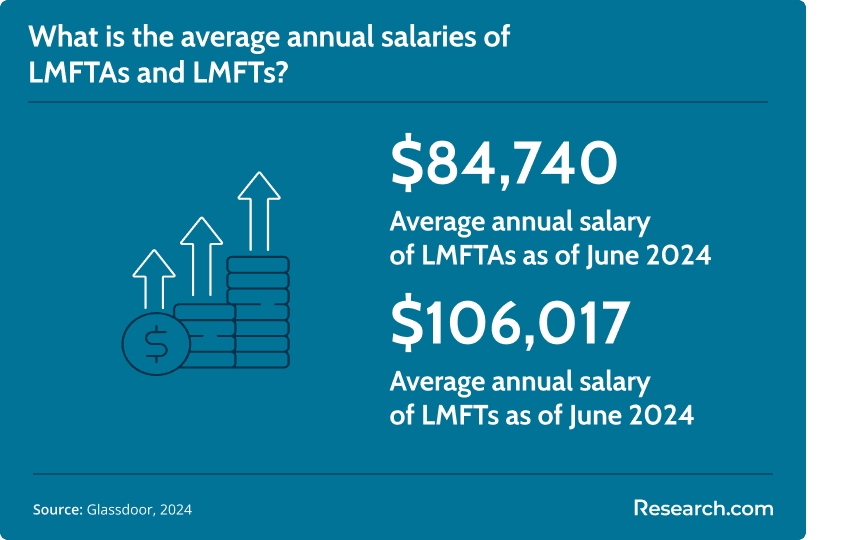
As of June 2024, LMFTAs had an average annual salary of $84,740, while LMFTs had $106,017 (Glassdoor, 2024). Salary differences can reflect licensure level, location, employer type, specialization, caseload, payer mix, years of experience, and whether the therapist works in private practice, an agency, a hospital-affiliated setting, or government service.
| Credential | Average annual salary cited | Important context |
| LMFTA | $84,740 | Associate-level therapists usually work under supervision and may have billing or practice limitations. |
| LMFT | $106,017 | Full licensure can support independent practice, insurance billing, supervision, and broader job eligibility. |
These figures should be treated as reference points, not guarantees. A newly licensed LMFT in a lower-paying setting may earn less than an experienced associate in a high-demand market, while private practice income can vary widely based on referrals, client retention, insurance participation, overhead, and business skills.
Do LMFTs and LMFTAs have the same job opportunities?
LMFTs and LMFTAs can appear in many of the same clinical environments, but they do not compete on equal licensure terms. LMFTAs need supervision, which can limit roles that require independent clinical judgment, unsupervised diagnosis, solo practice, or direct payer credentialing. LMFTs have broader access to independent and leadership-oriented positions.
Common employment options include:
- Community mental health therapist: LMFTs and LMFTAs may work in nonprofit agencies, outpatient clinics, public programs, or community-based services. In 2023, substance abuse, behavioral disorder, and mental health counselors across the US had a median annual wage of $53,710 (US BLS, 2024). Readers comparing related counseling roles can review what it takes to earn a substance abuse counseling degree.
- School-based family therapist: Schools and education-linked programs may use family therapists to support students, caregivers, and school staff around emotional, behavioral, and family-system concerns. In 2023, school and career counselors and advisors had a median annual wage of $61,710 (US BLS, 2024).
- Private practice therapist: Full LMFTs can usually operate an independent private practice and pursue direct insurance billing. LMFTAs may work in private practice settings only when supervision and state law allow it.
Employment for licensed marriage and family therapists (LMFTs) in the US is expected to increase by 16% between 2023 and 2033 (US BLS, 2024), making the field attractive for students who want a clinical career focused on relationships, family systems, and mental health treatment.
Related mental health careers to compare
Some students begin with MFT and later consider adjacent clinical, medical, or human-services roles. Additional education, licensure, and credentials may be required for the following careers:
- Social workers: Social workers support individuals, families, and communities through counseling, advocacy, resource navigation, crisis intervention, case management, and policy-related work. Clinical social workers can diagnose and treat mental health conditions when properly licensed. In 2023, social workers in the US had a median annual wage of $58,380 (US BLS, 2024).
- Psychologists: Psychologists may provide psychotherapy, psychological assessment, diagnosis, research, consulting, and testing services, depending on their degree level, specialization, and state licensure. In 2023, psychologists had a median annual wage of $92,740 (US BLS, 2024).
- Psychiatrists: Psychiatrists are physicians, either MDs or DOs, who diagnose and treat mental health conditions and can prescribe medication. They may combine medication management, psychotherapy, hospital-based care, research, and collaboration with other mental health professionals. In 2023, psychiatrists across the US had a median annual wage of $124,070 (US BLS, 2024).
The chart below compares the 2023 median annual wages of selected mental health professionals using 2024 data from the US BLS.
What strategies can LMFTs adopt for long-term career growth?
LMFT career growth is usually built through a mix of clinical depth, ethical practice, referral relationships, and business or leadership skill. Full licensure is only the starting point. Therapists who want a durable career should think deliberately about specialization, supervision training, documentation quality, continuing education, and how they will avoid burnout.
Useful long-term strategies include joining professional associations, seeking consultation from experienced clinicians, developing a niche, learning payer and documentation requirements, and building relationships with physicians, schools, attorneys, community agencies, and other referral sources. If you are still comparing counseling professions, Research.com’s guide on what is needed to become a counselor can help clarify how MFT compares with other counseling credentials.
| Career goal | Strategy that supports it | Why it helps |
| Build a stable caseload | Develop referral relationships and a clear clinical niche | Clients and referral partners are more likely to seek a therapist with visible expertise. |
| Move into supervision | Complete supervisor training and document ethical supervision experience | Supervision can create leadership opportunities and diversify income. |
| Reduce burnout risk | Set caseload limits, use consultation, and maintain clear policies | High emotional labor and administrative demands can affect retention. |
| Improve professional mobility | Track credentials, CE, and licensure records carefully | Good documentation makes job changes, renewal, and possible relocation easier. |
Should LMFTs Consider an Advanced Degree for Career Advancement?
An advanced degree is not required for every LMFT career goal, but it can be useful for therapists who want to teach, conduct research, move into senior clinical leadership, pursue psychology-related roles, or deepen expertise in assessment and evidence-based intervention. The decision should be based on the role you want, the cost of additional education, and whether the credential is recognized in your target setting.
For example, a Psy D degree online may appeal to clinicians interested in advanced psychological practice, doctoral-level training, or interdisciplinary work. However, a doctorate is a major investment and may not be necessary for LMFTs who primarily want to operate a therapy practice, supervise associates, or specialize through certificates and continuing education.
When an advanced degree may be worth considering
- You want to teach at the college or graduate level.
- You plan to pursue research, policy, or high-level clinical administration.
- Your target role specifically requires doctoral training.
- You want a deeper foundation in assessment, diagnosis, or specialized interventions.
When a shorter credential may be enough
- You want to strengthen one clinical specialty, such as trauma, couples therapy, or family systems work.
- You already have full licensure and need targeted continuing education rather than another degree.
- You are building a private practice and need business, documentation, marketing, or supervision training.
How Can LMFTs Leverage Telehealth and Digital Tools to Enhance Practice?
Telehealth has changed how many therapists deliver care, manage schedules, collect forms, communicate with clients, and document services. For LMFTs, digital tools can expand access for clients who face transportation, disability, scheduling, or geographic barriers. They can also help therapists manage routine administrative work more efficiently.
Still, telehealth is not simply video therapy. LMFTs must understand confidentiality, emergency planning, informed consent, cross-state practice rules, secure documentation, technology failures, and whether a given platform meets professional and legal expectations. Digital record systems, scheduling tools, outcome tracking, and secure messaging can support practice management, but they do not replace clinical judgment.
Students who are still building a broad psychology foundation may compare flexible undergraduate options such as an accelerated psychology bachelor's degree, especially if they are deciding whether to pursue graduate-level MFT training later.
Questions LMFTs should ask before using telehealth tools
- Does my state allow this type of telehealth service for my license?
- Can I legally serve the client if they are located in another state?
- Does the platform protect confidentiality and support appropriate documentation?
- What is my plan if a client has a crisis during a remote session?
- How will I verify identity, location, consent, and emergency contacts?
How Do Accredited Academic Programs Impact LMFT Career Outcomes?
Accreditation and licensure alignment can directly affect whether a graduate can become an LMFTA or LMFT without unnecessary delays. A strong MFT program should provide coursework that maps to state requirements, supervised clinical experience, faculty with relevant expertise, and clear guidance on practicum or internship expectations.
Prospective students should not assume that every online counseling or psychology program prepares graduates for MFT licensure. Some programs are designed for general psychology education, human services, applied behavior analysis, or counseling-adjacent careers rather than marriage and family therapy licensure. Comparing fields can be useful; for example, students interested in behavioral intervention may review colleges with ABA programs, but ABA preparation is not the same as LMFT preparation.
| Program feature | Why it matters for LMFT candidates |
| COAMFTE accreditation or state-recognized equivalency | It can make licensure review more straightforward and reduce the risk of missing coursework. |
| Clear practicum and internship structure | Students need supervised clinical experience that meets academic and licensing expectations. |
| State licensure disclosures | Online students must know whether the program meets requirements outside the school’s home state. |
| Faculty and supervisor expertise | Experienced MFT faculty can help students connect theory, ethics, and clinical practice. |
| Placement support | Students may struggle if they must locate approved clinical sites entirely on their own. |
Should LMFTs Specialize in Child and Adolescent Therapy?
Child and adolescent therapy can be a strong specialization for LMFTs because young clients are often treated within family, school, developmental, and community systems. This work may involve parent coaching, family sessions, school collaboration, trauma-informed care, behavioral concerns, emotional regulation, grief, divorce adjustment, and developmental transitions.
However, this specialty requires more than liking children or teens. Therapists need training in development, mandated reporting, caregiver involvement, consent and assent, family conflict, risk assessment, and age-appropriate interventions. Additional education, such as a child psychology degree online, may help clinicians deepen their knowledge, but LMFTs should still confirm how any program fits their licensure and practice goals.
Child and adolescent therapy may be a good fit if you:
- Want to work closely with families, caregivers, and schools.
- Are comfortable balancing the needs of children, parents, and other stakeholders.
- Can handle complex ethical questions around confidentiality, safety, and reporting.
- Enjoy developmental, trauma-informed, and family-systems approaches.
Can specialized online degrees broaden LMFT practice approaches?
Specialized online degrees or certificates can broaden an LMFT’s perspective when they are chosen strategically. The key is fit. A specialization should strengthen the therapist’s clinical niche, improve services for a defined client population, or support a realistic career goal.
For example, forensic psychology coursework can help therapists understand the relationship between mental health, family systems, custody disputes, risk assessment, and legal processes. LMFTs interested in this area may compare cheap forensic psychology masters online, but they should be careful not to assume that forensic psychology training automatically authorizes forensic evaluation, expert testimony, or legal decision-making. Scope of practice, training, and state rules still matter.
Before choosing a specialization, ask:
- Will this credential help me serve a client population I already work with or want to serve?
- Does the program provide clinical skill development, or is it mostly theoretical?
- Will the coursework count toward continuing education, licensure, or another credential?
- Is the cost justified by my likely career use of the specialization?
- Does the specialization fit within my LMFT scope of practice?
What challenges do LMFTs and LMFTAs face in the field?
Marriage and family therapy can be meaningful work, but it comes with real pressures. LMFTAs often face the challenge of balancing clinical growth with documentation, supervision requirements, exam preparation, and income limitations during the associate period. LMFTs may have more independence but also carry heavier responsibility for risk management, private practice operations, insurance requirements, and complex clinical decision-making.
Common challenges include burnout, high caseloads, administrative workload, changing regulations, client crises, reimbursement issues, professional isolation, and the emotional impact of trauma-focused or conflict-heavy work. Therapists who want broader clinical preparation may compare advanced pathways such as dual masters and PsyD programs in psychology, but additional degrees should be weighed carefully against time, cost, and career need.
| Common mistake | Why it creates problems | Better approach |
| Choosing a program without checking licensure fit | Graduates may discover missing coursework or ineligible clinical training. | Compare the curriculum with your state licensing board requirements before enrolling. |
| Focusing only on tuition | Low tuition may not offset weak placement support, delayed graduation, or licensure barriers. | Compare total cost, clinical support, graduation requirements, and licensure alignment. |
| Assuming online programs work in every state | Licensure rules vary and may not match the school’s disclosures for your location. | Request written confirmation about your intended state before committing. |
| Poor hour tracking during associate licensure | Missing supervision records can delay full LMFT approval. | Use a consistent tracking system and get supervisor signatures regularly. |
| Expecting salary outcomes to be guaranteed | Income varies by employer, location, payer mix, specialization, and experience. | Research local job postings, supervision pay, benefits, and private practice costs. |
How Can I Evaluate and Choose Quality Online MFT Programs?
A good online MFT program should do more than deliver convenient coursework. It should prepare students for licensure, supervised clinical work, ethical practice, and the realities of therapy with individuals, couples, and families. The most important question is not whether the program is online; it is whether the program is accepted for the license you want in the state where you plan to practice.
Students comparing programs can start with Research.com’s guide to online marriage and family therapy programs, then verify each school’s accreditation, clinical placement model, state authorization, faculty qualifications, and student support.
Checklist for comparing online MFT programs
- Licensure alignment: Ask whether the program meets MFT education requirements in your state.
- Accreditation: Confirm whether the program has COAMFTE accreditation or another status accepted by your board.
- Clinical placements: Find out whether the school helps secure practicum sites or expects you to locate them independently.
- Supervision standards: Ask who qualifies as a supervisor and whether supervision requirements differ by state.
- Residency requirements: Some online programs include in-person intensives, skills labs, or campus visits.
- Total cost: Include tuition, fees, technology, travel, books, liability insurance, exam fees, and licensure costs.
- Student outcomes: Ask about graduation, exam preparation, placement support, and alumni licensure pathways.
Which industries can LMFTs and LMFTAs work in?
LMFTs and LMFTAs work across healthcare, government, social services, education-related settings, and private practice. The industries available to an individual therapist depend on licensure level, supervision access, state law, employer requirements, and clinical specialization.
The top-paying industries for these professionals include (US BLS, 2024):
- State Government (excluding Education and Hospitals) ($86,030): LMFTs and LMFTAs may serve in public health agencies, correctional settings, behavioral health programs, and social service systems.
- Outpatient Care Centers ($61,390): These settings provide therapy and behavioral health services outside hospitals, often supporting clients with trauma, substance use, family conflict, relationship concerns, or ongoing mental health needs.
- Individual and Family Services ($50,700): Therapists in this sector may work for nonprofits, child welfare organizations, crisis programs, family service agencies, or community support programs.
- Offices of Other Health Practitioners ($49,190): LMFTs may collaborate with psychologists, psychiatrists, physicians, social workers, and other clinicians in group practices or integrated care environments.
Professionals who are comparing therapy with other income-focused education options may also review degrees that pay well, while keeping in mind that clinical licensure typically requires graduate education and supervised practice.
Do LMFTs and LMFTAs have different renewal and continuing education (CE) requirements?
LMFTs and LMFTAs often complete similar continuing education topics, but associate-level therapists may also have supervision-related renewal obligations. Renewal rules are set by state licensing boards, so therapists should confirm the exact renewal cycle, required topics, hour limits, and documentation format in their jurisdiction.
Common renewal and CE requirements include:
- Continuing Education (CE) Credits: Both LMFTs and LMFTAs generally complete state-required CE hours, usually 20-40 hours per renewal period, with required content such as ethics or clinical training.
- License Renewal: LMFTs typically renew every 1 to 2 years, depending on state regulations. LMFTAs must renew their associate credential and may need to prove they remain under active supervision.
- Supervision Documentation for LMFT-As: Associate-level therapists may need to submit supervision records, hour logs, or supervisor attestations, and some states limit how long an associate license can be renewed before full licensure is required.
Renewal planning tips
- Save CE certificates immediately after each training.
- Track ethics, supervision, telehealth, and specialty CE separately if your state requires specific categories.
- Do not wait until the final month of renewal to complete CE.
- Check whether online CE is accepted and whether provider approval is required.
- Keep supervision records even after becoming fully licensed.
What Are the Financial Considerations When Pursuing LMFT Licensure?
The cost of becoming an LMFT includes more than graduate tuition. Students and associates should budget for application fees, books, technology, liability insurance, background checks, practicum-related expenses, exam fees, license fees, supervision costs if not employer-paid, continuing education, and possible reduced earnings during the supervised associate period.
Financial planning should include both cost and career fit. A lower-cost program is not always the best choice if it does not meet licensure requirements or lacks clinical placement support. A higher-cost program may not be worthwhile if it does not improve your ability to become licensed, pass required exams, secure supervision, or reach your preferred work setting.
Students comparing mental health credentials may also look at related options such as BCBA programs, but they should remember that behavior analysis, counseling, psychology, social work, and marriage and family therapy lead to different scopes of practice and licensing requirements.
| Cost category | Why to include it in your budget |
| Graduate tuition and fees | This is usually the largest direct education expense. |
| Clinical placement costs | Students may need transportation, background checks, immunizations, or site-specific fees. |
| Licensing and exam fees | Associate and full licensure applications, exams, and renewals can add up over time. |
| Supervision | Some employers provide supervision, while others require associates to pay privately. |
| Continuing education | CE is an ongoing professional requirement after licensure. |
| Private practice startup costs | Independent LMFTs may need office space, telehealth tools, insurance, billing systems, and marketing. |
Key Insights
- LMFTA is a supervised stage, not the final independent credential. LMFTAs can provide therapy, but they generally cannot practice independently, supervise others, or bill directly in many situations.
- LMFT status expands professional authority. Full licensure usually allows independent diagnosis and treatment, private practice ownership, insurance billing, and broader employment options.
- The education path is similar, but the post-graduate requirements differ. Both credentials begin with graduate MFT training, while LMFTs must also complete supervised hours, exam requirements, and state licensure steps.
- Timeline depends heavily on state rules and work setting. Moving from LMFTA to LMFT commonly takes 1 year to 3 years and may require 1,500 to 4,000 supervised clinical hours.
- Salary potential tends to rise with full licensure. As of June 2024, LMFTAs in the US had an average annual salary of $84,740, while LMFTs had $106,017 (Glassdoor, 2024).
- Demand remains strong, but outcomes are not automatic. In 2023, 76,000 LMFTs were employed across the US (US BLS, 2024), and employment is expected to increase by 16% between 2023 and 2033 (US BLS, 2024).
- Program choice can affect licensure speed. Before enrolling, confirm accreditation, state licensure alignment, clinical placement support, and supervision expectations.
- Cost planning should include the whole pathway. Tuition is only one part of the investment; exam fees, supervision, renewal, CE, and associate-period earnings also matter.
References:
- Glassdoor. (2024, June 06). Associate Marriage and Family Therapist Salaries. https://www.glassdoor.com/Salaries/associate-marriage-and-family-therapist-salary-SRCH_KO0,39.htm
- Glassdoor. (2024, June 06). Licensed Marriage and Family Therapist Salaries. https://www.glassdoor.com/Salaries/licensed-marriage-and-family-therapist-salary-SRCH_KO0,38.htm
- Health Resources & Services Administration. (2025). Health Workforce Shortage Areas. US Department of Health & Human Services. https://data.hrsa.gov/topics/health-workforce/shortage-areas
- Mental Health America. (2024). The State of Mental Health in America. https://mhanational.org/issues/state-mental-health-america
- US Bureau of Labor Statistics. (2024, August 29). Marriage and Family Therapists. Occupational Outlook Handbook. https://www.bls.gov/ooh/community-and-social-service/marriage-and-family-therapists.htm
- US Bureau of Labor Statistics. (2024, April 03). Occupational Employment and Wages, May 2023, 29-1223 Psychiatrists. Occupational Employment and Wage Statistics. https://www.bls.gov/oes/2023/may/oes291223.htm
- US Bureau of Labor Statistics. (2024, August 29). Psychologists. Occupational Outlook Handbook. https://www.bls.gov/ooh/life-physical-and-social-science/psychologists.htm
- US Bureau of Labor Statistics. (2024, August 29). School and Career Counselors and Advisors. Occupational Outlook Handbook. https://www.bls.gov/ooh/community-and-social-service/school-and-career-counselors.htm
- US Bureau of Labor Statistics. (2024, August 29). Social Workers. Occupational Outlook Handbook. https://www.bls.gov/ooh/community-and-social-service/social-workers.htm
Other Things You Need to Know About Becoming an LMFTA and an LMFT
State marriage and family therapy boards, often housed within a state counseling or behavioral health board, license both LMFTs and LMFTAs. Requirements and titles are set by each state board, and applicants must follow that board’s specific statutes, application forms, and supervised practice rules.
The renewal process for LMFT licenses in 2026 typically involves meeting continuing education requirements, unlike LMFTA licenses which may focus more on acquiring supervised hours for full licensure. LMFTs often need to submit proof of CE completion and pay renewal fees regularly, while LMFTAs concentrate on transitioning to full LMFT status.


