2027 Most Affordable Online Associate Degree in Nursing (ADN) Programs

Co-Founder and Chief Data Scientist
An online Associate Degree in Nursing can shorten the path to registered nursing, but it is not a fully remote degree. The real decision for most students is whether a hybrid ADN program can fit their budget, clinical location, state licensure requirements, and schedule without delaying eligibility for the NCLEX-RN exam. This guide is for prospective nurses comparing affordable online or hybrid ADN options, including first-time college students, working adults, licensed practical nurses, paramedics, and career changers who want a practical route into nursing.
ADN programs remain a major entry point into the nursing workforce. According to the most recent data, ADN programs accounted for 44.7% of new nursing graduates in the United States. Below, you will learn what online ADN programs actually include, how to compare costs, which accreditation and clinical requirements matter, what career outcomes may look like, and how to choose a program that supports both licensure and long-term advancement.
Quick answer: Is an online ADN worth considering?
An online ADN is worth considering if you want a faster and often lower-cost route to RN licensure and can attend required in-person labs, simulations, and clinical rotations. Most programs combine online nursing theory courses with supervised patient-care experiences at approved sites. The best choice is not simply the lowest tuition; it is the program that is accredited, approved for your state, transparent about clinical placement, and aligned with your schedule and budget.
What are the main benefits of earning an online associate degree in nursing?
- More flexible coursework: Many ADN programs deliver lectures, discussions, assignments, and exams online, which can help students continue working or managing family responsibilities.
- A shorter RN pathway: An ADN usually takes about two years, allowing many graduates to enter nursing sooner than students who begin with a bachelor’s degree.
- Potentially lower total expenses: Online or hybrid formats may reduce commuting, relocation, and some campus-related costs, though students should still budget for clinical travel, supplies, uniforms, exams, and fees.
- Clear next-step options: After licensure, ADN-prepared RNs can often move into RN-to-BSN, RN-to-MSN, or specialty certification pathways while gaining work experience.
What can I expect from an online associate degree in nursing?
An online Associate Degree in Nursing is usually a hybrid prelicensure program. The academic portion may be completed through a learning platform, while hands-on nursing skills must be practiced in person. Expect online coursework in anatomy, physiology, pharmacology, nursing fundamentals, mental health nursing, maternal-child nursing, and medical-surgical nursing, along with scheduled labs and clinical rotations.
Clinical training is not optional. Nursing students must demonstrate safe patient-care skills in simulation labs and healthcare settings under supervision. These experiences help students build assessment skills, medication safety habits, communication techniques, clinical judgment, and professional standards needed for the NCLEX-RN and entry-level registered nursing practice.
Where can I work with an online associate degree in nursing?
After completing an approved ADN program and passing the NCLEX-RN, graduates may pursue registered nursing roles in hospitals, outpatient clinics, physician practices, long-term care facilities, rehabilitation centers, nursing homes, home health agencies, schools, and community health organizations.
ADN-prepared nurses commonly provide direct patient care, monitor patient conditions, administer medications, document care, communicate with families, coordinate with physicians and other providers, and support treatment plans. Job setting matters: hospital roles may involve fast-paced acute care, while home health, long-term care, and school nursing often require greater independence and patient education skills.
How much can I make with an online associate degree in nursing?
Registered nurses who entered the field through an ADN pathway can earn competitive wages, but pay depends heavily on state, city, employer type, shift, experience, union status, and specialty area. On average, registered nurses with an ADN earn around $70,000 to $80,000 per year, with lower earnings more common in entry-level positions and higher earnings possible with experience, certifications, high-demand locations, or advancement into leadership roles.
- List of the Best Online Associate Degree in Nursing Programs for 2027
- How long does it take to complete an online ADN program?
- How does an online ADN program compare to an on-campus program?
- What is the average cost of an online ADN program?
- What are the financial aid options for students enrolling in an online ADN program?
- What are the prerequisites for enrolling in an online ADN program?
- What courses are typically in an online ADN program?
- What types of specializations are available in an online ADN program?
- What advanced educational opportunities should I consider after earning an ADN?
- Can I quickly transition from an ADN to a BSN?
- What challenges might I face in an online ADN program?
- Can an online ADN program lead directly to accelerated advanced nursing degrees?
- What accreditation and quality standards should I look for in an online ADN program?
- How do I choose the best online ADN program?
- What career paths are available for graduates of online ADN programs?
- What is the job market for graduates with an online associate degree in nursing?
List of the Best Online Associate Degree in Nursing Programs for 2027
Use this list as a starting point, not as a final decision. Online ADN programs differ sharply in clinical locations, state approval, schedule expectations, transfer policies, and total cost. Before applying, confirm that the program can place you in approved clinical settings where you live or where you are willing to travel.
How do we rank schools?
Research.com evaluates programs using our methodology and verifies school information against trusted education data sources. For nursing programs, students should also independently confirm state board approval and program-level nursing accreditation because licensure eligibility can depend on those details. Sources used in school research include:
- IPEDS database
- Peterson's database, including their Distance Learning Licensed Data Set
- College Scorecard database
- National Center for Education Statistics
| Program | Length | Published cost information | Best fit |
| Purdue Global Associate of Science in Nursing | One and a half years | $315 per credit | Students able to complete required in-person components in Iowa and Maine |
| University of Charleston Associate Degree in Nursing | 16 months | $380 per credit | Non-traditional students who can attend every other weekend sessions |
| Midway University Associate Degree in Nursing | Two years | $883.33 per credit hour for full-time students; $990 per credit hour for part-time students | Students needing day, evening, online, or LPN-ADN bridge options |
| Panola College Associate Degree Nursing | 24 months | $128 per credit | Students near Carthage, Texas, who can complete clinicals within a 70-mile radius |
| Herzing University Associate of Science in Nursing | Two years | Varies by campus and program; detailed estimates available via Herzing's Tuition Wizard | Students seeking online coursework with campus-based lab and clinical requirements |
| American Career College Associate Degree in Nursing | One and a half years | $78,552 estimated total tuition cost | Students near Los Angeles or Ontario who want blended instruction and extensive clinical hours |
| Davidson-Davie Community College Associate Degree Nursing | Two years | Tuition rates are set by the North Carolina Community College System. | Students comparing traditional and LPN to ADN options in North Carolina |
| Hutchinson Community College Associate Degree in Nursing | Two years | $128 per credit in-state; $159 out-of-state | Students interested in a traditional ADN, LPN-to-RN bridge, or concurrent BSN pathway |
| Rasmussen University Professional Nursing Associate Degree | One to two years | Prospective students are encouraged to use Rasmussen's Tuition Estimator Tool. | Applicants wanting multiple start dates and no prerequisite coursework requirement |
| John A. Logan College Hybrid Online ADN | 15 months | $160 per credit hour for online/hybrid courses | LPNs who can attend campus two to three days per week |
1. Purdue Global Associate of Science in Nursing (ASN)
Purdue University Global offers a prelicensure Associate of Science in Nursing program built to prepare students for RN licensure and the NCLEX-RN exam. Coursework is paired with required in-person lab and clinical experiences in Iowa and Maine, so location is a critical consideration before applying. The program can be completed in as few as 18 months, and students who enroll should expect 15 to 18 hours per week of classes. Prospective students may try classes for three weeks at no cost. Graduates can also continue through Purdue Global’s RN-to-BSN options if they want to build on the ASN later.
- Program Length: One and a half years
- Tracks/concentrations: N/A
- Cost per Credit/Tuition: $315 per credit
- Accreditation: National League for Nursing Commission for Nursing Education Accreditation (NLN CNEA)
2. University of Charleston Associate Degree in Nursing (ADN)
The University of Charleston’s ADN program uses a hybrid format that may appeal to students who need nursing school to fit around work or family obligations. Online coursework is completed during the week, while classes and clinical sessions meet every other weekend from Friday through Sunday. The program is available at the Charleston and Beckley campuses, with cohorts beginning in the fall, spring, and summer semesters. General admission is available to freshman applicants with a 2.0 or higher high school GPA and transfer applicants with a 2.0 or higher cumulative college GPA.
- Program Length: 16 months
- Tracks/concentrations: N/A
- Cost per Credit/Tuition: $380 per credit
- Accreditation: HLC
3. Midway University Associate Degree in Nursing (ADN)
Midway University provides several ADN scheduling formats, including day, evening, and online/hybrid options. The program is designed for students who want a comprehensive nursing curriculum but need some flexibility in delivery. Graduates may continue into Midway's RN to BSN program, which can be useful for students planning to meet employer preferences for bachelor’s-prepared nurses. Licensed practical nurses can also consider the LPN-ADN bridge pathway.
- Program Length: Two years
- Tracks/concentrations: N/A
- Cost per Credit/Tuition: $883.33 per credit hour for full-time students (12–19 credit hours per semester); $990 per credit hour for part-time students.
- Accreditation: Commission for Education in Nursing (ACEN)
4. Panola College Associate Degree Nursing (ADN)
Panola College’s ADN program in Carthage, Texas, prepares students for registered nursing through classroom learning, simulation, and supervised clinical practice. Students can pursue the traditional two-year option or the 12-month Transition ADN track for Licensed Vocational Nurses and paramedics. Clinical rotations take place within a 70-mile radius of campus, so applicants should consider travel logistics before enrolling.
- Program Length: 24 months
- Tracks/concentrations: N/A
- Cost per Credit/Tuition: $128 per credit
- Accreditation: Accreditation Commission for Education in Nursing (ACEN)
5. Herzing University Associate of Science in Nursing (ASN)
Herzing University’s online ASN pathway blends web-based learning with required clinical and lab experiences. The curriculum includes major areas such as family nursing, medical-surgical nursing, and mental health nursing. Students also have access to virtual support resources, including advising, tutoring, and library services, which can be especially important for learners who are balancing coursework with outside responsibilities.
- Program Length: Two years
- Tracks/concentrations: N/A
- Cost per Credit/Tuition: Varies by campus and program; detailed estimates available via Herzing's Tuition Wizard
- Accreditation: Higher Learning Commission
6. American Career College Associate Degree in Nursing (ADN)
American Career College’s ADN program combines online coursework, in-person instruction, simulation lab practice, and over 800 hours of clinical rotations in inpatient and outpatient settings. The curriculum emphasizes clinical reasoning, critical thinking, evidence-based care, and the nursing process. Students train at the Los Angeles and Ontario campuses and prepare to take the NCLEX-RN after graduation.
- Program Length: One and a half years
- Tracks/concentrations: N/A
- Cost per Credit/Tuition: $78,552 (estimated total tuition cost)
- Accreditation: Accrediting Bureau of Health Education Schools (ABHES)
7. Davidson-Davie Community College Associate Degree Nursing (ADN)
Davidson-Davie Community College's ADN curriculum prepares students for NCLEX-RN eligibility through classroom instruction, labs, and clinical experiences. The program emphasizes safe, evidence-based, quality nursing care. Students may choose the Traditional Option with daytime in-person classes and local clinical rotations, or the LPN to ADN Option, which is intended for licensed practical nurses and uses a hybrid format with online coursework and on-campus requirements.
- Program Length: Two years
- Tracks/concentrations: N/A
- Cost per Credit/Tuition: Tuition rates are set by the North Carolina Community College System.
- Accreditation: Southern Association of Colleges and Schools Commission on Colleges (SACSCOC)
8. Hutchinson Community College Associate Degree in Nursing (ADN)
Hutchinson Community College’s ADN program offers a traditional two-year route and an LPN-to-RN bridge option with both online and in-person elements. Students study foundations of nursing, health assessment, adult and family care, complex care, and leadership while completing required clinical experiences. HutchCC also offers a concurrent enrollment pathway with Grand Canyon University for students who want to begin BSN coursework while finishing the associate degree.
- Program Length: Two years
- Tracks/concentrations: N/A
- Cost per Credit/Tuition: $128 per credit (in-state), $159 (out-of-state).
- Accreditation: Council on Higher Education Accreditation (CHEA)
9. Rasmussen University Professional Nursing Associate Degree (ADN/RN)
Rasmussen University’s Professional Nursing Associate Degree is designed for students entering nursing without prior healthcare experience. Its hybrid model includes online coursework, campus-based lab simulations, and clinical training. At most campuses, the program offers eight start dates per year and does not require prerequisite coursework. Rasmussen also provides an LPN to RN Bridge option for licensed practical nurses ready to advance.
- Program Length: One to two years
- Tracks/concentrations: N/A
- Cost per Credit/Tuition: Prospective students are encouraged to use Rasmussen's Tuition Estimator Tool for detailed cost information.
- Accreditation: HLC
10. John A. Logan College Associate Degree in Nursing (ADN)
John A. Logan College offers a hybrid online ADN for licensed practical nurses who want to become registered nurses. The full-time program runs for four semesters and combines online coursework with weekly campus labs and in-person clinical experiences at local healthcare facilities. Students should plan to be on campus two to three days per week during the 15-month program.
- Program Length: 15 months
- Tracks/concentrations: N/A
- Cost per Credit/Tuition: $160 per credit hour for online/hybrid courses
- Accreditation: Commission for Education in Nursing (ACEN)
How long does it take to complete an online ADN program?
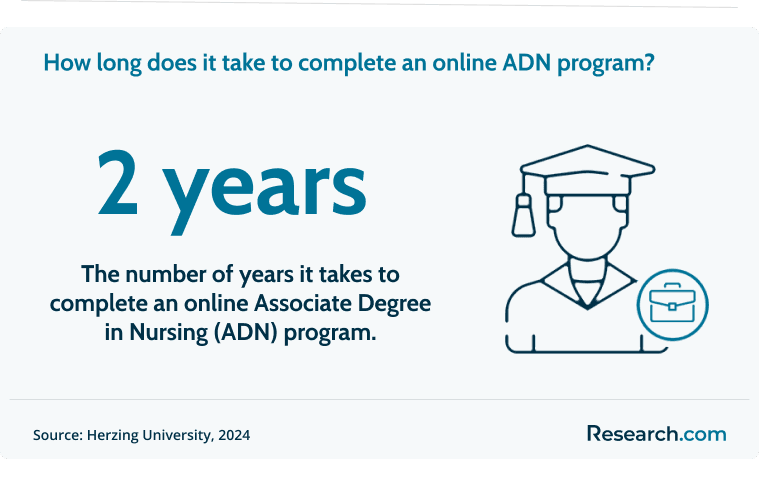
Most online or hybrid ADN programs take around two years for full-time students. The classroom portion may be online, but clinical rotations and skills labs are completed in person. This structure allows students to learn nursing theory remotely while still meeting the hands-on training requirements expected of registered nurses.
Completion time depends on the school’s curriculum, course sequencing, transfer credits, prerequisite requirements, enrollment status, and whether the student enters through a bridge pathway. LPNs, LVNs, or paramedics may qualify for advanced-standing options that reduce the timeline to as little as 12–18 months. First-time nursing students without prior healthcare credentials should usually plan for approximately two years from enrollment to graduation, followed by NCLEX-RN preparation and licensure steps.
| Student situation | Typical timeline | What may affect completion |
| First-time nursing student | Approximately two years | Prerequisite completion, course availability, clinical scheduling, and full-time enrollment |
| LPN, LVN, or paramedic bridge student | As little as 12–18 months | Advanced standing, bridge curriculum, state rules, and required clinical hours |
| Part-time student | Longer than the standard timeline | Workload limits, sequencing of nursing courses, and clinical placement availability |
How does an online ADN program compare to an on-campus program?
Online and campus-based ADN programs can both lead to RN licensure when they are properly accredited and state-approved. The main difference is how students complete didactic coursework and how much structure they need from instructors and classmates. A hybrid online format can be ideal for independent learners, while a traditional campus format may better serve students who want frequent in-person interaction.
| Factor | Online or hybrid ADN | On-campus ADN |
| Course delivery | Many lectures, assignments, and discussions are completed online. | Classes usually meet in person on a set weekly schedule. |
| Flexibility | Often better for working adults, caregivers, and students who need some schedule control. | Better for students who prefer a fixed routine and direct classroom engagement. |
| Clinical training | Still completed in person at approved sites, simulation labs, or healthcare facilities. | Completed in person through campus-arranged clinical partnerships. |
| Support and interaction | Requires strong communication with faculty, advisors, and clinical coordinators. | Provides more face-to-face access to classmates, faculty, labs, and campus services. |
| Cost considerations | May reduce commuting or relocation costs, but clinical travel and technology costs still matter. | May involve commuting, parking, and campus fees, but resources are physically nearby. |
| Future education | Can support progression into bridge options, including ADN to NP programs when the student meets later admissions requirements. | Can support the same RN-to-BSN, RN-to-MSN, and graduate pathways after licensure. |
What is the average cost of an online ADN program?
The price of an online ADN varies by institution, state residency, credit load, fees, supplies, clinical travel, and whether the student attends full time or part time. Published tuition does not always represent the full cost of attendance, so students should ask for an itemized estimate before enrolling.
- Purdue Global University: The estimated total cost for the online ADN program is approximately $36,540.
- University of Charleston: Students in the ADN program can expect total tuition of around $22,800.
- Midway University, full-time: Full-time students pay about $56,512 for the online ADN program.
- Midway University, part-time: Part-time enrollment brings estimated total tuition to approximately $63,360.
These examples show why a program that looks inexpensive per credit may not always be the lowest-cost path overall. Compare total tuition, fees, supplies, required campus visits, clinical travel, exam costs, and any repeated-course charges. The chart below shows the sample average cost of an online ADN degree in the U.S.:
What are the financial aid options for students enrolling in an online ADN program?
Students in accredited online or hybrid ADN programs may qualify for many of the same aid options available to campus students. Eligibility depends on the school, enrollment status, financial need, citizenship or eligible noncitizen status, academic progress, and program approval.
- Federal financial aid: Start with the Free Application for Federal Student Aid (FAFSA). Depending on eligibility, students may receive grants such as the Pell Grant, federal student loans, or work-study opportunities.
- State grants and scholarships: Some states fund nursing students who attend approved programs, especially residents preparing for high-need healthcare roles.
- Institutional scholarships: Colleges may offer awards based on need, academic performance, background, or nursing program admission status.
- Employer tuition assistance: Hospitals, long-term care facilities, and other healthcare employers may provide reimbursement or sponsorship for employees pursuing RN education.
- Private scholarships and loans: Nursing associations, foundations, and nonprofits may fund ADN students. Private loans can fill gaps but should be reviewed carefully because terms are often less favorable than federal loans.
| Cost-saving step | Why it matters |
| Ask for the full cost of attendance | Tuition alone may exclude fees, books, uniforms, supplies, background checks, drug screening, and NCLEX-related expenses. |
| Confirm transfer credit policies | Accepted general education credits can lower both cost and completion time. |
| Compare clinical travel requirements | A lower tuition program may cost more if clinical sites are far from home. |
| Prioritize federal aid first | Federal aid often offers stronger borrower protections than private loans. |
What are the prerequisites for enrolling in an online ADN program?
Admission requirements vary, but most ADN programs screen for academic readiness, clinical eligibility, and the ability to meet healthcare-site requirements. Competitive programs may require more than the minimum listed below.
- High school diploma or GED: Applicants usually need a high school credential or an equivalent such as a General Educational Development (GED) certificate.
- Minimum GPA: Many nursing schools set minimum cumulative GPA standards, often ranging from 2.5 to 3.0.
- Prerequisite coursework: Common prerequisites include anatomy and physiology, microbiology, English composition, and basic math or algebra.
- Health and immunization clearance: Clinical sites commonly require immunization records, a physical exam, background checks, and other safety documentation. Students interested in broader population health roles may also explore what is an MPH degree after building clinical experience.
- Entrance assessment: Some schools require the Test of Essential Academic Skills (TEAS) or a similar exam to evaluate reading, math, science, and English preparation.
If you want to enter healthcare before committing to RN training, medical assisting may be a shorter first step. Later, you can compare bridge options such as affordable online medical assistant to RN programs if you decide to move into registered nursing.
What courses are typically in an online ADN program?
An ADN curriculum combines science foundations, nursing theory, clinical judgment, patient safety, and supervised practice. Course names differ by school, but most programs cover the same major competency areas needed for entry-level RN practice.
- Anatomy and Physiology: Students study body systems and how structure relates to function, which is essential for assessment and care planning.
- Microbiology: This course introduces microorganisms, infection control, disease transmission, and prevention practices used in healthcare settings.
- Nursing Fundamentals: Students learn basic nursing procedures, ethical responsibilities, documentation, safety practices, and patient communication.
- Pharmacology: Coursework focuses on drug categories, medication actions, dosage concepts, side effects, and safe administration.
- Medical-Surgical Nursing: Students learn to care for adult patients with acute and chronic conditions across a wide range of clinical scenarios.
- Maternal and Child Health Nursing: This area covers pregnancy, birth, postpartum care, newborn care, pediatric development, and family-centered nursing.
- Mental Health Nursing: Students build skills in therapeutic communication, crisis response, and care for patients with psychiatric or behavioral health needs.
- Nursing Leadership and Management: Coursework introduces delegation, teamwork, prioritization, quality improvement, and professional accountability.
- Clinical Practicum or Clinical Rotations: Students apply classroom learning in approved healthcare environments under supervision.
Licensed practical nurses who already have clinical experience may be able to move faster through bridge options such as a 2 semester LPN to RN program online. These programs usually build on existing LPN knowledge while adding RN-level coursework in areas such as medical-surgical nursing, pharmacology, leadership, and clinical decision-making.
What types of specializations are available in an online ADN program?
Most ADN programs do not offer formal specializations because their purpose is to prepare students for generalist entry-level RN practice. However, students may gain exposure to specialty areas through clinical rotations, electives, simulation scenarios, or later certifications.
- Pediatric nursing: Students may complete coursework or clinical experiences focused on infants, children, and adolescents.
- Geriatric nursing: Many programs include older adult care through long-term care, rehabilitation, or medical-surgical clinical experiences. Nurses who later pursue advanced practice may consider adult gerontology pathways, including affordable adult gerontology primary care NP graduate certificate programs online after meeting graduate-level requirements.
- Mental health nursing: ADN students typically learn to support patients with psychological, behavioral, and emotional health needs. Students comparing adjacent careers may also review the benefits of being a mental health therapist.
- Maternal and newborn nursing: Programs often include instruction or clinical exposure related to pregnancy, delivery, postpartum care, and newborn health.
- Medical-surgical nursing: This broad area is a central part of ADN training and is a common first employment setting for new RNs.
Students who want deeper specialization usually pursue additional credentials after becoming licensed. An easiest RN to BSN program online option may help working nurses complete bachelor’s-level coursework before moving into graduate study, leadership, public health, or specialty certification.
What advanced educational opportunities should I consider after earning an ADN?
After earning an ADN and becoming licensed, many nurses use work experience to clarify their long-term goals. Common next steps include RN-to-BSN programs, RN-to-MSN pathways, specialty certifications, and eventually doctoral study for advanced practice, leadership, or systems-level roles. Nurses interested in doctoral preparation can compare options such as the shortest DNP program, but they should verify admissions requirements, clinical expectations, accreditation, and whether the program matches their intended specialty.
Can I quickly transition from an ADN to a BSN?
Yes, many ADN graduates move into RN-to-BSN or accelerated BSN pathways after licensure. These programs typically expand on associate-level nursing preparation by adding leadership, community health, research, evidence-based practice, and broader systems knowledge. If speed is a priority, an accelerated 1-year BSN online option may be worth reviewing, but applicants should confirm whether the program is designed for licensed RNs, second-degree students, or another applicant group.
What challenges might I face in an online ADN program?
Online ADN students need strong organization, reliable technology, and the discipline to keep up with nursing coursework without daily campus structure. The hardest part is often coordinating online assignments with fixed clinical schedules, lab days, exams, and personal obligations. Students who need more structured support may benefit from bridge or campus-based formats, including affordable LPN to RN bridge programs when they already hold practical nursing licensure.
| Common challenge | Better strategy |
| Assuming the degree is fully online | Ask exactly where labs and clinical rotations occur before applying. |
| Underestimating weekly time commitment | Build a schedule that includes reading, assignments, skills practice, commute time, and clinical shifts. |
| Waiting to ask for help | Use tutoring, faculty office hours, advising, and technical support early. |
| Choosing based only on tuition | Compare licensure eligibility, accreditation, NCLEX outcomes, clinical support, and total program cost. |
Can an online ADN program lead directly to accelerated advanced nursing degrees?
An ADN can be the first step toward advanced nursing education, but it usually does not lead directly into advanced practice without additional credentials and licensure milestones. Many nurses complete an RN-to-BSN or RN-to-MSN pathway before entering nurse practitioner, clinical nurse specialist, educator, administrator, or doctoral programs. Some schools offer streamlined progression routes, including specialty-focused options such as accelerated masters women's health NP programs, but students should review admissions rules, required RN experience, clinical placement expectations, and state authorization.
What accreditation and quality standards should I look for in an online ADN program?
Accreditation and state approval are among the most important quality checks for any online ADN program. Institutional accreditation evaluates the college or university, while nursing program accreditation reviews the nursing curriculum, faculty, student outcomes, and clinical training. State board approval is also essential because it affects NCLEX-RN eligibility and licensure.
- Institutional accreditation: Confirm that the school is accredited by a recognized institutional accreditor.
- Programmatic nursing accreditation: Look for nursing-specific recognition from agencies such as ACEN or another recognized nursing accreditor when applicable.
- State board approval: Verify that the program is approved in the state where you plan to become licensed.
- NCLEX-RN outcomes: Ask for recent pass rates and compare them with state expectations.
- Clinical placement quality: Confirm who arranges clinical sites, how far students may travel, and what happens if a placement falls through.
- Student support: Review tutoring, advising, simulation resources, remediation, technical support, and career services.
Students looking for accessible admissions options should still prioritize quality and licensure alignment. Lists such as the easiest nursing school guide can help with initial research, but they should not replace accreditation and state board checks.
How do I choose the best online ADN program?
The best online ADN program is the one that you can afford, complete on time, attend clinically, and use for RN licensure in your intended state. A low-cost program is not a good value if it lacks appropriate approval, leaves students to find clinical placements alone, or does not match your schedule.
| Question to ask | Why it matters |
| Is the program approved by my state board of nursing? | State approval can determine whether you are eligible for the NCLEX-RN and licensure. |
| Who secures clinical placements? | Students may face delays if the school does not provide strong placement support. |
| What is the full cost, not just tuition? | Fees, books, supplies, uniforms, exams, background checks, and travel can change affordability. |
| What are recent NCLEX-RN pass rates? | Pass rates can indicate how well the program prepares students for licensure exams. |
| Are online classes live, asynchronous, or both? | The delivery format should fit your work schedule and learning style. |
| Can credits transfer into an RN-to-BSN program? | Transfer-friendly programs can make future education faster and less expensive. |
- Start with accreditation and state approval: Do not apply until you verify both with official sources.
- Check clinical feasibility: Make sure required sites are reachable and compatible with your work and family responsibilities.
- Compare total cost: Include tuition, fees, supplies, travel, technology, testing, and lost work hours.
- Review student outcomes: Ask about NCLEX-RN pass rates, graduation rates, job placement support, and student retention.
- Think beyond the ADN: If you may later study pharmacy or another healthcare field, compare long-term education costs separately, including options such as cheap online PharmD programs only if they match your career goals.
What career paths are available for graduates of online ADN programs?
ADN graduates who pass the NCLEX-RN and obtain licensure can pursue multiple registered nursing roles. Actual responsibilities and pay vary by employer, state regulations, experience, shift, and specialty area.
- Registered Nurse ($93,600/year): RNs assess patients, deliver nursing care, administer medications, document outcomes, educate patients and families, and coordinate with the broader healthcare team.
- Charge Nurse ($85,509/year): Charge nurses supervise nursing staff during a shift, assign patients, help resolve workflow issues, and support policy compliance.
- Home Health Nurse ($75,459/year): Home health nurses provide care in patients’ homes, often supporting recovery, chronic disease management, medication adherence, and care coordination.
- School Nurse ($61,443/year): School nurses manage student health concerns, provide first aid, support chronic condition plans, and communicate with families and healthcare providers.
- Rehabilitation Nurse ($77,736/year): Rehabilitation nurses help patients recover function and independence after illness, injury, surgery, or disability.
These roles can serve as a foundation for further education, specialty certification, or leadership. If your long-term goal is advanced clinical specialization, review the education and CNS certification requirements early so you understand the BSN and graduate-level steps involved.
The chart below shows the average salary for varying job roles you can get with an ADN:
What is the job market for graduates with an online associate degree in nursing?
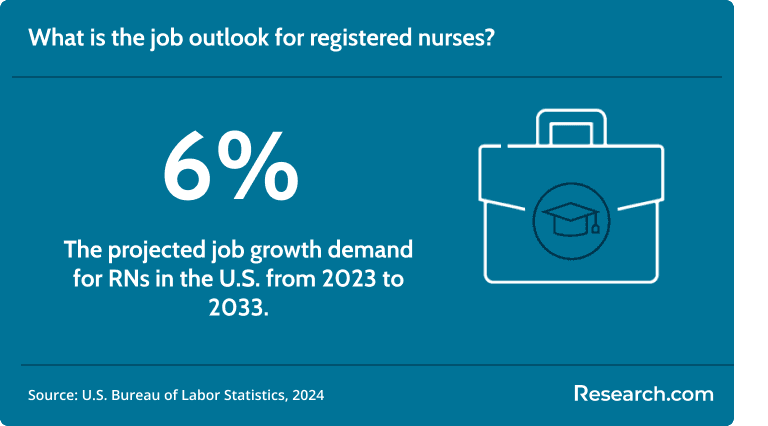
The employment outlook for registered nurses remains favorable. According to the U.S. Bureau of Labor Statistics, employment of registered nurses is projected to grow 6 percent from 2023 to 2033, faster than the average for all occupations. The BLS also reports approximately 194,500 job openings for registered nurses each year over the decade, driven largely by the need to replace workers who retire or move into other occupations.
ADN-prepared nurses can still find opportunities in hospitals, outpatient clinics, long-term care, rehabilitation, and home healthcare, especially in areas with staffing needs. However, some employers prefer or require a BSN for certain units, leadership tracks, magnet-status hospitals, or advancement opportunities. For that reason, many ADN graduates continue into RN-to-BSN pathways, including online RN to BSN programs without clinicals when they need additional flexibility.
Here’s what graduates have to say about their online ADN degrees:
Studying for my ADN online allowed me to keep working full-time while pursuing my dream of becoming a nurse. The flexibility meant I could study around my kids’ schedules, and the support from instructors was just as strong as in-person classes. – Melissa
The online format made it possible for me to learn at my own pace, which was perfect for someone like me returning to school after a long break. The clinical placements were well-organized and gave me the hands-on experience I needed to feel confident. – Jared
I was surprised by how engaging and interactive the online coursework was—I never felt like I was learning alone. Being able to access lectures and resources anytime helped me stay on track and ultimately pass the NCLEX-RN on my first try. – Alicia
Common mistakes to avoid when choosing an online ADN program
- Assuming “online” means no campus or clinical attendance: ADN students must complete hands-on training in person.
- Ignoring state approval: A program may be accredited but still not meet licensure requirements in your state.
- Comparing only tuition: Total cost includes fees, supplies, clinical travel, exams, and sometimes lost income.
- Overlooking clinical placement support: Weak placement coordination can delay graduation and licensure.
- Relying only on rankings: Rankings can help with research, but your final choice should depend on licensure fit, affordability, outcomes, and logistics.
- Assuming salary outcomes are guaranteed: Pay varies by region, employer, shift, experience, and specialty.
Key Insights
- Online ADN programs are usually hybrid, not fully remote; online coursework is paired with required labs and clinical rotations.
- The fastest common timeline is about two years, though LPN, LVN, and paramedic bridge pathways may shorten completion to as little as 12–18 months.
- Affordability should be measured by total cost, not only cost per credit. Clinical travel, fees, supplies, and schedule disruption can affect the real price.
- Accreditation, state board approval, NCLEX-RN outcomes, and clinical placement support are more important than convenience alone.
- Registered nurse employment is projected to grow 6 percent from 2023 to 2033, with approximately 194,500 job openings for registered nurses expected each year over the decade.
- An ADN can launch an RN career, but a BSN or graduate degree may be important for advancement, specialization, leadership, or advanced practice roles.
References:
- Herzing University. (2024). Online ASN Program. Herzing University
- Midway University. (2025). Tuition 2024-2025. Midway University
- Purdue Global. (2025). Associate of Science in Nursing — Iowa and Maine. Purdue Global
- Salary.com. (2025). School Nurse Salary in the United States. Salary.com
- U.S. Bureau of Labor Statistics. (2024). OOH: Registered Nurses. U.S. BLS
- University of Charleston. (2025). 2024-2025 Tuition Rates. Charleston Universit
- ZipRecruiter. (2025). RN Charge Nurse Salary. ZipRecruiter
Other things you should know about online ADN programs
Yes. Online ADN programs must place students in clinical sites approved by the nursing school and acceptable to the state board of nursing. Most programs also require a background check, immunization records, CPR certification, and a drug screen before clinicals begin.
Although the coursework is delivered online, clinical experiences must be completed in person. Online ADN programs typically arrange clinical placements at healthcare facilities near the student’s location. These hands-on experiences allow students to apply classroom knowledge in real-world settings under the supervision of licensed nurses and instructors. Clinical hours are essential to develop practical skills and meet state nursing board requirements for graduation and licensure.
In 2027, an online ADN program should be accredited by the Accreditation Commission for Education in Nursing (ACEN) or the Commission on Collegiate Nursing Education (CCNE). Accreditation ensures the program meets quality standards necessary for licensing and employment.