2027 Fastest Online MSN Women's Health Nurse Practitioner Programs

Co-Founder and Chief Data Scientist
More than 15% of women aged 18 and older in the U.S. report being in fair or poor health, highlighting a growing demand for healthcare professionals who specialize in women’s health. For those seeking a flexible and accelerated path to becoming a women’s health nurse practitioner, fast online MSN programs offer an efficient solution without compromising quality. This article helps prospective students understand what to expect from these programs and how they can quickly advance their careers in women’s health.
What are the benefits of getting a fast online MSN women's health nurse practitioner?
- Graduates can become women’s health nurse practitioners, taking on clinical roles in OB/GYN clinics, reproductive health centers, primary care, and specialty practices.
- Nurse practitioners earned a median annual salary of $129,210 as of May 2024, making this a high-reward career choice.
- Fast-track online programs allow students to balance school with work or family obligations, making it easier to advance professionally without relocating or pausing their careers.
What can I expect from a fast online MSN women's health nurse practitioner?
A fast online MSN women’s health nurse practitioner program is designed for registered nurses who want to deepen their expertise in women’s health and qualify for advanced practice roles in less time than traditional programs. These programs typically take 18 to 24 months to complete and focus on areas such as reproductive health, prenatal and postpartum care, gynecologic oncology, and primary care for women across the lifespan.
Coursework is delivered online with required clinical hours arranged in local healthcare settings. Expect to engage in both synchronous and asynchronous learning, complete rigorous clinical practicums, and prepare for national certification exams such as those offered by the National Certification Corporation.
Where can I work with an MSN women's health nurse practitioner?
Many women’s health nurse practitioners find roles in OB/GYN clinics, family planning centers, reproductive endocrinology practices, and community health organizations. Hospitals and private practices also employ women’s health nurse practitioners for both inpatient and outpatient services, particularly in areas with growing populations and increased demand for preventive and reproductive care.
Outside of traditional clinical settings, women’s health nurse practitioners may also work in public health departments, women’s wellness centers, and telehealth services, especially in rural or underserved communities. Some may serve in academic or policy roles, influencing women’s health education or healthcare access initiatives.
How much can I make with an MSN women's health nurse practitioner?
According to the U.S. Bureau of Labor Statistics (BLS), nurse practitioners earned a median salary of $129,210 as of May 2024. Those in outpatient care centers tend to earn higher wages, while women’s health nurse practitioners in rural clinics may earn slightly less but can receive loan forgiveness or incentive packages tied to healthcare shortages.
In addition to a competitive base salary, many employers offer benefits like continuing education support, flexible scheduling, and healthcare coverage. Women’s health nurse practitioners who gain years of experience or specialize further in areas like reproductive endocrinology or maternal-fetal medicine may earn well above the median salary.
For those who pursue fast-track online MSN programs, the ability to enter the workforce sooner can also mean gaining financial returns more quickly.
- List of the Fastest Online MSN Women's Health Nurse Practitioner Programs for 2027 List of Programs
- How long does it take to complete a fast online MSN women's health nurse practitioner program? Completion Time
- How does a fast online MSN women's health nurse practitioner compare to an on-campus program? Online vs. Traditional
- What is the average cost of a fast online MSN women's health nurse practitioner program? Cost
- What are the financial aid options for students enrolling in a fast online MSN women's health nurse practitioner program? Financial Aid
- What are the prerequisites for enrolling in a fast online MSN women's health nurse practitioner program? Prerequisites
- What courses are typically in a fast online MSN women's health nurse practitioner program? What courses are typically in a fast online MSN women's health nurse practitioner program?
- What types of specializations are available in a fast online MSN women's health nurse practitioner program? What types of specializations are available in a fast online MSN women's health nurse practitioner program?
- How do you choose the best among the fastest online MSN women's health nurse practitioner programs? How do you choose the best among the fastest online MSN women's health nurse practitioner programs?
- What career paths are available for graduates of fast online MSN women's health nurse practitioner programs? Career Paths
- What is the job market like for graduates of a fast online MSN women's health nurse practitioner program? What is the job market like for graduates of a fast online MSN women's health nurse practitioner program?
- Is the program accredited to ensure quality education? Is the program accredited to ensure quality education?
- What are the options for further advancement after completing an online MSN women's health nurse practitioner program? What are the options for further advancement after completing an online MSN women's health nurse practitioner program?
- Are direct entry pathways a viable alternative for career switchers? Are direct entry pathways a viable alternative for career switchers?
- What career placement and networking opportunities support long-term success? What career placement and networking opportunities support long-term success?
Fastest Online MSN Women’s Health Nurse Practitioner Programs for 2027
Choosing an accelerated online MSN women’s health nurse practitioner program is not just about finding the shortest timeline. You also need to know whether the program is accredited, whether clinical placements are realistic in your state, how much the full degree will cost, and whether the women’s health nurse practitioner track matches the kind of patients and settings you want to serve.
This guide is designed for registered nurses comparing fast online MSN WHNP programs and related advanced practice nursing options. You will find a ranked program list, cost and timeline comparisons, admission expectations, course topics, career paths, job outlook data, and practical questions to ask before applying.
Quick Answer: What is the fastest online MSN women’s health nurse practitioner path?
The fastest online MSN women’s health nurse practitioner programs commonly take about 18 to 24 months for full-time BSN-prepared registered nurses, although exact timelines depend on the school, credit load, clinical hour requirements, and entry pathway. Among the programs listed here, published completion times range from 12 to 27 months. The best choice is not automatically the shortest program; it is the fastest accredited option that fits your state authorization, clinical placement needs, budget, schedule, and certification goals.
How Research.com ranked these programs
A graduate nursing degree can affect your finances, work schedule, licensure path, and long-term career options. Research.com reviewed available institutional and federal data to identify fast online MSN women’s health nurse practitioner programs that balance speed, academic credibility, flexibility, and cost.
The ranking considers affordability, program length, academic quality, and online flexibility. More information about the evaluation process is available on our methodology page. Data sources include the IPEDS database, Peterson’s database, including the Distance Learning Licensed Data Set, the College Scorecard database, and the National Center for Education Statistics. Students should confirm current tuition, fees, clinical requirements, state authorization, and admissions policies directly with each school before applying.
| School | Program Length | Required Credits | Cost per Credit | Accreditation |
| Frontier Nursing University | 20 to 24 months | 61 | $646 | ACEN |
| Regis College | 24 months | 46 | $1,341 | CCNE |
| Georgetown University | 23 to 27 months | 44 | $2,358 | CCNE |
| Thomas Jefferson University | 24 months | 36 | $1,200 | CCNE |
| University of Cincinnati | 24 months | 49 | $746 in-state; $761 out-of-state | CCNE |
| Drexel University | 24 months | 57 | $1,069 | CCNE |
| University of South Alabama | 12 to 24 months | 45 to 51 | $594 | CCNE |
| Kent State University | 24 months | 42 | $536 in-state; $546 out-of-state | CCNE |
| Old Dominion University | 20 to 24 months | 51 | $599 in-state; $623 out-of-state | CCNE |
| University of Alabama at Birmingham | 24 months | 45 | $682 | CCNE |
1. Frontier Nursing University
Frontier Nursing University offers an MSN women’s health nurse practitioner track built for registered nurses who need graduate study to fit around work and community responsibilities. The program, launched in 2000, combines online didactic courses with clinical training arranged through local preceptorships.
Frontier’s model is especially relevant for nurses interested in community-based care, rural health, and service to underserved populations. Coursework is delivered asynchronously, with virtual engagement and faculty mentorship. Students also complete a short campus immersion before moving into clinical preparation.
- Program Length: 20 to 24 months
- Track/concentration: Women’s Health Nurse Practitioner
- Cost per Credit: $646
- Required Credits to Graduate: 61
- Accreditation: ACEN (Accreditation Commission for Education in Nursing)
2. Regis College
Regis College provides a fully online MSN women’s health nurse practitioner pathway for RNs who already hold a BSN and want a structured but flexible graduate program. Online tracks began in the mid-2010s, and the curriculum emphasizes evidence-based decision-making, reproductive care, women’s health promotion, and advanced pathophysiology.
Regis may appeal to students who value smaller class environments, accessible academic support, and help identifying local preceptors. As with any online NP program, applicants should verify whether clinical placement support is available in their state before enrolling.
- Program Length: 24 months
- Track/concentration: Women’s Health Nurse Practitioner
- Cost per Credit: $1,341
- Required Credits to Graduate: 46
- Accreditation: CCNE (Commission on Collegiate Nursing Education)
3. Georgetown University
Georgetown offers an online MSN women’s health nurse practitioner program for BSN-prepared nurses who want a rigorous graduate nursing education shaped by a Jesuit academic environment. The online program launched in 2011 and focuses on holistic patient care, cultural competence, leadership, and women’s health across the lifespan.
The format combines weekly live class meetings with self-paced learning. Students are also required to attend two on-campus intensives, which can be valuable for skill development but should be factored into travel planning and total cost. Georgetown provides clinical placement support, an important consideration for students who do not already have a strong preceptor network.
- Program Length: 23 to 27 months
- Track/concentration: Women’s Health Nurse Practitioner
- Cost per Credit: $2,358
- Required Credits to Graduate: 44
- Accreditation: CCNE
4. Thomas Jefferson University
Thomas Jefferson University offers an online MSN women’s health nurse practitioner program designed for working nurses who want advanced clinical preparation without pausing their careers. Available online since 2015, the program uses case-based learning to connect theory with patient scenarios.
Students complete both synchronous and asynchronous learning activities. The program’s connection to Jefferson’s clinical network may be useful for students seeking exposure to varied women’s health settings, though applicants should still confirm how clinical coordination works for their location.
- Program Length: 24 months
- Track/concentration: Women’s Health Nurse Practitioner
- Cost per Credit: $1,200
- Required Credits to Graduate: 36
- Accreditation: CCNE
5. University of Cincinnati
The University of Cincinnati offers an online MSN women’s health nurse practitioner program through a public research university. The program has been available online since 2007 and includes advanced reproductive health, chronic disease management, and women’s wellness coursework.
This option may be attractive to students looking for a public university pathway with rolling admissions and individualized advising. The in-state and out-of-state per-credit rates are close, which can make the program easier to compare against private institutions.
- Program Length: 24 months
- Track/concentration: Women’s Health Nurse Practitioner
- Cost per Credit: $746 (in-state), $761 (out-of-state)
- Required Credits to Graduate: 49
- Accreditation: CCNE
6. Drexel University
Drexel University’s College of Nursing and Health Professions has offered its online MSN women’s health nurse practitioner program since the early 2010s. The curriculum is intended for experienced registered nurses and emphasizes clinical reasoning, health promotion, and care for diverse patient populations.
Drexel’s online learning environment uses interactive simulations, video lectures, and student support resources. Clinical placements are arranged in students' home states, which can be a major advantage for nurses who cannot relocate for graduate school.
- Program Length: 24 months
- Track/concentration: Women’s Health Nurse Practitioner
- Cost per Credit: $1,069
- Required Credits to Graduate: 57
- Accreditation: CCNE
7. University of South Alabama
The University of South Alabama offers a flexible online MSN women’s health nurse practitioner track with entry options for BSN and non-BSN students. Its online nursing programs have been available for over a decade and are structured with working professionals in mind.
The program allows students to complete clinical rotations locally and includes optional on-campus intensives. Because the published timeline depends on entry path, applicants should ask admissions advisors for a personalized degree plan before comparing the program against fixed 24-month options.
- Program Length: 12 to 24 months (depending on entry path)
- Track/concentration: Women’s Health Nurse Practitioner
- Cost per Credit: $594
- Required Credits to Graduate: 45 to 51
- Accreditation: CCNE
8. Kent State University
Kent State University offers an online MSN with a women’s health nurse practitioner concentration through its College of Nursing, which has delivered distance education since 2005. The program is intended for registered nurses who want focused preparation in female health and wellness.
Kent State may be a strong fit for students who want faculty support, clinical placement guidance, and a comparatively lower listed per-credit cost, particularly for in-state students. As with all NP programs, students should confirm clinical site availability and state authorization before committing.
- Program Length: 24 months
- Track/concentration: Women’s Health Nurse Practitioner
- Cost per Credit: $536 (in-state), $546 (out-of-state)
- Required Credits to Graduate: 42
- Accreditation: CCNE
9. Old Dominion University
Old Dominion University offers an MSN women’s health nurse practitioner program in a flexible hybrid format. The online option launched in 2009 and blends asynchronous coursework with occasional synchronous sessions.
The program emphasizes clinical training and leadership in women’s healthcare. Students may pursue in-state or out-of-state clinical placements depending on location and availability, so applicants should clarify expectations for preceptors, campus attendance, and state approval early in the process.
- Program Length: 20 to 24 months
- Track/concentration: Women’s Health Nurse Practitioner
- Cost per Credit: $599 (in-state), $623 (out-of-state)
- Required Credits to Graduate: 51
- Accreditation: CCNE
10. University of Alabama at Birmingham
The University of Alabama at Birmingham offers an online MSN women’s health nurse practitioner program supported by a large academic health center. The program is practice-focused and includes clinical preparation with minimal campus visits.
The curriculum covers prenatal, intrapartum, postpartum, and long-term care for women. UAB may be a good option for students seeking a recognized nursing program with a listed per-credit cost lower than many private universities in this ranking.
- Program Length: 24 months
- Track/concentration: Women’s Health Nurse Practitioner
- Cost per Credit: $682
- Required Credits to Graduate: 45
- Accreditation: CCNE
How long does it take to complete a fast online MSN women’s health nurse practitioner program?
Fast online MSN women’s health nurse practitioner programs are generally built for licensed RNs who want to move into advanced practice without spending several years in a traditional campus-based format. Many full-time students can finish in 18 to 24 months, but completion time depends on credit requirements, course sequencing, clinical hour scheduling, and whether the student enters with a BSN or through another pathway.
Students earlier in the nursing pipeline should expect a longer route. A certified nursing assistant, for example, would first need to complete RN preparation and then qualify for graduate-level admission. If you are still mapping out the first stage of nursing education, Research.com’s guide to online nursing programs CNA to RN explains bridge options that can lead toward later MSN study.
| Student Situation | Likely Path | What to Check Before Applying |
| BSN-prepared RN | Direct entry into an MSN WHNP track | Program length, clinical placement rules, state authorization, certification eligibility |
| RN without a BSN | Bridge or alternative MSN entry pathway where available | Whether additional undergraduate nursing courses are required |
| CNA or non-RN healthcare worker | RN preparation first, then BSN or graduate nursing pathway | Licensure steps, transfer credits, and long-term timeline |
| Advanced practice nurse changing focus | Post-graduate certificate or specialty pathway may be more efficient | Prior graduate credits, certification requirements, and clinical hour expectations |
Fast online MSN WHNP vs. on-campus programs: Which format is better?
Online and campus-based MSN women’s health nurse practitioner programs prepare students for advanced practice roles, but the learning experience can be very different. The right format depends on your work schedule, learning style, ability to travel, and access to clinical sites.
| Factor | Fast Online MSN WHNP | On-Campus MSN WHNP |
| Course delivery | Usually uses asynchronous modules, live sessions, or a combination of both | Requires in-person class attendance on a regular schedule |
| Clinical training | Typically completed near the student’s community, if approved by the program | Often coordinated through university-affiliated local sites |
| Flexibility | Better for working nurses, parents, and students who cannot relocate | Better for students who want direct campus access and face-to-face interaction |
| Campus requirements | May include intensives, skills visits, or limited residencies | Requires ongoing campus participation |
| Best fit | Self-directed students with strong time-management skills | Students who prefer structured in-person learning and local clinical networks |
Online study can make an accelerated timeline more manageable, but it does not remove clinical obligations. Students still need approved preceptors, clinical sites, and state authorization. Nurses considering other accelerated advanced practice routes may also compare women’s health programs with the shortest online PMHNP certificate programs if they are interested in mental health care.
What is the average cost of a fast online MSN women’s health nurse practitioner program?
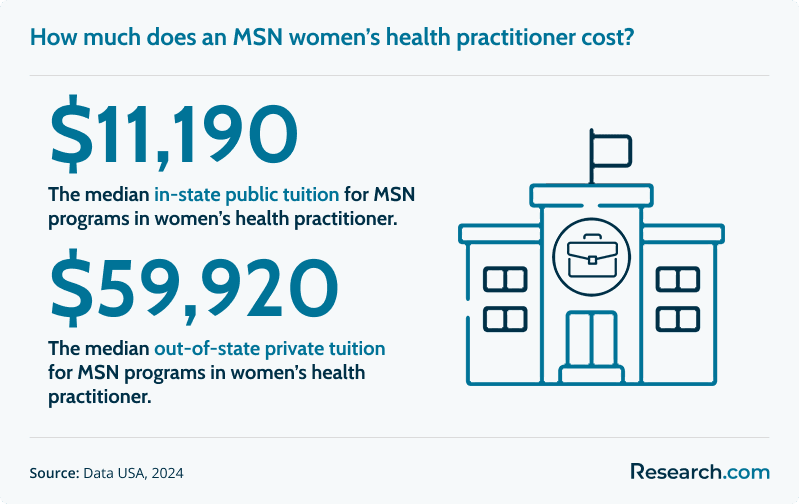
Costs vary widely because schools charge different per-credit rates and require different numbers of credits. According to Data USA, median in-state tuition at public institutions is around $11,190, while median tuition for private, out-of-state schools reaches approximately $59,920. Those figures show why students should calculate the full program price rather than comparing only one tuition number.
Private universities may offer extensive advising, clinical placement support, alumni networks, or smaller learning communities, but they often cost more. Public universities can be more affordable, especially for in-state residents, although students should still account for fees, books, technology costs, campus visits, background checks, immunizations, and travel for intensives if required.
If affordability is the deciding factor, compare several nursing pathways before enrolling. Some post-graduate certificate options, such as cheap post master's certificate pediatric NP online programs, can help advanced practice nurses add another specialty without completing a second full MSN.
| Cost Factor | Why It Matters | Question to Ask the School |
| Cost per credit | A low per-credit rate may still lead to a high total price if the program requires many credits | What is the total tuition for the full MSN WHNP curriculum? |
| Required credits | Credit requirements differ across programs in this ranking | Can prior graduate coursework reduce the credit load? |
| Residency status | Some public universities charge different in-state and out-of-state rates | Does the online program use separate tuition for distance learners? |
| Clinical expenses | Students may pay for compliance tracking, travel, health records, and site requirements | Are clinical costs included in tuition or billed separately? |
| Campus visits | Required intensives can add travel and lodging costs | How many campus visits are required, and when do they occur? |
What financial aid options are available for fast online MSN WHNP students?
Students in accredited graduate nursing programs may qualify for several forms of financial support. Aid availability depends on enrollment status, school participation, citizenship or residency eligibility, employer benefits, and scholarship criteria.
- FAFSA: The Free Application for Federal Student Aid is the starting point for federal loans, grants where applicable, and work-study eligibility.
- Nursing scholarships: Professional associations, healthcare employers, foundations, and community organizations may fund graduate nursing students, especially those serving high-need populations.
- Employer tuition reimbursement: Hospitals and healthcare systems sometimes help nurses pay for graduate study when the degree supports workforce needs.
- Loan forgiveness programs: Nurses working in public service or underserved settings may qualify for certain loan forgiveness options if they meet all program rules.
- Graduate assistantships or stipends: Some universities provide paid teaching, research, or administrative roles for eligible full-time graduate students.
Apply for aid early. Also ask each school whether scholarships require full-time enrollment, whether online students are eligible, and whether employer reimbursement is paid before or after each term.
What are the admission prerequisites for a fast online MSN women’s health nurse practitioner program?
Requirements vary by institution, but most accelerated online MSN WHNP programs are designed for licensed registered nurses who already have strong academic preparation and clinical experience. Competitive applicants should be ready to show that they can handle graduate coursework and advanced clinical responsibilities.
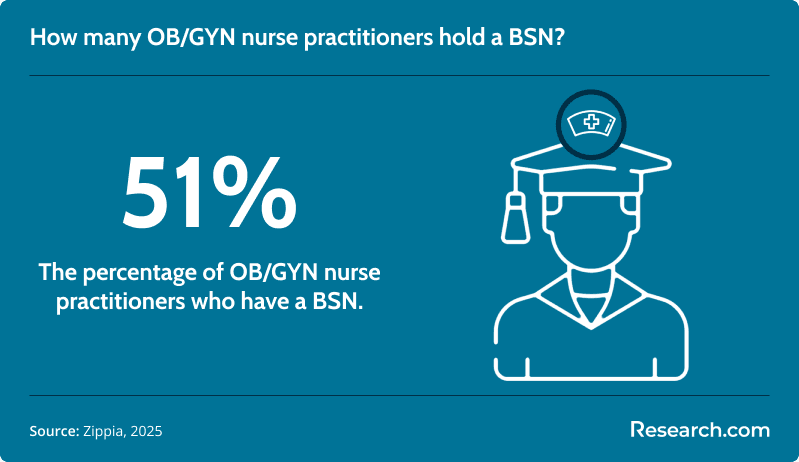
- BSN or approved entry pathway: A BSN is the most common admission route. According to Zippia, 51% of obstetrics-gynecology nurse practitioners hold a bachelor’s degree, while 27% have a master’s, and 14% hold an associate degree.
- Active RN license: Programs typically require an unencumbered RN license in the state where the student will complete clinical training.
- Minimum GPA: Many programs expect a 3.0 or higher on a 4.0 scale.
- Professional nursing experience: Some schools prefer or require at least one year of RN experience, especially in women’s health, maternal-child health, community health, or a related setting.
- Application materials: Letters of recommendation, a personal statement, transcripts, and a resume are commonly required to evaluate academic readiness and professional goals.
Before applying, make sure women’s health is the right population focus. Nurses comparing primary care specializations can review the difference between FNP and AGNP to understand how family, adult-gerontology, and women’s health practice areas differ.
What courses are included in an online MSN women’s health nurse practitioner program?
Fast online MSN WHNP programs typically combine advanced nursing core courses, women’s health specialty content, and supervised clinical practicum experiences. The goal is to prepare nurses to assess, diagnose, manage, and educate patients across reproductive, gynecologic, prenatal, postpartum, and lifespan health needs.
Some programs also emphasize care coordination skills, which are useful when managing complex cases involving OB/GYN providers, primary care clinicians, behavioral health professionals, and community services. Nurses interested in that skill set can compare WHNP coursework with fastest online MSN in care coordination programs.
Common MSN core courses
- Advanced Pathophysiology
- Advanced Health Assessment
- Pharmacology for Advanced Practice Nurses
Women’s health specialization courses
- Reproductive and Prenatal Care
- Gynecologic Health Management
- Menopause and Aging Care
- Advanced Maternal-Fetal Health
Clinical practice experiences
- Supervised clinical rotations in OB/GYN practices, community health settings, outpatient clinics, and related women’s health environments
Students should also understand how WHNP preparation fits within broader advanced practice nursing. Research.com’s guide to what is an APRN vs NP explains the relationship between advanced practice registered nurse roles and nurse practitioner credentials.
What specializations can complement a women’s health nurse practitioner MSN?
A women’s health nurse practitioner program is already a specialized MSN pathway, but students and graduates may develop additional expertise through electives, clinical site selection, certificates, continuing education, or later doctoral study. The best add-on focus depends on the patient population and work setting you want.
For nurses who want broader adult primary care preparation, a fast track MSN adult-gerontology primary care nurse practitioner online program may be worth comparing, especially if long-term career goals include adult and senior primary care.
| Focus Area | What It Emphasizes | Best For |
| Reproductive and Fertility Health | Preconception counseling, fertility care coordination, early pregnancy management | Nurses interested in reproductive medicine or fertility clinics |
| Menopause and Aging Care | Hormonal health, chronic disease management, wellness across later adulthood | Nurses who want to support aging female populations |
| High-Risk Obstetrics | Care coordination for pregnancy complications in collaboration with OB/GYN teams | Nurses drawn to maternal health and complex pregnancy care |
| Adolescent and Young Adult Health | Preventive care, sexual health education, menstrual concerns, early reproductive health | Nurses interested in education, prevention, and youth-focused care |
According to BLS data shown in the chart below, nurse practitioners are most commonly employed in the following settings:
- Offices of Physicians
- General Medical and Surgical Hospitals
- Outpatient Care Centers
- Offices of Other Health Practitioners
- Home Health Care Services
Graduates who want leadership, policy, executive, education, or advanced clinical roles may eventually pursue doctoral education. Research.com’s guide to what can you do with a DNP in nursing outlines possible pathways after advanced graduate nursing study.
How to choose the best fast online MSN women’s health nurse practitioner program
The best program is the one that gets you to eligible, competent practice without creating avoidable problems around accreditation, clinical placement, state authorization, cost, or schedule. A short timeline is valuable only if the program also supports your certification and career goals.
Key factors to compare
- Accreditation: Confirm that the nursing program is accredited by CCNE or ACEN. Accreditation can affect certification eligibility, licensure preparation, transferability, employer acceptance, and future academic options.
- State authorization: Online nursing programs may not be authorized to enroll students or support clinicals in every state. Ask specifically whether your state is approved.
- Clinical placement support: Some programs help secure preceptors; others expect students to find sites independently. This is one of the most important differences among online NP programs.
- Total cost: Compare cost per credit, required credits, fees, travel, clinical expenses, books, and lost income if you reduce work hours.
- Course format: Asynchronous courses offer flexibility, while synchronous sessions provide structure and real-time interaction. Many programs use both.
- Campus intensives: Required visits can strengthen hands-on preparation, but they also add time, travel, and cost.
- Certification preparation: Ask how the curriculum aligns with national certification expectations and whether the program publishes exam preparedness information.
Questions to ask before enrolling
- Is the program authorized to enroll students in my state?
- Will the school help me find clinical sites and preceptors, or am I responsible for that process?
- How many campus visits, live sessions, and clinical hours are required?
- What is the total estimated cost, including fees and travel?
- Do online students receive the same advising, library access, tutoring, and career services as campus students?
- What happens if I cannot secure a clinical placement on schedule?
- Does the program meet requirements for the certification or licensure pathway I plan to pursue?
Common mistakes to avoid
| Mistake | Why It Can Hurt You | Better Approach |
| Choosing only the shortest program | A fast timeline may not help if clinical placements delay graduation | Compare speed and clinical support together |
| Looking only at cost per credit | Total cost also depends on credits, fees, travel, and required visits | Ask for a full program cost estimate |
| Assuming all online programs work in every state | State authorization and clinical approval vary | Get written confirmation before applying |
| Ignoring accreditation | Accreditation can affect certification, employment, and further education | Verify CCNE or ACEN status independently |
| Waiting too long to plan clinicals | Preceptor shortages can delay progression | Start discussing clinical options before admission |
What careers can graduates pursue after a fast online MSN WHNP program?
Graduates of fast online MSN women’s health nurse practitioner programs commonly move into advanced practice roles focused on gynecologic, reproductive, prenatal, postpartum, preventive, and lifespan care. Typical employers include OB/GYN practices, outpatient clinics, women’s health centers, hospitals, community health organizations, and specialty care practices.
Some graduates also move into education, consulting, health policy, program development, or other specialized nursing roles. Nurses interested in blending clinical expertise with legal or investigative work may compare this pathway with an accelerated MSN in forensic nursing online.
According to BLS data, nurse practitioners earn the highest median annual wages in the following industries:
- Residential Intellectual and Developmental Disability, Mental Health, and Substance Abuse Facilities: $160,330
- Scientific Research and Development Services: $143,430
- Grantmaking and Giving Services: $141,400
- Psychiatric and Substance Abuse Hospitals: $140,400
- Management, Scientific, and Technical Consulting Services: $135,750
These industry wage figures apply to nurse practitioners broadly and do not guarantee earnings for every women’s health nurse practitioner graduate. Salary depends on location, employer type, experience, scope of practice, demand, and specialty responsibilities.
What is the job market like for women’s health nurse practitioners?
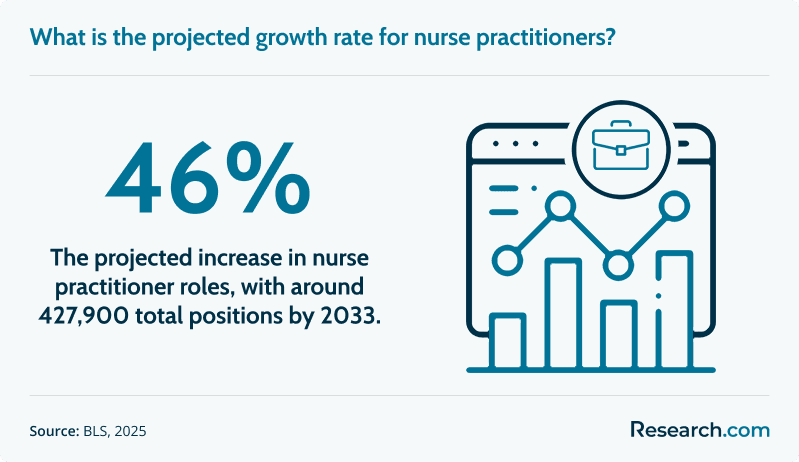
The employment outlook for nurse practitioners is strong. According to BLS, employment of nurse practitioners is projected to grow 46% from 2023 to 2033, much faster than the national average for all occupations. By 2033, the number of nurse practitioners is expected to reach 427,900.
Women’s health nurse practitioners may benefit from demand for preventive care, reproductive health services, chronic condition management, and advanced practice providers in outpatient and community settings. However, job opportunities still vary by state scope-of-practice laws, employer needs, local patient populations, and competition for clinical roles.
Technology is also changing advanced nursing practice. Electronic health records, telehealth workflows, remote patient monitoring, and data-informed care coordination are increasingly part of day-to-day clinical work. Nurses interested in technology-heavy roles can compare WHNP programs with the shortest MSN health informatics online options.
Why accreditation matters for online MSN women’s health nurse practitioner programs
Accreditation is one of the first items to verify before applying. A program accredited by the Commission on Collegiate Nursing Education (CCNE) or the Accreditation Commission for Education in Nursing (ACEN) has undergone external review of academic and clinical quality. Accreditation can affect certification exam eligibility, licensure preparation, transfer credit decisions, employer recognition, and doctoral study options.
Do not rely only on marketing language. Check the accreditor’s site, ask the school for its current accreditation status, and confirm whether the program meets clinical practicum and advanced practice requirements in the state where you plan to work. If you are still earlier in your nursing education path, Research.com also reviews inexpensive RN to BSN online programs that can help working nurses move toward graduate eligibility.
What advancement options are available after an online MSN WHNP program?
After completing an MSN women’s health nurse practitioner program, nurses may continue developing their careers through doctoral education, post-graduate certificates, leadership training, specialty continuing education, and professional certification pathways. A Doctor of Nursing Practice can support advanced clinical leadership, quality improvement, healthcare administration, and systems-level practice, while a Ph.D. in Nursing is typically more research-focused.
Students who already know they want doctoral-level preparation may compare MSN-to-DNP or post-master’s DNP pathways, including the fastest DNP online program options. The right route depends on whether your goal is clinical leadership, research, policy, teaching, executive management, or specialty practice expansion.
Are direct entry pathways a good alternative for career changers?
Direct entry nursing pathways can be useful for students who hold a non-nursing bachelor’s degree and want to transition into nursing. These programs are different from accelerated MSN WHNP programs for already licensed RNs. A direct entry route usually includes foundational nursing preparation before advanced clinical study, which means applicants must carefully evaluate licensure sequencing, clinical requirements, and whether the program leads to the role they actually want.
Career changers should compare program structure, RN licensure preparation, clinical placement support, specialty availability, cost, and timeline. If you are evaluating comparable alternatives, Research.com’s guide to direct entry psychiatric nurse practitioner programs can help you understand how direct entry NP pathways may differ from traditional RN-to-MSN routes.
What career placement and networking support should online MSN WHNP students expect?
Career support matters because an online program still needs to connect students with real clinical and professional opportunities. Useful services may include career advising, resume support, interview preparation, alumni networking, employer partnerships, mentorship, virtual career events, and guidance on certification or licensure steps.
Clinical networking is especially important in nurse practitioner education. A strong preceptor relationship can influence your confidence, references, and first job search. Students planning to continue beyond the MSN can also compare doctoral pathways, including easiest DNP programs to get into, while remembering that admission accessibility should be weighed alongside accreditation, outcomes, and fit.
Should you choose a fast online MSN women’s health nurse practitioner program?
A fast online MSN WHNP program may be worth it if you are a licensed RN, want to specialize in women’s health, can manage an intensive graduate schedule, and have a realistic plan for clinical placements. It is especially practical for working nurses who need online coursework but still want advanced practice preparation.
This path may not be the best fit if you are unsure about women’s health as a specialty, cannot commit to clinical hour requirements, need a slower part-time pace, or live in a state where your preferred program cannot support enrollment or clinical training. In those cases, compare family nurse practitioner, adult-gerontology, psychiatric-mental health, nursing informatics, nursing education, or DNP pathways before deciding.
Key Insights
- The fastest listed online MSN women’s health nurse practitioner timelines range from 12 to 27 months, but the practical timeline depends on clinical placement, course sequencing, and entry pathway.
- Accreditation by CCNE or ACEN should be treated as non-negotiable because it can affect certification, licensure preparation, employment, and further education.
- Clinical placement support is one of the most important differences among online NP programs. Ask whether the school finds placements, helps identify them, or leaves the process mostly to students.
- Cost comparisons should include required credits, fees, travel, campus intensives, books, clinical compliance expenses, and possible changes to work hours—not just cost per credit.
- BLS projects nurse practitioner employment to grow 46% from 2023 to 2033, with the number of nurse practitioners expected to reach 427,900 by 2033, but local WHNP opportunities depend on employer demand and state practice rules.
- The best program is not simply the cheapest or shortest. It is the accredited option that fits your state, schedule, budget, clinical access, and long-term women’s health career goals.
References:
- BLS. (2025, August 28). Nurse anesthetists, nurse midwives, and nurse practitioners. bls.gov.
- BLS. (2025). Occupational Employment and wage Statistics Profiles. data.bls.gov.
- Data USA. (2024). Women’s Health Nurse. datausa.io.
- FastStats. (n.d.). Womens Health. cdc.gov.
- Zippia. (2025, January 8). Best Colleges and Degrees for Obstetrics-Gynecology Nurse Practitioners. zippia.com.
Other Things You Should Know About the Fastest Online MSN Women's Health Nurse Practitioner Programs
Most programs require at least 500 supervised clinical hours in women’s health, and some exceed 600 hours. To qualify for national certification, the curriculum must prepare graduates for the NCC WHNP-BC exam through the National Certification Corporation, which verifies clinical and didactic competence.
In 2027, online MSN Women's Health Nurse Practitioner programs typically offer clinical placement options tailored to students’ geographic locations, facilitating hands-on practice in nearby healthcare facilities. These programs often have dedicated coordinators who assist students in securing approved placements that meet academic requirements.
In 2027, online MSN Women's Health Nurse Practitioner programs should be accredited by the Commission on Collegiate Nursing Education (CCNE) or the Accreditation Commission for Education in Nursing (ACEN) to ensure the program meets national standards for advanced nursing education and practice.