2027 Best One-Year Online PMHNP Programs

Co-Founder and Chief Data Scientist
The U.S. is facing a critical shortage of mental health providers, with over 38,000 job openings for psychiatric nurse practitioners and only about 10,000 practitioners available. For an aspiring registered nurse, this gap represents a significant career opportunity. A one-year online PMHNP program offers a strategic, high-intensity path to meet this demand, but it's a decision that requires a clear-eyed plan.
Our career planning experts created this guide with over 10 years of experience helping professionals make these exact high-stakes decisions. We've laid out the clear, actionable advice you need to move forward with confidence.
What are the benefits of getting a one-year online PMHNP program?
- This path prepares you to enter high-demand roles in settings like outpatient clinics and telepsychiatry, allowing you to address the nation's critical mental health needs a full year or two sooner.
- Graduates can expect to earn an average salary of around $139,500, providing a powerful and immediate return on your educational investment.
- The flexibility of a one-year online PMHNP program allows you to manage the intense, accelerated coursework from your own community without the need to relocate.
What can I expect from a one-year online PMHNP program?
You should expect an intense and immersive academic experience that demands a full-time commitment. These accelerated programs are designed to compress what is typically a two or three-year curriculum into approximately 12 months.
This means you’ll be managing graduate-level coursework and between 500 and 600 clinical hours in a highly condensed timeframe. It’s a common misconception that you can maintain a significant part-time job while enrolled. The reality is that success requires treating the program as your primary focus, as it is a total immersion experience designed for rapid completion.
Where can I work with a one-year online PMHNP program?
With this credential, you are qualified for the same roles and work settings as a graduate from a traditional two- or three-year program. Employers value your state license and board certification, not the length of your program. In fact, about 59% of psychiatric nurse practitioners work in healthcare settings.
Here are some of the most common environments where you can build your career:
- Outpatient Clinics: Providing ongoing therapy and medication management in private practices or community mental health centers.
- Inpatient Hospital Settings: Managing acute psychiatric conditions on psychiatric units or providing consultation-liaison services in general hospitals.
- Telepsychiatry Platforms: Delivering high-demand remote mental healthcare to patients in various locations, offering significant flexibility.
- Government Facilities: Serving unique populations in roles within VA hospitals, public health clinics, or correctional facilities.
- Integrated Care Settings: Working alongside primary care providers to offer holistic, accessible mental healthcare.
How much can I make with a one-year online PMHNP program?
As a board-certified PMHNP, you can expect to earn an average salary of around $139,500 per year. This powerful earning potential is a key reason the accelerated path offers such a strong return on investment.
However, your specific salary can vary based on several factors:
- Geographic Location: Salaries are often highest in states with high demand, such as Idaho, where PMHNPs can earn around $205,000 annually.
- Work Setting: Compensation differs by environment, with roles in residential facilities earning an average of $164,000.
- Years of Experience: While earnings generally increase over time, data shows practitioners with 10-19 years of experience earn around $120,000.
- Scope of Practice: Working in a state with full practice authority can create more opportunities for independent practice and higher earnings.
- Advanced Credentials: Earning a Doctor of Nursing Practice (DNP) can lead to salaries in the $140,000 to $150,000 range.
- List of the Best One-Year Online PMHNP Programs for 2027 List of Programs
- How long does it take to complete a one-year online PMHNP program? Completion Time
- How does an online PMHNP program compare to an on-campus program? How does an online PMHNP program compare to an on-campus program?
- What is the average cost of a one-year online PMHNP program? Program Cost
- What are the financial aid options for students enrolling in a one-year online PMHNP program? Financial Aid
- What are the prerequisites for enrolling in a one-year online PMHNP program? What are the prerequisites for enrolling in a one-year online PMHNP program?
- What courses are typically in a one-year online PMHNP program? What courses are typically in a one-year online PMHNP program?
- What types of specializations are available in a one-year online PMHNP program? Specializations
- How to Choose the Best One-Year Online PMHNP Program How to Choose the Best One-Year Online PMHNP Program
- What career paths are available for graduates of a one-year online PMHNP program? Career Paths
- What is the job market for graduates of a one-year online PMHNP program? Job Market
Best One-Year Online PMHNP Programs for 2027: What to Compare Before Applying
Choosing an accelerated online psychiatric-mental health nurse practitioner program is not just a question of speed. You also need to know whether the program is accredited, whether it supports clinical placement, whether the schedule is realistic, and whether the total cost makes sense for your career goals. This guide is for registered nurses, nurse practitioners, and graduate-prepared nurses comparing short online PMHNP pathways, including post-master’s certificates, MSN tracks, and DNP options.
You will find a ranked program list, a clear explanation of how long these programs take, cost and financial aid considerations, admissions requirements, coursework, career options, and practical questions to ask before enrolling. The goal is to help you avoid expensive mistakes and choose a program that prepares you for board certification and psychiatric-mental health practice.
Quick answer: What is a one-year online PMHNP program?
A one-year online PMHNP program is usually an accelerated psychiatric-mental health nurse practitioner pathway designed for nurses who already have substantial nursing education and clinical experience. Many true one-year options are post-master’s certificates, while MSN and DNP routes often take longer. Coursework may be online, but clinical hours must be completed in person at approved sites.
The fastest programs can be appealing, but speed should never be the only factor. Before applying, confirm accreditation, state authorization, clinical placement expectations, eligibility for PMHNP board certification, and whether your work and family schedule can handle an intensive year-round format.
How Research.com ranks schools
Because a graduate nursing program can be a major financial and professional commitment, Research.com uses a data-informed approach to help readers compare programs with more confidence. Ranking inputs draw from established education data sources, including the IPEDS database, Peterson's database, the College Scorecard database, and The National Center for Education Statistics.
These sources help evaluate program quality, institutional context, affordability, and student outcomes where available. To understand how Research.com builds rankings and evaluates education data, review the Research.com methodology page.
One-year online PMHNP programs at a glance
| School | Program | Program Length | Credits | Total Tuition | Accreditation |
| Johns Hopkins University | Post Master’s Psychiatric Mental Health Nurse Practitioner Program | As few as three semesters | 17 | $33,915 | Commission on Collegiate Nursing Education (CCNE) |
| California State University Fresno | Post-Master’s of Advanced Study for Psychiatric Mental Health Nurse Practitioner | 1 year | 18 | $10,800 | Commission on Collegiate Nursing Education (CCNE) |
| Baylor University | Psychiatric Mental Health Nurse Practitioner (DNP-PMHNP) Track | ~3 years and 4 months | 77 | $93,750 | Commission on Collegiate Nursing Education (CCNE) |
| Hawai‘i Pacific University | Psychiatric Mental Health Nurse Practitioner Program | ~1 year | 27 | $28,755 | Commission on Collegiate Nursing Education (CCNE) |
| University of Cincinnati | Post Master’s Psychiatric Mental Health Nurse Practitioner Program | ~1.5 years | 19 | $16,948 (in-state); $17,252 (out-of-state) | Commission on Collegiate Nursing Education (CCNE) |
| Simmons University | Master of Science in Nursing Psychiatric Mental Health Nurse Practitioner Program | ~2 years | 49 | $62,475 | Commission on Collegiate Nursing Education (CCNE) |
| West Coast University | Master of Science in Nursing Psychiatric Mental Health Nurse Practitioner Program | ~1.5 years | 53 | $49,710 | Commission on Collegiate Nursing Education (CCNE) |
| St. Thomas University | Psychiatric-Mental Health Nurse Practitioner (MSN – PMHNP) Online | ~1.5 years | 50 | $33,100 | Commission on Collegiate Nursing Education (CCNE) |
1. Johns Hopkins University – Post Master’s Psychiatric Mental Health Nurse Practitioner Program
Johns Hopkins University offers a post-degree certificate for nurse practitioners who want to add psychiatric-mental health expertise to their existing advanced practice background. The program uses a gap analysis to tailor the plan of study and includes advanced content in areas such as neurobiology and clinical psychopharmacology for inpatient and outpatient psychiatric care.
- Program Length: As few as three semesters
- Required Credits to Graduate: 17
- Total Tuition: $33,915
- Accreditation: Commission on Collegiate Nursing Education (CCNE)
2. California State University Fresno – Post-Master’s of Advanced Study for Psychiatric Mental Health Nurse Practitioner
California State University Fresno is built for primary care nurse practitioners who want to broaden their practice into psychiatric and behavioral healthcare. Its coursework is aligned with AACN Essentials core competencies and is designed to prepare graduates to provide psychiatric services for varied patient populations.
- Program Length: 1 year
- Required Credits to Graduate: 18
- Total Tuition: $10,800
- Accreditation: Commission on Collegiate Nursing Education (CCNE)
3. Baylor University – Psychiatric Mental Health Nurse Practitioner (DNP-PMHNP) Track
Baylor University offers a BSN-to-DNP pathway for nurses pursuing doctoral-level advanced practice preparation. The online curriculum emphasizes evidence-based psychiatric care, includes required on-campus immersions, and uses a clinical placement team to support completion of all 1,125 required practicum hours.
- Program Length: ~3 years and 4 months
- Required Credits to Graduate: 77
- Total Tuition: $93,750
- Accreditation: Commission on Collegiate Nursing Education (CCNE)
4. Hawai‘i Pacific University – Psychiatric Mental Health Nurse Practitioner Program
Hawai‘i Pacific University provides a post-master's certificate that may be completed in as few as 14 months. The program combines online coursework, more than 600 clinical hours, and placement assistance with an emphasis on holistic psychiatric-mental health care.
- Program Length: ~1 year
- Required Credits to Graduate: 27
- Total Tuition: $28,755
- Accreditation: Commission on Collegiate Nursing Education (CCNE)
5. University of Cincinnati – Post Master’s Psychiatric Mental Health Nurse Practitioner Program
The University of Cincinnati offers a post-master's certificate structured for working nurses and designed for part-time completion over four semesters. The curriculum prepares students to address psychiatric needs across the lifespan and includes a required two-day virtual intensive for cohort connection and applied learning.
- Program Length: ~1.5 years
- Required Credits to Graduate: 19
- Total Tuition: $16,948 (in-state); $17,252 (out-of-state)
- Accreditation: Commission on Collegiate Nursing Education (CCNE)
6. Simmons University – Master of Science in Nursing Psychiatric Mental Health Nurse Practitioner Program
Simmons University delivers an MSN-PMHNP program with full-time and part-time options for registered nurses. The program emphasizes evidence-based practice, clinical preparation, and provider self-care while requiring 756 clinical hours.
- Program Length: ~2 years
- Required Credits to Graduate: 49
- Total Tuition: $62,475
- Accreditation: Commission on Collegiate Nursing Education (CCNE)
7. West Coast University – Master of Science in Nursing Psychiatric Mental Health Nurse Practitioner Program
West Coast University offers an accelerated MSN pathway that can be completed in as few as 20 months. Students complete online coursework and two required on-site intensives, with training that includes telehealth and care for special populations.
- Program Length: ~1.5 years
- Required Credits to Graduate: 53
- Total Tuition: $49,710
- Accreditation: Commission on Collegiate Nursing Education (CCNE)
8. St. Thomas University – Psychiatric-Mental Health Nurse Practitioner (MSN – PMHNP) Online
St. Thomas University provides an online MSN-PMHNP program that may be finished in as few as 18 months. The program develops independent clinical decision-making and offers help arranging the 500 required clinical hours for eligible students living in Florida and Georgia.
- Program Length: ~1.5 years
- Required Credits to Graduate: 50
- Total Tuition: $33,100
- Accreditation: Commission on Collegiate Nursing Education (CCNE)
How long does a one-year online PMHNP program take?
A one-year online PMHNP program generally refers to an accelerated pathway that can be completed in about 12 months, although some programs run 15 or 18 months because of clinical hour requirements, course sequencing, or part-time design. The shortest routes are typically post-master’s certificates for nurses who already meet many advanced practice prerequisites. MSN and DNP pathways usually require more time because they include broader graduate or doctoral coursework.
Accelerated programs often require continuous enrollment across three or four demanding semesters. That structure can shorten the calendar, but it also reduces flexibility. If you are comparing the most direct routes, Research.com’s guide to the fastest online MSN in psychiatric mental health nurse practitioner programs can help you evaluate speed alongside accreditation, clinical support, and career readiness.
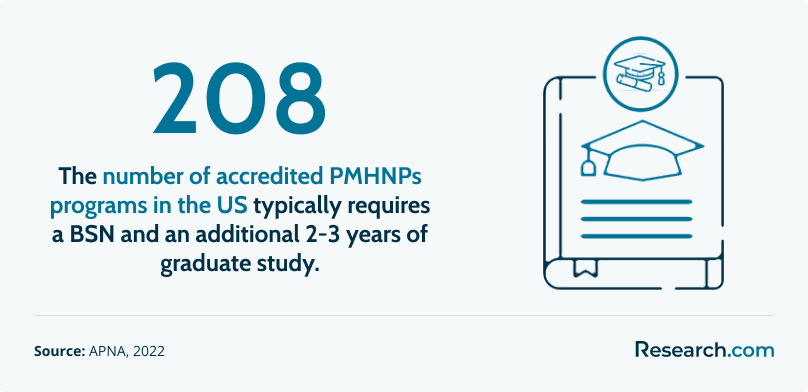
The growth of PMHNP education reflects the continued need for mental health providers. There are 374 active PMHNP degree programs, and 208 are fully accredited. Accreditation matters because it signals that a program has met recognized academic and clinical standards and is structured to prepare graduates for board certification.
| Pathway | Best for | Typical time based on listed programs | Main trade-off |
| Post-master’s PMHNP certificate | Graduate-prepared nurses or nurse practitioners adding psychiatric-mental health specialization | 1 year, as few as three semesters, ~1 year, or ~1.5 years | Fastest route, but admission often requires prior graduate nursing preparation |
| MSN-PMHNP | Registered nurses seeking graduate NP preparation | ~1.5 years or ~2 years in the listed options | More comprehensive than a certificate, but usually not a true 12-month option |
| DNP-PMHNP | Nurses seeking doctoral-level practice preparation | ~3 years and 4 months in the listed option | Longer and more expensive, but may align with leadership or doctoral practice goals |
Online PMHNP vs. on-campus PMHNP programs: Which format is better?
Accredited online and campus-based PMHNP programs are expected to meet the same professional preparation standards. The difference is not the credential itself; it is how you learn, how much structure you need, how clinical placements are arranged, and how well the format fits your life. Online coursework can be convenient, but psychiatric NP training is never fully remote because clinical practice must happen in person.
Online PMHNP programs
Online PMHNP programs are often the better fit for nurses who need geographic flexibility, want to keep living where they are, or can learn effectively through digital platforms. They work best for students who are organized, self-directed, and comfortable participating in virtual discussions, simulations, and assignments. The biggest issue to verify is clinical placement: ask whether the school finds placements, assists with placements, or expects you to secure preceptors yourself.
On-campus PMHNP programs
Campus programs may be better for students who prefer in-person lectures, immediate access to faculty, scheduled class routines, and campus resources such as simulation labs and libraries. They can also provide stronger local networking. The trade-off is less flexibility, possible commuting or relocation, and in some cases a heavier burden on the student to identify clinical sites.
| Comparison point | Online PMHNP program | On-campus PMHNP program |
| Course delivery | Mostly digital, often with live or asynchronous components | In-person classes and campus-based learning activities |
| Clinical hours | Completed in person at approved sites | Completed in person at approved sites |
| Best fit | Disciplined nurses who need flexibility | Students who want face-to-face structure |
| Main risk | Underestimating clinical placement logistics | Underestimating commuting, relocation, or scheduling limits |
| Key question to ask | Who is responsible for finding preceptors? | How are local clinical partnerships assigned? |
Nurses who want to broaden their hospital-based options may also benefit from understanding how to work in a hospital as an FNP. Combining family practice knowledge with psychiatric-mental health preparation can support a wider range of inpatient and outpatient career possibilities.
How much does a one-year online PMHNP program cost?
The average total tuition for a one-year online PMHNP program is approximately $41,200. Many programs fall between $25,000 and $60,000, although the listed options show that costs vary widely by institution, credential level, residency status, and credit load. Tuition is only one part of the cost. You should also plan for fees, books, technology requirements, background checks, travel for intensives if required, clinical compliance costs, and board certification expenses.
The largest hidden cost may be reduced income. A highly compressed PMHNP program can make full-time work difficult, especially during clinical semesters. Before choosing the fastest option, build a budget that includes living expenses and lost wages, not just tuition.
Some nurses may decide that a combined pathway is worth the additional time and cost. Research.com’s guide to dual FNP PMHNP online programs explains programs that prepare students for both family practice and psychiatric-mental health roles.
| Cost factor | Why it matters | Question to ask the school |
| Tuition | Credit price and total credits drive the published program cost | Is tuition locked for the program, or can it increase? |
| Fees | Online, technology, clinical, and graduation fees can add to the bill | What required fees are not included in tuition? |
| Clinical placement expenses | Travel, compliance documents, and site requirements can vary | Will I need to travel for clinicals or intensives? |
| Lost income | Accelerated study may reduce your ability to work | How many hours per week do students typically spend on coursework and clinicals? |
| Certification and licensure | Graduates may need board certification and state authorization for practice | Does the program meet requirements for my intended state of practice? |
Financial aid options for one-year online PMHNP students
Most students use more than one funding source for an accelerated PMHNP program. Because the schedule can be intense, it is smart to secure financing before the first term begins rather than assuming you can make up the difference through extra work hours.
- Federal student loans: Graduate students commonly begin by completing the Free Application for Federal Student Aid (FAFSA) to determine federal aid eligibility.
- Private loans: Banks, credit unions, and private lenders may help cover remaining costs after federal aid, although terms can vary.
- Nursing scholarships and grants: Professional organizations and nursing groups may offer awards, including Nurse Practitioner Health Association scholarships ranging from $1,000 to $4,000.
- Employer tuition reimbursement: Hospitals, clinics, and health systems may help fund education in high-need specialties, especially when the degree aligns with workforce needs.
Public and private universities can differ substantially in cost, and residency status may affect public university tuition. Ask each financial aid office for a full cost of attendance estimate, not just tuition. That estimate should include required fees and reasonable living expenses.
Admission requirements for one-year online PMHNP programs
Accelerated PMHNP programs are selective because students must move quickly through advanced psychiatric, diagnostic, and pharmacological content. Meeting the minimum requirements does not guarantee admission, especially if the program prioritizes applicants with psychiatric nursing or behavioral health experience.
- Active RN license: Applicants generally need a current, unencumbered registered nurse license.
- Bachelor of Science in Nursing (BSN): Many programs expect a BSN from an accredited nursing program, although post-master’s options may require graduate nursing preparation as well.
- Minimum GPA: A cumulative GPA of 3.0 or higher on a 4.0 scale is commonly required.
- Clinical experience: Programs often expect at least one to two years of direct patient care experience as a registered nurse.
- Psychiatric or behavioral health background: Prior psychiatric nursing experience is not always required, but it can make an application more competitive and help students adjust to the specialty faster.
If you are comparing admissions difficulty across nurse practitioner pathways, Research.com’s guide to the easiest NP schools to get into can help you understand how requirements vary. For PMHNP programs, however, do not choose solely by perceived ease of admission. Clinical placement quality, accreditation, and board preparation are more important than a quick acceptance.
Courses commonly included in a one-year online PMHNP program
A condensed PMHNP curriculum covers advanced practice nursing foundations and psychiatric-mental health specialty content. The pace is faster than a traditional program, but the core competencies are not optional. Students must be ready for heavy reading, case analysis, clinical documentation, diagnostic reasoning, and medication management content.
- Advanced Pathophysiology: Examines disease processes and physiologic changes that inform advanced clinical decision-making.
- Advanced Pharmacology: Covers medication principles, including pharmacokinetics and pharmacodynamics, for safe prescribing practice.
- Advanced Health Assessment: Builds comprehensive assessment skills, including physical, psychosocial, and psychiatric evaluation.
- Psychopharmacology: Focuses on psychiatric medications, mechanisms of action, therapeutic use, side effects, and monitoring.
- Diagnostic Reasoning and Psychotherapy: Develops differential diagnosis skills and introduces therapeutic approaches used in psychiatric care.
Students entering these programs often have strong nursing preparation. According to Zippia education data, nearly 74% of psychiatric nurse practitioners hold a Bachelor of Science in Nursing, which helps explain why BSN-level preparation is such a common expectation.
Students comparing PMHNP with counseling careers should understand the difference in scope. PMHNPs are advanced practice nurses who may diagnose, prescribe, and manage psychiatric medications within their state scope of practice. Counseling graduates follow a different licensure path and may pursue roles described in Research.com’s guide to top paying jobs with a master's degree in counseling.
PMHNP specialization options and practice focus areas
Most one-year PMHNP programs do not offer many formal sub-specialty tracks because the timeline is too compressed. Instead, the PMHNP credential itself is the specialization. After graduation and certification, many practitioners build expertise through clinical experience, continuing education, mentorship, and the patient populations they serve.
- Child and adolescent psychiatry: Focuses on mental health assessment and treatment for children and teens, an area that may interest readers also exploring accelerated school psychology programs online.
- Substance use and addictive disorders: Centers on patients with substance use disorders and co-occurring psychiatric needs.
- Geriatric psychiatry: Addresses psychiatric care for older adults, including complex medication and cognitive considerations.
- Forensic psychiatry: Applies psychiatric knowledge in legal, correctional, or court-related settings.
- Telepsychiatry: Delivers psychiatric care through secure virtual platforms, often improving access for patients who face travel or provider shortages.
How to choose the best one-year online PMHNP program
The best program is not always the shortest or cheapest. A strong PMHNP program should prepare you for certification, provide credible clinical training, fit your state requirements, and offer enough support to get through an accelerated schedule. Use the following criteria before committing.
- Accreditation: Look for recognized nursing accreditation such as CCNE or ACEN. Accreditation is a baseline requirement for program quality and may affect certification, licensure, financial aid, and employer acceptance.
- Board certification preparation: Ask about first-time pass rates and compare them with the national average of around 83%.
- Clinical placement support: Clarify whether the school places students, helps identify sites, or leaves placement entirely to the student. This is especially important in an accelerated program.
- Faculty access: Strong programs provide responsive faculty, active clinicians, advising, and clear communication during clinical planning.
- State authorization and licensure alignment: Confirm that the program accepts students from your state and meets requirements where you plan to practice.
- Personal readiness: Be honest about your time, finances, family support, mental bandwidth, and ability to reduce work hours if needed.
| Before you apply, ask | Why the answer matters |
| Is the program accredited by CCNE or ACEN? | Accreditation affects credibility, certification preparation, and often financial aid eligibility. |
| Will this program meet requirements in my state? | Online programs may not be authorized for every state or may not satisfy every state board requirement. |
| Who secures clinical placements? | Delayed placements can delay graduation, even when coursework is online. |
| How many campus visits or intensives are required? | Travel costs and time away from work can change the real cost of the program. |
| What is the expected weekly workload? | One-year formats can be difficult to combine with full-time employment. |
| What student support is available during clinical semesters? | Accelerated programs leave little room for administrative delays or unclear advising. |
Nurses still deciding between advanced practice specialties may also want to compare PMHNP programs with other demanding pathways, such as BSN to CRNA routes. The best choice depends on the patient population, clinical environment, autonomy, and long-term work style you want.
Common mistakes to avoid
- Choosing only by speed: A shorter timeline is not useful if clinical placement delays graduation or weak preparation hurts certification readiness.
- Ignoring accreditation: Never assume every online nursing program meets the same standards.
- Looking only at tuition: Fees, travel, clinical costs, certification costs, and lost income can change affordability.
- Assuming online means fully remote: PMHNP students still complete in-person clinical hours.
- Forgetting state requirements: A program may be reputable but still not fit your state authorization or practice plans.
- Overestimating work capacity: Accelerated study, clinical hours, and advanced coursework can make full-time employment unrealistic for some students.
Career paths after a one-year online PMHNP program
Graduates of PMHNP programs can pursue psychiatric-mental health roles in outpatient clinics, hospitals, emergency departments, telehealth settings, residential programs, and private practice. Their work differs from counseling roles because PMHNPs bring advanced nursing preparation, psychiatric assessment skills, and psychopharmacology training. If you are comparing mental health careers, Research.com’s guide to the fastest online master's programs in clinical mental health counseling can help clarify the counseling route.
| Career path | Typical work | Median salary |
| Outpatient Psychiatric Nurse Practitioner | Provides ongoing psychiatric assessment, medication management, and therapeutic support in clinics or group practices. | $135,000 per year. |
| Inpatient Psychiatric Nurse Practitioner | Works with patients experiencing acute psychiatric needs in hospitals or residential treatment settings. | $145,000 per year. |
| Telehealth PMHNP | Delivers psychiatric care through secure virtual platforms, often serving patients with access barriers. | $140,000 per year. |
| Emergency Department PMHNP | Provides urgent psychiatric consultation, crisis evaluation, safety planning, and care coordination. | $150,000 per year. |
| Private Practice PMHNP | Builds an independent or specialized practice with greater control over services, schedule, and patient focus. | $151,000 per year. |
Salary varies by state, employer, scope of practice, experience, patient population, and work setting. The cited salary profile also shows that the 75th percentile of PMHNPs earns over $135,000, while the 90th percentile earns close to $197,000 annually. These figures are useful benchmarks, not guaranteed outcomes.
PMHNP job market outlook
The job market for PMHNP graduates is strong because mental healthcare access remains a major challenge across many communities. Projections cited for the field indicate a 40% job growth rate over the next decade, equal to approximately 118,600 new positions. This demand reflects broader healthcare workforce growth, including adjacent areas such as those covered in Research.com’s guide to the fastest online health information management degree programs.
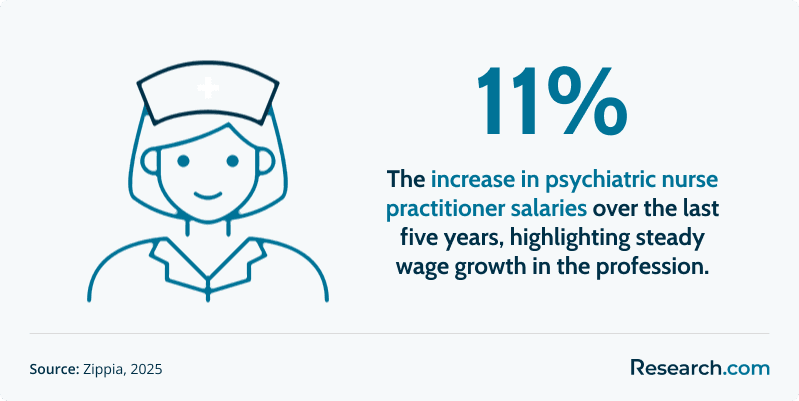
Compensation trends also suggest rising demand. PMHNP salaries have increased by 11% over the last five years. Still, employment outcomes depend on location, state scope of practice, employer type, certification, and experience. Applicants should evaluate local demand before enrolling, especially if they plan to remain in one geographic area.
Current trends affecting PMHNP students and graduates
- Telepsychiatry is now a major practice setting: Students should expect to learn about remote assessment, documentation, privacy, and virtual patient engagement.
- Clinical placements are a major bottleneck: Program quality increasingly depends on how well schools support preceptor and site placement.
- Employers value readiness, not just credentials: Strong assessment skills, medication knowledge, crisis response, and documentation remain essential.
- AI and digital tools require judgment: PMHNPs may encounter AI-assisted documentation or decision-support tools, but clinical accountability, privacy, and patient safety still rest with the provider.
- State practice rules matter: Scope of practice, supervision requirements, and prescribing authority can differ by state.
What graduates say about accelerated online PMHNP programs
- : "Working as an ER nurse showed me how serious the mental health access problem had become. I wanted to move into a provider role, but I did not want to spend several years away from the workforce. The one-year format was demanding, but it helped me change roles quickly and return with more autonomy and a stronger income path. — Ellie"
- : "After a decade in the ICU, I needed a career that still used my clinical background but allowed deeper patient relationships. PMHNP training helped me move into outpatient psychiatric care, where I can work with patients over time instead of only during crises. — Dale"
- : "I worried that an online accelerated program might feel disconnected or less rigorous. It turned out to be structured, challenging, and highly interactive. The live virtual sessions and faculty access made a real difference in how prepared I felt for practice. — Mira"
Key Insights
- “One-year” usually means accelerated, not easy. The shortest PMHNP options are often post-master’s certificates; MSN and DNP routes commonly take longer.
- Accreditation is non-negotiable. Prioritize programs with recognized nursing accreditation such as CCNE or ACEN before considering price or speed.
- Clinical placement support can make or break the timeline. Online coursework does not remove the need for in-person clinical hours, and placement delays can postpone graduation.
- Cost should include more than tuition. Budget for fees, books, travel, certification, clinical requirements, and potential lost income during an intensive schedule.
- Admissions favor prepared nurses. A strong RN background, BSN-level preparation, a GPA of 3.0 or higher on a 4.0 scale, and psychiatric experience can improve readiness and competitiveness.
- PMHNP career options are broad. Graduates may work in outpatient care, inpatient psychiatry, telehealth, emergency departments, or private practice, with listed median salaries ranging from $135,000 per year to $151,000 per year.
- Do not choose by ranking alone. The best program for you is the one that meets your state requirements, supports your clinical training, fits your finances, and prepares you for certification and safe psychiatric practice.
References:
- American Association of Colleges of Nursing. (n.d.). Scholarships and financial aid. Retrieved from AACN Nursing.
- American Psychiatric Nurses Association. (2022). Psychiatric-mental health nurses: Key to addressing the nation’s mental health crisis. Retrieved from APNA report.
- APEA. (2024). 2025 PMHNP career outlook: High need, high demand. Retrieved from APEA.
- Data USA. (n.d.). Psychiatric nurse profile. Retrieved from Data USA.
- National Library of Medicine. (2022). The psychiatric-mental health nurse practitioner workforce. Journal of the American Psychiatric Nurses Association. Retrieved from PMC.
- NursingWorld. (n.d.). Psychiatric-Mental Health Nurse Practitioner certification. Retrieved from NursingWorld.
- ZipRecruiter. (2024). PMHNP salary. Retrieved from ZipRecruiter.
- Zippia. (2024). Psychiatric nurse practitioner trends. Retrieved from Zippia.
Other Things You Should Know About One-Year Online PMHNP Programs
Most one-year online PMHNP programs require at least 500 supervised direct patient care hours, and many require 600 to 700 hours. These clinical hours must be completed in approved mental health settings under a qualified preceptor and documented for APRN program and certification compliance.
The average credit hour requirement for the best one-year online PMHNP programs in 2027 typically ranges from 40 to 50 credit hours. This includes coursework relevant to psychiatric-mental health topics, advanced nursing practice, and clinical experiences mandated by program guidelines.