2027 Best Online Pediatric Nurse Practitioner Graduate Certificate Programs

Co-Founder and Chief Data Scientist
With rising demand for pediatric care, 292,500 nurse practitioners employed in 2023 are pursuing specialized credentials. Online pediatric nurse practitioner programs offer flexible, advanced training to build clinical and leadership skills for both primary and acute care settings.
In this article, I will talk about the top online pediatric nurse practitioner certificate programs, including what to expect from the curriculum, career opportunities, and earning potential. I will also cover admissions, available certification routes, and how this credential prepares nurses to meet rising pediatric healthcare needs in hospitals, clinics, and communities.
What are the benefits of getting into an online pediatric nurse practitioner graduate certificate program?
- Online pediatric nurse practitioner (PNP) programs offer flexible learning options, allowing registered nurses to advance their careers while balancing work and personal responsibilities.
- Students gain the specialized knowledge and clinical competencies needed to assess, diagnose, and manage acute and chronic pediatric health conditions.
- With this credential, pediatric nurse practitioners can move into leadership roles and earn a median salary of $129,210, with potential for more based on experience and location.
What can I expect from an online pediatric nurse practitioner graduate certificate program?
An online PNP graduate certificate equips nurses with the advanced clinical training needed to care for infants, children, and adolescents across healthcare settings. As a student pursuing this certification, you can expect the following:
- Core courses often include pediatric pathophysiology, pharmacology, health assessment, and clinical decision-making.
- Programs are typically designed for licensed nurse practitioners or MSN-prepared nurses seeking pediatric specialization.
- Clinical practicum hours are completed in local pediatric settings under approved preceptors.
- Online learning platforms include video lectures, discussion forums, and real-time faculty interaction.
- Some programs offer primary care or acute care PNP tracks, allowing students to align training with their career goals.
Where can I work with an online pediatric nurse practitioner graduate certificate program?
Graduates with a PNP certificate are prepared to work in a variety of child-focused healthcare settings. They deliver both preventative and specialized care in common workplaces that include:
- Pediatric Clinics and Private Practices: Providing ongoing care and developmental assessments for children.
- Hospitals and Pediatric Specialty Units: Managing acute and chronic conditions in inpatient or outpatient environments.
- School-Based Health Centers: Supporting children’s physical and emotional health within educational settings.
- Community Health Organizations: Serving underserved populations with a focus on pediatric preventive care.
- Telehealth Platforms: Offering virtual pediatric consultations and follow-up care for families.
How much can I make with an online pediatric nurse practitioner graduate certificate program?
Nurse practitioners with pediatric specialization earn competitive salaries that reflect their advanced clinical expertise and vital role in healthcare. The median annual salary for nurse practitioners is $129,210, with higher earnings possible in urban or high-demand areas. Factors such as geographic location, years of experience, employer type, and chosen subspecialty can all influence pay.
Pursuing an online pediatric nurse practitioner certificate can enhance both earning potential and career advancement. These programs offer flexible, targeted training that prepares nurses for one of the most rewarding and impactful specialties in the field, delivering expert care to children across various healthcare settings.
- Best Online Pediatric Nurse Practitioner Graduate Certificate Programs for 2027 List of Programs
- How long does it take to complete an online pediatric nurse practitioner graduate certificate program? Program Length
- How does an online pediatric nurse practitioner graduate certificate compare to an on-campus program? How does an online pediatric nurse practitioner graduate certificate compare to an on-campus program?
- What is the average cost of an online pediatric nurse practitioner graduate certificate program? Average Cost
- What are the financial aid options for students enrolling in an online pediatric nurse practitioner graduate certificate program? Financial Aid
- What are the prerequisites for enrolling in an online pediatric nurse practitioner graduate certificate program? What are the prerequisites for enrolling in an online pediatric nurse practitioner graduate certificate program?
- What courses are typically in an online pediatric nurse practitioner graduate certificate program? What courses are typically in an online pediatric nurse practitioner graduate certificate program?
- What types of specializations are available in online pediatric nurse practitioner graduate certificate programs? What types of specializations are available in online pediatric nurse practitioner graduate certificate programs?
- How to choose the best online pediatric nurse practitioner graduate certificate program? How to choose the best online pediatric nurse practitioner graduate certificate program?
- What career paths are available for graduates of online pediatric nurse practitioner graduate certificate programs? Career Paths
- What is the job market for graduates with an online pediatric nurse practitioner graduate certificate? Job Market
- Are online pediatric nurse practitioner graduate certificate programs accredited? Are online pediatric nurse practitioner graduate certificate programs accredited?
- What are the potential challenges of online pediatric nurse practitioner graduate certificate programs? What are the potential challenges of online pediatric nurse practitioner graduate certificate programs?
- Can I transition from my certificate to a doctoral program in pediatric care? Can I transition from my certificate to a doctoral program in pediatric care?
Best Online Pediatric Nurse Practitioner Graduate Certificate Programs for 2027
Choosing an online pediatric nurse practitioner graduate certificate is a high-stakes decision for nurses who already have graduate training and want to move into advanced pediatric practice. The right program can help you qualify for pediatric primary care or acute care certification, complete required clinical hours, and expand your scope of practice without leaving your job. The wrong program can create problems with licensure, clinical placement, certification eligibility, or cost.
This guide is designed for MSN- or DNP-prepared nurses comparing online pediatric nurse practitioner certificate options. It explains how leading programs differ, what they cost, how long they take, what prerequisites to expect, and how to evaluate whether a program fits your state, schedule, clinical goals, and budget.
Quick answer: What is the best online pediatric nurse practitioner graduate certificate program?
The best online pediatric nurse practitioner graduate certificate depends on your intended practice setting. Nurses who want outpatient pediatric care should compare Pediatric Primary Care NP tracks, while nurses aiming for hospital, emergency, or intensive care roles should consider Acute Care Pediatric NP options. Key factors include CCNE or ACEN accreditation, certification alignment with PNCB or ANCC expectations, clinical placement support, total tuition, required credits, and whether the program accepts your prior graduate nursing coursework.
How do we rank schools?
Graduate nursing education requires a serious investment of time, money, and clinical effort. Research.com built this ranking with a research-based methodology intended to help prospective students compare programs using consistent and relevant information.
The ranking draws from trusted education data sources, including the Integrated Postsecondary Education Data System, Peterson’s database and its Distance Learning Licensed Data Set, College Scorecard, and the National Center for Education Statistics (NCES). These sources help students evaluate schools with clearer information on institutional quality, program delivery, and student decision factors.
Program comparison at a glance
| Rank | School | Track | Program Length | Credits | Cost per Credit Hour | Accreditation |
| 1 | University of Texas at Austin | Acute Care Pediatric NP | 16 months | 30 | $1924 | CCNE |
| 2 | Maryville University | Pediatric Primary Care NP | 20 to 24 months part-time | 31 | $863 | CCNE, HLC |
| 3 | Saint Louis University | Pediatric Primary Care NP | Eight to 12 months | 20 | $1400 | CCNE |
| 4 | Spring Arbor University | Pediatric Primary Care NP | 18 to 24 months | 21 | $782 | CCNE |
| 5 | University of Arizona | Pediatric Primary Care NP | One year | 27 | $1,053 | CCNE |
| 6 | Walden University | Pediatric Primary Care NP | 24 months | 29 | $775 | CCNE |
| 7 | The University of Texas at Arlington | Pediatric Primary Care NP | 13 weeks | 18 | $654 | CCNE |
| 8 | Drexel University | Pediatric Primary Care NP | Two years | 30 | $1298 | CCNE |
| 9 | University of Colorado Anschutz | Acute Care Pediatric NP | One and a half years | 11 | $634 in-state / $820 non-resident | CCNE |
| 10 | Regis College | Pediatric Primary Care NP | 28 to 36 months | 46 | $995 | CCNE and ACEN |
1. University of Texas at Austin
The University of Texas at Austin offers an online post-master’s Acute Care Pediatric Nurse Practitioner certificate for MSN-prepared nurses who want to care for children with critical, complex, or chronic health conditions. The program emphasizes advanced assessment, pediatric pharmacology, diagnostics, and acute care decision-making. Students complete 540 to 720 supervised clinical hours in hospital-based settings, and graduates are positioned to pursue CPNP-AC board certification.
- Program Length: 16 months
- Tracks/Concentrations: Acute Care Pediatric NP, post-MSN only
- Cost per Credit Hour: $1924
- Required Credits to Graduate: 30
- Accreditation: Commission on Collegiate Nursing Education (CCNE)
2. Maryville University
Maryville University provides a fully online Post-Master’s NP Certificate with a Pediatric Primary Care NP track. The curriculum prepares nurses to conduct pediatric wellness visits, diagnose common conditions, manage chronic illnesses, and prescribe medications for children and adolescents. Students complete advanced assessment, pharmacotherapeutics, role development, and pediatric practicum coursework, with preparation for the CPNP-PC exam.
- Program Length: 20 to 24 months part-time
- Tracks/Concentrations: Pediatric Primary Care NP
- Cost per Credit Hour: $863
- Required Credits to Graduate: 31
- Accreditation: CCNE, Higher Learning Commission (HLC)
3. Saint Louis University
Saint Louis University offers a post-master’s Primary Care Pediatric NP Certificate for nurses planning to serve children in outpatient clinics, urgent care settings, school-based care, or other primary care environments. The program includes faculty mentorship, clinical placement support, and coursework in advanced pediatric assessment, diagnosis, health promotion, and practicum learning. Graduates are prepared for PNCB PNP-PC certification.
- Program Length: Eight to 12 months
- Tracks/Concentrations: Pediatric Primary Care NP
- Cost per Credit Hour: $1400
- Required Credits to Graduate: 20
- Accreditation: CCNE
4. Spring Arbor University
Spring Arbor University delivers an online, faith-based Post-Master’s Pediatric NP Primary Care Certificate. Its 7-1-7 structure uses 7-week courses followed by a 1-week break, and six annual start dates can help working nurses plan around professional and family responsibilities. Students study pediatric pharmacotherapeutics, advanced assessment, health promotion, and practicum content, completing around 500 clinical hours while preparing for the CPNP-PC exam.
- Program Length: 18 to 24 months
- Tracks/Concentrations: Pediatric Primary Care NP
- Cost per Credit Hour: $782
- Required Credits to Graduate: 21
- Accreditation: CCNE
5. University of Arizona
The University of Arizona offers a Pediatric Nurse Practitioner Graduate Certificate that blends online coursework with required campus-based clinical skills labs. The curriculum focuses on pediatric assessment, developmental health, pharmacology, and evidence-based practice. Students complete 720 clinical hours, and graduates are prepared to pursue the PNCB CPNP-PC exam.
- Program Length: One year
- Tracks/Concentrations: Pediatric Primary Care NP
- Cost per Credit Hour: $1,053
- Required Credits to Graduate: 27
- Accreditation: CCNE
6. Walden University
Walden University offers a fully online PNP Primary Care certificate for MSN-prepared nurses. The program includes NP core coursework, pediatric clinical seminars, case-based Grand Rounds, and four practicum courses. Graduates complete preparation aligned with CPNP-PC board certification eligibility.
- Program Length: 24 months
- Tracks/Concentrations: Pediatric Primary Care NP
- Cost per Credit Hour: $775
- Required Credits to Graduate: 29
- Accreditation: CCNE
7. The University of Texas at Arlington
The University of Texas at Arlington offers an online Pediatric Primary Care NP Certificate with flexibility based on a gap analysis of the student’s prior graduate coursework. The program may be completed in as few as five courses, and clinical work is completed locally with an approved preceptor. Graduates are prepared for PNCB certification and pediatric primary care practice.
- Program Length: 13 weeks
- Tracks/Concentrations: Pediatric Primary Care NP
- Cost per Credit Hour: $654
- Required Credits to Graduate: 18
- Accreditation: CCNE
8. Drexel University
Drexel University offers a hybrid post-master’s PNP Primary Care Certificate that combines synchronous online classes, supervised clinical rotations, and a required in-person summer intensive. The program emphasizes evidence-based pediatric care and technology-supported clinical delivery. Graduates may pursue ANCC or PNCB NP certification.
- Program Length: Two years
- Tracks/Concentrations: Pediatric Primary Care NP
- Cost per Credit Hour: $1298
- Required Credits to Graduate: 30
- Accreditation: CCNE
9. University of Colorado Anschutz
The University of Colorado Anschutz offers a post-graduate Acute Care Pediatric Nurse Practitioner Certificate that combines online courses with campus-based experiences in Aurora, CO. Students complete 360 clinical hours at sites such as Children’s Hospital Colorado and Rocky Mountain Hospital for Children. The curriculum covers acute pediatric pharmacology, diagnostics, and evidence-based care, preparing graduates for AC-PNP board certification.
- Program Length: One and a half years
- Tracks/Concentrations: Acute Care Pediatric NP
- Cost per Credit Hour: $634 (in-state)/$820 (non-resident)
- Required Credits to Graduate: 11
- Accreditation: CCNE
10. Regis College
Regis College offers a fully online MSN Pediatric Primary Care NP program with ADN-to-MSN, BSN-to-MSN, and non-nursing bachelor’s entry routes. The program includes pediatric clinical seminars, leadership coursework, advanced health assessment, and local clinical placements. Graduates prepare for CPNP-PC board certification and pediatric primary care roles.
- Program Length: 28 to 36 months
- Tracks/Concentrations: Pediatric Primary Care NP
- Cost per Credit Hour: $995
- Required Credits to Graduate: 46
- Accreditation: CCNE and ACEN
How long does it take to complete an online pediatric nurse practitioner graduate certificate program?
Most online pediatric nurse practitioner graduate certificate programs are built for experienced registered nurses or advanced practice nurses who need flexibility while continuing clinical work. Students comparing certificate timelines may also want to review accelerated NP programs online, especially if they can handle a heavier course load and faster clinical schedule.
Completion time can range from 13 weeks (three months) to 36 months. The timeline depends on whether the program is full-time or part-time, how many credits are required after the school reviews your prior coursework, and whether you already hold an MSN or DNP.
Clinical practicum requirements also affect pacing. Many programs require 500 to 600+ hours, while some listed programs require 360 clinical hours, 540 to 720 clinical hours, or 720 clinical hours. Even in an online program, those hours must be coordinated with approved pediatric sites and preceptors, which can influence how quickly you finish.
The chart below shows the common completion-time range for online pediatric nurse practitioner graduate certificate programs.
How does an online pediatric nurse practitioner graduate certificate compare to an on-campus program?
An online pediatric nurse practitioner certificate can be academically comparable to a campus program when it is accredited, certification-aligned, and supported by strong clinical oversight. Flexibility is the main advantage, but students should not assume online means easier. Even nurses researching the easiest nurse practitioner program should expect rigorous graduate coursework, supervised clinical practice, and certification standards.
| Factor | Online PNP Certificate | On-Campus PNP Certificate | Best Fit |
| Course delivery | Often uses asynchronous modules, live sessions, virtual simulations, and digital assignments | Usually relies on scheduled in-person classes, labs, and campus meetings | Online works well for working nurses who need schedule flexibility |
| Clinical training | Requires supervised pediatric clinical hours, often arranged near the student’s location | Usually uses school-affiliated hospitals, clinics, or regional partners | Campus may be easier if the school has strong local clinical networks |
| Faculty access | Uses video meetings, email, online office hours, and learning platforms | Allows face-to-face conversations and immediate in-person feedback | Online students must be proactive about communication |
| Hands-on practice | May include virtual simulation and, in some programs, short campus intensives | Often includes regular in-person labs and simulation center access | Hybrid formats can balance flexibility with in-person skill development |
| Location | Allows students to enroll without relocating, subject to state authorization and clinical placement rules | Requires access to the campus and affiliated clinical sites | Online is useful for rural or geographically limited students |
| Structure | May offer part-time pacing, multiple starts, and local practicums | May follow fixed semesters and more predictable campus schedules | Choose based on your work schedule and clinical-site availability |
- Curriculum standards: Accredited online and campus programs generally cover the same core areas, including pediatric pathophysiology, pharmacology, advanced assessment, and pediatric primary or acute care management.
- Certification preparation: Both formats should prepare graduates for national pediatric NP certification through organizations such as PNCB or ANCC, depending on the track.
- Student engagement: Campus students interact in person, while online students rely on discussion boards, group projects, video meetings, simulation platforms, and clinical seminars.
- Technology expectations: Online students need reliable internet access, comfort with digital learning platforms, and readiness to use telehealth, EHR documentation practice, and virtual case tools.
What is the average cost of an online pediatric nurse practitioner graduate certificate program?
The cost of online pediatric nurse practitioner programs varies by school type, tuition model, required credits, and state residency rules. Students focused on price should compare affordable online pediatric NP graduate certificate programs, but tuition should not be the only deciding factor.
Across the programs listed here, cost per credit hour ranges from $634 to $1,924. Public universities may offer different rates for in-state and non-resident students, while private institutions often use one tuition rate regardless of location.
Total tuition commonly ranges from $11,000 to over $30,000, depending on required credits. Students should also budget for technology fees, background checks, immunization documentation, clinical placement expenses, travel for any campus intensives, certification exam fees, and graduation charges. Before applying, ask each school for a full cost sheet rather than relying only on the advertised per-credit rate.
Cost factors to compare before enrolling
| Cost Factor | Why It Matters | Question to Ask |
| Credits required | A lower per-credit price may not mean lower total tuition if the program requires more credits | How many credits will I need after my gap analysis? |
| Residency rate | Some public schools charge different rates for in-state and non-resident students | Will I pay in-state, non-resident, or a flat online tuition rate? |
| Clinical costs | Students may pay for compliance documentation, travel, placement services, or site onboarding | Are clinical placement or practicum-related fees included in tuition? |
| Campus visits | Hybrid programs may require travel, lodging, and time away from work | Are any intensives, labs, or orientations required in person? |
| Certification expenses | Graduates must budget for board certification and licensure-related costs | Does the program fee include exam preparation or practice exams? |
What are the financial aid options for students enrolling in an online pediatric nurse practitioner graduate certificate program?
Many nurses pay for online pediatric nurse practitioner certificate programs through a mix of loans, employer support, scholarships, service-based repayment programs, and personal funds. Because graduate certificates may be handled differently from full degree programs, students should confirm eligibility with the financial aid office before assuming federal aid applies.
An AACN report states that 69% of students in similar graduate-level programs take out loans, while 27% received institutional aid. That makes financing strategy an important part of the program-selection process, not an afterthought.
- Public Service Loan Forgiveness (PSLF) Program: Nurses working full-time for an eligible government or not-for-profit employer may qualify to have remaining Direct Loan balances forgiven after 120 qualifying monthly payments under an accepted repayment plan.
- Federal Loans: Graduate nursing students may use Federal Direct Unsubsidized Loans when their certificate program qualifies. These loans are not based on financial need.
- Nurse Corps Loan Repayment Program: This federal program repays up to 85% of unpaid nursing education debt for eligible nurses who work in critical shortage areas, including pediatric clinics and underserved communities.
- Institutional Nursing Awards: Schools may offer merit scholarships, need-based aid, or awards for graduate nursing students, online learners, or students planning to serve underserved populations.
- Military and VA Education Benefits: Active-duty service members, veterans, and eligible dependents may be able to use GI Bill® benefits or military education funding.
- Advanced Nursing Education Workforce (ANEW) Grants: Some universities work with the Health Resources and Services Administration (HRSA) to support advanced practice nursing students preparing for primary care roles.
The chart below from AACN shows how graduate nursing education is financed.
What are the prerequisites for enrolling in an online pediatric nurse practitioner graduate certificate program?
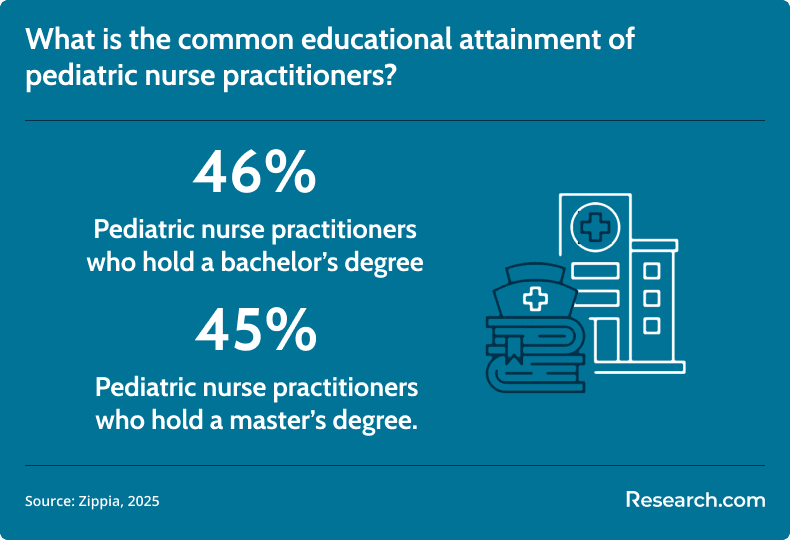
Admission to an online pediatric nurse practitioner certificate is usually selective because the curriculum builds on prior graduate nursing preparation. Requirements differ by school, but most programs look for licensed nurses with advanced education, clinical experience, and readiness for pediatric practicum work.
- Graduate nursing degree: Applicants generally need an MSN or DNP from an accredited institution.
- Active RN or APRN license: A current, unencumbered RN or APRN license is typically required, often in the state where the student will complete clinical hours.
- Clinical nursing experience: Many programs expect one to two years of nursing experience, preferably in pediatrics, neonatal care, acute care, or a closely related setting.
- National APRN certification: Some schools, including Drexel University and the University of Texas at Austin, require nationally certified APRN status for certain post-APRN applicants.
- Minimum GPA: A cumulative GPA of at least 3.0 on a 4.0 scale is commonly expected, although some schools may consider conditional admission.
- Prior graduate coursework: Advanced health assessment, pathophysiology, and pharmacology are often required before admission or early in the certificate sequence.
- Recommendations: Programs commonly request two to three academic or professional references from supervisors, faculty, or clinical preceptors.
- Resume or CV: Applicants should document education, licenses, certifications, pediatric or advanced practice experience, and clinical responsibilities.
- Goal statement: Many schools ask for an essay explaining why the applicant wants pediatric NP preparation and how the certificate supports their career plans.
Some programs may also require an interview, background check, malpractice insurance, immunization records, or proof of clinical site readiness before practicum courses. Administrative and documentation skills matter as well; 94% of nurse practitioners regularly document patient data. Nurses interested in broader community and population health roles can also compare MSN public health nursing jobs.
What courses are typically in an online pediatric nurse practitioner graduate certificate program?
Online pediatric nurse practitioner certificate curricula combine graduate-level theory with supervised pediatric clinical practice. Course names vary by university, but the core content is usually tied to pediatric NP certification expectations and the student’s chosen primary care or acute care track.
- Advanced Pediatric Pathophysiology: Covers disease processes in neonates, infants, children, and adolescents, with attention to growth and developmental differences.
- Pediatric Pharmacology: Focuses on medication selection, dosing, safety, adverse effects, and pharmacotherapeutic decision-making for pediatric patients.
- Pediatric Primary or Acute Care Management: Builds diagnostic and treatment skills for pediatric care settings. Primary care courses often emphasize wellness, prevention, and chronic disease management, while acute care courses focus on unstable or complex patients in hospital-based environments.
- Advanced Pediatric Health Assessment: Teaches age-specific history taking, developmental screening, physical examination, diagnostic interpretation, and clinical reasoning.
- Pediatric Clinical Practicum Courses: Requires supervised practice in approved pediatric settings such as clinics, hospitals, specialty practices, or urgent care environments. Many programs require 500 to 600+ hours.
- Professional Roles and Ethics in Pediatric Practice: May address scope of practice, legal and ethical issues, advocacy, cultural responsiveness, and interprofessional collaboration.
- Evidence-Based Practice in Pediatric Nursing: Emphasizes using research and clinical evidence to improve pediatric care quality and patient outcomes. Nurses interested in quality-focused careers can also read about what you can do with an msn degree in patient safety and healthcare quality.
Some programs add electives or focused modules in adolescent health, pediatric behavioral health, neonatal care, pediatric emergency care, or specialty practice. Always compare the course plan with your intended certification exam before enrolling.
What types of specializations are available in online pediatric nurse practitioner graduate certificate programs?
Most online pediatric nurse practitioner certificates are organized around the care setting: primary care or acute care. This choice affects your courses, clinical placements, certification pathway, and job options after graduation.
| Specialization | Primary Focus | Common Clinical Settings | Best For |
| Primary Care Pediatric Nurse Practitioner (PNP-PC) | Well-child care, immunizations, developmental screening, family education, chronic condition management, and common pediatric illnesses | Pediatric clinics, schools, community health centers, private practices, and outpatient care sites | Nurses who want long-term outpatient relationships with children and families |
| Acute Care Pediatric Nurse Practitioner (PNP-AC) | High-acuity illness, complex conditions, stabilization, diagnostics, and inpatient management | Emergency departments, PICUs, specialty hospitals, inpatient units, and acute care teams | Nurses with strong acute, critical care, or hospital-based pediatric experience |
The Primary Care Pediatric Nurse Practitioner track is designed for nurses who want to deliver comprehensive outpatient care to children and adolescents. Graduates often work in pediatric practices, schools, community clinics, and family-centered care settings.
The Acute Care Pediatric Nurse Practitioner track prepares nurses to manage complex or unstable pediatric patients in hospitals, emergency departments, and intensive care settings. Clinical training often includes specialty units, pediatric intensive care, or other high-acuity environments.
Nurses interested in maternal and newborn care may want to compare this pathway with nurse-midwifery options, including information related to certified nurse midwife salary.
Some schools may also offer elective or related focus areas, including pediatric mental health, pediatric emergency care, or neonatal care. Neonatal care may be offered through a related NNP certificate or elective path for nurses working in NICUs with premature or critically ill newborns. Nurses considering administrative or systems-level roles may also explore careers with a nursing leadership graduate certificate.
The chart from the US BLS below shows the industries with the highest levels of employment for nurse practitioners.
How to choose the best online pediatric nurse practitioner graduate certificate program?
The best program is not simply the cheapest, shortest, or most flexible option. It is the one that meets certification rules, supports clinical placement, fits your schedule, and prepares you for the pediatric setting where you actually want to practice.
Students comparing online pediatric nurse practitioner programs should evaluate the following factors before applying:
- Accreditation: Prioritize programs accredited by CCNE or ACEN because accreditation supports educational quality, certification eligibility, financial aid access, and employer confidence.
- Certification alignment: Confirm that the track prepares you for the relevant PNCB or ANCC certification, such as PNP-PC or PNP-AC.
- State authorization and licensure: Ask whether the school can enroll students from your state and whether the curriculum meets your state’s nurse practice and APRN requirements.
- Clinical placement support: Find out whether the school secures placements, helps identify sites, or expects you to find your own pediatric preceptor.
- Faculty experience: Look for instructors with current or recent pediatric primary care, acute care, specialty, or advanced practice experience.
- Delivery format: Compare asynchronous courses, live class requirements, part-time options, start dates, and any required campus intensives.
- Board exam preparation: Strong programs include exam review, practice questions, and certification-focused assessments.
- Student outcomes: Ask for graduation rates, certification pass rates, placement support, and student satisfaction information when available.
- Support services: Online students benefit from advising, technology help, writing support, library access, and peer networking.
Common mistakes to avoid
| Mistake | Why It Can Hurt You | Better Approach |
| Choosing based only on tuition | A low per-credit rate may still lead to high total cost if the program requires many credits or extra fees | Compare total program cost, fees, travel, and certification expenses |
| Ignoring accreditation | Non-accredited programs may create problems with certification, licensure, financial aid, and employer recognition | Verify CCNE or ACEN accreditation before applying |
| Assuming online means fully remote | Some programs require campus intensives, labs, or travel for clinical requirements | Ask about every in-person requirement in writing |
| Overlooking clinical placement rules | Clinical-site delays can extend your timeline and create stress during practicum courses | Ask how placements are approved and who finds the preceptor |
| Picking the wrong track | Primary care and acute care tracks prepare students for different certifications and settings | Choose PNP-PC for outpatient care and PNP-AC for high-acuity pediatric practice |
| Assuming salary or job outcomes are guaranteed | Employment depends on location, licensure, certification, experience, and employer demand | Research local pediatric NP openings before enrolling |
What career paths are available for graduates of online pediatric nurse practitioner graduate certificate programs?
Graduates of online pediatric nurse practitioner programs can pursue advanced practice roles focused on infants, children, adolescents, and families. The exact path depends on certification, state scope of practice, clinical background, and whether the graduate completed a primary care or acute care track.
- Pediatric Nurse Practitioner – Primary Care: Provides wellness exams, developmental screening, chronic condition management, family education, and treatment for common pediatric illnesses in outpatient settings.
- Pediatric Nurse Practitioner – Acute Care: Cares for critically ill or injured children in PICUs, emergency departments, specialty hospitals, or inpatient pediatric units.
- Pediatric Clinical Nurse Specialist: Supports pediatric quality improvement, staff education, clinical consultation, and evidence-based care initiatives in health systems.
- Pediatric Urgent Care Provider: Evaluates and treats acute but non-emergency pediatric concerns, including minor injuries, infections, and sudden symptoms.
- School-Based Health Provider: Delivers health services in school settings, supports wellness initiatives, and helps manage chronic conditions that affect learning and attendance.
- Telehealth Pediatric NP: Provides virtual pediatric care, triage, follow-up, and family guidance, especially for patients in rural or underserved areas.
Nurses who complete one of the shortest online nurse practitioner program options may move more quickly into advanced practice if they already have the right graduate coursework, licensure, and clinical experience. Pediatric NP preparation may also support future roles in leadership, education, advocacy, research, or care coordination.
What is the job market for graduates with an online pediatric nurse practitioner graduate certificate?
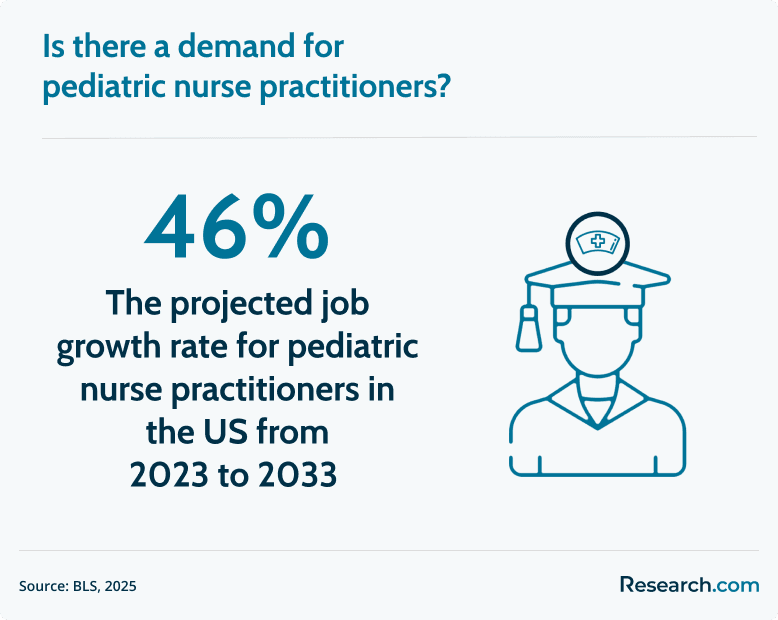
The broader nurse practitioner labor market is strong. Nurse practitioner employment is projected to grow 46% from 2023 to 2033, reaching 427,900 positions. For pediatric NP graduates, demand is shaped by access to pediatric care, preventive services, chronic disease management, telehealth expansion, and state-level rules governing NP practice authority.
Graduates from certificate pathways, including 1 year nurse practitioner programs, may qualify for roles in clinics, hospitals, schools, specialty practices, and virtual care settings. However, job availability is not guaranteed and varies by region, certification, pediatric experience, and local employer needs.
Current trends affecting pediatric nurse practitioner graduates
- Telehealth is now part of pediatric care: Pediatric NPs increasingly need comfort with virtual assessment, documentation, family education, and follow-up care.
- Clinical placement competition remains a concern: Online students should start early when identifying pediatric preceptors and approved sites.
- Employers value certification-ready training: Programs that clearly align with PNCB or ANCC expectations can make the transition from school to practice smoother.
- Technology skills matter: EHR use, telehealth platforms, remote monitoring tools, and digital communication are now routine in many pediatric settings.
- State scope-of-practice rules affect opportunity: Graduates should verify prescribing authority, supervision requirements, and APRN licensure rules in the state where they plan to work.
Here’s What Graduates Have to Say About Their Online Pediatric Nurse Practitioner Graduate Certificate Programs
- : "Online study allowed me to keep my hospital schedule while building stronger pediatric assessment and treatment skills. The classes were demanding, but the material connected directly to the care I provided at work. — Marissa"
- : "The online certificate helped me advance without moving or leaving my position. I expected the format to feel isolated, but the live discussions, faculty access, and peer interaction made the experience much more connected. — James"
- : "I worried that online graduate study would be difficult to manage with family responsibilities, but the structure helped me stay organized. The program strengthened my confidence and prepared me to care for children in underserved communities. — Anika"
Are online pediatric nurse practitioner graduate certificate programs accredited?
Accreditation is one of the first items to verify before applying to an online pediatric nurse practitioner graduate certificate. Programs accredited by the Commission on Collegiate Nursing Education (CCNE) or the Accreditation Commission for Education in Nursing (ACEN) have undergone review for curriculum quality, faculty preparation, clinical expectations, and program effectiveness.
Accreditation can affect certification eligibility, state licensure, financial aid access, employer recognition, and future academic progression. Before enrolling, confirm both institutional accreditation and nursing program accreditation. If you are comparing other nursing education routes, reviewing the standards used for online accelerated BSN online programs can also show why accreditation matters across nursing pathways.
What are the potential challenges of online pediatric nurse practitioner graduate certificate programs?
Online pediatric NP certificate programs offer flexibility, but they also require strong self-management. Students must keep up with graduate-level reading, case assignments, clinical documentation, discussion requirements, and practicum planning without the daily structure of campus attendance.
- Finding clinical sites can be difficult: Some programs help secure placements, while others expect students to identify preceptors locally.
- Time management is demanding: Working nurses must balance shifts, coursework, family responsibilities, and clinical hours.
- Online learning requires active engagement: Students need to participate in virtual discussions, ask questions early, and maintain contact with faculty.
- Technology issues can interrupt learning: Reliable internet, digital literacy, and comfort with learning platforms are essential.
- State rules can limit options: Not every online program can accept students from every state or place students in every clinical location.
Nurses who want a more foundational or less specialized route may want to compare alternatives such as the easiest RN to BSN online degree before committing to advanced pediatric practice.
Can I transition from my certificate to a doctoral program in pediatric care?
An online pediatric nurse practitioner graduate certificate can support a future doctoral pathway, especially for nurses who want to move into clinical leadership, evidence-based practice, education, policy, or advanced pediatric care systems. Many doctoral programs value applicants with focused clinical preparation and a clear advanced practice direction.
Admission requirements vary, so students should ask whether certificate credits can transfer, whether additional practicum hours are needed, and how the certificate aligns with DNP expectations. Nurses who want a faster doctoral route can compare accelerated DNP programs, while confirming that speed does not reduce clinical quality or state licensure alignment.
Key Insights
- Track choice is the most important decision: Choose PNP-PC if you want outpatient pediatric care, prevention, chronic disease management, and family education. Choose PNP-AC if you want hospital, emergency, intensive care, or high-acuity pediatric practice.
- Program length varies widely: Listed options range from 13 weeks (three months) to 36 months, mainly because of credit requirements, prior coursework, pacing, and clinical placement logistics.
- Costs require careful comparison: Per-credit tuition ranges from $634 to $1,924, while total tuition commonly ranges from $11,000 to over $30,000. Always ask for a full fee breakdown.
- Accreditation is non-negotiable: CCNE or ACEN accreditation helps protect your eligibility for certification, licensure, financial aid, and employer recognition.
- Clinical placement support can make or break the experience: Before enrolling, ask whether the school finds preceptors, approves student-selected sites, or provides structured placement assistance.
- The job market is favorable but not automatic: Nurse practitioner employment is projected to grow 46% from 2023 to 2033, reaching 427,900 positions, but pediatric NP opportunities still depend on location, certification, experience, and state practice rules.
- Online does not mean easier: Reputable online programs still require advanced coursework, supervised clinical hours, certification preparation, and strong independent study habits.
References:
- American Association of Colleges of Nursing (2025). The Numbers Behind the Degree Financing Nursing Graduate Education. Retrieved from https://www.aacnnursing.org/Portals/42/Policy/PDF/Debt_Report.pdf
- American Association of Colleges of Nursing (2025). Graduate nursing education financing data. Retrieved from https://www.aacnnursing.org/Portals/42/Policy/PDF/Debt_Report.pdf
- Gigli, K. H., Dierkes, A., Dill, J., Martsolf, G. (2024). Opportunities to Diversify the Pediatric Nursing Workforce: A Focus on Male Nurses, Journal of Pediatric Health Care, Volume 38, Issue 2. Retrieved from https://doi.org/10.1016/j.pedhc.2023.11.010
- O*Net OnLine (n.d.). Nurse Practitioners. Retrieved from https://www.onetonline.org/link/details/29-1171.00
- US BLS (2025). Nurse Anesthetists, Nurse Midwives, and Nurse Practitioners. Retrieved from https://www.bls.gov/ooh/healthcare/nurse-anesthetists-nurse-midwives-and-nurse-practitioners.htm#tab-6
- US BLS (2025). Occupational Employment and Wages, May 2022 29-1171 Nurse Practitioners. Retrieved from https://www.bls.gov/oes/2022/may/oes291171.htm
Other Things You Should Know About Online Pediatric Nurse Practitioner Graduate Certificate Programs
The best online Pediatric Nurse Practitioner Graduate Certificate Programs in 2027 focus on core components such as pediatric assessment, pharmacology, and evidence-based practice. These programs blend online coursework with clinical requirements, ensuring comprehensive education and practical experience. Faculty support is integral, often through virtual office hours and interactive discussion forums.
Most online nurse practitioner programs offer a mix of live (synchronous) sessions and self-paced (asynchronous) modules. This hybrid approach provides flexibility while ensuring students can interact with instructors and peers in real time for discussions or case studies.
Yes, in 2027, there are fully online Pediatric Nurse Practitioner Graduate Certificate Programs available. These programs offer flexibility for working professionals by allowing them to complete coursework remotely, although clinical placements must still be done in person at approved sites.
To enroll in the best online Pediatric Nurse Practitioner Graduate Certificate Programs in 2027, candidates typically need to hold a valid RN license and a BSN degree. Some programs may also require a minimum GPA, clinical experience, or additional certifications.