2027 Easiest Pediatric Nurse Practitioner Online Programs to Get Into

Co-Founder and Chief Data Scientist
Choosing an online pediatric nurse practitioner program is not just about finding a school that admits more applicants. It is about finding a program that is accessible, accredited, clinically strong, and realistic for your schedule as a working nurse. Pediatric nurse practitioners are especially important now because workforce shortages can limit children’s access to specialized primary and acute care, particularly in underserved communities.
This guide explains what to expect from online pediatric nurse practitioner programs, which programs may be easier to enter for 2027, how online study compares with campus-based learning, what the programs cost, and how to evaluate admissions requirements, accreditation, clinical placements, certification preparation, and long-term career value.
Quick Answer: What Are the Easiest Online Pediatric Nurse Practitioner Programs to Get Into?
The easiest pediatric nurse practitioner online programs to get into are generally accredited programs with clear admissions requirements, flexible online delivery, multiple start options, part-time enrollment, local clinical placement support, and reasonable credit requirements. “Easiest” should not mean academically weak. Pediatric nurse practitioner programs still prepare students for advanced practice, board certification, and care of infants, children, and adolescents.
For 2027, accessible options include programs at the University of Texas at El Paso, University of Kentucky, Old Dominion University, Northwestern State University of Louisiana, Texas Woman’s University, University of Texas at Arlington, University of Arizona, University of Iowa, Regis University, and Maryville University.
What are the benefits of earning a pediatric nurse practitioner degree?
- Expanded pediatric practice opportunities: Graduates can work with children and families in pediatric clinics, hospitals, specialty practices, public health programs, and community health settings.
- Higher earning potential than many BSN-level roles: The U.S. Bureau of Labor Statistics reports a median annual wage for nurse practitioners of approximately $126,260, although pay varies by specialty, employer, experience, and location.
- Flexible education options for working nurses: Online pediatric nurse practitioner programs often allow nurses to complete didactic courses remotely while arranging required clinical experiences near their communities.
What can I expect from an online pediatric nurse practitioner program?
An online pediatric nurse practitioner program prepares registered nurses for advanced assessment, diagnosis, treatment planning, prescribing responsibilities where permitted, and family-centered pediatric care. The online portion usually covers theory, pathophysiology, pharmacology, research, evidence-based practice, healthcare policy, and pediatric-specific clinical decision-making.
Although coursework may be online, pediatric nurse practitioner education is not fully virtual. Students must complete supervised clinical hours with approved preceptors, and some programs require campus visits for simulations, skills checks, intensives, or objective structured clinical examinations. Many schools allow students to complete clinical rotations locally, but students should confirm who is responsible for securing preceptors before enrolling.
| Program component | What it usually includes | Why it matters |
| Online coursework | Recorded or live lectures, readings, discussions, exams, and case-based assignments | Builds the advanced nursing knowledge needed for pediatric practice |
| Clinical training | Supervised pediatric experiences in approved healthcare settings | Develops hands-on assessment, diagnosis, treatment, and patient-family communication skills |
| Simulation | Virtual or on-campus pediatric patient scenarios | Allows students to practice decision-making before working with real patients |
| Certification preparation | Review materials, practice questions, advising, and exam-focused coursework | Helps graduates prepare for pediatric nurse practitioner board certification |
Where can I work with a pediatric nurse practitioner degree?
Pediatric nurse practitioners work wherever children need primary, acute, preventive, or specialty care. Exact responsibilities depend on state scope-of-practice laws, employer policies, specialty track, and certification.
- Pediatric clinics and private practices: PNPs provide wellness visits, developmental screening, immunizations, sick-child visits, chronic condition management, family education, and care coordination.
- Hospitals and medical centers: Pediatric acute care NPs may work in emergency departments, pediatric intensive care units, neonatal units, inpatient pediatric floors, or specialty services.
- Public health agencies: Some graduates focus on community health, immunization initiatives, school-based health programs, child advocacy, and population-level pediatric care.
- Specialty practices: Pediatric nurse practitioners may support cardiology, endocrinology, pulmonology, oncology, behavioral health, gastroenterology, and other child-focused specialties.
How much can I make with a pediatric nurse practitioner degree?
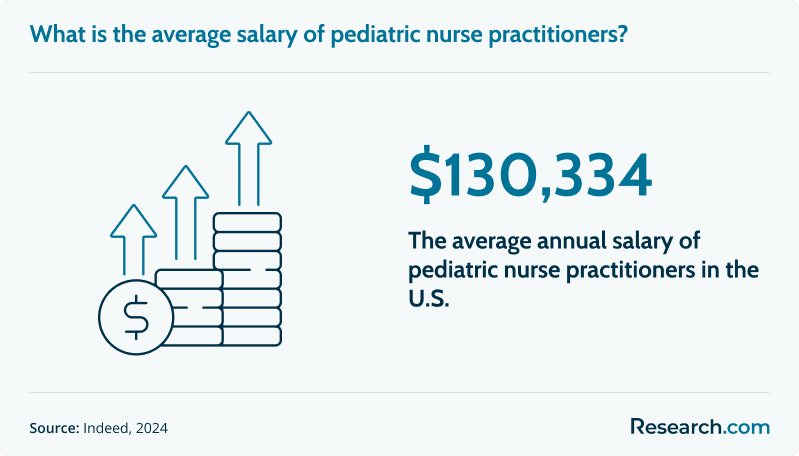
Pediatric nurse practitioner pay depends on location, employer, experience, specialty, shift structure, and whether the role is primary care, acute care, or specialty-based. According to the U.S. Bureau of Labor Statistics, the median annual wage for nurse practitioners is around $126,260. Some pediatric nurse practitioners may earn less or more than this figure depending on their market and role, and experienced practitioners in metropolitan or specialized settings can earn upwards of $190,000 annually.
Because BLS reports wage data for nurse practitioners broadly rather than every pediatric subspecialty separately, applicants should compare national data with local job postings, employer salary ranges, and state-level demand before estimating return on investment.
- Easiest Pediatric Nurse Practitioner Online Programs to Get Into for 2027
- How long does it take to complete an online pediatric nurse practitioner degree?
- How does an online pediatric nurse practitioner degree compare to an on-campus program?
- What is the average cost of an online pediatric nurse practitioner program?
- What are the financial aid options for online pediatric nurse practitioner students?
- What are the prerequisites for online pediatric nurse practitioner programs?
- What courses are typically included in an online pediatric nurse practitioner program?
- What pediatric nurse practitioner specializations are available online?
- How do pediatric nurse practitioner salaries compare to BSN nurse salaries?
- Which nurse practitioner specialties offer the highest pay?
- How do you choose the best online pediatric nurse practitioner program?
- How do pediatric nurse practitioner salaries compare to other advanced practice roles?
- What career paths are available after an online pediatric nurse practitioner program?
- What is the job market for pediatric nurse practitioner graduates?
- Is a bridge program without clinical requirements useful for a pediatric NP career?
- How do online pediatric NP programs use telehealth and simulation?
- What networking and professional development opportunities are available online?
- What challenges could I face in an online pediatric NP program?
- Can I pursue an accelerated pediatric nurse practitioner pathway?
- Can I become a pediatric nurse practitioner without prior nursing experience?
- How can I transition from RN to pediatric nurse practitioner?
- What accreditation and certification standards should I verify?
- How does a program support board certification success?
- Key insights and references
List of the Easiest Pediatric Nurse Practitioner Online Programs to Get Into for 2027
How do we rank schools?
Research.com’s rankings are developed to help students compare education options using transparent criteria and data from recognized sources. For this list, Research.com reviewed information from multiple databases and institutional sources, including:
- IPEDS database
- Peterson’s database, including the Distance Learning Licensed Data Set
- College Scorecard database
- National Center for Education Statistics
The programs below are presented as accessible options based on factors such as online availability, credit requirements, program flexibility, stated costs, pediatric tracks, and accreditation. Applicants should still confirm current admissions rules, state authorization, clinical placement policies, and certification eligibility directly with each school.
1. University of Texas at El Paso (UTEP)
UTEP offers MSN options in Pediatric Acute Care and Pediatric Primary Care Nurse Practitioner preparation. The program is a strong fit for nurses seeking a shorter credit load because it requires 49 credits and can be completed over two years. Coursework is mostly online, with limited campus requirements and clinical experiences arranged within a 200-mile radius.
- Program Length: Two years
- Tracks/Concentrations: Pediatric Acute Care, Pediatric Primary Care
- Cost per Credit: $494
- Required Credits to Graduate: 49
- Accreditation: Commission on Collegiate Nursing Education (CCNE)
2. University of Kentucky
The University of Kentucky offers a BSN-to-DNP pediatric pathway with Pediatric Acute Care and Primary Care Nurse Practitioner tracks. Students complete online didactic coursework and attend in-person sessions on the Lexington campus twice per semester. This model works well for students who want online flexibility but still value structured campus-based clinical learning and faculty interaction.
- Program Length: Three years
- Tracks/Concentrations: Pediatric Acute Care, Pediatric Primary Care
- Cost per Credit: $705
- Required Credits to Graduate: 74
- Accreditation: CCNE
3. Old Dominion University (ODU)
ODU offers an MSN Pediatric Nurse Practitioner program with full-time and part-time study options. The 49-credit curriculum includes online coursework and occasional campus visits for skills assessment. The program is especially relevant for nurses who want primary care pediatric preparation without committing to a fully campus-based format.
- Program Length: Two to four years
- Tracks/Concentrations: Pediatric Primary Care
- Cost per Credit: $551
- Required Credits to Graduate: 49
- Accreditation: CCNE
4. Northwestern State University of Louisiana
Northwestern State University of Louisiana offers an online Pediatric Primary Care pathway requiring 42 credits. Periodic campus visits may be required, but the overall format is built for nurses who need distance learning access. Its lower credit requirement and listed cost per credit can make it a practical option for cost-conscious applicants.
- Program Length: Two to three years
- Tracks/Concentrations: Pediatric Primary Care
- Cost per Credit: $475
- Required Credits to Graduate: 42
- Accreditation: CCNE
5. Texas Woman’s University (TWU)
TWU offers an MSN Pediatric Nurse Practitioner program with a 45-credit curriculum. The program focuses on pediatric primary care and may appeal to nurses who want a flexible schedule, a moderate credit load, and access to an established nursing school network.
- Program Length: Two to three years
- Tracks/Concentrations: Pediatric Primary Care
- Cost per Credit: $526
- Required Credits to Graduate: 45
- Accreditation: CCNE
6. University of Texas at Arlington (UTA)
UTA offers MSN tracks in Pediatric Acute Care and Pediatric Primary Care Nurse Practitioner preparation. The program requires 41 credits and can be completed full time or part time, giving students more control over pacing. Applicants comparing acute and primary care tracks may find UTA useful because both pediatric options are available.
- Program Length: Two to five years
- Tracks/Concentrations: Pediatric Acute Care, Pediatric Primary Care
- Cost per Credit: $515
- Required Credits to Graduate: 41
- Accreditation: CCNE
7. University of Arizona
The University of Arizona offers hybrid BSN-to-DNP and MSN-to-DNP pathways for students at different stages of nursing education. Online coursework is combined with on-campus intensives and clinical placements. The program may suit nurses who want doctoral-level preparation and are comfortable with periodic in-person requirements.
- Program Length: Two and a half to four years
- Tracks/Concentrations: Pediatric Nurse Practitioner
- Cost per Credit: $850
- Required Credits to Graduate: 27 to 64 (depending on the track)
- Accreditation: CCNE
8. University of Iowa
University of Iowa offers DNP pathways for BSN-to-DNP and MSN-to-DNP students, with Pediatric Acute Care and Pediatric Primary Care options. The curriculum combines online coursework with periodic campus visits and advanced clinical training. It may be a strong match for students seeking doctoral preparation with a choice between acute and primary pediatric practice.
- Program Length: Two to four years
- Tracks/Concentrations: Pediatric Acute Care, Pediatric Primary Care
- Cost per Credit: $743
- Required Credits to Graduate: 43 to 78
- Accreditation: CCNE
9. Regis University
Regis University offers RN-to-MSN and BSN-to-DNP pathways for future pediatric nurse practitioners. With online delivery and three annual start dates, the program can be practical for working nurses who need flexible entry points. Students should compare the RN-to-MSN and BSN-to-DNP structures carefully because credit requirements and timelines differ.
- Program Length: 28 to 40 months
- Tracks/Concentrations: Pediatric Nurse Practitioner
- Cost per Credit: $895
- Required Credits to Graduate: 46 to 76
- Accreditation: CCNE
10. Maryville University
Maryville offers an online DNP pathway focused on Pediatric Primary Care. The program is designed for working nurses and does not require campus visits. It may be a good fit for students who want a fully online didactic format while still completing the clinical experiences required for advanced pediatric practice.
- Program Length: Two to three years
- Tracks/Concentrations: Pediatric Primary Care
- Cost per Credit: $897
- Required Credits to Graduate: 41 to 69
- Accreditation: CCNE
How long does it take to complete an online pediatric nurse practitioner degree?
Most pediatric nurse practitioner online programs take two to three years, although the actual timeline depends on the degree level, enrollment status, transfer credits, clinical placement availability, and whether the student already has a BSN or MSN. Full-time students usually finish sooner, while part-time students may need additional semesters to manage work and family responsibilities.
Students entering from different nursing backgrounds may need different routes. Nurses comparing advancement options can review the easiest RN to MSN online program options, while those still comparing entry-level nursing credentials may want to understand the differences between an RN diploma program, ADN, and BSN. Some healthcare workers also compare nursing with adjacent career paths such as learning how to become a medical coder.
| Pathway | Typical student | Time expectation | Best fit |
| MSN Pediatric NP | RN with a BSN | Often two to three years | Nurses who want advanced practice preparation without a DNP requirement |
| BSN-to-DNP Pediatric NP | RN with a BSN seeking doctoral preparation | Often three or more years | Nurses who want advanced clinical leadership and doctoral-level training |
| MSN-to-DNP Pediatric NP | Advanced-prepared nurse seeking a DNP | Varies by transfer credits and track | Nurses who already hold graduate nursing education |
| RN-to-MSN or bridge route | RN without a BSN or with a nontraditional background | Varies widely | Nurses who need an integrated route into graduate nursing study |
How does an online pediatric nurse practitioner degree compare to an on-campus program?
Online pediatric nurse practitioner programs are usually best for licensed nurses who need flexibility but can stay organized, communicate proactively, and complete clinical requirements in approved settings. Campus programs may be better for students who prefer face-to-face instruction, frequent faculty access, structured lab time, and local networking.
Both formats can be rigorous if they are properly accredited and include supervised clinical training. The right choice depends less on whether courses are online and more on whether the program supports your state licensure needs, clinical placement process, board certification goals, and learning style. Nurses comparing similar online advanced practice pathways may also explore what are the easiest WHNP programs online.
| Factor | Online pediatric NP program | On-campus pediatric NP program |
| Schedule flexibility | Usually stronger, especially with asynchronous courses | More fixed class and lab schedules |
| Clinical requirements | Still required; may be arranged locally | Often tied to regional clinical partners |
| Faculty access | Virtual advising, email, video meetings, online office hours | More in-person interaction |
| Networking | Depends on virtual events, alumni networks, and clinical sites | Often easier through campus and local healthcare connections |
| Best for | Working nurses, rural students, and students balancing family obligations | Students who want frequent in-person guidance and structured campus learning |
What is the average cost of an online pediatric nurse practitioner program?
The cost of an online pediatric nurse practitioner program commonly ranges from $400 to $1,200 per credit. For a typical 45-credit program, tuition alone may total $18,000 to $54,000. Students should also budget for technology fees, books, clinical documentation systems, background checks, immunization tracking, travel for campus intensives, certification exam costs, and possible clinical placement fees.
When asking, “Is a nursing degree worth it?” focus on total cost, lost work time, expected local wages, employer tuition assistance, certification eligibility, and whether the program prepares you for the pediatric role you want. According to the 2022 workforce report by the Pediatric Nursing Certification Board (PNCB), over 50,000 registered nurses and advanced practice nurses in the U.S. hold PNCB certification. Students comparing other accessible healthcare programs may also review what are the easiest radiology programs.
| Cost category | What to check before enrolling |
| Tuition | Cost per credit, total credits, in-state versus out-of-state pricing, and tuition increases |
| Fees | Technology, clinical, lab, simulation, graduation, and program-specific fees |
| Clinical expenses | Background checks, health documentation, drug screening, travel, parking, uniforms, and preceptor requirements |
| Certification and licensure | Board exam fees, state application fees, continuing education, and credentialing costs |
| Opportunity cost | Reduced work hours, childcare, commuting for intensives, and time away from paid employment |
What are the financial aid options for students enrolling in an online pediatric nurse practitioner program?
Students in eligible online pediatric nurse practitioner programs may use federal loans, institutional scholarships, grants, payment plans, employer tuition reimbursement, military education benefits, and professional nursing scholarships. Availability depends on the school, program type, enrollment status, and student eligibility.
Before borrowing, ask the financial aid office whether the program qualifies for federal aid, whether part-time enrollment changes aid eligibility, and whether clinical placements could create extra expenses. Nurses interested in child-focused careers outside advanced practice may also compare child development graduate programs. Students considering a major career pivot can review unrelated but flexible professional pathways such as how to become a criminal investigator.
What are the prerequisites for enrolling in an online pediatric nurse practitioner program?
Most online pediatric nurse practitioner programs require an active RN license, a BSN for MSN or BSN-to-DNP entry, official transcripts, prerequisite coursework, professional references, a resume, a personal statement, and a minimum GPA. Some programs also expect pediatric nursing experience, current clinical employment, or specific certifications.
In 2022, 90% of certified pediatric nurse credential holders have completed a bachelor’s degree or above. That figure reflects how common bachelor’s-level or higher preparation is among pediatric nursing professionals and why applicants should confirm degree expectations early.
| Admission requirement | Why schools require it | Question to ask the program |
| Active RN license | Confirms legal eligibility for nursing practice | Must my RN license be in the same state as my clinical placement? |
| BSN or equivalent preparation | Provides the academic foundation for graduate nursing study | Do you accept RN-to-MSN applicants or only BSN-prepared nurses? |
| Pediatric experience | Helps students enter advanced pediatric coursework with relevant clinical context | Is pediatric experience required, preferred, or optional? |
| Minimum GPA | Signals readiness for graduate-level science and clinical coursework | Do you consider applicants below the minimum GPA with strong experience? |
| Clinical placement eligibility | Ensures students can complete supervised practice hours | Does the school place students, or must I find my own preceptors? |
What courses are typically in an online pediatric nurse practitioner program?
Like other types of masters in nursing, pediatric nurse practitioner programs combine advanced nursing science with clinical decision-making. Courses vary by school and track, but most include the following areas:
- Pediatric Pharmacology: Medication selection, dosing, monitoring, and safety considerations for infants, children, and adolescents.
- Advanced Physical Assessment: Head-to-toe assessment, diagnostic reasoning, and recognition of normal and abnormal pediatric findings.
- Child Health Assessment: Growth, development, screening, family history, psychosocial assessment, and anticipatory guidance.
- Pediatrics in Primary Care: Common pediatric conditions, preventive care, health maintenance, chronic disease management, and referral decisions.
- Evidence-Based Practice: Research interpretation, quality improvement, and application of best practices in pediatric care.
What types of specializations are available in online pediatric nurse practitioner programs?
Pediatric nurse practitioner programs are not all the same. The most important distinction is usually primary care versus acute care, because each track prepares students for different patient populations, settings, and certification pathways.
- Pediatric Primary Care: Focuses on wellness care, prevention, common illnesses, developmental screening, chronic disease management, and outpatient pediatrics.
- Pediatric Acute Care: Prepares nurses to care for children with complex, unstable, or critical conditions in hospitals and specialty settings.
- Pediatric Behavioral Health: Addresses mental health, behavioral concerns, developmental issues, and family-centered intervention for children and adolescents.
| Specialization | Best for students who want to work in | Typical care focus |
| Pediatric Primary Care | Clinics, private practices, school-based health, community health | Prevention, wellness, common conditions, chronic care, family education |
| Pediatric Acute Care | Hospitals, emergency departments, intensive care, specialty units | High-acuity illness, complex conditions, inpatient management, urgent intervention |
| Pediatric Behavioral Health | Integrated care clinics, specialty practices, community programs | Mental health screening, behavioral concerns, developmental support, referrals |
How do pediatric nurse practitioner salaries compare to BSN nurse salaries?
Pediatric nurse practitioners typically qualify for advanced practice roles that carry different responsibilities and compensation structures than BSN-level registered nursing positions. A BSN nurse may provide direct bedside or clinical care under RN scope, while a pediatric nurse practitioner may assess, diagnose, manage treatment plans, and prescribe when allowed by state law and employer policy.
Actual salary differences vary by region, setting, union status, specialty, and experience. For broader RN salary context, review how much BSN nurses make.
Which nurse practitioner specialties offer the highest pay?
Pediatric nurse practitioner roles can offer strong compensation, but some nurse practitioner specialties may pay more because of acuity, work setting, call requirements, procedure intensity, or labor market demand. Acute care and emergency medicine roles are often discussed among higher-paying NP paths, although pay varies considerably by employer and location.
Students comparing long-term earning potential should review specialty-specific data, local job postings, and certification requirements. Research.com’s guide to the highest paying nurse practitioner jobs can help applicants compare pediatric practice with other advanced nursing options.
How do you choose the best online pediatric nurse practitioner program?
The best online pediatric nurse practitioner program is the one that fits your state, schedule, budget, clinical placement needs, certification goal, and preferred pediatric setting. Do not choose solely because a program appears easy to enter. A weak fit can delay graduation, increase costs, or leave you unprepared for board certification.
Clinical placement support deserves special attention. Research has emphasized the importance of evaluating clinical placement structures, and applicants should assess the clinical placement options before committing to a program.
| Selection factor | What to verify | Why it affects your decision |
| Accreditation | CCNE or another recognized nursing accreditation status | Can affect certification, licensure, employer acceptance, and financial aid |
| State authorization | Whether the school can enroll students and approve clinicals in your state | Online programs may not be available in every state |
| Clinical placement support | School-arranged placements, student-secured placements, or shared responsibility | Clinical delays are one of the biggest risks in NP programs |
| Track alignment | Primary care, acute care, or another pediatric focus | Your track should match your desired job and certification pathway |
| Total cost | Tuition, fees, travel, books, certification, and reduced work hours | Low tuition per credit does not always mean lowest total cost |
| Board preparation | Pass-rate information, review resources, practice exams, and advising | Certification readiness is essential for advanced practice employment |
How do pediatric nurse practitioner salaries compare to other advanced practice roles?
Pediatric nurse practitioner compensation can differ from other advanced practice roles because pediatric care settings, reimbursement patterns, acuity levels, and geographic demand vary. Psychiatric-mental health, acute care, family practice, and specialty NP roles may have different salary patterns depending on the state and employer.
Students comparing advanced practice specialties should look at state-level salary patterns, not only national medians. For example, reviewing PMHNP salary by state can show how compensation changes across markets and specialties.
What career paths are available for graduates of online pediatric nurse practitioner programs?
Graduates of online pediatric nurse practitioner programs can pursue clinical, educational, administrative, research, and consulting roles. The best path depends on certification, practice authority, experience, and specialty track.
- Pediatric primary care provider: Offers preventive care, sick visits, health education, developmental screening, and chronic condition management in outpatient settings.
- Pediatric acute care provider: Works with children who have complex, urgent, or critical health needs in hospital-based environments.
- Pediatric nurse educator: Teaches nursing students, staff nurses, patients, or families in academic and clinical settings.
- Pediatric healthcare researcher: Supports studies, quality improvement, and evidence-based pediatric care initiatives.
- Healthcare consultant: Advises organizations on pediatric care delivery, quality, workflow, education, and policy implementation.
Location can also influence opportunity. Nurses comparing employment markets can review the best cities to work as a nurse while researching pediatric NP openings in their target state.
What is the job market for graduates with a pediatric nurse practitioner degree?
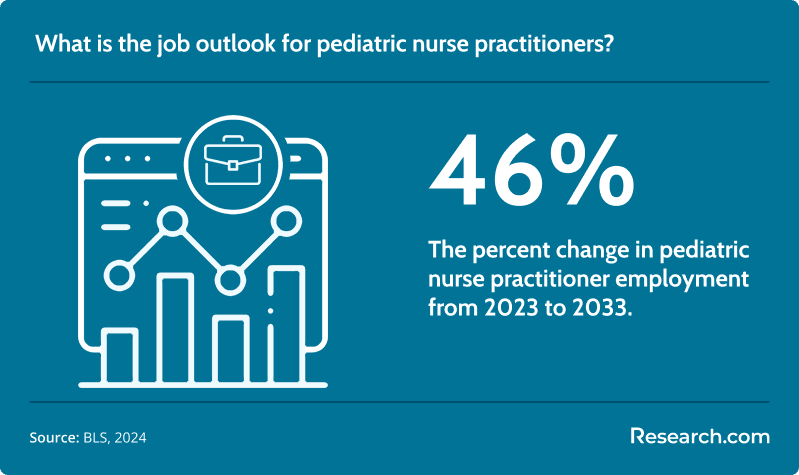
The job outlook for nurse practitioners is strong. The projected job growth for nurse practitioners from 2023 to 2033 is 46%, which indicates continued demand for advanced practice clinicians. Pediatric nurse practitioners may benefit from this broader demand, especially in areas with shortages of pediatric providers, growing outpatient care needs, and limited access to child-focused services.
However, job availability is not identical in every region. Graduates should compare local pediatric clinics, children’s hospitals, community health centers, specialty practices, and state scope-of-practice rules. The American Association of Nurse Practitioners provides additional perspective on the quality of nurse practitioner practice.
Here’s What Graduates Have to Say About Their Online Pediatric Nurse Practitioner Degree
-
: "
“Online study let me keep working full time while preparing for pediatric advanced practice. The flexibility mattered, but I still had to be disciplined with clinical hours, assignments, and family responsibilities.” Mia
"
-
: "
“The virtual classroom format worked because faculty were responsive and the program gave clear expectations. I could study on my schedule, but I never felt completely disconnected from classmates or instructors.” Josh
"
-
: "
“I appreciated learning with nurses from different regions and practice settings. The coursework connected directly to pediatric cases I was seeing at work, which made the online format feel practical rather than distant.” Trisha
"
Is a Bridge Program Without Clinical Requirements a Viable Option for Advancing My Pediatric Nurse Practitioner Career?
A bridge program without clinical requirements can help an RN strengthen academic credentials, especially when moving from RN to BSN or preparing for graduate study. It is not a substitute for a pediatric nurse practitioner program, because PNP preparation requires supervised clinical training for advanced practice readiness.
For nurses who first need a bachelor’s degree, online RN to BSN no clinicals programs may be useful. But students planning to become pediatric nurse practitioners should expect graduate-level clinical requirements later.
How Do Online Pediatric Nurse Practitioner Programs Integrate Telehealth and Simulation in Clinical Training?
Online pediatric nurse practitioner programs often use telehealth modules, virtual patient cases, standardized scenarios, and simulation labs to help students practice assessment and clinical reasoning. These tools are especially useful for pediatric care because children’s symptoms, family communication, developmental stages, and safety concerns require specialized judgment.
Simulation does not replace required clinical hours, but it can strengthen readiness before students enter pediatric clinical settings. Nurses building toward advanced practice may also compare foundational pathways such as the best accelerated BSN online programs.
What Are the Networking and Professional Development Opportunities in Online Pediatric Nurse Practitioner Programs?
Strong online pediatric nurse practitioner programs create professional connection points through virtual orientations, faculty mentoring, discussion boards, clinical site relationships, alumni groups, webinars, professional association engagement, and career advising. These opportunities matter because many pediatric NP jobs are found through clinical rotations, faculty referrals, local healthcare networks, and specialty communities.
Students still moving through earlier nursing stages may explore the most affordable LPN to RN online pathway before progressing to BSN and graduate pediatric NP preparation.
What challenges could I face in completing an online pediatric nurse practitioner program?
Online pediatric nurse practitioner programs can be demanding because students must manage graduate coursework, clinical hours, technology requirements, communication with preceptors, and often full-time or part-time employment. Flexibility helps, but it also requires self-discipline.
| Common challenge | Why it happens | How to reduce the risk |
| Clinical placement delays | Preceptors may be limited in some regions | Ask before enrollment whether the school guarantees, arranges, or only approves placements |
| Time-management pressure | Students balance work, family, coursework, and clinical hours | Plan work schedules around clinical semesters before the program begins |
| State authorization issues | Online programs cannot always operate or place students in every state | Confirm state eligibility in writing with the program |
| Technology and simulation demands | Online platforms may require reliable devices, internet, webcams, and testing tools | Review technical requirements before accepting admission |
| Mismatch between track and career goal | Primary care and acute care preparation lead to different roles | Compare job postings and certification pathways before selecting a track |
Students comparing time-intensive NP options may also review the fastest WHNP MSN degree online to understand how accelerated advanced nursing programs structure clinical and academic expectations.
Can I pursue an accelerated pathway to earning my pediatric nurse practitioner degree?
Some pediatric nurse practitioner programs offer accelerated or shorter pathways, especially for applicants who already meet specific nursing education and clinical experience requirements. These options can reduce time to completion, but they may also require heavier course loads, tighter clinical schedules, and fewer breaks.
Before choosing an accelerated format, confirm that the program remains accredited, includes all required clinical hours, supports certification eligibility, and is realistic with your work schedule. Nurses interested in doctoral-level accelerated options can compare accelerated DNP programs.
Can I Become a Pediatric Nurse Practitioner Without Prior Nursing Experience?
Becoming a pediatric nurse practitioner without prior nursing experience is possible only through longer pathways that first prepare you for RN licensure and foundational nursing practice. Pediatric nurse practitioner roles are advanced practice nursing roles, so applicants must eventually complete nursing prerequisites, become licensed nurses, and meet graduate program admission and clinical requirements.
Non-nurses exploring advanced nursing should carefully review direct-entry nurse practitioner programs for non-nurses online. Not every direct-entry program leads directly to pediatric NP eligibility, so confirm the exact track, licensure sequence, accreditation, and clinical placement plan.
How Can I Transition from RN to Pediatric Nurse Practitioner Effectively?
The most effective RN-to-pediatric-NP transition starts with identifying your current education level, target pediatric setting, state requirements, and preferred timeline. An RN without a BSN may need an RN-to-BSN or RN-to-MSN route first. A BSN-prepared RN can compare MSN and BSN-to-DNP pediatric NP programs directly.
Cost can shape the pathway. Nurses looking for an affordable bachelor’s completion step may review the cheapest online accelerated BSN programs before applying to pediatric nurse practitioner programs.
- Confirm your RN license status and state practice goals.
- Decide whether you want pediatric primary care, acute care, or another child-focused specialty.
- Compare accredited MSN, BSN-to-DNP, and bridge pathways.
- Ask each school how clinical placements are secured.
- Estimate total cost, not just tuition per credit.
- Verify that the program prepares graduates for the correct pediatric certification exam.
What Accreditation and Certification Standards Should I Verify?
Accreditation and certification eligibility should be non-negotiable. An online pediatric nurse practitioner program should hold recognized nursing accreditation, clearly identify its pediatric track, meet state authorization rules, and prepare graduates for the appropriate board certification pathway.
Applicants comparing cost across advanced practice options may also review cheapest FNP programs online, but pediatric NP students should not assume an FNP program is interchangeable with pediatric-specific preparation.
- Is the nursing program accredited by CCNE or another recognized accreditor?
- Does the pediatric track match the certification you plan to pursue?
- Is the program authorized for students in your state?
- Will your clinical sites be approved for your state and specialty track?
- Does the school publish or provide board certification preparation support?
How Does My Program Ensure Board Certification Success?
A strong pediatric nurse practitioner program supports certification readiness throughout the curriculum, not only at the end. Look for certification-aligned courses, pediatric case reviews, faculty advising, practice exams, simulation, remediation plans, and guidance on application requirements.
Students comparing broader nursing admissions options can also review the easy nursing school to get into directory, but graduate pediatric NP applicants should prioritize certification outcomes, clinical quality, and accreditation over admission convenience alone.
Common Mistakes to Avoid When Choosing an Online Pediatric Nurse Practitioner Program
- Assuming “online” means no clinicals: Pediatric nurse practitioner programs require hands-on supervised clinical training.
- Choosing only by tuition per credit: Fees, travel, clinical costs, and lost work time can change the real cost.
- Ignoring state authorization: Some online programs cannot enroll students or approve clinical placements in every state.
- Confusing primary care and acute care tracks: These tracks prepare students for different roles and certification pathways.
- Waiting too long to plan clinical placements: Preceptor availability can affect graduation timing.
- Relying only on rankings: A highly ranked program may still be a poor fit if it does not support your state, schedule, or pediatric specialty goal.
Key Insights
- Accessible pediatric nurse practitioner programs are not “easy” academically; they are easier to enter or manage because of flexible formats, clear admissions requirements, reasonable credit loads, and online coursework.
- The most important decision is track fit. Pediatric Primary Care is usually best for outpatient, preventive, and chronic care roles, while Pediatric Acute Care prepares students for hospital and high-acuity settings.
- Online programs still require clinical hours. Before enrolling, confirm whether the school finds preceptors, helps with placement, or expects students to secure their own sites.
- Program costs commonly range from $400 to $1,200 per credit, with a typical 45-credit program totaling $18,000 to $54,000 before additional fees and expenses.
- Nurse practitioners have a strong employment outlook, with projected job growth of 46% from 2023 to 2033, but pediatric NP opportunities vary by state, setting, and specialty.
- Accreditation, certification eligibility, state authorization, and clinical placement support matter more than admission convenience.
References
- BLS. (2024). Occupational Employment and Wage Statistics: Nurse Practitioners. BLS.
- BLS. (2024). Occupational Outlook Handbook: Nurse Anesthetists, Nurse Midwives, and Nurse Practitioners. BLS.
- Courtwright, S. and Barr, E. (2023). Pediatric nurse practitioner workforce shortage threatens child health equity: Key contributors and recommendations. Journal of the American Association of Nurse Practitioners, 35(11), 661–665. PubMed.
- Indeed. (2024). Pediatric nurse practitioner salary in United States. Indeed.
- PNCB. (2022). Pediatric Nursing Workforce Report 2022: A Demographic Profile of 53,000 PNCB-Certified Nursing Professionals. pncb.org.
Other Things You Should Know About Pediatric Nurse Practitioner Online Programs
Tennessee, Kentucky, and Arizona are known for having more lenient admission criteria for Pediatric Nurse Practitioner online programs in 2027, focusing more on GPA and less on GRE scores, making them accessible to a wider range of applicants.
Yes. Most Pediatric Nurse Practitioner online programs require a BSN from an accredited school and an active, unencumbered RN license. Many also ask for at least one year of pediatric or acute-care nursing experience, plus a minimum GPA of 3.0 on undergraduate coursework.