
2027 BSN Salary: How Much Does a BSN Nurse Make?

Co-Founder and Chief Data Scientist
A BSN salary matters because nursing is no longer a single-track career where every registered nurse earns roughly the same pay. Your degree level, state, employer type, specialty, certifications, shift structure, and long-term education plans can all affect how much you earn after becoming a registered nurse. For students comparing ADN, BSN, RN-to-BSN, MSN, NP, and DNP pathways, salary is also central to the question of whether the degree is worth the time and cost.
This guide explains how much BSN-prepared nurses earn, where registered nurses are paid the most, which industries hire and compensate RNs well, and what steps can raise earning potential after graduation. It is written for prospective nursing students, ADN-prepared RNs considering a BSN, current BSN nurses planning advancement, and career changers comparing nursing with other healthcare paths.
Quick Answer: How Much Can You Earn With a BSN?
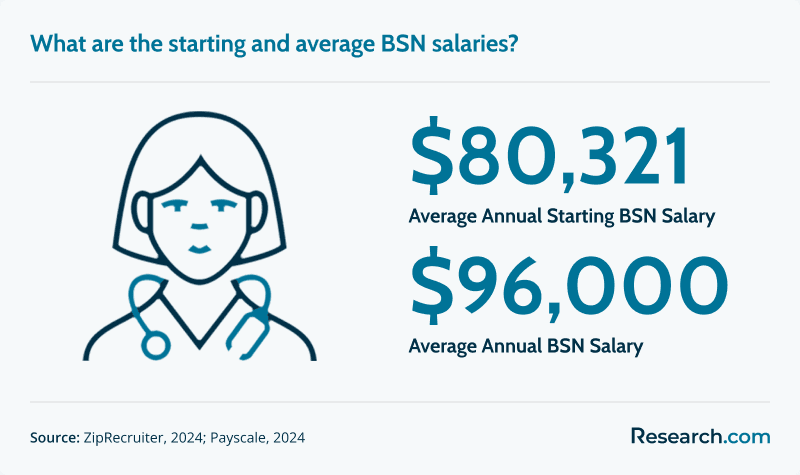
The starting wage of nurses with a BSN degree ranges from $61,152 to $80,321, based on the sources cited in this guide. Payscale reports the average annual BSN salary at $96,000. By comparison, the BLS reports average annual and median annual RN salaries of $94,480 and $86,070, respectively. Pay can rise with experience, specialty certification, leadership responsibility, advanced education, and relocation to higher-paying states or industries.
Key Things You Should Know About BSN Salary
- The starting wage of nurses with a BSN degree ranges from $61,152 to $80,321.
- The average annual BSN salary is $96,000.
- There are around 3,175,390 registered nurses in the United States.
- The US states that offer the highest average annual salaries to registered nurses are California ($137,690), Hawaii ($119,710), Oregon ($113,440), Washington ($111,030), and Alaska ($109,210).
- The industries that furnish the highest average annual salary to registered nurses in the United States are the US government ($114,860), employment services ($110,230), pharmaceutical and medicine manufacturing ($108,640), navigational, measuring, electromedical, and control instrument manufacturing ($106,470), and merchant wholesalers and nondurable goods ($103,940).
- The US states that hire the most registered nurses are California (332,560), Texas (251,840), Florida (207,910), New York (188,060), and Pennsylvania (144,100).
- Starting BSN salary: what new nurses can expect
- Average BSN salary and how it compares with ADN pay
- Registered nurse workforce size in the United States
- Certifications that may help BSN nurses earn more
- Highest-paying states for registered nurses
- Lowest-paying states for registered nurses
- Advanced education options for BSN nurses
- How BSN nurses can prepare for salary negotiations
- Why BSN salaries vary by nurse and location
- Can a 12-month FNP program online accelerate a nursing career?
- PMHNP salary considerations by stateFNP program planning
- Highest-paying industries for registered nurses
- Job outlook for BSN-prepared nurses
- BSN degree ROI and cost considerations
- Online DNP programs and career acceleration
- Affordable women’s health NP specialization options
- States with the highest RN employment levels
- Industries that employ the most registered nurses
- How to choose a BSN program that fits your goals
- Can a DNP help BSN nurses move into advanced roles?DNP planning questions
What a BSN Salary Really Means
A BSN salary generally refers to earnings for registered nurses who hold a Bachelor of Science in Nursing. A BSN does not replace RN licensure. Instead, it is an academic degree that can prepare graduates to sit for licensure, qualify for more competitive RN roles, or meet employer preferences for bachelor’s-prepared nurses.
Salary data can look different across sources because each source may measure a different group of nurses. Some report salaries for all RNs, while others focus on people who list a BSN as their degree. Some sources also include experienced nurses, charge nurses, travel nurses, case managers, nurse leaders, or specialty nurses. For that reason, salary figures should be used as planning benchmarks rather than guaranteed earnings.
| Salary question | Reported figure | How to interpret it |
| Entry-level BSN salary range | $61,152 to $80,321 | A useful planning range for new BSN-prepared nurses, though actual pay varies by employer, shift, state, and specialty. |
| Average annual BSN salary | $96,000 | A broad degree-based figure from Payscale that may include nurses at different career stages. |
| BLS average annual RN salary | $94,480 | A national RN wage measure that includes registered nurses with different education levels. |
| BLS median annual RN salary | $86,070 | The midpoint salary for registered nurses, meaning half earn more and half earn less. |
| Payscale ADN salary | $79,000 | A comparison point for nurses deciding whether moving from an ADN to a BSN may improve long-term earning potential. |
What is the starting BSN salary?
ZipRecruiter reports an average annual entry-level BSN salary of $80,321. Indeed salary data for registered nurses reports a lower figure of $61,152. Taken together, these sources place starting BSN pay between $61,152 and $80,321. That range is higher than the collective median annual salary of all jobs in the United States, which is $48,060.
New BSN nurses should not assume that the highest number applies to every first job. Entry-level pay depends heavily on the state, hospital system, union status, specialty unit, night or weekend differentials, and whether the role is in acute care, long-term care, outpatient care, home health, or another setting. A new graduate in a high-cost metro area may see a very different offer from a nurse in a rural clinic or smaller facility.
Early-career salary growth usually comes from gaining clinical experience, moving into higher-demand units, earning specialty credentials, taking charge nurse responsibilities, or pursuing graduate education. Nurses who later complete a Master of Science in Nursing may qualify for advanced practice roles, and MSN salary varies by APRN specialization and employer type.
How new BSN nurses can evaluate a first offer
- Compare base pay separately from differentials. Night shift, weekend, float pool, overtime, and on-call pay can make an offer look stronger, but base salary matters for long-term comparisons.
- Look beyond salary. Tuition reimbursement, certification support, health benefits, retirement contributions, scheduling stability, and residency programs can affect total value.
- Ask about progression. A lower starting offer may be acceptable if the employer has transparent clinical ladders, specialty training, and defined pay increases.
- Check whether a BSN is preferred or required. In some settings, BSN preparation may improve access to competitive units or leadership tracks.
What is the average BSN salary?
Payscale reports the average annual BSN salary at $96,000, including graduates of fast-track RN-to-BSN online programs. This figure is slightly higher than the BLS average annual RN salary of $94,480 and the BLS median annual RN salary of $86,070. Payscale also reports that ADN graduates typically earn $79,000, which makes the BSN the undergraduate nursing credential with the stronger reported earning potential in the data cited here.
The BSN is also a common credential among registered nurses. Data from the American Association of Colleges of Nursing shows that 71.7% of RNs earned a BSN or higher degree. For working RNs, flexible options such as online RN-to-BSN programs without clinicals may make it easier to complete the bachelor’s degree while remaining employed.
The salary advantage of a BSN should be evaluated in context. A BSN can support career mobility, but it does not automatically guarantee a specific wage. The strongest financial outcomes often come when the degree is paired with in-demand experience, specialty certification, strong references, leadership ability, or graduate preparation for advanced practice.
| Path | Reported salary figure | Best fit for | Important trade-off |
| ADN | $79,000 | Students who want the shortest undergraduate route into RN practice. | Some employers prefer or require a BSN for advancement, specialty units, or leadership roles. |
| BSN | $96,000 | Students and RNs seeking broader employment options and stronger long-term mobility. | Usually requires more education than an ADN, so cost and time should be weighed carefully. |
| MSN or NP pathway | Depends on specialization | BSN nurses who want advanced clinical, leadership, education, or specialized practice roles. | Graduate education requires additional tuition, clinical hours, and licensure or certification planning. |
How many registered nurses are there in the United States?
HRSA reports around 3,175,390 registered nurses in the United States. The BLS reports about 3,300,100 registered nurses. RNs represent the largest share of the national nursing workforce, accounting for 76.69%. For BSN graduates, this means the profession is large, geographically widespread, and present across many employer types.
Workforce size also affects career planning. States and industries with large RN employment levels may offer more openings, more specialty units, and more mobility between employers. However, high employment does not always mean the highest pay. A nurse comparing two states should look at wages, cost of living, licensing requirements, work conditions, union presence, and advancement opportunities.
Nurse practitioners account for around 6.77% of the US nursing workforce, but their employment in 2023 grew by 35.5% year-over-year. That growth explains why many BSN nurses eventually consider graduate study, especially if they want more autonomy, a defined specialization, or a stronger salary ceiling.
What are the best certifications to increase a BSN salary?
Certification can make a BSN-prepared nurse more competitive for specialized units, leadership opportunities, or roles that require advanced clinical judgment. A credential is most valuable when it aligns with the nurse’s actual practice area. For example, critical care certification is more relevant for ICU nurses than for school nurses, while diabetes education credentials may fit chronic disease management, outpatient care, or population health roles.
Graduates of flexible programs, including some of the easiest online RN-to-BSN programs, should choose certifications based on their career direction rather than collecting credentials at random.
| Certification | Best suited for | How it can support salary growth |
| CCRN (Critical Care Registered Nurse) | ICU and critical care nurses | The CCRN credential confirms expertise with acutely and critically ill patients, which can strengthen applications for critical care roles and advancement. |
| CEN (Certified Emergency Nurse) | Emergency department nurses | Demonstrates emergency nursing knowledge that may help nurses qualify for higher-responsibility acute care positions. |
| OCN (Oncology Certified Nurse) | Oncology units and cancer care settings | Signals specialized competence in cancer care, patient education, symptom management, and oncology treatment support. |
| CNOR (Certified Perioperative Nurse) | Operating room and surgical services nurses | Supports perioperative career growth by validating knowledge of surgical care, patient safety, and quality standards. |
| PALS (Pediatric Advanced Life Support) | Pediatric, emergency, and critical care nurses | Shows competency in pediatric life support skills required or preferred in certain acute care roles. |
| NE-BC/NEA-BC (Nurse Executive Certification) | Nurse managers, directors, and administrative leaders | Helps BSN-prepared nurses demonstrate readiness for management and organizational leadership pathways. |
| CDCES (Certified Diabetes Care and Education Specialist) | Diabetes education, chronic disease management, and outpatient care | Can support roles focused on diabetes self-management, patient coaching, and population health initiatives. |
| CNE (Certified Nurse Educator) | Academic, staff development, and clinical education roles | May help nurses move toward teaching, onboarding, simulation, or staff training responsibilities. |
| ACLS (Advanced Cardiovascular Life Support) | Emergency, telemetry, ICU, and acute care settings | Often strengthens eligibility for roles where advanced cardiac response skills are expected. |
| NC-BC (Board-Certified Nurse Coach) | Wellness, patient advocacy, private practice, and holistic care roles | Supports career paths involving behavior change, care navigation, and patient-centered coaching. |
How to choose the right certification
- Start with the specialty you already work in or want to enter.
- Ask whether your employer pays certification fees or offers a salary differential.
- Review experience requirements before paying for exam preparation.
- Prioritize credentials that hiring managers in your target unit recognize.
- Avoid paying for certifications that do not match your clinical responsibilities.
What are the highest-paying states for RNs?
The US states with the highest average annual salaries for registered nurses are California ($137,690), Hawaii ($119,710), Oregon ($113,440), Washington ($111,030), and Alaska ($109,210). California is also the state with the highest RN employment level, which makes it notable for both pay and job volume.
High-paying states can be attractive, but salary should not be the only decision point. Housing costs, commute time, patient ratios, overtime expectations, licensing timelines, family needs, and local competition can change the real value of a job offer. A six-figure salary in one state may not stretch as far as a lower salary in a region with lower living costs.
BSN nurses who want to move into higher-paid clinical roles can also consider advanced practice. If that is your long-term goal, Research.com’s guide on how to become a nurse practitioner explains the education and credentialing path.
| Rank among listed states | State | Average annual RN salary | Planning note |
| 1 | California | $137,690 | Highest listed pay and highest RN employment level. |
| 2 | Hawaii | $119,710 | Strong pay, but relocation and cost considerations are important. |
| 3 | Oregon | $113,440 | Competitive RN wages in the Pacific Northwest. |
| 4 | Washington | $111,030 | Strong salary market with multiple healthcare employers. |
| 5 | Alaska | $109,210 | High pay may reflect regional staffing needs and practice conditions. |
What are the lowest-paying states for RNs?
The states with the lowest average annual salaries for registered nurses are South Dakota ($69,030), Alabama ($71,370), Arkansas ($72,900), Iowa ($74,610), Mississippi ($75,510), and West Virginia ($75,990). Lower average pay does not mean these states are poor choices for every nurse. They may offer lower living costs, less competitive entry-level markets, community-based opportunities, or clearer paths into local leadership roles.
South Dakota has the lowest average BSN salary among the listed states, but nurses there may eventually earn $79,450-$85,400 as they build experience and move into senior roles. Nurses who want a larger salary jump can also consider graduate education, including online direct-entry MSN programs for eligible students pursuing advanced nursing pathways.
| State | Average annual RN salary | How to think about the number |
| South Dakota | $69,030 | Lowest listed average, but experienced nurses may still progress into stronger local earnings. |
| Alabama | $71,370 | Salary should be weighed against local costs, employer benefits, and advancement options. |
| Arkansas | $72,900 | May still offer meaningful opportunities in hospitals, outpatient care, and community health. |
| Iowa | $74,610 | Job choice, specialty, and employer type may matter more than statewide average alone. |
| Mississippi | $75,510 | RNs should compare total compensation and career ladder policies before accepting offers. |
| West Virginia | $75,990 | Advancement may depend on specialty experience, certifications, and graduate education plans. |
What advanced education opportunities can further propel a BSN nurse’s career?
BSN nurses who want to move beyond bedside RN roles can pursue graduate education, specialty certificates, leadership preparation, or advanced practice training. The right pathway depends on whether the nurse wants to diagnose and treat patients, manage teams, teach future nurses, work in informatics, influence policy, or lead quality improvement projects.
For nurses aiming at nurse practitioner roles, bridge and graduate pathways can shorten the transition when they are properly accredited and aligned with state requirements. Research.com’s overview of RN-to-NP programs can help nurses compare bridge options that may lead toward advanced clinical practice.
| Education option | Career direction | When it makes sense |
| RN-to-BSN | Broader RN opportunities and bachelor’s-level preparation | Best for ADN-prepared RNs whose employers prefer or require a BSN. |
| MSN | Advanced practice, education, leadership, or specialized nursing roles | Useful when the nurse has a defined graduate-level career target. |
| NP program | Family, psychiatric, women’s health, adult-gerontology, or other advanced practice areas | Appropriate for nurses seeking advanced clinical responsibility and licensure eligibility. |
| DNP | Advanced clinical leadership, systems improvement, policy, or executive practice | Best for nurses who want practice-focused doctoral preparation. |
| Specialty certification | Unit-specific expertise or leadership within a specialty | Often valuable when the nurse wants advancement without immediately starting another degree. |
How can BSN nurses effectively negotiate their salaries?
BSN nurses improve their negotiating position when they bring evidence, not vague expectations. Before discussing pay, gather local salary benchmarks, review comparable job postings, document recent accomplishments, and identify credentials or responsibilities that make your work more valuable. Examples include precepting new nurses, serving as charge nurse, covering high-acuity assignments, holding specialty certification, or contributing to quality improvement.
Negotiation is strongest when it is tied to employer needs. A nurse who can fill a difficult-to-staff unit, reduce onboarding burden, support patient education, or take leadership tasks has a clearer case than a nurse who asks for a raise based only on tenure. Nurses planning advanced practice may also explore accelerated nurse practitioner programs if graduate preparation fits their career goals.
Salary negotiation checklist for BSN nurses
- Know the pay range for your role, specialty, and geographic area.
- Separate base pay from overtime, bonuses, and shift differentials.
- Prepare examples of measurable contributions, such as mentoring, committee work, specialty training, or high-acuity experience.
- Ask about clinical ladder requirements if salary is not immediately negotiable.
- Consider negotiating tuition assistance, certification reimbursement, schedule flexibility, or professional development funds.
What factors influence BSN salary variations?
BSN salaries vary because nursing jobs are not interchangeable. Two nurses with the same degree may earn different pay because they work in different states, specialties, shifts, facilities, or industries. A government role, a hospital ICU role, a pharmaceutical manufacturing role, and a home health role may all require nursing judgment but operate under different compensation models.
Education outside nursing can also shape career direction, though it should be chosen carefully. For example, a nurse interested in medication safety, clinical research, or interdisciplinary healthcare work might evaluate whether a pharmacy online degree supports a realistic career transition. That type of decision should be based on licensure requirements, cost, career fit, and employer demand rather than salary assumptions alone.
| Factor | Why it affects pay | Question to ask |
| State and metro area | Local demand, cost of living, employer competition, and labor conditions affect wages. | Does the higher salary still make sense after relocation and living costs? |
| Employer type | Government, hospital, outpatient, manufacturing, staffing, and home health employers pay differently. | Which employers in my area pay for the specialty I want? |
| Specialty | Critical care, emergency, oncology, perioperative, and other areas may reward specialized skills. | What experience or certification is needed for the unit I want? |
| Experience level | Senior nurses often qualify for charge, preceptor, clinical ladder, or supervisory responsibilities. | How does this employer define and reward progression? |
| Education and credentials | BSN, MSN, NP preparation, DNP study, and certifications may expand role eligibility. | Will this credential qualify me for a specific role, or is it only a resume addition? |
Can a 12-month FNP program online accelerate my career transition?
A 12-month FNP pathway may appeal to BSN-qualified nurses who want to move quickly into family nurse practitioner preparation, but speed should never be the only selection factor. A compressed program can be demanding, especially for nurses who are working, managing family responsibilities, or completing clinical placement requirements.
Before enrolling, verify accreditation, state authorization, clinical placement support, curriculum sequence, faculty access, and whether the program meets requirements for your intended licensure state. If the timeline is realistic for your background and schedule, a 12-month FNP program online may provide a focused route toward advanced family practice preparation.
When a shorter FNP program may make sense
- You already have strong RN experience and clear advanced practice goals.
- Your work schedule can accommodate intensive coursework and clinical expectations.
- The program is accredited and appropriate for your state’s licensure rules.
- You have confirmed how clinical placements are arranged.
- You understand that faster completion can mean a heavier short-term workload.
How do PMHNP salaries compare across states?
BSN nurses interested in psychiatric mental health care should evaluate salary by state before choosing a graduate specialty or relocation plan. PMHNP compensation can differ from broader RN and BSN salary patterns because psychiatric workforce demand, mental health service access, state practice rules, and regional employer needs vary widely.
Rather than assuming that a high-paying RN state automatically offers the best psychiatric NP opportunity, compare role-specific data. Research.com’s PMHNP salary by state guide provides a more targeted view for nurses considering psychiatric mental health specialization.
What are the highest-paying industries for RNs?
The highest-paying industries for registered nurses in the United States are the US government ($114,860), employment services ($110,230), pharmaceutical and medicine manufacturing ($108,640), navigational, measuring, electromedical, and control instrument manufacturing ($106,470), and merchant wholesalers and nondurable goods ($103,940).
Hospitals and traditional healthcare employers may not always top the salary list, but they remain important because they employ large numbers of nurses and provide broad clinical training. Nurses who complete one of the most affordable accredited online RN-to-BSN programs may use the BSN to compete for roles across both direct care and nontraditional nursing settings.
| Industry | Average annual RN salary | Career planning note |
| US government | $114,860 | May offer structured benefits and roles in federal healthcare systems. |
| Employment services | $110,230 | Can include staffing models where flexibility and assignment type affect compensation. |
| Pharmaceutical and medicine manufacturing | $108,640 | May fit nurses interested in clinical research, safety, education, or industry-facing roles. |
| Navigational, measuring, electromedical, and control instrument manufacturing | $106,470 | Can involve healthcare technology, devices, or clinical expertise outside traditional bedside care. |
| Merchant wholesalers and nondurable goods | $103,940 | May involve sales support, product education, clinical liaison work, or related functions. |
What is the job outlook of BSN nurses?
BLS data shows that employment of registered nurses is projected to grow by 6% from 2023 to 2033. That is slightly faster than the 4% growth rate projected for all occupations over the same period. The BLS also projects around 194,500 RN openings each year across the country.
For BSN nurses, the outlook is supported by continued healthcare needs, aging populations, chronic disease management, outpatient care growth, and ongoing demand across hospitals, clinics, home health, and community settings. However, job quality and competitiveness vary by region and specialty. New graduates should evaluate nurse residency options, staffing models, training support, and turnover indicators rather than relying only on national growth projections.
Graduate-prepared nurses may see different opportunities. Employment of nurse practitioners is projected to grow by 46% over the same period. Nurses comparing graduate routes can explore accelerated DNP programs or, for non-nursing professionals pursuing a combined pathway, direct-entry nurse practitioner programs.
Current trends affecting BSN salary and hiring
- Higher employer expectations: Many healthcare employers continue to value BSN preparation, especially for hospital roles, leadership pipelines, and specialty units.
- Growth in outpatient and home-based care: RNs increasingly work outside traditional inpatient settings, including home health, ambulatory care, chronic disease programs, and telehealth-supported services.
- Technology and documentation demands: Electronic health records, remote monitoring, clinical decision tools, and data-driven quality measures require nurses who can combine patient care with digital fluency.
- Specialization matters: Certifications and focused experience can help nurses stand out in critical care, emergency nursing, perioperative services, oncology, pediatrics, and care coordination.
- Graduate pathways remain attractive: Strong projected NP growth encourages many BSN nurses to compare MSN, NP, and DNP options.
What is the return on investment (ROI) of a BSN degree?
The ROI of a BSN degree depends on the cost of the program, how much prior credit transfers, whether the student can keep working, the salary difference after graduation, and the degree’s effect on future roles. A BSN may be financially worthwhile when it improves access to preferred employers, specialty units, leadership tracks, tuition-supported graduate study, or stronger long-term mobility.
Students should avoid judging ROI based only on tuition. Fees, books, uniforms, technology requirements, commuting, childcare, reduced work hours, licensure costs, and exam preparation can all affect the real cost of completion. For nurses planning doctoral advancement, comparing affordable BSN-to-DNP programs online may help identify pathways that balance cost and career progression.
| ROI factor | Why it matters | What to verify before enrolling |
| Accreditation | Accreditation can affect licensure eligibility, graduate admission, and employer recognition. | Confirm that the nursing program and institution meet required standards. |
| Transfer credit | More accepted credits can reduce time and cost. | Ask for a written transfer evaluation before committing. |
| Clinical requirements | Clinical placement affects scheduling, travel, and completion timeline. | Find out who arranges placements and where they may occur. |
| Work compatibility | Many RN-to-BSN students need to remain employed. | Review course pacing, practicum expectations, and attendance rules. |
| Career outcomes | Salary value depends on whether the degree helps you reach specific jobs. | Ask how graduates use the degree for promotion, specialty access, or graduate admission. |
Is an online DNP program the right fit for accelerating my nursing career?
An online DNP can be a strong option for BSN nurses who want practice-focused doctoral preparation without leaving the workforce completely. The fit depends on career goals. A DNP may be useful for advanced clinical practice, healthcare leadership, evidence-based practice implementation, population health, executive roles, and quality improvement.
Before choosing an online DNP, review accreditation, state authorization, clinical or practicum requirements, faculty support, graduate outcomes, and whether the program aligns with your intended role. A program described as flexible or streamlined is not automatically easy; doctoral work requires sustained writing, clinical application, and project completion. Nurses comparing options can review Research.com’s guide to the easiest DNP online program while still checking quality indicators carefully.
How can I attain an affordable women’s health NP specialization?
BSN nurses interested in women’s health should compare NP programs based on more than advertised tuition. The right program should prepare students for the intended population focus, meet licensure and certification requirements, offer appropriate clinical experiences, and provide enough flexibility for working nurses.
Affordability should include total program cost, transfer policies, fees, travel for clinicals or campus intensives, exam preparation, and financial aid. Research.com’s guide to the cheapest online women’s health NP programs can help nurses compare cost-conscious options while still evaluating accreditation and clinical quality.
Which states hire the most RNs?
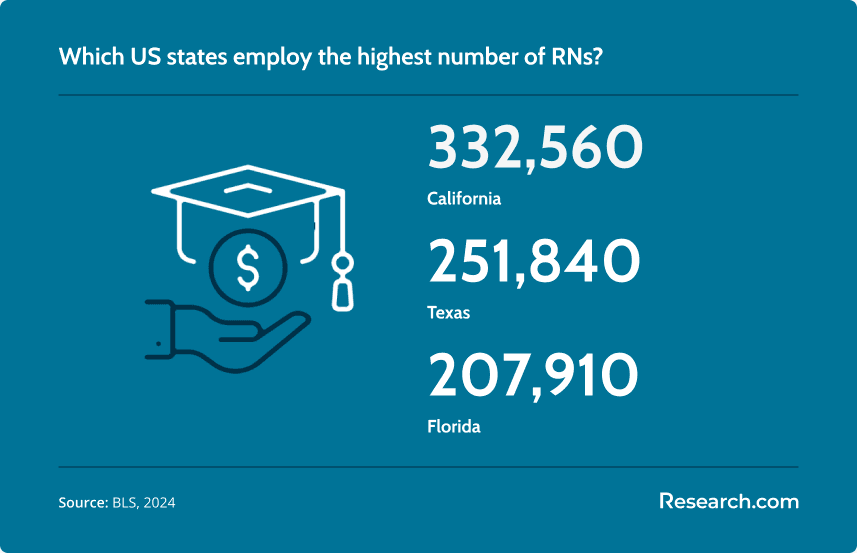
BLS data shows that the states employing the most registered nurses are California (332,560), Texas (251,840), Florida (207,910), New York (188,060), and Pennsylvania (144,100). These states offer RN opportunities in hospitals, clinics, long-term care, outpatient centers, home health, and other healthcare settings.
California and New York also typically offer six-figure salaries to registered nurses, making them especially visible in salary discussions. Still, the best state for an individual nurse depends on licensure processing, relocation costs, specialty availability, union environment, family needs, and lifestyle preferences.
ADN-prepared RNs who want to meet employer preferences for bachelor’s education can consider a 6-month RN-to-BSN program if they need a faster completion option and can handle the pace.
| State | RN employment level | Why it matters |
| California | 332,560 | Largest listed RN workforce and highest listed average annual RN salary. |
| Texas | 251,840 | Large healthcare market with many hospital and outpatient employers. |
| Florida | 207,910 | High RN employment across acute care, outpatient, and aging-related care settings. |
| New York | 188,060 | Large employment base and typically six-figure RN salary opportunities. |
| Pennsylvania | 144,100 | Substantial RN workforce across hospital systems and community care settings. |
Which industries hire the most RNs?
The industries employing the most registered nurses are general medical and surgical hospitals (1,749,320), doctor’s offices (220,070), home healthcare services (179,530), outpatient care centers (163,630), and employment services (130,890). These settings differ significantly in pace, patient acuity, schedule structure, advancement options, and compensation models.
Hospitals remain the largest RN employer category, but they are not the only path. Doctor’s offices and outpatient care centers may offer more predictable schedules. Home healthcare may provide autonomy and continuity with patients. Employment services may offer flexibility, though assignment stability and benefits can vary. BSN nurses should choose settings based on career goals, not just job volume.
| Industry | RN employment level | Potential fit |
| General medical and surgical hospitals | 1,749,320 | Nurses seeking acute care, specialty units, residency programs, and broad clinical experience. |
| Doctor’s offices | 220,070 | Nurses who prefer ambulatory care, patient education, and more regular scheduling. |
| Home healthcare services | 179,530 | Nurses comfortable with independent practice, care coordination, and patient homes. |
| Outpatient care centers | 163,630 | Nurses interested in procedures, chronic care, infusion, surgery centers, or same-day services. |
| Employment services | 130,890 | Nurses who want staffing flexibility or varied assignments. |
Skills employers increasingly value in BSN nurses
- Clear communication with patients, families, and interdisciplinary teams.
- Adaptability across changing staffing, technology, and care delivery models.
- Cultural competence and patient-centered education.
- Comfort with telehealth, remote monitoring, and electronic documentation.
- Specialty readiness through credentials such as CCRN for critical care or CEN for emergency nursing.
How can I identify the right BSN program for my career goals?
The right BSN program is the one that prepares you for RN licensure, fits your schedule and finances, and supports the kind of nursing work you want after graduation. For some students, that means a traditional campus BSN with extensive in-person support. For working RNs, it may mean an online RN-to-BSN program with flexible pacing and generous transfer credit.
Do not choose a school based only on name recognition or convenience. Review accreditation, licensure outcomes, clinical placement support, faculty access, transfer policies, total cost, student services, and employer partnerships. Students worried about admission competitiveness can also review Research.com’s guide to easy nursing schools to get into, but accessibility should still be balanced with program quality.
| Question to ask a BSN program | Why it matters |
| Is the nursing program properly accredited? | Accreditation can affect licensure, employment, graduate school admission, and financial aid eligibility. |
| Does the program meet requirements in my state? | Online and out-of-state programs may not automatically satisfy every state board requirement. |
| How are clinical experiences arranged? | Clinical placement logistics can determine whether you can complete the program on time. |
| How many credits will transfer? | Transfer credit can reduce tuition, workload, and time to graduation. |
| What is the full cost of attendance? | Tuition alone does not show fees, supplies, travel, exams, or lost work hours. |
| What support is available for working nurses? | Advising, tutoring, flexible pacing, and responsive faculty can affect completion. |
Can a DNP degree accelerate career advancement for BSN nurses?
A DNP can help BSN nurses pursue advanced practice, clinical leadership, healthcare systems improvement, policy, and executive roles. It is most useful when the nurse has a clear goal that requires or benefits from doctoral-level practice preparation. It is less useful if the nurse is unsure about specialty direction or expects a salary increase without changing responsibilities.
Cost-conscious nurses can compare affordable online DNP programs to find options that align with their budget and schedule. Before enrolling, confirm whether the program prepares students for the desired NP specialty, leadership role, or practice focus, and ask how practicum or clinical requirements are completed.
DNP planning questions for BSN nurses
- Do I want direct advanced practice, leadership, education, informatics, policy, or quality improvement?
- Will this DNP track meet licensure or certification requirements for my state and specialty?
- Can I complete clinical or practicum hours while working?
- Does the program provide placement support or expect students to secure sites independently?
- Will the salary and role change justify the time, tuition, and workload?
Common Mistakes to Avoid When Evaluating BSN Salary
- Using national averages as personal guarantees. Salary data is useful for planning, but your actual offer depends on local market conditions and the specific job.
- Ignoring accreditation. A low-cost program can become expensive if it does not support licensure, employment, or graduate school goals.
- Comparing salaries without cost of living. Higher pay in one state may be offset by housing, commuting, taxes, or relocation costs.
- Looking only at tuition. Fees, supplies, clinical travel, reduced work hours, and exam costs can change the real price of a BSN.
- Choosing certifications randomly. Credentials should match your specialty and employer expectations.
- Assuming online means easier. Online BSN, MSN, NP, and DNP programs can be rigorous and may still require clinical or practicum hours.
- Overlooking total compensation. Benefits, tuition reimbursement, retirement plans, schedule stability, and professional development support can be as important as salary.
References
- BLS (2024, April 3). 29-1141 Registered Nurses. BLS registered nurse occupational employment and wage data
- BLS (2024, August 29). Nurse Anesthetists, Nurse Midwives, and Nurse Practitioners. BLS advanced practice nurse outlook data
- BLS (2024, August 29). Registered Nurses. BLS registered nurse outlook data
- Health Resources and Services Administration (2024, November). State of the U.S. Health Care Workforce, 2024. HRSA healthcare workforce report
- Nighttingale College (2024, September 11). Highest Paying BSN Jobs: How Can a Bachelor’s Degree in Nursing Impact Your Earnings. Nighttingale College BSN salary discussion
- Payscale (2024). Associate Degree Nursing (ADN) Jobs by Salary. Payscale ADN salary data
- Payscale (2024). Bachelor of Science in Nursing (BSN) Jobs by Salary. Payscale BSN salary data
- ZipRecruiter (2024, December 12). Entry Level Bsn Nurse Salary. ZipRecruiter entry-level BSN salary data
Key Insights
- A BSN-prepared nurse’s starting salary ranges from $61,152 to $80,321, while the average annual BSN salary cited in this guide is $96,000.
- BSN salary is shaped by more than the degree itself. Location, employer type, specialty, experience, certification, schedule, and advancement path all matter.
- California, Hawaii, Oregon, Washington, and Alaska report the highest average annual RN salaries among the states listed, but cost of living and work conditions should be part of any relocation decision.
- Hospitals employ the largest number of RNs, but some of the highest-paying RN industries are outside traditional bedside care, including government and manufacturing-related settings.
- Certification can strengthen earning potential when it matches a nurse’s specialty. Random credentials are less valuable than targeted ones.
- The BSN can offer stronger long-term mobility than an ADN, but ROI depends on program cost, transfer credit, accreditation, work flexibility, and career outcomes.
- Graduate pathways such as MSN, NP, and DNP programs may increase advancement potential, but they require careful review of accreditation, licensure alignment, clinical placement, workload, and total cost.
Other Things You Need to Know About BSN Salaries
BSN-prepared nurses can qualify for federal loan repayment through the Nurse Corps Loan Repayment Program if they work in a Critical Shortage Facility or a Health Professional Shortage Area. The program can repay up to 60% of eligible nursing educational debt for a two-year service commitment.
In 2027, BSN-educated nurses generally earn more than their RN counterparts who have an associate degree. The additional education often results in higher salary opportunities due to advanced roles and responsibilities. While entry-level positions might have similar pay, BSN holders tend to quickly advance to roles with increased salaries.
Yes, BSN nurses can boost their 2027 salaries by obtaining certifications such as Certified Emergency Nurse (CEN) or Certified Pediatric Nurse (CPN). These certifications demonstrate specialized skills and can lead to higher-paying positions within healthcare facilities.
Yes, BSN nurse salaries in 2027 vary significantly by region. For example, urban areas like California or New York typically offer higher salaries compared to rural regions. This variation is due to factors such as cost of living and regional demand for healthcare professionals.


