
2027 Best RN to BSN Programs With No Clinicals

Co-Founder and Chief Data Scientist
For many registered nurses, the path to a bachelor of science in nursing (BSN) can seem daunting, especially when clinical requirements are considered. However, there are flexible and accessible RN to BSN programs that don't require clinicals.
As a career planning expert, I've seen many nursing professionals seek ways to advance their careers without disrupting their busy schedules. The median annual salary of nurses with a BSN degree in the US is around $85,000 to $102,263 in 2024, highlighting the significant financial benefits of further education.
In this guide, I aim to help you find the best programs that fit your needs and career goals.
What are the benefits of getting a degree from the best RN to BSN programs with no clinicals?
- A BSN degree with no clinicals opens doors to a wider range of nursing positions, including leadership roles, specialty areas, and advanced practice positions.
- Nurses with a BSN degree typically command higher salaries than those with an RN license alone, with an annual salary of $85,000 to $102,263 in the US in 2024.
- Pursuing an online RN to BSN program with no clinicals offers flexibility and convenience. Students can balance their studies with work and personal commitments without needing to relocate or commute to campus.
What can I expect from the best RN to BSN programs with no clinicals?
- In the best RN to BSN programs without clinicals, students can expect a curriculum tailored to their needs, focusing on theoretical knowledge, research, leadership, and community health.
- Coursework in non-clinical RN to BSN programs emphasizes critical thinking, evidence-based practice, and professional development. Students engage in classes exploring healthcare policy, informatics, ethics, and population health management.
- RN to BSN programs with no clinicals may cost anywhere from $300 to $900 per credit, depending on the institution.
- RN to BSN programs with no clinicals may last from 9 to 18 months. The lack of required clinical hours means that these programs are typically shorter than traditional RN to BSN programs.
- Students may expect to complete projects, case studies, and simulations to apply theoretical concepts to real-world scenarios.
Where can I work with a degree from the best RN to BSN programs with no clinicals?
Graduates of the best RN to BSN programs without clinicals can pursue various rewarding career paths in the healthcare industry. They are qualified to work in the following settings:
- Hospitals
- Clinics
- Long-term care facilities
- Community health centers
- Outpatient settings
Additionally, they can explore opportunities in public health agencies, educational institutions, pharmaceutical companies, and healthcare technology firms.
With their advanced education and skills in leadership, research, and patient care, these nurses are well-equipped to thrive in diverse roles across the healthcare continuum.
How much can I make with a degree from the best RN to BSN programs with no clinicals?
Graduates of the best RN to BSN programs without clinicals can expect competitive salaries in the nursing field. According to recent industry data, nurses with a BSN degree earn an average annual salary of $102,263. However, wages may also differ based on several factors, like education and experience level.
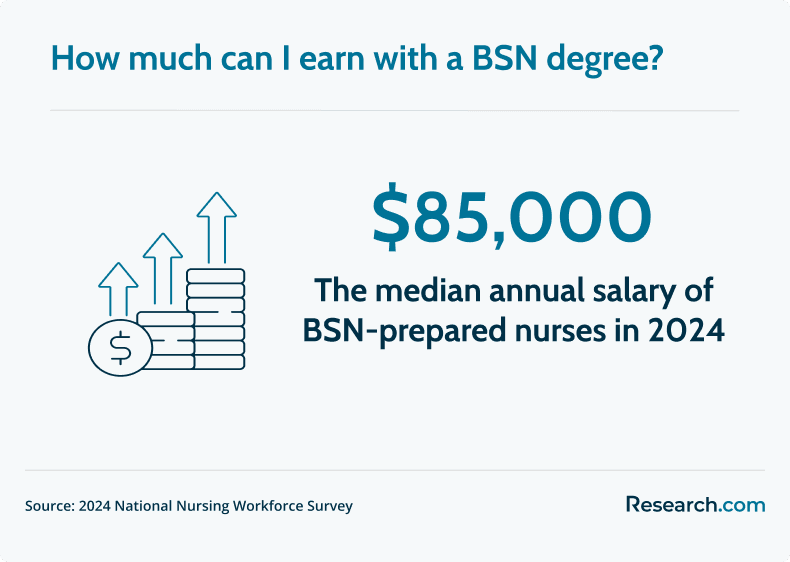
For instance, the 2024 National Nursing Workforce Survey reported that RNs who possessed a bachelor’s degree as their highest academic attainment earned a median annual salary of $85,000, which is closer to the RN median salary of $93,600 recorded by the Bureau of Labor Statistics (BLS).
Meanwhile, associate degree-educated RNs earned a median wage of $80,000, while diploma-educated nurses earned $73,000. With their advanced education and specialized skills, BSN-educated nurses are well-positioned to secure lucrative positions in the healthcare industry.
- 2027 Best RN to BSN Programs With No Clinicals RN to BSN Programs
- How long does it take to complete the best RN to BSN programs with no clinicals? How long does it take to complete the best RN to BSN programs with no clinicals?
- Can I transfer credits from previous nursing programs into the best RN to BSN programs with no clinicals? Can I transfer credits from previous nursing programs into the best RN to BSN programs with no clinicals?
- How does an online RN to BSN degree program compare to an on-campus program? How does an online RN to BSN degree program compare to an on-campus program?
- What is the average cost of the best RN to BSN programs with no clinicals? Degree Cost
- What are the financial aid options for students enrolling in the best RN to BSN programs with no clinicals? Financial Aid
- What are the prerequisites for enrolling in the best RN to BSN programs with no clinicals? Requirements
- What courses are typically in the best RN to BSN programs with no clinicals? Typical Courses
- What types of specializations are available in the best RN to BSN programs with no clinicals? What types of specializations are available in the best RN to BSN programs with no clinicals?
- How do you choose the best RN to BSN programs with no clinicals? How do you choose the best RN to BSN programs with no clinicals?
- What career paths are available for graduates of the best RN to BSN programs with no clinicals? Career Paths
- What are the potential challenges of RN to BSN programs without clinicals? What are the potential challenges of RN to BSN programs without clinicals?
- Are non-clinical RN to BSN programs accredited and recognized for quality? Are non-clinical RN to BSN programs accredited and recognized for quality?
- How do RN to BSN programs without clinicals develop practical nursing skills? How do RN to BSN programs without clinicals develop practical nursing skills?
- How do non-clinical RN to BSN programs equip graduates for digital transformation in healthcare? How do non-clinical RN to BSN programs equip graduates for digital transformation in healthcare?
- What is the job market for graduates with a degree from the best RN to BSN programs with no clinicals? What is the job market for graduates with a degree from the best RN to BSN programs with no clinicals?
- Career Opportunities After Completing an RN to BSN Program with No Clinicals Career Opportunities After Completing an RN to BSN Program with No Clinicals
- Do employers value non-clinical RN to BSN degrees as highly as traditional programs? Do employers value non-clinical RN to BSN degrees as highly as traditional programs?
- What are the current trends in RN to BSN programs without clinicals? What are the current trends in RN to BSN programs without clinicals?
- How Can Networking and Mentorship Enhance Success in Non-Clinical RN to BSN Programs? How Can Networking and Mentorship Enhance Success in Non-Clinical RN to BSN Programs?
- How Do Employers Evaluate Practical Competence in Graduates from Non-Clinical RN to BSN Programs? How Do Employers Evaluate Practical Competence in Graduates from Non-Clinical RN to BSN Programs?
- Exploring Career Growth and Specialization Opportunities with a BSN Exploring Career Growth and Specialization Opportunities with a BSN
- Is the Investment in a Non-Clinical RN to BSN Program Cost-Effective? Is the Investment in a Non-Clinical RN to BSN Program Cost-Effective?
2026 Best RN to BSN Programs With No Clinicals
Registered nurses who already hold an ADN or nursing diploma often pursue an RN to BSN program to qualify for broader roles, strengthen leadership skills, or prepare for graduate nursing study. The challenge is finding a program that fits around shift work and does not require traditional in-person clinical rotations. This guide focuses on RN to BSN programs that replace conventional clinical placements with online coursework, community-based projects, simulations, service learning, leadership assignments, or practice-focused experiences.
You will find a ranked list of programs, cost and timeline details, admissions expectations, transfer credit guidance, career options, and practical questions to ask before enrolling. The goal is not simply to identify a convenient program, but to help you choose one that is accredited, affordable, realistic for your schedule, and aligned with your next nursing career move.
Quick answer: What is an RN to BSN program with no clinicals?
An RN to BSN program with no clinicals is a post-licensure bachelor’s degree completion pathway for registered nurses that does not require traditional bedside clinical rotations. Instead, these programs typically use leadership projects, population health assignments, evidence-based practice work, informatics projects, virtual scenarios, or community-focused learning. Most still include applied nursing work, but it is usually completed in the student’s workplace, local community, or online environment rather than through a scheduled clinical placement.
How do we rank schools?
Research.com uses a dedicated methodology to evaluate programs with the goal of helping students compare academic quality, affordability, flexibility, and potential educational value. To support accuracy and transparency, we consult established data sources, including the IPEDS database from the National Center for Education Statistics, Peterson's database and its Distance Learning Licensed Data Set, and the College Scorecard database.
Best RN to BSN Programs With No Clinicals: At-a-Glance Comparison
| Rank | School and Program | Program Length | Credits | Published Cost | Accreditation |
| 1 | University of Massachusetts Boston Online RN to BSN | about 1.5 years | 30 | $370 per credit | Commission on Collegiate Nursing Education (CCNE) |
| 2 | University of Illinois at Chicago Online RN to BSN | 16 months | 30 | $475 per credit | Commission on Collegiate Nursing Education (CCNE) |
| 3 | Oklahoma City University Online RN to BSN | 2 semesters | 30 | $390 per credit | Commission on Collegiate Nursing Education (CCNE) |
| 4 | Widener University Online RN to BSN | 3 semesters | 30 | $522 per credit | Commission on Collegiate Nursing Education (CCNE) |
| 5 | Clarkson College Online RN to BSN | 4 semesters full-time; 6 semesters part-time | 34 | $310 per credit | Accreditation Commission for Education in Nursing (ACEN) |
| 6 | Nebraska Methodist College Online RN to BSN | about 1 year | 28 | $320 per credit | Commission on Collegiate Nursing Education (CCNE) |
| 7 | Missouri Baptist University Online RN to BSN | 12 to 22 months | 30 | $521 per credit | Commission on Collegiate Nursing Education (CCNE) |
| 8 | Nightingale College Online RN to BSN | about 2 to 2.5 years | 48 | $630 per credit | Commission on Collegiate Nursing Education (CCNE) |
| 9 | Western Governors University Online RN to BSN | about 1.5 to 2.5 years | 30 | $14,655 estimated total tuition | Commission on Collegiate Nursing Education (CCNE) |
| 10 | University of Central Florida Online RN to BSN | about 2 to 2.5 years | 30 | $5,944 estimated tuition per year | Commission on Collegiate Nursing Education (CCNE) |
| 11 | Arizona State University Online RN to BSN | about 2 to 2.5 years | 39 | $547 per credit | Commission on Collegiate Nursing Education (CCNE) |
| 12 | St. Petersburg College Online RN to BSN | about 2 to 2.5 years | 40 | $122 in-state; $425.79 out-of-state per credit | Commission on Collegiate Nursing Education (CCNE) |
| 13 | Herzing University Online RN to BSN | 12 months | 26 | $415 per credit | Commission on Collegiate Nursing Education (CCNE) |
| 14 | Norwich University Online RN to BSN | 18 months | 30 | $375 per credit | Commission on Collegiate Nursing Education (CCNE) |
| 15 | Franklin University Online RN to BSN | about 1.5 years | 40 | $298 per credit | Commission on Collegiate Nursing Education (CCNE) |
| 16 | The College of New Jersey RN to BSN | 24-36 months part-time | 128 | $521.58 in-state; $991.96 out-of-state per credit | Commission on Collegiate Nursing Education (CCNE) |
| 17 | Appalachian State University RN to BSN | 1-3 years | 30 | $8,081 in-state; $25,077 out-of-state annual tuition | Commission on Collegiate Nursing Education (CCNE) |
| 18 | Albany State University RN to BSN | 2 semesters | 27 | $1,030 in-state; $1,294.67 out-of-state per credit | Commission on Collegiate Nursing Education (CCNE) |
1. University of Massachusetts Boston Online RN to BSN
The University of Massachusetts Boston’s online RN to BSN program is built for licensed RNs who want a flexible bachelor’s completion path without traditional clinical rotations. Students may transfer 42 credits from existing RN licensure and can finish in as few as three semesters. Coursework is fully online, with optional synchronous class meetings for students who want live virtual interaction. Instead of standard clinical placements, the program uses service learning projects that connect academic work to community-based nursing practice.
- Best for: RNs who want a public university option with community-focused applied learning.
- Program length: about 1.5 years
- Required Credits to Graduate: 30
- Cost per Credit: $370
- Accreditation: Commission on Collegiate Nursing Education (CCNE)
2. University of Illinois at Chicago Online RN to BSN
The University of Illinois at Chicago offers a fully online RN to BSN program with fall, spring, and summer entry points. The format is designed for working nurses who need predictable scheduling and access to faculty support without relocating or commuting. Students complete the 16-month program through continuous enrollment, and the school states that tuition remains consistent throughout the program. Financial aid and several scholarship options may be available based on need, academic performance, and leadership qualities.
- Best for: RNs who want multiple start dates and a structured 16-month completion plan.
- Program length: 16 months
- Required Credits to Graduate: 30
- Cost per Credit: $475
- Accreditation: Commission on Collegiate Nursing Education (CCNE)
3. Oklahoma City University Online RN to BSN
Oklahoma City University’s online RN to BSN program is designed for nurses who want to strengthen baccalaureate-level competencies while continuing to work. The curriculum emphasizes skills that can be used immediately in current nursing roles, including leadership, professional practice, and evidence-based decision-making. Courses are delivered asynchronously, which can be useful for RNs with rotating shifts. The program also reports a student-to-faculty ratio and average class size of less than 20 students, supporting more individualized interaction.
- Best for: RNs seeking a short, asynchronous pathway with smaller class environments.
- Program length: 2 semesters
- Required Credits to Graduate: 30
- Cost per Credit: $390
- Accreditation: Commission on Collegiate Nursing Education (CCNE)
4. Widener University Online RN to BSN
Widener University offers an online RN to BSN pathway that can be completed in as little as three semesters. The program is intended for registered nurses who want to build on their existing clinical background while developing stronger leadership, communication, and care-quality skills. It may be a practical option for nurses who want an accelerated bachelor’s completion route that supports movement into broader nursing responsibilities.
- Best for: RNs looking for a three-semester online BSN completion plan.
- Program length: 3 semesters
- Required Credits to Graduate: 30
- Cost per Credit: $522
- Accreditation: Commission on Collegiate Nursing Education (CCNE)
5. Clarkson College Online RN to BSN
Clarkson College’s online RN to BSN program serves associate-degree and diploma-prepared registered nurses who want a customizable bachelor’s completion route. The curriculum combines core coursework and nursing courses in areas such as evidence-based practice, leadership, and population health. The program aligns its learning outcomes with Institute of Medicine core competencies and may appeal to students who value smaller student-to-faculty ratios and experience in online nursing education.
- Best for: RNs comparing full-time and part-time pacing options.
- Program length: 4 semesters full-time; 6 semesters part-time
- Required Credits to Graduate: 34
- Cost per Credit: $310
- Accreditation: Accreditation Commission for Education in Nursing (ACEN)
6. Nebraska Methodist College Online RN to BSN
Nebraska Methodist College offers an online RN to BSN program with a population health-centered curriculum and practice-based learning. The program is designed to be transfer-credit friendly, helping students apply prior nursing education and RN experience toward degree completion. Coursework focuses on practical, job-relevant learning that can support nurses working in varied healthcare environments.
- Best for: RNs who want a transfer-friendly program with a population health emphasis.
- Program length: about 1 year
- Required Credits to Graduate: 28
- Cost per Credit: $320
- Accreditation: Commission on Collegiate Nursing Education (CCNE)
7. Missouri Baptist University Online RN to BSN
Missouri Baptist University provides an online RN to BSN degree completion program for registered nurses who have finished an associate degree in nursing. The curriculum is framed around professional, intellectual, and spiritual development, making it a fit for students who want a nursing program in a faith-based educational environment. The program is intended to help RNs strengthen their nursing knowledge and prepare for wider responsibilities in healthcare.
- Best for: RNs seeking a faith-informed online BSN completion program.
- Program length: 12 to 22 months
- Required Credits to Graduate: 30
- Cost per Credit: $521
- Accreditation: Commission on Collegiate Nursing Education (CCNE)
8. Nightingale College Online RN to BSN
Nightingale College’s RN-to-BSN track is intended for licensed registered nurses who want to expand clinical reasoning, professional judgment, leadership, and holistic care skills. The curriculum is grounded in the American Association of Colleges of Nursing Essentials of Baccalaureate Education for Professional Nursing. Students study care that accounts for physical, psychological, spiritual, emotional, cultural, and environmental needs, while also integrating ethical, legal, moral, and evidence-based principles into professional practice.
- Best for: RNs who want a broader, essentials-based BSN curriculum with a holistic care focus.
- Program length: about 2 to 2.5 years
- Required Credits to Graduate: 48
- Cost per Credit: $630
- Accreditation: Commission on Collegiate Nursing Education (CCNE)
9. Western Governors University Online RN to BSN
Western Governors University offers an online RN to BSN program for current registered nurses who hold an ADN or nursing diploma. The program is structured for working nurses who want to improve patient outcomes, contribute to community health, and strengthen their résumé. Its flexible model may be particularly useful for students who need to fit coursework around full-time employment. Earning the BSN can also support hospitals working toward magnet status by increasing the number of baccalaureate-prepared nurses on staff.
- Best for: Working RNs who want a flexible online model and a published estimated total tuition.
- Program length: about 1.5 to 2.5 years
- Required Credits to Graduate: 30
- Estimated Tuition total: $14,655
- Accreditation: Commission on Collegiate Nursing Education (CCNE)
10. University of Central Florida Online RN to BSN
The University of Central Florida offers a fully online post-licensure RN to BSN program for registered nurses pursuing a bachelor’s degree while remaining employed. The program is designed for nurses who need an online format and want to build the academic foundation increasingly expected in healthcare settings. Students should confirm state authorization, transfer policies, and any practice-based requirements before applying.
- Best for: RNs seeking a public university online BSN pathway with an estimated annual tuition figure.
- Program length: about 2 to 2.5 years
- Required Credits to Graduate: 30
- Estimated Tuition per year: $5,944
- Accreditation: Commission on Collegiate Nursing Education (CCNE)
11. Arizona State University Online RN to BSN
Arizona State University’s online RN to BSN program helps registered nurses strengthen patient care, professional reasoning, and preparation for future healthcare challenges. The online delivery format is intended for RNs who want to expand their nursing skill set without interrupting current employment. The program may be especially relevant for nurses who want a large university environment with online infrastructure.
- Best for: RNs who want a well-known online university format and a broader 39-credit curriculum.
- Program length: about 2 to 2.5 years
- Required Credits to Graduate: 39
- Cost per Credit: $547
- Accreditation: Commission on Collegiate Nursing Education (CCNE)
12. St. Petersburg College Online RN to BSN
St. Petersburg College offers an online RN to BSN program for registered nurses seeking a Bachelor of Science degree in nursing. The program highlights evidence-based practice, health promotion, cultural humility, technology, and leadership. It may suit nurses who want to advance professionally or prepare for graduate-level nursing study while developing skills for serving diverse populations.
- Best for: Florida residents comparing lower in-state per-credit pricing with an online format.
- Program length: about 2 to 2.5 years
- Required Credits to Graduate: 40
- Cost per Credit: $122 in-state; $425.79 out-of-state
- Accreditation: Commission on Collegiate Nursing Education (CCNE)
13. Herzing University Online RN to BSN
Herzing University’s online RN to BSN program is built for practicing licensed registered nurses who want advanced, job-relevant coursework. The curriculum includes continuing education activities within each course, which may be used toward license renewal. This can be useful for nurses who want their BSN coursework to support both degree completion and ongoing professional requirements.
- Best for: Licensed RNs who want a 12-month route with continuing education activities embedded in courses.
- Program length: 12 months
- Required Credits to Graduate: 26
- Cost per Credit: $415
- Accreditation: Commission on Collegiate Nursing Education (CCNE)
14. Norwich University Online RN to BSN
Norwich University offers an online RN to BS in nursing for working registered nurses. The program focuses on expanding nursing knowledge, leadership ability, evidence-based practice, diagnostic reasoning, and evaluation of nursing interventions. It uses a 100% online classroom and multiple start dates. Graduates may also be able to move more quickly into Norwich’s Master of Science in nursing program, making this option relevant for RNs considering graduate study.
- Best for: RNs who want multiple start dates and a possible bridge into MSN study.
- Program length: 18 months
- Required Credits to Graduate: 30
- Cost per Credit: $375
- Accreditation: Commission on Collegiate Nursing Education (CCNE)
15. Franklin University Online RN to BSN
Franklin University’s online RN to BSN program is designed for registered nurses with an associate degree in nursing or nursing diploma. The program is transfer-friendly and structured around nine, 6-week online courses. It has no clinical requirements and is intended for busy RNs who want an efficient route to a BSN while continuing to work.
- Best for: RNs looking for short online courses and no clinical requirements.
- Program length: about 1.5 years
- Required Credits to Graduate: 40
- Cost per Credit: $298
- Accreditation: Commission on Collegiate Nursing Education (CCNE)
16. The College of New Jersey RN to BSN
The College of New Jersey offers an RN to BSN program for ADN-prepared nurses and nurses with a diploma who want to build leadership, quality, and safety competencies. The program is designed for adult learners and is available in face-to-face and online formats depending on course availability and student preference. Prospective students should confirm which courses can be completed online before enrolling.
- Best for: Part-time students who may want online or face-to-face options depending on availability.
- Program length: 24-36 months part-time
- Required Credits to Graduate: 128
- Cost per Credit: $521.58 in-state; $991.96 out-of-state
- Accreditation: Commission on Collegiate Nursing Education (CCNE)
17. Appalachian State University RN to BSN
Appalachian State University offers an online RN to BSN that incorporates non-traditional clinical learning across courses. Examples include a community windshield survey, physical assessments, and medication education for adults. The program is intended for working nurses who want to develop leadership, informatics, nursing theory, and community-based nursing skills without a conventional clinical rotation structure.
- Best for: RNs who are comfortable completing applied community-based assignments within courses.
- Program length: 1-3 years
- Required Credits to Graduate: 30
- Tuition Annual: $8,081 in-state; $25,077 out-of-state
- Accreditation: Commission on Collegiate Nursing Education (CCNE)
18. Albany State University RN to BSN
Albany State University’s RN to BSN program is designed for working nurses who hold an ADN or nursing diploma. Since 2022, the program has participated in the University System of Georgia's eMajor Course Collaborative, allowing select courses to be offered in collaboration with other USG institutions. Students with remaining baccalaureate coursework should note that some requirements may need to be completed on campus.
- Best for: RNs in Georgia who want a USG-connected program and can verify any on-campus requirements in advance.
- Program length: 2 semesters
- Required Credits to Graduate: 27
- Cost per Credit: $1,030 in-state; $1,294.67 out-of-state
- Accreditation: Commission on Collegiate Nursing Education (CCNE)
If speed is your top priority, compare these options with fastest RN to BSN program online choices. RN to BSN programs can also be a next step for students coming from bridge pathways, including those who completed a paramedic to RN bridge program online.
How long does it take to complete the best RN to BSN programs with no clinicals?
Many RN to BSN programs without traditional clinical rotations can be completed in 12 to 18 months, but timelines vary by transfer credits, course load, term structure, and whether you enroll full-time or part-time. Some accelerated formats move quickly through short courses or continuous enrollment, while other programs allow students to slow down to accommodate work schedules, family responsibilities, or licensing requirements.
If your main goal is the shortest possible timeline, review transfer credit rules before you compare advertised completion times. A program that appears faster may take longer if it accepts fewer prior credits or requires additional general education coursework. Students considering broader bachelor’s pathways may also compare the best online accelerated BSN programs, but these are not the same as post-licensure RN to BSN completion programs.
A BSN can also support later moves into related fields or graduate study. Some nurses eventually explore options such as an accelerated MSW program online for social work-related roles or an affordable HR degree online for healthcare recruitment, workforce development, or training roles. These routes are not automatic outcomes of a BSN, but the bachelor’s degree can broaden eligibility for future education and career pivots.
Can I transfer credits from previous nursing programs into the best RN to BSN programs with no clinicals?
Yes. Many RN to BSN programs accept prior nursing credits from an associate degree or diploma program, and some award additional credit for active RN licensure. Transfer credit can shorten the degree timeline and lower total tuition, but policies differ widely by school.
Before applying, ask each admissions office for a preliminary transcript evaluation. Confirm how many ADN or diploma credits will transfer, whether general education courses are still needed, whether there is a minimum grade requirement, and whether nursing credits expire after a certain number of years. Do not rely only on the advertised program length; your personal completion time depends on how the school applies your previous coursework.
How does an online RN to BSN degree program with no clinicals compare to an on-campus program?
An online RN to BSN program is usually the better fit for working nurses who need flexible scheduling, no commute, and the ability to complete assignments around shifts. An on-campus program may be better for students who prefer in-person discussion, direct faculty access, campus resources, and local professional networking.
| Factor | Online RN to BSN With No Traditional Clinicals | On-Campus RN to BSN |
| Schedule | Often asynchronous or designed for working RNs | May require fixed class meeting times |
| Clinical format | Often uses projects, simulations, local community work, or virtual assignments | May include in-person practice experiences or campus-based activities |
| Best for | Nurses balancing employment, family, or variable shifts | Students who learn best through face-to-face interaction |
| Main risk | Requires self-discipline and comfort with online learning systems | Less convenient for nurses who cannot commute or attend set sessions |
| Quality check | Verify CCNE or ACEN accreditation and state authorization | Verify accreditation, faculty access, and local placement expectations |
Online nursing education can still include rigorous faculty interaction, case-based learning, and simulation. This is also common in other online nursing pathways, such as FNP online programs. The important question is not whether the format is online, but whether the program is accredited, well-supported, and transparent about how it develops applied nursing competencies.
What is the average cost of the best RN to BSN programs with no clinicals?
The cost of RN to BSN programs without traditional clinical rotations depends on residency status, transfer credits, fees, and the school’s pricing model. For in-state students, the average cost per credit is approximately $390, producing an average total tuition of around $11,540 for the program. For out-of-state students, the average cost per credit is about $610, with average total tuition of approximately $15,420.
Tuition is only one part of the total price. Also review technology fees, graduation fees, transcript fees, books, background check requirements, immunization documentation, and any travel tied to orientation or project work. If a program lists a low per-credit rate but accepts fewer transfer credits, it may not be the cheapest option for you.
What are the financial aid options for students enrolling in the best RN to BSN programs with no clinicals?
RN to BSN students may be able to reduce out-of-pocket costs through federal aid, employer support, scholarships, and state-based programs. Availability depends on enrollment status, school eligibility, financial need, employer policy, and state rules.
- Federal Student Aid Programs. Eligible students can apply for grants and loans by completing the Free Application for Federal Student Aid (FAFSA). Confirm that your program and enrollment load qualify before assuming aid will cover the full cost.
- Nursing Scholarships. Nursing scholarships may be awarded based on academic record, leadership, financial need, location, employer affiliation, or service commitments. Unlike loans, scholarships generally do not require repayment.
- Employer Tuition Reimbursement Programs. Hospitals and healthcare systems may reimburse part of the cost for RNs earning a BSN, often with grade requirements, annual caps, or post-graduation work commitments.
- State-Based Financial Aid Programs. Some states offer grants, scholarships, or loan forgiveness programs for nursing students. Requirements may include residency, employment in shortage areas, or service after graduation.
What are the prerequisites for enrolling in the best RN to BSN programs with no clinicals?
Most RN to BSN programs are post-licensure programs, meaning they expect applicants to already be registered nurses or to become licensed before progressing in the program. Requirements vary, but common prerequisites include the following:
- Active RN license. Most programs require a valid, current registered nurse license.
- ADN or nursing diploma. Applicants usually need an associate degree in nursing or a diploma from an accredited nursing program.
- Minimum GPA. Some schools require a GPA in the 2.5 to 3.0 range on a 4.0 scale.
- Official transcripts. Schools generally require transcripts from every college, nursing school, or postsecondary institution attended.
- Recommendations. Some programs request academic or professional references, especially for competitive admission.
- Personal statement or essay. A written statement may be required to explain professional goals, BSN motivation, and relevant nursing experience.
- RN work experience. Prior nursing employment is not always mandatory, but some programs prefer or expect applicants to be practicing RNs.
Preparing documents early can speed up admission and credit evaluation. If your goal is to finish a bachelor's degree online fast, verify admission dates, transcript deadlines, and whether the school reviews transfer credits before or after acceptance.
What courses are typically in the best RN to BSN programs with no clinicals?
RN to BSN coursework is designed to move licensed nurses beyond entry-level preparation and into broader professional competencies. Rather than repeating basic nursing skills, these programs usually emphasize leadership, quality improvement, population health, research, ethics, informatics, and evidence-based practice.
- Nursing Leadership and Management. Students study leadership theories, team coordination, healthcare organizations, unit management, quality improvement, and professional accountability.
- Community Health Nursing. Coursework focuses on health promotion, disease prevention, community assessment, and nursing care for diverse populations outside acute-care settings.
- Nursing Research and Evidence-Based Practice. Students learn to evaluate research, interpret evidence, and apply findings to nursing decisions and quality initiatives.
- Health Assessment. This course strengthens assessment, health history, physical examination, and clinical reasoning skills for baccalaureate-prepared practice.
- Nursing Ethics and Legal Issues. Students examine patient rights, professional standards, ethical dilemmas, advocacy, and legal responsibilities in nursing.
- Population Health. Topics may include epidemiology, health disparities, social determinants of health, and prevention strategies across groups and communities.
- Healthcare Informatics. Students explore electronic health records, data management, digital tools, and technology applications in nursing practice.
- Nursing Informatics. This course connects nursing science, computer science, and information science to improve documentation, decision support, and care delivery.
Students planning to continue into graduate study should confirm that the RN to BSN curriculum meets prerequisites for future programs. Some nurses later consider nursing doctorates or research-focused study, including the cheapest online PhD programs in related fields. Others compare 1 year graduate programs in healthcare or adjacent disciplines to diversify their skills.
In 2024, the highest-paying industries for registered nurses were the government at $124,460, medical equipment manufacturing at $116,040, and medical control instruments manufacturing at $115,210. The chart below provides additional detail.
What types of specializations are available in the best RN to BSN programs with no clinicals?
RN to BSN programs do not always offer formal concentrations, but many allow students to shape projects, electives, or applied assignments around a career interest. Common focus areas include leadership, informatics, population health, education, and care coordination.
- Nursing Leadership and Management. This area supports nurses interested in supervision, unit leadership, staffing, budget awareness, quality improvement, and administrative decision-making.
- Community Health Nursing. Students focus on health education, prevention, population needs, outreach, and public health-oriented nursing practice.
- Nursing Informatics. This focus connects nursing practice with technology, electronic records, data analytics, decision support, and workflow improvement.
- Pediatric Nursing. Nurses interested in infants, children, adolescents, and family-centered care may use electives or projects to deepen pediatric knowledge.
- Gerontology Nursing. This area emphasizes the care of older adults, chronic disease management, aging-related needs, and end-of-life considerations.
Specialization can help you align coursework with your current unit or your next target role. However, a BSN alone does not automatically qualify a nurse for every specialty credential or advanced practice role. In 2024, BSN-prepared nurses in the US make $85,000 annually on average.
How do you choose the best RN to BSN programs with no clinicals?
The best RN to BSN program is not simply the shortest or cheapest one. It is the program that accepts your credits, fits your work schedule, carries recognized nursing accreditation, supports your career goals, and avoids hidden requirements you cannot meet.
- Confirm nursing accreditation first. Look for recognized programmatic accreditation from CCNE or ACEN. This matters for employer recognition, transferability, graduate school admission, and academic quality.
- Ask what “no clinicals” actually means. Some programs have no traditional clinical rotations but still require community projects, practice hours, simulations, capstones, or workplace-based assignments.
- Request a transfer credit estimate. Compare your actual remaining credits, not just the school’s advertised completion time.
- Compare total cost. Include tuition, fees, books, required technology, residency pricing, and the number of credits you still need.
- Match pacing to your work schedule. A 12-month program may be attractive, but it may be unrealistic during full-time night shifts or overtime-heavy periods.
- Evaluate student support. Online learners should have access to advising, library resources, technical help, career services, and faculty communication.
- Check graduate school compatibility. If you plan to pursue an MSN, DNP, or NP pathway, confirm that the BSN meets prerequisites for those programs.
Students who want a less intensive online pathway may also compare the easiest RN to BSN online programs, but “easy” should never replace accreditation, academic fit, or career relevance.
What career paths are available for graduates of the best RN to BSN programs with no clinicals?
An RN to BSN degree can help registered nurses qualify for roles that involve leadership, education, care coordination, quality improvement, informatics, public health, and preparation for graduate nursing education. The degree does not guarantee promotion or salary increases, but it can make nurses more competitive for positions that prefer or require a bachelor’s degree.
- Nursing Leadership and Management. Graduates may pursue nurse manager, nurse supervisor, charge nurse, or nursing director roles that involve staff coordination, unit performance, and care quality.
- Nursing Education. BSN-prepared nurses may support patient education, staff development, precepting, or training roles, although academic faculty roles often require graduate education.
- Community Health Nursing. Nurses can work in public health agencies, community organizations, outreach programs, and nonprofit health initiatives.
- Nursing Informatics. Nurses with technology and data interests may move toward informatics nurse, healthcare IT, clinical systems, or documentation improvement roles.
- Advanced Nursing Practice Preparation. A BSN is commonly a foundation for future graduate study toward nurse practitioner, clinical nurse specialist, nurse anesthetist, or nurse midwife roles.
Salary is influenced by more than degree level. Specialty, employer, experience, shift differentials, collective bargaining, and location all matter. The top-paying state for registered nurses in the US is California at $148,330. See the chart below for more detail.
What are the potential challenges of RN to BSN programs without clinicals?
Programs without traditional clinical rotations are convenient, but they are not challenge-free. Students must be intentional about building applied skills, professional relationships, and evidence of competence.
| Challenge | Why It Matters | What to Do Before Enrolling |
| Limited in-person practice exposure | Some students may miss direct observation, bedside feedback, and hands-on faculty coaching. | Ask whether the program uses simulations, workplace projects, community assignments, or skills-based assessments. |
| Less face-to-face networking | Online students may have fewer informal connections with peers, faculty, and local employers. | Look for mentorship, alumni groups, discussion-based courses, and career services. |
| Self-directed workload | Online programs require strong time management and consistent participation. | Review weekly time expectations and test whether asynchronous learning fits your schedule. |
| Misunderstanding “no clinicals” | No traditional clinical rotations does not always mean no practice-based assignments. | Request the student handbook or sample course requirements before applying. |
| Graduate program prerequisites | Some future MSN or NP programs may expect specific courses or clinical-related documentation. | Compare BSN coursework with requirements for future programs before committing. |
If you want a program with more applied nursing exposure, review other nursing completion routes and practical training structures, including the easiest accelerated nursing programs to get into.
Are non-clinical RN to BSN programs accredited and recognized for quality?
Non-clinical RN to BSN programs can be accredited and respected, but accreditation must be verified program by program. The most important distinction is between institutional accreditation, which applies to the college or university, and nursing programmatic accreditation, such as CCNE or ACEN. For RN to BSN students, nursing accreditation is especially important because it signals that the program has been reviewed against professional education standards.
Accreditation can also affect credit transfer, employer reimbursement, and eligibility for graduate nursing pathways. If your long-term plan includes an MSN or nurse practitioner route, compare the RN to BSN program with future options such as RN to MSN NP online pathways before enrolling.
How do RN to BSN programs without clinicals develop practical nursing skills?
Most post-licensure RN to BSN students are already practicing nurses, so the goal is not to replace pre-licensure clinical training. Instead, non-clinical RN to BSN programs typically develop higher-level practice skills through applied assignments, case analysis, leadership projects, community assessments, quality improvement plans, informatics activities, and virtual patient scenarios.
These learning methods can strengthen clinical reasoning, communication, systems thinking, and evidence-based decision-making. Students who want future advanced practice preparation should also examine how graduate programs structure hands-on learning. For example, researching the cheapest nurse practitioner programs can help you understand how advanced programs approach clinical preparation and supervised practice.
How do non-clinical RN to BSN programs equip graduates for digital transformation in healthcare?
Healthcare increasingly depends on electronic health records, telehealth workflows, data reporting, remote communication, and technology-supported care coordination. RN to BSN programs without traditional clinical rotations often address these changes through informatics coursework, virtual scenarios, technology-based case studies, and data-informed quality improvement projects.
For working nurses, this digital preparation can be immediately useful in documentation improvement, care coordination, patient education, and interdisciplinary communication. It can also support later specialization. Nurses considering family practice or advanced clinical roles may compare certificate and graduate routes such as a 12-month FNP program online, while confirming that those programs include the clinical requirements needed for advanced practice preparation.
What is the job market for graduates with a degree from the best RN to BSN programs with no clinicals?
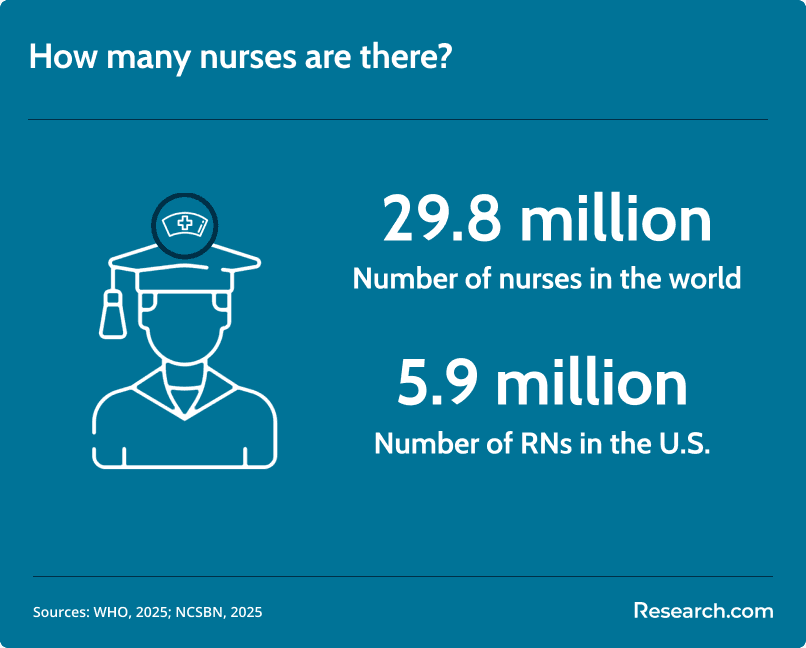
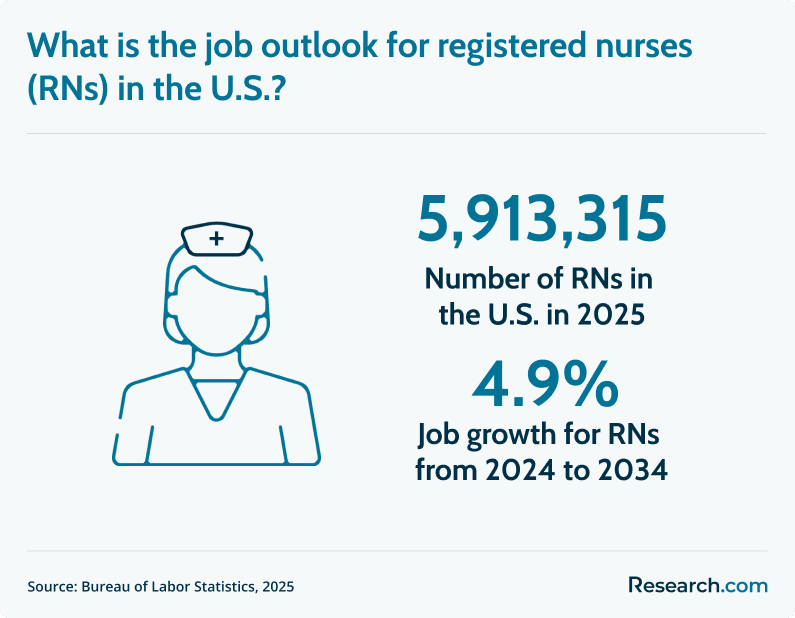
The job market for registered nurses remains substantial, but outcomes vary by region, employer, specialty, and experience. The projected job growth for registered nurses is expected to be 4.9% from 2024 to 2034, faster than the average growth rate of 3% for all occupations. With approximately 5,913,315 registered nurses in the US in 2025, nursing continues to represent a major part of the healthcare workforce.
A BSN may help nurses compete for positions in hospitals, clinics, long-term care, community health organizations, care coordination, informatics, education, and leadership. However, a non-clinical RN to BSN program does not replace specialized credentials, employer-specific training, or graduate education when those are required for a target role.
Career Opportunities After Completing an RN to BSN Program with No Clinicals
Graduates of RN to BSN programs without traditional clinical rotations often use the degree to move into roles that value leadership, research literacy, care coordination, and systems-level thinking. Common options include:
- Nurse Manager: Supervises nursing teams, coordinates staffing, supports quality standards, and manages unit operations.
- Clinical Nurse Educator: Teaches patients, staff, or healthcare colleagues and supports professional development initiatives.
- Nurse Informatics Specialist: Uses nursing knowledge and technology to improve documentation, workflows, data use, and patient care systems.
- Public Health Nurse: Works with government agencies, nonprofits, or community organizations to promote health and prevent disease.
If cost is a deciding factor, compare this list with cheapest RN to BSN online options to identify lower-cost pathways that still provide flexibility and recognized credentials.
Do employers value non-clinical RN to BSN degrees as highly as traditional programs?
Many employers value accredited RN to BSN degrees because they build leadership, evidence-based practice, communication, research, and population health competencies. For working RNs, existing clinical experience can help offset the absence of traditional clinical rotations in the BSN completion program. Employers are more likely to focus on accreditation, RN licensure, work history, skills, references, and whether the degree meets job or reimbursement requirements.
When comparing programs, make sure the online format is not your only deciding factor. An accredited BSN online pathway can be credible, but students should still verify program outcomes, support services, graduate school acceptance, and employer reimbursement rules.
What are the current trends in RN to BSN programs without clinicals?
RN to BSN programs continue to adapt to the needs of employed nurses and changing healthcare systems. Several trends are especially relevant for students comparing no-clinical or non-traditional clinical formats.
- More leadership and systems coursework. Programs increasingly emphasize management, policy, quality improvement, and interprofessional collaboration because many BSN-prepared nurses move into broader organizational roles.
- Greater use of online and asynchronous learning. Flexible delivery helps working RNs complete coursework without leaving their jobs or relocating.
- Informatics and digital health integration. Nursing programs are placing more attention on data, electronic health records, telehealth, and technology-supported care.
- Applied projects instead of traditional clinical rotations. Many programs use workplace-based assignments, community assessments, simulations, and capstones to demonstrate practical competence.
- BSN as a stepping stone to graduate nursing. Some nurses use the BSN to prepare for MSN, DNP, or NP study. Students comparing advanced routes can also review the cheapest online nurse practitioner programs to understand future cost considerations.
How Can Networking and Mentorship Enhance Success in Non-Clinical RN to BSN Programs?
Because non-clinical RN to BSN programs may not include in-person clinical cohorts, students should be proactive about networking. Useful strategies include participating in online discussion groups, attending professional webinars, joining nursing associations, connecting with alumni, and asking faculty about mentorship opportunities. These activities can help students learn how other nurses use the BSN for leadership, informatics, education, public health, or graduate school preparation.
Mentorship is especially valuable if you are changing specialties or returning to school after a long break. If you are still comparing nursing entry points or advising someone earlier in the process, this guide to Whats the easiest nursing program to get into? may help clarify differences among nursing education pathways.
How Do Employers Evaluate Practical Competence in Graduates from Non-Clinical RN to BSN Programs?
Employers usually evaluate practical competence through a combination of RN licensure, work experience, performance history, references, specialty certifications, interview responses, and examples of applied work. For graduates of non-clinical RN to BSN programs, evidence-based projects, simulation outcomes, community assessments, quality improvement assignments, and leadership portfolios can help demonstrate skill development beyond the transcript.
If a job requires a specific clinical competency, the BSN alone may not be enough. Supplemental training, employer onboarding, continuing education, or additional credentials may be needed. Students who want faster nursing pathways should be careful not to confuse BSN completion with pre-licensure training; resources on one year RN programs can help distinguish different nursing education routes.
Exploring Career Growth and Specialization Opportunities with a BSN
A BSN can expand a nurse’s professional options by strengthening leadership, research literacy, population health, informatics, ethics, and communication skills. For many nurses, the degree is also a required or preferred credential for advancement into management, education, public health, or graduate study.
1. Nurse Leadership and Management Roles
BSN coursework can support nurses who want to move into roles that require coordination, accountability, and decision-making beyond direct bedside tasks. Possible roles include:
- Nurse Manager: Coordinates nursing teams, supports care standards, and manages day-to-day unit operations.
- Clinical Nurse Leader: Supports evidence-based improvements and helps improve the delivery of patient care.
- Director of Nursing: Takes on higher-level planning and leadership responsibilities within nursing departments or care facilities.
2. Specializing in a Nursing Field
A BSN can help nurses move toward specialty-aligned roles, although some positions require additional experience, credentials, or graduate education. Common directions include:
- Nurse Educator: Supports teaching in patient education, staff development, or academic environments, depending on credential requirements.
- Case Manager: Coordinates services, advocates for patients, and helps manage care across healthcare systems.
- Nurse Informatics Specialist: Uses clinical knowledge and digital systems to improve documentation, workflows, and care delivery.
3. Transitioning to Advanced Practice Roles
Advanced practice roles such as nurse practitioner, nurse anesthetist, nurse midwife, or clinical nurse specialist generally require graduate education. A BSN often serves as an important step toward those programs. Future specializations may include:
- Family Nurse Practitioner (FNP)
- Adult-Gerontology Nurse Practitioner (AGNP)
- Psychiatric-Mental Health Nurse Practitioner (PMHNP)
4. Improving Patient Care through Evidence-Based Practice
RN to BSN programs commonly emphasize research interpretation and evidence-based care. This training can be useful in roles focused on quality, safety, prevention, and better patient outcomes.
- Quality Improvement Specialist: Helps identify care gaps and supports process improvements in healthcare settings.
- Public Health Nurse: Works with communities on prevention, health education, and population health initiatives.
- Infection Control Nurse: Focuses on preventing, monitoring, and managing infections in healthcare environments.
5. Flexibility and Mobility Across the Healthcare Sector
BSN-prepared nurses may work in hospitals, clinics, community health centers, public health agencies, long-term care, health insurance, healthcare technology, corporate wellness, or consulting-adjacent roles. The degree can be a versatile foundation, but each role has its own requirements. If you are comparing long-term options, this guide to what can you do with a BSN can help you map the degree to specific career paths.
Questions to Ask Before Choosing an RN to BSN Program With No Clinicals
- Is the nursing program accredited by CCNE or ACEN?
- Does “no clinicals” mean no traditional rotations, or are practice hours, community projects, or simulations still required?
- How many of my credits will transfer, and can I receive credit for RN licensure?
- What is my estimated total cost after transfer credits, fees, and residency pricing?
- Can I complete the program while working full-time or rotating shifts?
- Are courses asynchronous, synchronous, or a mix of both?
- Will the degree meet requirements for employer tuition reimbursement?
- Does the program meet prerequisites for MSN, DNP, or NP programs I may pursue later?
- What support is available for online learners, including advising, tutoring, library access, and technical help?
- Are there any campus visits, on-site intensives, or local project requirements?
Common Mistakes to Avoid
| Mistake | Why It Can Hurt You | Better Approach |
| Choosing only by lowest tuition | A low per-credit price may not mean the lowest total cost if fewer credits transfer. | Compare the full degree completion estimate after transcript review. |
| Ignoring accreditation | Non-accredited nursing programs may create problems with graduate admission, employer recognition, or reimbursement. | Verify institutional accreditation and CCNE or ACEN nursing accreditation. |
| Assuming “no clinicals” means no applied work | Many programs still require projects, simulations, community assessments, or workplace assignments. | Ask for a sample curriculum and course requirement details. |
| Overestimating available study time | Accelerated programs can be difficult for nurses working overtime or rotating shifts. | Choose a pace that matches your work and personal responsibilities. |
| Relying only on rankings | A ranked program may not be the best fit for your state, transfer credits, or career goals. | Use rankings as a starting point, then compare accreditation, cost, format, and requirements. |
| Forgetting future graduate requirements | Some MSN or NP programs may require specific prerequisites or documentation. | Check future program requirements before selecting your BSN pathway. |
Here's what graduates have to say about their degrees earned from the best RN to BSN programs with no clinicals
- : "As a single parent, I needed a program that would not force me to choose between work, school, and family. The online RN to BSN format let me study when my schedule allowed it. Earning the BSN helped me feel more confident about my future and showed my children what persistence looks like. — Anthony"
- : "I was not sure I could complete a BSN while working full-time, but having online access to lectures, assignments, and course materials made the workload more manageable. The degree helped me feel better prepared for the responsibilities I want to take on in nursing. — Ben"
- : "Working while going back to school was demanding, but the online platform and faculty support made it possible to keep moving forward. After completing the BSN, I felt more ready to pursue the next stage of my nursing career. — Gina"
Is the Investment in a Non-Clinical RN to BSN Program Cost-Effective?
A non-clinical RN to BSN program can be cost-effective when it accepts a strong number of transfer credits, fits your work schedule, carries recognized nursing accreditation, and supports roles or graduate programs you actually plan to pursue. It may be less cost-effective if you choose a high-tuition program without confirming transfer credits, employer reimbursement, or career relevance.
To evaluate return on investment, compare the total cost of attendance with your likely career use of the degree. Consider whether your employer requires or rewards the BSN, whether tuition reimbursement is available, and whether the program positions you for graduate study such as the most affordable MSN nursing education online. Avoid assuming that any BSN will automatically produce a specific salary increase.
References:
- National Council of State Boards of Nursing, Inc. Active RN licenses. NCSBN.
- Smiley, R. A., Kaminski-Ozturk, N., Reid, M., Burwell, P., Oliveira, C. M., Shobo, Y., Allgeyer, R. L., Zhong, E., O’Hara, C., Volk, A., & Martin, B. The 2024 National Nursing Workforce Survey. Journal of Nursing Regulation.
- U.S. Bureau of Labor Statistics. Registered nurses. BLS.
- World Health Organization. State of the world's nursing report 2025. WHO.
- ZipRecruiter. BSN nurse salary. ZipRecruiter.
- ZipRecruiter. What is a non clinical RN and how to become one. ZipRecruiter.
Key Insights
- “No clinicals” usually means no traditional bedside rotations, not no applied learning. Expect projects, simulations, community assessments, leadership assignments, or workplace-based activities.
- Accreditation should be non-negotiable. Prioritize RN to BSN programs with recognized nursing accreditation such as CCNE or ACEN.
- Transfer credits determine your real timeline and cost. Always request a transcript review before relying on advertised completion times.
- Online RN to BSN programs work best for self-directed learners. Flexibility is valuable, but accelerated online coursework still requires consistent weekly effort.
- The BSN can support leadership, informatics, public health, education, and graduate study. It does not guarantee a specific job or salary, but it can make nurses more competitive for roles that prefer or require a bachelor’s degree.
- The best program is the one that fits your career plan. Compare accreditation, total cost, schedule, applied learning requirements, student support, employer reimbursement, and future graduate school compatibility before enrolling.
Other Things You Should Know About RN to BSN Programs with No Clinicals
To qualify for 2027 RN to BSN programs with no clinicals, candidates typically need an active RN license, an associate degree in nursing, and a minimum GPA (often around 2.5-3.0). Additional requirements may include transcripts, a background check, and possibly letters of recommendation.
Yes. Most RN to BSN programs that waive clinical rotations still require a capstone or practicum-style project instead of direct patient clinical hours. Schools often assign 3 to 6 credit hours for this final requirement, and it may involve evidence-based practice, quality improvement, or population health work.


