
2027 Most Affordable Online Master’s Degrees in Engineering

Co-Founder and Chief Data Scientist
Pursuing a master's degree in engineering can be overwhelming with the options available and the cost of education. Many students struggle to find affordable programs that fit their needs.
I’ve been helping students with career planning for over ten years. Using my expertise, I researched data from credible sources to create this guide. Data published in 2024 showed that international science and engineering graduate students at U.S. institutions jumped from about 200,000 in 2020 to almost 310,000. This means more students are seeking out these degrees. Reading this article will help you find the most affordable online engineering degree options for 2024.
What are the benefits of getting an online master’s degree in engineering?
- An online master’s degree in engineering opens doors to higher-level roles like project manager, systems engineer, and R&D engineer in fields such as aerospace, civil, and electrical engineering.
- Online degrees offer flexibility, letting you balance studies with work and personal commitments.
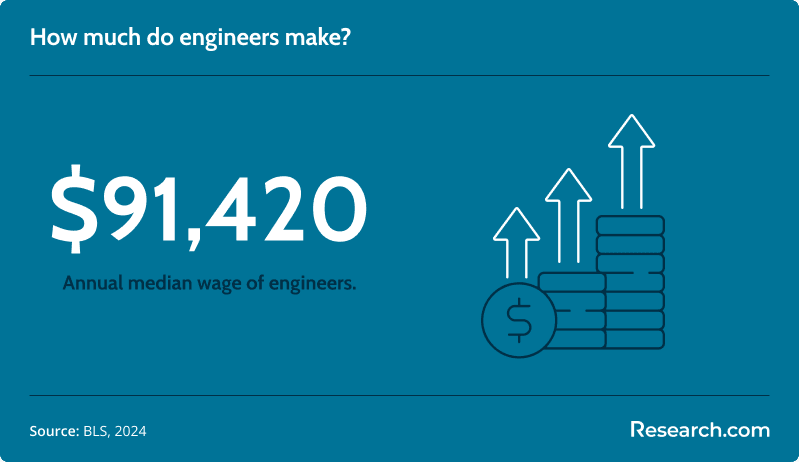
- With a master’s in engineering, you can expect to earn a median annual salary of $91,420, with opportunities for higher pay based on your specialization and experience.
What can I expect from an online master’s degree in engineering?
An online master's degree in engineering offers flexibility and convenience for students. The core curriculum usually includes advanced math, engineering theory, and specialized courses, depending on your focus. You might study subjects like systems engineering, software engineering, or civil engineering.
The average tuition for an online engineering degree varies, but you can expect to pay between $500 to $1,500 per credit hour. This cost can add up, but it's often cheaper than traditional on-campus programs.
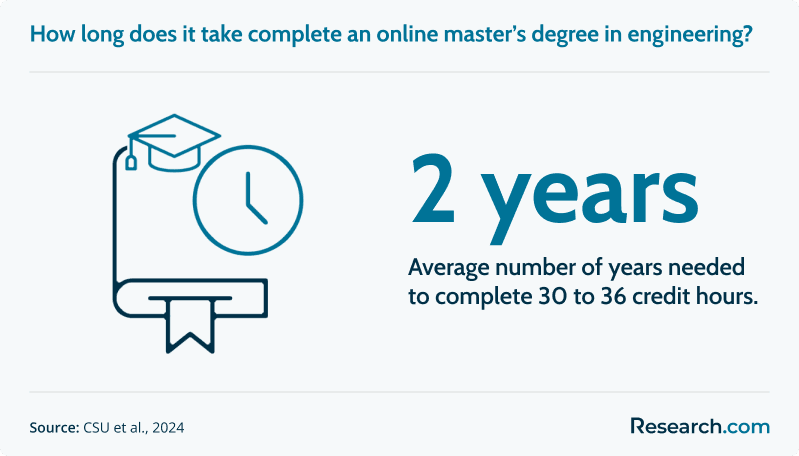
Most online engineering degree programs take about two years to complete if you study full-time. However, some programs offer part-time options, which can extend the time to graduation. Overall, an online engineering degree provides a comprehensive education that fits into a busy schedule.
Where can I work with an online engineering master’s degree?
Many graduates find positions in industries like technology, manufacturing, construction, and consulting. Depending on the company, you might work in an office, a lab, or even remotely. Typical job roles include project manager, systems engineer, software developer, and civil engineer. These positions often involve designing, testing, and managing projects. Some engineers work in research and development, creating new products or improving existing ones. An online engineering degree equips you with the skills needed for these diverse roles, making finding a job that suits your interests and lifestyle easier.
According to data published by the BLS in 2023, the following are the distribution of employment for those with an engineering degree:
- Architecture and engineering occupations (30%)
- Management occupations (19%)
- Computer and mechanical occupations (15%)
- Business and financial operations occupations (7%)
- Sales and related occupations (5%)
How much can I make with an online master’s in engineering degree?
The median annual wage for engineers is around $91,420. However, your specialization can significantly impact your earnings. For example, Aerospace Engineers have a median annual salary of about $130,720, while Electrical Engineers can make around $109,010 yearly. Overall, an online engineering degree can lead to lucrative career opportunities.
In 2024, the BLS reported the highest-paying engineering occupations as the following:
- Computer Hardware Engineers ($138,080)
- Petroleum Engineers ($135,690)
- Aerospace Engineers ($130,720)
- Nuclear Engineers ($125,460)
- Chemical Engineers ($112,100)
- List of the Most Affordable Online Master's Degrees in Engineering for 2027 Affordable Programs
- How long does it take to complete an online master’s degree in engineering? Completion Time
- How does an online master’s degree in engineering compare to on-campus programs? How does an online master’s degree in engineering compare to on-campus programs?
- How do online engineering programs provide hands-on experience? How do online engineering programs provide hands-on experience?
- What is the average cost of an online master’s degree in engineering? Average Cost
- What are the financial aid options for students enrolling in an online master’s degree in engineering? Financial Aid
- What are the prerequisites for enrolling in online master’s degree programs in engineering? Requirements
- What courses are typically in an online master’s degree in engineering program? What courses are typically in an online master’s degree in engineering program?
- How do online engineering degrees integrate data analytics for real-world problem solving? How do online engineering degrees integrate data analytics for real-world problem solving?
- What types of specializations are available in an online master's degree in engineering program? What types of specializations are available in an online master's degree in engineering program?
- What is the return on investment for an online master’s degree in engineering? What is the return on investment for an online master’s degree in engineering?
- How do online master's programs integrate emerging technologies into the curriculum? How do online master's programs integrate emerging technologies into the curriculum?
- How do online master’s programs support career networking and professional development? How do online master’s programs support career networking and professional development?
- How can interdisciplinary studies boost career prospects in online engineering? How can interdisciplinary studies boost career prospects in online engineering?
- How to choose the best online master’s degree in engineering program? How to choose the best online master’s degree in engineering program?
- What career paths are available for graduates of an online master’s degree in engineering? What career paths are available for graduates of an online master’s degree in engineering?
- What is the job market for graduates with an online master’s degree in engineering? Job Market
- How can I balance work and study while pursuing an online master’s degree in engineering? How can I balance work and study while pursuing an online master’s degree in engineering?
- What are the technical requirements for success in an online master’s degree in engineering? What are the technical requirements for success in an online master’s degree in engineering?
- What to Look for in Accreditation for Online Master's Degrees in Engineering What to Look for in Accreditation for Online Master's Degrees in Engineering
- How do online master’s programs support student research and innovation? How do online master’s programs support student research and innovation?
Most Affordable Online Master’s Degrees in Engineering for 2027
An online master’s degree in engineering can help working engineers move into advanced technical, management, research, or specialized roles without leaving their jobs or relocating. The challenge is choosing a program that is affordable, reputable, flexible, and aligned with the kind of engineering work you want to do next.
This guide is designed for engineers, technical professionals, military personnel, and recent engineering graduates comparing online graduate programs. You will find a ranked list of affordable options, key program details, cost and timeline expectations, accreditation considerations, common specializations, career outcomes, and practical questions to ask before applying.
Quick Answer: Is an Affordable Online Master’s in Engineering Worth Considering?
Yes, an affordable online master’s in engineering can be worthwhile if the program matches your specialization, is properly accredited or institutionally recognized, fits your schedule, and has a total cost you can justify based on your career goals. Most programs require about 30 to 36 credits, and full-time students commonly finish in about two years. Part-time students may need three or four years.
The best choice is not always the lowest advertised tuition. You should compare total program cost, transfer credit rules, faculty expertise, employer recognition, technical requirements, hands-on learning opportunities, and whether the curriculum supports your target role.
How Research.com Ranks Affordable Online Engineering Master’s Programs
Graduate engineering education is a major financial decision, so our ranking process emphasizes transparent data and practical value. Research.com reviews information from established education data sources, including the IPEDS database, Peterson's database, the College Scorecard database, and the National Center for Education Statistics. These sources help us evaluate affordability, institutional information, and program availability for online master’s degrees in engineering. You can review the broader evaluation approach on Research.com's methodology page.
Affordable Online Master’s in Engineering Programs at a Glance
| School | Online Engineering Options | Credits | Listed Tuition and Fees | Accreditation Listed |
| California State University | Computer, electrical, mechanical, systems, aerospace, quality assurance, and related engineering tracks | Minimum 30 credits | $2,208 for 0-6 units, $3,804 for 6.1+ units, additional $420 for non-residents | WASC Senior College and University Commission |
| University of North Carolina at Charlotte | Construction and Facilities Engineering; Engineering Management | 30-31 credits | $376.11 per credit hour for NC residents, $632.22 for out of NC non-residents, and $1,211.39 for non-NC residents | United States Distance Learning Association (USDLA), Commission on Colleges of the Southern Association of Colleges and Schools (SACS) |
| University of Colorado at Boulder | Aerospace, computer science, electrical, engineering management, water engineering, analytics, and related areas | Minimum 30 credits | $2,823 for in-state students, $6,270 for out-of-state students | The Accreditation Board for Engineering and Technology (ABET) |
| Mississippi State University | General engineering, military engineering, civil, mechanical, materials, leadership, and interdisciplinary options | Minimum 30 credits | $558.50 per credit hour | ABET, SACSCOC |
| Kansas State University | Engineering management, chemical, civil, electrical and computer, industrial, mechanical, and operations research | 15-33 credit hours | $825.83 per credit hour | ABET |
| Texas Tech University | Interdisciplinary engineering with chemical, civil, construction, electrical and computer, environmental, industrial, mechanical, and petroleum options | Minimum 36 credit hours | $1,410.90 for 3 credit hours | ABET |
| Purdue University | Aeronautics, biomedical, civil, electrical and computer, industrial, mechanical, nuclear, semiconductors, and dual MSE+MBA | Minimum 30 credit hours | $1,139 per credit hour for residents, $1,459 per credit hour for Indiana non-residents | ABET |
| University of Arkansas | Biological, chemical, civil, computer systems, electrical, environmental, industrial, mechanical, transportation, and operations management | Minimum 30 credit hours | $1,139 per credit hour for residents, $1,459 per credit hour for Indiana non-residents | ABET |
| Ohio University | Engineering Management, Electrical Engineering, Civil Engineering, Project Management | 30-36 credit hours | $737 per credit hour for residents, $756 per credit hour for non-residents | Higher Learning Commission (HLC) |
| University of Nebraska | Engineering Management | 30 credit hours | $675 per credit hour | HLC |
1. California State University
California State University offers online graduate engineering options through Cal State Online, including computer, electrical, and mechanical engineering pathways. The program catalog is especially useful for students who want a public university option with several technical and applied engineering concentrations. Online students can access graduate coursework without committing to a campus-based schedule, making it a practical choice for professionals who need flexibility.
- Tracks/Concentrations: Computer Engineering, Electrical Engineering, Fire Protection Engineering, Industrial Management and Engineering, Interior Architecture, Materials Engineering, Quality Assurance, Systems Engineering, Aerospace Engineering
- Required Credits to Graduate: Minimum 30 credits
- Tuition and Fees: $2,208 for 0-6 units, $3,804 for 6.1+ units, additional $420 for non-residents
- Accreditation: WASC Senior College and University Commission
2. University of North Carolina at Charlotte
The University of North Carolina at Charlotte provides online graduate engineering programs for students interested in construction, facilities, and engineering management. The MS in Construction and Facilities Engineering focuses on the planning, oversight, and execution of construction-related work, while the MSEM pathway is built for professionals who want to combine technical judgment with project, systems, and organizational leadership.
- Tracks/Concentrations: Construction and Facilities Engineering, Engineering Management
- Required Credits to Graduate: 30-31 credits
- Tuition and Fees: $376.11 per credit hour for NC residents, $632.22 for out of NC non-residents, and $1,211.39 for non-NC residents
- Accreditation: United States Distance Learning Association (USDLA), Commission on Colleges of the Southern Association of Colleges and Schools (SACS)
3. University of Colorado at Boulder
The University of Colorado at Boulder offers online learning through its College of Engineering and Applied Science for engineers, technical managers, and professionals seeking advanced training. Courses may use live class recordings and recorded lecture libraries, which can support students balancing graduate study with employment, military service, or geographic constraints. The university also offers dual degree opportunities that connect engineering management with fields such as aerospace, computer science, and electrical engineering.
- Tracks/Concentrations: Aerospace Engineering, Computer Science, Electrical Engineering, Engineering Management, Water Engineering and Management, Computational Linguistics, Analytics, Search and Informatics, Curriculum & Instruction (C&I): Math & Science Education
- Required Credits to Graduate: Minimum 30 credits
- Tuition and Fees: $2,823 for in-state students, $6,270 for out-of-state students
- Accreditation: The Accreditation Board for Engineering and Technology (ABET)
4. Mississippi State University
Mississippi State University offers online graduate engineering study with general and military engineering options. Students can choose thesis or non-thesis formats, which is important for applicants deciding between research-oriented preparation and applied professional advancement. The program also allows students to combine engineering coursework with other disciplines, giving working professionals room to shape a plan around specialized career goals.
- Tracks/Concentrations: Aeronautics & Aerodynamics, Civil, Transportation & Construction Systems, Coastal & Water Management, Management & Leadership, Electronics & Electric & Computer Systems, Engineering Systems, Materials & Fluids, Military Engineering, Structural & Mechanical, Sustainable Bioproducts, Agricultural, City/County Engineers, Mechanical/Engineering Mechanics, Industrial/Civil, Industrial/Computer Science, Diverse/Business
- Required Credits to Graduate: Minimum 30 credits
- Tuition and Fees: $558.50 per credit hour
- Accreditation: ABET, SACSCOC
5. Kansas State University
Kansas State University, through the Carl R. Ice College of Engineering, offers fully online master’s options across multiple engineering disciplines. The programs are designed for professionals who need advanced technical coursework as well as stronger skills in management, resource planning, and complex problem-solving. Students should note the requirement to visit the Manhattan, Kansas campus for an oral exam at the end of the program.
- Tracks/Concentrations: Engineering Management, Chemical Engineering, Civil Engineering, Electrical and Computer Engineering, Industrial Engineering, Mechanical Engineering, Operations Research
- Required Credits to Graduate: 15-33 credit hours
- Tuition and Fees: $825.83 per credit hour
- Accreditation: ABET
6. Texas Tech University
Texas Tech University offers an interdisciplinary Master of Engineering for practicing engineers through campus and distance learning formats. The non-thesis degree requires 36 semester hours, allows up to 9 hours of transfer credit from other accredited graduate schools, and must be completed within nine years. Applicants are expected to hold a bachelor’s degree in engineering or an equivalent background.
- Tracks/Concentrations: Chemical, Civil, Construction, Electrical and Computer Engineering, Engineering, Environmental, Industrial, Mechanical and Petroleum
- Required Credits to Graduate: Minimum 36 credit hours
- Tuition and Fees: $1,410.90 for 3 credit hours
- Accreditation: ABET
7. Purdue University
Purdue University offers several online master’s degrees for engineers seeking advanced specialization. Its online engineering portfolio includes traditional disciplines, emerging technical areas, and interdisciplinary options for professionals who want a respected graduate credential without relocating. Purdue may be a strong fit for students who want a large engineering school with multiple technical pathways.
- Tracks/Concentrations: Aeronautics & Astronautics, Biomedical Engineering, Civil Engineering, Electrical & Computer Engineering, Engineering Education, Industrial Engineering, Interdisciplinary Engineering, Mechanical Engineering, Microelectronics and Semiconductors, Nuclear Engineering, and Dual MSE+MBA
- Required Credits to Graduate: Minimum 30 credit hours
- Tuition and Fees: $1,139 per credit hour for residents, $1,459 per credit hour for Indiana non-residents
- Accreditation: ABET
8. University of Arkansas
The University of Arkansas offers an online Master of Science in Engineering for students with engineering or computer science backgrounds. Instead of forcing students into a narrow single-discipline track, the program allows graduate-level coursework across engineering areas. Students may organize three related engineering courses around topics such as sustainability, power systems, or energy management, although the emphasis area does not appear on transcripts or diplomas.
- Tracks/Concentrations: Biological, Chemical, Civil, Computer Systems, Electrical, Environmental, Industrial, Mechanical, and Transportation Engineering, as well as Operations Management
- Required Credits to Graduate: Minimum 30 credit hours
- Tuition and Fees: $1,139 per credit hour for residents, $1,459 per credit hour for Indiana non-residents
- Accreditation: ABET
9. Ohio University
Ohio University offers online graduate programs through the Russ College for engineering professionals. The Online Master of Engineering Management includes areas such as Six Sigma, information systems, and project management. The Online Master of Science in Electrical Engineering includes concentrations such as Electronic Navigation Systems and Computer Engineering, while the Online Master of Science in Civil Engineering offers specializations in Environmental Engineering, Construction Engineering, Structural Engineering, and Transportation Engineering.
- Tracks/Concentrations: Engineering Management, Electrical Engineering, Civil Engineering, Project Management
- Required Credits to Graduate: 30-36 credit hours
- Tuition and Fees: $737 per credit hour for residents, $756 per credit hour for non-residents
- Accreditation: Higher Learning Commission (HLC)
10. University of Nebraska
The University of Nebraska offers a fully online Master of Engineering Management through a partnership between the College of Engineering and the MBA program. The degree is aimed at engineers preparing for leadership, operations, and management responsibilities. The program is certified by the American Society for Engineering Management (ASEM), and graduates are exempt from Certified Associate Engineering Manager (CAEM®) testing and may apply for credentialing through ASEM.
- Tracks/Concentrations: Engineering Management
- Required Credits to Graduate: 30 credit hours
- Tuition and Fees: $675 per credit hour
- Accreditation: HLC
How Long Does It Take to Complete an Online Master’s Degree in Engineering?
Most online master’s degrees in engineering take about two years for full-time students. Programs commonly require 30 to 36 credits, which is similar in overall credit load to many other graduate programs, including the cheapest MLIS degree online. Students who enroll part time should expect a longer timeline, often three or four years, depending on course availability and workload.
Some universities also offer accelerated bachelor’s-to-master’s pathways. These 5-year programs let eligible students complete both a bachelor’s and a master’s degree in engineering in five years. This format may reduce total time and cost, but it is usually best for students who already know they want graduate engineering study before finishing the bachelor’s degree.
| Study Pace | Typical Timeline | Best For | Trade-Off |
| Full-time online study | About two years | Students who can handle multiple graduate courses at once | Faster completion but heavier weekly workload |
| Part-time online study | Three or four years | Working engineers, military students, and caregivers | Easier scheduling but longer time to graduation |
| 5-year bachelor’s-to-master’s program | Five years for both degrees | Undergraduates committed to graduate engineering early | Less flexibility to change fields later |
How Does an Online Master’s in Engineering Compare With an On-Campus Program?
An online engineering master’s can be academically comparable to a campus program when it uses the same curriculum, faculty standards, assessments, and institutional oversight. The real difference is usually delivery format, not necessarily degree quality. However, online learning requires more self-direction, strong technology access, and careful planning for labs, group projects, and exams.
| Factor | Online Master’s in Engineering | On-Campus Master’s in Engineering | Which May Be Better? |
| Schedule | Often designed for asynchronous or flexible study | Usually follows set class times and campus schedules | Online is often better for working professionals |
| Cost | May reduce commuting, relocation, and housing expenses; online programs, including online FNP programs, may also use different tuition structures | May include campus fees, commuting, or relocation costs | Online may be more affordable, but compare total costs |
| Curriculum | Often mirrors the campus curriculum when offered by the same department | May provide more direct access to physical labs and campus activities | Depends on specialization and hands-on requirements |
| Faculty and peers | Interaction happens through video, discussion boards, email, and virtual teamwork | More spontaneous in-person interaction | Campus may suit students who need frequent face-to-face support |
| Resources | Usually includes digital libraries, advising, technical support, and career services | Includes physical libraries, labs, offices, and campus events | Online can work well if remote support is strong |
| Accreditation | Should be checked at the institutional and program level | Also needs institutional and program-level review | Neither format should be chosen without accreditation verification |
How Do Online Engineering Programs Provide Hands-On Experience?
Engineering is not purely theoretical, so strong online programs must show how students apply concepts to real technical problems. Hands-on learning may happen through simulations, remote-access tools, local industry projects, capstones, thesis work, and software-based design assignments. Before enrolling, ask the school exactly how practical work is delivered in your specialization.
| Hands-On Method | How It Works Online | Why It Matters |
| Virtual labs and simulations | Students use digital environments to test models, adjust variables, and analyze outcomes | Builds problem-solving experience when physical lab access is limited |
| Engineering software assignments | Programs may require CAD, modeling, analytics, design, or discipline-specific tools | Helps students practice technologies used in technical workplaces |
| Internships or local partnerships | Some students complete practical work with employers or local organizations | Connects coursework to workplace engineering problems |
| Co-op options | Selected programs may allow alternating academic study with full-time engineering work | Adds experience to a resume before or during graduation |
| Capstone projects | Students solve an applied engineering problem, often with faculty or industry input | Demonstrates readiness to manage complex technical work |
| Thesis work | Students complete deeper research under faculty supervision | Useful for research, doctoral study, or specialized technical roles |
| Remote seminars and workshops | Programs may host webinars, expert talks, and professional development sessions | Keeps students connected to current engineering practice |
When comparing programs, request examples of recent capstones, virtual lab tools, software requirements, and industry collaborations. You can also compare institutions through Research.com’s guide to the most accredited online colleges if accreditation and distance learning quality are major concerns.
What Is the Average Cost of an Online Master’s Degree in Engineering?
The average cost of an online master’s degree in engineering varies by institution, residency status, program length, and fee structure. Many students can expect tuition and fees between $10,000 to $30,000 per year. Public universities often charge lower in-state rates, commonly ranging from $500 to $1,200 per credit hour, while private universities may charge between $1,000 to $1,500 per credit hour. Additional expenses may include technology fees, textbooks, software licenses, exam fees, and lab materials.
To compare affordability accurately, calculate the full degree price rather than looking only at per-credit tuition. Multiply tuition by required credits, add mandatory fees, and include software or equipment costs. Also check whether online students pay the same rate regardless of state residency.
| Cost Item | Why It Affects Total Price | Question to Ask |
| Tuition per credit | The largest cost driver in most programs | Is the rate different for residents, non-residents, or online students? |
| Required credits | A 36-credit program can cost more than a 30-credit program even with lower tuition | How many credits are required for my exact track? |
| Fees | Technology, distance learning, graduation, and course fees can add up | Which fees are mandatory each term? |
| Software and equipment | Engineering courses may require specialized tools or high-performance hardware | Are software licenses included in tuition? |
| Residency rules | Public universities may charge different rates by state residency | Do online students qualify for a separate online tuition rate? |
| Transfer credits | Accepted graduate credits may reduce both cost and time | How many credits can I transfer, and from where? |
The chart below lists the number of science, technology, engineering, and mathematics (STEM) degrees granted, according to data published in 2024 by the NCES.
What Financial Aid Options Are Available for Online Engineering Master’s Students?
Online engineering graduate students may be eligible for several types of financial support. Availability depends on enrollment status, citizenship or residency, employer policies, institutional funding, and whether the program participates in federal aid programs.
- Federal Aid: Students can complete the Free Application for Federal Student Aid (FAFSA) to determine eligibility for federal loans and other aid options.
- Scholarships and Grants: Professional organizations such as the National Society of Professional Engineers (NSPE) and the Society of Women Engineers (SWE) may offer scholarship opportunities for engineering students. Unlike loans, scholarships and grants generally do not need to be repaid.
- Employer Tuition Assistance: Engineers already employed in technical roles should ask whether their employer reimburses graduate coursework related to current or future job responsibilities.
- Private Loans: Private student loans can help cover remaining costs, but terms, interest rates, repayment protections, and borrower requirements vary. Compare them carefully against federal options.
- Institutional Aid: Universities may offer scholarships, tuition discounts, fellowships, or department-based awards for online graduate students. Contact the financial aid office and engineering department, not just admissions.
What Are the Prerequisites for Online Master’s Programs in Engineering?
Admission requirements vary by university and specialization, but most online engineering master’s programs expect applicants to show technical preparation, academic readiness, and clear career purpose. Some programs are built for students with engineering bachelor’s degrees, while others may consider applicants from closely related technical fields if they have completed prerequisite coursework.
- Bachelor's Degree: Most programs require a bachelor’s degree in engineering or a related field from an accredited institution. A student coming from one of the top graphic design schools, for example, would usually need to verify whether their math, science, computing, and engineering prerequisites meet the program’s standards.
- GPA Requirements: Many programs look for a minimum GPA, often around 3.0 or higher, as evidence that the applicant can handle graduate-level engineering coursework.
- Letters of Recommendation: Recommendations from faculty, supervisors, or technical leaders can help demonstrate your engineering ability, professionalism, and readiness for advanced study.
- Statement of Purpose: A strong statement should explain your technical background, career direction, reason for choosing the specialization, and why the online format fits your situation.
- GRE Scores: Some programs may still request GRE scores, although this requirement is becoming less common. Always confirm current testing rules before applying.
What Courses Are Typically Included in an Online Master’s in Engineering?
Coursework depends heavily on the engineering discipline, but graduate programs usually combine advanced technical theory, applied analysis, design, systems thinking, and specialization electives. Students preparing for leadership roles may also take project management, operations, or business-focused courses.
- Advanced Mathematics: Applies calculus, differential equations, linear algebra, and related methods to engineering analysis.
- Engineering Mechanics: Examines motion, forces, structural behavior, and mechanical response in engineered systems.
- Electrical Circuits: Covers circuit behavior, electronic components, and electrical systems used across multiple engineering fields.
- Materials Science: Studies the properties, performance, and engineering uses of materials in design and manufacturing.
- Fluid Mechanics: Analyzes fluid behavior and its use in mechanical, civil, aerospace, and environmental systems.
- Engineering Design: Focuses on developing, testing, and improving engineering solutions under real constraints.
- Computer-Aided Design (CAD): Builds skills in digital modeling, technical drawing, and component or system design.
- Systems Engineering: Teaches students how to coordinate parts, people, processes, and technologies within complex systems.
- Environmental Engineering: Addresses sustainability, pollution control, water systems, and environmental impact in engineering projects.
- Specialization Courses: Lets students go deeper into fields such as mechanical, civil, aerospace, electrical, or management-oriented engineering. Some programs may also include leadership or business material similar to an MBA or EDD leadership online course for students interested in entrepreneurship or organizational leadership.
How Do Online Engineering Degrees Use Data Analytics for Real-World Problem Solving?
Engineering decisions increasingly rely on data, modeling, optimization, and predictive analysis. Online engineering master’s programs may include coursework in data analysis, systems optimization, process engineering, simulation, and analytics-driven decision-making. These skills help engineers interpret performance data, improve processes, forecast failures, and design more efficient systems.
Data analytics can be valuable across aerospace, environmental engineering, manufacturing, transportation, infrastructure, and energy. Students who want a deeper analytics-focused path may also compare engineering programs with a dedicated data analytics degree, especially if their long-term goal is to become a data-oriented technical leader.
What Specializations Are Available in an Online Master’s Degree in Engineering?
Specialization is one of the most important choices in an engineering master’s program. The right concentration should match your current background, target industry, and desired job function. A mechanical engineer pursuing aerospace design, for example, should evaluate different coursework than an engineer preparing for construction management or power systems work.
| Specialization | Primary Focus | Good Fit For |
| Mechanical Engineering | Design, analysis, testing, and manufacturing of mechanical systems and components | Students interested in machines, energy systems, product design, or manufacturing |
| Electrical Engineering | Circuits, electronics, power systems, signal processing, and electrical infrastructure | Engineers targeting energy, electronics, communications, or automation |
| Civil Engineering | Infrastructure, construction, structures, transportation, and environmental systems | Students interested in public works, construction, structural systems, or transportation |
| Environmental Engineering | Water resources, sustainability, pollution control, and environmental protection | Engineers focused on sustainability and environmental compliance |
| Aerospace Engineering | Aircraft, spacecraft, propulsion, aerodynamics, and flight systems | Students pursuing aviation, defense, space, or advanced vehicle systems |
| Chemical Engineering | Processes that transform raw materials into products such as fuels, chemicals, and pharmaceuticals | Students interested in process industries, energy, materials, or biotechnology |
| Biomedical Engineering | Engineering solutions for healthcare, medical devices, biological systems, and clinical technologies | Engineers who want to work at the intersection of medicine and technology |
| Computer Engineering | Hardware, software integration, networks, embedded systems, and computing architecture | Students targeting computing systems, automation, or connected devices |
| Systems Engineering | Integration and management of complex technical systems across disciplines | Engineers moving into systems architecture, defense, operations, or technical leadership |
| Software Engineering | Software development methods, algorithms, programming, testing, and system design | Students pursuing technical software roles in engineering-heavy industries |
The chart below lists the top-paying engineering specializations by annual median wage, according to data published in 2024 by the BLS.
What Is the Return on Investment for an Online Master’s Degree in Engineering?
The return on investment depends on your total cost, current salary, target role, specialization, employer support, and how much the degree improves your advancement options. A lower-cost program can improve ROI, but only if it has the coursework, recognition, and technical depth employers in your field value.
To evaluate ROI, compare tuition and fees against likely career benefits in your specialization. Review employer tuition assistance, promotion requirements, alumni outcomes, and whether your target roles commonly prefer or require a master’s degree. You can also compare lower-cost undergraduate and graduate engineering pathways through Research.com’s guide to an online engineering degree.
| ROI Factor | Why It Matters | How to Evaluate It |
| Total program cost | Debt can reduce the financial benefit of the degree | Add tuition, fees, software, books, travel, and interest if borrowing |
| Career goal | Some roles reward graduate training more than others | Review job postings for your target title and specialization |
| Employer support | Tuition reimbursement can significantly reduce out-of-pocket cost | Ask HR about reimbursement limits, grade requirements, and service commitments |
| Program reputation | Employer recognition can influence hiring and promotion value | Check faculty, alumni, industry partnerships, and engineering department strength |
| Time to completion | Longer programs may delay career benefits | Compare full-time, part-time, and transfer-credit options |
How Do Online Master’s Programs Integrate Emerging Technologies?
Many online engineering master’s programs now use cloud-based simulation, virtual labs, analytics platforms, automation tools, and machine learning concepts to help students work with modern engineering problems. These technologies can support remote experimentation, collaborative design, modeling, and data-heavy analysis.
Students interested in artificial intelligence, automation, and advanced computing should review course descriptions carefully. Some engineering programs include AI-related modules, while others may pair better with a separate online AI degree if the student wants more concentrated preparation in artificial intelligence.
How Do Online Master’s Programs Support Career Networking and Professional Development?
Strong online programs do more than deliver lectures. They help students connect with faculty, peers, alumni, and employers through virtual career events, industry webinars, mentoring, project collaboration, and career advising. These services matter because many online students are already working and want direct career mobility, not just a credential.
Before enrolling, ask whether the program offers resume reviews, interview preparation, employer information sessions, alumni networking, and access to engineering-specific job boards. Students comparing cost-sensitive options may also review Research.com’s guide to the cheapest online master's degree in engineering management to see how affordability and career support can be evaluated together.
How Can Interdisciplinary Study Improve Engineering Career Prospects?
Interdisciplinary engineering study can prepare graduates for roles where technical systems intersect with computing, biotechnology, analytics, operations, sustainability, or business strategy. This matters because many engineering problems are no longer limited to a single discipline; they require teams to combine data, design, materials, regulation, economics, and user needs.
Students interested in computational biology, biotech systems, or data-heavy life science applications may compare engineering master’s options with programs such as a master bioinformatics pathway. The best interdisciplinary choice should still connect clearly to your target job market.
How to Choose the Best Online Master’s Degree in Engineering Program
The best online engineering master’s program is the one that fits your technical background, career target, budget, learning style, and credential needs. Do not choose based only on rankings or tuition. A low-cost program that lacks your desired specialization, has limited student support, or does not meet employer expectations may not be the best value.
- Verify accreditation first. Check institutional accreditation and, when relevant, program-specific accreditation through a recognized source such as the Accreditation Board for Engineering and Technology. ABET accreditation is program-specific, so confirm the exact program and level.
- Match the specialization to your next role. Choose mechanical, civil, electrical, systems, engineering management, or another track based on the work you want after graduation.
- Calculate the full cost. Include tuition, fees, textbooks, software, equipment, travel, and interest if you plan to borrow.
- Check flexibility and pacing. Review whether courses are asynchronous, synchronous, full-time, part-time, or cohort-based.
- Review faculty expertise. Look for faculty whose research or professional background aligns with your technical interests.
- Evaluate student support. Confirm access to digital libraries, academic advising, tutoring, software help, and career services.
- Ask about hands-on learning. Request details about labs, simulations, capstones, thesis options, and industry projects.
- Compare outcomes, not promises. Ask for graduation, placement, promotion, or alumni career information when available, but avoid assuming any salary is guaranteed.
| Common Mistake | Why It Can Hurt You | Better Approach |
| Choosing only the cheapest tuition | The program may lack your specialization or required support | Compare total value, not just price |
| Ignoring accreditation | Employers, licensing boards, or future schools may question the credential | Verify institutional and program-level accreditation before applying |
| Assuming all online programs are fully remote | Some programs require campus visits, exams, labs, or internships | Ask about every in-person requirement before enrolling |
| Overlooking software and hardware needs | Engineering tools may require a capable computer and stable internet | Request the technical specifications for your program |
| Relying only on rankings | A highly ranked program may not fit your goals or schedule | Use rankings as one input alongside curriculum, cost, and outcomes |
| Assuming salary gains are automatic | Career growth depends on experience, field, location, and employer demand | Review job postings and talk with professionals in your target role |
What Career Paths Are Available With an Online Master’s Degree in Engineering?
Graduates may use an online engineering master’s degree to deepen technical expertise, move toward leadership, or shift into a specialized engineering field. Actual outcomes depend on prior experience, specialization, licensure, industry, location, and employer requirements.
- Project Manager: Coordinates engineering projects, schedules, budgets, teams, risks, and deliverables.
- Systems Engineer: Designs, integrates, tests, and manages complex technical systems across disciplines.
- Software Developer: Builds and maintains software, often for embedded systems, automation, technical platforms, or engineering applications.
- Civil Engineer: Plans, designs, and oversees infrastructure such as roads, bridges, buildings, and transportation systems.
- Mechanical Engineer: Develops mechanical devices, machines, engines, tools, and energy-related systems.
- Electrical Engineer: Works with power systems, electronics, circuits, controls, and related electrical technologies.
- Aerospace Engineer: Designs, analyzes, and tests aircraft, spacecraft, propulsion systems, and related components.
- Environmental Engineer: Creates engineering solutions for pollution control, water systems, sustainability, and environmental protection.
- Biomedical Engineer: Applies engineering principles to healthcare equipment, medical devices, computer systems, and biomedical technologies.
- Consultant: Advises organizations on technical problems, engineering processes, system improvements, or specialized projects.
An online master’s in engineering can be demanding, and it is not the right fit for every student. If you are still exploring lower-cost or easier-entry academic routes in other fields, you may also compare cheap nursing schools with simple admission, cheap easy psychology programs, cheap easy associate's degree programs, or the easiest PhD programs.
What Is the Job Market for Graduates With an Online Master’s Degree in Engineering?
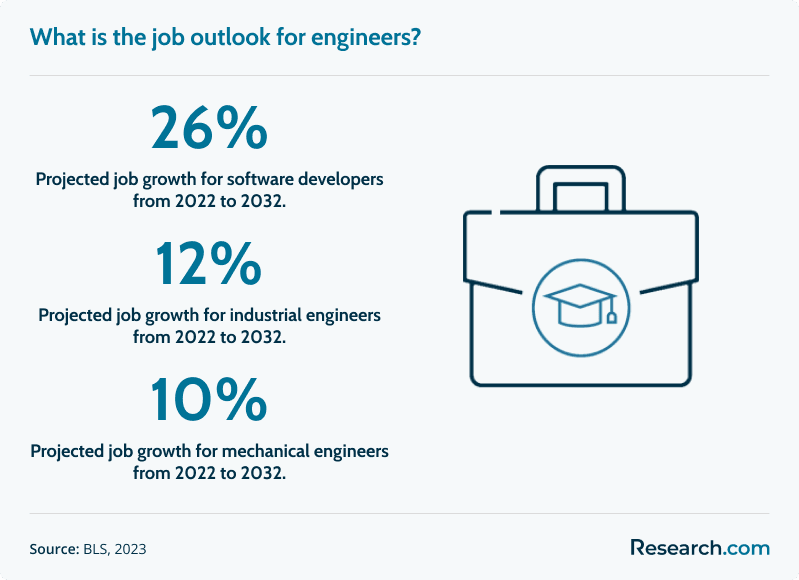
The job market for engineering graduates varies by discipline, region, industry, and experience level. According to the BLS information cited in this guide, architecture and engineering occupations are projected to grow faster than usual from 2022 to 2032, with about 188,000 job openings in these fields each year. The cited outlook is especially strong for software developers, industrial engineers, and mechanical engineers, with projected growth of 26%, 12%, and 10%, respectively.
A master’s degree may help candidates qualify for advanced technical, management, research, or specialized roles, but it does not guarantee employment or a specific salary. Students should compare job postings in their target discipline and location before choosing a specialization.
How Can You Balance Work and Study in an Online Engineering Master’s Program?
Balancing graduate engineering coursework with a job is possible, but it requires planning before classes begin. Engineering courses can involve problem sets, software work, group projects, labs, and exams, so students should avoid underestimating weekly time demands.
- Build a weekly study plan. Block time for lectures, readings, assignments, software work, and exam preparation before your workweek fills up.
- Use the online format strategically. If lectures are asynchronous, schedule them during your most focused hours instead of treating them as optional background tasks.
- Prioritize high-impact tasks. Focus first on graded deliverables, major projects, and technical concepts that build across the semester.
- Talk with your employer early. Some employers may offer flexible scheduling, tuition support, or project opportunities related to your coursework.
- Use productivity tools. Calendars, task boards, and reminder systems can help you track work deadlines and academic milestones.
- Ask for help before you fall behind. Contact professors, teaching assistants, classmates, advisors, or mentors as soon as you see a problem developing.
What Technical Requirements Do Online Engineering Students Need?
Online engineering students should confirm computer and software requirements before enrolling. Some courses may require simulation platforms, CAD tools, data analysis software, virtual labs, or cloud-based engineering environments. A basic laptop may not be enough for every specialization.
Ask the program for recommended hardware specifications, operating system requirements, internet speed expectations, browser compatibility, required peripherals, and whether software licenses are included. Students comparing technical graduate programs may also find it useful to review the cheapest masters in data science degree options, especially if they are weighing engineering against data-heavy alternatives.
What Should You Look for in Accreditation for an Online Master’s in Engineering?
Accreditation is one of the most important checks before choosing an online engineering master’s program. At minimum, the university should hold recognized institutional accreditation. For some engineering pathways, program-level accreditation may also matter, especially if your career goals involve licensure, regulated work, or employer requirements.
Confirm accreditation directly through the accreditor and the university’s official program page. Do not assume that all degrees at a university share the same program-level status. Students considering broader business-technology graduate options can compare accreditation considerations with the cheapest online MBA in information technology.
How Do Online Master’s Programs Support Student Research and Innovation?
Online engineering master’s programs can support research through remote seminars, digital libraries, faculty-guided projects, virtual collaboration platforms, thesis options, and applied capstones. These opportunities are especially useful for students interested in innovation, product development, advanced systems, emerging technologies, or doctoral study.
Ask whether online students can participate in faculty research, publish or present project work, access research databases, and collaborate with industry partners. Students who want to connect engineering with advanced AI topics may also review the best affordable AI online degree.
What Graduates Say About Their Online Master’s Degree in Engineering
- Mina: "Completing my engineering master’s online changed how I approached technical problems. Managing classes while working was difficult, but the flexible format helped me keep moving. The virtual labs and applied projects made the material feel connected to my aerospace work, and I now feel more prepared to handle complex engineering assignments."
- Johann: "Choosing an online engineering master’s was the right decision for my situation. I could study from home, keep my job, and still learn from experienced instructors and classmates with different industry backgrounds. The discussions, live sessions, and practical assignments helped me earn more responsibility in industrial automation."
- Shawna: "The online format gave me the flexibility I needed while I continued working. Simulations, instructor feedback, and project-based assignments helped me understand difficult concepts more clearly. Since finishing the program, I have been able to focus more deeply on renewable energy work and apply my skills to sustainability problems."
Key Insights
- Affordability requires a full-cost comparison. Look beyond tuition and include fees, software, equipment, travel, books, and the number of required credits.
- Most online engineering master’s programs require 30 to 36 credits. Full-time students often finish in about two years, while part-time students may need three or four years.
- Accreditation should be verified before applying. Check institutional accreditation and confirm whether program-level accreditation matters for your specialization or licensure goals.
- The right specialization matters more than the broad degree title. Mechanical, civil, electrical, systems, engineering management, aerospace, and data-focused pathways can lead to very different career outcomes.
- Hands-on learning is possible online, but you must ask how it works. Compare virtual labs, simulations, capstones, thesis options, software access, internships, and any required campus visits.
- ROI depends on your career plan. A low-cost program is valuable only if it supports your target role, employer expectations, and advancement goals.
- Online study is flexible, not easy. Working students should plan weekly study blocks, confirm technical requirements, and use advising and faculty support early.
References:
- Bureau of Labor Statistics (BLS). (2023). Field of degree: Engineering. Occupational Outlook Handbook. BLS.
- Bureau of Labor Statistics (BLS). (2024a). Civil Engineers. Occupational Outlook Handbook. BLS.
- Bureau of Labor Statistics (BLS). (2024b). Mechanical Engineers. Occupational Outlook Handbook. BLS.
- Bureau of Labor Statistics (BLS). (2024c). Architecture and Engineering Occupations. Occupational Outlook Handbook. BLS.
- National Center for Education Statistics (NCES). (2024). Science, Technology, Engineering, and Mathematics (STEM) education, by gender. Fast Facts. NCES.
- National Center for Science and Engineering Statistics (NCSES). (2024). The State of U.S. Science and Engineering 2024. NCSES.
- ZipRecruiter. (2024). Masters Engineering Salary. ZipRecruiter.
Other Things You Should Know About An Online Master’s Degree in Engineering
Many affordable online engineering master’s programs require either a thesis or a capstone, not both. Thesis options often take 6 to 9 credits, while capstones are usually 3 to 6 credits and may require a faculty-approved project proposal before registration.
In 2027, the most affordable online master's programs in engineering often include specializations like civil engineering, electrical engineering, mechanical engineering, and software engineering. Availability varies by institution, so check individual program offerings for specific options tailored to your career goals.


