
2027 Most Affordable Online Energy Policy Degree Programs

Co-Founder and Chief Data Scientist
Choosing an online energy policy degree is not just a tuition decision. It is a career decision about where you want to work in a changing energy economy: government regulation, renewable energy development, utility planning, sustainability consulting, environmental compliance, or energy-focused research. The right program can help you build the policy, economics, law, data, and technical knowledge needed to evaluate energy systems and shape decisions that affect communities, companies, and public agencies.
This guide is for working professionals, recent graduates, STEM degree holders, public policy students, and career changers comparing affordable online energy policy degree options for 2027. You will learn what these programs cover, how much they can cost, how online study compares with campus-based learning, what careers may be available, and how to evaluate whether a program is worth the investment.
In 2023, the U.S. energy industry supported 8.4 million jobs. However, access to many policy, consulting, regulatory, and sustainability roles depends on more than interest in clean energy. Employers often look for evidence that candidates understand energy markets, climate policy, environmental law, data analysis, stakeholder communication, and the practical trade-offs behind energy decisions.
Quick Answer: Is an Online Energy Policy Degree Worth It?
An online energy policy degree can be worth it if you want to move into energy regulation, sustainability strategy, renewable energy policy, environmental consulting, government affairs, or energy systems management without leaving your current job. The strongest programs combine policy analysis, economics, environmental law, energy markets, and applied projects. The best value usually comes from accredited programs with reasonable tuition, strong faculty experience, practical capstone work, and clear career support.
It may not be the best choice if you need a highly technical engineering credential, a licensure-focused path, or a low-cost credential for a role that only requires a certificate. Before enrolling, compare total cost, transfer policies, employer recognition, curriculum fit, and whether graduates enter the kinds of roles you want.
What are the benefits of getting an online energy policy degree?
- Career alignment: The degree can prepare you for roles such as energy policy analyst, sustainability consultant, regulatory affairs specialist, environmental policy analyst, or energy program manager in government, nonprofit, consulting, utility, and private-sector settings.
- Competitive earning potential: Median salary for energy policy professionals is around $96,819 per year, with higher earnings possible in federal agencies and think tanks. Actual salary depends on role, employer, location, prior experience, and technical specialization.
- Flexible study format: Online delivery can help working professionals build policy and energy expertise while staying employed, avoiding relocation, and managing family or personal responsibilities.
- Interdisciplinary preparation: Energy policy programs often connect economics, law, science, technology, public administration, and sustainability, which reflects how real energy decisions are made.
- Useful bridge for STEM and policy backgrounds: Engineers, environmental science graduates, business professionals, and public policy students can use the degree to add sector-specific energy expertise.
What can I expect from an online energy policy degree?
An online energy policy degree teaches students how energy systems are governed, financed, regulated, and evaluated. Most programs combine public policy, environmental regulation, energy economics, sustainability strategy, climate policy, and applied research. Some programs lean toward policy and management, while others emphasize engineering, renewable energy systems, or energy business.
Students should expect coursework in areas such as environmental law, energy markets, climate policy, energy systems, regulatory analysis, data-informed decision-making, and sustainability planning. Many programs require a capstone, thesis, or applied project where students analyze a real policy problem, energy transition challenge, or organizational sustainability issue. Some programs may also offer optional internship opportunities or applied research experiences.
Tuition typically ranges from $7,600 to $86,000, depending on the school, degree level, credit load, residency rules, and program length. Online courses may use recorded lectures, scheduled live discussions, faculty feedback, simulations, discussion boards, group projects, and independent research. Many programs are asynchronous, while others include required live sessions. Success usually requires strong time management, comfort with digital learning platforms, and regular participation in online discussions.
| Program feature | What it usually means for students | Why it matters |
| Asynchronous coursework | You can often complete weekly work on your own schedule. | Helpful for students working full time or balancing family responsibilities. |
| Live online sessions | Some courses require real-time attendance for discussions, presentations, or guest lectures. | Improves interaction but may be harder across time zones or work schedules. |
| Capstone or thesis | You complete a major applied project or research paper. | Can become a portfolio piece for consulting, government, or sustainability roles. |
| Policy and economics core | Courses examine regulation, energy markets, environmental law, and policy design. | Builds the foundation for analyst, planning, compliance, and advisory roles. |
| Technical or data electives | Some programs include modeling, energy systems, analytics, or engineering topics. | Useful for students targeting utilities, clean energy firms, or technical policy work. |
Where can I work with an online energy policy degree?
Graduates can pursue roles across public agencies, utilities, renewable energy companies, consulting firms, nonprofits, research organizations, and corporations with sustainability or regulatory teams. The degree is especially useful in jobs that require translating technical energy issues into policy recommendations, compliance strategies, business decisions, or public programs.
According to the U.S. Bureau of Labor Statistics, as of May 2023, industries with high employment levels for environmental scientists and specialists, a category that overlaps with some energy policy work, include:
- Government agencies: Federal, state, and local government employers account for over 28% of environmental scientists and specialists.
- Professional, scientific, and technical services: This sector employs approximately 19% of these workers, including roles tied to consulting, environmental analysis, and policy support.
- Local government, excluding education and hospitals: Local public agencies employ around 14% of environmental scientists and specialists.
- Engineering services: Engineering services employ approximately 11% in areas such as research, energy policy development, infrastructure planning, and environmental review.
How much can I make with an online energy policy degree?
Energy policy salaries vary by job title, degree level, employer, geography, technical skill set, and prior experience. A graduate working in a local government analyst role may earn differently from a federal energy specialist, sustainability consultant, environmental engineer, or senior policy advisor. The figures below show related roles and salary benchmarks already reported for this field.
The following roles had median wages in 2023 that exceeded the U.S. average hourly wage of $23.11 (BLS, 2024):
| Role or career stage | Reported wage or salary | How to interpret it |
| Environmental Scientists and Specialists | $38.49 per hour; $80,060 per year | Relevant for students interested in environmental assessment, compliance, and policy analysis. |
| Environmental Engineers | $50.08 per hour; $104,170 per year | Most relevant to students with engineering backgrounds or technical energy systems expertise. |
| Management Analysts, including sustainability consultants | $48.65 per hour; $101,190 per year | Useful benchmark for consulting, strategy, and organizational sustainability roles. |
| Entry-level Positions | $70,000 annually | Actual entry-level pay may differ by employer, location, and prior experience. |
| Senior Roles | $116,000 annually or more | Often associated with leadership, specialized expertise, or significant professional experience. |
| Federal Jobs, Department of Energy | $115,000 annually | Federal compensation depends on grade, locality pay, experience, and position requirements. |
| Advanced degrees and specialized certifications for senior professionals | Between $110,000 and $130,000 per year | May apply to experienced professionals in higher-level consulting, research, policy, or management roles. |
- Best Online Energy Policy Degree Programs for 2027
- How long does it take to complete an online energy policy degree program?
- How does an online energy policy degree program compare to an on-campus program?
- What is the average cost of an online energy policy degree program?
- What are the financial aid options for students enrolling in an online energy policy degree program?
- What are the prerequisites for enrolling in an online energy policy degree program?
- What courses are typically in an online energy policy degree program?
- What types of specializations are available in an online energy policy degree program?
- How to Choose the Best Online Energy Policy Degree Program
- How can digital skills integration enhance an online energy policy degree program?
- What career paths are available for graduates of an online energy policy degree program?
- What is the job market for graduates with an online energy policy degree program?
- What challenges might I encounter in an online energy policy degree program?
- How can integrating technical expertise enhance my energy policy career?
- How do online energy policy degree programs foster industry connections and mentorship?
- What is the return on investment of an online energy policy degree program?
Best Online Energy Policy Degree Programs for 2027
The programs below include online degrees in energy policy, energy business, energy systems, renewable energy, sustainability, and related fields. Because “energy policy” can sit within public policy, business, engineering, environmental management, or sustainability departments, compare each curriculum carefully before assuming it matches your career goal.
How do we rank schools?
Research.com considers affordability, institutional data, program information, and student decision factors when evaluating schools. This ranking draws from established education data sources, including the IPEDS database, Peterson's database, the College Scorecard database, and The National Center for Education Statistics. For more detail on ranking criteria and data use, review Research.com's methodology page.
| Rank | School and program | Credits or classes | Cost | Accreditation |
| 1 | University of Oklahoma — EMBA in Energy | 36 | $2,375 per credit hour | Association to Advance Collegiate Schools of Business (AACSB) |
| 2 | University of Texas Permian Basin — MBA with Certificate in Energy Business | 36-45 | $14,075.64 to $17,594.55 tuition fee | Association to Advance Collegiate Schools of Business (AACSB); Southern Association of Colleges and Schools Commission on Colleges (SACSCOC) |
| 3 | Iowa State University — M.Eng. in ESE | 30 | $818 per credit hour | Higher Learning Commission (HLC) |
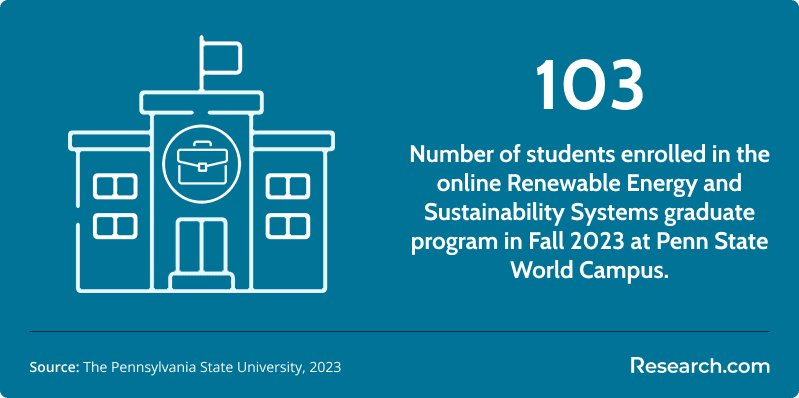
| 4 | Pennsylvania State University – World Campus — M.P.S. in Renewable Energy and Sustainability Systems | 33 | $1,027 per credit hour | Middle States Commission on Higher Education (MSCHE) |
| 5 | EUCLID - Euclid University — M.Sc. in Renewable Energy | 40 | $169 per credit hour / $7,610 tuition fee | United Nations Treaty-based intergovernmental university; recognized by participating states and listed in the UNESCO/IAU World Higher Education Database (WHED) |
| 6 | University of North Dakota — Ph.D. in Energy Engineering | 90 | $798.08 per credit hour | Higher Learning Commission (HLC) |
| 7 | National American University — B.S. in Energy Management | 180 | $304 per credit hour | Higher Learning Commission (HLC) |
| 8 | Capitol Technology University — Ph.D. in Sustainability | 60 | $190 per credit hour (in-state), $975 per credit hour | Middle States Commission on Higher Education (MSCHE) |
| 9 | Colorado State University — Ph.D. in Systems Engineering | 72 | $1,175 per credit hour | Higher Learning Commission (HLC) |
| 10 | University of Connecticut — Master of Energy and Environmental Management | 30 | $925 per credit hour / $2,775 per 3 credit course | New England Commission of Higher Education (NECHE) |
1. University of Oklahoma (EMBA in Energy)
The University of Oklahoma offers an online Executive MBA in Energy for professionals who want a business-focused route into energy leadership. The curriculum emphasizes energy economics, policy analysis, regulatory frameworks, environmental impact, and management decisions in the energy sector.
- Required Credits to Graduate: 36
- Cost: $2,375 per credit hour
- Accreditation: Association to Advance Collegiate Schools of Business (AACSB)
2. University of Texas Permian Basin (MBA with Certificate in Energy Business)
The University of Texas Permian Basin offers an online MBA with a Certificate in Energy Business for students seeking a combination of graduate business training and energy-sector specialization. Coursework connects management fundamentals with energy economics, operations, markets, and industry decision-making.
- Required Credits to Graduate: 36-45
- Cost: $14,075.64 to $17,594.55 tuition fee
- Accreditation: Association to Advance Collegiate Schools of Business (AACSB); Southern Association of Colleges and Schools Commission on Colleges (SACSCOC)
3. Iowa State University (M.Eng. in ESE)
The online Master of Engineering in Energy Systems Engineering at Iowa State University is designed for professionals who want technical preparation in energy systems. Students study topics such as power generation, energy efficiency, systems optimization, and energy applications that can support technical leadership or management roles.
- Required Credits to Graduate: 30
- Cost: $818 per credit hour
- Accreditation: Higher Learning Commission (HLC)
4. Pennsylvania State University – World Campus (M.P.S. in Renewable Energy and Sustainability Systems)
The online Master of Professional Studies in Renewable Energy and Sustainability Systems from Pennsylvania State University focuses on applied renewable energy and sustainability work. The program combines renewable technologies, systems analysis, strategic sustainability, and practical problem-solving for corporate, government, and nonprofit contexts.
- Required Credits to Graduate: 33
- Cost: $1,027 per credit hour
- Accreditation: Middle States Commission on Higher Education (MSCHE)
5. EUCLID - Euclid University (M.Sc. in Renewable Energy)
The online Master in Renewable Energy at EUCLID examines renewable energy through technical, policy, economic, and international lenses. Students explore climate policy, global energy issues, renewable energy systems, and project management for roles in international organizations, NGOs, government, and sustainability-focused organizations.
- Required Credits to Graduate: 40
- Cost: $169 per credit hour / $7,610 tuition fee
- Accreditation: United Nations Treaty-based intergovernmental university; recognized by participating states and listed in the UNESCO/IAU World Higher Education Database (WHED)
6. University of North Dakota (Ph.D. in Energy Engineering)
The online Ph.D. in Energy Engineering at the University of North Dakota is a research-oriented option for students pursuing advanced technical work in energy. Areas of study may include carbon capture, fuel systems, renewable energy technology, and engineering-based energy solutions.
- Required Credits to Graduate: 90
- Cost: $798.08 per credit hour
- Accreditation: Higher Learning Commission (HLC)
7. National American University (B.S. in Energy Management)
The online Bachelor of Science in Energy Management from National American University introduces students to the technical, business, regulatory, and sustainability dimensions of the energy industry. It may suit learners seeking undergraduate preparation for supervisory or management-oriented energy roles.
- Required Credits to Graduate: 180
- Cost: $304 per credit hour
- Accreditation: Higher Learning Commission (HLC)
8. Capitol Technology University (Ph.D. in Sustainability)
The online Ph.D. in Sustainability at Capitol Technology University is intended for professionals interested in advanced sustainability research. Students can focus on issues such as energy efficiency, resilient infrastructure, sustainable systems, and applied environmental innovation.
- Required Classes to Graduate: 60
- Cost: $190 per credit hour (in-state), $975 per credit hour
- Accreditation: Middle States Commission on Higher Education (MSCHE)
9. Colorado State University (Ph.D. in Systems Engineering)
The online Ph.D. in Systems Engineering from Colorado State University serves engineers and technical professionals working on complex systems across energy, aerospace, defense, and related sectors. The curriculum includes systems modeling, lifecycle analysis, interdisciplinary research, and applied engineering problem-solving.
- Required Credits to Graduate: 72
- Cost: $1,175 per credit hour
- Accreditation: Higher Learning Commission (HLC)
10. University of Connecticut (Master of Energy and Environmental Management)
The online Master of Energy and Environmental Management at the University of Connecticut combines environmental law, energy regulation, natural resource management, policy, science, and business. It is designed for students seeking leadership roles in government, industry, and nonprofit organizations focused on energy and environmental systems.
- Required Credits to Graduate: 30
- Cost: $925 per credit hour / $2,775 per 3 credit course
- Accreditation: New England Commission of Higher Education (NECHE)
How long does it take to complete an online energy policy degree program?
Most online energy policy master’s programs take 18 to 24 months to complete. A full-time student may finish a master’s in Energy Policy in about two years, while part-time students may need up to three years. Some accelerated tracks can be completed in one year full-time, depending on course load, start dates, and program design.
Accelerated options usually require heavier course loads and consistent weekly study time. Some full-time, competency-based programs can be completed in 12–18 months. Students comparing flexible graduate credentials may also review how other online professional programs, such as affordable nurse educator graduate certificate programs online, structure pacing for working adults.
Working while enrolled is common. About 60–68% of online graduate students are employed full time. Asynchronous energy policy programs can make it more realistic to balance school with professional and personal responsibilities, but students should still plan for weekly reading, writing, research, group work, and deadlines.
| Enrollment pace | Typical completion time | Best for | Main trade-off |
| Accelerated full-time | One year or 12–18 months | Students who can prioritize school heavily | Higher workload and less schedule flexibility |
| Standard full-time | 18 to 24 months | Students who want steady progress | May be difficult with demanding full-time work |
| Part-time | Up to three years | Working professionals and caregivers | Longer time before seeing career benefits |
How does an online energy policy degree program compare to an on-campus program?
Online and on-campus energy policy degrees can be similar in academic quality when they are offered by accredited institutions and use the same faculty standards, curriculum expectations, and assessment methods. The main differences are delivery format, networking style, schedule flexibility, campus access, and student experience.
- Credibility: 83% of employers regard online and on-campus degrees as equally credible, according to a 2023 Online Learning Consortium survey.
- Curriculum: At institutions offering both formats, core subjects such as energy law, economics, climate policy, and policy analysis are often aligned across online and campus programs.
- Cost: Public online graduate programs average $40,536 for a full bachelor’s track, comparable to in-state tuition. Private online grand tuition averages $63,185 per program. Students comparing cost differences across online fields may also find similar affordability questions in guides on construction management degree online cost.
- Networking: Online programs may use virtual events, alumni panels, group projects, career platforms, and occasional hybrid gatherings. Campus programs may offer more spontaneous relationship-building, but online programs can connect students across broader geographic regions.
- Employer Perception: Post-pandemic studies show hiring managers increasingly accept online credentials. One survey reported 61% of HR leaders now view online degrees as equal or superior.
| Factor | Online energy policy degree | On-campus energy policy degree |
| Schedule | Often better for working adults, especially if asynchronous | More structured around class meeting times |
| Networking | Depends on virtual events, faculty access, alumni networks, and group projects | More informal access to classmates, campus events, and faculty offices |
| Cost profile | Can reduce relocation, commuting, and some campus-related expenses | May include higher living, transportation, or campus costs |
| Learning style | Requires self-direction and strong written communication | Provides more in-person accountability and classroom interaction |
| Best fit | Professionals who need flexibility and geographic choice | Students who want immersive campus access and face-to-face learning |
What is the average cost of an online energy policy degree program?
The cost of an online energy policy master’s program varies widely by school type, residency status, degree level, credit requirement, and whether the program is housed in a business, engineering, policy, or environmental studies department. For example, the University of North Carolina at Chapel Hill charges approximately $10,552 for in-state graduate tuition, while out-of-state tuition is around $28,844. The University of Florida lists in-state tuition at $10,770 and out-of-state tuition at $27,335.
Online study can be less expensive than campus-based study, especially when students avoid relocation, commuting, and some campus fees. Private institutions, on average, charge $62,756 for an online degree compared to $198,616 for an in-person degree. Similar cost comparisons appear in other online professional fields, including discussions of construction management degree cost.
Financial aid may reduce the net price for eligible students. In 2025, federal student aid disbursements are projected to total $135 billion, including $40.651 billion in grants. Additionally, 74% of students under age 24 receive financial aid, which can help offset tuition and related expenses.
Debt should be part of the ROI calculation. The average graduate degree holder owes up to $102,790 in cumulative federal student loan debt, and 54% of all graduate school completers have federal student loan debt.
| Cost factor | What to check before enrolling |
| Tuition model | Confirm whether the school charges per credit, per course, per term, or a flat program rate. |
| Residency pricing | Ask whether online students pay in-state, out-of-state, or separate online tuition. |
| Fees | Review technology, graduation, library, distance learning, and student service fees. |
| Course load | Calculate the total cost based on required credits, not only advertised per-credit tuition. |
| Employer support | Check whether your employer offers tuition reimbursement and whether the program qualifies. |
| Time to completion | Longer enrollment may increase fees, loan interest, and opportunity costs. |
What are the financial aid options for students enrolling in an online energy policy degree program?
Eligible online students can often use the same major funding categories as campus-based students, provided the institution and program meet aid requirements. Start by confirming that the school participates in federal student aid and that your specific online program is aid-eligible. You can review federal aid categories through the U.S. Department of Education’s financial aid options.
- Federal aid, including grants and loans: About 74% of graduate students received financial aid in 2019–20, including loans, grants, or assistantships.
- Graduate assistantships and fellowships: Roughly 12% of graduate students were supported through assistantships in that same period. The NSF GRFP awards about 2,000 fellowships annually, including many to students in environmental and energy-related fields, and provides stipends and tuition support.
- Employer tuition reimbursement: Around 51% of large U.S. employers offer tuition benefits, often covering $5,000–$7,000 yearly for graduate education.
- Federal Pell grants for qualified post-baccalaureate programs: Some certificate and credential programs may qualify for Pell grants, but standard master’s degrees generally do not.
- Scholarships from schools or professional organizations: Ask admissions offices whether online students can apply for the same institutional scholarships as campus students.
- Payment plans: Monthly payment plans can reduce upfront pressure, although they do not lower the total program cost.
What are the prerequisites for enrolling in an online energy policy degree program?
Admission requirements vary, but most online energy policy programs look for evidence that applicants can handle graduate-level writing, quantitative work, policy analysis, and interdisciplinary energy topics. Some programs are open to many undergraduate majors, while technical tracks may expect engineering, science, economics, or statistics preparation.
- Bachelor’s degree: Many programs accept applicants from multiple disciplines, not only environmental science. Common backgrounds include sustainability, economics, political science, public policy, engineering, business, and related fields.
- GRE policy: The GRE is often not required. Michigan Technological University explicitly waives the GRE for its online energy policy master’s program.
- Prerequisite coursework: Some programs expect prior knowledge in microeconomics, statistics, or environmental science. Michigan Tech identifies these areas as necessary preparation.
- Professional or academic experience: Energy, policy, environmental, sustainability, engineering, or government experience may strengthen an application, although it is not always mandatory. Strong applicants often have 1–3 years of related experience or coursework.
- International applicant requirements: Non-native English speakers may need TOEFL or IELTS scores, such as 79 TOEFL or 6.5 IELTS at Michigan Tech.
- Statement of purpose: Many programs use essays to evaluate whether your goals fit the curriculum and faculty expertise.
- Recommendations: Letters from supervisors, professors, or policy professionals can help show readiness for graduate study.
Students considering academic or research-heavy careers may need additional preparation beyond baseline admission requirements. For example, those exploring what does it take to be a college professor should consider research experience, doctoral study, publications, and teaching opportunities.
What courses are typically in an online energy policy degree program?
Online energy policy programs usually start with core coursework in energy economics, public policy, environmental law, energy systems, and climate policy. These courses help students understand how energy resources are produced, regulated, priced, distributed, and evaluated.
Renewable energy systems are also common in the curriculum, reflecting the growing job market in this sector, which is expected to grow by 11% through 2030 according to the U.S. Bureau of Labor Statistics.
Many programs include electives in climate change policy, sustainability, environmental justice, energy finance, grid modernization, or data analysis. These topics can support careers in environmental policy analysis and related paths such as a conservationist career path.
Most online energy policy degrees require a capstone project or thesis. About 70% of policy-related graduate programs include this requirement to strengthen applied research, policy writing, and practical problem-solving skills.
| Course area | What students learn | Career relevance |
| Energy economics | How energy markets, prices, incentives, and investment decisions work | Useful for consulting, utility planning, and policy analysis |
| Environmental law and regulation | How laws, agencies, permits, and compliance systems affect energy projects | Relevant to regulatory affairs, compliance, and government roles |
| Climate policy | How governments and organizations design responses to emissions and climate risks | Important for sustainability, public policy, and nonprofit work |
| Renewable energy systems | How solar, wind, and other renewable systems fit into energy planning | Supports roles in clean energy firms and policy organizations |
| Data analysis and modeling | How to interpret energy data, forecast impacts, and support evidence-based decisions | Valuable for technical policy, research, and analytics roles |
| Capstone or thesis | How to apply research and policy tools to a real-world energy problem | Can provide a work sample for employers |
What types of specializations are available in an online energy policy degree program?
Specializations help students match their studies to a specific career path. Some programs focus on renewable energy, others on economics, environmental justice, sustainability management, energy business, engineering systems, or data-driven policy. As with other flexible online pathways, including the cheapest dental assistant to dental hygienist online programs, affordability and schedule design should be evaluated alongside curriculum fit.
Renewable Energy Policy
A renewable energy policy specialization focuses on policies, incentives, regulations, and planning tools that support renewable energy adoption. For example, the University of Colorado's Master of the Environment program offers a Renewable & Sustainable Energy specialization with coursework in renewable energy development, data analysis, project finance, and decarbonization planning.
Energy Economics and Finance
This track is designed for students interested in energy markets, pricing, investment, project finance, utility regulation, and financial analysis. It can be valuable for consulting, energy business, and regulatory roles where policy decisions must be evaluated alongside cost and market impacts.
Environmental Justice
An environmental justice concentration examines how energy and environmental decisions affect communities differently. Students may study equity, public participation, pollution burdens, access to clean energy, and fair distribution of environmental benefits and risks.
Technology-Focused Energy Policy
Some programs emphasize energy modeling, data science, sustainable energy systems, technology assessment, business, law, behavioral science, and energy technologies. A data-driven specialization can be especially useful for students who want to work at the intersection of policy and technical analysis.
Graduate Enrollment Trends
According to the Council of Graduate Schools, graduate enrollment in energy and environmental policy-related fields has increased steadily, reflecting stronger demand for professionals who can work across policy, science, and sustainability. Similar interest in specialized online credentials is visible in fields such as nursing, including an affordable online nursing informatics post graduate certificate.
| Specialization | Best for students who want to work in | Skills emphasized |
| Renewable Energy Policy | Clean energy companies, public agencies, advocacy groups, utilities | Policy design, incentives, decarbonization planning, renewable project context |
| Energy Economics and Finance | Consulting, energy business, utility planning, regulatory analysis | Market analysis, project finance, pricing, cost-benefit evaluation |
| Environmental Justice | Nonprofits, government agencies, community-focused policy organizations | Equity analysis, stakeholder engagement, community impact assessment |
| Technology-Focused Energy Policy | Research organizations, energy analytics teams, technical policy groups | Data analysis, modeling, energy systems, technology assessment |
How to Choose the Best Online Energy Policy Degree Program
The best online energy policy degree is the one that fits your career target, budget, schedule, academic background, and preferred level of technical depth. Do not choose based only on tuition or ranking position. A lower-cost program is not a good value if it lacks relevant courses, weakens your career options, or does not provide adequate support.
1. Verify accreditation
Confirm that the institution is properly accredited. CHEA explains how accreditation helps students, employers, and institutions evaluate educational quality. Accreditation can also affect credit transfer, employer recognition, and access to federal financial aid.
2. Match the curriculum to your target role
Read the course catalog, not just the program description. If you want policy work, look for energy law, public policy, economics, climate policy, and policy analysis. If you want a technical role, look for modeling, engineering systems, data analysis, grid topics, or renewable technologies.
3. Evaluate faculty and practitioner expertise
Review faculty biographies for experience in energy policy, environmental law, utility regulation, engineering, sustainability, economics, or government. Programs with instructors connected to the energy sector may offer more practical examples, project guidance, and career insight.
4. Compare total cost against expected value
Calculate tuition, required fees, books, technology costs, travel requirements, and time to completion. A strong value balances affordability with accreditation, curriculum relevance, faculty strength, career support, and graduate outcomes.
5. Review graduate outcomes carefully
Use College Scorecard data and school-reported outcomes to examine completion, debt, and post-graduation employment information. For public policy and environmental fields, 90% of graduates report securing employment in their field within six months.
6. Ask about career services for online students
Online students should have access to advising, resume reviews, alumni networks, employer events, internship guidance, and job search support. Ask whether these services are equally available to distance learners.
| Question to ask before enrolling | Why it matters |
| Is the institution accredited, and by whom? | Accreditation affects credibility, aid eligibility, and transfer options. |
| Does the curriculum match my career goal? | Energy business, engineering, sustainability, and policy programs can have very different outcomes. |
| What is the total program cost, including fees? | Advertised tuition may not reflect the full amount you will pay. |
| Are live sessions required? | Scheduled classes may affect students with full-time jobs or time zone constraints. |
| What capstone, thesis, internship, or applied project options are available? | Applied work can strengthen your portfolio and job applications. |
| Can online students access alumni, faculty, and career support? | Networking is especially important in policy, consulting, and government-related careers. |
| What do graduates do after finishing the program? | Outcomes help you judge whether the degree leads to roles similar to your goals. |
How can digital skills integration enhance an online energy policy degree program?
Digital skills can make an energy policy degree more useful because energy decisions increasingly rely on data, modeling, scenario planning, dashboards, remote collaboration, and technical communication. A graduate who can interpret energy data, evaluate policy impacts, communicate findings visually, and understand digital tools may be better prepared for consulting, utility planning, government analysis, and sustainability strategy.
Students who want deeper technical preparation can look for electives in data analytics, energy modeling, GIS, statistics, coding, or systems analysis. Some may also consider complementary credentials, such as accelerated computer science degrees, if their career goals involve software, analytics, modeling, or technology policy.
What career paths are available for graduates of an online energy policy degree program?
Graduates can pursue careers in government, utilities, consulting, renewable energy, environmental organizations, corporate sustainability, and research. The U.S. energy sector grew to 8.4 million jobs in 2023, about 5% of the U.S. workforce, with annual growth at 3%.
| Career path | Typical employers | Common responsibilities |
| Energy Policy Analyst | Government agencies, think tanks, nonprofits, consulting firms | Research energy issues, evaluate regulations, write briefs, compare policy options |
| Sustainability Consultant | Consulting firms, corporations, public agencies | Advise organizations on sustainability plans, reporting, compliance, and energy strategy |
| Regulatory Affairs Specialist | Utilities, energy companies, public agencies | Track regulations, prepare filings, support compliance, communicate with regulators |
| Renewable Energy Program Manager | Clean energy companies, state agencies, nonprofits | Coordinate programs, monitor policy incentives, support project implementation |
| Environmental Policy Analyst | Government, advocacy groups, research organizations | Analyze environmental impacts, prepare reports, support public policy recommendations |
| Energy Systems or Sustainability Researcher | Universities, research institutes, labs, think tanks | Study energy systems, model policy effects, publish findings, support grant-funded projects |
Key career paths include:
- Government and agencies: Federal, state, and local energy departments, environmental agencies, and regulatory bodies hire professionals who understand energy rules, programs, and public policy.
- Consulting: Firms such as Deloitte or EY may employ energy and environmental consultants who advise clients on policy strategy, compliance, sustainability, and market change.
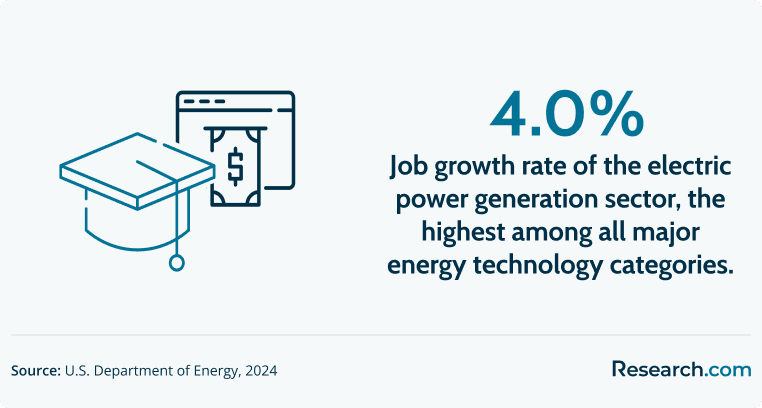
- Renewable energy companies: Clean energy employment rose by 4.2% in 2023, creating opportunities in project development, policy compliance, market analysis, and program coordination.
- Environmental Policy Analyst: Analysts earn around $72,221 /yr on average as of April 2025.
- Environmental Engineers and Scientists: Environmental engineers and environmental scientists had median salaries of $104,170 and $80,060, respectively, in 2024.
As in other interdisciplinary fields with specialized career tracks, such as exercise science degree jobs that pay well, salary potential in energy policy depends heavily on specialization, experience, employer type, and advanced skills.
What is the job market for graduates with an online energy policy degree program?
The job market for energy policy graduates is tied to public investment, clean energy growth, utility modernization, climate policy, environmental regulation, and corporate sustainability commitments. In 2023, the U.S. energy sector employed 8.4 million people, about 5% of the U.S. workforce, with 3% annual growth, outpacing overall job growth. Other public-service fields are also seeing demand for specialized graduate training, including programs such as an affordable online EdS degree in special education.
Energy policy graduates can work for government agencies, utilities, consulting firms, renewable energy companies, research organizations, and nonprofits. Clean energy jobs in the U.S. surpassed 3.5 million in 2023 and grew at more than twice the national job growth rate. Globally, the sector employed 65 million people in 2019, with clean energy roles making up half the workforce.
Job growth is expected to continue. In the U.S., solar jobs remain among the fastest growing, and clean energy portfolios could add over 400,000 new jobs because of recent policy investments.
Location also matters. Texas, California, and North Carolina are among regions leading in clean energy hiring. Texas added 4.1% more clean energy jobs year-over-year and ranks second in total clean energy positions.
Salaries for energy policy professionals vary, but related clean energy occupations commonly fall between $60,000 and $100,000 per year, with senior roles often exceeding $90,000.
Current trends affecting energy policy careers
- Clean energy expansion: Growth in clean energy employment is increasing demand for professionals who understand policy incentives, project approval, finance, and compliance.
- Data-driven policy work: Employers increasingly value analysts who can interpret datasets, model scenarios, and explain trade-offs clearly to nontechnical audiences.
- Grid modernization and resilience: Energy policy professionals may need to understand reliability, storage, transmission, distributed energy resources, and climate-related risks.
- Environmental justice expectations: Public agencies and organizations are paying closer attention to community impacts, equity, access, and stakeholder engagement.
- Employer acceptance of online credentials: Online degrees are more widely accepted when they come from accredited institutions and produce strong applied skills.
What challenges might I encounter in an online energy policy degree program?
Online energy policy programs can be flexible, but flexibility also creates responsibility. Students must manage deadlines, stay engaged without daily campus structure, participate in virtual collaboration, and handle technical tools used for research and coursework. Students should evaluate support services as carefully as they evaluate tuition.
| Common challenge | Why it happens | How to manage it |
| Falling behind in asynchronous courses | There may be fewer fixed class meetings to create routine. | Block weekly study time and track all deadlines at the start of each term. |
| Limited face-to-face networking | Online students may have fewer informal conversations with peers and faculty. | Attend virtual events, request faculty meetings, join student groups, and use alumni networks. |
| Technical learning curve | Courses may use data tools, simulations, learning platforms, and group software. | Complete tutorials early and ask about technical support availability before enrolling. |
| Group project coordination | Classmates may be in different time zones or work schedules. | Set communication norms early and use shared project management tools. |
| Unclear career direction | Energy policy is broad and can lead to policy, business, engineering, or sustainability roles. | Choose electives and capstone topics that match a specific job target. |
When comparing programs, look for advising, tutoring, faculty responsiveness, career services, library access, writing support, and technical help. Reviewing support structures in other online professional programs, such as healthcare administration degree online, can help you identify the kinds of services that matter for working adults.
How can integrating technical expertise enhance my energy policy career?
Technical expertise can help energy policy graduates move beyond general analysis into roles that require interpreting energy data, evaluating technology options, modeling policy effects, or communicating with engineers and project developers. This is especially useful in utilities, clean energy firms, research organizations, consulting, and government agencies dealing with infrastructure or technology-heavy decisions.
Depending on your goals, useful technical additions may include statistics, GIS, Python or R, energy modeling, lifecycle analysis, grid fundamentals, environmental data analysis, or software skills. Students who want a stronger technology foundation may compare options such as a cheap software engineering degree if they are considering analytics, digital energy platforms, or technical policy roles.
How do online energy policy degree programs foster industry connections and mentorship?
Strong online programs intentionally build networking into the student experience. Common approaches include virtual career fairs, alumni panels, guest lectures, employer webinars, faculty mentoring, group consulting-style projects, online discussion communities, and access to university career centers.
Before enrolling, ask how students meet alumni, whether faculty help with capstone topics connected to employers, and whether online students can attend campus or hybrid events. Students who want to combine policy, data, and professional networks across disciplines may also explore related online graduate pathways, such as fast track masters in health informatics online programs, to understand how different fields structure industry mentorship.
What is the return on investment of an online energy policy degree program?
The ROI of an online energy policy degree depends on the total price you pay, the opportunity cost of your time, your prior experience, the credibility of the school, and whether the program helps you qualify for roles with better pay, stronger advancement potential, or greater career stability. A degree with a low tuition price can still have poor ROI if it lacks relevant coursework, weak career support, or limited employer recognition.
To estimate ROI, compare tuition and fees against realistic career outcomes. Use salary data for your target roles, not only broad averages. Also consider whether you can keep working while enrolled, whether your employer will reimburse tuition, and whether the capstone or applied project can help you compete for jobs. Similar ROI logic applies in other specialized online graduate fields, including an online bioinformatics masters degree.
| ROI factor | Positive sign | Warning sign |
| Accreditation | The institution is properly accredited and recognized by employers. | The school’s accreditation status is unclear or hard to verify. |
| Total cost | You can calculate the full cost before enrolling. | The program advertises low tuition but has unclear fees or long completion timelines. |
| Career alignment | Courses, electives, and projects match your intended job path. | The curriculum is too general for your goals. |
| Work compatibility | The format lets you continue earning income while studying. | Required live sessions conflict with your job or time zone. |
| Employer support | Your employer offers reimbursement or values the credential for advancement. | You assume the degree will raise your salary without confirming employer expectations. |
| Graduate outcomes | The school provides transparent employment, debt, and completion information. | Career outcomes are vague, promotional, or unavailable. |
Common Mistakes to Avoid When Choosing an Online Energy Policy Degree
| Mistake | Why it can hurt you | Better approach |
| Choosing only by lowest tuition | A cheap program may not offer the courses, faculty, or career support you need. | Compare total value: cost, curriculum, accreditation, support, and outcomes. |
| Ignoring accreditation | Accreditation can affect financial aid, employer recognition, and credit transfer. | Verify accreditation through recognized sources before applying. |
| Assuming all energy degrees are policy degrees | Some programs emphasize engineering, business, or sustainability rather than public policy. | Read course descriptions and capstone requirements carefully. |
| Overlooking quantitative requirements | Energy economics, statistics, and modeling can be challenging without preparation. | Review prerequisites and consider refresher courses if needed. |
| Relying only on rankings | A ranked program may not fit your schedule, goals, or budget. | Use rankings as a starting point, then evaluate fit. |
| Assuming salary outcomes are guaranteed | Pay varies by location, employer, experience, and specialization. | Research specific job titles in your target region and industry. |
| Neglecting networking | Policy and consulting roles often depend on relationships and applied experience. | Choose programs with mentoring, alumni access, projects, and career events. |
References
- Hanson, M. (2024a, August 31). Cost of Online Education vs. Traditional Education [2024]: Comparison. Education Data Initiative. https://educationdata.org/cost-of-online-education-vs-traditional-education
- Jordan, E., EdD. (n.d.). The benefits of online graduate education for working professionals and recent graduates. News. https://www.lincolnu.edu/news/2024/10/benefits-online-graduate-education.html
- Wylie, I. (2024, April 10). Schools test new tools for networking in a virtual world. Financial Times. https://www.ft.com/content/b3829c60-47c9-451e-8fc3-d24854079461
- Hanson, M. (2025b, February 3). Financial Aid Statistics [2025]: Average aid per student. Education Data Initiative. https://educationdata.org/financial-aid-statistics
- Hanson, M. (2025e, March 16). Student Loan Debt Statistics [2025]: Average + total debt. Education Data Initiative. https://educationdata.org/student-loan-debt-statistics
- Barfield, B. (2025, April 8). The Average indebtedness at Graduation in 2025 [Analyzed]. Student Loan Professor. https://www.studentloanprofessor.com/average-indebtedness-at-graduation
- Johns Hopkins AAP. (2024, July 10). MS in Energy Policy and Climate Admission Requirements. Academics. https://advanced.jhu.edu/academics/graduate/ms-energy-policy-climate/admission-application-requirements
- Environmental and Energy Policy MS, PhD Degrees | Michigan Tech Graduate School. (n.d.). Michigan Technological University. https://www.mtu.edu/gradschool/programs/degrees/environmental-energy-policy
- UF Online. (2025, April 16). International Students | University of Florida online. University of Florida Online. https://ufonline.ufl.edu/apply/admissions-requirements/international-students
- Oregon State University Ecampus. (n.d.). Energy Policy (Graduate Certificate) – Oregon State online. Oregon State Ecampus. https://ecampus.oregonstate.edu/online-degrees/graduate/energy-policy/curriculum.htm
- Johns Hopkins AAP. (2025, April 17). MS in Energy Policy and Climate Details and Courses Details. Academics. https://advanced.jhu.edu/academics/graduate/ms-energy-policy-climate/degree-details-and-courses
- Specialization in Energy & Environmental Policy | Harris School of Public Policy | The University of Chicago. (2025, January 29). https://harris.uchicago.edu/academics/design-your-path/specializations/specialization-energy-environmental
- Environmental Justice Program | U-M SEAS Environment Sustainability. (n.d.). https://seas.umich.edu/academics/master-science/environmental-justice
- Graduate Interdisciplinary Specialization in Data-driven Sustainable Energy Systems. (n.d.). EmPOWERment. https://energyfuture.osu.edu/GIS
- National Center for Education Statistics. (n.d.). Fast Facts: Back-to-school statistics (372). https://nces.ed.gov/fastfacts/display.asp?id=372
- Home | College Scorecard. (n.d.). https://collegescorecard.ed.gov/
- 2024 U.S. Energy & Employment Jobs Report (USEER). (n.d.). Energy.gov. https://www.energy.gov/policy/us-energy-employment-jobs-report-useer
- DOE report shows clean energy jobs grew at more than twice the rate of overall U.S. employment. (2024, August 28). Energy.gov. https://www.energy.gov/articles/doe-report-shows-clean-energy-jobs-grew-more-twice-rate-overall-us-employment
- National Renewable Energy Laboratory. (n.d.). State-Level Employment Projections for Four Clean Energy Technologies in 2025 and 2030. https://docs.nrel.gov/docs/fy22osti/81486.pdf
Key Insights
- An online energy policy degree is most valuable when it directly matches your target role, whether that is policy analysis, sustainability consulting, regulatory affairs, renewable energy planning, or technical energy systems work.
- In 2023, the U.S. energy sector employed 8.4 million people, representing about 5% of the national workforce, with annual growth of 3%.
- Most online energy policy master’s programs take 18 to 24 months, though accelerated options may take one year full-time and part-time routes may extend to three years.
- Cost varies widely. Reported tuition ranges from $7,600 to $86,000, so students should compare total program cost rather than relying only on per-credit tuition.
- Online study can work well for employed students. About 60–68% of online graduate students work full time, and asynchronous formats can make scheduling more manageable.
- Accreditation, curriculum fit, faculty expertise, career services, and applied projects are more important than ranking position alone.
- Technical skills such as data analysis, modeling, statistics, GIS, and energy systems knowledge can strengthen policy careers and improve competitiveness for analytics-heavy roles.
- Do not assume salary outcomes are guaranteed. Earnings depend on job title, employer, region, prior experience, degree level, and specialization.
- Before enrolling, ask whether online students receive the same career support, faculty access, alumni networking, and project opportunities as campus students.
Other Things You Should Know About Online Energy Policy Degree Programs
Most affordable online energy policy degrees require 30 to 36 credits for a master’s program and about 120 credits for a bachelor’s program. Accelerated tracks may accept transfer credits, but the degree still must meet the school’s total credit minimum and any capstone or thesis requirement.
Admission requirements typically include a bachelor's degree in a related field, a minimum GPA of 2.5, and submission of transcripts and a personal statement. Some programs may also require letters of recommendation or relevant work experience in energy policy.


