2027 Most Affordable Online Master’s in Bioinformatics Programs

Co-Founder and Chief Data Scientist
As an expert in the field of bioinformatics education, I understand the challenges students face when researching online bioinformatics degree programs in the USA. The abundance of information available can be overwhelming, and it's crucial to sift through the noise to find reputable, up-to-date, and accurate details.
In this introduction, I aim to provide a concise overview of the online bioinformatics landscape, highlighting the key considerations and guiding the reader towards making an informed decision about their educational path. By the end, the reader should have a clearer understanding of the opportunities and potential hurdles in pursuing an online bioinformatics degree in the United States.
What are the benefits of getting a bioinformatics degree?
- A Bioinformatics degree prepares you for a cutting-edge career at the intersection of biology, computer science, and data analysis.
- Online Bioinformatics programs offer the flexibility to study at your own pace while potentially working or managing other commitments, saving you money on commuting and relocation costs.
- With a Bioinformatics degree, you can pursue diverse career paths in academia, the biotech industry, pharmaceuticals, and government research, with opportunities for specialization and career advancement.
What can I expect from a bioinformatics degree?
A Bioinformatics degree equips you with the knowledge and skills to analyze biological data, develop computational tools, and contribute to research in areas like genomics, drug discovery, and personalized medicine. Here's a breakdown of what you can expect:
- Scientific Foundation: You'll gain a strong foundation in biology, genetics, and molecular biology, essential for understanding the data you'll be working with.
- Computational Skills: You'll learn programming languages (like Python or R), statistics, and database management, crucial for analyzing and manipulating large datasets.
- Bioinformatics Techniques: You'll study algorithms, data mining, machine learning, and visualization techniques specifically applied to biological data.
- Genomics and Proteomics: You'll delve into the analysis of genomes, gene expression, protein structures, and biological pathways.
- Critical Thinking and Problem-Solving: Bioinformatics requires strong analytical skills to interpret complex data, identify patterns, and draw meaningful conclusions.
- Communication Skills: You'll develop the ability to communicate your findings effectively through presentations, reports, and publications.
Where can I work with a Bioinformatics degree?
A Bioinformatics degree opens doors to a variety of workplaces:
- Biotechnology Companies: Analyze genomic data, develop bioinformatics tools, and contribute to drug discovery and development.
- Pharmaceutical Companies: Work on drug design, target identification, and personalized medicine research.
- Research Institutions: Conduct bioinformatics research in universities, government labs (like the NIH), and non-profit organizations.
- Hospitals and Healthcare: Analyze patient data, contribute to disease diagnostics, and support clinical decision-making.
- Government Agencies: Work for agencies like the FDA or CDC, applying bioinformatics to public health and regulatory challenges.
- Academia: Pursue research and teaching positions in universities.
How much can I make with a Bioinformatics degree?
Salaries for bioinformatics professionals can vary based on experience, location, specialization, and industry. Here are some general ranges:
- Bioinformatics Scientist: $70,000 - $150,000 per year
- Bioinformatics Analyst: $60,000 - $120,000 per year
- Computational Biologist: $65,000 - $140,000 per year
- Research Scientist (Bioinformatics): $75,000 - $160,000 per year
Remember to research salary data specific to your desired career path and location for a more accurate picture.
- Most Affordable Online Master’s in Bioinformatics Degree Programs for 2027 List of Programs
- How long does it take to complete a bioinformatics degree program? How long does it take to complete a bioinformatics degree program?
- How does an online bioinformatics degree compare to an on-campus program? How does an online bioinformatics degree compare to an on-campus program?
- What is the average cost of a bioinformatics degree program? Program Cost
- What are the financial aid options for students enrolling in a bioinformatics degree program? Financial Aid Options
- What are the prerequisites for enrolling in a bioinformatics degree program? What are the prerequisites for enrolling in a bioinformatics degree program?
- What courses are typically in a bioinformatics degree program? What courses are typically in a bioinformatics degree program?
- What types of specializations are available in bioinformatics degree programs? What types of specializations are available in bioinformatics degree programs?
- How does one choose the best bioinformatics degree program? How does one choose the best bioinformatics degree program?
- What career paths are available for graduates of bioinformatics degree programs? Career Paths
- How are emerging technological trends influencing online bioinformatics education? How are emerging technological trends influencing online bioinformatics education?
- What is the job market for graduates with a bioinformatics degree? Job Market
- What is the return on investment for online bioinformatics degree programs? What is the return on investment for online bioinformatics degree programs?
- What ethical guidelines and data privacy measures are implemented in online bioinformatics degree programs? What ethical guidelines and data privacy measures are implemented in online bioinformatics degree programs?
- What role do alumni networks and mentorship opportunities play in online bioinformatics education? What role do alumni networks and mentorship opportunities play in online bioinformatics education?
- How do accreditation and industry partnerships impact online bioinformatics degree programs? How do accreditation and industry partnerships impact online bioinformatics degree programs?
- Should I complement my bioinformatics degree with business analytics expertise? Should I complement my bioinformatics degree with business analytics expertise?
- How can I effectively evaluate the quality of an online bioinformatics degree program? How can I effectively evaluate the quality of an online bioinformatics degree program?
- How do online bioinformatics programs offer comprehensive student support? How do online bioinformatics programs offer comprehensive student support?
- What practical research and hands-on experiences are integrated into online bioinformatics programs? What practical research and hands-on experiences are integrated into online bioinformatics programs?
Most Affordable Online Master’s in Bioinformatics Degree Programs for 2027
Choosing an online master’s in bioinformatics is a cost, time, and career decision. The right program can help you move into genomics, biomedical informatics, computational biology, health data science, pharmaceutical research, or clinical data roles. The wrong program can leave you with expensive credits, limited hands-on experience, or coursework that does not match the jobs you want.
This guide is designed for students and working professionals comparing affordable online and hybrid bioinformatics-related graduate programs. It explains which programs appear on our affordability list, how long these degrees usually take, what they cost, what courses and specializations to expect, how online programs compare with campus-based study, and how to evaluate return on investment before enrolling.
Bioinformatics matters now because biology, medicine, public health, and drug development increasingly depend on large-scale data. Employers need people who can understand biological systems, write code, use statistics, manage data responsibly, and communicate results to scientists, clinicians, or business leaders.
Quick Answer: What Is the Most Affordable Online Master’s in Bioinformatics?
Based on the tuition figures provided in this guide, North Dakota State University has the lowest listed in-state tuition at $8,000, while The University of Texas at El Paso follows with $9,000 for in-state students. For out-of-state students, The University of Texas at El Paso has the lowest listed tuition at $15,000. However, the best choice is not always the lowest price. Students should also compare accreditation, curriculum fit, research access, online flexibility, faculty expertise, and career support.
Most online master’s-level bioinformatics or biomedical informatics programs listed here take about 2 years and require 30 to 36 credits. Students with strong preparation in biology, programming, statistics, or mathematics may move through the curriculum more easily, while students changing fields may need prerequisite coursework.
How We Rank Schools
Because graduate education can require a major financial commitment, our ranking approach emphasizes transparent, comparable information. We review data from respected education sources, including:
- the IPEDS database
- Peterson's database, including its Distance Learning Licensed Data Set
- the College Scorecard database
- the National Center for Education Statistics
The following list highlights affordable online or flexible master’s-level programs in bioinformatics, biomedical informatics, health informatics, biostatistics, or closely related fields for 2027.
| Rank | School | Program Focus | Listed Tuition | Credits |
| 1 | The University of Texas at El Paso | Bioinformatics | In-state: $9,000; Out-of-state: $15,000 | 36 credits |
| 2 | University of Arkansas at Little Rock | Bioinformatics with multiple tracks | In-state: $10,000; Out-of-state: $18,000 | 35 credits |
| 3 | University of Utah | Biomedical Informatics | In-state: $12,000; Out-of-state: $24,000 | 30 credits |
| 4 | North Dakota State University | Genomics, Phenomics, and Bioinformatics | In-state: $8,000; Out-of-state: $18,000 | 30 credits |
| 5 | Hood College | Health Informatics with bioinformatics and AI options | In-state: $15,000; Out-of-state: $20,000 | 36 credits |
| 6 | Morgan State University | Bioinformatics | In-state: $12,000; Out-of-state: $25,000 | 36 credits |
| 7 | University of Maine | Biostatistics with bioinformatics applications | In-state: $11,000; Out-of-state: $26,000 | 30 credits |
| 8 | University of Nebraska Medical Center | Biomedical Informatics | In-state: $10,500; Out-of-state: $22,500 | 36 credits |
| 9 | The University of Texas Health Science Center at Houston | Biomedical Informatics | In-state: $12,500; Out-of-state: $25,000 | 36 credits |
| 10 | Ball State University | Bioinformatics | In-state: $11,500; Out-of-state: $23,500 | 30 credits |
1. The University of Texas at El Paso
The Master of Science in Bioinformatics at the University of Texas at El Paso is built for students entering the field from biology, chemistry, computer science, health sciences, mathematics, or statistics. The program uses a problem-focused learning model and combines faculty mentoring with coursework and research-oriented training. Students complete core study in bioinformatics principles and applications, then use electives to shape the degree around their interests in healthcare, research, or computational analysis.
- Program Length: Typically 2 years
- Tracks/Concentrations: None specified; general bioinformatics focus
- Tuition Cost: In-state: $9,000; Out-of-state: $15,000
- Required Credits to Graduate: 36 credits
- Accreditation: Southern Association of Colleges and Schools Commission on Colleges (SACSCOC)
2. University of Arkansas at Little Rock
The Master of Science in Bioinformatics at the University of Arkansas at Little Rock is offered in collaboration with the University of Arkansas for Medical Sciences (UAMS). This structure gives students exposure to bioinformatics, genomics, computational biology, biomedical informatics, and drug discovery. The curriculum blends required courses, electives, and research experiences so students can connect computational methods with biomedical questions.
- Program Length: Approximately 2 years
- Tracks/Concentrations: Drug Design and Discovery; Integrated Bioinformatics and Genomics; Computational Biology; Biomedical Informatics
- Tuition Cost: In-state: $10,000; Out-of-state: $18,000
- Required Credits to Graduate: 35 credits
- Accreditation: Higher Learning Commission (HLC)
3. University of Utah
The Master of Science in Biomedical Informatics at the University of Utah is a strong fit for working professionals who want to build applied skills in health information technology, healthcare analytics, and informatics management. Students choose among three tracks and complete practicum experiences that connect classroom learning to real healthcare data and systems. The program requires a minimum of 30 credit hours.
- Program Length: 2 years (part-time options available)
- Tracks/Concentrations: Clinical Informatics; Health Data Science; Health Information Technology Management
- Tuition Cost: In-state: $12,000; Out-of-state: $24,000
- Required Credits to Graduate: 30 credits
- Accreditation: Commission on Accreditation for Health Informatics and Information Management Education (CAHIIM)
4. North Dakota State University
North Dakota State University offers graduate study in Genomics, Phenomics, and Bioinformatics for students interested in functional genomics, computational analysis, and cross-disciplinary research. The program is designed for students who want exposure to modern genomic data methods and collaboration across scientific fields, including pathways toward academic research or industry roles.
- Program Length: 2 years
- Tracks/Concentrations: Functional Genomics; Phenomics; Bioinformatics
- Tuition Cost: In-state: $8,000; Out-of-state: $18,000
- Required Credits to Graduate: 30 credits
- Accreditation: Higher Learning Commission (HLC)
5. Hood College
Hood College offers a Master of Science in Health Informatics that connects computer science, healthcare data, and health sciences. The hybrid format is intended for students preparing for data-centered health informatics roles. Students may focus their studies on health informatics, bioinformatics, or artificial intelligence and machine learning, making this option especially relevant for learners who want applied healthcare data training with technical depth.
- Program Length: 2 years (part-time options available)
- Tracks/Concentrations: Health Informatics; Bioinformatics; Artificial Intelligence/Machine Learning
- Tuition Cost: In-state: $15,000; Out-of-state: $20,000
- Required Credits to Graduate: 36 credits
- Accreditation: Middle States Commission on Higher Education (MSCHE)
6. Morgan State University
Morgan State University offers a Master of Science in Bioinformatics that emphasizes computational biology, biostatistics, project-based learning, and research exposure. Students can use elective coursework to sharpen their focus while developing practical skills for analyzing biological and biomedical data.
- Program Length: 2 years
- Tracks/Concentrations: General Bioinformatics with elective options available
- Tuition Cost: In-state: $12,000; Out-of-state: $25,000
- Required Credits to Graduate: 36 credits
- Accreditation: Middle States Commission on Higher Education (MSCHE)
7. University of Maine
The University of Maine offers a professional science master’s program in Biostatistics with training that can support bioinformatics-related work. The curriculum focuses on statistical methods used to address health and biomedical problems, preparing graduates for quantitative roles in healthcare agencies, pharmaceutical organizations, and related settings.
- Program Length: Approximately 2 years
- Tracks/Concentrations: Biostatistics with applications in bioinformatics
- Tuition Cost: In-state: $11,000; Out-of-state: $26,000
- Required Credits to Graduate: 30 credits
- Accreditation: New England Commission of Higher Education (NECHE)
8. University of Nebraska Medical Center
The University of Nebraska Medical Center offers a master’s program centered on biomedical informatics. The program combines healthcare knowledge with data management and informatics skills used in modern healthcare environments, preparing students for roles that involve health data, information systems, and decision support.
- Program Length: 2 years
- Tracks/Concentrations: Biomedical Informatics with options for specialization
- Tuition Cost: In-state: $10,500; Out-of-state: $22,500
- Required Credits to Graduate: 36 credits
- Accreditation: Higher Learning Commission (HLC)
9. The University of Texas Health Science Center at Houston
The biomedical informatics master’s program at the University of Texas Health Science Center at Houston focuses on the management and use of health information systems. Students complete core coursework and practical learning experiences intended to match the needs of healthcare organizations that rely on accurate, secure, and useful data.
- Program Length: Approximately 2 years
- Tracks/Concentrations: General Biomedical Informatics with elective options available
- Tuition Cost: In-state: $12,500; Out-of-state: $25,000
- Required Credits to Graduate: 36 credits
- Accreditation: Southern Association of Colleges and Schools Commission on Colleges (SACSCOC)
10. Ball State University
Ball State University offers an online master’s degree in Bioinformatics that combines biological science with data analysis. The program is designed for students who need flexible graduate study while building computational and analytical skills for bioinformatics work.
- Program Length: Approximately 2 years
- Tracks/Concentrations: General Bioinformatics with elective options available
- Tuition Cost: In-state: $11,500; Out-of-state: $23,500
- Required Credits to Graduate: 30 credits
- Accreditation: Higher Learning Commission (HLC)
How Long Does It Take to Complete a Bioinformatics Degree Program?
A bioinformatics degree can take from 1-2 years at the master’s level to 4-6 years at the doctoral level. The timeline depends on degree level, full-time or part-time enrollment, credit load, research requirements, and whether prior credits apply.
| Degree Level | Typical Completion Time | What Can Affect the Timeline? |
| Bachelor's degree | 4 years | Transfer credits, course availability, major prerequisites, and full-time status |
| Master's degree | 1-2 years | Part-time enrollment, thesis or capstone requirements, and prerequisite gaps |
| Doctoral degree | 4-6 years | Dissertation research, funding structure, lab placement, and publication expectations |
- Degree Level: Bachelor's programs typically take 4 years, master's programs often require 1-2 years, and doctoral programs usually take 4-6 years.
- Program Format: Full-time students usually finish faster than part-time students, but part-time study may be more realistic for working professionals.
- Course Load: Taking more credits per term can shorten the calendar timeline, but it may be difficult if the curriculum includes programming, statistics, or lab-heavy assignments.
- Research Requirements: A thesis, dissertation, or major research project can extend the timeline, especially in graduate programs.
- Prior Learning: Transfer credits or advanced standing can reduce the number of required courses if the program accepts them.
Accelerated and online options may shorten the path for some students, but speed should not come at the expense of research experience or skill development. If your interests lean toward evidence analysis, criminal investigations, or laboratory-based data work, comparing bioinformatics with the cheapest online forensic science degree options may also be useful.
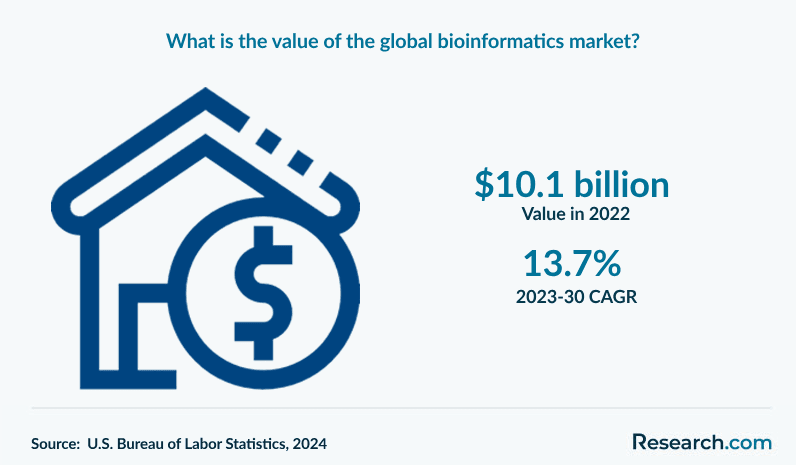
The global bioinformatics market was valued at $10.1 billion in 2022 and is projected to grow at a compound annual growth rate (CAGR) of 13.7% from 2023 to 2030. That expansion is linked to rising use of bioinformatics in drug research and development, along with public and private investment in research activities.
How Does an Online Bioinformatics Degree Compare to an On-Campus Program?
Online and on-campus bioinformatics programs can lead to similar academic outcomes, but the learning experience is different. Online study works best for students who need schedule flexibility and can stay organized without frequent in-person structure. Campus study may be better for students who want direct lab access, face-to-face mentoring, and frequent research collaboration.
| Factor | Online Bioinformatics Degree | On-Campus Bioinformatics Degree |
| Flexibility | Best for working adults, caregivers, and students who need location independence | Best for students who can attend scheduled classes and campus activities |
| Hands-on learning | May use virtual labs, cloud tools, public datasets, remote projects, or practicums | Often provides easier access to labs, research teams, and campus facilities |
| Networking | Depends heavily on discussion boards, faculty outreach, cohort design, and virtual events | More organic peer, faculty, and lab networking opportunities |
| Cost considerations | May reduce relocation, commuting, and housing costs | May involve additional campus fees, housing, transportation, or relocation costs |
| Best fit | Self-directed learners with strong time management | Students who want structured routines and in-person support |
When an Online Bioinformatics Program Makes Sense
- You need flexibility: Online programs allow students to continue working while completing graduate coursework.
- You are not near a suitable campus program: Distance learning can expand your options beyond your local area.
- You are comfortable with technology: Bioinformatics already requires computational work, so online platforms, cloud tools, and remote collaboration may fit naturally.
- You want to control indirect costs: Avoiding relocation or commuting can make a program more affordable overall.
Students who are more interested in healthcare records, compliance, coding systems, and medical data administration may want to compare bioinformatics programs with a health information management degree online.
When an On-Campus Program May Be Better
- You want daily structure: In-person courses can provide a more consistent academic routine.
- You need direct lab access: Some research projects are easier to complete with campus-based labs and equipment.
- You value face-to-face mentoring: Students who learn best through frequent in-person feedback may prefer campus study.
- You want a traditional graduate school environment: Campus life can provide more immediate access to seminars, student groups, and research events.
If you are still comparing healthcare-focused graduate routes, online women's health nurse practitioner programs may be relevant for licensed nurses pursuing advanced clinical practice. Students who are earlier in their education may also compare cheap accredited online bachelor degree programs before committing to a master’s path. For those considering student support or counseling careers instead, this guide on what do you need to be a school counselor explains a different master’s-level pathway with state licensure considerations.
What Is the Average Cost of a Bioinformatics Degree Program?
The cost of a bioinformatics program depends on the type of institution, residency status, degree level, delivery format, fees, books, software, and living expenses. Public universities often charge lower in-state tuition, while private institutions and out-of-state public tuition can cost more. Online study may reduce commuting or relocation costs, but students should still review technology fees, course fees, and any required campus visits.
| Degree Type | In-State Cost | Out-of-State Cost | What to Check Before Enrolling |
| Associate of Arts (AA) | $8,784 per year | $11,811 per year | Transfer pathways into a bachelor’s program and whether science prerequisites are included |
| Master of Science (MS) | $18,900 per year | $42,663 per year | Total credits, thesis or capstone requirements, and graduate fees |
| Master of Biostatistics (MS) | $20,682 per semester ($41,364 per year) | $20,682 per semester ($41,364 per year) | Whether the curriculum includes enough biological data, genomics, and computing for your goals |
| PhD in Bioinformatics | Varies by institution; average around $31,871 per year | Varies by institution; average around $31,871 per year | Funding, assistantships, dissertation expectations, and research fit |
- Institution Type: Public institutions commonly charge less than private institutions, especially for in-state students.
- Residency Status: In-state tuition can be much lower than out-of-state tuition at public universities.
- Degree Level: Graduate and doctoral study generally costs more than undergraduate education.
- Program Format: Online programs may reduce indirect expenses, but tuition policies vary by school.
- Additional Expenses: Students should budget for fees, books, software, equipment, internet access, and possible travel.
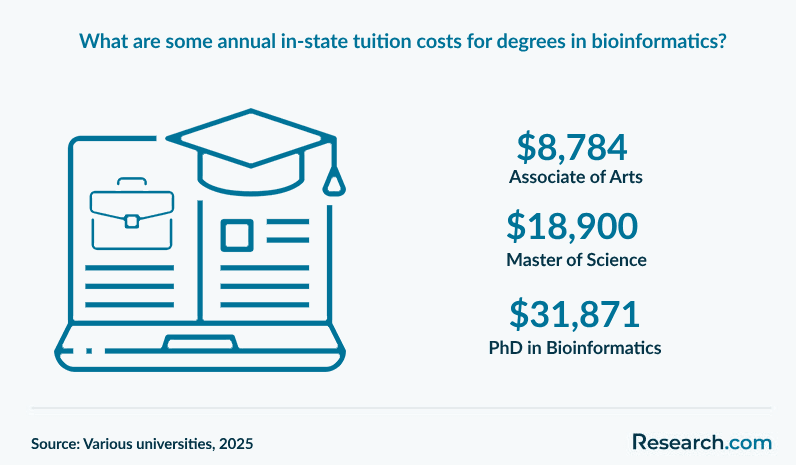
The cost pattern shown here makes the Associate of Arts (AA) the lowest-cost option, at $8,784 per year for in-state students and $11,811 per year for out-of-state students. A Master of Science (MS) costs $18,900 per year for in-state students and $42,663 per year for out-of-state students. A Master of Biostatistics (MS) is listed at $20,682 per semester ($41,364 per year) regardless of residency. A PhD in Bioinformatics varies by institution, with an average around $31,871 per year.
Before applying, ask each program for a full cost of attendance, not just tuition. The lowest tuition may not be the lowest total cost if fees, travel, or technology requirements are high.
What Financial Aid Options Are Available for Bioinformatics Students?
Students enrolling in bioinformatics programs may be able to use scholarships, grants, loans, work-study, employer tuition benefits, or graduate assistantships. Availability depends on degree level, enrollment status, citizenship or residency rules, institutional policy, and financial need.
- Scholarships: Awards may be based on academic merit, financial need, STEM participation, research interests, or program-specific criteria.
- Grants: Federal and state grants can reduce out-of-pocket costs for eligible students.
- Loans: Federal student loans and private loans can help cover remaining costs, but students should compare interest rates and repayment obligations carefully.
- Work-Study: Eligible students may earn money through part-time work connected to federal work-study programs.
- Assistantships: Graduate students may qualify for teaching or research assistantships that include tuition remission and a stipend.
Completing the Free Application for Federal Student Aid (FAFSA) is an important first step for students who want to determine eligibility for federal, state, and some institutional aid programs.
Salary potential is one part of the affordability decision, but it should not be treated as a guarantee. A Bioinformatics Programmer/Analyst I can expect to earn around $83,900 annually, while a Bioinformatics Scientist earns an average of $121,871. With more experience and specialized expertise, earnings can rise. A Bioinformatics Scientist V can earn as much as $226,060, and a Principal Bioinformatics Scientist can earn between $140,745 and $224,318, depending on location.
What Are the Prerequisites for Enrolling in a Bioinformatics Degree Program?
Admissions requirements vary by school, but master’s-level bioinformatics programs usually expect a bachelor’s degree and evidence that the applicant can handle graduate work in biology, computing, mathematics, and statistics. Applicants from biology may need more programming preparation, while applicants from computer science may need more life science coursework.
- Undergraduate Degree: Master’s programs usually require a bachelor’s degree in a related field such as biology, computer science, mathematics, statistics, chemistry, or health sciences.
- GPA: Many programs require a minimum GPA, often around 3.0.
- Standardized Tests: Some schools may request Graduate Record Exams (GRE) scores, although GRE requirements have become less common in some graduate admissions processes.
- Coursework: Programs often expect prior study in biology, chemistry, calculus, statistics, and computer programming.
- Letters of Recommendation: Strong recommendations should come from faculty members or supervisors who can speak to your analytical ability, research potential, and readiness for graduate-level work.
- Statement of Purpose: A focused statement should explain why you want bioinformatics training, what skills you bring, and how the degree fits your goals.
| Your Background | Common Strength | Likely Gap to Address |
| Biology or chemistry | Life science knowledge | Programming, algorithms, statistics, and database skills |
| Computer science | Coding, software, and algorithms | Molecular biology, genetics, and biomedical context |
| Mathematics or statistics | Quantitative reasoning and modeling | Biological systems, genomics, and applied programming tools |
| Health sciences | Healthcare context and clinical systems | Advanced computing, statistical analysis, and molecular biology |
What Courses Are Typically Included in a Bioinformatics Degree Program?
Bioinformatics curricula combine biology, computer science, statistics, and data management. A strong program should teach students not only how to run tools, but also how to interpret biological results, evaluate data quality, and communicate findings responsibly.
Core Courses
- Introduction to Bioinformatics: Covers the major concepts, tools, applications, and data types used in the field.
- Molecular Biology: Explains DNA, RNA, proteins, gene expression, and the central principles needed to interpret biological data.
- Genetics: Examines inheritance, genetic variation, gene regulation, and related biological mechanisms.
- Statistics: Introduces methods such as hypothesis testing, regression, experimental design, and data interpretation.
- Programming for Bioinformatics: Builds skills in languages commonly used in the field, such as Python and R.
- Databases and Data Mining: Teaches students how to use biological databases, retrieve data, clean datasets, and identify patterns.
Advanced Courses
- Genomics: Focuses on genome sequencing, genome comparison, and large-scale DNA analysis.
- Proteomics: Studies protein structure, function, interactions, and computational approaches to protein data.
- Structural Bioinformatics: Examines three-dimensional biological macromolecule structures and structure prediction.
- Algorithms for Bioinformatics: Covers data structures and algorithms used to solve biological sequence and analysis problems.
- Machine Learning in Bioinformatics: Applies classification, prediction, and pattern recognition methods to biological data.
- Systems Biology: Uses computational models and simulations to study complex biological systems.
- Artificial Intelligence: Explores machine learning and deep learning approaches for analyzing complex biological datasets.
Electives
- Drug Discovery and Development: Shows how bioinformatics supports drug target identification, design, and development.
- Personalized Medicine: Examines how genomic information can inform tailored treatment decisions.
- Bioinformatics of Infectious Diseases: Applies computational tools to the study, tracking, and control of infectious diseases.
- Evolutionary Bioinformatics: Uses computational methods to study evolutionary relationships and biological change.
- Ethical and Legal Issues in Bioinformatics: Reviews responsible data use, privacy, consent, and legal concerns related to biological data.
Course requirements differ by school and specialization. Students interested in nursing-adjacent data roles sometimes compare bioinformatics with fast track medical LPN options before deciding whether they want a clinical or data-centered healthcare pathway.
What Types of Specializations Are Available in Bioinformatics Degree Programs?
Specializations help students align coursework with specific career goals. Bioinformatics overlaps with computer science, biology, healthcare, agriculture, pharmaceuticals, and environmental science, so the right track depends on the problems you want to solve.
- Genomics and Proteomics: Focuses on genome sequencing, gene expression, protein analysis, and molecular-scale data.
- Computational Biology: Emphasizes computational models and methods for answering biological questions.
- Biomedical Informatics: Applies data and technology to healthcare systems, electronic health records, and clinical decision support.
- Pharmaceutical Bioinformatics: Connects bioinformatics with drug discovery, development, and personalized medicine.
- Agricultural Bioinformatics: Uses biological data to support crop improvement, plant disease resistance, and agricultural research.
- Forensic Bioinformatics: Applies DNA analysis and computational methods to forensic investigations and human identification. Students in this area may also benefit from data security training through Online cybersecurity courses.
- Environmental Bioinformatics: Uses computational tools to study biodiversity, ecosystems, and environmental challenges.
Students deciding between a broad technology path and a biology-focused data path may also compare bioinformatics with computer science degree online programs.
Degree completion data also show where bioinformatics education is active. The University of California-San Diego leads with 81 completions, followed by Northeastern University with 63. The University of California-Santa Cruz has 58 completions, while Virginia Commonwealth University has 51. Arizona State University Digital Immersion and Boston University each have 40 completions.
How Should You Choose the Best Bioinformatics Degree Program?
The best bioinformatics program is the one that matches your academic background, budget, schedule, technical goals, and intended career path. A low-cost program can be a strong choice, but only if it offers the coursework, support, and credibility you need.
| Selection Factor | Why It Matters | Question to Ask |
| Accreditation | Helps confirm institutional quality and can affect aid eligibility and employer confidence | Is the institution accredited by a recognized accreditor? |
| Curriculum | Determines whether you build the right mix of biology, coding, statistics, and data skills | Does the program require Python, R, statistics, genomics, and database work? |
| Faculty expertise | Faculty research areas shape mentoring, electives, and project opportunities | Do faculty members work in the bioinformatics area I want to enter? |
| Hands-on experience | Employers value practical experience with real datasets and tools | Are there capstones, practicums, research projects, or internships? |
| Career support | Graduate outcomes depend partly on networking, advising, and employer connections | Does the program offer job search support and alumni networking? |
| Total cost | Tuition is only one part of affordability | What is the full cost, including fees, software, and any travel? |
- Do not rely only on rankings: Use rankings as a starting point, not the final decision.
- Review faculty profiles: Look for faculty whose research matches your interests.
- Compare required courses: A program that lacks programming, statistics, or genomics may not prepare you well for technical roles.
- Ask about datasets and tools: Strong programs should expose students to realistic computational workflows.
- Confirm online support: Online students need advising, tutoring, library access, tech support, and career services.
If your main goal is general data work rather than biological or biomedical data, compare bioinformatics with the cheapest online masters in data analytics programs before applying.
What Career Paths Are Available for Bioinformatics Graduates?
Bioinformatics graduates work in biotechnology, pharmaceuticals, hospitals, academic research, government labs, public health, software companies, and data science teams. Job titles vary widely because the field sits between biology and computing.
| Career Path | Typical Work | Helpful Skills |
| Bioinformatics Scientist | Designs analyses, develops algorithms, and interprets biological data | Genomics, statistics, Python, R, research methods |
| Bioinformatics Analyst | Processes datasets, creates visualizations, and prepares reports | Data cleaning, databases, visualization, scripting |
| Computational Biologist | Builds computational models to study biological systems | Modeling, algorithms, molecular biology, systems biology |
| Biostatistician | Applies statistical methods to biological and health data | Experimental design, regression, statistical software |
| Clinical Bioinformatics Specialist | Supports patient-data analysis and clinical decision-making | Genomics, clinical workflows, privacy, health informatics |
| Software Engineer | Builds bioinformatics tools, pipelines, and platforms | Programming, cloud tools, version control, testing |
| Data Scientist | Uses analytics and machine learning on biological or healthcare datasets | Machine learning, statistics, data engineering, communication |
- Bioinformatics Scientist: Conducts research, develops analytical methods, and interprets biological datasets.
- Bioinformatics Analyst: Cleans, analyzes, visualizes, and reports biological or biomedical data.
- Computational Biologist: Applies computational models to biological systems and research questions.
- Research Scientist: Works in academia, government laboratories, biotechnology, or pharmaceutical research.
- Data Scientist: Applies analytics and machine learning to biological data. Students who want a broader analytics route may compare this path with the cheapest data science masters online.
- Software Engineer: Develops tools, pipelines, and platforms used by researchers or healthcare teams.
- Biostatistician: Designs studies and applies statistical methods to biological or health-related datasets.
- Clinical Bioinformatics Specialist: Works with patient data and supports clinical interpretation or decision-making.
- Science Writer or Communicator: Translates complex biological data and research findings for broader audiences.
How Are Emerging Technology Trends Changing Online Bioinformatics Education?
Online bioinformatics programs are being shaped by cloud computing, artificial intelligence, machine learning, big data analytics, virtual laboratories, and remote collaboration platforms. These tools can make online learning more practical when programs use real datasets, reproducible workflows, and project-based assignments.
Students should look for programs that teach current tools without chasing trends at the expense of fundamentals. Strong bioinformatics education still requires statistics, molecular biology, programming, databases, algorithms, reproducibility, and ethical data handling. For students comparing flexible education formats across fields, broader guides to affordable online courses can help frame cost and access considerations.
What Is the Job Market for Graduates With a Bioinformatics Degree?
The job market for bioinformatics graduates is supported by the growth of biological data, genomics, personalized medicine, drug development, and healthcare analytics. Demand is strongest for candidates who can combine biological knowledge with programming, statistics, data management, and communication skills.
- Growth in Biotechnology and Pharmaceuticals: These sectors use bioinformatics in drug discovery, development, and personalized medicine.
- Advancements in Genomics and Proteomics: Sequencing and other high-throughput technologies create large datasets that require expert analysis.
- Big Data and Healthcare: Healthcare organizations increasingly use data to improve diagnostics, care delivery, and research.
- Government Initiatives: Agencies such as the NIH and FDA support research and applications connected to bioinformatics.
Key labor market figures include:
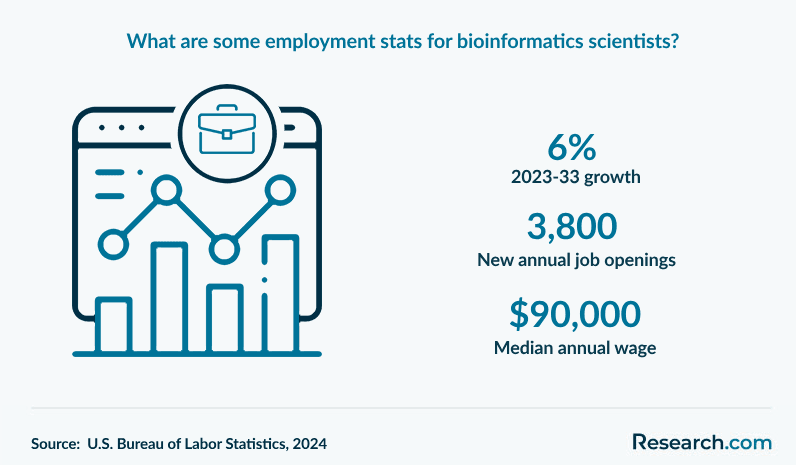
- Employment Projections: The employment of bioinformatics scientists is projected to grow by 6% from 2023 to 2033, which is considered faster than the average for all occupations. This reflects an increase from approximately 66,800 employees in 2023 to 70,600 by 2033, with about 3,800 new job openings annually due to growth and replacement needs.
- Median Annual Wage: The median annual wage for bioinformatics scientists is around $90,000, with salaries varying by experience, education, location, and role.
- Job Openings: Approximately 10,300 openings for biological technicians are projected each year on average over the decade, largely because workers leave the labor force or change occupations.
The BLS also reports that related roles such as computer and information research scientists are expected to see a job growth rate of 15% through 2030, which reinforces the value of advanced data analysis skills in life sciences. Research and development firms in life sciences and software development companies are among the sectors expected to experience growth in bioinformatics-related work.
How Is Academic Integrity Maintained in Online Bioinformatics Programs?
Credible online bioinformatics programs protect academic integrity through secure learning platforms, identity verification, plagiarism detection, timed assessments, and remote proctoring when appropriate. Project-based courses may also require version-controlled code, reproducible analysis files, oral explanations, or staged submissions so instructors can verify student work.
Students should ask how exams, coding projects, lab simulations, and group work are assessed. Academic integrity policies are especially important in data-heavy programs because employers need graduates who can produce trustworthy analyses. If you are comparing graduate programs based on workload and structure, resources on easy masters programs may help you understand why “easy” should not mean low-quality or weakly assessed.
What Is the Return on Investment for Online Bioinformatics Degree Programs?
Return on investment depends on total program cost, financial aid, time to completion, current income, career goals, and the type of role you pursue after graduation. A lower-cost program can improve ROI, but only if it offers enough technical depth and employer-relevant experience.
To evaluate ROI, compare tuition, fees, aid, salary expectations, job placement information, internship access, alumni outcomes, and career services. Students should also think about whether the degree helps them move into a better role, change fields, qualify for research work, or prepare for doctoral study. For learners evaluating online education later in life or during a career transition, guides to online degrees for seniors can provide additional context on fit, flexibility, and value.
What Ethical Guidelines and Data Privacy Measures Are Included in Online Bioinformatics Programs?
Bioinformatics programs should train students to handle biological and health-related data responsibly. Important topics include informed consent, data security, research ethics, patient privacy, responsible data sharing, bias in algorithms, and compliance with applicable policies and regulations.
Ethics training should not be limited to a single lecture. Strong programs integrate case studies, data governance practices, privacy protocols, and discussions of real-world dilemmas into technical coursework. Students planning to continue into research leadership may eventually compare master’s study with the most affordable PhD programs.
What Role Do Alumni Networks and Mentorship Opportunities Play?
Mentorship and alumni connections can make an online bioinformatics program more valuable. Because online students may not have the same informal campus access as residential students, formal mentoring, faculty office hours, cohort activities, alumni panels, and industry events can help bridge the gap.
Before enrolling, ask whether students are matched with faculty mentors, whether alumni work in bioinformatics-related roles, and whether the program hosts networking events with employers. If you are still exploring broader academic directions, Research.com’s guide to What is the best course in college? can help compare fields before narrowing your choice.
How Do Accreditation and Industry Partnerships Affect Online Bioinformatics Programs?
Accreditation helps confirm that an institution meets recognized academic standards. It can also affect financial aid access, credit transfer, employer perception, and eligibility for further education. Students should verify accreditation directly with the school and accrediting body before enrolling.
Industry partnerships can add value when they lead to internships, capstone projects, guest lectures, employer networking, or access to real datasets. However, students should ask for specifics. A partnership is more meaningful if students can actually participate in projects or career opportunities. Learners seeking a faster graduate route may also compare bioinformatics programs with one year masters programs, while checking whether accelerated formats still provide enough technical practice.
Should You Complement a Bioinformatics Degree With Business Analytics Expertise?
Business analytics can be useful if you want to manage teams, evaluate research investments, work with biotech strategy, translate data findings for executives, or lead cross-functional projects. Bioinformatics teaches biological data analysis; business analytics can add decision-making, operations, finance, and organizational strategy skills.
This combination may make sense for professionals aiming for leadership, product, consulting, or biotech management roles. Students interested in that bridge can compare science-focused graduate study with an online MBA business analytics program.
How Can You Evaluate the Quality of an Online Bioinformatics Degree Program?
Program quality should be judged through evidence, not marketing language. Look for clear curriculum maps, qualified faculty, transparent tuition, accessible student support, meaningful hands-on projects, and outcome information such as graduation rates or job placement data when available.
- Check accreditation first: Do not enroll until you confirm institutional accreditation.
- Review the curriculum in detail: Make sure it includes programming, statistics, biological data, and applied projects.
- Ask about faculty access: Online students need timely feedback and mentoring.
- Evaluate student support: Advising, tutoring, technical help, library access, and career coaching matter.
- Compare outcomes carefully: Salary and employment results can vary, so ask how the school collects and reports them.
Students who prefer mission-driven or publicly accountable institutions may also compare options using resources on non profit schools.
How Do Online Bioinformatics Programs Support Students?
Online bioinformatics programs should offer more than recorded lectures. Students need academic advising, technical support, online tutoring, library access, research guidance, career services, and help navigating complex software environments.
Career support is especially important for students changing fields. Look for resume workshops, portfolio guidance, internship support, mock interviews, employer events, and alumni networking. Students who need federal aid eligibility as part of their affordability plan can review options through online schools that accept FAFSA.
What Practical Research and Hands-On Experiences Are Integrated Into Online Bioinformatics Programs?
Hands-on experience is essential in bioinformatics because employers want proof that graduates can work with real data, not just describe methods. Online programs may provide practical learning through virtual labs, cloud-based computing environments, case studies, capstone projects, research partnerships, internships, and analysis of public biological datasets.
When comparing programs, ask whether you will build a portfolio of code, reports, visualizations, or reproducible workflows. Students considering advanced research roles after a master’s degree may later compare doctoral options, including a 1-year online PhD, while verifying academic rigor and research expectations carefully.
How Do Online Bioinformatics Programs Stay Affordable Without Sacrificing Quality?
Affordable online bioinformatics programs can maintain quality when they use efficient course delivery, shared digital resources, virtual labs, cloud tools, and strong faculty support. Cost savings are most valuable when the program still provides academic rigor, applied projects, advising, and career preparation.
Students should be cautious of programs that are inexpensive but vague about coursework, faculty, outcomes, or support services. A better affordability strategy is to compare total cost, accreditation, hands-on requirements, financial aid, and job relevance together. Students who want a lower-cost starting point before graduate study may also explore the cheapest online associate programs.
Common Mistakes to Avoid When Choosing an Online Bioinformatics Program
| Mistake | Why It Can Hurt You | Better Approach |
| Choosing only by tuition | The lowest tuition may not include strong projects, mentoring, or career support | Compare total cost, curriculum, faculty, outcomes, and support services |
| Ignoring accreditation | Accreditation can affect aid, transfer options, and employer trust | Verify accreditation before applying |
| Assuming online means easier | Bioinformatics requires coding, statistics, and independent problem-solving | Ask about workload, project expectations, and support resources |
| Overlooking prerequisites | Skill gaps in biology, programming, or statistics can slow progress | Complete bridge courses or self-study before starting |
| Not asking about hands-on work | Employers value practical experience with real datasets and tools | Look for capstones, practicums, research projects, or internships |
| Assuming salary outcomes are guaranteed | Pay varies by role, location, experience, education, and industry | Use salary data as a planning tool, not a promise |
Key Insights
- Affordability is only the starting point. North Dakota State University has the lowest listed in-state tuition at $8,000, while The University of Texas at El Paso has the lowest listed out-of-state tuition at $15,000. Still, students should weigh cost against curriculum, accreditation, research access, and career support.
- Most listed programs take about 2 years. The programs in this guide generally require 30 to 36 credits, though timelines vary for part-time students and those completing research requirements.
- Bioinformatics is interdisciplinary. Strong programs combine biology, programming, statistics, databases, genomics, machine learning, and responsible data management.
- Online programs can work well for self-directed learners. The best online options include practical projects, faculty access, student support, and exposure to real data tools.
- Career outcomes depend on skills, not just the degree title. Graduates may pursue roles as bioinformatics scientists, analysts, computational biologists, biostatisticians, software engineers, clinical informatics specialists, or data scientists.
- Check the details before enrolling. Confirm accreditation, total cost, prerequisites, hands-on learning, faculty expertise, and student support before committing to any program.
References:
- Data USA. (2024). Bioinformatics. Data USA.
- National Center for Education Statistics. (2023). Tuition costs of colleges and universities. National Center for Education Statistics.
- Salary.com. (2025). Bioinformatics Programmer/Analyst I Salary. Salary.com.
- Salary.com. (2025). Bioinformatics Scientist Salary. Salary.com.
- Salary.com. (2025). Bioinformatics Scientist V Salary in New York, NY. Salary.com.
- Salary.com. (2025). Bioinformatician Salary. Salary.com.
- Salary.com. (2025). Principal Bioinformatics Scientist Salary in New York, NY. Salary.com.
- Salary.com. (2025). Principal Bioinformatics Scientist Salary in the United States. Salary.com.
- U.S. Bureau of Labor Statistics. (2024). Biological Technicians: Occupational Outlook Handbook. Bureau of Labor Statistics.
- U.S. Bureau of Labor Statistics. (2024). Biological Scientists, All Other - Bureau of Labor Statistics. Bureau of Labor Statistics.
- U.S. Bureau of Labor Statistics. (2024). Occupational Outlook Handbook: Biological Scientists. U.S. Bureau of Labor Statistics.
Other Things You Should Know About Bioinformatics Degree Programs
Eligibility criteria typically include a bachelor's degree in a related field such as biology, computer science, or mathematics, and a minimum GPA, often around 3.0. Some programs may require GRE scores, letters of recommendation, and personal statements. Specific criteria vary between different universities.
No. Many programs accept students from biology, chemistry, or related life sciences if they have prerequisite coursework in programming, statistics, and molecular biology. Some schools require bridge classes before enrollment, and admissions committees often look for a minimum GPA of 3.0 in prior undergraduate study.