2027 Most Affordable Online General Studies Degree Programs

Co-Founder and Chief Data Scientist
An online general studies degree is often considered by adults who have college credits but no completed degree, students who want a flexible bachelor’s path, and career changers who need a recognized credential without locking themselves into one narrow major. The appeal is clear: instead of following a single-discipline curriculum, you can combine coursework in areas such as communication, business, social sciences, humanities, technology, health, or public service.
That flexibility can be valuable, but it also requires careful planning. A general studies degree works best when you use electives, concentrations, transfer credits, internships, certificates, or work experience to shape a clear career direction. Without that focus, the degree may feel too broad for employers seeking role-specific skills.
This guide explains what an online general studies degree includes, who it is best for, how much it can cost, how long it may take, which affordable programs stand out, and how to compare schools before enrolling. You will also find career options, salary context, accreditation checks, financial aid considerations, and practical questions to ask admissions advisors.
Quick Answer: Is an Online General Studies Degree Worth It?
An online general studies degree can be worth it if you need a flexible bachelor’s degree, have transfer credits to apply, want to qualify for jobs that require any bachelor’s degree, or plan to combine the degree with targeted experience or certifications. It is usually less ideal if your goal requires a specialized undergraduate major, professional licensure, or highly technical preparation from the start.
According to Wells Fargo, the starting salary of general studies majors is $52,000 per year. Earnings can vary widely by role, location, industry, experience, and additional credentials. The degree is strongest when paired with a practical focus, such as business operations, human services, communications, healthcare administration, public service, technology support, or education-related work.
What are the benefits of getting an online general studies degree?
- Flexible course planning: Online general studies programs usually let students combine subjects instead of following one rigid major. This can be useful if you want a broad academic background or need to make prior credits count toward graduation.
- Better fit for working adults: Many online programs offer asynchronous classes, multiple start dates, part-time enrollment, and transfer-friendly policies. These features can help students continue working while completing a degree.
- Broad workplace skills: Students often build communication, research, writing, digital collaboration, problem-solving, and critical thinking skills. These abilities are useful across many entry-level and mid-level roles.
- Potential cost savings: Online learners may save on commuting, campus housing, relocation, and some student fees. However, tuition and technology fees still vary by school, so total cost should be checked carefully.
- Career flexibility: A general studies degree can support roles in administration, sales, customer service leadership, training, nonprofit work, government support, healthcare administration, communications, and human services.
- Pathway to specialization: The degree can serve as a foundation for graduate school, professional certificates, or employer-based training when you later decide on a specific field.
What can I expect from an online general studies degree?
An online general studies degree is an interdisciplinary program that gives students a broad academic foundation rather than intensive preparation in one major. Most programs include general education courses, upper-division electives, interdisciplinary seminars, and sometimes a capstone project, portfolio, or internship.
Common subject areas include humanities, natural sciences, social sciences, business, communication, mathematics, public policy, psychology, criminal justice, health-related administration, and technology. The exact mix depends on the school and on how much freedom students have to choose electives or concentrations.
Online delivery is typically designed for students with work, military, family, or other obligations. Courses may be asynchronous, meaning students do not have to attend live class meetings at fixed times. Some programs also allow full-time or part-time enrollment, year-round courses, and transfer credit evaluations that can shorten the time to graduation.
The most important thing to understand is that “general” should not mean “unplanned.” Students who get the most value from this degree usually choose courses around a specific goal, such as moving into supervision, preparing for graduate study, building communication skills, entering human services, or finishing a bachelor’s degree for promotion eligibility.
| Program feature | What it usually means | Why it matters |
| Interdisciplinary curriculum | Courses come from multiple academic areas instead of one major. | Useful for students with varied interests or mixed transfer credits. |
| Elective-heavy structure | Students may choose many courses based on goals. | Can help you tailor the degree, but poor planning can make it too unfocused. |
| Online format | Coursework is completed remotely through a learning platform. | Helpful for working adults, parents, military students, and distance learners. |
| Transfer-friendly policies | Schools may accept prior college credits after review. | Can reduce cost and completion time if credits apply to degree requirements. |
| Capstone or portfolio | Some programs require a final project connecting coursework to career goals. | Can help you demonstrate practical skills to employers or graduate schools. |
Where can I work with an online general studies degree?
General studies graduates can work in many sectors because the degree emphasizes transferable skills rather than training for one occupation. Common industries include business services, education support, healthcare administration, nonprofit organizations, local and state government, marketing, sales, insurance, customer experience, and public service.
- Business and operations: Graduates may pursue administrative coordinator, office manager, project support, sales, customer success, or operations assistant roles.
- Human services and nonprofits: The degree can support entry-level work in community outreach, program support, case aide roles, and nonprofit administration.
- Healthcare administration: Students who choose health-related electives may qualify for non-clinical positions such as patient services, medical records support, or health services coordination.
- Education and training: Some graduates work in academic support, advising, tutoring coordination, corporate training assistance, or education program administration. Teaching roles usually require separate state certification.
- Communications and public-facing roles: Coursework in writing, media, psychology, or public relations can support content, customer experience, social media, or communications assistant positions.
- Government and public service: General studies can be useful for roles that value writing, policy awareness, research, and administrative ability.
Because the degree is broad, your job prospects will often depend on how clearly you connect your coursework and experience to a specific role. Employers may not hire someone simply because the major is general studies, but they may value a candidate who can show strong writing, organization, technology use, leadership potential, and relevant work experience.
How much can I make with an online general studies degree?
Pay depends heavily on the job you pursue after graduation. A general studies graduate entering administrative support, customer service, retail leadership, nonprofit support, or office coordination may earn less than someone who uses the degree to move into management, healthcare administration, sales, training, or a specialized field after additional credentials.
Entry-level positions may see median earnings of $52,089 per year, according to 2024 salary data from Wells Fargo. Examples often include administrative assistants, customer service representatives, retail-related positions, and basic office support roles.
With experience, stronger job-specific skills, and movement into positions with more responsibility, some graduates may earn in the range of $60,000 to $80,000 annually in roles such as office manager, human resources assistant, sales associate, or similar positions. These figures should not be treated as guaranteed outcomes; industry, location, employer size, performance, and prior experience all matter.
The main salary limitation is that general studies does not provide the same specialized technical preparation as fields such as engineering, nursing, accounting, computer science, or licensed healthcare professions. The main salary advantage is that it can help working adults complete a bachelor’s credential, qualify for degree-preferred roles, and build a platform for later specialization.
| Career goal | How to strengthen a general studies degree | Best next step |
| Move into supervision or management | Add business, leadership, communication, and project management coursework. | Seek team lead experience or a management certificate. |
| Enter human services or nonprofit work | Choose psychology, sociology, public administration, and social services electives. | Build volunteer, internship, or case support experience. |
| Work in healthcare administration | Take health systems, records, communication, ethics, and management courses. | Consider medical records or healthcare administration credentials. |
| Pursue communications roles | Focus on writing, digital media, public relations, and research. | Create a portfolio with writing samples or campaign projects. |
| Prepare for graduate school | Choose courses that meet prerequisites for the intended graduate program. | Ask graduate admissions offices which undergraduate courses are expected. |
- Affordable online general studies degree programs to compare
- How long does an online general studies degree take?
- Online general studies degree vs. on-campus program
- Average cost of an online general studies degree
- Financial aid options for online general studies students
- Admission requirements and prerequisites
- Common courses in a general studies online program
- Available concentrations and focus areas
- How to choose the right online general studies program
- How to verify accreditation and program quality
- Academic options after a general studies bachelor’s degree
- When doctoral study may make sense
- Certifications that can add career value
- Career paths for general studies graduates
- Job market outlook for general studies graduates
- Support services that improve online student success
Most Affordable Online General Studies Degree Programs
How do we rank schools?
Online general studies options are available at both the associate and bachelor’s levels. For this guide, the focus is on online bachelor’s programs in general studies because a bachelor’s degree can support broader employment options, degree-completion goals, graduate study preparation, and advancement for adults with prior college credits or work experience.
The programs below were selected with affordability and online flexibility in mind. Students should still verify current tuition, fees, transfer policies, residency rules, course availability, and accreditation before applying because costs and requirements can change.
Research.com uses data from credible sources such as the College Scorecard database, the IPEDS database, the National Center for Education Statistics (NCES), and Peterson’s database, including the Distance Learning Licensed Data Set.
More details are available in the Research.com ranking methodology.
| School | Online degree | Cost per credit | Transfer credit note | Best fit |
| California Coast University | BS in General Studies | $170 | Accepts up to 93 transfer credits | Self-paced learners who want a low per-credit rate. |
| Fort Hays State University | Bachelor of General Studies | $257.33 | Accepts up to 64 transfer credits | Students who want many concentration choices. |
| Arkansas State University | Bachelor of General Studies | $282 | Accepts up to 90 transfer credits | Transfer students seeking accelerated online coursework. |
| Indiana University | Bachelor of General Studies | $317.26 for in-state residents, $475.89 for out-of-state students | 120 credits required | Students who want an Indiana University degree with broad academic areas. |
| University of Maryland Global Campus | BS in General Studies | $330 for in-state residents, $499 for out-of-state students, $250 for military | Accepts up to 90 transfer credits | Adult learners who want to build a customized path from multiple disciplines. |
1. California Coast University
California Coast University offers an online Bachelor of Science in General Studies built for students who need maximum scheduling independence. The program is self-paced, fully online, and designed for adults who may not want fixed weekly class meetings, group assignments, or traditional semester deadlines.
The curriculum includes subject areas such as business, psychology, criminal justice, and marketing. This structure may work well for students who want to finish a bachelor’s degree while selecting coursework that supports current employment, career movement, or personal academic interests.
- Program Length: As few as nine months and as long as five years for completion.
- Tracks/concentrations: BS in General Studies
- Cost per Credit: $170
- Required Credits to Graduate: 126 credits (accepts up to 93 transfer credits)
- Accreditation: Distance Education Accrediting Commission (DEAC)
2. Fort Hays State University
Fort Hays State University offers an online Bachelor of General Studies with a wide selection of concentrations. Students work with an advisor to build a degree plan that connects their interests, transfer credits, and professional goals.
The program includes multiple start dates and does not place a time limit on completion, which can help students who need to adjust their course load around work, military service, caregiving, or other responsibilities.
- Program Length: Approximately four years
- Tracks/concentrations: Business Communication, Child Development, Education, General Business, Geoscience Studies, Gerontology, Health Promotion, Historical Studies, Human Services (Sociology), Informatics Studies, Justice Studies, Military Specialties (must be part of the military partnership program), Leadership Studies, Political Leadership and Public Service, Psychological Studies, Rural Studies, Sustainability, Tourism & Hospitality Management, Web Development Studies
- Cost per Credit: $257.33
- Required Credits to Graduate: 120 credits (accepts up to 64 transfer credits)
- Accreditation: Higher Learning Commission (HLC)
3. Arkansas State University
Arkansas State University provides an online Bachelor of General Studies for students who want an adaptable degree-completion route. The program uses online delivery, multiple start dates, and accelerated coursework to support working adults and transfer students.
The curriculum includes 38 credit hours of general education, 9 credit hours of major courses, and 73 credit hours of electives. Students select two areas of emphasis from options such as communication, criminology, health, industrial management, and related fields.
- Program Length: Approximately four years
- Tracks/concentrations: Communications, Criminology, Education, Industrial Management, Health, Physical Education, Political Science, Preschool Education/Childhood Services, Psychology, Sociology
- Cost per Credit: $282
- Required Credits to Graduate: 120 credits (accepts up to 90 transfer credits)
- Accreditation: Higher Learning Commission
4. Indiana University
Indiana University offers an online Bachelor of General Studies that allows students to study across several academic disciplines while completing a respected university degree. Students choose from three concentrations and use electives to shape the program around their interests.
The program is fully online and includes a capstone or internship experience. Multiple start dates and academic advising can be especially helpful for students returning to college after time away.
- Program Length: Approximately four years
- Tracks/concentrations: Arts and Humanities, Natural Science and Mathematics, Social and Behavioral Science
- Cost per Credit: $317.26 for in-state residents, $475.89 for out-of-state students
- Required Credits to Graduate: 120 credits
- Accreditation: Higher Learning Commission
5. University of Maryland Global Campus
The University of Maryland Global Campus offers a fully online Bachelor of Science in General Studies with a strong emphasis on customization. Students complete major requirements that include 6 credits from one discipline area, 6 credits from a second discipline area, 15 credits selected from other disciplines, and a 3-credit General Studies Capstone course.
This design lets students create a practical academic focus by choosing courses in areas that match career goals. The program may be a good fit for adult learners, military students, transfer students, and those who want to combine prior credits with new coursework.
- Program Length: Approximately four years
- Tracks/concentrations: The curriculum includes 49 credits for electives in disciplines such as Business and Management, Cybersecurity and Information Technology, Social Sciences, Liberal Arts and Communication, and Natural Sciences and Mathematics.
- Cost per Credit: $330 for in-state residents, $499 for out-of-state students, $250 for military
- Required Credits to Graduate: 120 credits (accepts up to 90 transfer credits
- Accreditation: Middle States Commission on Higher Education (MSCHE)
How long does it take to complete an online general studies degree program?
A bachelor’s degree in general studies typically requires about 120 semester credits, although individual programs may differ. Full-time students commonly finish in approximately four years, while part-time students may need more time. Students with substantial transfer credits can sometimes finish faster, especially in programs built for degree completion.
Completion time is affected by several factors:
- Enrollment intensity: Full-time students usually take 12-15 credit hours per semester. Part-time students take fewer courses, which can make the program more manageable but extend the timeline to five to seven years or more.
- Transfer credits: Previously completed college courses can reduce the number of credits you still need. Some programs may accept up to 90 transfer credits, but each school decides which credits apply to the degree.
- Course format: Some online programs use accelerated 8-week terms instead of 15-week semesters. Students who take courses year-round may progress faster, but the workload can be demanding.
- Self-paced design: Self-paced programs allow students to move more quickly or slowly depending on motivation, schedule, and course mastery. This can be helpful for independent learners but challenging for students who need weekly structure.
- Remaining requirements: Even with many transfer credits, students may still need upper-division credits, major requirements, residency credits, or a capstone course before graduating.
Students comparing degree-completion options should ask for an unofficial transfer evaluation before enrolling. This is the only reliable way to estimate time to graduation and total cost. If you are exploring online credentials in other fields as well, comparing structures across options such as affordable nursing informatics graduate certificate programs online can also help you understand how certificates and bachelor’s programs differ in length and purpose.
Returning students should also review flexible options designed for adults, including online degree programs for adults, because these programs may be more transfer-friendly and better aligned with nontraditional schedules.
| Student profile | Likely timeline | What to check before enrolling |
| No prior college credit | Approximately four years full time | Total credits required, term length, and annual course availability. |
| Some prior credit | Often shorter than four years | How many credits transfer and which requirements they satisfy. |
| Working part time student | May take five to seven years or more | Maximum time allowed, course rotation, and advising support. |
| Accelerated learner | Potentially much faster if credits transfer and courses are available | Workload expectations and whether accelerated terms fit your schedule. |
| Self-paced student | Highly individual | Motivation requirements, faculty access, and deadline policies. |
How does an online general studies degree compare to an on-campus program?
Online and on-campus general studies degrees often lead to the same credential, especially when offered by the same accredited institution. The main differences are how courses are delivered, how students interact, and how much schedule structure the program provides.
| Factor | Online general studies degree | On-campus general studies degree |
| Schedule | Often more flexible, especially with asynchronous classes. | Usually follows set class times and campus schedules. |
| Location | Can be completed remotely if the program is fully online. | Requires commuting, relocation, or living near campus. |
| Interaction | Uses discussion boards, email, video meetings, and online collaboration. | Provides face-to-face interaction with faculty and classmates. |
| Accountability | Requires strong self-direction and time management. | Offers more built-in structure through scheduled classes. |
| Cost considerations | May reduce commuting and housing costs, but fees vary. | May include campus-based costs such as transportation, housing, and facility fees. |
| Campus resources | Access is usually virtual, including advising, library databases, tutoring, and tech help. | Students can use physical libraries, labs, offices, events, and campus spaces. |
Online programs are often the better fit for students who work full time, care for family, live far from campus, or need to complete coursework at unusual hours. This same flexibility is common in other online fields, such as affordable ESL online programs, where students often need to balance school with work or family responsibilities.
On-campus programs may be better for students who prefer in-person discussions, immediate access to faculty, structured weekly routines, campus activities, and local networking. Some students also find it easier to stay motivated when classes meet in person.
In a 2024 survey conducted by Statista, online students in the U.S. reported concerns about choosing online education. The leading concerns included balancing education with other obligations and the quality of instruction and academic support. The chart below provides additional detail.
What is the average cost of an online general studies degree program?
The average cost of an online general studies degree depends on the institution, residency status, transfer credits, fees, and whether the school is public or private. Education Data Initiative reports that the average cost of an online bachelor’s degree ranges from $40,536 to $63,185.
Based on the programs reviewed for this guide, more affordable online general studies options charge $170 to $330 per credit, though some schools charge higher tuition for out-of-state students. A low per-credit rate is important, but it is not the only cost factor.
- Public colleges for in-state students: Around $250 to $400 per credit, totaling approximately $30,000 to $45,000 for a full bachelor’s degree with 120 credits.
- Public colleges for out-of-state students: May range from $350 to $600 per credit, with a total cost of $40,000 to $60,000.
- Private colleges and universities: Typically charge $500 to $700 per credit, which can bring the total cost to $60,000 to $85,000 or more.
When comparing prices, look beyond advertised tuition. Ask whether technology fees, distance learning fees, graduation fees, books, e-textbooks, proctoring fees, and transfer evaluation fees are included. This same cost-comparison approach is useful when reviewing shorter workforce options such as affordable data analytics bootcamps online.
| Cost item | Why it matters | Question to ask the school |
| Per-credit tuition | This is the base price for each course credit. | Is the rate the same for online, in-state, out-of-state, and military students? |
| Mandatory fees | Fees can raise the actual cost beyond tuition. | Are technology, online learning, registration, or graduation fees required? |
| Transfer credits | Accepted credits can reduce total tuition. | How many of my prior credits apply to this exact degree plan? |
| Books and materials | Some programs require paid materials each term. | Are textbooks, e-books, or course materials included in tuition? |
| Time to completion | Longer enrollment can increase total costs. | How many terms will I need after transfer evaluation? |
What are the financial aid options for students enrolling in an online general studies degree program?
Online general studies students may qualify for many of the same financial aid options as campus-based students, as long as they attend an eligible accredited institution and meet aid requirements. Always confirm aid eligibility with the school before enrolling.
- Federal financial aid: Students can complete the FAFSA to be considered for federal grants, loans, and work-study. Pell Grants and federal student loans are common forms of support.
- State aid: Some states offer grants, scholarships, or tuition programs for residents attending eligible institutions, including certain online programs.
- Institutional aid: Schools such as Fort Hays State University and the University of Maryland Global Campus may offer scholarships, need-based aid, discounts, or awards for online students, transfer students, adult learners, or military-affiliated students.
- Private scholarships: Organizations, foundations, associations, and employers may offer awards based on merit, financial need, career plans, community involvement, or personal background.
- Employer tuition assistance: Some employers reimburse tuition or provide education benefits when a degree supports job performance or advancement.
- Payment plans and discounts: Some institutions, including California Coast University, offer interest-free payment plans. Others may provide tuition discounts for active duty military, veterans, law enforcement, firefighters, government employees, public servants, emergency responders, and other groups.
Financial planning is especially important because many students cannot pay for college from current income alone. A report on student affordability concerns notes that more students struggle to keep up with school expenses.
A 2024 financial wellness survey by Trellis Strategies found that only 5% of students were able to pay for their education by themselves using their current employment and savings.
In the same survey, 34% of respondents said they had taken out student loans to pay for college.
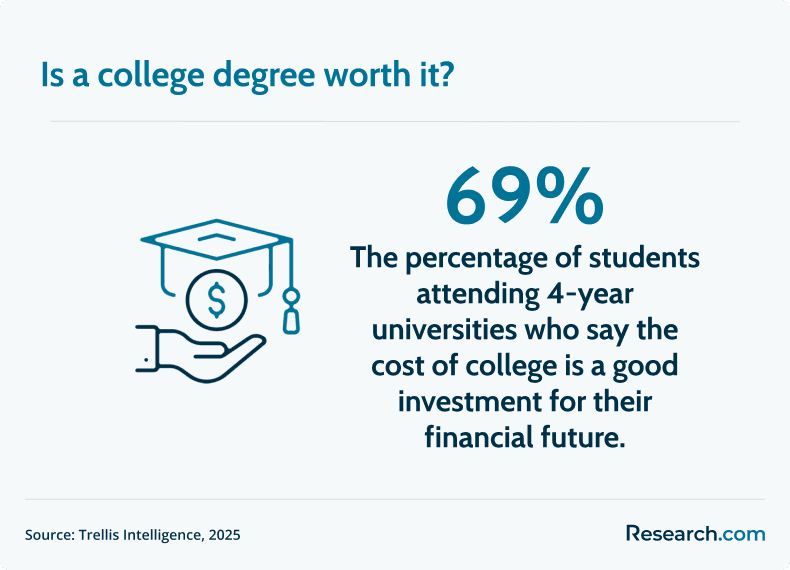
Despite cost concerns, 69% of students attending four-year universities agreed that the cost of college is a good investment for their financial future, while 82% said a college degree will provide a higher quality of life.
What are the prerequisites for enrolling in an online general studies degree program?
Admission requirements vary by school, but online general studies programs are often designed to be accessible to first-time college students, transfer students, and adults returning to college. Requirements may be more flexible than those for selective or highly technical majors.
- High school diploma or GED: Most associate and bachelor’s programs require proof of high school completion or an equivalent credential.
- Official transcripts: Applicants typically submit transcripts from high school and every college previously attended. Some schools require a minimum GPA, often around 2.0 to 2.5.
- Application form: Students usually complete an online application. Some institutions charge a small application fee.
- Standardized test scores: Many online general studies programs are test-optional, though some may request SAT or ACT scores from recent high school graduates.
- Transfer credit review: Students with prior college coursework should submit transcripts for evaluation. The 2024 Online College Students Report from EducationDynamics shows that about 50% of students said previously earned credits affected their decision to enroll in online programs. Transfer credits still need school approval before they count toward the degree.
- Personal statement or essay: Some programs may ask for a brief statement, especially when applicants are seeking admission to accelerated or selective pathways.
Flexible admissions are common in many adult-oriented online programs. For example, students comparing faith-based graduate routes such as the cheapest master of divinity online programs may also find admissions processes designed for working adults and second-career learners.
What courses are typically in an online general studies degree program?
Online general studies curricula usually combine general education, interdisciplinary core courses, and electives. The degree’s flexibility is one of its main strengths, but students should choose courses strategically instead of selecting electives at random.
1. General Education Requirements
These courses provide the academic foundation expected in a bachelor’s degree:
- English Composition
- College Algebra or Statistics
- Introduction to Psychology or Sociology
- Natural Sciences, such as Biology or Environmental Science
- U.S. History or Government
2. Core General Studies Courses
Core courses often connect different disciplines and strengthen broad professional skills:
- Critical Thinking and Problem Solving
- Interpersonal Communication
- Ethics and Society
- Research Methods
- Introduction to Liberal Arts or Interdisciplinary Studies
3. Electives and Focus Areas
Electives let students shape the degree around career interests, graduate school plans, or prior credit. Possible areas include:
- Business Administration
- Health Sciences
- Information Technology
- Human Resource Management
- Public Policy or Criminal Justice
- Criminal Justice
- Advanced courses in Psychology, Sociology, History, Literature, and related fields
Course selection should support a clear outcome. If you want business roles, take courses in management, communication, analytics, and marketing. If you want human services, prioritize psychology, sociology, public administration, and ethics. If you want graduate school, confirm prerequisites before choosing electives.
According to data from EducationDynamics, 66% of online college students agreed they were prepared to begin their career after graduating.
What types of specializations are available in online general studies degree programs?
Many online general studies degrees allow students to add a concentration, emphasis, minor, or planned cluster of electives. These focus areas do not usually go as deep as a dedicated major, but they can make the degree more relevant to a specific career path.
- Business-related specializations: Options may include Business Administration, Management, Marketing, Human Resources, Entrepreneurship, or Organizational Leadership. This can be useful for students interested in sales, operations, supervision, or administrative roles. Students considering sales careers can also review guidance on how to become a sales representative.
- Social and behavioral sciences: Focus areas may include Psychology, Sociology, Criminal Justice, Human Services, or Social Welfare. These can support entry-level roles in human services, community programs, social support, or public service. Students interested in counseling-related careers should understand that licensure requires additional education and can review the fastest way to become a counselor.
- Communication and media: Coursework in communications, digital media, public relations, writing, or professional communication can help students pursue public-facing roles in organizations, nonprofits, agencies, or corporate teams.
- Information technology and data analytics: Some programs include options in information systems, web development, computer applications, or data interpretation. These can be useful starting points, although many technical roles require additional hands-on skills or credentials.
- Healthcare-related specializations: Programs may offer health sciences, healthcare administration, public health, or related electives for students interested in non-clinical healthcare roles.
- Humanities and arts: Students may focus on English, history, liberal arts, interdisciplinary studies, writing, or cultural analysis. These areas can support communication-heavy roles or graduate study preparation.
Before selecting a specialization, compare it with a dedicated major. A general studies concentration may be enough for broad administrative or support roles, but a specialized bachelor’s degree may be stronger for fields that require technical depth, licensure, or strict prerequisites.
How to choose the best online general studies degree program?
The best online general studies program is not simply the cheapest one. It is the program that accepts the most usable transfer credits, offers relevant concentrations, fits your schedule, has recognized accreditation, provides strong student support, and helps you reach a specific career or academic goal.
- Confirm accreditation first: Accreditation affects federal financial aid eligibility, transferability, employer recognition, and graduate school options.
- Request a transfer credit evaluation: Ask how many credits will apply to your degree, not just how many the school is willing to accept in general.
- Compare total cost, not only tuition: Include fees, materials, books, technology costs, residency rules, and the number of credits you still need.
- Review concentrations and electives: Make sure the school offers enough courses in your intended area, such as business, health administration, communications, technology, education, or human services.
- Check course availability: A concentration is less useful if key courses are offered rarely or only during terms that do not fit your schedule.
- Evaluate student support: Look for advising, tutoring, writing support, library access, technical support, career services, and transfer advising for online learners.
- Ask about career services: Online students should have access to resume help, interview preparation, job boards, networking support, and internship guidance. If your long-term goal involves education, ask whether advisors can explain how to earn a teaching credential and whether the degree aligns with state requirements.
- Look at graduate outcomes carefully: Ask about completion rates, employment support, graduate school placement, and alumni career paths, but remember that outcomes vary by student.
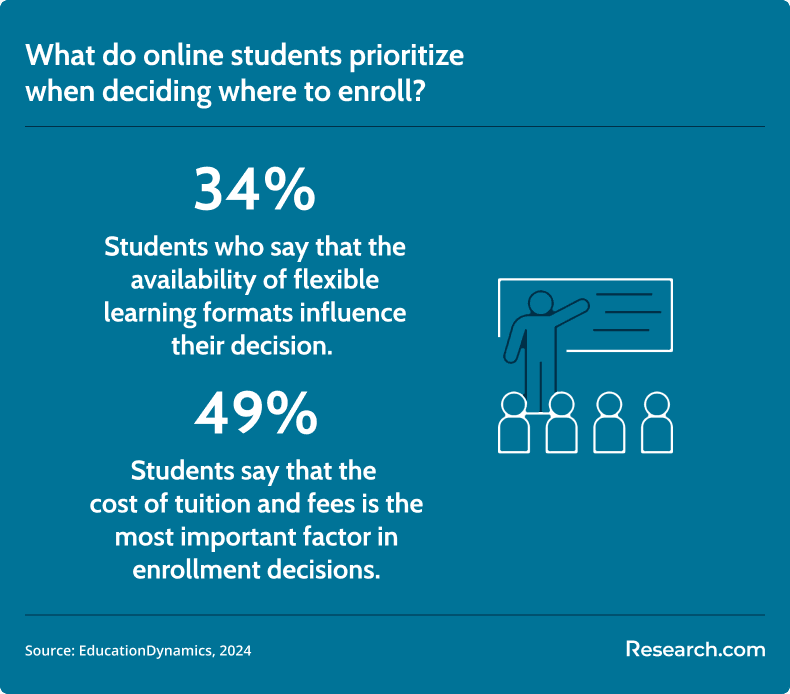
The 2024 Online College Students Report from EducationDynamics found that online students often prioritize tuition and fees (49%), flexible formats (28%), and length of time to complete studies (32%) when choosing where to enroll.
| Before choosing a program, ask this | Why the answer matters |
| Is the institution accredited by a recognized accreditor? | Accreditation affects aid, transfer, graduate school, and employer acceptance. |
| How many of my credits apply to the degree? | Accepted credits only help if they satisfy actual requirements. |
| What will my total cost be after transfer credits? | The cheapest per-credit rate is not always the lowest final price. |
| Are courses asynchronous, synchronous, or mixed? | The format must fit your work and family schedule. |
| Can I build a career-relevant concentration? | A focused plan makes the degree easier to explain to employers. |
| What support do online students receive? | Advising, tutoring, and tech support can affect persistence and graduation. |
| Does the degree meet requirements for my next step? | Some careers, licenses, and graduate programs require specific coursework. |
How do I verify the accreditation and quality of an online general studies degree program?
Start by checking whether the institution is accredited by an agency recognized by the appropriate higher education authorities. Accreditation helps confirm that the school meets standards for curriculum, faculty qualifications, student support, and institutional operations. It can also affect federal financial aid eligibility, graduate school admission, and whether future employers recognize the degree.
Next, review the program itself. Look at required courses, concentration options, faculty background, transfer rules, academic advising, career services, online learning support, completion expectations, and student outcomes. Independent rankings and reviews may be useful, but they should not replace direct questions to the school.
If you are comparing education-related online pathways, broader resources on online education degree programs can help you understand how quality indicators, accreditation, and career alignment differ across online programs.
What further academic opportunities can boost my career after an online general studies degree?
After completing a general studies bachelor’s degree, many graduates strengthen their career path through more specialized education. Options may include postbaccalaureate certificates, graduate certificates, master’s degrees, licensure-oriented programs, or professional training tied to a specific field.
The right next step depends on your career target. A student moving toward management might consider business or leadership training. Someone interested in education may need a licensure pathway or a specialized graduate degree. A student interested in public service could explore public administration, human services, policy, or nonprofit management.
Cost matters at the graduate level as well. Students interested in education-focused specialization may compare financially accessible options such as cheap online masters in early childhood education while reviewing curriculum, practicum expectations, state requirements, and career outcomes.
What advantages do advanced doctoral programs offer to online general studies graduates?
Doctoral programs are not the next step for most general studies graduates, but they may make sense for professionals who later build experience in education, leadership, policy, administration, research, or organizational development. A doctorate can deepen subject knowledge, strengthen research skills, and support advancement into senior leadership, teaching, consulting, or specialized administrative roles.
Students considering doctoral study should first clarify the return on investment. Ask whether the credential is required for your target role, how long the program will take, what research or dissertation expectations apply, and whether your current career experience supports admission. Professionals interested in education leadership may compare flexible options such as accelerated EdD programs online.
What certifications or additional qualifications can further enhance my online general studies degree?
Certifications can make a general studies degree more job-specific. Because the major is broad, a targeted credential can show employers that you have practical knowledge in a defined area.
- Project management: Useful for operations, administration, nonprofit programs, business support, and team coordination.
- Digital marketing: Helpful for communications, social media, content, public relations, and small business roles.
- Data analysis: Valuable for students who want to add quantitative skills for business, marketing, operations, or public service.
- Human resources: Useful for students interested in recruiting, employee relations, training, or workplace administration.
- Healthcare administration or medical records: Helpful for non-clinical healthcare support roles.
- Technical writing or communication: Relevant for documentation, content, training materials, and corporate communication.
Students who want a stronger quantitative academic foundation can also compare interdisciplinary study with focused math training, such as the fastest bachelor's degree in mathematics online.
What career paths are available for graduates of online general studies degree programs?
General studies graduates can pursue a range of roles, especially when they pair the degree with relevant experience, a concentration, internships, volunteer work, professional certificates, or industry-specific skills. The degree is often most useful in careers that value communication, coordination, research, adaptability, and broad organizational understanding.
Business and Administration
- Office Manager
- Administrative Coordinator
- Sales Representative
- Marketing Assistant
- Project Support Specialist
Education and Training
- Education Program Coordinator
- Corporate Trainer
- Academic Advisor
- Teacher’s Assistant (K–12 with additional certification)
Healthcare, Non-Clinical Roles
- Medical Office Manager
- Health Services Coordinator
- Patient Advocate
- Medical Records Specialist
Communications and Media
- Content Writer
- Public Relations Assistant
- Social Media Coordinator
- Customer Experience Specialist
Government and Public Service
- Social Services Assistant
- Program Analyst
- Community Outreach Coordinator
- Policy Support Specialist
Public agencies and nonprofit organizations may value general studies graduates for program support, outreach, administrative work, and community-facing roles. Students interested in long-term advancement in this sector can explore what can you do with a masters in human services.
Legal support is another possible direction, though a general studies bachelor’s degree is not the most direct legal training path. Graduates with strong writing, research, organization, and analytical skills may consider entry-level legal support roles and review how to get a paralegal certificate if they want a more focused credential.
| If you want to work in... | Choose electives in... | Add this experience or credential |
| Business operations | Management, communication, accounting basics, marketing | Administrative, sales, or project support experience |
| Human services | Psychology, sociology, ethics, public administration | Volunteer work, case support, nonprofit experience |
| Healthcare administration | Health systems, records, ethics, management | Medical office, patient services, or records-related training |
| Communications | Writing, digital media, public relations, research | Portfolio, internship, or content samples |
| Education support | Child development, instructional support, communication | School-based experience and any required state credential |
| Public service | Government, policy, sociology, data interpretation | Internship, community work, or government support experience |
What is the job market for graduates with an online general studies degree?
The job market for general studies graduates is broad but competitive. The degree can help candidates qualify for roles that require a bachelor’s degree without specifying a major, but it may not provide enough specialized preparation for technical, licensed, or highly regulated occupations without additional coursework or credentials.
- Graduates may pursue roles in industrial management, legal services, aviation, insurance, healthcare administration, education, IT services, marketing, and related fields.
- Online programs can let students tailor coursework to career goals, which may improve how clearly they present their qualifications to employers.
- Some companies require a bachelor’s degree but do not require the major to match the industry exactly.
- Online learners who complete school while managing work or family obligations may demonstrate persistence and time management, which are traits valued by hiring managers.
Using the most current data from O*NET OnLine, these are the projected growth rates in 2023-2033 for several occupations that general studies graduates may pursue:
- Public Relations Specialists - 6%
- Technical Writers - 4%
- Search Marketing Strategists - 8%
- Customer Service Representatives - (-5%)
- Social and Human Service Assistants - 8%
- General and Operations Managers - 6%
- Training and Development Specialists - 12%
- Medical Records Specialists - 9%
- Patient Representatives - 7%
- Probation Officers and Correctional Treatment Specialists - 4%
A 2025 report from the National Association of Colleges and Employers (NACE) found that 24.3% of employers said they will hire any majors regardless of whether they relate to the specific industry. That does not mean major choice is irrelevant. It means general studies graduates should clearly show relevant skills, experience, and accomplishments on their resumes.
Using data from the 2025 Job Outlook report from NACE, here are the attributes that employers look for on the resumes of candidates:
What Support Services Enhance the Online General Studies Experience?
Strong support services can make a major difference in online student success. Because general studies students often transfer credits, change direction, or study while working, they need more than access to online courses. They need clear advising and practical career planning.
- Academic advising: Advisors should help students choose electives that support a career goal, not just fill credit requirements.
- Transfer credit support: A good program should explain which credits count, which do not, and how transfer decisions affect graduation timelines.
- Tutoring and writing help: Online access to tutoring, writing centers, and research support is important for students returning after time away from school.
- Technical support: Reliable help with the learning platform, exams, library tools, and course access can prevent avoidable delays.
- Career services: Resume reviews, interview coaching, internship guidance, job boards, and career planning should be available to online learners.
- Library and research access: Online students should have access to academic databases, research guides, and virtual librarian support.
Graduates who later want to specialize in information organization, libraries, archives, or knowledge management may compare advanced options such as cheap MLIS online degrees.
Common Mistakes to Avoid When Choosing an Online General Studies Degree
- Choosing a program without checking accreditation: Accreditation can affect aid, transfer, graduate school, and employer recognition.
- Looking only at tuition: Fees, books, transfer limits, and extra terms can change the true cost.
- Assuming all transfer credits will apply: A school may accept credits generally but still not apply them to your degree requirements.
- Selecting random electives: A general studies degree should still have a career-focused plan.
- Ignoring licensure requirements: Teaching, counseling, nursing, and many healthcare or legal roles may require specific degrees, supervised hours, exams, or state approval.
- Relying only on rankings: Rankings can help narrow options, but fit, cost, credit transfer, support, and career alignment matter more.
- Assuming salary outcomes are guaranteed: Earnings depend on role, experience, location, industry, and additional credentials.
- Underestimating online workload: Flexible does not mean easy. Online students need consistent time management and self-discipline.
Practical Steps Before You Enroll
- Define your goal first. Decide whether you want promotion eligibility, career change, graduate school preparation, or completion of an unfinished bachelor’s degree.
- Collect all transcripts. Include every college you attended, even if credits are old or from a different major.
- Request transfer evaluations from multiple schools. Compare how many credits actually apply to the degree at each institution.
- Build a course plan. Ask an advisor to show how your electives can support a specific career field.
- Calculate total cost. Include tuition, fees, materials, and the number of remaining credits.
- Check accreditation and aid eligibility. Confirm the school’s status before committing.
- Review support services for online students. Make sure advising, tutoring, library resources, tech support, and career services are accessible remotely.
- Ask about outcomes. Request information on completion support, common career paths, and graduate school preparation.
- Plan one skill-building add-on. Consider a certificate, internship, portfolio, volunteer role, or job-specific training to make the degree more marketable.
References:
- Aslanian, C.B. & Discher, S. (2024). Online College Students Report 2024. EducationDynamics. https://insights.educationdynamics.com/rs/183-YME-928/images/EDDY-Online-College-Students-2024.pdf
- Fletcher, C. et al. (2025). Student Financial Wellness Survey report: Fall 2024. Trellis Strategies. https://www.trellisstrategies.org/wp-content/uploads/2025/04/SFWS-Aggregate-Report_FALL-2024_FINAL.pdf
- Hanson, M. (February 2025). Average Cost of Online College. Education Data Initiative. https://educationdata.org/average-cost-of-online-college
- Korhonen, V. (December 2024). Concerns about choosing online education in the U.S. 2024. Statista. https://www.statista.com/statistics/944409/concerns-about-choosing-online-education-usa
- National Association of Colleges and Employers (January 2025). Job Outlook 2025. https://www.naceweb.org/docs/default-source/default-document-library/2025/publication/research-report/2025-nace-job-outlook-jan-2025.pdf?Status=Master&sfvrsn=57d47fb0_3
- O*NET OnLine (n.d.). O*NET OnLine Help. https://www.onetonline.org Data Retrieved June 2025
- U.S. Bureau of Labor Statistics (n.d.). Occupational Employment and Wage Statistics, Industry: Cross-industry, Private, Federal, State, and Local Government, Period: May 2024. https://data.bls.gov/oes/#/industry/000000 Data retrieved May 2025
- Wells Fargo (May 2024). Starting Salaries by Major. https://collegesteps.wf.com/starting-salaries-by-major
Key Insights
- An online general studies degree is best for students who need flexibility, have transfer credits, or want a bachelor’s credential that can support several career directions.
- The degree is broad, so it works best when you choose electives, concentrations, certificates, or work experience around a specific goal.
- Affordable programs in this guide list tuition from $170 to $330 per credit, but total cost depends on fees, residency, transfer credits, and time to completion.
- Transfer credit policy can be the biggest factor in both cost and speed. Always request a program-specific evaluation before enrolling.
- Accreditation should be verified before applying because it affects financial aid, graduate school options, credit transfer, and employer recognition.
- Career outcomes vary. General studies graduates can pursue business, administration, healthcare support, communications, education support, government, nonprofit, and human services roles, but specialized credentials may be needed for advancement.
- Do not treat “general studies” as an unfocused major. Treat it as a customizable degree plan that needs a clear career strategy.
Other Things You Need to Know About Online General Studies Degrees
In 2027, several online general studies degree programs offer affordability, including institutions like Western Governors University and Southern New Hampshire University, known for competitive tuition rates and flexible online offerings. Prospective students are advised to research specific financial aids and scholarships available at these schools.
Yes, if the program is offered by a school accredited by a U.S. Department of Education–recognized accreditor and the institution participates in federal aid programs. Students usually file the FAFSA, and eligibility may include Pell Grants, Direct Subsidized and Unsubsidized Loans, and work-study.
In 2027, most online general studies degree programs require around 120 credit hours to graduate. This typically includes a mix of core courses, electives, and general education requirements that ensure a well-rounded academic experience at an affordable price.