2027 Most Affordable Online Data Analytics Bootcamps

Co-Founder and Chief Data Scientist
Choosing an affordable online data analytics bootcamp is not just a tuition decision. The bigger question is whether a short, skills-based program can help you build a usable portfolio, learn the tools employers expect, and move into a data role without taking on unnecessary cost. For career changers, recent graduates, and working professionals, the right bootcamp can be a practical alternative to a longer degree program—but only if the curriculum, support services, schedule, and outcomes match your goals.
This guide explains what online data analytics bootcamps teach, how much they cost, how long they take, what careers they may lead to, and how to compare affordable programs for 2027. It also highlights common risks, including unclear job placement claims, limited accreditation, weak career support, and payment plans that may cost more than they appear.
Quick Answer: Are Online Data Analytics Bootcamps Worth It?
An online data analytics bootcamp can be worth it if you want focused training in Excel, SQL, Python, Tableau, Power BI, data cleaning, visualization, and portfolio development without enrolling in a full degree. Many programs cost between $6,000 and $13,000 and can be completed in a few months to about a year, depending on whether you study full-time or part-time.
Bootcamps are best for learners who can practice consistently, build projects, and use career services actively. They are less ideal for students who need a formal academic credential, a research-heavy curriculum, or a pathway that requires regional accreditation or transfer credits.
What are the main benefits of enrolling in an online data analytics bootcamp?
- Career-focused training: Bootcamps are built around practical roles such as data analyst, business intelligence analyst, financial analyst, marketing analyst, and operations analyst.
- Shorter timeline than many degree programs: Most bootcamps focus on job-ready tools and projects rather than broad general education requirements.
- Flexible access: Online delivery can help working adults, parents, military learners, and career changers study without relocating or commuting.
- Portfolio development: Strong programs include projects that let students demonstrate data cleaning, dashboarding, analysis, and storytelling skills to employers.
- Salary potential: Reported salaries for data analytics roles range from $44,000 to $170,000 annually, with an average salary for data analytics roles around $84,348 per year. Actual earnings depend on role, location, experience, industry, and technical depth.
What can I expect from an online data analytics bootcamp?
An online data analytics bootcamp is a condensed training program that teaches learners how to collect, clean, analyze, visualize, and explain data. Most programs focus on tools used in business settings, including Excel, SQL, Python, Tableau, Power BI, and sometimes generative AI tools for analysis workflows. The best programs do more than introduce software; they teach students how to frame a business question, choose the right data, check for errors, present findings, and defend recommendations.
Many bootcamps end with a capstone project. This final project is important because employers often want proof that a candidate can apply skills to messy, realistic datasets. Some programs also include internship-style experiences, mentor meetings, technical interview practice, resume support, LinkedIn profile reviews, or job search coaching.
| Bootcamp Feature | What It Usually Means | Why It Matters |
| Core technical tools | Excel, SQL, Python, Tableau, Power BI, and related analytics platforms | These tools appear frequently in entry-level analytics job descriptions. |
| Applied projects | Dashboards, reports, exploratory analysis, and capstone work | Projects help convert coursework into portfolio evidence. |
| Live or self-paced learning | Instructor-led sessions, recorded modules, online discussions, or a mix | The format affects accountability, scheduling, and instructor access. |
| Career services | Resume reviews, interview prep, networking support, and job search resources | Career help can be valuable, but students should verify the depth of support. |
| Typical tuition range | $6,000 to $13,000, depending on length and services | Total cost should be compared with outcomes, financing terms, and included resources. |
Where can I work after completing an online data analytics bootcamp?
Data analytics skills are used across industries because organizations need people who can turn raw information into decisions. After a bootcamp, graduates may look for roles in business operations, technology, finance, healthcare, marketing, consulting, education, and other data-informed environments. There are over 93,471 data analysts currently employed in the United States, which reflects how widely the role is used across sectors.
Common employment settings include:
- Fortune 500 Companies (24%): Large corporations use analysts to monitor performance, evaluate strategy, identify risks, and support executive decisions.
- Technology (17%): Tech employers use analytics to study product behavior, user experience, customer retention, platform performance, and operational efficiency.
- Finance (13%): Banks, investment firms, insurers, and financial services companies rely on analysts for forecasting, risk review, reporting, and market analysis.
- Health Care (8%): Healthcare organizations use data to improve operations, evaluate outcomes, manage costs, and support quality improvement initiatives.
- Professional Services (7%): Consulting firms and service providers use analysts to produce client insights, dashboards, and recommendations.
- Education (6%): Schools, colleges, and education organizations use data to evaluate enrollment, retention, student outcomes, and program performance.
How much can I make after completing an online data analytics bootcamp?
The average annual salary for data analysts in the U.S. is approximately $84,348, with a typical range between $44,000 and $170,000. A bootcamp does not guarantee a specific salary. Compensation depends on your previous experience, location, technical portfolio, communication skills, industry, and the level of the role you secure.
- Location: Data analysts in higher-cost markets such as San Francisco or New York may earn higher salaries, often in the range of $75,000 to $130,000 annually.
- Industry: Pay varies by sector. Entry-level data analysts in marketing and advertising can earn between $58,375 and $83,875, while healthcare roles may range from $37,000 to $55,000.
- Experience: Entry-level analysts typically earn around $60,642, while mid-career professionals can expect approximately $73,424.
- Specialization: More specialized analytics roles may pay more. Financial analysts can earn between $65,000 and $103,000, and system analysts may earn from $57,000 to $89,000 annually.
- Most Affordable Online Data Analytics Bootcamps for 2027
- How long does an online data analytics bootcamp take?
- Online vs. on-campus data analytics bootcamps
- Average cost of an online data analytics bootcamp
- Financial aid and payment options for bootcamp students
- Common prerequisites for online data analytics bootcamps
- Typical courses in a data analytics bootcamp
- Common data analytics bootcamp specializations
- Should you pursue another credential after a bootcamp? Credential planning note
- Are online data analytics bootcamps accredited?
- How to choose the best online data analytics bootcamp
- Career paths after completing a data analytics bootcamp
- Job placement rates for online data analytics bootcamps
- Job market for online data analytics bootcamp graduates
- ROI of an online data analytics bootcamp
- Challenges and limitations of online data analytics bootcamps Common decision risks
List of the Most Affordable Online Data Analytics Bootcamps for 2027
How do we rank schools?
Affordability matters, but a low price alone does not make a bootcamp a good choice. Our ranking approach considers cost, program structure, institutional information, and available outcome indicators so readers can compare options more clearly. Research.com uses sources such as the IPEDS database, Peterson's database, the College Scorecard database, and The National Center for Education Statistics.
These sources help support comparisons involving institutional credibility, pricing, and student decision-making. Readers who want a fuller explanation of the ranking process can review Research.com's methodology page.
| Rank | Institution | Program Length | Concentrations | Total Cost |
| 1 | University of Oklahoma - Norman Campus | 26 weeks | Data Analytics, Artificial Intelligence | $9,995 |
| 2 | Stony Brook University | 24 weeks | Data Analytics, Business Intelligence | $8,500 |
| 3 | Lawrence Technological University | 26 weeks | Data Analytics, Artificial Intelligence | $10,140 |
| 4 | Louisiana State University - Shreveport | 10–26 weeks | Data Analytics, Artificial Intelligence | $12,995 |
| 5 | California Institute of Technology | 24 weeks | Data Analytics, Artificial Intelligence | $8,000 |
| 6 | Adelphi University | 15–34 weeks | Data Analytics, Artificial Intelligence | $6,500 |
| 7 | University of Texas at Arlington | 28 weeks | Data Analytics, Data Visualization | $7,900 |
| 8 | University of Tennessee - Knoxville | 10–18 weeks | Data Analytics, Data Visualization | $8,900 |
| 9 | University of North Carolina at Charlotte | 24 weeks | Data Analytics, Artificial Intelligence | $12,745 |
| 10 | University of Maryland - College Park | 24 weeks | Data Analysis, Business Intelligence | $9,900 |
1. University of Oklahoma - Norman Campus
The University of Oklahoma offers an online data analytics bootcamp focused on data analysis, visualization, and the use of AI-supported workflows. Students work with tools such as Excel, SQL, Python, Tableau, and generative AI technologies such as ChatGPT. The program emphasizes applied projects and prepares learners for roles such as Data Analyst and Insights Analyst.
- Program Length: 26 weeks
- Concentrations: Data Analytics, Artificial Intelligence
- Total Cost: $9,995
2. Stony Brook University
Stony Brook University provides an online data analytics bootcamp with a flexible, mentor-supported format. Developed in partnership with Microsoft, the curriculum includes Excel, SQL, Python, and Tableau. Learners can receive personalized mentorship and optional career support for roles such as data analyst, business intelligence analyst, and financial analyst.
- Program Length: 24 weeks
- Concentrations: Data Analytics, Business Intelligence
- Total Cost: $8,500
3. Lawrence Technological University
Lawrence Technological University offers an online data analytics bootcamp developed with Microsoft. The program combines technical instruction with applied problem-solving through over 20 mini-projects and a capstone project. Students study Excel, SQL, Python, and Tableau while receiving mentorship, career coaching, and a flexible self-paced online experience.
- Program Length: 26 weeks
- Concentrations: Data Analytics, Artificial Intelligence
- Total Cost: $10,140
4. Louisiana State University - Shreveport
Louisiana State University - Shreveport offers an online bootcamp in partnership with Fullstack Academy. Students can choose full-time or part-time options and attend live instructor-led sessions covering Python, SQL, Tableau, and AWS Glue. The program also includes preparation for credentials such as Tableau Desktop Specialist and AWS Certified Data Analytics, along with resume and job search support.
- Program Length: 10–26 weeks
- Concentrations: Data Analytics, Artificial Intelligence
- Total Cost: $12,995
5. California Institute of Technology
California Institute of Technology offers an online data analytics bootcamp designed for learners building foundational analytics skills. Coursework covers Excel, SQL, Python, Tableau, Power BI, and Generative AI, including ChatGPT. Students complete labs and collaborative projects that simulate practical analytics work. The program is designed for beginners and does not require prior experience.
- Program Length: 24 weeks
- Concentrations: Data Analytics, Artificial Intelligence
- Total Cost: $8,000
6. Adelphi University
Adelphi University offers an online data analytics bootcamp centered on hands-on practice with Excel, SQL, Python, and Tableau. Students learn data visualization, statistical analysis, and data storytelling for roles such as data analyst, business intelligence analyst, and data engineer. Flexible scheduling and scholarship opportunities may make the program appealing to career changers and professionals adding analytics skills.
- Program Length: 15–34 weeks
- Concentrations: Data Analytics, Artificial Intelligence
- Total Cost: $6,500
7. University of Texas at Arlington
The University of Texas at Arlington offers an online data analytics bootcamp powered by QuickStart. The program covers data visualization, predictive analytics, Power BI, Excel, and Transact-SQL. Students complete practical exercises and may prepare for the Microsoft Power BI Data Analyst Associate (PL-300) certification.
- Program Length: 28 weeks
- Concentrations: Data Analytics, Data Visualization
- Total Cost: $7,900
8. University of Tennessee - Knoxville
The University of Tennessee - Knoxville offers an online data analytics bootcamp aimed at learners preparing for entry-level analytics positions. The curriculum includes Excel, Python, SQL, and Power BI, with virtual labs, career simulations, and a final project. Students also receive preparation for the Microsoft Power BI Data Analyst (PL-300) certification exam.
- Program Length: 10–18 weeks
- Concentrations: Data Analytics, Data Visualization
- Total Cost: $8,900
9. University of North Carolina at Charlotte
University of North Carolina at Charlotte offers a data analytics bootcamp powered by Flatiron School. The online program teaches Python, SQL, Excel, Tableau, and JavaScript charting libraries through practical assignments. Students complete a capstone project and receive mentorship and career support for roles in data analysis, business intelligence, and related fields.
- Program Length: 24 weeks
- Concentrations: Data Analytics, Artificial Intelligence
- Total Cost: $12,745
10. University of Maryland - College Park
University of Maryland - College Park offers an online bootcamp covering Excel, SQL, Python, Power BI, and Tableau. Students complete over 20 mini-projects and a mentor-guided capstone to demonstrate analytics skills. The program also includes personalized mentorship, career coaching, and flexible scheduling for learners preparing for a career move or skill upgrade.
- Program Length: 24 weeks
- Concentrations: Data Analysis, Business Intelligence
- Total Cost: $9,900
How long does it take to complete an online data analytics BootCamp?
Most online data analytics bootcamps take 3 to 12 months to complete. The exact timeline depends on the program format, weekly workload, project requirements, and whether students enroll full-time or part-time. Full-time bootcamps often last around 8 to 12 weeks and may require roughly 40 hours of study each week. Part-time bootcamps can take 6 months or even 12 months and often require around 10 to 20 hours per week.
Instructor-led programs usually follow a fixed calendar with live sessions, deadlines, and scheduled assignments. Self-paced programs give students more control, but that flexibility can become a drawback if learners do not set a consistent schedule. Students comparing bootcamps with longer academic programs should understand that a bootcamp is narrower and faster, while a degree or graduate credential usually offers broader study and deeper theory. For example, a masters in library science online program typically requires a longer commitment and may support different career outcomes in information management.
| Study Format | Typical Timeframe | Best For | Main Trade-Off |
| Full-time bootcamp | 8 to 12 weeks | Learners who can study intensively and pause other commitments | Fast completion, but demanding workload |
| Part-time bootcamp | 6 months or even 12 months | Working adults and learners balancing family or job responsibilities | More manageable schedule, but slower career transition |
| Self-paced bootcamp | Varies by student | Independent learners with strong time management | Flexible, but less built-in accountability |
| Live online bootcamp | Set by program calendar | Students who want structure and instructor interaction | More support, but less scheduling freedom |
How does an online data analytics bootcamp compare to an on-campus program?
Online and on-campus data analytics bootcamps can cover similar technical skills, but the learning experience is different. Online programs are usually more flexible and accessible, while on-campus programs may provide more immediate in-person interaction, structured networking, and local employer connections. Similar format decisions matter in many fields, including an affordable esports business degree online, where delivery style affects schedule, cost, and peer interaction.
| Aspect | Online Bootcamp | On-Campus Bootcamp |
| Flexibility | Often offers self-paced, evening, weekend, or part-time options for working learners. | Usually follows a set schedule and may require full-time availability. |
| Learning Format | Uses virtual classrooms, recorded lessons, discussion boards, labs, and remote collaboration tools. | Relies on in-person lectures, workshops, labs, and face-to-face discussions. |
| Accessibility | Available from any location with a suitable computer and reliable internet connection. | Requires commuting, relocation, or living near the campus site. |
| Support and Mentorship | Support is typically delivered through chat, email, video meetings, office hours, and scheduled mentor calls. | Students may have easier access to instructors, classmates, and on-site support staff. |
| Cost | May reduce transportation, housing, and campus-related costs. | May involve higher total costs if commuting, parking, housing, or campus fees apply. |
| Career Services | Usually includes virtual resume reviews, interview coaching, online job resources, and remote networking events. | May include local employer events, in-person career fairs, and campus-based recruiting. |
What is the average cost of an online data analytics bootcamp?
The average cost of an online data analytics bootcamp typically ranges between $7,000 and $13,000, with the mean cost approximating around $9,500. Some programs cost below $7,000, especially if they are shorter, self-paced, or lighter on live support. Others exceed $13,000 when they include live instruction, mentor access, career coaching, certification preparation, or extended project work.
Students should compare total cost rather than tuition alone. Ask whether the price includes software access, exam vouchers, tutoring, career services, portfolio review, and post-completion support. Upfront savings can disappear if a program charges separately for required resources. Some learners also compare bootcamps with broader low-cost college options, such as online college no application fee options, to reduce initial expenses while evaluating credential choices.
| Cost Factor | What to Check Before Enrolling |
| Tuition | Confirm the full listed price and whether discounts, scholarships, or payment plans change the final amount. |
| Software and tools | Ask whether licenses for Tableau, Power BI, cloud tools, or other platforms are included. |
| Career services | Clarify whether coaching continues after graduation and whether support is one-on-one or group-based. |
| Certification preparation | Find out whether certification exam preparation or exam fees are included in tuition. |
| Financing terms | Read the details for loans, deferred tuition, and income share agreements before signing. |
What are the financial aid options for students enrolling in an online data analytics bootcamp?
Bootcamp financing can be helpful, but every option has trade-offs. Before choosing a payment plan, compare the total amount owed, repayment trigger, interest rate, refund policy, and what happens if you do not get a job quickly. Like affordable CNC machining online courses, bootcamps may be marketed as accessible and career-oriented, but students still need to evaluate the fine print.
- Scholarships: Some bootcamps offer partial or full scholarships, often for women in tech, military veterans, career changers, or students from underrepresented groups. Award amounts and eligibility rules vary widely.
- Income Share Agreements (ISAs): ISAs allow students to pay a percentage of future income after employment. About 40% of U.S. students are open to using ISAs to fund their education, but borrowers should carefully review repayment caps, income thresholds, and contract length.
- Deferred Tuition Plans: These plans delay payment until after employment or program completion. Students should confirm whether payments are fixed, whether interest applies, and what counts as qualifying employment.
- Private Loans: Some bootcamps partner with lenders. Loan terms may vary, so compare interest rates, fees, grace periods, and repayment obligations.
- Employer Sponsorships: Employers may pay part or all of the cost when the training supports a current job or promotion path. Ask whether repayment is required if you leave the company.
- Upfront Payment Discounts: Some providers reduce tuition for students who pay in full before the program begins. This can lower cost, but it also increases financial risk if the refund policy is limited.
What are the prerequisites for enrolling in an online data analytics bootcamp?
Many online data analytics bootcamps are designed for beginners, but “beginner-friendly” does not mean effortless. Students usually need comfort with basic computer tasks, consistent study habits, and enough math or logic readiness to work through data problems. Admissions requirements differ by provider, so verify them before applying.
- Minimum Age and Educational Background: Applicants are typically required to be at least 18 years old and have a high school diploma or equivalent. Some advanced tracks may recommend or require a bachelor's degree.
- English Proficiency: Because instruction and materials are delivered in English, students need strong written and spoken English skills.
- Basic Computer Literacy: Learners should be comfortable using browsers, spreadsheets, file systems, communication tools, and common productivity software.
- Technical Requirements: A reliable computer and stable internet connection are necessary for online coursework, live sessions, labs, and project submissions.
- Assessment Tests: Some programs use admissions assessments to evaluate logic, problem-solving, or learning readiness rather than advanced coding knowledge.
- Work Experience: Some programs, especially those with job guarantees, may require relevant work experience or a bachelor's degree. Similar expectations can appear in affordable educational policy degree programs online, where prior academic or professional experience may strengthen an application.
What courses are typically in an online data analytics bootcamp?
A strong data analytics bootcamp should move from fundamentals to applied analysis. Students usually start with spreadsheet and database skills, then progress to programming, visualization, statistical thinking, and project work. As with the cheapest humanities degree online, course design matters because the sequence determines whether students build connected skills or only learn isolated topics.
- Excel for Business Analytics: Students learn spreadsheet analysis, formulas, data cleaning, pivot tables, and basic visualization for business reporting.
- SQL for Data Acquisition and Manipulation: SQL coursework teaches students how to query relational databases, filter records, join tables, and prepare datasets for analysis.
- Python Programming for Data Analysis: Python modules usually introduce Pandas, NumPy, notebooks, and basic scripting for cleaning and analyzing data.
- Data Visualization with Tableau: Students learn to build dashboards, charts, and interactive visuals that communicate findings clearly.
- ETL Processes: ETL training covers extracting data from sources, transforming it into usable formats, and loading it into storage or analysis environments.
- Capstone Project: The capstone asks students to combine multiple skills in a real-world-style analytics project that can be included in a portfolio.
What types of specializations are available in online data analytics bootcamps?
Specializations help students align projects and tools with a specific career direction. Not every bootcamp offers a formal concentration, but many allow students to choose datasets, capstone themes, or elective modules that support a target industry.
| Specialization | What You Study | Good Fit For |
| Business Intelligence Analytics | Dashboards, KPI tracking, Tableau, Power BI, and executive reporting | Learners interested in reporting, operations, and decision support |
| Marketing Analytics | Consumer behavior, campaign performance, customer segmentation, and ROI analysis | Students targeting marketing, advertising, e-commerce, or growth roles |
| Financial Analytics | Budgeting, forecasting, financial modeling, and risk analysis | Learners with finance, accounting, banking, or investment interests |
| Healthcare Analytics | Healthcare datasets, operational metrics, patient outcomes, and compliance-aware reporting | Students interested in hospitals, insurers, public health, or healthcare technology |
| Operations Analytics | Workflow analysis, supply chain metrics, logistics, and process improvement | Learners aiming for roles in operations, manufacturing, logistics, or consulting |
| Data Engineering | Data pipelines, storage, ETL, and infrastructure concepts | Students who want a more technical path beyond standard analyst roles |
| AI and Machine Learning Analytics | Predictive modeling, AI tools, machine learning concepts, and advanced analysis workflows | Learners who want to expand into predictive analytics or AI-supported analysis |
Should I Consider Advanced Degrees After an Online Data Analytics Bootcamp?
A bootcamp may be enough for some entry-level analytics roles, especially when paired with a strong portfolio and prior business experience. However, an advanced degree can be useful if you want deeper theory, research training, leadership roles, domain specialization, or eligibility for positions that prefer graduate credentials. The right next step depends on the job market you are targeting.
For example, professionals interested in the intersection of analytics, life sciences, and computational biology may compare a bootcamp with an online bioinformatics master's degree. Students who want a broader computing foundation may also consider how bootcamps differ from accelerated computer science degree programs. A bootcamp is usually faster and more applied; a degree is usually broader, more formal, and more recognizable in academic or credential-sensitive settings.
Are online data analytics bootcamps accredited?
Many bootcamps are not accredited in the same way colleges and universities are accredited. A university-affiliated bootcamp may be offered through a continuing education division or third-party provider, which does not automatically mean the bootcamp itself carries academic accreditation or produces transferable credits. Students should ask direct questions before enrolling.
- Is the bootcamp offered by the university, a third-party provider, or a partnership?
- Does completion award academic credit, a certificate of completion, or a noncredit credential?
- Will credits transfer into a degree program?
- Who teaches the course, and what qualifications do instructors and mentors have?
- What organization reviews curriculum quality and student outcomes?
Accreditation matters most when you need transfer credit, employer tuition reimbursement, graduate school eligibility, or a credential for regulated roles. If your goal is a portfolio-based analytics job, employer recognition, projects, and skills may matter more than formal accreditation—but you should still verify quality carefully.
How to Choose the Best Online Data Analytics Bootcamp
The best bootcamp is not necessarily the cheapest or the most famous. It is the program that teaches the right skills, fits your schedule, gives you enough support, and offers a realistic path to your target role. Use the following steps before you commit.
- Define your target role. Decide whether you want to become a data analyst, BI analyst, marketing analyst, financial analyst, operations analyst, or another data-focused professional. Your goal should shape your curriculum needs.
- Review the curriculum line by line. Look for Excel, SQL, Python, Tableau, Power BI, statistics, data cleaning, visualization, and capstone work. Avoid programs that list tools but do not explain what students actually build.
- Compare learning formats. Choose live instruction if you need accountability and instructor interaction. Choose self-paced learning only if you are disciplined and comfortable troubleshooting independently.
- Evaluate projects and portfolio support. Ask how many projects you complete, whether they use realistic datasets, and whether mentors review them.
- Verify career services. Ask whether support includes resume work, mock interviews, LinkedIn reviews, job search planning, employer networking, and post-graduation access.
- Understand the full cost. Compare tuition, financing fees, required tools, certification costs, and refund terms.
- Check outcome claims. Ask for job placement methodology, definitions, timeframes, exclusions, and whether the data has been independently reviewed.
Common mistakes to avoid when choosing a bootcamp
| Mistake | Why It Can Hurt You | Better Approach |
| Choosing only by lowest tuition | The cheapest option may offer limited support, weak projects, or little career guidance. | Compare cost against curriculum depth, mentorship, portfolio work, and outcomes. |
| Assuming university-branded means accredited | A bootcamp may be noncredit or run by a third-party provider. | Ask whether the credential carries academic credit and who delivers instruction. |
| Ignoring financing terms | Deferred payment plans, loans, or ISAs can increase total cost. | Read repayment triggers, interest, caps, and refund policies before signing. |
| Skipping employer research | Some programs teach tools that may not match local or target job postings. | Review real job ads and compare required skills with the syllabus. |
| Relying only on rankings | Rankings are useful starting points but cannot reflect your schedule, goals, or learning style. | Use rankings with admissions calls, alumni feedback, and curriculum review. |
What career paths are available after completing an online data analytics bootcamp?
Bootcamp graduates may pursue roles that involve collecting, organizing, interpreting, and presenting data. Entry-level opportunities often depend on portfolio quality, previous work history, communication ability, and comfort with tools such as SQL, Excel, Python, Tableau, and Power BI.
1. Data Analyst
Data analysts examine datasets to identify patterns, answer business questions, and produce reports or dashboards. They often clean data, run queries, create visualizations, and explain findings to managers or stakeholders. Accuracy, curiosity, and clear communication are essential.
Median salary: $82,640 per year.
2. Business Intelligence Analyst
Business intelligence analysts build dashboards, reporting systems, and performance metrics that help organizations monitor operations and make decisions. They often combine technical reporting skills with knowledge of business processes and stakeholder needs.
Median salary: $99,864 per year.
3. Financial Analyst
Financial analysts use data to support budgeting, forecasting, investment analysis, and risk evaluation. Learners aiming for more specialized finance roles sometimes compare bootcamp training with the cheapest online master's in finance, especially when employers prefer deeper finance credentials.
Median salary: $88,111 per year.
4. Marketing Analyst
Marketing analysts study campaign performance, customer behavior, market trends, conversion patterns, and return on investment. They help marketing teams decide where to spend, which audiences to target, and how to improve performance.
Median salary: $77,589 per year.
5. Operations Analyst
Operations analysts evaluate workflows, costs, processes, and performance metrics to improve organizational efficiency. Professionals who want to move from analysis into management may later consider an accelerated MBA to build leadership and strategy skills.
Median salary: $70,210 per year.
What are the job placement rates for online data analytics bootcamps?
Job placement rates can help evaluate a bootcamp, but they should be read carefully. Many reputable programs report placement rates ranging between 70% and 90% within six months of graduation, but the meaning of “placed” can vary. Some reports may include full-time roles, part-time roles, internships, freelance work, promotions, or jobs that only partly use data skills.
Before trusting a placement figure, ask whether the data is independently audited, what graduates are excluded, whether salaries are reported, and how the program defines a relevant job. Strong career services should include resume support, portfolio review, mock interviews, job search planning, and employer networking—not only access to a job board. Students comparing career-support models across fields may also look at programs such as a health administration degree online to understand how different credentials provide employer connections and advising.
What is the job market for graduates of an online data analytics bootcamp?
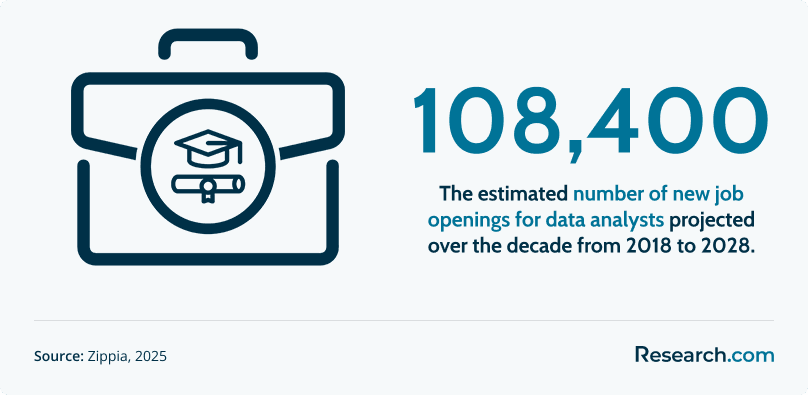
The demand for data analysts is expected to increase by 11% from 2018 to 2028, creating approximately 108,400 new job opportunities in the next decade. Businesses in finance, healthcare, marketing, technology, education, and professional services continue to rely on data to guide decisions. With over 93,000 data analysts currently employed in the U.S. and more than 167,000 active job openings, the field offers opportunities for candidates who can demonstrate practical skill.
Salaries for data analysts have risen by 8% over the past five years, which points to continued employer demand. However, competition can be strong for entry-level roles. Bootcamp graduates improve their chances when they build a credible project portfolio, practice SQL and visualization heavily, learn to explain business impact, and tailor applications to specific industries. Some professionals also combine analytics skills with other information-focused credentials, such as a degree in library science, for paths involving data curation, digital archiving, or information management.
What is the ROI of an online data analytics bootcamp?
The return on investment of a data analytics bootcamp depends on tuition, financing costs, time to completion, job search duration, and the salary increase you can realistically achieve. A bootcamp with a lower price may produce weak ROI if it lacks projects or career support. A more expensive program may be worthwhile if it helps you build stronger work samples, prepare for interviews, and access better employer networks.
To estimate ROI, compare the full program cost with expected earnings, current income, and the time you can devote to job searching. Include hidden costs such as certification fees, software, unpaid study time, and loan interest. Learners comparing technical education investments may also review cheap online software engineering degree programs to understand the trade-offs between short bootcamps and longer degree pathways.
Questions to ask before enrolling
- What roles do recent graduates actually get, and how long does the job search usually take?
- Are salary and placement outcomes independently verified?
- Will I graduate with at least three strong portfolio projects?
- Does the curriculum match current job postings in my target city or remote job market?
- What happens financially if I withdraw, pause, or do not find a job?
What are the potential challenges and limitations of online data analytics bootcamps?
Online data analytics bootcamps can be efficient, but they are not a shortcut around practice, networking, or employer expectations. Students should enter with realistic expectations about workload, competition, and credential value.
- Uneven curriculum depth: Some programs teach tools at a surface level without enough statistics, business context, or project complexity.
- Limited in-person networking: Online learners may need to work harder to build peer, mentor, and employer relationships.
- Variable instructor access: Mentorship quality differs by program, so ask how often you can meet with instructors and how feedback is delivered.
- No guaranteed job outcome: Career support can help, but job offers depend on market conditions, your portfolio, interview skills, and prior experience.
- Credential limitations: A certificate of completion may not replace a degree for employers that require formal academic credentials.
Students who want a more specialized healthcare data path, for example, may compare bootcamp training with a fast online masters of health informatics to decide whether a graduate credential is more appropriate for their target role.
Here’s What Graduates Have to Say about Online Data Analytics Bootcamps
The program’s structure helped me break down difficult analytics topics into manageable lessons. The projects gave me a way to practice immediately, and I became more confident using data tools and explaining trends. The learning community also helped me stay consistent. — Ben
Studying online while working full-time was challenging, but the flexible schedule made it possible. I was able to apply new analytics methods at work, which improved my productivity and helped me contribute more useful insights to my team. — Francis
Changing careers into data analytics felt intimidating at first. The step-by-step format, project work, and support from peers made the transition easier. Building a portfolio helped me feel prepared for my first role in the field. — Sabrina
Key Insights
- Online data analytics bootcamps are best for learners who want fast, applied training in Excel, SQL, Python, Tableau, Power BI, and data storytelling.
- Tuition commonly falls between $6,000 and $13,000, while the average cost is around $9,500 depending on format, length, mentorship, and career services.
- The data analytics job market is projected to grow by 11% from 2018 to 2028, with over 167,000 active job openings reported nationwide.
- Salary potential varies widely. The average annual salary for data analysts is approximately $84,348, but outcomes depend on location, industry, experience, and specialization.
- Do not rely on placement claims without context. Ask how job placement is defined, whether results are audited, and what support continues after graduation.
- Accreditation can be confusing. Many bootcamps are noncredit programs, even when university-affiliated, so students should verify whether the credential transfers or carries academic credit.
- The highest-ROI bootcamp is the one that fits your schedule, teaches tools used in your target job postings, includes substantial portfolio projects, and provides credible career support.
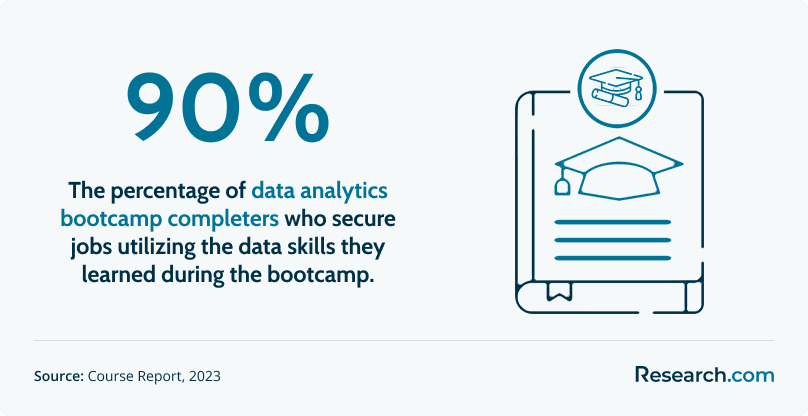
- About 90% of data analytics bootcamp completers secure jobs that utilize the data skills they learned during the program, but students should still evaluate how each provider reports outcomes.
- The most common degree among data analysts is a bachelor’s degree, held by 65% of professionals in the field.
- Approximately 24% of data analysts major in business, making business knowledge a useful complement to technical analytics skills.
References:
- Congress.gov. (n.d.). Congressional Research Service report. Retrieved from Congress.gov.
- Data Science Corps. (n.d.). Data science and analytics fellows program. Retrieved from DigitalCorps.
- Discover Data Science. (n.d.). Income sharing agreements. Retrieved from DiscoverDataScience.
- EdX. (n.d.). Data analysis learning resources. Retrieved from edX.
- Fullstack Academy. (n.d.). Data analytics bootcamp. Retrieved from Fullstack Academy.
- Gartner. (n.d.). Data and analytics. Retrieved from Gartner.
- General Assembly. (n.d.). Data analytics bootcamp. Retrieved from GeneralAssembly.
- Google. (n.d.). Data analytics certificate. Retrieved from Grow with Google.
- NSF. (n.d.). Data Science Corps funding opportunity. Retrieved from NSF.gov.
- ZipRecruiter. (n.d.). Business intelligence analyst salary. Retrieved from ZipRecruiter.
- ZipRecruiter. (n.d.). Data analyst salary. Retrieved from ZipRecruiter.
- ZipRecruiter. (n.d.). Financial analyst salary. Retrieved from ZipRecruiter.
- ZipRecruiter. (n.d.). Marketing analyst salary. Retrieved from ZipRecruiter.
- ZipRecruiter. (n.d.). Operations analyst salary. Retrieved from ZipRecruiter.
- Zippia. (n.d.). Data analyst jobs and education. Retrieved from Zippia.
Other Things You Should Know About Online Data Analytics Bootcamps
Key factors to consider include the curriculum, instructor expertise, student reviews, duration, cost, and career support services. Ensure the program covers the essential tools and skills and check if it offers good value for money.
Yes, many affordable online data analytics bootcamps in 2027 welcome beginners with no coding experience. These programs typically offer foundational courses in data science and analytics, ensuring learners gain necessary skills like data manipulation and visualization. They emphasize hands-on projects and real-world applications, making them accessible to newcomers.