
2027 Best Online Master’s Degree Programs in Data Analytics

Co-Founder and Chief Data Scientist
Choosing an online master’s degree in data analytics is a high-stakes decision: the right program can strengthen your technical portfolio, help you qualify for analytics leadership roles, and let you keep working while you study. The wrong program can leave you with high debt, weak career support, or coursework that does not match the tools employers expect.
This guide explains how online master’s programs in data analytics work, what they cost, how long they take, which schools stand out for 2027, and how to compare programs based on accreditation, curriculum, flexibility, practical experience, and career outcomes. It is designed for working professionals, career changers, and recent graduates who want a structured way to evaluate their options before applying.
Quick Answer: Is an Online Master’s in Data Analytics Worth Considering?
An online master’s degree in data analytics can be worth it for students who want advanced training in statistics, programming, data visualization, machine learning, and business decision-making without relocating or leaving the workforce. Programs commonly take 12 to 36 months to finish, and tuition can range from $9,900 to over $65,000 depending on the institution. The strongest programs are regionally accredited, include hands-on projects, teach current analytics tools, and provide clear career support.
What are the benefits of getting an online master’s degree in data analytics?
- Access to data-focused roles: Graduate study can support careers such as data analyst, business intelligence analyst, analytics manager, and data scientist, especially for positions that expect advanced modeling, programming, or quantitative reasoning.
- Strong salary potential: Data-focused occupations can pay well. As of May 2023, data scientists earned a median annual wage of $108,020.
- Flexibility for working adults: Many online programs use asynchronous coursework, evening sessions, or part-time pacing so students can continue working while building graduate-level analytics skills.
What can I expect from an online master’s degree in data analytics?
An online master’s in data analytics is a graduate program that teaches students how to collect, clean, model, interpret, visualize, and communicate data. Most programs combine statistics, programming, database work, machine learning, and business or industry applications. Depending on the school, the degree may be called data analytics, business analytics, applied data analytics, data science, analytics engineering, or a closely related title.
Program length usually falls between 12 and 36 months. Full-time and accelerated students may move faster, while part-time learners often take longer because they are balancing school with employment or family responsibilities. Courses may be asynchronous, synchronous, or a mix of both. Asynchronous formats offer more control over weekly study time, while synchronous courses provide live interaction with faculty and classmates.
Expect coursework in topics such as data mining, predictive analytics, machine learning, database design, data visualization, and statistical modeling. Many programs end with a capstone project where students use real or simulated datasets to solve an applied problem. Some programs also offer internships, practicum experiences, or employer-sponsored projects, which can be especially useful for students changing careers.
| Program feature | What it means for students | Why it matters |
| Asynchronous courses | Students complete weekly work on their own schedule. | Best for working adults who need maximum flexibility. |
| Synchronous courses | Students attend live online classes at scheduled times. | Useful for learners who want structure and real-time discussion. |
| Capstone project | Students complete an applied analytics project near the end of the program. | Can become a portfolio piece for job applications. |
| Specialization | Students focus on an area such as AI, business analytics, data engineering, or healthcare analytics. | Helps align coursework with a target career path. |
| Regional accreditation | The school is reviewed by a recognized accrediting body. | Important for transferability, employer recognition, and financial aid eligibility. |
Where can I work with an online master’s degree in data analytics?
Data analytics skills are used across industries that rely on forecasting, automation, customer insights, operational efficiency, risk modeling, and evidence-based decision-making. According to the U.S. Bureau of Labor Statistics, the industries with the highest employment levels for data scientists as of May 2023 include:
- Professional, Scientific, and Technical Services: This sector employed approximately 29,790 data scientists, representing 1.1% of its workforce.
- Management of Companies and Enterprises: About 6,800 data scientists worked in corporate management settings, where analytics supports planning, forecasting, and executive decisions.
- Insurance Carriers: More than 5,000 data scientists worked in insurance, where analytics is used for risk assessment, claims modeling, pricing, and policy optimization.
- Computer Systems Design and Related Services: Roughly 4,000 data scientists worked in this field, often supporting software, IT infrastructure, cybersecurity, and technology services.
- Management, Scientific, and Technical Consulting Services: More than 3,500 data scientists provided analytics support to organizations seeking operational, strategic, or technical improvements.
How much can I make with an online master’s degree in data analytics?
Salary depends on role, industry, geography, experience, technical depth, and portfolio quality. A master’s degree can help candidates compete for advanced roles, but it does not guarantee a specific salary. The figures below show commonly cited earning ranges and should be used as planning benchmarks rather than promises.
- Data scientists: The median annual wage for data scientists was $108,020 in May 2023.
- Data analysts: Data analysts in finance and insurance earn a median annual wage of $82,640.
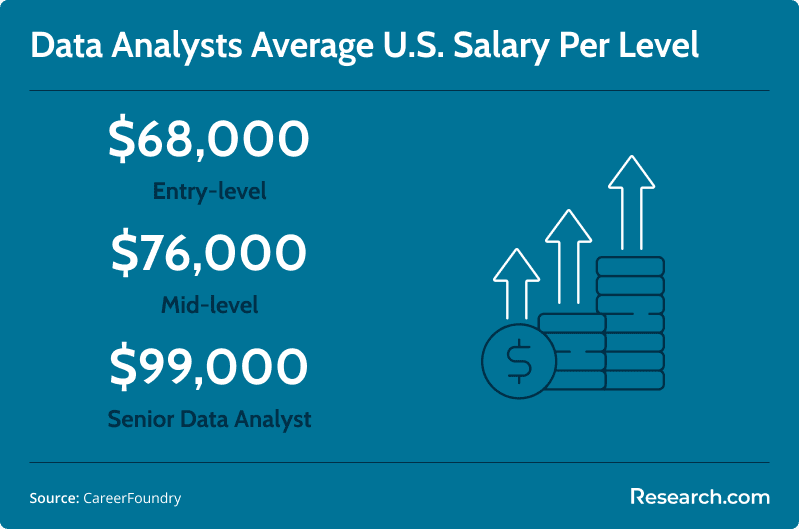
- Entry-level roles: Entry-level data analysts commonly begin around $68,000 per year.
- Mid-career roles: Professionals with 3-7 years of experience can expect an average base salary of $76,000.
- Senior data analysts: Senior data analysts earn approximately $99,000.
- Advanced skill sets: Professionals with advanced skills or at least three years of experience can earn over $100,000 per year.
- Best Online Master’s Degree in Data Analytics Programs for 2027
- How long does an online master’s in data analytics take?
- Online vs. on-campus master’s in data analytics: which format fits you?
- How much does an online master’s in data analytics cost?
- What financial aid is available for online data analytics master’s students?
- What admission requirements should applicants expect?
- What courses are usually included?
- Which data analytics specializations are available?
- What technical credentials can strengthen a data analytics master’s degree?
- What challenges do online data analytics students face?
- How to choose the best online master’s in data analytics program
- What jobs can graduates pursue?
- How are emerging technologies changing data analytics curricula?
- How can digital media skills improve analytics communication?
- What is the job market for online data analytics master’s graduates?
- How can cybersecurity knowledge improve data analytics expertise?
- How can AI training strengthen analytics skills?
- How can interdisciplinary study support career growth?
- How can bioinformatics expand analytics career options?
- How can an associate degree in cybersecurity complement data analytics?
Best Online Master’s Degree in Data Analytics Programs for 2027
How do we rank the programs?
Because a graduate degree requires a major investment of time and money, rankings should be used as one decision tool rather than the only factor. Research.com evaluates programs using data from the IPEDS database, Peterson's database, the College Scorecard database, and the National Center for Education Statistics. These sources help compare schools using consistent institutional and program information. You can review the full ranking process on Research.com’s methodology page.
1. Northeastern University
Northeastern University offers an online Master of Science in Data Analytics Engineering for students who want to build skills in visualization, database design, data mining, and applied analytics. The program is designed for both experienced engineers and students entering analytics from another field.
- Required Credits to Graduate: 32 semester hours
- Cost: $1,856 per credit hour
- Accreditation: New England Commission of Higher Education (NECHE)
2. University of Miami
The University of Miami provides an online Master of Science in Data Analytics and Program Evaluation that emphasizes data management, statistical analysis, and program assessment. Students work with tools such as R and Python while preparing for data-informed decision-making roles.
- Required Credits to Graduate: 30
- Cost: $37,950 total tuition
- Accreditation: Southern Association of Colleges and Schools Commission on Colleges (SACSCOC)
3. Southern New Hampshire University (SNHU)
Southern New Hampshire University (SNHU) offers an online Master of Science in Data Analytics focused on collecting, interpreting, and applying data to solve organizational problems. The program is structured for students who want practical analytics skills across industries.
- Required Credits to Graduate: 36
- Cost: $637 per credit hour
- Accreditation: New England Commission of Higher Education (NECHE)
4. Eastern University
Eastern University offers an online Master of Science in Data Analytics with a technical curriculum that also addresses ethics and values-based decision-making. The program may appeal to students who want analytics training connected to broader moral, philosophical, and social questions.
- Required Credits to Graduate: 30
- Cost: $9,900 total tuition and program fees
- Accreditation: Middle States Commission on Higher Education (MSCHE)
5. Northern Illinois University
The Northern Illinois University online Master of Science in Data Analytics develops skills in business intelligence, data analysis, and big data analytics. Its applied focus is suited to students seeking analytics responsibilities in data-driven organizations.
- Required Credits to Graduate: 30
- Cost: $933.32 per credit hour
- Accreditation: Higher Learning Commission (HLC)
6. Arizona State University (ASU) Online
Arizona State University (ASU) Online offers an online Master of Science in Business Analytics that centers on using data to create business value. Students study large datasets, analytical measurement, and evidence-based strategy for organizational decision-making.
- Required Credits to Graduate: 30
- Cost: $44,000 total tuition
- Accreditation: Higher Learning Commission (HLC)
7. Penn State World Campus
The Penn State World Campus Master of Data Analytics emphasizes data management, predictive modeling, statistics, big data, and database design. It is a strong fit for students interested in both analytical methods and the infrastructure that supports data work.
- Required Credits to Graduate: 30
- Cost: $1,067 per credit
- Accreditation: Middle States Commission on Higher Education (MSCHE)
8. Oregon State University Ecampus
Oregon State University Ecampus offers an online Master of Science in Data Analytics that blends statistics and computer science. The curriculum prepares students to work with complex datasets using computational and statistical techniques.
- Required Credits to Graduate: 45 quarter credits
- Cost: $571 per credit
- Accreditation: Northwest Commission on Colleges and Universities (NWCCU)
9. Boston University
Boston University offers an online Master of Science in Applied Data Analytics built around organizing, cleaning, analyzing, and visualizing data. Graduates may pursue roles such as data scientist, business intelligence analyst, or analytics manager.
- Required Credits to Graduate: 32
- Cost: $975 per credit hour
- Accreditation: New England Commission of Higher Education (NECHE)
10. Carnegie Mellon University
Carnegie Mellon University—Tepper School of Business offers a part-time online Master of Science in Business Analytics for working professionals. The program includes data mining, machine learning, statistical modeling, and business intelligence with an applied business focus.
- Required Credits to Graduate: 108 units
- Cost: From $33,424 to $63,636 + tuition per year
- Accreditation: AACSB International
How long does it take to complete an online master’s degree in data analytics?
Most online master’s programs in data analytics take 12 to 36 months. Full-time students often finish in 12 to 16 months, while part-time students may need up to three years. Some accelerated options, such as the program at the University of North Texas, allow students to complete the degree in under two years.
| Enrollment path | Typical completion time | Best for |
| Accelerated | Under two years | Students who can handle a heavier course load and want to finish quickly. |
| Full-time | 12 to 16 months | Students with flexible schedules or reduced work commitments. |
| Part-time | Up to three years | Working professionals balancing school with employment or family responsibilities. |
Several factors can change your timeline: transfer credits, prerequisite requirements, course availability, capstone scheduling, and whether the program uses fixed cohorts or self-paced terms. Before enrolling, ask whether courses are offered every term and whether you can pause enrollment without losing good academic standing.
How does an online master’s degree in data analytics program compare to an on-campus program?
An online data analytics degree is usually best for students who need location flexibility, while an on-campus program may be better for students who value in-person networking, classroom structure, and campus-based recruiting. The degree format matters less than accreditation, curriculum quality, faculty experience, and the strength of your project portfolio.
| Factor | Online master’s program | On-campus master’s program |
| Schedule | Often more flexible, especially with asynchronous courses. | Usually follows set class times and campus schedules. |
| Networking | Requires intentional participation in virtual events, discussion boards, and group projects. | Provides more informal face-to-face interaction with peers, faculty, and recruiters. |
| Cost considerations | May reduce commuting and relocation expenses, though tuition varies by school. | May include housing, transportation, and campus-related costs. |
| Learning environment | Works well for independent learners with strong time management skills. | Works well for students who prefer direct structure and in-person accountability. |
| Employer perception | Often accepted when the school is reputable and accredited. | Traditionally familiar to employers, especially for campus recruiting pipelines. |
Employers’ Perception of Online Degrees
Employer acceptance of online education has improved, especially when the program comes from an accredited and recognizable institution.
- A Carrington Crisp and LinkedIn survey found that 74% of employers recognize online learning as equivalent to traditional face-to-face education.
- Employers commonly pay attention to the school’s reputation, accreditation, your technical portfolio, and your ability to explain projects clearly.
Networking Opportunities
Online students can build strong professional networks, but they often need to be more deliberate than campus-based students.
- Campus programs make it easier to attend in-person events, meet faculty after class, and collaborate informally.
- Online programs may offer virtual career fairs, Slack or Teams communities, remote group projects, alumni events, and faculty office hours.
Curriculum and Faculty Quality
Many universities use the same faculty standards and comparable course outcomes across online and campus formats.
- Look for programs that clearly state whether online students take the same or equivalent courses as campus students.
- Review faculty backgrounds to see whether instructors have industry analytics, machine learning, statistics, or database experience.
Cost Considerations
Online study can lower indirect costs, but it is not automatically cheaper. Some institutions charge the same tuition for online and campus students.
- Compare total program cost, not just per-credit tuition.
- Ask about technology fees, graduation fees, course materials, software subscriptions, and required residencies.
Choosing the Right Format
Choose online if you need flexibility, live far from campus, or plan to keep working full time. Choose campus if you want a highly structured environment, face-to-face networking, and access to local recruiting events. Either format can be valuable when the program is accredited, rigorous, and aligned with your career goals.
What is the average cost of an online master’s degree in data analytics program?
Tuition for an online master’s degree in data analytics can range from $9,900 to over $65,000. Public universities, private universities, business school programs, and technology-focused programs can differ widely in cost. In-state pricing, out-of-state pricing, flat-rate tuition, and per-credit tuition can also change the final amount you pay.
Do not compare programs by tuition alone. Include fees, textbooks, software, exam proctoring, travel for any residency requirement, and the opportunity cost of reducing work hours. If affordability is a top priority, compare public universities, employer-supported options, and Research.com’s guide to the cheapest online data science master's programs.
| Cost item | Why it matters | Question to ask |
| Tuition | Usually the largest expense. | Is tuition charged per credit, per term, or as a total program price? |
| Technology fees | Online students may pay platform, proctoring, or support fees. | Are fees included in the published tuition estimate? |
| Course materials | Analytics courses may require textbooks, datasets, or software tools. | Are required tools free, institution-provided, or student-paid? |
| Residency or travel | Some online programs include in-person sessions. | Is any campus visit required? |
| Time away from work | Heavy course loads can affect earnings. | Can the program be completed part time without delaying required courses? |
What are the financial aid options for students enrolling in an online master’s degree in data analytics program?
Online graduate students may qualify for federal aid, institutional scholarships, employer benefits, and private loans. Availability depends on the school, enrollment status, citizenship or residency status, and whether the program is eligible for aid.
Federal Student Loans
Eligible U.S. citizens or permanent residents can apply for Federal Direct Unsubsidized Loans, which provide up to $20,500 per academic year. Federal Direct Graduate PLUS Loans can help cover remaining costs up to the total cost of attendance, but they require a credit check.
Grants and Scholarships
Graduate grants and scholarships may be less common than undergraduate aid, but many schools offer merit-based awards, need-based support, or scholarships for online students. For example, the University of Michigan's Master of Applied Data Science program offers scholarships ranging from $1,000 to $5,000.
Employer Tuition Reimbursement
If you are already employed, ask your human resources department whether your company reimburses tuition for job-related graduate study. Also ask whether you must stay with the employer for a set period after receiving reimbursement.
Private Loans
Private loans may help fill funding gaps, but they can vary in interest rate, repayment terms, and borrower protections. Compare them carefully against federal loan options before borrowing.
Eligibility Requirements
Students seeking federal aid must complete the Free Application for Federal Student Aid (FAFSA). Continued eligibility generally requires maintaining satisfactory academic progress and meeting enrollment requirements.
What are the prerequisites for enrolling in an online master’s degree in data analytics program?
Admission requirements vary by university, but most online master’s programs in data analytics look for evidence that applicants can handle graduate-level quantitative, technical, and analytical coursework.
- Bachelor’s Degree: Most programs require a bachelor’s degree from an accredited institution, and many prefer a minimum GPA of 3.0 on a 4.0 scale.
- Mathematics and Statistics Preparation: Some programs expect prior coursework in statistics, calculus, linear algebra, or related quantitative subjects.
- Programming Familiarity: Experience with Python, R, SQL, or similar tools can help, although some programs offer bridge courses for students without a technical background.
- GRE/GMAT Scores: Many schools have waived standardized testing, but some programs may still request GRE or GMAT results.
- Professional Experience: Work experience in analytics, business, technology, finance, healthcare, or related areas can strengthen an application but is not always mandatory.
- Prerequisite Courses: Applicants may need foundational coursework in analytics, programming, statistics, or business systems, especially in programs with overlap similar to an MIS degree.
If you are changing careers, contact admissions before applying and ask whether you can complete prerequisite courses after conditional admission or through the university’s own bridge pathway.
What courses are typically in an online master’s degree in data analytics program?
Most data analytics master’s programs include a mix of statistics, programming, databases, machine learning, visualization, and applied problem-solving. The best curricula help students move from raw data to business or research decisions, not just learn tools in isolation.
Core Courses
- Data Mining: Students learn how to detect patterns, relationships, and trends using methods such as classification, regression, clustering, and recommendation systems.
- Data Visualization: Coursework covers dashboards, visual storytelling, and communication techniques that support data-driven business decision-making.
- Predictive Analytics: Students study forecasting, modeling, and applied analytical techniques, often using tools such as the R statistical system.
- Machine Learning: Courses introduce supervised and unsupervised learning and show how machine learning methods can be used in analytics projects.
Specializations and Electives
Electives allow students to shape the degree around a target role or industry. Common options include:
- Analytics and Modeling: Advanced statistical and computational methods for analyzing complex data.
- Artificial Intelligence: AI methods and applications used in data science and automation.
- Data Engineering: Design, maintenance, and optimization of data pipelines and infrastructure.
Practical Experience
- Capstone Projects: Students apply analytics methods to a real-world or simulated problem and often create a portfolio-ready final project.
- Internships: Some programs offer workplace-based learning, though availability differs by school and student location.
What types of specializations are available in an online master’s degree in data analytics program?
Specializations help students connect analytics training to specific careers. Before choosing one, compare the courses, tools, projects, and likely employers connected to each track.
| Specialization | Focus | Best fit for |
| Business Analytics | Using data to improve strategy, operations, marketing, finance, and organizational decisions. | Students targeting analyst, BI, consulting, or management roles. |
| Data Science | Advanced modeling, programming, statistics, and machine learning. | Students who want technically intensive analytics or data scientist roles. |
| Artificial Intelligence | AI methods such as neural networks and natural language processing. | Students interested in automation, intelligent systems, and advanced modeling. |
| Data Engineering | Building and managing data pipelines, databases, cloud systems, and analytics infrastructure. | Students who enjoy systems, architecture, and back-end data work. |
| Industry-Specific Analytics | Analytics applied to healthcare, finance, cybersecurity, or other regulated sectors. | Students with a clear industry target or prior experience in a specific field. |
Business analytics often overlaps with management and decision-making, while data science and AI tend to require stronger programming and mathematical depth. Students who want a broader technology-management focus may also compare analytics programs with an online MBA in management information systems.
Choose a specialization only after reviewing job descriptions for the roles you want. If employers repeatedly ask for Python, SQL, Tableau, cloud platforms, or machine learning experience, make sure the specialization gives you direct practice with those skills.
What additional technical credentials complement an online master’s in data analytics?
A data analytics master’s degree can be stronger when paired with credentials that deepen programming, systems, cloud, database, or security knowledge. Students who want a more technical profile may benefit from computer science coursework, software development experience, database administration, cloud certifications, or data architecture training.
For students who need broader computing depth, an accelerated computer science degree can strengthen coding ability, algorithmic thinking, and systems knowledge. Those interested in the infrastructure side of analytics can also explore the data architect career path, which connects analytics with data modeling, cloud platforms, and enterprise database design.
What are common challenges faced by students in online data analytics programs?
Online analytics programs can be demanding because students must manage technical coursework, independent learning, group projects, and deadlines without the daily structure of a campus environment. The most common challenges include time management, limited informal networking, technical setup issues, and uneven preparation in math or programming.
| Common challenge | Why it happens | Better approach |
| Falling behind in asynchronous courses | No fixed class meeting can make deadlines easier to miss. | Block recurring study time and treat it like a work meeting. |
| Weak programming foundation | Students may enter from nontechnical backgrounds. | Complete Python, R, SQL, or statistics refreshers before the first term. |
| Limited networking | Online students have fewer spontaneous interactions. | Attend virtual events, join analytics groups, and connect with classmates early. |
| Hardware or software problems | Analytics courses may require specific tools or computing capacity. | Ask for technical requirements before enrolling and test tools before classes begin. |
| Unclear career direction | Analytics roles vary widely by industry and technical level. | Use job postings to choose electives, projects, and certifications strategically. |
Students who want deeper technical preparation may also compare analytics programs with an online master degree computer science, especially if their career goals include software engineering, machine learning engineering, or advanced systems work.
How to Choose the Best Online Master's Degree in Data Analytics Program
The best online master’s in data analytics is not necessarily the highest-ranked or most expensive option. It is the program that matches your current preparation, schedule, budget, target roles, and preferred learning style.
- Verify accreditation first: Choose a school with recognized accreditation so the degree is more likely to be accepted by employers, other universities, and financial aid agencies.
- Review the curriculum line by line: Make sure the program includes statistics, programming, data visualization, databases, machine learning, and applied analytics projects.
- Check tool coverage: Look for hands-on use of Python, R, SQL, visualization tools, cloud platforms, or other technologies tied to your target jobs.
- Evaluate flexibility honestly: Decide whether you need asynchronous courses, part-time enrollment, live evening classes, or a cohort structure.
- Compare total cost: Include tuition, fees, software, materials, and any required travel.
- Ask about career support: Strong programs offer career coaching, portfolio guidance, employer connections, alumni access, and interview preparation.
- Look for applied work: Prioritize capstones, practicums, internships, or industry projects that produce evidence of skill.
Questions to ask before applying
- Is the institution regionally accredited?
- Can online students access the same faculty, career services, and library resources as campus students?
- What percentage of coursework is project-based?
- Are courses taught by full-time faculty, adjunct instructors, or industry professionals?
- What prerequisites are required if I do not have a technical background?
- Can I complete the program while working full time?
- What is the total estimated cost, including fees?
- Does the program publish graduate employment or career outcome information?
Common mistakes to avoid
- Choosing only by price: Low tuition helps, but a weak curriculum or poor support can reduce value.
- Ignoring accreditation: Accreditation affects financial aid, employer trust, and future academic options.
- Assuming “online” means self-paced: Some online programs have fixed deadlines, live sessions, or cohort requirements.
- Skipping prerequisites: Starting without enough statistics or programming preparation can make the first term much harder.
- Relying only on rankings: Rankings are useful, but your best choice depends on your goals, budget, and schedule.
- Overlooking portfolio value: Employers often want evidence of what you can build, analyze, and explain.
What career paths are available for graduates of an online master’s degree in data analytics program?
Graduates can pursue technical, business, consulting, and industry-specific analytics roles. The right path depends on your prior experience, specialization, tools, and portfolio.
Data Analyst
Data analysts examine datasets, identify trends, build reports, and communicate findings that support decisions. The average salary for data analysts is approximately $82,640 per year. Students interested in how to start a career in marketing analytics can use analytics training to work with customer behavior, campaign performance, segmentation, and marketing ROI.
Data Scientist
Data scientists build models, develop algorithms, test hypotheses, and use predictive methods to extract insights from data. The median annual wage for data scientists was $108,020 in May 2023.
Business Intelligence Analyst
Business intelligence analysts convert organizational data into dashboards, reports, and insights for leaders. The average salary range for a BI Analyst is $100,000-$170,000. Students researching how to start a career in business intelligence analytics should focus on SQL, dashboarding, data modeling, and communication with business stakeholders.
| Role | Typical focus | Skills to prioritize |
| Data Analyst | Reporting, trend analysis, dashboards, business questions. | SQL, Excel, Python or R, visualization, communication. |
| Data Scientist | Predictive modeling, machine learning, experimentation. | Python, statistics, machine learning, model evaluation. |
| Business Intelligence Analyst | Decision support, KPI tracking, executive reporting. | SQL, Tableau or Power BI, data modeling, stakeholder communication. |
| Analytics Manager | Team leadership, strategy, analytics operations. | Leadership, project management, business strategy, technical fluency. |
| Data Engineer | Data pipelines, databases, infrastructure. | SQL, cloud platforms, ETL, database design, programming. |
Data analytics also overlaps with technology roles where coding is important. Many computer programming jobs value analytics skills because professionals often need to manipulate data, automate workflows, and build data-driven applications.
How will emerging technological advancements influence online data analytics curricula?
Artificial intelligence, cloud computing, automation, and real-time data processing are changing what analytics graduates need to know. Programs are responding by adding more work with machine learning, cloud-based data environments, responsible AI, simulation exercises, visualization platforms, and secure data practices.
Students should look for curricula that move beyond static spreadsheet work and include practical exposure to modern workflows: collecting data, cleaning it, building models, testing outputs, explaining limitations, and deploying results responsibly. Those comparing analytics with broader technology programs can also review online information technology degrees.
How can integrating creative digital media skills enhance data analytics outcomes?
Analytics is not only about building accurate models; it is also about explaining results clearly. Skills in digital media, visual design, interaction design, and storytelling can help analysts create dashboards, presentations, and data narratives that nontechnical audiences understand.
Students who want to strengthen visual communication may benefit from studying design principles, interactive media, and user experience. Programs at video game design colleges online can offer examples of how design and interactivity can improve engagement with complex information.
What is the job market for graduates with an online master’s degree in data analytics program?
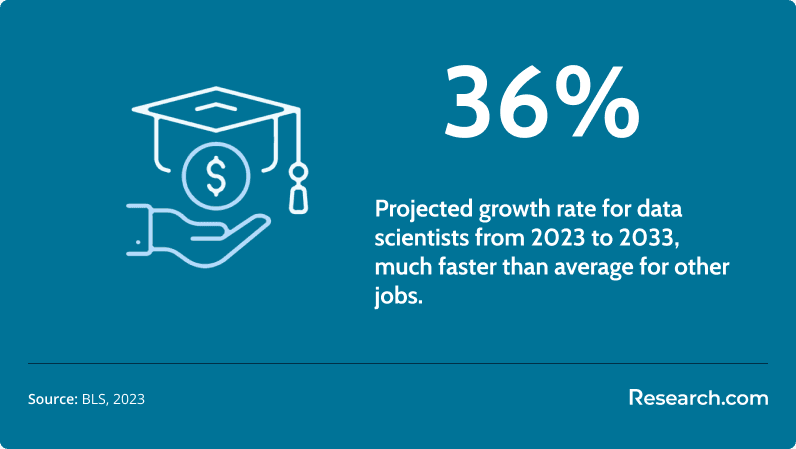
The job market for data analytics graduates remains strong, but it is also competitive. The U.S. Bureau of Labor Statistics projects that data analyst jobs will grow by 23% between 2022 and 2032. Demand comes from fields such as business intelligence, finance, healthcare, technology, retail, entertainment, insurance, and consulting.
Approximately 34% of data analysis job postings seek candidates with a master's degree, which shows that graduate education can matter for some roles. At the same time, advanced degrees do not guarantee employment. Employers increasingly evaluate candidates based on demonstrated skill, relevant projects, internships, domain knowledge, and the ability to communicate insights.
AI and machine learning are also reshaping analytics work. Some routine reporting tasks may be automated, while demand is growing for professionals who can validate models, interpret AI-assisted outputs, manage data quality, and connect analytics to business decisions. Students comparing graduate options may also review top ranked data analytics master's degree programs to identify programs with strong technical and applied training.
How can integrating cybersecurity enhance data analytics expertise?
Cybersecurity knowledge helps data professionals understand how sensitive information should be collected, stored, processed, and protected. This is especially important in industries that manage personal, financial, health, or proprietary business data.
Combining analytics with security can support work in fraud detection, risk modeling, anomaly detection, compliance analytics, and secure data governance. Students who want affordable ways to add this skill set can explore cheap cybersecurity degrees.
How can integrating artificial intelligence enhance your data analytics competencies?
Artificial intelligence can expand an analyst’s ability to automate workflows, improve predictive modeling, process unstructured data, and identify patterns that are difficult to detect with traditional methods alone. AI training is especially useful for students interested in machine learning, natural language processing, recommendation systems, or advanced decision support.
Students who want structured AI preparation can compare options such as the cheapest artificial intelligence degree programs, especially if they plan to move toward more technical analytics or data science roles.
How can complementing a data analytics degree with interdisciplinary studies boost career advancement?
Analytics professionals often become more valuable when they understand both data methods and a business, technical, or scientific domain. Interdisciplinary study can help students move beyond generic analysis and solve specialized problems in finance, healthcare, cybersecurity, operations, marketing, education, or public policy.
Additional study in AI can be particularly useful because employers increasingly seek professionals who understand automated decision-making and model-based systems. Students interested in this path can review online AI degrees.
How can integrating bioinformatics expand data analytics career prospects?
Bioinformatics combines data analytics with biology, healthcare, and life sciences. This can lead to work involving clinical datasets, genomics, biomedical research, precision medicine, and health-related predictive modeling.
Students interested in healthcare analytics or scientific data careers may benefit from adding bioinformatics coursework or credentials. Research.com’s guide to an online bioinformatics masters degree can help compare specialized options.
How can an associate degree in cybersecurity complement your data analytics skills?
An associate-level cybersecurity credential can add practical training in threat detection, incident response, risk management, and information security. For data analytics students, these skills can improve work involving sensitive datasets, compliance requirements, fraud analysis, and secure data operations.
Students seeking a shorter security-focused credential can review whether an associate in cyber security careers pathway fits their career goals, budget, and timeline.
Here’s What Graduates Have to Say about Online Master's Degree in Data Analytics
My online master’s in data analytics helped me move from marketing into data science. Because the program was flexible, I could keep working while applying new skills to real projects. I now lead data-focused initiatives at a Fortune 500 company. – Leif
The degree improved my technical confidence and opened more options in technology and finance. I worried that employers might undervalue an online program, but they paid more attention to my projects, skills, and experience. After graduation, I accepted a strong finance analytics role. – Mireille
Studying online connected me with classmates from several industries. Faculty guidance and collaborative projects helped me become a stronger problem-solver. I now work in healthcare analytics, where I use data to support better organizational decisions. – Alan
Key Insights
- Online master’s programs in data analytics are best for self-directed learners: The format works well for working adults, but students need strong time management and comfort with independent technical work.
- Completion time varies widely: Most programs take 12 to 36 months, with full-time students often finishing in 12 to 16 months and part-time students taking up to three years.
- Cost should be evaluated as total investment: Tuition ranges from $9,900 to over $65,000, but fees, software, materials, and lost work time can affect affordability.
- Accreditation matters: A reputable, accredited institution can affect employer perception, financial aid access, and future education options.
- Projects are critical for employability: Capstones, internships, and portfolio-ready assignments help prove skill in ways a transcript alone cannot.
- Career outcomes depend on specialization and skills: Business analytics, data science, AI, data engineering, and industry-specific analytics lead to different roles and skill expectations.
- Salary potential is strong but not guaranteed: Data scientists earned a median annual wage of $108,020 in May 2023, while data analyst and BI roles vary by industry, experience, and technical depth.
- The job market is promising but competitive: Data analyst jobs are projected to grow by 23% between 2022 and 2032, but candidates still need relevant tools, projects, and communication ability.
- AI, cloud, and cybersecurity are reshaping analytics work: Students should choose programs that teach modern workflows, responsible data use, and adaptable technical skills.
- The best program is the one that fits your goal: Use rankings as a starting point, then compare curriculum, flexibility, cost, accreditation, career support, and applied learning before applying.
References:
- Reyell, B. (2025, February 26). Data analyst salary guidance from Northeastern University Graduate Programs. https://graduate.northeastern.edu/knowledge-hub/how-much-do-data-analysts-make
- Southern New Hampshire University. Master’s in Data Analytics online. https://www.snhu.edu/online-degrees/masters/ms-in-data-analytics
- Tufts University. MS in Data Analytics program information. https://as.tufts.edu/dataanalytics/academics/masters-program/ms-data-analytics
- Eastern University. MS in Data Analytics program and tuition information. https://www.eastern.edu/academics/graduate-programs/ms-data-analytics
- Colorado State University Global. Online Master’s Degree in Data Analytics. https://csuglobal.edu/academic-programs/graduate-degrees/masters-degree-data-analytics
- U.S. Bureau of Labor Statistics. Data Scientists: Occupational Employment and Wages, May 2023. https://www.bls.gov/oes/current/oes152051.htm
- Coursera. Master of Data Science Salaries: 2025 Guide. https://www.coursera.org/articles/master-of-data-science-salary
- Franklin University. Data Analytics Salary with Masters Degree: What to Expect. https://www.franklin.edu/blog/data-analytics-mvp/masters-in-data-analytics-salary
- CareerFoundry. Data analyst salary information by industry. https://careerfoundry.com/en/blog/data-analytics/data-analyst-salaries-by-industry
- mastersindatascience.org. Guide to Data Analyst Salaries. https://www.mastersindatascience.org/careers/data-analyst/salary
- Rice University. Online vs. In-Person Master of Data Science. https://csweb.rice.edu/academics/graduate-programs/online-mds/blog/online-vs-in-person-master-of-data-science
- TechGuide. Online master’s in Data Analytics program information. https://techguide.org/analytics/online-masters-in-data-analytics
- Oregon State University Ecampus. Tuition and fees for online and distance degrees. https://ecampus.oregonstate.edu/online-degrees/tuition
- Western Governors University. Data Analytics – M.S. https://www.wgu.edu/online-it-degrees/data-analytics-masters-program.html
- UNC Online. Tuition and financial aid information. https://online.unc.edu/online-masters-programs/masters-data-science/admissions/tuition-financial-aid
- Coursera. University of Michigan Master of Applied Data Science tuition and financing. https://www.coursera.org/degrees/master-of-applied-data-science-umich/tuition-financing
- Pace University Online. Tuition and Financial Aid for MS in Data Science. https://online.pace.edu/graduate-programs/ms-in-data-science/tuition-and-financial-aid
- Georgia Tech Professional Education. Online Master of Science in Analytics. https://pe.gatech.edu/degrees/analytics
- Arizona State University Online. Online Master of Science in Program Evaluation and Data Analytics. https://asuonline.asu.edu/online-degree-programs/graduate/program-evaluation-and-data-analytics-ms
- Penn State World Campus. Data Analytics Master’s Degree Online. https://www.worldcampus.psu.edu/degrees-and-certificates/penn-state-online-data-analytics-masters-degree
- University of Maryland Global Campus. Online Master’s in Data Analytics. https://www.umgc.edu/online-degrees/masters/data-analytics
- Northwestern University School of Professional Studies. Master’s in Data Science Online. https://sps.northwestern.edu/masters/data-science
- Baker College. Data Analytics Degree Specializations. https://www.baker.edu/about/get-to-know-us/blog/data-analytics-degree-specializations
- Georgia Tech Professional Education. Factors to consider when choosing an online degree program. https://pe.gatech.edu/blog/working-learning/choosing-online-degree-program
- Indeed Editorial Team. How To Pick a Data Science Master’s Program in 5 Steps. https://www.indeed.com/career-advice/finding-a-job/how-to-pick-data-science-masters-program
- Syracuse University iSchool. Data Scientist vs. Data Analyst. https://ischool.syracuse.edu/data-scientist-vs-data-analyst
- U.S. Bureau of Labor Statistics. Data Scientists: Occupational Outlook Handbook. https://www.bls.gov/ooh/math/data-scientists.htm
- Mondo Staffing Agency. Data Analyst vs Data Scientist: Roles and Salaries. https://mondo.com/insights/data-analyst-vs-data-scientist-roles-and-salaries
- NMSU Global Campus. Is a Master’s in Data Analytics Worth It? https://global.nmsu.edu/blog/business-and-marketing/masters-data-analytics-path-to-data-driven-future
- CareerFoundry. Industries hiring data analysts. https://careerfoundry.com/en/blog/data-analytics/top-industries-hiring-data-professionals
- 365 Data Science. Data analyst job market research. https://365datascience.com/career-advice/the-data-analyst-job-market
- Business Insider. Advanced degrees and employment challenges. https://www.businessinsider.com/long-term-unemployment-job-search-advanced-degrees-mba-phd-ai-2025-2
- Financial Times. Consulting hiring and AI/data advisory demand. https://www.ft.com/content/c921dee7-6ecd-4a80-90f6-7cc4a5a4a988
Other Things You Should Know About Online Master's Degree in Data Analytics Programs
Top online master's degree programs in data analytics typically take 12 to 24 months to complete. However, the duration can vary based on whether you study part-time or full-time, and specific program structures or prerequisites may also affect this timeline.
Most programs expect college-level statistics, calculus, or linear algebra before enrollment. Many also require a minimum GPA of 3.0, and some ask for GRE scores if the applicant’s undergraduate preparation is weak. Conditional admission and prerequisite bridge courses are common at accredited universities.


