2027 How to Become a Data Architect

Co-Founder and Chief Data Scientist
Becoming a data architect is a long-term career move for professionals who want to design the systems that make organizational data usable, secure, and scalable. It is not usually a first job in technology. Most data architects build their credibility through database administration, data engineering, software development, analytics, or cloud data roles before they are trusted to make architecture-level decisions.
This guide explains what data architects do, what education and experience usually prepare you for the role, which technical skills matter most, how long the path can take, what certifications may help, and how to decide whether this career fits your strengths. It also covers salary considerations, market trends, emerging technologies, common mistakes, and practical steps for building a data architecture career in 2026.
Key Insights
- Data architecture is generally not an entry-level job. Plan to build several years of experience in databases, engineering, analytics, software, or cloud systems before pursuing architect-level roles.
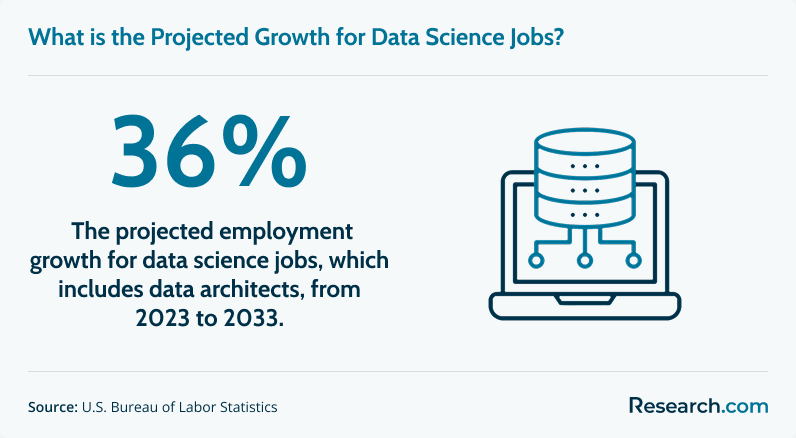
- The broader data science field is projected to grow 36% from 2023 to 2033, with an average of 20,800 annual job openings, making data architecture a promising path for experienced data professionals.
- A bachelor’s degree in computer science, data science, IT, MIS, engineering, mathematics, or statistics can provide a useful foundation; a master’s degree may help for senior or specialized roles but does not replace practical experience.
- The most important technical skills include SQL, relational and NoSQL databases, data modeling, ETL and ELT, data warehousing, data lakes, cloud platforms, big data tools, governance, and security.
- Average annual salary estimates for U.S. data architects generally fall in the $145,000 to $150,000 range, though compensation varies by location, industry, seniority, and specialized skills.
- Cloud migration, AI, machine learning, data governance, security, and real-time data needs are reshaping the role. Data architects who can design scalable and governed systems will be better positioned.
- Certifications can help, especially in AWS, Azure, GCP, data management, or enterprise architecture, but they should support a clear career plan rather than serve as a substitute for hands-on work.
- The best data architects combine technical depth with business understanding. Their value comes from designing systems that are reliable, secure, cost-aware, and genuinely useful to the organization.
Quick Answer: How Do You Become a Data Architect?
To become a data architect, you typically need a strong foundation in computer science or a related field, several years of hands-on experience with databases and data systems, advanced skills in data modeling, cloud platforms, data warehousing, governance, and integration, and the ability to translate business requirements into technical designs. A bachelor’s degree is commonly recommended, a master’s degree can strengthen senior-level prospects, and certifications in cloud data platforms or data management can help validate specialized expertise.
Key Things You Should Know About Becoming a Data Architect
- Data architecture is usually a mid- to senior-level career path. Employers generally expect proven experience in data engineering, database administration, analytics, software development, or a related IT role before hiring someone to design enterprise-level data systems.
- Technical depth matters, but business judgment is just as important. Data architects must understand why data is needed, who will use it, how it supports decisions, and what trade-offs exist between speed, cost, security, and flexibility.
- The field changes quickly. Cloud services, AI-ready infrastructure, data governance practices, and real-time data pipelines continue to reshape what employers expect from data architects.
- Cloud expertise is now central to many roles. Familiarity with AWS, Azure, and GCP data services can make a candidate more competitive, especially in organizations modernizing legacy systems.
- Communication is a core job skill. Data architects regularly explain complex designs to executives, engineers, analysts, compliance teams, and product leaders who may have very different priorities.
- What is a data architect?
- What does a data architect do?
- What are the steps to become a data architect in 2026?
- What degree should I get to become a data architect?
- What technical skills do data architects need?
- How long does it take to become a data architect?
- What is the career path for a data architect?
- What is the average salary of a data architect in the U.S.?
- How can interdisciplinary learning enhance a data architect's career?
- What job market trends are shaping data architecture?
- How can emerging technologies affect data architecture strategy?
- Is continuous professional development important for data architects?
- What are the best certifications for aspiring data architects?
- Should I invest in specialized education for data architecture?
- What challenges do data architects face?
- What networks and resources can accelerate a data architect career?
- How can interdisciplinary expertise improve data architecture strategies?
What is a data architect?
A data architect is a technology professional who designs the structure, standards, and systems an organization uses to collect, store, integrate, secure, govern, and use data. In practical terms, the data architect creates the blueprint that helps data move from raw sources into reliable databases, warehouses, lakes, dashboards, analytics tools, and AI or machine learning workflows.
The role sits between business strategy and technical execution. A data architect may not build every data pipeline personally, but they decide how data should be organized, which platforms are appropriate, how data quality will be protected, and how the architecture can scale as the organization grows.
The broader data science field, which includes data architects, is projected to grow 36% from 2023 to 2033, with an average of 20,800 annual job openings. That growth reflects how much organizations now depend on reliable data infrastructure for analytics, automation, reporting, compliance, and product development.
Data architecture is also associated with strong earning potential and is often discussed among the highest-paying computer science career paths. However, pay and advancement depend heavily on experience, industry, location, cloud skills, and the complexity of the systems a professional can design.
What does a data architect do?
A data architect designs the environment that makes data trustworthy, accessible, and useful. The work is part technical design, part governance, part collaboration, and part long-term planning. In many organizations, the data architect is the person who ensures that data systems do not become fragmented, insecure, expensive, or impossible to maintain.
Core Responsibilities of a Data Architect
- Design data models: Create conceptual, logical, and physical models that define how data entities relate to one another and how information should be structured.
- Plan databases, warehouses, and data lakes: Choose or design storage environments for operational data, analytics data, unstructured data, and large-scale processing.
- Guide data integration: Define how data will move across applications, platforms, pipelines, APIs, ETL processes, and ELT workflows.
- Support data governance: Establish standards for data ownership, quality, definitions, lineage, access, retention, and compliance.
- Strengthen data security: Work with security and compliance teams to protect sensitive data and reduce exposure to privacy or regulatory risks.
- Select architecture technologies: Evaluate databases, cloud services, big data platforms, integration tools, and data catalog or governance solutions.
- Improve performance and scalability: Help ensure that systems can handle expected query loads, storage requirements, processing needs, and future growth.
- Collaborate across teams: Work with data engineers, analysts, data scientists, software developers, product managers, executives, and business stakeholders.
- Align systems with business goals: Translate business questions and operational needs into durable, realistic, and cost-aware technical designs.
Data Architect vs. Related Data Roles
| Role | Main Focus | How It Differs From Data Architecture |
| Data architect | Designs the overall structure, standards, and strategy for data systems | Owns the blueprint and long-term design decisions across platforms and teams |
| Data engineer | Builds and maintains data pipelines and processing systems | Usually implements many of the systems the data architect designs |
| Database administrator | Manages database performance, access, backups, and reliability | Focuses more on operational database health than enterprise-wide architecture strategy |
| Data analyst | Uses data to answer business questions and produce reports | Depends on well-designed data systems but is less focused on infrastructure design |
| Business intelligence analyst | Creates dashboards, metrics, and reporting tools for decision-makers | Works closer to reporting and business interpretation than system architecture |
The following chart highlights high-earning career paths in big data and shows how compensation can differ across specializations.
What are the steps to become a data architect?
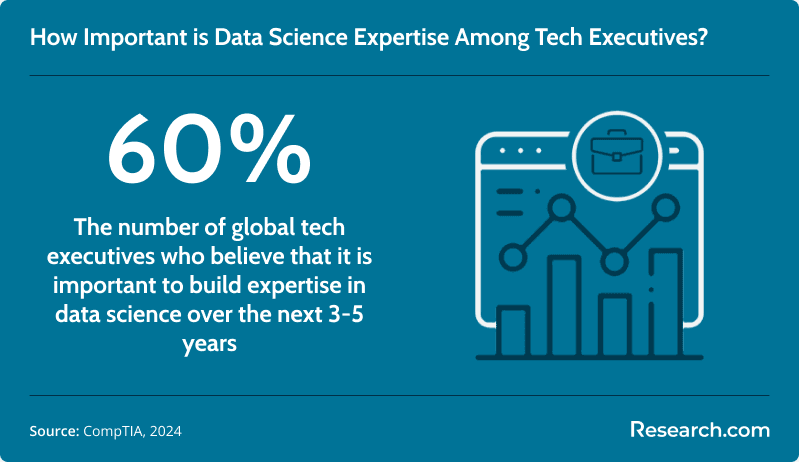
Becoming a data architect requires a deliberate progression from fundamentals to real-world systems experience. It is not enough to know tools in isolation. Employers want people who can make architecture decisions that are technically sound, financially realistic, secure, and aligned with business needs. As one indicator of demand, 60% of global tech executives believe building data architecture expertise will be important over the next three to five years.
Step 1: Build a strong technical education base
Start with formal study in computer science, data science, information technology, management information systems, engineering, mathematics, statistics, or another technical field. A bachelor’s degree is a common foundation because it introduces programming, database concepts, algorithms, systems analysis, and software design. A master’s degree can be useful later if you are aiming for senior architecture, strategy, or leadership roles.
Step 2: Learn databases and SQL deeply
Data architects must understand how data is stored, queried, indexed, secured, normalized, modeled, replicated, and optimized. SQL remains essential, but modern architecture also requires familiarity with NoSQL systems and distributed storage.
Step 3: Gain experience in a related role
Most professionals move into data architecture after building practical experience as a database administrator, data engineer, data analyst, software developer, cloud engineer, or BI professional. These roles teach how data systems behave under real workloads, how business users consume data, and where poor architecture creates downstream problems.
Step 4: Develop data modeling and integration skills
Learn how to create conceptual, logical, and physical data models. Practice designing systems that handle source data, transformations, governance rules, analytics requirements, and performance constraints. You should also understand ETL, ELT, streaming, APIs, batch processing, and metadata management.
Step 5: Build cloud and big data expertise
Modern employers often expect knowledge of AWS, Azure, or GCP, along with cloud storage, managed databases, data warehouses, data lakes, and large-scale processing frameworks. Big data tools such as Hadoop, Spark, and streaming technologies may also be relevant depending on the organization.
Step 6: Create a portfolio of architecture work
Even if your job title is not yet “data architect,” you can document projects that show architecture thinking. Useful portfolio examples include a normalized relational database design, a warehouse schema, a cloud data lake plan, a sample data governance framework, or an end-to-end pipeline architecture diagram.
Step 7: Use certifications strategically
Certifications can help prove competence in a platform or discipline, especially when paired with professional experience. Cloud data certifications, data management credentials, and enterprise architecture certifications can all strengthen your profile.
Step 8: Practice stakeholder communication
A data architect must explain trade-offs clearly. For example, business leaders may want speed, analysts may want flexibility, security teams may want tighter controls, and engineers may want maintainability. Your value increases when you can help these groups reach practical architecture decisions.
| Career Stage | What to Focus On | Evidence Employers Look For |
| Early preparation | Programming, SQL, systems fundamentals, statistics, and database concepts | Degree coursework, projects, internships, and technical labs |
| First data or IT role | Hands-on experience with databases, reporting, pipelines, or software systems | Production experience, troubleshooting examples, and measurable project contributions |
| Mid-career specialization | Cloud platforms, data modeling, governance, warehousing, and integration | Architecture diagrams, platform certifications, and cross-functional project work |
| Architecture transition | Enterprise design, stakeholder management, cost trade-offs, and data strategy | Leadership in design decisions, standards, and scalable data solutions |
What degree should I get to become a data architect?
The best degree for a future data architect is one that develops strong computing, database, systems, and analytical skills. Because 60% of global tech executives emphasize the need to build data architecture expertise within the next three to five years, students should prioritize programs that go beyond basic analytics and include database systems, programming, cloud computing, software engineering, and data management.
Best Degree Options for Aspiring Data Architects
| Degree Field | Why It Fits Data Architecture | Best For |
| Computer science | Covers programming, algorithms, database systems, software design, and systems thinking | Students who want the strongest technical foundation for architecture roles |
| Data science | Builds skills in data modeling, analysis, statistics, machine learning, and data management | Students interested in architecture that supports analytics and AI use cases |
| Information technology or MIS | Connects systems, infrastructure, business processes, and data management | Students who want a broader business-technology pathway |
| Mathematics, statistics, or engineering | Develops analytical reasoning, quantitative thinking, and problem-solving discipline | Students who plan to add programming, databases, and cloud skills through electives or certifications |
A computer science degree is one of the most versatile options because it supports both software and data infrastructure careers. If speed is a major concern, you may want to compare accelerated options such as the fastest computer science degree programs.
Who should consider a master’s degree?
A master’s degree may make sense if you want to move into senior architecture, data strategy, AI infrastructure, research-heavy roles, or leadership. It may also help if your bachelor’s degree is not technical and you need a structured way to build deeper computing and data management expertise. However, a graduate degree does not replace hands-on system experience.
What technical skills do data architects need?
Data architects need a wide technical skill set because their decisions affect storage, pipelines, analytics, security, governance, performance, cost, and long-term maintainability. The strongest candidates understand both specific tools and the architecture principles behind them.
Database management systems
- Relational databases: SQL proficiency is essential for designing, querying, and managing systems such as MySQL, PostgreSQL, Oracle, and SQL Server.
- NoSQL databases: Knowledge of systems such as MongoDB, Cassandra, and Redis helps architects choose appropriate solutions for semi-structured, unstructured, distributed, or high-volume data.
Data warehousing and data lakes
- Warehousing concepts: Data architects should understand dimensional modeling, star schemas, snowflake schemas, OLAP, and analytics-ready data structures.
- Data lake architecture: Modern data environments often require ingestion, storage, cataloging, governance, and processing strategies for large and varied datasets.
- ETL and ELT: Architects need to know when data should be transformed before loading, when transformation can happen inside the target platform, and how pipeline design affects performance and governance.
Cloud computing
- Major cloud platforms: Familiarity with AWS, Azure, or GCP is increasingly important for cloud-based data architecture.
- Cloud data services: Architects should understand services such as AWS S3, Azure Data Lake Storage, Google Cloud Storage, Amazon Redshift, Azure Synapse Analytics, and Google BigQuery.
Big data and distributed processing
- Hadoop ecosystem: Understanding HDFS, MapReduce, and YARN can be useful in organizations that maintain large-scale distributed data systems.
- Apache Spark: Spark knowledge supports large-scale data processing and analytics workloads.
- Streaming data: Tools such as Apache Kafka matter when organizations require real-time or near-real-time data movement.
Data modeling
- Conceptual, logical, and physical models: Data architects must be able to represent business concepts, define relationships, and translate designs into database structures.
- Modeling tools: Experience with ERwin or similar tools can help document, communicate, and maintain architecture designs.
Governance, security, and compliance
- Data quality: Architects help define rules for consistency, accuracy, completeness, and usability.
- Access control: Security design should account for sensitive data, role-based permissions, auditing, and regulatory requirements.
- Metadata and lineage: Organizations increasingly need to know where data came from, how it changed, and who uses it.
Technical vs. analytical careers in data
Data architecture is more infrastructure-focused than many analytics roles. A data architect designs the systems that make analysis possible, while analysts and marketing analysts usually focus on interpreting data and applying insights to decisions. If you prefer campaigns, customer behavior, market performance, and business recommendations over system design, reviewing the requirements to become a marketing analyst may help you compare a more business-facing path.
Common mistakes when building data architect skills
- Learning tools without architecture principles: Knowing one platform is useful, but architects must understand trade-offs across platforms.
- Ignoring business context: A technically elegant system can still fail if it does not solve the organization’s actual data problems.
- Skipping governance: Data quality, security, lineage, and ownership are not optional in enterprise systems.
- Assuming cloud knowledge is enough: Cloud services matter, but database fundamentals, modeling, integration, and communication remain essential.
- Underestimating documentation: Architecture decisions must be documented so teams can maintain and improve systems over time.
How long does it take to become a data architect?
The path usually takes several years because data architecture depends on both education and applied judgment. A typical starting point is a bachelor’s degree, often completed in approximately four years. A master’s degree may add another two years. Some professionals explore options such as an affordable online master’s in computer science when they want advanced training without leaving the workforce.
After formal education, many professionals spend three to five years, or more, in related roles such as database administration, data engineering, data analysis, or software development before moving into data architecture. The exact timeline depends on prior experience, the complexity of projects you handle, your cloud and data modeling skills, and the expectations of employers in your target industry.
Certifications and targeted training may help accelerate progression when they match market needs. For example, acquiring in-demand skills and certifications can support career movement, but credentials are most valuable when they reinforce real project experience.
| Milestone | Typical Timeframe Mentioned | What You Should Be Able to Do |
| Bachelor’s degree | Approximately four years | Understand programming, databases, systems, and core computing concepts |
| Optional master’s degree | Another two years | Develop advanced knowledge in computer science, data science, analytics, or related areas |
| Related IT or data experience | Three to five years, or more | Work with production data systems, pipelines, databases, analytics platforms, or software systems |
| Architecture readiness | Varies by role and employer | Design scalable data solutions, communicate trade-offs, and align systems with business requirements |
What is the career path for a data architect?
Data architects usually advance through a sequence of technical and data-focused roles. In 2023, there were approximately 2.8 million job postings for tech occupations, showing broad opportunity across the technology workforce. At the same time, a large market can also mean strong competition, so career planning matters.
Foundational roles
- Database administrator: Builds experience in database operations, performance tuning, backup strategies, access control, and data integrity.
- Data engineer: Develops the pipeline, warehousing, integration, and cloud data skills that directly support architecture work.
- Data analyst: Provides experience with business questions, reporting needs, metrics, and how end users consume data.
- Software developer: Strengthens programming, systems design, APIs, application architecture, and software lifecycle knowledge.
Architecture roles
- Junior data architect: Supports senior architects by documenting models, reviewing requirements, assisting with platform decisions, and helping implement architecture standards.
- Data architect: Designs data structures, integration patterns, governance approaches, and technical blueprints that support business and analytics needs.
- Senior data architect: Leads complex initiatives, advises multiple teams, mentors less experienced professionals, and shapes enterprise data strategy.
Leadership roles
- Lead data architect: Guides architecture teams and coordinates standards across major systems or business units.
- Enterprise architect: Aligns data architecture with broader IT infrastructure, applications, security, and business strategy.
- Chief data officer: Oversees the organization’s data strategy, governance, analytics direction, and data value creation.
The skill base developed on this path can also support other data careers. For example, there is overlap with business intelligence analyst career requirements, especially in data management, integration, stakeholder communication, and aligning technical solutions with business goals.
The chart below provides a snapshot of employment across major technology job categories and helps show where the tech workforce is concentrated.
What is the average salary of a data architect in the U.S.?
Salary aggregators such as LinkedIn and similar sources generally place the average annual salary for a data architect in the U.S. in the range of $145,000 to $150,000. Some sources report higher averages, and individual compensation can vary widely.
Data architect pay depends on several factors:
- Location: Markets with higher costs of living and large technology ecosystems, such as San Francisco and New York City, often offer higher compensation.
- Experience: Senior data architects with enterprise-scale project experience and leadership responsibilities usually command higher salaries.
- Technical specialization: Cloud computing, big data, governance, and security skills can improve marketability. Some professionals compare certifications that pay well when planning upskilling investments.
- Industry: Finance, technology, and other data-intensive sectors may pay more because architecture decisions directly affect risk, operations, analytics, and revenue.
Professionals who want to move into senior data roles sometimes consider online data analytics master’s degree programs to deepen their analytical and strategic capabilities. A graduate degree can be useful, but it should be evaluated alongside cost, time, employer expectations, and the practical experience you already have.
How can interdisciplinary learning enhance a data architect's career?
Interdisciplinary learning can make data architects better at designing systems people can actually use. Fields such as visual design, human-computer interaction, product strategy, and domain-specific analytics can improve how architects think about data usability, visualization, workflows, and stakeholder adoption.
This does not mean every data architect needs a design degree. It means that exposure to other disciplines can sharpen problem-solving and communication. For example, learning how interactive systems are designed in fields such as online game development degree programs may help some professionals think more creatively about user behavior, interface logic, and complex system interactions.
For data architects working with nontechnical stakeholders, interdisciplinary knowledge can also make it easier to explain architecture choices, design intuitive data products, and build systems that support real decisions rather than isolated technical goals.
What job market trends are shaping data architecture?
Demand for data architects is being shaped by the growth, complexity, and strategic value of organizational data. Companies need professionals who can modernize legacy environments, support analytics and AI initiatives, improve governance, reduce risk, and manage the shift toward cloud-based data infrastructure.
Cloud migration remains a major driver. Organizations moving data infrastructure to AWS, Azure, or GCP need architects who understand cloud storage, cloud-native data warehouses, data lakes, networking, security, cost controls, and integration patterns. Students comparing advanced study options may also look at affordable pathways such as the cheapest online data science master’s programs.
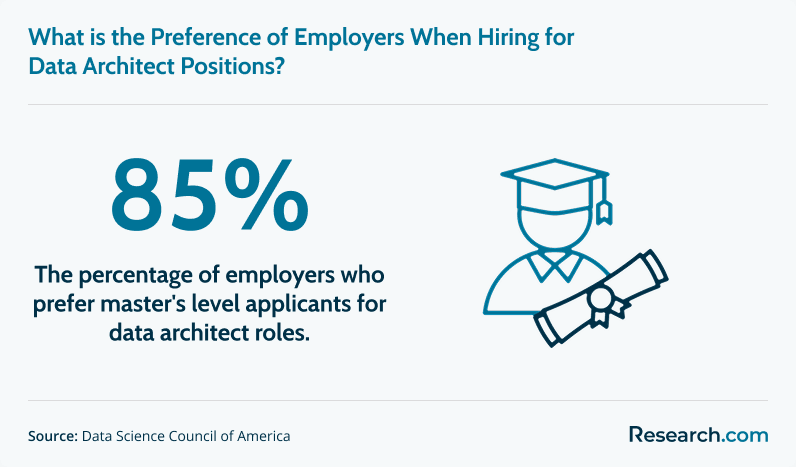
Employers are also placing more emphasis on data governance, privacy, security, and business fluency. Increasingly, employers are looking for master’s-level applicants, as reflected by 85% of tech executives. At the same time, AI and machine learning are raising expectations for data architectures that can deliver clean, accessible, well-labeled, and well-governed data to advanced models.
Trends to watch in 2026
- AI-ready data infrastructure: Organizations need architecture that supports model development, monitoring, governance, and reliable data access.
- Cloud cost discipline: Cloud flexibility can become expensive without careful storage, processing, and workload design.
- Stronger governance expectations: Data quality, lineage, access control, and regulatory readiness are becoming more central to architecture decisions.
- Real-time and streaming needs: More organizations want faster insight, requiring architectures that support event-driven and near-real-time data flows.
- Hybrid and legacy modernization: Many companies must connect older systems with cloud platforms rather than replacing everything at once.
How can emerging technologies affect data architecture strategy?
Artificial intelligence, machine learning, and the Internet of Things are changing the way organizations think about data architecture. Traditional reporting systems are no longer enough for many businesses. They now need architectures that can support predictive analytics, automated decision workflows, model training, real-time monitoring, and large volumes of machine-generated data.
These shifts place more pressure on data architects to design flexible, scalable, and secure systems. An architecture that works for periodic reporting may not be sufficient for AI pipelines, streaming data, or high-frequency sensor data. Architects must also consider data quality, metadata, lineage, model governance, privacy, and operational risk.
Professionals who want to connect data architecture with AI strategy may consider targeted education such as the cheapest online master’s in artificial intelligence programs. The key is to choose education that strengthens your ability to design responsible, maintainable, and business-relevant systems rather than chasing trends without a clear career purpose.
Is continuous professional development important for data architects?
Continuous learning is essential in data architecture because platforms, employer expectations, security practices, and governance standards evolve quickly. A data architect who stops learning may struggle to evaluate new tools, modernize aging systems, or guide teams through cloud and AI-related changes.
Professional development can include advanced coursework, short technical programs, vendor certifications, architecture communities, conference sessions, documentation practice, and hands-on labs. Some professionals also use broader technology programs, such as an accelerated online bachelor’s in information technology degree, to strengthen practical systems knowledge.
The best learning plan is not random. It should be tied to the systems you work with, the roles you want next, and the gaps employers repeatedly mention in job descriptions.
What are the best certifications for aspiring data architects?
Certifications can help aspiring data architects show platform knowledge, data management discipline, and commitment to professional growth. They are most useful when they align with your target roles and are backed by hands-on experience. A certification alone is unlikely to qualify someone for a data architect role, but it can strengthen a resume, especially in cloud-heavy environments.
Graduate education is another option. Some professionals compare an online master’s in computer science with certifications when deciding how to advance. The right choice depends on your current experience, budget, time, and career target.
Cloud platform certifications
- AWS Certified Data Analytics - Specialty: Validates knowledge of AWS data analytics services and can be useful for professionals working in AWS environments.
- Microsoft Certified: Azure Data Engineer Associate: Demonstrates ability with Azure data engineering tasks such as integration, transformation, and data platform implementation.
- Google Professional Data Engineer Certification: Confirms capability in designing and building data processing systems on Google Cloud Platform.
Data architecture and data management certifications
- Certified Data Management Professional: Offered by DAMA International, this credential covers broad data management principles and is recognized globally.
- TOGAF 9 Certification: The Open Group Architecture Framework credential can support professionals who want to connect data architecture with enterprise architecture practices.
How to choose a certification
| If Your Goal Is... | Consider Certifications In... | Why It Helps |
| Cloud data architecture | AWS, Azure, or Google Cloud data credentials | Shows familiarity with managed data services and cloud-native design patterns |
| Enterprise data management | Certified Data Management Professional | Strengthens knowledge of governance, quality, metadata, and data management standards |
| Enterprise architecture leadership | TOGAF 9 Certification | Supports broader architecture strategy and alignment with organizational goals |
| Analytics leadership | Graduate data analytics education | Can deepen understanding of how data architecture supports insight and decision-making |
If you want a broader academic route into advanced data roles, the best master’s degree programs for data analysis careers may help you compare programs that connect technical data work with business decision-making.
Should I invest in specialized education for data architecture?
Specialized education can be worthwhile if it clearly supports the industry, systems, or leadership path you want. Data architects in healthcare, finance, manufacturing, government, and AI-driven organizations may need domain knowledge beyond general database and cloud skills.
For example, healthcare data environments require attention to privacy, interoperability, compliance, clinical workflows, and secure information exchange. A health informatics master’s degree online may be relevant for professionals who want to design data systems in healthcare settings.
When specialized education makes sense
- You are targeting a regulated industry where domain expertise affects architecture decisions.
- You already have technical experience but need stronger strategic or leadership preparation.
- Your employer values advanced credentials for senior data or architecture roles.
- The program includes practical work in databases, governance, analytics, cloud systems, or domain-specific data standards.
When a different option may be better
- You still lack basic programming, SQL, or database experience.
- The program is expensive but does not match your target job descriptions.
- You need hands-on cloud or engineering experience more than another credential.
- You have not checked accreditation, transfer policies, employer tuition support, or total program cost.
What do professionals say about becoming a data architect?
Anecdotal experiences can be useful, but they should not be treated as guaranteed outcomes. The following perspectives reflect common themes professionals mention: strategic impact, technical variety, and career growth.
- Transitioning into data architecture gave me the chance to work on complex systems that directly influence business strategy. The compensation growth also helped me reach personal financial goals. Sandra
- The role stays interesting because the work changes constantly. One project may involve cloud migration, while another may focus on big data or governance. I also enjoy collaborating with different teams. Daniel
- Moving from software development into data architecture let me keep using my technical background while gaining a wider view of how businesses operate. Designing a solution that finally works at scale is deeply satisfying. Emily
What challenges do data architects face?
Data architects often work in environments where technical, financial, security, and business priorities compete. The job can be rewarding, but it requires patience, negotiation, and careful design judgment.
Common challenges
- Legacy systems: Older databases and applications may be difficult to integrate with modern cloud or analytics platforms.
- Data silos: Business units may store data differently, define metrics inconsistently, or resist shared governance.
- Security and compliance pressure: Architects must design systems that protect sensitive information while still making data usable.
- Cloud complexity: Cloud platforms offer flexibility, but poor design can increase costs, create duplication, or introduce risk.
- Changing requirements: Business needs, analytics priorities, regulations, and technology standards can shift during long projects.
- Stakeholder alignment: Executives, engineers, analysts, and compliance teams may define success differently.
If you are pursuing additional education to handle more advanced responsibilities, compare program cost, speed, and relevance carefully. Some professionals exploring accelerated graduate options review resources such as the quickest cheapest master’s degree programs, but the fastest option is not always the best fit for a technical architecture career.
What professional networks and resources can accelerate my career as a data architect?
Professional networks can help you learn architecture patterns, evaluate tools, find mentors, and understand how employers define senior-level data roles. Because data architecture decisions vary by industry, networking can also expose you to domain-specific constraints you may not encounter in your current job.
Useful career-building activities
- Join data management, cloud architecture, analytics, and enterprise architecture communities.
- Attend conferences, webinars, and vendor technical sessions focused on data platforms and governance.
- Follow technical blogs and documentation from major database, cloud, and data engineering providers.
- Find mentors who have moved from engineering, DBA, analytics, or software roles into architecture.
- Study architecture case studies, postmortems, and migration stories to understand real trade-offs.
- Build cross-industry awareness by exploring specialized fields such as careers for master’s in health informatics, where data integration, privacy, and governance are central concerns.
How can interdisciplinary expertise improve data architecture strategies?
Data architects often design systems for specialized business problems. Interdisciplinary expertise can help them understand the data’s meaning, not just its structure. This is especially important in fields such as healthcare, biotechnology, finance, education, and AI ethics, where poor assumptions about data can lead to misleading outputs or operational risk.
For example, learning about bioinformatics career options can show how specialized datasets require careful structuring, interpretation, metadata, privacy considerations, and analytical workflows. That kind of domain awareness can make architecture decisions more realistic and valuable.
The broader lesson is simple: strong data architects combine technical architecture, business understanding, governance discipline, and enough domain knowledge to design systems that fit the real use case.
How to Decide Whether Data Architecture Is Right for You
Data architecture can be a strong fit if you enjoy designing systems, solving complex technical problems, working across teams, and thinking several steps ahead. It may be less appealing if you prefer short-term tasks, individual contributor work with little stakeholder interaction, or roles focused mostly on dashboarding or analysis.
| Choose Data Architecture If... | Consider Another Path If... |
| You enjoy designing scalable systems and setting technical standards | You mainly want to analyze data and present insights |
| You are comfortable balancing security, cost, performance, and usability | You prefer work with fewer cross-functional negotiations |
| You want a senior technical career that connects business and engineering | You want an entry-level data role you can enter quickly with limited experience |
| You like databases, cloud platforms, modeling, pipelines, and governance | You prefer marketing, product, research, or visualization-heavy data work |
Questions to Ask Before Choosing a Degree, Certification, or Training Program
- Does the program teach databases, SQL, data modeling, cloud data platforms, data engineering, and governance?
- Is the institution or provider appropriately accredited or recognized by employers in your field?
- Does the curriculum include hands-on projects that can become portfolio evidence?
- Will the credential help with your next role, or is it aimed at a job you are not ready for yet?
- How much will the full program cost, including fees, materials, exams, and time away from work?
- Can you transfer credits, use employer tuition support, or study part time?
- Do job postings in your target market actually request the skills or certifications the program teaches?
- Will the program strengthen your weakest area: technical fundamentals, cloud tools, architecture strategy, governance, or industry knowledge?
References
- Bureau of Labor Statistics. Data scientists. U.S. Department of Labor.
- CompTIA. State of the tech workforce.
- CompTIA. Your next move: Data architect.
- Heidrick & Struggles. 2024 data analytics and artificial intelligence executive organization compensation survey.
- Northeastern University Graduate Programs. Data science careers shaping our future.
- Northeastern University Graduate Programs. Highest paying big data careers.
Other Things You Should Know About Becoming a Data Architect
Beneficial certifications for data architects in 2027 include AWS Certified Solutions Architect, Microsoft Certified: Azure Solutions Architect Expert, and Google Professional Cloud Architect. These enhance your cloud computing skills, vital for data architecture roles as businesses increasingly rely on cloud solutions.
In 2027, a software developer transitioning to a data architect should focus on enhancing skills in database management, cloud computing, data modeling, and understanding big data technologies. Familiarity with data governance and having strong communication skills is also essential to align data architecture with business needs.