
2027 How To Become A Cybersecurity Analyst

Co-Founder and Chief Data Scientist
Becoming a cybersecurity analyst is one of the most practical entry points into cybersecurity, but the path is not always obvious. Some employers expect a bachelor’s degree, others care more about hands-on IT experience, and many job descriptions list certifications that can be confusing for beginners. At the same time, CyberSeek’s 2025 data shows 1.25 million individuals employed in the cybersecurity workforce, which reflects how large and essential this field has become.
This guide explains how to become a cybersecurity analyst for 2027, including the education routes, certifications, skills, salary expectations, job outlook, specializations, remote work options, and common mistakes to avoid. It is designed for students, IT professionals, career changers, and anyone deciding whether cybersecurity analysis is a realistic and worthwhile career move.
Quick Answer: How Do You Become a Cybersecurity Analyst for 2027?
The most common path is to build a foundation in information technology, earn a relevant degree or equivalent training, gain hands-on experience, add industry-recognized certifications, and apply for entry-level security analyst or security operations center roles. A bachelor’s degree in cybersecurity, computer science, information technology, or a related field is often preferred, but practical skills, internships, certifications, and technical portfolios can also help candidates enter the field.
| Decision Point | What Aspiring Cybersecurity Analysts Should Know |
| Typical education | Many roles prefer at least a bachelor’s degree in cybersecurity, computer science, information technology, or a closely related area. |
| Alternative entry route | IT support, networking, systems administration, internships, labs, and certifications can help career changers build credibility. |
| Useful first certification | CompTIA Security+ is often used as a starting credential because it covers core security concepts. |
| Salary snapshot | Glassdoor reports an average U.S. cyber security analyst salary of $102,783 per year, excluding bonuses, profit sharing, commissions, and tips. |
| Workforce demand | CyberSeek shows 457,398 cybersecurity job openings in 2025, although hiring conditions vary by employer, location, and skill level. |
| Best preparation strategy | Combine technical training, problem-solving practice, cloud security knowledge, communication skills, and real-world projects. |
Key Things to Know About Becoming a Cybersecurity Analyst for 2027
- Cybersecurity can lead to multiple career directions. Analyst experience can support advancement into roles such as security architect, incident response manager, penetration tester, threat intelligence analyst, security engineer, or chief information security officer (CISO).
- Pay can be competitive, but it is not automatic. Cybersecurity analysts are often associated with strong earning potential, with salary figures reported around $103,000 annually. Actual compensation depends on location, employer, experience, certifications, industry, and specialization.
- Online programs can work well for working adults. A cybersecurity analyst degree online may allow students to study while keeping a job or managing family responsibilities. Strong programs often include virtual labs, career support, and preparation for industry certifications.
- What are the steps to becoming a cybersecurity analyst?
- What degree do you need to become a cybersecurity analyst for 2027?
- Which certifications are best for aspiring cybersecurity analysts?
- What skills are essential for a cybersecurity analyst?
- How can students gain cybersecurity experience while in school?
- How much do cybersecurity analysts earn?
- What is the job outlook for cybersecurity analysts?
- Does location impact cybersecurity analyst compensation?
- Can data science expertise unlock new opportunities in cybersecurity?
- How can an accelerated degree program boost cybersecurity career prospects?
- How can complementary computer science skills boost cybersecurity careers?
- Can online cybersecurity degree programs accelerate career growth?
- How can continuous education boost cybersecurity career success?
- What are the best specializations for advancing in cybersecurity?
- Can cross-disciplinary technical expertise boost cybersecurity innovation?
- Do cybersecurity analysts work remotely or on-site?
- What are the biggest challenges in cybersecurity today?
- Can unconventional degrees enhance cybersecurity career growth?
- Can mentorship and networking accelerate cybersecurity career growth?
- How is artificial intelligence transforming cybersecurity roles?
- Can a health informatics online program boost cybersecurity analysis?
- Key insights and references
What are the steps to becoming a cybersecurity analyst?
A cybersecurity analyst monitors systems, investigates suspicious activity, helps prevent attacks, and supports incident response when a breach or vulnerability appears. The role overlaps with security operations, network defense, compliance, risk management, and technical troubleshooting. Some professionals eventually move into consulting, including roles similar to a cyber security consultant, while others stay in security operations or specialize in areas such as forensics, cloud security, or threat intelligence.
The best path depends on your starting point. A student with no IT background may need formal coursework and labs, while an experienced help desk or network administrator may be able to transition through certifications and security projects.
- Build a technical foundation. Learn networking, operating systems, security fundamentals, cloud basics, and common attack methods. A degree can help, but structured nondegree training, labs, and IT experience can also build the foundation employers expect.
- Choose an education route that fits your timeline. Some learners pursue a full bachelor’s degree, while others compare certificates, associate programs, or the fastest online cyber security degree programs to shorten the time to career readiness.
- Get practical IT or security experience. Entry-level IT support, network administration, systems administration, internships, and security operations center support roles can all provide experience that transfers into cybersecurity analysis.
- Earn certifications strategically. Start with credentials that match your current level. Foundational certifications can validate core knowledge, while advanced certifications are more useful after you have experience.
- Practice with real tools. Work with firewalls, SIEM platforms, vulnerability scanners, Linux command-line tools, packet analysis, cloud security dashboards, and scripting languages.
- Create evidence of your skills. Build a portfolio using labs, capture the flag writeups, home network projects, open-source contributions, or documented incident-response exercises.
- Network with the cybersecurity community. Join student groups, local meetups, security forums, professional associations, webinars, and conferences. Many entry-level opportunities are easier to find through informed referrals.
- Apply with targeted materials. Customize your resume for each role. Emphasize specific tools, projects, certifications, internship work, troubleshooting experience, and your ability to communicate risk clearly.
Career changers do not always need to start over. A finance professional may already understand compliance, risk, fraud, and regulated systems. A healthcare worker may understand privacy requirements and sensitive data workflows. Even graduates from one of the easiest majors in college can transition if they add technical training, certifications, and credible project experience.
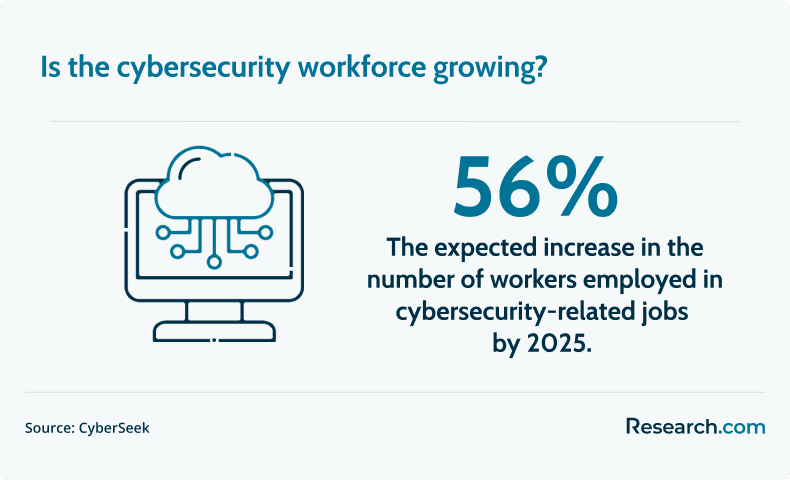
CyberSeek’s historical data indicates that the estimated number of workers employed in cybersecurity-related jobs since 2010 is expected to increase by 56% by 2025. That growth does not mean every applicant will be hired quickly, but it does show why well-prepared candidates with relevant skills can find opportunities across many industries.
| Starting Point | Best Next Move | Why It Helps |
| High school student or college beginner | Study networking, programming basics, cybersecurity fundamentals, and participate in clubs or competitions. | Early hands-on practice helps you compete for internships and entry-level roles. |
| Current IT support professional | Add security certifications, SIEM practice, vulnerability management experience, and incident-response projects. | IT troubleshooting experience is highly transferable to security operations. |
| Career changer from a nontechnical field | Identify transferable skills, complete structured technical training, and build a project portfolio. | Employers need proof that you can work with systems, tools, and security workflows. |
| Working adult with limited time | Compare online, part-time, and accelerated cybersecurity or IT programs. | Flexible formats can make career preparation more manageable. |
What degree do you need to become a cybersecurity analyst for 2027?
Many cybersecurity analyst job postings prefer candidates with a bachelor’s degree in cybersecurity, computer science, information technology, computer and information systems security, information assurance, or a related field. However, the degree requirement is not identical across employers. Some organizations prioritize experience and certifications, especially for candidates who already have strong IT backgrounds.
- Bachelor’s degree: This is the most common academic expectation for analyst roles. Coursework often covers networks, operating systems, programming, databases, risk management, digital forensics, and information security. Students who need a shorter route may compare online accelerated bachelor's degree options.
- Master’s degree: A graduate degree can support advancement into leadership, architecture, governance, research, or specialized technical roles. Even one of the easiest masters degree to get online may help if the curriculum includes the right cybersecurity, systems, data, or security management coursework.
- Associate degree or certificate: These can help beginners enter IT support, junior security, or technical support roles. Some learners use fast-track options to earn a degree online in 6 months, but short programs should be evaluated carefully for rigor, transferability, and employer recognition.
- Specialized cybersecurity programs: Degrees focused on cybersecurity, information assurance, penetration testing, incident response, hacking countermeasures, and digital forensics may align closely with analyst responsibilities.
How to Choose the Right Cybersecurity Degree
The right degree is the one that matches your target role, current experience, budget, learning style, and time constraints. Before enrolling, compare the curriculum against job descriptions for roles you want. Look for required labs, cloud security content, networking depth, scripting opportunities, internship support, and preparation for industry certifications.
Academic credentials can matter more as professionals move into advanced roles. The 2024 Cybersecurity Workforce Study from the International Information System Security Certification Consortium (ISC2) found that 96% of respondents believe their postbaccalaureate degree in cybersecurity or a related field was valuable in their career growth, while 95% said the same about their advanced degree in cybersecurity or a related field.
National Center for Education Statistics (NCES) degree data for AY 2023-2024 was not yet available when this guide was prepared. The most current figures located were for AY 2021-2022. In the field classified as computer and information systems security/auditing/information assurance, NCES reported the following degrees conferred:
- Bachelor’s - 7,131 degrees conferred
- Master’s - 6,566 degrees conferred
- Doctorate - 118 degrees conferred
| Education Option | Best For | Main Trade-Off |
| Cybersecurity bachelor’s degree | Students who want a direct academic route into security roles. | Can require more time and cost than certificate-based pathways. |
| Computer science degree | Learners who want broader software, systems, and algorithmic training. | May require extra cybersecurity electives, labs, or certifications. |
| Information technology degree | Students focused on networks, systems, support, cloud, and infrastructure. | Cybersecurity depth varies widely by program. |
| Associate degree or short credential | Beginners seeking a faster entry into IT or junior technical roles. | May not meet bachelor’s-preferred job requirements. |
| Master’s degree | Professionals targeting leadership, advanced technical, or specialized roles. | Usually works best after a strong technical foundation or relevant experience. |
Which certifications are best for aspiring cybersecurity analysts?
Certifications help employers evaluate your knowledge, especially when you are new to cybersecurity or changing careers. They do not replace hands-on ability, but they can strengthen your resume, support promotions, and show commitment to the field. In the 2024 ISC2 Cybersecurity Workforce Study, 98% of respondents said cybersecurity certification was valuable to their career growth.
| Certification | Best Fit | What It Signals to Employers |
| CompTIA Security+ | Beginners and early-career IT professionals. | Core knowledge of threats, vulnerabilities, risk, controls, and security concepts. |
| CompTIA Cybersecurity Analyst (CySA+) | Analysts focused on security operations, monitoring, detection, and response. | Ability to analyze threats and respond to security incidents. |
| CompTIA Advanced Security Practitioner (CASP+) | Experienced professionals moving toward advanced technical or leadership responsibilities. | Advanced enterprise security and risk management knowledge. |
| Certified Information Systems Security Professional (CISSP) | Experienced security professionals seeking senior roles. | Broad, advanced security expertise across multiple domains. |
| Certified Ethical Hacker (CEH) | Professionals interested in ethical hacking and vulnerability discovery. | Understanding of attacker methods and practical vulnerability identification. |
| GIAC Security Essentials (GSEC) | Newer and experienced professionals who want a broad security credential. | Knowledge of information security concepts and defensive practices. |
| Certified Information Security Manager (CISM) | Professionals moving into management, governance, and risk roles. | Readiness for security program oversight, incident strategy, and risk-based decision-making. |
| GIAC Penetration Tester (GPEN) | Candidates focused on penetration testing. | Knowledge of ethical hacking methods used to test system security. |
If you are weighing the question, “should I get a cyber security degree or certificate?” the most practical answer is often both, but not necessarily at the same time. A degree can provide a durable academic foundation, while certifications can demonstrate job-specific skills. For career changers, a certificate plus hands-on labs may be the first step; for students, certifications can make a degree more employment-focused.
CyberSeek also tracks certification holders and job openings requesting specific credentials. The most useful way to read that data is to compare your target jobs against the certifications employers are actually listing, rather than collecting credentials without a plan.
What skills are essential for a cybersecurity analyst?
Cybersecurity analysts need more than technical knowledge. They must interpret alerts, investigate unclear evidence, communicate risk, document incidents, and work under pressure. The strongest candidates combine systems knowledge with curiosity, judgment, and communication.
Technical Skills
- Network security: Analysts need to understand protocols, network architecture, firewalls, segmentation, intrusion detection, and secure configuration.
- Incident response: Security teams rely on analysts to identify, contain, document, and help recover from security events.
- Cryptography: Familiarity with encryption, hashing, key management, and secure transmission helps analysts protect data in motion and at rest.
- Digital forensics: Analysts may review logs, devices, files, and compromised systems to understand what happened and preserve evidence.
- Cloud security: As organizations move workloads into cloud environments, analysts need to understand cloud identity, storage, monitoring, and shared-responsibility models.
- Security Information and Event Management (SIEM): SIEM tools help teams collect, correlate, and analyze security events across systems.
- Programming and scripting: Python, JavaScript, PowerShell, or similar tools can help automate tasks, parse logs, and support investigations.
- Operating systems: Windows, Linux, and MacOS knowledge helps analysts recognize normal behavior, misconfigurations, and platform-specific vulnerabilities.
Professional and Analytical Skills
- Problem-solving: Analysts often work with incomplete information and must test explanations logically.
- Attention to detail: Small anomalies in logs, alerts, user behavior, or traffic patterns may reveal a serious issue.
- Communication: Security findings must be explained clearly to technical teams, managers, executives, and sometimes legal or compliance stakeholders.
- Teamwork: Analysts collaborate with IT, engineering, legal, compliance, business units, vendors, and sometimes law enforcement.
- Analytical thinking: The role requires connecting evidence from multiple sources and deciding which risks require immediate action.
- Regulatory awareness: Knowledge of frameworks and regulations such as the General Data Protection Regulation (GDPR) and the Health Insurance Portability and Accountability Act (HIPAA) is especially useful in regulated industries.
When comparing affordable online bachelor's degree options, do not look only at tuition. Review whether the program develops both hands-on technical skills and workplace skills such as reporting, teamwork, and risk communication.
The 2024 ISC2 report shows that hiring managers are placing strong emphasis on nontechnical capabilities. Among participating hiring managers, 31% identified strong problem-solving abilities as the top skill they seek when hiring. The top five hiring priorities were:
- Strong problem-solving abilities - 31%
- Teamwork and collaboration - 28%
- Curiosity/eagerness to learn - 26%
- Strong communication skills - 25%
- Cloud computing security - 19%
For career advancement, the report identified the following in-demand skills:
- Strong communication skills - 31%
- Cloud computing security - 30%
- Strong problem solving abilities - 28%
- Artificial intelligence/machine learning (AI/ML) - 23%
- Teamwork and collaboration skills - 21%
How can students gain cybersecurity experience while in school?
Experience is often the missing piece for students. A degree can teach concepts, but employers want evidence that you can use tools, investigate problems, and work responsibly with systems. Students should start building experience before graduation.
- Join a cybersecurity club. Student groups often run workshops, labs, peer projects, and competition teams that make classroom learning more practical.
- Compete in Capture the Flag events. National Cyber League, CyberPatriot, and PicoCTF help students practice forensics, exploitation, web security, cryptography, and network defense in controlled environments.
- Pursue internships. Internships expose students to professional tools, team workflows, ticketing systems, security policies, and real incident processes. The ISC2 2024 report found that 95% of the cybersecurity workforce considered their internship valuable for career growth.
- Attend workshops and camps. Short-format training can introduce specific tools or topics that a degree program may not cover deeply.
- Use online practice platforms. Interactive training resources such as Cybrary or TryHackMe can supplement formal coursework with guided hands-on exercises.
- Contribute to open-source projects. Security documentation, testing, scripting, and tool contributions can become portfolio evidence.
- Build a home lab. Students can practice with virtual machines, logs, firewalls, packet captures, vulnerability scanners, and intentionally vulnerable systems in a safe environment.
- Network before job hunting. Conferences, meetups, webinars, alumni groups, and professional communities can help students learn what employers actually expect.
| Experience Builder | What to Document | How It Helps Your Resume |
| Internship | Tools used, tasks completed, tickets handled, and security processes observed. | Shows workplace readiness and exposure to real security operations. |
| CTF competition | Challenge writeups, techniques used, and lessons learned. | Demonstrates problem-solving and technical curiosity. |
| Home lab | Network diagrams, screenshots, configurations, and incident simulations. | Provides evidence of practical self-directed learning. |
| Open-source work | Pull requests, documentation, scripts, or testing contributions. | Shows collaboration and public proof of technical effort. |
How much do cybersecurity analysts earn?
Cybersecurity analyst compensation varies by region, employer, role level, industry, certification, and specialization. Related roles, including cyber crime analyst salary paths, may also differ depending on investigative responsibilities and sector.
- Glassdoor’s latest salary data reports that the average salary of a cyber security analyst in the U.S. is $102,783 per year. This figure does not include bonuses, profit sharing, commissions, or tips.
- Total pay can range from $106,000 up to $172,000 per year, with a median salary of $134,000.
- Analysts in higher-cost or high-demand markets such as San Francisco, New York City, or Washington, D.C., often see higher pay levels.
- Remote roles can be competitive because employers may recruit from wider talent pools.
- Financial services roles may pay more because analysts protect highly sensitive financial data and regulated systems.
- Federal agencies such as the Department of Homeland Security may offer different compensation patterns, with strong benefits and job stability often playing an important role.
- Technology companies may offer higher pay, signing bonuses, and other perks for cybersecurity talent.
- Advanced degrees, including a master’s in cybersecurity, may help some professionals move into higher-paying or leadership roles.
- Specializations such as penetration testing, threat intelligence, cloud security, and risk management can improve earning potential as experience grows.
Certifications may also affect pay. The International Information System Security Certification Consortium reports salaries ranging from $95,000 to $120,000 for cybersecurity experts with certain ISC2 certifications.
What is the job outlook for cybersecurity analysts?
The cybersecurity analyst job outlook remains strong, but candidates should understand the difference between long-term demand and short-term hiring conditions. Organizations need security talent, yet budget constraints, experience requirements, and skill mismatches can make entry-level hiring competitive.
- Job openings: CyberSeek’s supply and demand heat map shows 457,398 cybersecurity job openings in 2025. Some openings are driven by growth, while others come from workers retiring or moving into different roles.
- Industry demand: Finance, healthcare, government, technology, education, manufacturing, and other sectors need professionals who can protect digital systems and sensitive data.
- Advancement options: Analysts can progress into security manager, penetration tester, security engineer, threat intelligence, risk, governance, or chief information security officer roles.
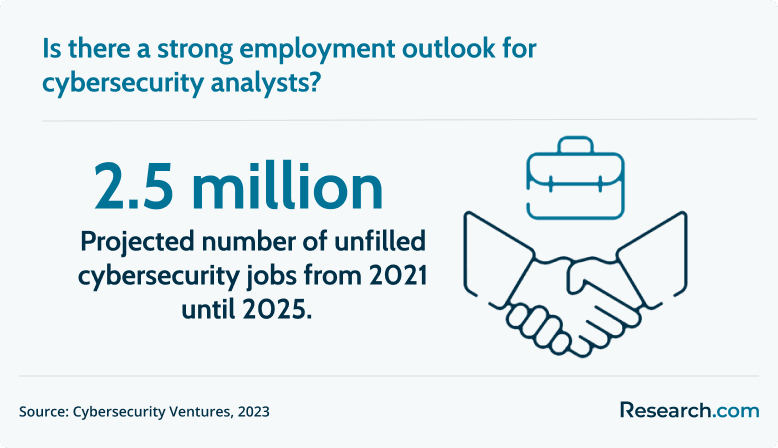
- Unfilled roles: The 2023 Cybersecurity Jobs Report from Cybersecurity Ventures projected 2.5 million unfilled cybersecurity jobs from 2021 until 2025.
Still, the market is not without friction. Industry experts have noted slower cybersecurity workforce growth for 2023-2024 because of budget cuts, talent shortages, and skills gaps. In North America, the cybersecurity workforce gap was 542,687 individuals in 2024. Globally, it was 4,762,963.
For aspiring analysts, this means preparation matters. Candidates who can demonstrate cloud platform and infrastructure security, cloud data security, cloud architecture and design, incident response, and clear communication may have a stronger position than applicants who rely only on coursework.
Does location impact cybersecurity analyst compensation?
Yes. Location can influence cybersecurity analyst pay because employers adjust compensation based on labor market competition, cost of living, local industry concentration, and regulatory environment. Analysts in major metropolitan areas and technology hubs may see higher salaries, while remote roles can change how employers price talent across regions. Candidates comparing offers should review state-level data, employer benefits, and living costs together. For a broader geographic comparison, Research.com’s guide to cyber security salary by state can help frame expectations.
Can data science expertise unlock new opportunities in cybersecurity?
Data science can strengthen cybersecurity analysis because modern security teams work with large volumes of logs, alerts, user behavior signals, network data, and threat intelligence. Analysts who understand data analytics can better detect anomalies, reduce false positives, and support predictive security models. For professionals who want to combine analytics and security, an advanced option such as the cheapest online data science master's programs may be worth comparing with cybersecurity-specific graduate study.
How can an accelerated degree program boost cybersecurity career prospects?
Accelerated programs may help motivated learners build technical foundations faster, especially when they already have some IT knowledge or can commit to an intensive schedule. The key is quality: students should confirm that the curriculum includes networking, operating systems, secure coding concepts, cryptography, incident response, and hands-on labs. A 2 year computer science degree online can be a useful stepping stone when it provides enough systems and programming depth to support cybersecurity work.
How can complementary computer science skills boost cybersecurity careers?
Computer science skills can make cybersecurity analysts more effective because they support automation, tool development, malware analysis, application security, and better understanding of how software fails. Programming, algorithms, databases, and systems design are especially valuable for analysts who want to move beyond alert monitoring. Professionals who build both security and software expertise may also qualify for some of the highest paying jobs in computer science field, depending on experience and specialization.
Can online cybersecurity degree programs accelerate career growth?
Online cybersecurity programs can be effective when they are rigorous, accredited, hands-on, and aligned with current employer needs. Good programs should offer labs, security tools, networking fundamentals, cloud security, incident response practice, and career support. Working adults often compare online cyber security degree programs because they need flexibility without giving up practical training.
How Can Continuous Education Boost Cybersecurity Career Success?
Cybersecurity does not reward outdated knowledge. Threats, tools, regulations, and employer expectations change frequently, so analysts need continuous learning throughout their careers. This may include certifications, vendor training, graduate study, conferences, security labs, or updated IT coursework. Professionals who want a broader infrastructure background can also explore online IT degree programs to strengthen systems, networking, and cloud knowledge.
What are the best specializations for advancing in cybersecurity?
Specialization can help analysts move beyond entry-level monitoring and into higher-value work. Cloud platform and infrastructure security, cloud data security, and cloud architecture and design are especially relevant because many organizations now operate in cloud or hybrid environments. However, the best specialization depends on your interests, strengths, and target industry.
If you are asking “What can you do with a cyber security degree?” the answer is broad: analysts can move into offensive security, defensive operations, management, compliance, application security, cloud security, or specialized investigative roles.
| Specialization | What It Focuses On | Helpful Credentials Mentioned |
| Penetration testing and ethical hacking | Finding weaknesses by simulating real attacks against systems, networks, and applications. | Offensive Security Certified Professional (OSCP), Certified Ethical Hacker (CEH) |
| Threat intelligence | Collecting and analyzing information about adversaries, tactics, vulnerabilities, and emerging risks. | Certified Threat Intelligence Analyst (CTIA), GIAC Cyber Threat Intelligence (GCTI) |
| Cloud security | Protecting workloads, identities, data, and infrastructure in AWS, Azure, Google Cloud, and related environments. | Certified Cloud Security Professional (CCSP), AWS Certified Security – Specialty |
| Incident response and digital forensics | Investigating breaches, determining root cause, preserving evidence, reducing damage, and supporting recovery. | GIAC Certified Incident Handler (GCIH), Certified Forensic Examiner (GCFE) |
| Cybersecurity management and governance | Building security policies, managing teams, aligning security with business goals, and overseeing compliance. | Certified Information Security Manager (CISM), Certified Information Systems Auditor (CISA) |
| Application security | Securing software against vulnerabilities such as SQL injection and cross-site scripting (XSS). | Certified Secure Software Lifecycle Professional (CSSLP) |
| Risk management and compliance | Assessing risk, supporting audits, and helping organizations meet legal and regulatory expectations. | Certified Information Systems Risk Manager (CISRM), ISO 27001 Lead Implementer |
| Artificial intelligence and machine learning in cybersecurity | Using AI to improve detection, prioritization, response, and predictive security workflows. | AI-focused cybersecurity training programs or vendor certifications |
| Identity and Access Management (IAM) | Controlling user identities, permissions, authentication, and access to systems and data. | Certified Identity and Access Manager (CIAM), Certified Access Management Specialist (CAMS) |
| Critical infrastructure security | Protecting essential systems such as power grids, transportation, communication networks, and industrial environments. | GIAC Critical Infrastructure Protection (GCIP) |
How to Choose a Cybersecurity Specialization
- Start with your strengths. If you enjoy investigations, consider forensics or incident response. If you like coding, application security may fit better. If you prefer business risk, governance or compliance may be a better match.
- Check real job postings. Search for roles in your target region or industry and record the tools, certifications, and experience employers repeatedly request.
- Match training to the role. Do not choose a certification because it is popular. Choose it because it supports the specialization and job level you want.
- Consider leadership preparation. If management is your goal, training for security leaders can matter. ISC2 has discussed additional training for cybersecurity leaders, which reflects the growing importance of leadership skills in the field.
Can cross-disciplinary technical expertise boost cybersecurity innovation?
Cybersecurity is not limited to software and networks. Some threats involve hardware, embedded systems, industrial controls, sensors, and physical-digital systems. Professionals with backgrounds in electronics, signal processing, or engineering may bring useful perspectives to hardware risk, device security, and critical infrastructure protection. For learners interested in that direction, an electrical degree online may complement cybersecurity training.
Do cybersecurity analysts work remotely or on-site?
Cybersecurity analysts may work remotely, on-site, or in hybrid arrangements. The right work model depends on employer policy, security requirements, role responsibilities, and the sensitivity of the systems being protected.
| Work Model | When It Makes Sense | Potential Limitation |
| Remote | Monitoring alerts, analyzing logs, writing reports, coordinating response, and using cloud-based tools. | May require secure access controls, strict documentation, and strong communication discipline. |
| Hybrid | Roles that mix remote analysis with periodic team collaboration, audits, or secure facility access. | Schedules may depend on incidents, meetings, or employer security rules. |
| On-site | Government, defense, critical infrastructure, forensic labs, or roles involving highly sensitive systems. | Less location flexibility and potentially more restricted work environments. |
Remote cybersecurity work became more accepted after the COVID-19 pandemic, and secure collaboration tools have made distributed security operations more practical. However, some tasks still require physical access, secure facilities, or direct coordination with infrastructure teams.
What are the biggest challenges in cybersecurity today?
Cybersecurity analysts work in a field where threats, tools, regulations, and attacker methods change constantly. The biggest challenges are not only technical; they also involve people, budgets, governance, and risk decisions.
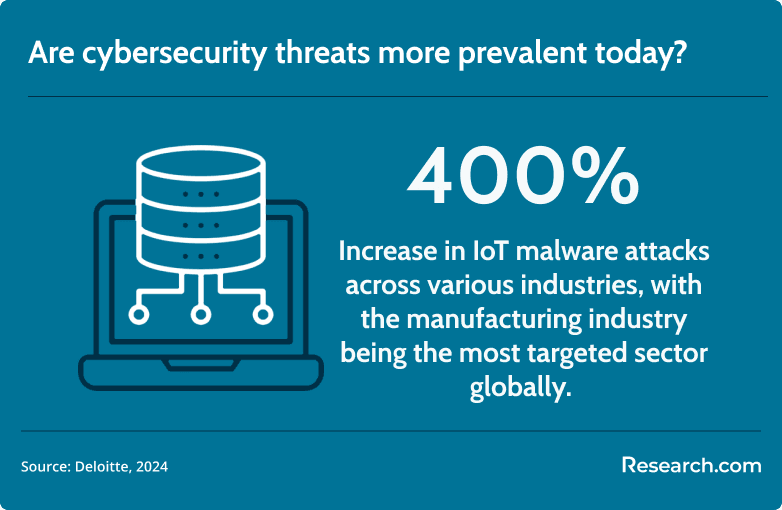
- More sophisticated attacks: Ransomware, phishing, advanced persistent threats (APTs), and targeted attacks continue to pressure organizations. Deloitte’s 2024 report cited recent data showing a 400% increase in IoT malware attacks across industries, with manufacturing identified as the most targeted sector worldwide.
- Shortage of skilled professionals: Employers need qualified security workers, but many struggle to find candidates with the right mix of technical, communication, and business skills.
- Changing regulations: Data protection and cybersecurity rules continue to evolve, especially for organizations operating across borders.
- Insider threats: Employees, contractors, and trusted users can create risk through mistakes, negligence, or malicious actions.
- Expanding attack surfaces: Cloud services, remote work, mobile devices, Internet of Things (IoT), and third-party systems create more points for attackers to target.
- AI-enabled threats: Attackers can use artificial intelligence and machine learning to automate attacks, improve phishing, or evade detection, while defenders must learn how to use AI responsibly.
- Data privacy concerns: Public concern about privacy remains high. Pew Research has reported that more Americans are uneasy and uncertain about data privacy, which increases pressure on organizations and policymakers.
- Third-party risk: Vendors, contractors, cloud providers, and service partners can introduce security weaknesses into an organization’s supply chain.
- Low security awareness: Human error remains a persistent issue when employees fall for phishing, mishandle data, use weak passwords, or ignore security procedures.
- Security versus usability: Strong controls must be balanced with workflows people can actually follow; otherwise, users may look for unsafe workarounds.
Common Mistakes to Avoid When Preparing for a Cybersecurity Analyst Career
| Mistake | Why It Hurts | Better Approach |
| Choosing a program without checking accreditation | Credits may not transfer, and some employers may question the credential. | Verify institutional accreditation and review program outcomes before enrolling. |
| Focusing only on tuition | A cheaper program may lack labs, career support, certification alignment, or transfer value. | Compare total cost, curriculum quality, hands-on training, and student support. |
| Collecting certifications without a plan | Random credentials can waste money and fail to match target roles. | Start with job postings and choose certifications tied to those requirements. |
| Ignoring hands-on practice | Employers need proof that you can use tools and solve real problems. | Build labs, complete projects, document work, and seek internships. |
| Assuming salary outcomes are guaranteed | Pay varies by experience, location, employer, industry, and specialization. | Use salary data as a benchmark, not a promise. |
| Relying only on rankings | A highly ranked school may not fit your schedule, budget, or career goals. | Use rankings as one factor alongside curriculum, support, flexibility, and outcomes. |
What Cybersecurity Analysts Say About Their Careers
- "Moving into cybersecurity analysis changed the way I think about technology. I get to solve difficult problems while helping protect real organizations from real threats, and that makes the work feel meaningful.” – Alex
- "I chose cybersecurity because the field keeps expanding. The work never feels static, and the constant learning keeps me engaged while giving me confidence in the long-term value of my skills.” – Payton
- "After switching into cybersecurity, I found a career that blends technical investigation with teamwork. Collaborating with different groups to reduce risk has made the job challenging, creative, and rewarding.” – Jordan
Can unconventional degrees enhance cybersecurity career growth?
Yes, but only when paired with security-specific training and experience. Nontraditional academic backgrounds can add creativity, systems thinking, and domain knowledge to a cybersecurity team. For example, a learner with a gaming degree online may bring programming, simulation, user behavior, and interactive systems experience that can support security testing, threat modeling, or secure application design.
Can mentorship and networking accelerate cybersecurity career growth?
Mentorship and networking can shorten the learning curve because experienced professionals can explain which certifications matter, what hiring managers expect, and how to avoid common early-career mistakes. Networking also exposes candidates to roles that may not be widely advertised. Technical communities that overlap with engineering can be useful as well, especially for learners comparing broader technical education options such as the cheapest engineering online colleges.
How is artificial intelligence transforming cybersecurity roles?
Artificial intelligence is changing cybersecurity analysis by helping teams review large data sets, identify abnormal patterns, prioritize alerts, and automate repetitive tasks. Analysts are not being replaced by AI; instead, they are increasingly expected to validate AI-generated insights, understand false positives, and make judgment calls about risk and response. Professionals who want deeper preparation in this area can compare the best artificial intelligence online degrees with cybersecurity-focused AI training.
Can a health informatics online program boost cybersecurity analysis?
Health informatics can be valuable for cybersecurity analysts who want to work in healthcare, insurance, public health, or other data-sensitive environments. Healthcare security requires understanding privacy, regulated data, clinical systems, and analytics-driven workflows. A health informatics online program may help analysts interpret healthcare data environments and align security controls with privacy expectations in that sector.
Key Insights
- A cybersecurity analyst career is realistic for students, IT professionals, and career changers, but it requires proof of technical ability, not just interest in cybersecurity.
- Many analyst roles prefer a bachelor’s degree in cybersecurity, computer science, information technology, or a related field, though certifications and experience can help candidates without a traditional degree path.
- Certifications are most valuable when chosen strategically. CompTIA Security+ can support entry-level preparation, while credentials such as CySA+, CISSP, CISM, CEH, GSEC, and GPEN serve different experience levels and career goals.
- Hands-on experience is essential. Internships, CTF competitions, open-source work, home labs, and security clubs can make a student or career changer more competitive.
- Salary data is strong but variable. Glassdoor reports an average U.S. cyber security analyst salary of $102,783 per year, while total pay can range from $106,000 up to $172,000 per year with a median salary of $134,000.
- CyberSeek shows 457,398 cybersecurity job openings in 2025, but entry-level candidates still need to address skills gaps, especially in cloud security, communication, incident response, and problem-solving.
- AI, cloud computing, privacy regulation, third-party risk, IoT threats, and workforce gaps are reshaping what cybersecurity analysts need to know.
- The best next step is to identify the exact role you want, compare job postings, map required skills to your current gaps, and choose education, certifications, and projects that directly close those gaps.
References:
- Cybersecurity Ventures (2023). 2023 Official Cybersecurity Jobs Report. https://newsletter.radensa.ru/wp-content/uploads/2023/11/2023_OfficialCyberSecurity_JobsReport.pdf
- CyberSeek (n.d.). Cybersecurity Supply And Demand Heat Map. https://www.cyberseek.org/heatmap.html Data Retrieved on January 08, 2025
- Deloitte (n.d.). Deloitte Cybersecurity Threat Trends Report 2024. https://www2.deloitte.com/us/en/pages/risk/articles/cybersecurity-threat-trends-report-2024.html
- Glassdoor (June 2024). How much does a Cyber Security Analyst make? https://www.glassdoor.co.uk/Salaries/us-cyber-security-analyst-salary-SRCH_IL.0,2_IN1_KO3,25.htm
- International Information System Security Certification Consortium (May 2024). ISC2 Reveals Global ISC2 Certification Salaries. https://www.isc2.org/Insights/2024/05/ISC2-Reveals-Global-ISC2-Certification-Salaries
- International Information System Security Certification Consortium (October 2024). 2024 ISC2 Cybersecurity Workforce Study. https://www.isc2.org/Insights/2024/10/ISC2-2024-Cybersecurity-Workforce-Study#CyberSecurityCareer
- National Center for Education Statistics (December 2023). Table 318.30. Bachelor's, master's, and doctor's degrees conferred by postsecondary institutions, by sex of student and field of study: Academic year 2021-22. https://nces.ed.gov/programs/digest/d23/tables/dt23_318.30.asp
Other Things You Should Know About Becoming a Cybersecurity Analyst
To become a cybersecurity analyst in 2027, earn a bachelor's degree in cybersecurity or a related field. Gain practical experience through internships. Obtain certifications like CompTIA Security+ or CISSP. Stay updated with industry trends and develop skills in threat modeling, incident response, and network security.
In 2027, a cybersecurity analyst must possess skills in threat detection, incident response, and risk management. Familiarity with programming languages like Python and proficiency in using security tools such as SIEM systems are crucial. Strong analytical and problem-solving abilities are also essential.


