2027 How to Become an Information Security Analyst

Co-Founder and Chief Data Scientist
Becoming an information security analyst is not as simple as collecting random cybersecurity certificates or choosing the first degree program that mentions “cyber.” Employers usually look for a mix of technical skill, security judgment, hands-on practice, and proof that you can protect real systems under pressure. This guide explains the practical path into the role for 2027, including education options, certifications, job duties, salary expectations, experience-building strategies, specializations, ethical responsibilities, and common mistakes to avoid.
Use this guide if you are comparing cybersecurity degrees, moving from IT into security, choosing between certifications, or trying to understand whether an information security analyst career is worth the time and cost.
Quick Answer: How Do You Become an Information Security Analyst?
To become an information security analyst, most candidates complete a bachelor’s degree in computer science, information technology, cybersecurity, or a closely related field; build hands-on experience through IT support, networking, systems administration, internships, labs, or security projects; and earn relevant certifications such as CompTIA Security+, CEH, CISSP, GIAC credentials, or vendor-specific certifications. A state license is generally not required, but employers often expect practical evidence that you can monitor systems, assess risks, respond to incidents, and communicate security recommendations clearly.
| Step | What to Do | Why It Matters |
| 1. Build technical foundations | Study operating systems, networking, databases, scripting, and security fundamentals. | Security analysts must understand the systems they are protecting. |
| 2. Earn a relevant degree or equivalent preparation | Pursue cybersecurity, computer science, IT, or related coursework. | Many entry-level information security analyst roles list a bachelor’s degree as the typical requirement. |
| 3. Get hands-on experience | Use internships, help desk work, labs, capture-the-flag exercises, or junior IT roles. | Employers value candidates who can troubleshoot real systems, not just describe concepts. |
| 4. Add certifications strategically | Start with foundational credentials and move into advanced or specialized certifications as your experience grows. | Certifications can validate knowledge, improve confidence, and support advancement. |
| 5. Choose a specialization | Explore incident response, cloud security, network security, penetration testing, governance, or forensics. | Specialization helps you target better-fit roles and develop deeper expertise. |
Key Things to Know Before Choosing This Career
- Education: A bachelor’s degree in computer science, information technology, cybersecurity, or a related field is commonly expected for entry-level analyst positions.
- Certifications: Credentials such as CompTIA Security+, CEH, CISSP, GIAC certifications, and vendor-specific certifications can strengthen your résumé when they match the role.
- Experience: Practical exposure through internships, IT support, systems administration, networking roles, home labs, or security projects is essential for credibility.
- Specialization: Analysts can move into network security, incident response, penetration testing, digital forensics, cloud security, compliance, or security architecture.
- Skills: Core abilities include threat analysis, risk assessment, security monitoring, communication, problem-solving, attention to detail, and ethical judgment.
- Work demands: Cybersecurity work can include urgent incidents, alert fatigue, after-hours response, and high-pressure decision-making.
- Compensation: Pay can be strong, but salaries vary by role, location, experience, certifications, and employer.
- Job market: The Bureau of Labor Statistics projects 33% growth for information security analysts from 2023 to 2033.
- Career mindset: Successful analysts keep learning because tools, attack methods, compliance demands, and business risks change continuously.
- How can you become an information security analyst for 2027?
- What does an information security analyst do?
- What are the educational requirements for becoming an information security analyst?
- What skills are required for an information security analyst?
- What is the certification and licensing process for information security analysts?
- What ethical and legal guidelines should you observe as an information security analyst?
- How much can you earn as an information security analyst?
- What is the job market like for an information security analyst?
- How can hands-on experience complement academic learning in information security?
- What subspecialties and career paths are available for information security analysts?
- What challenges should you consider as an information security analyst?
- How can mentorship and networking accelerate my career in information security?
- How are emerging technologies reshaping cybersecurity career opportunities?
- How can healthcare specialization enhance cybersecurity career prospects?
- Should I Pursue Further Education to Advance My Information Security Analyst Career?
- How can interdisciplinary expertise enhance an Information Security Analyst’s career?
- How is artificial intelligence reshaping the information security landscape?
How can you become an information security analyst for 2027?
The most reliable route into information security analysis is to combine formal learning, technical practice, security-focused credentials, and a portfolio that shows how you think through risk. A degree may help you meet screening requirements, but experience and demonstrated skill usually determine whether you can compete for analyst roles.
- Start with IT and computing fundamentals. Learn how networks, operating systems, identity systems, databases, applications, and cloud environments work before trying to secure them.
- Choose an education path that matches your starting point. A bachelor’s degree is typically expected, but career changers may combine prior technical experience, targeted coursework, certifications, and projects.
- Gain practical experience early. Look for internships, help desk roles, network support jobs, system administration work, security operations center exposure, or supervised lab projects.
- Earn certifications in the right order. Foundational certifications can help early on, while advanced credentials are more useful once you have experience to support them.
- Build a focused portfolio. Document security labs, incident write-ups, vulnerability assessments, scripts, cloud hardening projects, or policy work without exposing confidential data.
- Practice communication. Analysts must explain risk to managers, employees, engineers, auditors, and sometimes customers.
- Network with security professionals. Conferences, professional groups, online communities, and alumni connections can reveal job openings and realistic expectations that job ads often do not explain.
| Candidate Type | Best Entry Strategy | What to Avoid |
| High school graduate or early college student | Earn a computing-related degree, join cybersecurity clubs, complete labs, and pursue internships. | Relying only on classroom theory without building technical evidence. |
| IT support professional | Move toward networking, systems administration, vulnerability management, or SOC work. | Skipping foundational security because you already work in technology. |
| Career changer | Use structured coursework, a portfolio, certifications, and entry-level IT experience to bridge gaps. | Assuming one certificate alone will replace hands-on experience. |
| Experienced developer or engineer | Pivot into application security, cloud security, DevSecOps, or security engineering. | Ignoring governance, risk, incident response, and communication skills. |
What does an information security analyst do?
Information security analysts protect an organization’s systems, networks, applications, and data from unauthorized access, misuse, disruption, and loss. The work can be technical, investigative, policy-driven, and advisory, often all in the same week.
- Monitor security events: Review alerts, logs, and unusual activity to identify possible threats.
- Investigate incidents: Determine what happened, what systems were affected, and what actions are needed to contain or recover from an event.
- Assess vulnerabilities: Evaluate weaknesses in networks, endpoints, applications, cloud systems, and user access controls.
- Support security policies: Help write, update, and enforce procedures for access, acceptable use, data handling, incident response, and compliance.
- Configure and maintain tools: Work with firewalls, SIEM platforms, endpoint protection, vulnerability scanners, identity systems, and intrusion detection tools.
- Conduct risk assessments: Estimate how threats could affect business operations, data, customers, and regulatory obligations.
- Train users: Teach employees how to recognize phishing, protect credentials, handle sensitive data, and report suspicious activity.
- Coordinate with teams: Work with IT, software engineering, legal, compliance, leadership, and external vendors during security planning and incident response.
Students comparing degree options may want to review affordable cyber security degree online programs, especially if they need coursework that covers incident response, network defense, and security operations.
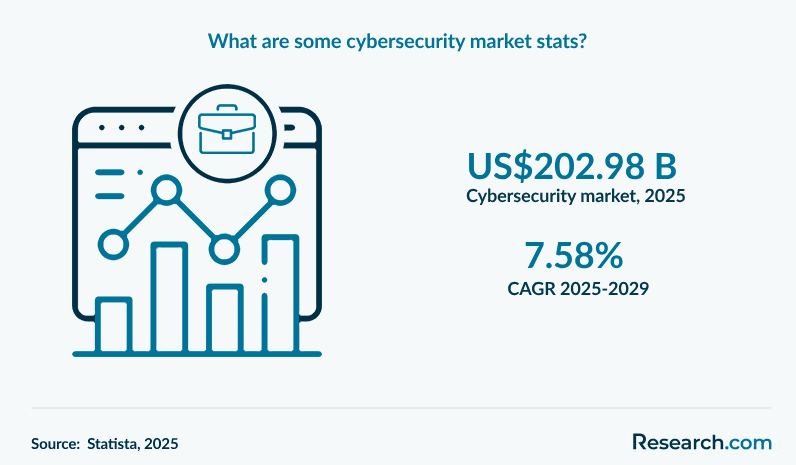
The cybersecurity market is projected to keep expanding. Forecasts cited in the original data indicate a global cybersecurity market size of US$202.98 billion by 2025, with the security services segment expected to account for US$103.09 billion in 2025. The same forecast indicates a 7.58% CAGR from 2025 to 2029, reaching US$271.91 billion by 2029. For aspiring analysts, this market growth matters because employers are investing in prevention, detection, response, compliance, and security services across industries.
Although job titles differ by employer, most analyst roles revolve around the same core mission: reduce risk while helping the organization continue to operate.
What are the educational requirements for becoming an information security analyst?
A bachelor’s degree in computer science, information technology, cybersecurity, information systems, or a related discipline is typically required for information security analyst roles. However, employers vary. Some prioritize experience and certifications, while others use degree requirements as a firm screening standard.
Common Degree Options
| Education Path | Best For | Typical Strength | Potential Limitation |
| Cybersecurity degree | Students who want direct preparation for security operations, risk, and incident response. | Focused security curriculum from the beginning. | Program quality varies, so accreditation, labs, and faculty expertise matter. |
| Computer science degree | Students interested in deeper computing, programming, systems, software security, or technical advancement. | Strong foundation in algorithms, systems, and software. | May require electives or projects to build cybersecurity depth. |
| Information technology degree | Students who want practical preparation in networks, systems, infrastructure, and support roles. | Useful path into IT operations and security administration. | May be less theoretical than computer science, depending on the program. |
| Related technical degree plus certifications | Career changers or professionals with adjacent experience. | Can be efficient when combined with hands-on projects. | May require extra effort to pass résumé screening for analyst roles. |
Courses That Help Prepare You
- Computer science fundamentals: Programming, data structures, algorithms, and secure coding concepts.
- Networking principles: Protocols, network architecture, routing, segmentation, wireless security, and defensive monitoring.
- Operating systems: Windows, Linux, permissions, services, logs, patching, and hardening.
- Database management: Database administration, access control, encryption, and data protection. Students interested in adjacent data-focused technical training may compare cheapest data science masters online programs as part of broader planning.
- Information security principles: Cryptography, authentication, authorization, access control, threat modeling, and risk management.
- Network security: Firewalls, VPNs, intrusion detection, endpoint defense, traffic analysis, and secure architecture.
- Cybersecurity law and ethics: Privacy, compliance, professional responsibility, breach reporting, and acceptable security testing. These topics are commonly found in online cybersecurity degrees.
- Digital forensics: Evidence handling, log analysis, incident timelines, malware investigation, and forensic reporting.
- Cloud security: Identity management, shared responsibility models, cloud logging, configuration risks, and secure deployment.
- Incident response: Preparation, detection, containment, eradication, recovery, and post-incident improvement.
If you want a faster bachelor’s pathway, accelerated computer science degree programs may provide a technical foundation, but you should still confirm that the curriculum includes security electives, labs, and project work.
Core cybersecurity knowledge also overlaps with adjacent technical careers. For example, readers exploring how to start a career in machine learning will find that secure data handling, privacy controls, and risk awareness are increasingly relevant when machine learning systems use sensitive data.
GIAC data cited in the original article reports that 81% of candidates produced higher quality work after earning cybersecurity certifications, 92% reported greater professional confidence, 27% received promotions after certification, and 84% showed stronger determination to achieve professional success. Those figures support the idea that education and certification can reinforce each other when paired with actual job practice.
What skills are required for an information security analyst?
Information security analysts need more than tool familiarity. They must understand how attackers operate, how systems fail, how business risk is evaluated, and how to communicate technical findings without causing confusion or panic.
| Skill Area | What It Includes | How to Demonstrate It |
| Networking | TCP/IP, DNS, VPNs, firewalls, segmentation, packet analysis, and network monitoring. | Build a lab, analyze traffic, document firewall rules, or complete network security projects. |
| Operating systems | Windows and Linux administration, logs, permissions, services, patching, and endpoint hardening. | Create hardening checklists, write incident notes from logs, or manage lab systems. |
| Security tools | SIEM platforms, vulnerability scanners, endpoint tools, intrusion detection, and ticketing workflows. | Use lab tools, write sample alerts, and explain findings in plain language. |
| Risk assessment | Threat identification, likelihood, impact, controls, and prioritization. | Prepare a sample risk register or vulnerability remediation plan. |
| Incident response | Detection, triage, containment, escalation, recovery, and reporting. | Write incident reports based on simulated events or capture-the-flag scenarios. |
| Communication | Briefing executives, supporting employees, writing reports, and translating technical risk. | Include polished documentation and executive summaries in your portfolio. |
| Ethics and judgment | Privacy, authorization, responsible disclosure, confidentiality, and professional boundaries. | Follow lab rules, avoid unauthorized testing, and cite ethical limits in project write-ups. |
- Threat analysis: Recognizing attack patterns, suspicious behavior, and likely attacker objectives.
- Problem-solving: Moving from incomplete evidence to a defensible conclusion.
- Attention to detail: Noticing small anomalies that may indicate a larger compromise.
- Scripting and automation: Using basic programming to parse logs, automate checks, and improve workflows.
- Cloud literacy: Understanding cloud identity, access controls, logs, storage, and configuration risks.
- Compliance awareness: Knowing how regulations and internal policies affect security decisions.
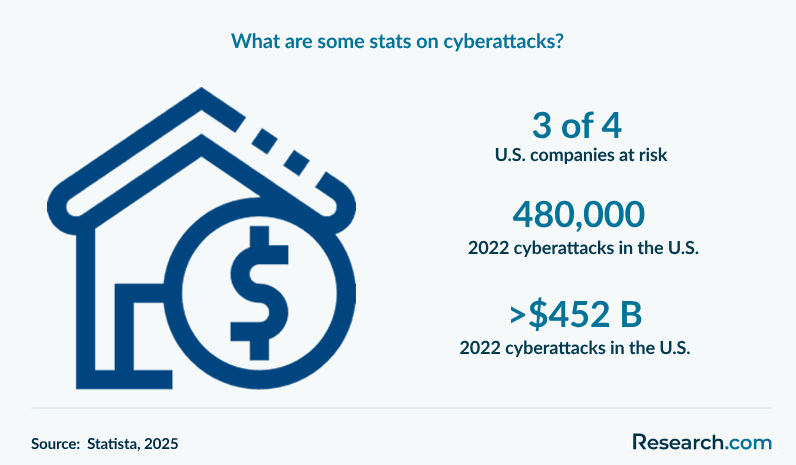
Cybersecurity risk is not theoretical for businesses. The original data reports that in 2023, three out of four U.S. companies were considered vulnerable to material cyberattacks by CISOs, with 480,000 cyberattacks in the U.S. in 2022 and projected U.S. cybercrime costs exceeding $452 billion in 2024. Reputational damage was also highlighted as a major concern for leaders. These pressures help explain why technical roles, including those on the computer engineer career path, increasingly intersect with cybersecurity responsibilities.
What is the certification and licensing process for information security analysts?
Information security analysts generally do not need a state-issued license to work in the United States. Certifications, however, can be important because they give employers a standardized way to evaluate knowledge. The best certification depends on your experience level, target role, and specialization.
| Certification | Best Fit | How to Think About It |
| CompTIA Security+ | Entry-level candidates and IT professionals moving into security. | A broad foundational credential covering core security concepts. |
| Certified Ethical Hacker (CEH) | Candidates interested in ethical hacking and offensive security concepts. | Useful when the role involves vulnerability discovery or penetration testing exposure. |
| Certified Information Systems Security Professional (CISSP) | Experienced professionals pursuing senior, management, architecture, or governance roles. | An advanced credential that usually makes more sense after substantial professional experience. |
| GIAC certifications | Professionals seeking specialized validation in focused cybersecurity domains. | Can support deeper specialization when aligned with job duties. |
| Vendor-specific certifications | Analysts working with Cisco, Microsoft, AWS, or other platforms. | Best when your target employers use the same technology ecosystem. |
- Check experience rules: Some certifications require documented work experience or continuing education.
- Do not over-certify too early: A résumé with many credentials but little practical evidence can raise questions.
- Match certification to role: A SOC analyst, cloud security analyst, penetration tester, and security manager may need different credentials.
- Maintain credentials: Many certifications require renewal activities, continuing education, or fees.
Some professionals later pursue graduate study to deepen technical or leadership preparation. If cost is a major concern, compare cheapest online MS in computer science programs and verify whether they include security, systems, or AI-related electives. The same decision logic applies when comparing software developer vs software engineer career paths: choose credentials that support the role you actually want, not credentials that simply sound impressive.
What ethical and legal guidelines should you observe as an information security analyst?
Information security analysts often have access to sensitive systems, logs, credentials, employee activity, customer data, and incident details. That access creates responsibility. Ethical mistakes can damage careers, violate laws, and undermine the trust that security teams depend on.
- Confidentiality: Protect sensitive data and avoid sharing details with anyone who lacks a legitimate need to know.
- Integrity: Preserve the accuracy of records, evidence, reports, configurations, and investigative findings.
- Availability: Support security controls that protect systems without unnecessarily interrupting business operations.
- Legal compliance: Follow applicable laws and regulatory requirements, including frameworks tied to GDPR and HIPAA when relevant.
- Authorization: Never scan, test, access, or exploit systems without clear permission.
- Privacy: Limit data collection and review to what is necessary for a legitimate security purpose.
- Responsible disclosure: Report vulnerabilities through approved channels and avoid public exposure that increases risk.
- Conflict avoidance: Disclose relationships, incentives, or outside work that could affect professional judgment.
- Evidence handling: Document actions carefully during investigations so findings are credible and defensible.
Strong ethics are not optional in cybersecurity. They are part of the job’s technical competence because analysts must be trusted with powerful tools and sensitive information.
How much can you earn as an information security analyst?
Information security analyst pay depends on job level, location, employer, industry, specialization, certifications, and years of experience. Salary data should be interpreted as a benchmark, not a guarantee.
The original salary data reports the following figures: Chief Information Security Officer (CISO) at $258,235; Security Administrators ranging from $150,000 to $225,000; Cybersecurity Engineers ranging from $130,000 to $200,000; Security Architects at $168,800; Penetration Testers at $134,979; Cybersecurity Professionals at $132,962; Information Security Engineers at $126,833; Information Security Analysts at $120,360; Information Security Analyst I at $75,052; and Information Systems and Cyber Security positions at $89,236.
| Role | Reported Salary Figure | What the Number Suggests |
| Chief Information Security Officer (CISO) | $258,235 | Executive-level responsibility, leadership, strategy, and risk ownership can command the highest pay. |
| Security Administrator | $150,000 to $225,000 | Operational security experience can be highly valued, especially in complex environments. |
| Security Architect | $168,800 | Designing secure systems often pays more than entry-level monitoring roles. |
| Penetration Tester | $134,979 | Specialized offensive security skills may support higher compensation. |
| Cybersecurity Professional | $132,962 | Broad category reflecting strong market demand for security expertise. |
| Cybersecurity Engineer | $130,000 to $200,000 | Engineering-heavy roles may reward automation, architecture, and implementation skills. |
| Information Security Engineer | $126,833 | Technical implementation and maintenance of security systems can offer strong earning potential. |
| Information Security Analyst | $120,360 | The role has competitive pay, especially as experience and responsibility grow. |
| Information Systems and Cyber Security | $89,236 | Pay varies widely by location, scope, and employer type. |
| Information Security Analyst I | $75,052 | Entry-level roles may start lower while building experience. |
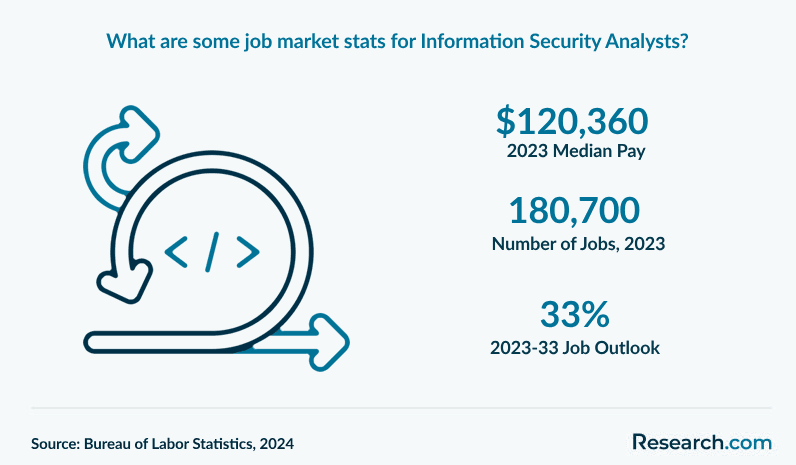
The Bureau of Labor Statistics reported 2023 median pay for Information Security Analysts of $120,360 per year, or $57.87 per hour. Use that figure as a national reference point, then compare it with local salary data, job postings, cost of living, and role expectations.
What is the job market like for an information security analyst?
The information security analyst job market is strong by BLS measures. According to the Bureau of Labor Statistics, there were 180,700 jobs in this occupation in 2023, and employment is projected to grow 33% from 2023 to 2033. That projection represents an employment change of 59,100 jobs and is described as much faster than average.
- Employers need defensive capability: Increased cyber threats, data breaches, ransomware risks, and compliance obligations continue to drive demand.
- Hiring spans many industries: Finance, healthcare, government, technology, insurance, education, retail, and managed security services all employ security analysts.
- Entry-level competition can still be real: Strong job growth does not mean every applicant will be hired quickly. Candidates still need evidence of skill.
- Security demand connects with business expertise: Professionals interested in finance-sector security may consider whether accelerated finance degree programs could complement technical cybersecurity preparation.
The BLS also notes that a bachelor’s degree is typically required for entry-level positions, less than five years of related work experience is generally expected, and on-the-job training is typically not provided. That makes pre-employment preparation especially important: do not wait until you are hired to learn core tools, logs, networks, and incident response fundamentals.
How can hands-on experience complement academic learning in information security?
Hands-on experience turns security concepts into job-ready judgment. A student may understand malware, access control, or firewalls in theory, but analysts must also know how to interpret messy logs, prioritize alerts, document findings, and act without complete information.
Ways to Build Practical Experience
- Internships: Seek roles in security operations, IT support, networking, compliance, cloud administration, or systems support.
- Home labs: Build controlled environments to practice logging, scanning, patching, Linux administration, Windows hardening, and incident response.
- Capture-the-flag exercises: Use legal, structured platforms to practice problem-solving and attack-defense concepts.
- Volunteer projects: Help small organizations improve basic security only when you have permission and appropriate supervision.
- Documentation samples: Create sanitized incident reports, risk assessments, security awareness materials, and remediation plans.
- Project-based coursework: Choose classes that require applied work, not only exams and lectures.
Complex project work can strengthen systems thinking. For example, students examining game development degree programs may notice that secure multiplayer systems, account protection, and real-time infrastructure share some risk-management concepts with cybersecurity operations.
What subspecialties and career paths are available for information security analysts?
Information security analyst can be a destination role or a launch point. After building experience, analysts often move into specialized technical work, leadership, consulting, compliance, architecture, or industry-specific security roles.
| Career Path | Primary Focus | Good Fit If You Like |
| Network Security Analyst | Defending network infrastructure, traffic, segmentation, and perimeter controls. | Packets, routing, firewalls, VPNs, and network troubleshooting. |
| Incident Response Analyst | Investigating alerts, containing attacks, and improving response playbooks. | High-pressure analysis, evidence, and time-sensitive decisions. |
| Penetration Tester | Ethically testing systems to find exploitable weaknesses. | Offensive security, exploit chains, and technical reporting. |
| Security Architect | Designing secure systems, controls, and enterprise security patterns. | Big-picture design, technical depth, and long-term planning. |
| Cloud Security Analyst | Protecting cloud platforms, identities, workloads, storage, and configurations. | Cloud services, automation, identity, and DevSecOps practices. |
| Digital Forensics Analyst | Collecting, preserving, and analyzing evidence after security incidents. | Investigation, timelines, artifacts, and detailed reporting. |
| Security Auditor | Evaluating controls, documentation, policies, and compliance readiness. | Governance, standards, evidence, and process improvement. |
| Security Manager | Leading teams, budgets, priorities, policies, and business risk communication. | Leadership, strategy, people management, and executive communication. |
| Vulnerability Analyst | Identifying, ranking, tracking, and validating remediation of weaknesses. | Scanning, prioritization, patching, and risk-based decision-making. |
| Data Security Analyst | Protecting sensitive data, privacy, access, encryption, and data governance. | Data classification, privacy, compliance, and access controls. |
| Mobile or IoT Security Analyst | Securing connected devices, applications, sensors, and mobile endpoints. | Device security, embedded systems, app risk, and emerging technology. |
Career growth in cybersecurity is often nonlinear. Like the steps to become a full stack developer, advancement may involve stacking related capabilities over time rather than following one rigid sequence.
What challenges should you consider as an information security analyst?
Information security analysis can be rewarding, but it is not a low-pressure career. The work requires vigilance, restraint, technical curiosity, and the ability to make decisions when evidence is incomplete.
| Challenge | Why It Happens | How to Prepare |
| Constantly changing threats | Attackers adapt to new tools, systems, and defenses. | Follow trusted threat reports, practice labs, and keep learning. |
| Alert fatigue | Security tools can produce large volumes of noisy alerts. | Learn triage, tuning, prioritization, and escalation discipline. |
| Resource limits | Teams may lack budget, staffing, or executive support. | Frame recommendations around business risk and practical priorities. |
| Human error | Employees can click phishing links, reuse passwords, or mishandle data. | Support awareness training, usable controls, and clear reporting channels. |
| Compliance pressure | Organizations must meet privacy, audit, and industry requirements. | Understand policy, evidence collection, and control mapping. |
| Remote and cloud environments | Workloads, users, and data may be distributed across many platforms. | Study identity, cloud logging, endpoint protection, and secure configuration. |
| Incident pressure | During breaches, decisions may affect operations, customers, and reputation. | Practice playbooks, documentation, communication, and calm escalation. |
| Supply chain risk | Vendors and third-party software can introduce vulnerabilities. | Learn vendor risk management, software updates, and dependency tracking. |
Common Mistakes to Avoid
- Choosing a program without checking accreditation: A low-cost or fast program is less useful if employers or graduate schools do not recognize it.
- Focusing only on tuition: Compare fees, books, certification exam costs, lab access, transfer credit, and time away from work.
- Assuming every online program fits every goal: Review curriculum, labs, faculty background, career support, and employer alignment.
- Collecting certifications without practice: Employers want proof that you can apply knowledge in real environments.
- Ignoring communication skills: Analysts who cannot explain risk often struggle to influence decisions.
- Relying only on rankings: A ranked program may still be a poor fit if it lacks the coursework, schedule, support, or cost structure you need.
- Expecting salary outcomes to be guaranteed: Published pay figures are useful benchmarks, not promises.
How can mentorship and networking accelerate my career in information security?
Mentorship can shorten the learning curve because experienced professionals can explain what job postings leave out: which skills matter first, which certifications are worth the cost, how interviews evaluate analysts, and how security teams actually operate. Networking can also expose you to internships, referrals, volunteer opportunities, local security groups, and project collaborations.
- Find role-specific mentors: A SOC analyst, cloud security engineer, compliance manager, and penetration tester will give different advice.
- Ask practical questions: Request feedback on your résumé, portfolio, certification plan, and target job titles.
- Join professional communities: Attend cybersecurity meetups, conferences, online study groups, and alumni events.
- Offer useful contributions: Share write-ups, help with events, contribute to discussions, or collaborate on legal lab projects.
If you need a faster academic foundation while building connections, an accelerated online information technology degree may be worth comparing against traditional timelines and costs.
How are emerging technologies reshaping cybersecurity career opportunities?
Cybersecurity roles are expanding as organizations adopt cloud platforms, artificial intelligence, connected devices, blockchain systems, and data-intensive applications. These technologies create new attack surfaces and require analysts who can understand both security controls and the systems being protected.
- Cloud adoption: Increases demand for identity security, configuration management, logging, and cloud incident response.
- AI-enabled systems: Create new questions about model abuse, data leakage, automation, and defensive monitoring.
- Blockchain and distributed systems: Require attention to wallet security, smart contracts, access controls, and transaction integrity.
- Bioinformatics and data-heavy fields: Increase the need for privacy, secure storage, and careful data governance. Readers researching the bioinformatics career outlook may see how analytics-heavy fields intersect with security risk.
How can healthcare specialization enhance cybersecurity career prospects?
Healthcare cybersecurity is a strong specialization because medical organizations rely on sensitive patient data, connected devices, clinical systems, insurance workflows, and regulated records. Analysts who understand healthcare operations can design controls that protect information without disrupting patient care.
- Domain knowledge matters: Healthcare security teams must account for clinical workflows, privacy obligations, emergency access, and legacy systems.
- Data sensitivity is high: Patient records, billing information, prescriptions, lab systems, and connected medical devices require careful protection.
- Compliance affects daily work: Analysts may need to support audits, evidence collection, access reviews, and incident documentation.
Professionals who want to combine healthcare operations and cybersecurity may compare health informatics master's programs online to see whether the curriculum includes privacy, data governance, clinical systems, and security-related coursework.
Should I Pursue Further Education to Advance My Information Security Analyst Career?
Further education can help if it directly supports your next career move. A master’s degree may be useful for security architecture, leadership, research, specialized engineering, compliance, or roles that require deeper technical or strategic preparation. It is less useful if you enroll only because you feel stuck and have not identified the skills or credentials your target jobs require.
| Further Education Makes Sense If... | Consider a Different Step First If... |
| You want roles involving architecture, leadership, research, advanced systems, or security strategy. | You lack basic networking, operating systems, or security operations experience. |
| Your employer values graduate credentials for promotion or salary bands. | You have not yet earned role-appropriate certifications or built a portfolio. |
| You need structured study in computer science, AI, data security, or governance. | You are trying to avoid entry-level experience by staying in school longer. |
| You can manage the cost without undermining your financial stability. | You have not compared tuition, fees, transfer credits, and expected career benefit. |
An online computer science masters can strengthen systems, software, data, and analytical knowledge, but the best choice depends on curriculum fit, accreditation, flexibility, total cost, and whether the program supports your desired cybersecurity specialization.
Questions to Ask Before Choosing a Cybersecurity Program
- Is the institution accredited by a recognized accreditor?
- Does the curriculum include networking, operating systems, incident response, cloud security, risk, law, and hands-on labs?
- Are courses taught by faculty with cybersecurity experience or research expertise?
- Can you transfer prior credits or earn credit for certifications?
- What career services, internships, labs, employer partnerships, or alumni networks are available?
- Does the program prepare you for specific certifications, and are exam fees included or separate?
- What is the full cost after tuition, fees, books, technology, travel, and time commitment?
- Can you complete the schedule while working or managing family responsibilities?
- Does the program publish transparent student outcomes without guaranteeing employment or salary?
How can interdisciplinary expertise enhance an Information Security Analyst’s career?
Cybersecurity problems rarely exist in isolation. Analysts who understand another discipline can make better risk decisions because they know what the organization is trying to protect and why it matters. Finance, healthcare, manufacturing, education, software development, public administration, and data science all bring different security priorities.
- Healthcare knowledge: Helps protect patient information, clinical systems, and regulated workflows.
- Finance knowledge: Supports fraud prevention, transaction security, audit readiness, and risk governance.
- Software development knowledge: Improves application security, secure coding review, and DevSecOps collaboration.
- Data expertise: Strengthens privacy, classification, encryption, analytics security, and retention planning.
For example, professionals exploring careers for masters in health informatics may find that cybersecurity knowledge can broaden opportunities in privacy, compliance, data protection, and healthcare technology risk.
How is artificial intelligence reshaping the information security landscape?
Artificial intelligence is changing both defensive security work and attacker behavior. Security teams can use AI-assisted tools to analyze large datasets, prioritize alerts, support threat detection, and speed parts of incident response. At the same time, analysts must understand the limits of automation and verify findings before acting.
- Detection support: AI-enabled tools can help identify patterns across logs, endpoints, networks, and user behavior.
- Faster triage: Automation can reduce repetitive work when alerts are properly tuned and reviewed.
- New risks: AI systems may introduce concerns around sensitive data exposure, model misuse, adversarial behavior, and overreliance on automated conclusions.
- Skill shift: Analysts need to understand how to question AI outputs, validate evidence, and use automation responsibly.
Cybersecurity professionals who want deeper AI literacy may compare the cheapest online artificial intelligence degrees while checking whether coursework includes data security, ethics, governance, and applied technical projects.
Key Insights
- The standard path combines degree, practice, and credentials. A bachelor’s degree is typically expected, but hands-on experience and job-ready skills are what make a candidate competitive.
- Cybersecurity demand is strong but not automatic. BLS data reports 180,700 jobs in 2023 and projected 33% growth from 2023 to 2033, yet entry-level applicants still need proof of ability.
- Pay can be attractive, especially with specialization. BLS reported 2023 median pay of $120,360 annually, or $57.87 per hour, while related senior and specialized roles show higher reported salary figures.
- Certifications are most useful when targeted. CompTIA Security+, CEH, CISSP, GIAC credentials, and vendor certifications can help, but they should match your experience level and desired role.
- Hands-on evidence matters. Labs, internships, incident reports, vulnerability assessments, cloud security projects, and documentation samples can make your résumé more credible.
- Ethics are part of technical competence. Analysts must respect authorization, privacy, confidentiality, responsible disclosure, and evidence integrity.
- Specialization improves career direction. Incident response, cloud security, penetration testing, digital forensics, security architecture, governance, and healthcare security all offer different advancement paths.
- AI is changing the analyst role, not eliminating it. Analysts who can validate automated findings, understand data risk, and use AI responsibly will be better prepared for evolving security work.
- Program choice should be practical. Before enrolling, verify accreditation, curriculum depth, labs, transfer credit, total cost, certification alignment, and career support.
References:
- Bureau of Labor Statistics. (2024, August 29). Information Security Analysts: Occupational Outlook Handbook. Bureau of Labor Statistics.
- GIAC. (2023, December 19). The transformative power of cybersecurity certifications: A win-win for employees and employers. GIAC.
- InfoSec Jobs. (2025, January 1). The Global InfoSec / Cybersecurity Salary Index for 2025. InfoSec Jobs.
- Nucamp. (2025, February 23). Cybersecurity Salary in 2025: Top 5 High-Paying Cybersecurity Jobs in the US in 2025. Nucamp.
- Salary.com. (2025, January 1). Information Security Analyst I Salary in Virginia. Salary.com.
- Salary.com. (2025, January 1). Information Security Engineer Salary. Salary.com.
- Salary.com. (2025, February 1). Information Systems and Cyber Security Salary in Alabama. Salary.com.
- Salary.com. (2025, March 1). Information Security Analyst Salary. Salary.com.
- Statista. (2024). SMB and cyber crime in the U.S. - statistics & facts. Statista.
- Statista. (2025). Cybersecurity - Worldwide | Statista Market Forecast. Statista.
- Statista. (2025). Security Services - Worldwide | Statista Market Forecast. Statista.
Other Things You Should Know About Becoming an Information Security Analyst
In 2027, aspiring Information Security Analysts should consider certifications such as Certified Information Systems Security Professional (CISSP), Certified Ethical Hacker (CEH), and CompTIA Security+. These certifications are recognized for validating professionals' skills and knowledge in the fast-evolving cybersecurity landscape.
Becoming a qualified Information Security Analyst by 2026 typically takes around 4-6 years. This includes earning a relevant bachelor's degree, gaining hands-on experience or internships, and obtaining necessary industry certifications to demonstrate your expertise and commitment to the field.