
2027 How to Become a Digital Forensic Investigator: Salary & Career Paths

Co-Founder and Chief Data Scientist
Digital forensic investigators are the professionals called in when phones, computers, cloud accounts, networks, images, logs, or storage devices may contain evidence. Their work matters more now because cyberattacks increasingly hide malicious activity in ordinary-looking files, encrypted communications, compromised accounts, mobile apps, and connected devices. Image steganography, ransomware, phishing, insider fraud, and cloud-based incidents have made digital evidence central to both criminal cases and corporate investigations.
This guide explains how to become a digital forensic investigator in 2026, what the job involves, which degrees and certifications are most useful, how long the path can take, where these professionals work, and what salary and job outlook data suggest. It is written for students choosing a degree, IT professionals moving into forensics, cybersecurity workers seeking a specialized role, and law enforcement professionals who want stronger technical skills.
Quick answer: How do you become a digital forensic investigator?
The most common route is to earn a bachelor’s degree in computer science, cybersecurity, digital forensics, or a related field; gain hands-on experience in IT, cybersecurity, incident response, or law enforcement technology; and add recognized certifications such as CompTIA Security+, EnCE, CCE, GCFE, or GCFA. Some candidates enter through an associate degree plus strong technical experience, but many employers prefer a bachelor’s degree for forensic examiner and analyst roles.
Key Things You Should Know About Becoming a Digital Forensic Investigator
- A bachelor’s degree in computer science, cybersecurity, or digital forensics is the standard entry point for many roles, although an associate degree paired with certifications such as CompTIA Security+, EnCE, CCE, or GCFA can help candidates compete for junior positions.
- The job requires more than technical curiosity. Investigators must recover data, analyze encrypted or damaged files, detect malware, understand networks, document evidence, and explain findings clearly to legal teams, executives, investigators, or courts.
- Public-sector and law enforcement roles often emphasize criminal cases, evidence handling, warrants, and testimony. Private-sector roles are more likely to involve data breaches, insider threats, fraud, compliance, and incident response, especially in finance, healthcare, and technology.
- Digital forensics changes quickly. Ransomware, cloud platforms, mobile applications, AI-supported attacks, and IoT devices require investigators to keep learning new tools, procedures, and legal standards.
- The broader cybersecurity labor market remains attractive. The article’s cited data includes 33% projected job growth for information security analysts and salary ranges of $75,000 to $110,000 per year for digital forensics-related cybersecurity roles, with higher earning potential tied to experience, location, specialization, and certifications.
- What is a digital forensic investigator?
- What does a digital forensic investigator do?
- What are the steps to become a digital forensic investigator in 2027?
- What are the different types of digital forensic investigators?
- What degree do you need to become a digital forensic investigator?
- How long does it take to become a digital forensic investigator?
- Is pursuing further education essential for career advancement in digital forensics?
- What challenges do digital forensic investigators encounter in a rapidly evolving cyber landscape?
- What certifications are required for digital forensic investigators?
- How can collaboration with legal professionals enhance digital forensic investigations?
- How can digital forensic investigators benefit from interdisciplinary legal training?
- How can digital forensic investigators transition into government or law enforcement roles?
- What is the average salary for a digital forensic investigator?
- What is the job outlook for digital forensic investigators?
- What are the legal and ethical considerations for digital forensic investigators?
- What continuing education options are most valuable for digital forensic investigators? Legal considerations Job outlook Additional career planning questions
What is a digital forensic investigator?
A digital forensic investigator is a trained professional who identifies, preserves, extracts, analyzes, and reports on digital evidence. That evidence may come from laptops, desktops, mobile phones, tablets, servers, removable drives, databases, cloud accounts, email systems, network logs, surveillance files, images, videos, or connected devices.
The role sits at the intersection of cybersecurity, investigation, and legal procedure. A forensic investigator may help determine how an attacker entered a system, whether a file was deleted or altered, what happened on a device during a specific time period, or whether digital records support allegations of fraud, theft, harassment, data leakage, or unauthorized access.
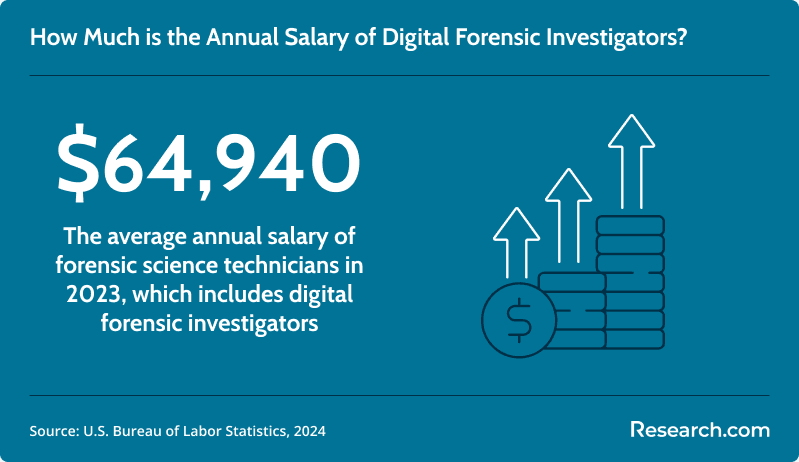
Digital forensic investigators are often discussed within the broader forensic science technician category used by the U.S. Bureau of Labor Statistics. Under that grouping, the digital forensic investigator salary in 2023 was $64,940, with the upper percentile reaching $107,490.
The work is not simply “finding deleted files.” Evidence must be handled in a way that preserves its integrity. Investigators document the chain of custody, use validated methods where required, create forensic images when appropriate, avoid changing source data, and prepare reports that can withstand review by attorneys, auditors, managers, law enforcement, or courts.
Because their findings can affect criminal cases, employment decisions, insurance claims, compliance outcomes, or civil litigation, digital forensic investigators need technical skill, accuracy, professional skepticism, and strong written communication.
What does a digital forensic investigator do?
A digital forensic investigator examines digital systems to reconstruct events, locate evidence, and support investigations. The work can involve criminal cases, cybersecurity incidents, employee misconduct reviews, corporate fraud inquiries, intellectual property theft, data breach response, or regulatory investigations. On average, a digital forensic investigator examines 130 devices per month and eventually takes responsibility for at least 17 devices.
In practical terms, digital forensics focuses on collecting and interpreting digital evidence in a way that is technically reliable and legally defensible.
Core responsibilities
| Responsibility | What it involves | Why it matters |
| Evidence acquisition | Creating forensic copies of drives, mobile devices, cloud data, logs, or storage media while minimizing changes to the original source. | Improper acquisition can damage evidence or make findings easier to challenge. |
| Data recovery | Recovering deleted, hidden, corrupted, encrypted, or fragmented data from devices and storage systems. | Important evidence is often incomplete, intentionally concealed, or partially destroyed. |
| Timeline analysis | Reconstructing user actions, file access, login events, malware activity, or network connections across time. | Investigators often need to answer what happened, when it happened, and who may have been involved. |
| Malware and intrusion review | Analyzing suspicious files, logs, persistence mechanisms, command activity, and indicators of compromise. | This helps organizations understand breaches and prevent reinfection or repeat attacks. |
| Reporting and testimony | Writing clear reports and, in some roles, explaining technical evidence in depositions, hearings, or trials. | Evidence has limited value if decision-makers cannot understand or trust the findings. |
Data recovery and technical analysis
- Investigators collect information from computers, phones, servers, external drives, cloud environments, application logs, email archives, and network records. They may recover deleted files, analyze browser history, inspect registry artifacts, examine app data, and trace digital activity.
- They use forensic software, write scripts, analyze logs, and apply hardware tools when necessary. Accuracy is critical because small errors can change the interpretation of a case.
Evidence preservation and documentation
- A major part of the job is protecting the chain of custody. Investigators document who handled the evidence, when it was accessed, how it was stored, and what methods were used.
- They prepare reports that explain findings, limitations, tools used, and conclusions. In legal or compliance matters, documentation can be just as important as the technical analysis.
Investigation and collaboration
- Digital forensic investigators often work with incident responders, attorneys, compliance teams, human resources, law enforcement, auditors, and executives.
- In court-related cases, they may serve as expert witnesses and translate technical evidence into plain language for judges, juries, or attorneys.
What are the steps to become a digital forensic investigator in 2026?
Becoming a digital forensic investigator usually requires education, technical practice, evidence-handling knowledge, and proof of competence through experience or certifications. Computer science and cybersecurity degrees are part of the broader computer and information technology degree category, where 108,503 bachelor’s degrees were conferred in 2021-2022.
Step 1: Build a technical foundation
Start with the systems digital evidence comes from: operating systems, file systems, networks, cloud services, mobile platforms, databases, and security tools. A bachelor’s degree in computer science, cybersecurity, digital forensics, or a related discipline is widely useful. These programs may not be the fastest computer science degree options, but they can provide the depth needed for forensic work.
- Learn Windows, Linux, macOS, networking, scripting, cybersecurity fundamentals, and database basics.
- Take courses in cyber law, criminal procedure, ethics, or evidence handling if available.
- Use lab environments to practice imaging drives, reviewing logs, analyzing malware indicators, and documenting findings.
Step 2: Get practical experience before expecting a forensic title
Many professionals enter digital forensics after working in IT support, systems administration, network analysis, cybersecurity operations, incident response, or law enforcement technology. In 2023, local government employed 10,770 forensic science technicians, which shows one public-sector employment setting for related forensic work.
- Look for internships with law enforcement agencies, cybersecurity firms, corporate security teams, managed security service providers, or compliance departments.
- Entry-level roles such as IT support specialist, network analyst, systems engineer, security operations center analyst, or junior incident responder can build relevant skills.
- Capture The Flag competitions for hackers can sharpen investigative thinking, log analysis, exploitation awareness, and problem-solving under pressure.
Step 3: Add certifications that match your target role
Certifications can help employers verify your technical baseline, especially if your degree is broad or your experience is not yet forensic-specific.
- CompTIA Security+ is useful for foundational cybersecurity knowledge.
- CCE, GCFE, GCFA, CFCE, EnCE, and ACE are more directly connected to forensic examination, incident response, or tool-specific competency.
- Choose certifications based on the systems and cases you want to handle. A corporate incident response analyst may prioritize different credentials than a law enforcement examiner.
Step 4: Learn forensic reporting, not just forensic tools
Technical findings must be explainable. Practice writing reports that include scope, evidence sources, methods, findings, timelines, limitations, and conclusions. Avoid unsupported claims. A good forensic report should allow another qualified professional to understand what you did and why your conclusions are reasonable.
Step 5: Apply for roles that fit your background
Use your prior experience strategically. IT professionals may transition into incident response or corporate forensics. Law enforcement professionals may move toward digital evidence units. Cybersecurity analysts may specialize in breach investigations, malware triage, or endpoint forensics.
| Background | Strong entry point | Skills to strengthen |
| Student or recent graduate | Internship, junior forensic technician, SOC analyst, IT support | Evidence handling, operating systems, scripting, report writing |
| IT professional | Security analyst, incident response associate, forensic lab support | Chain of custody, malware basics, legal documentation |
| Cybersecurity analyst | Digital forensic analyst, incident responder, threat investigation analyst | Disk and memory forensics, courtroom-ready documentation, mobile forensics |
| Law enforcement professional | Digital evidence technician, computer crimes unit, forensic examiner trainee | Networking, operating systems, cloud platforms, forensic tools |
The following chart shows the primary industries employing forensic science technicians and helps illustrate where related forensic roles are commonly concentrated.
What are the different types of digital forensic investigators?
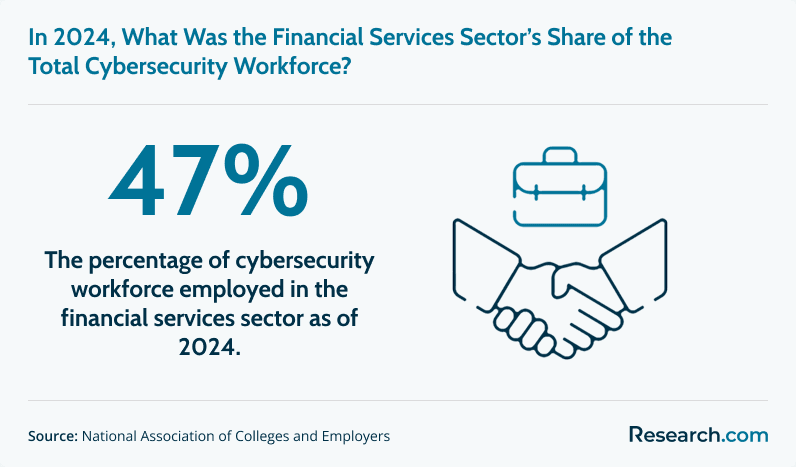
Digital forensics is not a single job. Investigators often specialize by device type, evidence source, case type, or industry. In 2024, 47% of the cybersecurity workforce was employed in the financial services sector, where network security, fraud detection, incident response, and evidence analysis are major priorities.
Some digital forensics paths also overlap with the highest paying jobs in computer science field, especially when the role requires cybersecurity expertise, advanced analytics, or incident response leadership.
| Specialization | Main focus | Common work settings |
| Computer forensics | Examining desktops, laptops, hard drives, USB drives, and file systems. | Law enforcement, corporate investigations, litigation support, forensic labs. |
| Mobile device forensics | Recovering and analyzing texts, call logs, photos, app data, location artifacts, and device backups. | Criminal investigations, family law cases, workplace investigations, fraud inquiries. |
| Network forensics | Reviewing packet captures, firewall logs, authentication records, traffic flows, and intrusion evidence. | Security operations centers, incident response teams, managed security providers. |
| Forensic data analysis | Finding patterns, anomalies, fraud indicators, or irregular transactions in structured data. | Finance, audit, compliance, insurance, corporate fraud teams. |
| Database forensics | Investigating unauthorized changes, deleted records, account activity, and database access history. | Enterprises, healthcare systems, financial institutions, litigation matters. |
| Digital image and video forensics | Assessing authenticity, metadata, manipulation, compression artifacts, and file history. | Criminal cases, media verification, fraud investigations, civil litigation. |
| IoT forensics | Analyzing data from smart devices, wearables, vehicles, sensors, home systems, and connected equipment. | Cybersecurity investigations, criminal cases, insurance claims, product investigations. |
| Cloud forensics | Reviewing logs, identities, storage activity, access permissions, and cloud service events. | Corporate security, breach response, SaaS investigations, compliance teams. |
How to choose a specialization
- Choose computer or mobile forensics if you are interested in device-level evidence and traditional investigative work.
- Choose network, cloud, or incident response forensics if you prefer active cybersecurity investigations and breach reconstruction.
- Choose forensic data analysis if you enjoy databases, spreadsheets, fraud detection, and financial evidence.
- Choose IoT or image forensics if you want an emerging niche, but expect to keep learning as tools and device ecosystems change.
What degree do you need to become a digital forensic investigator?
A bachelor’s degree is the most common educational requirement for digital forensic investigator roles. Employers often look for majors in computer science, cybersecurity, digital forensics, information technology, computer engineering, or criminal justice programs with a strong technical concentration.
Over 74% of cyber professionals say they have seen an increase in the sophistication of phishing attacks. In France, the U.S., and Germany, GenAI was identified as the leading threat, surpassing ransomware, with concern levels at 35.5%, 34.3%, and 32.8%, respectively. Those figures show why forensic investigators need both technical depth and the ability to adapt as attack methods change.
| Degree path | Best for | Limitations to consider |
| Associate degree in IT, cybersecurity, or criminal justice technology | Students seeking a lower-cost starting point or a faster route into IT support, help desk, or junior security roles. | May not meet bachelor’s degree preferences for forensic analyst positions; certifications and experience become especially important. |
| Bachelor’s degree in computer science | Students who want strong programming, systems, algorithms, and technical problem-solving skills. | May need electives, labs, or certifications focused specifically on forensic procedure and evidence handling. |
| Bachelor’s degree in cybersecurity | Students targeting incident response, network defense, malware analysis, and cyber investigations. | Programs vary widely, so check whether they include hands-on forensic labs and legal/ethical coursework. |
| Bachelor’s degree in digital forensics | Students who already know they want forensic examination, evidence collection, and investigative work. | Can be narrower than computer science, so make sure the program includes strong systems, networking, and scripting coursework. |
| Master’s degree in computer science, cybersecurity, forensics, or related fields | Professionals aiming for senior analyst, leadership, research, specialized, or teaching roles. | Often most valuable after some work experience; cost and time should be weighed against career goals. |
A master’s degree is not always required for entry-level digital forensics work, but it can strengthen qualifications for advanced roles. Options such as an affordable online masters in computer science may make sense for professionals who need deeper technical training while continuing to work.
Certifications remain important even for degree holders. Credentials such as CCE, GCFA, GCFE, CFCE, EnCE, ACE, and Security+ can help demonstrate that a candidate can apply knowledge in practical forensic or cybersecurity contexts.
What to check before choosing a degree program
- Does the curriculum include hands-on labs in disk, memory, mobile, network, or cloud forensics?
- Are students trained in chain of custody, documentation, legal procedure, and ethics?
- Can you complete internships, capstone projects, or forensic lab work?
- Does the program prepare students for certifications valued by employers?
- Does the school have regional or appropriate institutional accreditation?
- If the program is online, are labs realistic and technically rigorous?
How long does it take to become a digital forensic investigator?
The timeline depends on your starting point, degree choice, prior experience, and certification plan. A student starting from high school may need several years to become competitive for a full forensic investigator role, while an experienced IT or cybersecurity professional may transition faster.
Typical timeline
| Stage | Estimated time | What you should accomplish |
| Associate degree | 2 years | Build a foundation for IT, cybersecurity support, or junior technical roles. |
| Bachelor’s degree | 4 years | Develop stronger knowledge in computer science, cybersecurity, digital forensics, or a related technical field. |
| Master’s degree | 1-2 years | Prepare for specialized, senior, research-oriented, or leadership opportunities. |
| Hands-on experience | 6 months – 2 years | Gain practical exposure through IT, security, incident response, internships, labs, or law enforcement technology work. |
| Certifications | 3–12 months | Validate specific skills through credentials aligned with your target job. |
Common route options
- Fastest route: 2–3 years. Complete an associate degree, earn entry-level certifications, build hands-on experience, and apply for junior technical or forensic support roles.
- Most common route: 4–5 years. Earn a bachelor’s degree, complete internships or labs, add certifications, and apply for entry-level investigator, examiner, or analyst roles.
- Advanced route: 6+ years. Combine a bachelor’s degree, master’s degree, certifications, and substantial experience for senior or specialized positions.
Aside from completing a degree in cyber security, many candidates use certifications to show practical readiness. Examples include CompTIA Security+ for beginners, Certified Digital Forensic Examiner for developing practitioners, and GCFA for advanced forensic analysis and incident response.
If you already work in law enforcement, IT, cybersecurity, audit, or compliance, you may not need to restart your career. Your best path may be a targeted transition: fill technical gaps, document forensic projects, earn a relevant certification, and apply for roles that value your existing investigation or systems experience.
Is pursuing further education essential for career advancement in digital forensics?
Further education is not automatically required, but it can be valuable when it solves a specific career problem. A master’s degree, graduate certificate, legal studies coursework, or advanced technical training may help if you want to move into leadership, expert testimony, specialized incident response, government work, or complex litigation support.
Before enrolling, compare the cost with the outcome you want. For example, professionals who work near law enforcement or court processes may benefit from understanding criminal procedure, evidence rules, and legal documentation. Reviewing the cost of criminal justice degree options can help you evaluate whether a criminal justice or legal-adjacent program supports your goals without creating unnecessary debt.
Further education makes the most sense when:
- Your target job description repeatedly asks for a graduate degree.
- You want to supervise forensic teams, lead incident response programs, or teach.
- You need deeper knowledge in malware analysis, cloud security, data science, law, or compliance.
- Your current degree is unrelated and you need a stronger academic foundation.
Further education may not be necessary when:
- You lack hands-on experience more than academic credentials.
- A certification, lab portfolio, or internship would address your biggest skills gap faster.
- Your employer values case experience and tool proficiency more than additional degrees.
- The program does not include practical forensic training or relevant legal instruction.
What challenges do digital forensic investigators encounter in a rapidly evolving cyber landscape?
Digital forensic investigators work in a field where evidence sources, attack methods, privacy rules, and tools change quickly. Encryption, cloud storage, ephemeral messaging, anti-forensic techniques, malware obfuscation, large data volumes, and cross-border systems can all make investigations harder.
Investigators also face pressure from time-sensitive incidents. During a ransomware attack or breach response, organizations need answers quickly, but forensic work still requires disciplined evidence handling and careful interpretation. Moving too fast can lead to missed artifacts, weak documentation, or conclusions that cannot be defended later.
Professionals who want broader investigative careers may also compare digital forensics with high paying criminal justice jobs, especially when deciding whether to focus on public safety, corporate security, fraud investigation, or cybercrime response.
Major challenges to prepare for
- Encrypted devices and applications: Evidence may be inaccessible without credentials, lawful authority, backups, or specialized methods.
- Cloud and SaaS evidence: Logs and files may be distributed across providers, regions, accounts, and retention settings.
- Massive data volumes: Investigators must separate relevant evidence from large collections of routine system activity.
- AI-enabled threats: Generative AI can support phishing, impersonation, and malicious automation, complicating attribution and analysis.
- Legal boundaries: Search authority, privacy rights, employment law, and jurisdictional rules can determine what evidence may be collected and used.
- Tool limitations: Forensic tools are powerful, but no tool replaces professional judgment, validation, and documentation.
What certifications are required for digital forensic investigators?
There is no single certification required for every digital forensic investigator. Requirements depend on the employer, sector, case type, tools used, and whether the work involves law enforcement, corporate security, consulting, or litigation. However, certifications can significantly strengthen credibility and may be required or preferred in job postings.
The growth of connected evidence sources also matters. The increasing adoption of IoT devices, projected to reach 24.2 billion by 2030, is driving the need for digital forensic skills across more device types and data environments.
Some of the certifications that pay well are also relevant to digital forensics, cybersecurity, and incident response roles.
| Certification | Best for | What it signals |
| CompTIA Security+ | Beginners building cybersecurity fundamentals before specializing in forensics. | Baseline knowledge of security concepts, threats, controls, and risk. |
| GCFE | Investigators focused on Windows systems and core forensic examination. | Ability to collect and analyze common forensic artifacts. |
| GCFA | Experienced analysts working on breach investigations and incident response. | Advanced forensic analysis, threat hunting, and response skills. |
| CCE | Professionals seeking broad validation of forensic examination knowledge. | General competence in computer forensic processes and analysis. |
| CFCE | Computer investigation specialists, including those working in law enforcement contexts. | Knowledge of aspects of computer investigations and forensic examination practice. |
| EnCE | Examiners who use EnCase in forensic investigations. | Tool-specific proficiency with EnCase forensic software. |
| ACE | Professionals working with AccessData’s Forensic Toolkit. | Tool-specific knowledge related to FTK-based forensic workflows. |
GIAC certifications
Global Information Assurance Certification credentials are widely recognized in cybersecurity and digital forensics. GCFA emphasizes advanced breach investigation and incident response. GCFE focuses more on core forensic collection and analysis, particularly in Windows environments.
Certified Computer Examiner
The Certified Computer Examiner credential from the International Society of Forensic Computer Examiners validates broad forensic knowledge and can be useful for professionals who want a general computer forensics credential.
Certified Forensic Computer Examiner
The Certified Forensic Computer Examiner credential from the International Association of Computer Investigative Specialists is designed for professionals involved in computer investigations and forensic examination.
EnCase Certified Examiner
EnCE is useful when employers rely on EnCase and want evidence that a candidate can use that platform in forensic workflows.
AccessData Certified Examiner
ACE is relevant for professionals who work with AccessData’s Forensic Toolkit and need to show tool-specific competence.
CompTIA Security+
Security+ is not a dedicated forensic credential, but it can help early-career candidates establish cybersecurity literacy before moving into specialized digital evidence work.
The next chart shows the expected growth of Internet of Things device adoption. As connected devices become more common, investigators may need stronger methods for collecting, validating, and interpreting evidence from nontraditional sources.
How can collaboration with legal professionals enhance digital forensic investigations?
Legal collaboration helps digital forensic investigators avoid procedural mistakes that can weaken evidence. Attorneys and legal teams can clarify the scope of consent, search authority, subpoenas, warrants, discovery obligations, privacy limits, and reporting expectations before evidence is collected or analyzed.
This collaboration is especially important when findings may be used in court, arbitration, employment proceedings, regulatory matters, or internal disciplinary action. Legal professionals can help investigators define the question being answered, protect privileged material, and prepare documentation that supports admissibility.
Technical professionals who frequently work with attorneys may benefit from legal training. A cheap paralegal certificate can be one way to learn legal terminology, document handling, research methods, and litigation procedures that are relevant to forensic work.
How can digital forensic investigators benefit from interdisciplinary legal training?
Digital forensic investigators do not need to become lawyers, but they do need to understand how evidence is challenged. Interdisciplinary legal training can improve how investigators document searches, handle privileged data, maintain chain of custody, write reports, and communicate with counsel.
Programs such as accelerated paralegal certificate programs may be useful for professionals who want a faster introduction to legal process, courtroom procedure, discovery, and evidence-related documentation. This type of training is most helpful when paired with strong technical forensic skills.
How can digital forensic investigators transition into government or law enforcement roles?
Digital forensic investigators can move into government or law enforcement by aligning their technical background with public-sector hiring requirements. These roles may require background checks, citizenship or residency requirements, agency-specific training, physical or academy requirements for sworn positions, and familiarity with criminal procedure and evidentiary standards.
Candidates should study the exact requirements of the agency they want to join. For example, reviewing DEA requirements to join can help applicants understand how federal investigative roles may combine technical expertise with broader law enforcement qualifications.
Practical transition steps
- Build a portfolio of lawful, ethical forensic lab projects and incident analysis reports.
- Earn certifications that match the agency’s preferred qualifications.
- Learn evidence procedures, search authority, report writing, and courtroom testimony expectations.
- Network with digital evidence units, cybercrime task forces, internship programs, and public-sector recruiters.
- Be prepared for extensive background screening and strict professional conduct standards.
What is the average salary for a digital forensic investigator?
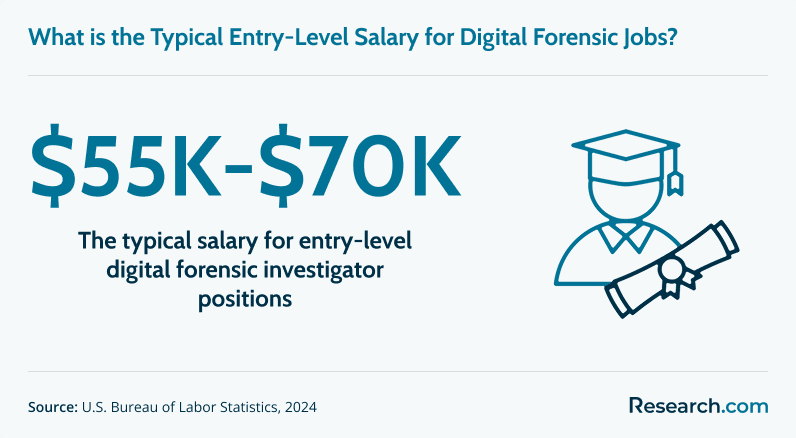
The average cyber security jobs salary category that includes digital forensic investigator work in the U.S. is approximately $75,000 to $110,000 per year, depending on experience, education, location, employer, and industry. Entry-level positions typically start around $55,000 to $70,000. Experienced professionals in government agencies, financial institutions, private cybersecurity firms, or specialized consulting roles can earn $100,000 or more.
Senior forensic analysts and professionals with specialized certifications such as GCFA or Certified Digital Forensics Examiner may have stronger earning potential, particularly when they handle breach response, expert testimony, malware investigations, cloud forensics, or high-stakes corporate investigations.
| Career level | Salary information cited in this guide | Factors that can affect pay |
| Entry-level | Around $55,000 to $70,000 | Degree, internships, certifications, technical labs, location, and employer type. |
| General digital forensics-related cybersecurity roles | Approximately $75,000 to $110,000 per year | Experience, industry, credentials, forensic specialization, and demand in the local market. |
| Experienced or specialized professionals | $100,000 or more | Advanced certifications, incident response expertise, consulting work, finance or healthcare experience, and senior responsibilities. |
| Forensic science technician grouping | $64,940 in 2023, with the upper percentile reaching $107,490 | BLS occupational grouping, sector, geography, and forensic role type. |
Employer type matters. Government agencies such as the FBI or Department of Homeland Security may offer strong benefits and structured career paths. Private cybersecurity firms, consulting companies, financial institutions, healthcare organizations, and technology companies may offer higher compensation for specialized forensic and incident response skills. Location also matters, with high-demand markets such as Washington, D.C., New York, and San Francisco often paying more than smaller markets.
What is the job outlook for digital forensic investigators?
The job outlook for digital forensic investigators is supported by the growth of cybercrime, digital evidence, data privacy obligations, and incident response needs. According to the U.S. Bureau of Labor Statistics figure cited in this article, information security analyst roles are projected to grow 33% through 2023.
Digital forensic investigators are not limited to police departments. Their skills are used by corporations, cybersecurity firms, law firms, financial institutions, healthcare organizations, insurers, government agencies, and consulting companies.
Factors supporting demand
- More cybercrime and fraud: Ransomware, phishing, account takeover, data theft, insider activity, and online fraud all create demand for skilled investigators.
- More digital evidence: Devices, apps, cloud platforms, logs, databases, and connected systems generate records that may be relevant to investigations.
- Demand across sectors: Law enforcement, government, finance, healthcare, technology, and private corporations need forensic expertise for different reasons.
- Security awareness and skills gaps: As the industry deals with a skills shortage, 71% of organizations continue to focus on educating employees and strengthening security awareness.
- Technology change: Cloud computing, mobile devices, IoT, AI-enabled threats, and encrypted platforms create new forensic challenges.
- Regulatory pressure: Privacy, breach notification, cybersecurity, and compliance rules can make forensic investigation part of organizational risk management.
Industries that commonly hire digital forensic professionals
| Industry | Why digital forensics is needed | Example focus areas |
| Law enforcement and government | Digital evidence is central to many criminal, national security, and public integrity investigations. | Device exams, cybercrime, warrants, evidence reporting, courtroom testimony. |
| Financial services | Fraud, account compromise, insider risk, and network security are major concerns. | Transaction analysis, breach response, network forensics, fraud investigation. |
| Healthcare | Patient data, ransomware risk, compliance, and insider access issues require forensic review. | Data breach investigation, access logs, endpoint analysis, compliance support. |
| Technology and cybersecurity firms | Clients need help responding to incidents and understanding attack activity. | Incident response, malware triage, cloud forensics, consulting reports. |
| Legal and litigation support | Attorneys need defensible evidence collection and analysis for civil and criminal matters. | Discovery, expert reports, device analysis, email and document review support. |
What are the legal and ethical considerations for digital forensic investigators?
Digital forensic investigators handle sensitive information, so legal and ethical judgment is central to the job. They may encounter private messages, medical records, financial data, trade secrets, privileged communications, location history, personal images, or unrelated third-party information. The goal is to collect and analyze what is authorized and relevant, not to search without limits.
Key legal and ethical duties
- Stay within authorization: Investigators must understand the scope of consent, warrant authority, employer policy, court orders, or contractual permission before collecting evidence.
- Protect chain of custody: Evidence handling must be documented from collection through storage, analysis, reporting, and transfer.
- Preserve evidence integrity: Investigators should use methods that avoid unnecessary alteration of original data and clearly document any unavoidable changes.
- Respect privacy: Relevant evidence should be separated from unrelated private information whenever possible and handled according to applicable rules.
- Avoid overstating conclusions: Reports should distinguish facts, interpretations, assumptions, and limitations.
- Maintain impartiality: The investigator’s responsibility is to the evidence, not to a preferred outcome.
Professionals who regularly support litigation, compliance, or regulatory investigations may benefit from stronger legal training. Exploring online master of legal studies programs can help technically trained investigators understand legal systems, privacy issues, and evidence-related responsibilities at a deeper level.
What continuing education options are most valuable for digital forensic investigators?
The most useful continuing education is targeted, current, and tied to the evidence sources you actually handle. Digital forensic investigators should prioritize training in areas where technology, attacker behavior, and legal expectations are changing fastest.
| Continuing education option | Best for | What to look for |
| Vendor-neutral forensic courses | Investigators who want broader skills beyond one tool. | Hands-on labs, realistic case files, reporting practice, and legal context. |
| Tool-specific training | Professionals whose employers use EnCase, FTK, Cellebrite, Magnet, or similar platforms. | Practical exercises, certification preparation, and current software versions. |
| Cloud forensics training | Incident responders and corporate investigators. | Identity logs, SaaS activity, cloud storage, access controls, and retention issues. |
| Mobile forensics training | Law enforcement, litigation support, and corporate investigators. | Modern mobile operating systems, app artifacts, backups, encryption, and legal limits. |
| Malware and memory analysis | Professionals investigating breaches, ransomware, or advanced attacks. | Hands-on reverse engineering basics, volatile evidence, persistence, and indicators of compromise. |
| Legal or paralegal coursework | Investigators who work closely with attorneys or courts. | Evidence rules, litigation process, legal writing, discovery, and ethics. The best paralegal certificate programs online may be relevant for this purpose. |
Common mistakes to avoid when preparing for a digital forensics career
| Mistake | Why it can hurt you | Better approach |
| Choosing a program without checking accreditation | Employers and graduate schools may not recognize weak or unaccredited credentials. | Verify institutional accreditation and review program outcomes, labs, faculty background, and employer relevance. |
| Focusing only on forensic tools | Tools change, and tool output can be misunderstood without systems knowledge. | Learn operating systems, networks, scripting, file systems, cloud basics, and evidence principles. |
| Ignoring report writing | A technically correct finding may fail if it cannot be explained clearly. | Practice concise, evidence-based writing and have reports reviewed by instructors or mentors. |
| Assuming a degree guarantees a forensic job | Employers often want hands-on practice, internships, certifications, or related experience. | Build labs, complete internships, earn relevant certifications, and document practical projects. |
| Overlooking legal boundaries | Improper collection can make evidence unusable or create liability. | Learn consent, warrants, privacy rules, chain of custody, and organizational policy limits. |
| Relying only on salary averages | Pay varies by location, sector, seniority, certifications, and specialization. | Compare local job postings and required qualifications before estimating ROI. |
Questions to ask before choosing this career path
- Do I enjoy detailed technical work that may require patience, documentation, and repeated validation?
- Am I comfortable handling sensitive or disturbing evidence in some roles?
- Do I prefer public-sector criminal investigations, corporate cybersecurity incidents, fraud analysis, or litigation support?
- Can I communicate technical findings to nontechnical audiences?
- Am I willing to keep learning as devices, platforms, threats, and laws change?
- Does my target job require a degree, certification, law enforcement background, security clearance, or courtroom testimony?
- Would I be more competitive by first working in IT, cybersecurity, or incident response?
Key Insights
- Digital forensic investigation is a technical evidence career, not just a cybersecurity role. Success requires systems knowledge, investigative discipline, documentation, and legal awareness.
- A bachelor’s degree in computer science, cybersecurity, digital forensics, or a related field is the most common path, but associate-degree holders and career changers can compete by adding experience, labs, and certifications.
- Certifications are not universally required, but credentials such as Security+, CCE, GCFE, GCFA, CFCE, EnCE, and ACE can improve credibility when they match the role you want.
- Salary potential varies widely. The guide cites $75,000 to $110,000 per year for digital forensics-related cybersecurity roles, with entry-level roles around $55,000 to $70,000 and experienced professionals sometimes earning $100,000 or more.
- The field is expanding because digital evidence now appears in cybercrime, fraud, employment disputes, compliance investigations, ransomware cases, cloud incidents, and IoT-related matters.
- Legal and ethical judgment is nonnegotiable. Chain of custody, privacy, authorization, and clear reporting can determine whether evidence is useful or challenged.
- The best next step depends on your starting point: students should prioritize technical degrees and internships; IT professionals should add forensic methods and certifications; cybersecurity analysts should deepen incident response and evidence skills; and law enforcement professionals should strengthen systems, networks, and mobile or cloud forensics.
References:
- Bitdefender. (n.d.). New Bitdefender survey of 1,200 cybersecurity professionals reveals top concerns and challenges for businesses globally.
- Bureau of Labor Statistics, U.S. Department of Labor. (n.d.). Forensic science technicians. Occupational Outlook Handbook.
- Chartered Institute of Information Security. (n.d.). Security profession survey 2022-2023.
- Chartered Institute of Information Security. (2024). CIISec state of security profession 23/24.
- ISACA. (2024). Nearly two-thirds of cybersecurity pros say job stress is growing, according to new ISACA research.
- National Center for Education Statistics. (n.d.). Table 325.35. Bachelor's degrees conferred by postsecondary institutions, by field of study: Selected years, 1970-71 through 2020-21. Digest of Education Statistics.
- ZipRecruiter. (n.d.). Digital forensics investigator salary.
Other Things You Should Know About Becoming a Digital Forensic Investigator
In 2027, certifications like Certified Forensic Computer Examiner (CFCE), Certified Information Systems Security Professional (CISSP), and Certified Computer Examiner (CCE) enhance credibility and career prospects for digital forensic investigators by demonstrating expertise in the field.
Digital forensic investigators must document every transfer of evidence, including who handled it, when, where, and why, and keep originals sealed and stored securely. Courts expect an unbroken chain of custody, hash values for verification, and written procedures that match agency or lab policy.
To become a digital forensic investigator in 2027, a bachelor's degree in computer science, information technology, or cybersecurity is commonly required. Specializing in digital forensics through certifications or a master's degree can enhance job prospects and expertise in the field.
In 2027, digital forensic investigators commonly use software like EnCase and FTK, and tools such as write blockers and disk imagers. Mastery of these helps in collecting, preserving, and analyzing digital evidence, which is critical for work in cybersecurity and criminal investigations.


