2027 AI Master's Degrees for Project Managers

Co-Founder and Chief Data Scientist
For project managers, the AI career question is no longer whether to become a software engineer. It is whether you can lead AI initiatives well enough to manage scope, risk, vendors, data requirements, stakeholder expectations, and business value. A master’s degree with an AI focus can help close that gap, especially for professionals who already understand project delivery but need stronger fluency in machine learning, analytics, automation, governance, and AI implementation.
The best choice depends on your starting point. A technical project manager may benefit from a computer science or artificial intelligence master’s with advanced machine learning coursework. A nontechnical project manager may be better served by an applied AI, analytics, information systems, or technology management program that teaches enough technical depth to lead teams without requiring a full engineering background.
This guide explains how AI master’s degrees fit project management careers, what admissions requirements to expect, how online and campus formats compare, what these programs typically cost, and which careers, salaries, and certifications may make the investment worthwhile.
Key Things You Should Know
- Master's degrees in artificial intelligence for project managers integrate AI skills with leadership, improving project delivery; 72% of programs updated curricula by 2025 to include AI ethics and risk management.
- Demand for AI-savvy project managers grew 35% from 2024 to 2025 due to AI adoption across sectors, making relevant graduate degrees critical for career advancement.
- U.S. programs often offer hybrid formats, with average tuition ranging between $20,000 and $45,000, balancing flexibility for working professionals with access to cutting-edge AI tools and case studies.
What is an AI master's degree for project managers, and who is it for?
An AI master’s degree for project managers is a graduate program that combines artificial intelligence concepts with the leadership, planning, communication, and risk management skills needed to deliver technology projects. The goal is not always to train students to become full-time AI engineers. In many programs, the goal is to help managers understand how AI systems are designed, trained, tested, deployed, monitored, and governed so they can lead AI work more effectively.
These programs commonly cover machine learning, data analytics, automation, AI ethics, model evaluation, data quality, and decision-support systems. For project managers, the most valuable programs also connect those topics to budgeting, Agile delivery, stakeholder management, procurement, compliance, and change management.
This degree can be a strong fit for experienced project managers who want to move into AI-enabled roles but do not necessarily have a technical undergraduate degree. It may also suit product managers, operations managers, business analysts, IT managers, and consultants who regularly coordinate technical and business teams.
The need for AI literacy is already visible in the profession. The 2024 PMI Global Survey reports that 81% of project managers recognize AI's current or imminent impact on their work. That does not mean every project manager needs to code production models, but it does mean managers increasingly need to ask better questions about data, feasibility, bias, cybersecurity, vendor claims, regulatory exposure, and measurable business outcomes.
Who benefits most from this type of program?
- Project managers moving into AI delivery: Professionals who want to lead machine learning, automation, analytics, or AI product initiatives.
- Nontechnical managers working with technical teams: Leaders who need enough AI fluency to communicate with data scientists, engineers, executives, vendors, and end users.
- Technology project managers seeking advancement: PMs who already manage software, cloud, or data projects and want to specialize in AI-enabled transformation.
- Industry specialists: Managers in healthcare, finance, construction, manufacturing, or public-sector settings where AI adoption must be aligned with regulation, safety, privacy, and operations.
The main challenge is choosing a program with the right technical level. Some AI master’s degrees are mathematically and computationally demanding. Others emphasize applied AI strategy and governance. Before enrolling, compare prerequisites, required programming courses, capstone expectations, and whether the curriculum is designed for working professionals or for students preparing for technical research and engineering roles.
For readers still comparing broader options, reviewing possible degrees in ai can help clarify how AI study connects to different career paths.
Which AI master's programs best support project management careers?
The AI master’s programs that best support project management careers are usually applied, interdisciplinary, and project-based. They teach the technical foundations of AI while giving students repeated practice translating technical work into business decisions, implementation plans, governance controls, and measurable outcomes.
A strong program for project managers should not focus only on algorithms. It should help students understand how AI projects fail in real organizations: unclear use cases, poor data quality, unrealistic timelines, weak adoption planning, inadequate testing, security gaps, regulatory concerns, or an inability to explain results to decision-makers.
Program features to prioritize
| Feature | Why it matters for project managers |
| Applied AI and machine learning coursework | Builds enough technical fluency to manage model development, testing, deployment, and monitoring conversations. |
| Data analytics and decision-making courses | Helps managers evaluate whether AI outputs are useful, reliable, and aligned with business goals. |
| Project-based learning or capstone work | Shows how students handle real implementation constraints, not just theory. |
| AI ethics, governance, and risk management | Prepares managers to address privacy, bias, accountability, compliance, and stakeholder trust. |
| Agile, Scrum, or technology delivery integration | Connects AI development to practical delivery frameworks used by modern teams. |
| Industry partnerships or internship options | Can improve exposure to real AI workflows, tools, and employer expectations. |
Programs at institutions with strong AI research centers may offer deeper technical training and stronger faculty expertise. Programs at institutions known for business, information systems, analytics, or technology management may be more accessible for project managers who want applied leadership roles rather than research or engineering positions. Institutions like Carnegie Mellon and Stanford demonstrate how AI strength can support interdisciplinary learning, though applicants should still review each program’s actual curriculum, prerequisites, delivery format, and career outcomes.
For cost-conscious students, a related analytics or data science master’s may also support AI project management goals if it includes machine learning, applied analytics, and implementation-focused coursework. Comparing options such as the cheapest master in data science can be useful when balancing tuition, technical depth, and career fit.
Is programmatic or institutional accreditation required for AI master's degrees?
Institutional accreditation is the key accreditation factor for most AI master’s degrees. It indicates that the college or university has been reviewed by an accrediting body for academic quality, governance, financial stability, student support, and institutional integrity. For students, institutional accreditation also matters because it is often tied to federal financial aid eligibility and employer recognition.
Programmatic accreditation is less common for AI master’s programs than it is in fields such as nursing, counseling, or engineering. Some related computing programs may have specialized accreditation, such as ABET in related computing fields, but many legitimate AI, data science, analytics, and information systems master’s programs do not carry separate program-level accreditation. The absence of programmatic accreditation is not automatically a problem; the absence of recognized institutional accreditation is a much larger concern.
Accreditation also helps with transferability and credibility. If you later pursue another graduate credential, apply for employer tuition reimbursement, or need your degree evaluated by a hiring committee, an accredited institution is more likely to be accepted. This is especially important in a fast-growing AI education market where bootcamps, certificates, and new online degrees can vary widely in rigor.
Accreditation does not guarantee a strong return on investment. Data from the U.S. Department of Education's College Scorecard reveal that median earnings vary widely even within the same credential level and field. Project managers should therefore evaluate both accreditation and outcomes, including graduation rates, debt levels, career services, alumni roles, and employer partnerships.
Accreditation checklist for AI master’s applicants
- Confirm that the institution holds recognized regional or national accreditation from an agency recognized by the U.S. Department of Education or CHEA.
- Ask whether any program-specific accreditation applies, especially if the degree is housed in a computing, engineering, or information systems department.
- Review published employment, salary, completion, and student debt outcomes where available.
- Contact admissions or career services for recent alumni employment information, especially for AI, analytics, product, and technology project management roles.
- Be cautious with programs that make aggressive salary promises, lack transparent faculty information, or do not clearly identify the awarding institution.
Students comparing accredited and affordable pathways can also review this online artificial intelligence degree resource for additional context on value and quality.
What prerequisites and admissions requirements do AI master's programs commonly expect?
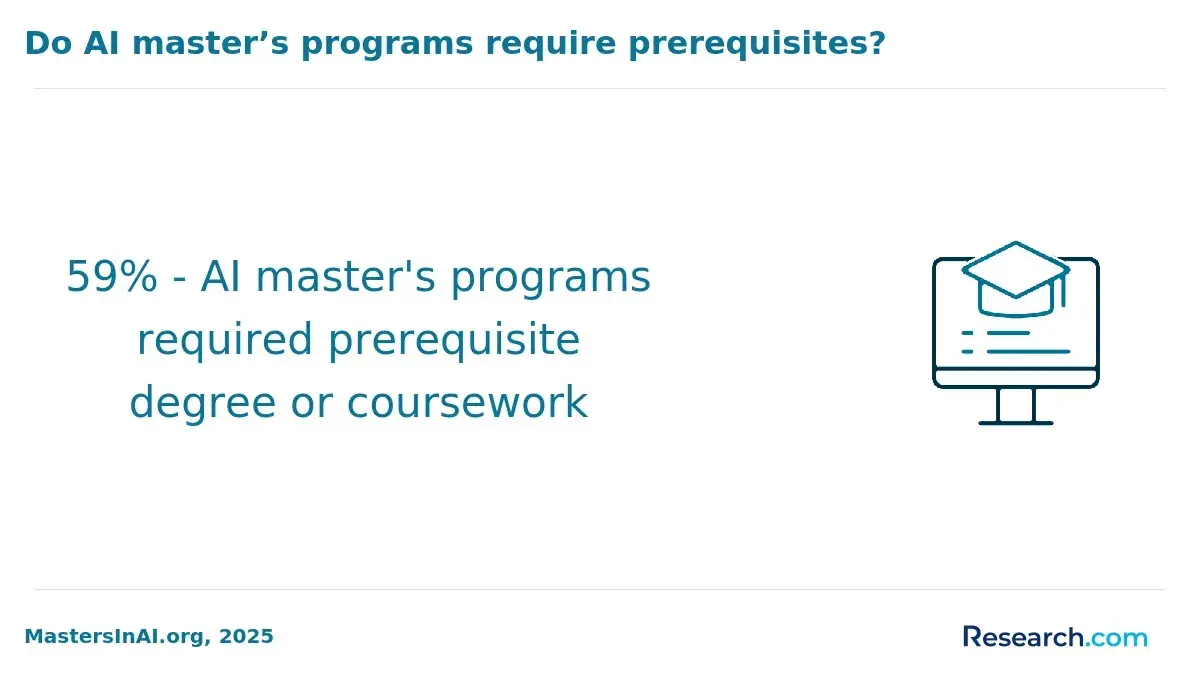
AI master’s admissions requirements vary by program type. Technical artificial intelligence or computer science programs often expect previous coursework in programming, statistics, linear algebra, calculus, discrete mathematics, algorithms, or data structures. Applied AI, analytics, information systems, and technology management programs may be more open to applicants from business or project management backgrounds, especially when they can show quantitative ability and professional experience.
Most programs require a bachelor’s degree. Some prefer STEM-related or quantitative fields such as computer science, engineering, mathematics, statistics, business analytics, or information systems. However, project managers with nontechnical undergraduate degrees may still be competitive if they have relevant work experience, completed prerequisite courses, earned technical certificates, or used data and technology tools in professional settings.
Common application materials
- Official academic transcripts from prior colleges or universities
- A resume showing project leadership, technical exposure, analytics work, product delivery, or process improvement experience
- Letters of recommendation that speak to analytical ability, leadership, communication, and readiness for graduate study
- A statement of purpose explaining why AI fits your project management career goals
- GRE or GMAT scores, if required, or documentation for a waiver if available
- English proficiency scores such as TOEFL or IELTS for many international applicants
Standardized test requirements have become more flexible at many institutions. Some programs still request GRE or GMAT scores, while others offer waivers or use a holistic review process that weighs work experience, leadership, prior coursework, and career goals more heavily. The Graduate Management Admission Council (2024) notes rising trends in AI and data analytics pathways that prioritize applicant potential over test results.
How nontechnical project managers can strengthen an application
- Complete introductory coursework in Python, statistics, data analytics, or machine learning before applying.
- Document projects where you worked with data teams, software teams, automation tools, dashboards, or analytics platforms.
- Use the statement of purpose to connect AI study to a realistic role, such as AI project manager, analytics product manager, or technology transformation lead.
- Ask recommenders to highlight your ability to learn technical material, manage ambiguity, and communicate across business and technical teams.
- Check whether the program offers bridge courses, foundation modules, or conditional admission for students missing technical prerequisites.
Applicants comparing AI-adjacent graduate programs may also want to review online masters data science programs, many of which include AI-related pathways suitable for project managers who want stronger analytics and machine learning fluency.
What core courses and skills will AI master's students learn for managing AI projects?
AI master’s students preparing for project management roles learn two kinds of skills: technical literacy and implementation leadership. Technical literacy helps managers understand what AI systems can and cannot do. Implementation leadership helps them guide teams through planning, development, deployment, monitoring, and adoption.
Core coursework commonly includes AI fundamentals, machine learning applications, data analytics, algorithm design, data management, automation, and model evaluation. For project managers, the value of these courses is practical: they help you understand why data quality affects project scope, why model testing differs from traditional software testing, why AI systems require ongoing monitoring, and why stakeholder expectations must be managed carefully.
Many programs also include AI ethics and governance. This is especially important because AI projects can create risk related to bias, privacy, explainability, security, compliance, and accountability. A project manager who understands these issues can build governance checkpoints into the project plan instead of treating them as last-minute legal or technical concerns.
Skills that matter most in AI project leadership
| Skill area | What students learn to do |
| AI and machine learning literacy | Understand common AI methods, model development workflows, limitations, and evaluation metrics. |
| Data-driven decision-making | Assess data quality, interpret model outputs, and connect analytics results to business decisions. |
| Risk and governance | Identify concerns related to bias, privacy, security, compliance, explainability, and operational impact. |
| AI project lifecycle management | Plan for experimentation, training, validation, deployment, monitoring, updates, and retirement. |
| Cross-functional communication | Translate technical findings for executives, end users, vendors, engineers, and data scientists. |
| Change management | Support adoption, training, workflow redesign, and stakeholder trust when AI changes how work is done. |
The 2024 World Economic Forum Future of Jobs report highlights the importance of systems thinking and technological literacy. Those skills are central to AI project management because AI initiatives rarely affect only one tool or team. They often change processes, decision rights, customer experiences, staffing needs, and risk controls.
Capstone projects, simulations, labs, or industry projects are especially valuable. They allow students to practice setting AI project goals, coordinating technical contributors, defining success metrics, responding to uncertainty, and explaining trade-offs to stakeholders. For project managers, these applied experiences can be more career-relevant than purely theoretical coursework.
How do online AI master's programs compare with on-campus options for working adults?
Online AI master’s programs are often the practical choice for working adults because they reduce relocation and commuting barriers and may allow students to study outside standard business hours. On-campus programs can offer stronger in-person networking, direct access to labs, and more spontaneous faculty and peer interaction. The better option depends on your schedule, learning style, career goals, and need for hands-on support.
Many online programs use asynchronous lectures, discussion boards, recorded demonstrations, virtual labs, and remote collaboration tools. Some also include synchronous sessions for live discussion, group work, or faculty coaching. Hybrid formats combine online coursework with occasional campus visits, residencies, or intensive sessions. According to the EDUCAUSE Horizon Report, these models increasingly incorporate AI-driven instruction and support tools that personalize learning and increase engagement.
Online versus on-campus AI master’s programs
| Factor | Online programs | On-campus programs |
| Schedule flexibility | Usually better for full-time workers, caregivers, and students in different locations. | Often requires attendance at fixed class times and may be harder to fit around work. |
| Networking | Can be strong if the program has live sessions, group projects, active alumni networks, and career support. | Often stronger for face-to-face relationships, campus events, research groups, and informal mentoring. |
| Hands-on learning | Depends on the quality of virtual labs, cloud tools, simulations, and project infrastructure. | May provide easier access to campus labs, research centers, and in-person collaboration. |
| Cost considerations | May reduce commuting, relocation, and some campus-related expenses; tuition policies vary. | May involve higher living or commuting costs, depending on location and enrollment format. |
| Best fit | Working professionals who need flexibility and can stay self-directed. | Students who want immersive campus access, in-person networking, or research involvement. |
Working adults should look beyond the “online” label. The most important questions are whether the program offers meaningful faculty access, realistic AI project work, strong technical support, career services, and opportunities to collaborate with classmates. A flexible format is valuable only if it still provides enough structure to help students master difficult topics such as machine learning, model evaluation, data governance, and AI implementation.
Before enrolling, ask whether students use AI-enabled labs or simulations, whether group work is required, how often live sessions occur, whether career services support online students equally, and whether the diploma or transcript distinguishes the delivery format.
How long do AI master's programs take, and what do they typically cost?
AI master’s programs commonly take two years of full-time study. Accelerated programs can be as short as 12 months, while part-time and flexible programs may take up to three years. Many online options are designed for working professionals and allow completion in two to three years, depending on course load, prerequisites, and capstone requirements.
Project managers should think carefully about pace. A shorter program may get you back to full career momentum sooner, but it can be difficult if you are working full time and learning technical material for the first time. A part-time program may be more manageable, but it can extend the time before you see the full career benefit of the degree.
Tuition varies widely by institution type and program structure. According to National Center for Education Statistics data, private nonprofit institutions generally charge substantially higher annual tuition and fees compared to public universities. Public schools often range from $12,000 to $25,000 per year, while private nonprofit programs can cost $30,000 to $50,000 or more annually.
Cost factors to compare before applying
- Tuition structure: Some schools charge per credit, while others charge by term, year, or program.
- Fees: Technology, online learning, graduation, student services, and lab fees can increase the total cost.
- Prerequisite courses: Students without programming or math preparation may need extra coursework before starting the core degree.
- Time away from work: Full-time study may reduce income if you cut back hours or leave employment.
- Employer tuition assistance: Some students reduce out-of-pocket costs through workplace education benefits.
- Financial aid: Eligibility often depends on institutional accreditation, enrollment status, and program policies.
When comparing programs, calculate the full cost of attendance rather than only the advertised tuition. Include fees, books or software, travel for residencies, possible prerequisite courses, and any income impact from changing your work schedule. Also compare outcomes: a lower-cost program is not automatically better if it lacks applied AI projects, employer recognition, or career support aligned with your goals.
What careers can project managers pursue after earning an AI master's degree?
Project managers who earn an AI master’s degree can pursue roles that sit between technical delivery and business strategy. These jobs often require enough AI knowledge to guide technical teams and enough leadership ability to keep initiatives aligned with organizational goals, budgets, timelines, compliance expectations, and user needs.
Common career paths include AI project manager, data science project manager, analytics product manager, AI operations manager, AI strategy consultant, and AI governance or ethics-focused roles. The right path depends on whether you prefer delivery management, product ownership, consulting, operations, compliance, or executive-facing strategy work.
Career options for AI-skilled project managers
| Role | Typical focus |
| AI project manager | Coordinates AI system development, testing, deployment, stakeholder communication, and delivery milestones. |
| Data science project manager | Manages machine learning, predictive analytics, reporting, and data product initiatives. |
| Analytics product manager | Translates user needs and business goals into data- or AI-enabled product features. |
| AI strategy consultant | Helps organizations identify practical AI use cases, build roadmaps, and manage transformation efforts. |
| AI operations manager | Oversees deployed AI systems, performance monitoring, vendor coordination, compliance, and process integration. |
| AI ethics officer | Focuses on responsible AI use, bias mitigation, governance, transparency, and accountability practices. |
These roles are valuable because many organizations have technical AI talent but still struggle to deliver AI projects reliably. A project manager who understands data dependencies, model uncertainty, evaluation metrics, user adoption, and governance can reduce miscommunication between executives, engineers, data scientists, vendors, legal teams, and business units.
Demand for AI-adjacent skills is supported by broader labor market trends. Employment for data scientists is expected to grow 35% from 2022 to 2032, according to the U.S. Bureau of Labor Statistics. While that figure refers to data scientists rather than project managers specifically, it signals strong demand for professionals who can help organizations use data and machine learning effectively.
To improve career mobility, students should use the master’s program to build a portfolio of applied projects, not just a transcript. Capstones, case studies, dashboards, implementation plans, governance frameworks, and measurable project outcomes can help demonstrate readiness for AI leadership roles.
What salary ranges can AI-skilled project managers expect in the U.S.?
AI-skilled project managers in the U.S. can often command higher pay than project managers without AI or analytics expertise, especially when they manage complex technical programs, cross-functional data teams, or AI products in regulated or high-growth sectors. According to data from the Dice Tech Salary Report, AI-focused project managers in the U.S. typically make between $95,000 and $145,000 annually, depending on experience, location, industry, and scope of responsibility.
Entry-level professionals often start between $95,000 and $110,000. Mid-career managers overseeing AI or machine learning projects usually earn $115,000 to $130,000. Senior project managers responsible for complex AI programs at major tech firms or financial institutions can surpass $140,000.
Compensation is not uniform. Healthcare and autonomous vehicle sectors tend to offer higher salaries because AI work in those fields can involve advanced technology, safety concerns, sensitive data, and regulatory demands. Tech hubs including San Francisco, Seattle, and New York pay 10% to 20% above national averages, though higher living costs may offset part of that advantage.
Salary factors to evaluate
- Experience level: Senior managers with a track record of delivering AI, analytics, or software programs usually have stronger earning power.
- Technical fluency: Familiarity with AI frameworks, data pipelines, model evaluation, and cloud-based tools can strengthen compensation negotiations.
- Industry: Finance, healthcare, technology, and autonomous systems may pay more for AI project leadership.
- Location: Salaries can rise in major tech markets, but cost of living should be considered.
- Scope of responsibility: Managing a single project is different from leading a portfolio, transformation program, or enterprise AI governance initiative.
- Credentials: An advanced degree, project management certification, AI coursework, and security or governance credentials can support advancement.
Salary data should be treated as a planning range, not a guarantee. Before enrolling in a program, compare expected earnings with tuition, fees, time to completion, current salary, employer support, and the likelihood that the degree will help you move into a higher-value role.
Which certifications complement an AI master's degree for project managers?
Certifications can complement an AI master’s degree by proving targeted skills that employers often look for in project leadership roles. A master’s degree signals graduate-level study and broader expertise; certifications can add evidence of project management discipline, cybersecurity awareness, governance knowledge, or hands-on familiarity with specific AI platforms.
The strongest certification mix depends on your target role. A project manager leading AI delivery may prioritize PMP plus AI-specific training. A manager working on AI governance, privacy, or risk may benefit from security and information systems credentials. The ISC2 Cybersecurity Workforce Study reveals a substantial global shortage in cybersecurity talent, which makes security fluency especially useful for AI projects involving sensitive data, regulated environments, or enterprise risk.
Certifications to consider
- Project Management Professional (PMP): A widely recognized project management credential that strengthens credibility in planning, execution, risk, stakeholder management, and organizational leadership.
- Certified Information Systems Security Professional (CISSP): A globally recognized cybersecurity credential that can help project managers understand how to protect AI projects involving sensitive systems or data.
- Certified Information Security Manager (CISM): Useful for managers responsible for governance, risk management, compliance, and security oversight in AI-enabled environments.
- Certified Ethical Hacker (CEH): Provides exposure to system vulnerabilities and security testing concepts, which can help managers understand technical risk discussions.
- AI-specific certifications: Options such as PMI's AI Project Manager Certification or courses from Microsoft and Google can deepen knowledge of AI tools, implementation practices, and platform-specific workflows.
Do not collect certifications without a strategy. Choose credentials that match the roles you want and the gaps in your background. For example, a nontechnical project manager may start with AI fundamentals and PMP, then add a cloud or security credential later. A technology project manager already holding PMP may gain more value from AI governance, machine learning operations, or cybersecurity-focused certifications.
The best profile combines three signals: graduate-level AI understanding, proven project leadership, and credible knowledge of risk, governance, and implementation. That combination can help project managers lead AI initiatives with more confidence and reduce organizational exposure to avoidable technical, ethical, and operational failures.
Other Things You Should Know About Artificial Intelligence
Most 2027 programs require either a capstone project or a thesis to finish the degree. Capstones are often 6 to 9 credits and involve an applied AI project with project-management methods. Thesis tracks usually need faculty approval and a formal research proposal before final submission.
To enroll, candidates typically need a bachelor's degree in a relevant field, such as computer science or engineering, and at least two years of project management experience. Some programs may also require a GRE score and proficiency in programming languages like Python.
Graduates with a 2027 AI Master's Degree focused on project management can pursue careers as AI project leads, technology consultants, or AI implementation managers. Industries such as finance, healthcare, and technology frequently seek experts for roles guiding AI-driven projects and transformational initiatives.
AI master's degrees for project managers focus on leadership and managing AI initiatives, with coursework emphasizing collaboration and ethical considerations. In contrast, general AI programs delve deeper into technical AI development. For finance-focused studies, consider an AI finance master’s.
References
- Application and admission - Master Artificial Intelligence https://www.uva.nl/shared-content/programmas/en/masters/artificial-intelligence/application-and-admission/international-prior-education/international-prior-education-foldout-menu.html
- M.SC. IN Artificial Intelligence https://put.poznan.pl/msc-artificial-intelligence
- Best AI Project Management Courses: 2025 Guide https://www.techademy.com/ai-project-management-courses
- Online vs On-Campus Artificial Intelligence Degrees: Which Is Better? https://hakia.com/degrees/artificial-intelligence/online-vs-campus/
- Who Accredits Artificial Intelligence (AI) Degree Programs? - AI Degrees Online https://aidegreesonline.com/accreditation/who-accredits-ai-degree-programs/
- Top 10 Careers You Can Pursue With an Online Master’s in AI https://www.ucumberlands.edu/blog/careers-you-can-pursue-with-an-online-masters-in-ai
- Ultimate Guide: How to Choose the Right AI Training Course to Boost Your Career - ONLC https://www.onlc.com/blog/how-to-choose-ai-training-courses/
- 10 AI Courses to Master Artificial Intelligence in 2025 | DigitalOcean https://www.digitalocean.com/resources/articles/ai-courses
- Ai Project Manager Salary - April 2026 https://www.comparably.com/salaries/salaries-for-ai-project-manager
- New Use of Artificial Intelligence Accreditation Policy and Procedures - Middle States Commission on Higher Education https://www.msche.org/2025/07/02/new-use-of-artificial-intelligence-accreditation-policy-and-procedures/