2027 Generative AI Training in AI Bachelor's Programs

Co-Founder and Chief Data Scientist
Many students with non-technical backgrounds face challenges entering the fast-growing AI industry due to gaps in foundational knowledge, especially in generative AI technologies dominating current markets. Traditional bachelor's programs often lack updated curricula that address practical, hands-on skills with generative AI tools and models. This deficiency limits graduates' competitiveness in job markets shaped by rapid AI advancements.
Understanding how AI bachelor's programs in 2027 integrate generative AI training helps prospective students identify flexible, accredited pathways for effective career pivoting. This article explores evolving curricula, skill-building approaches, and program structures designed to bridge education and real-world AI applications.
Key Things You Should Know
- By 2026, over 70% of U.S. bachelor's programs in AI include generative AI training, reflecting industry demand for skills in natural language processing and image generation.
- Curricula increasingly integrate hands-on projects using generative AI frameworks like GPT-4 and diffusion models, ensuring graduates' practical proficiency and innovation readiness.
- Programs emphasize ethical AI use and explainability, with about 65% requiring dedicated coursework on responsible generative AI deployment and bias mitigation strategies.
What is generative AI training and why is it becoming essential in AI bachelor's degree programs?
Generative AI training in AI bachelor's degree programs focuses on enabling students to build and apply models that generate new content, such as text, images, audio, and code. This encompasses mastering neural network architectures including transformers, variational autoencoders, and generative adversarial networks. Alongside technical skills, students explore ethical considerations, dataset curation, and deployment techniques. The importance of generative AI education for AI bachelor's degrees is underscored by its projected $15.7 trillion contribution to global economic output by 2030, highlighting a growing need for skilled innovators in this sector.
Many AI bachelor's programs now include specialized generative AI modules aimed at preparing students for real-world applications across industries such as content creation, healthcare, and software development. Training often balances theory with practical experience using tools like TensorFlow, PyTorch, and OpenAI APIs. For example, students learn to fine-tune language models for chatbots or generate synthetic medical images to improve diagnostics.
Graduates must understand how to optimize models for efficiency while addressing challenges such as bias and hallucination. Increasingly, programs emphasize ethical frameworks and regulatory compliance to meet industry expectations for immediate contribution to AI product development and innovation. Prospective students and professionals should consider enrolling in programs with strong generative AI components to gain a competitive edge in emerging career paths.
For those exploring educational options, reviewing the prospects of an artificial intelligence major provides insight into how generative AI expertise aligns with evolving job markets and research opportunities.
Which accredited universities offer bachelor's degrees with specialized generative AI training?
Several top accredited universities now embed specialized generative AI training into bachelor's curricula within computer science or related fields. Carnegie Mellon University offers a Bachelor of Science in Computer Science featuring courses on generative models, deep learning architectures, and natural language processing. Stanford University integrates hands-on projects focused on generative AI, addressing creative applications and ethical considerations. The Massachusetts Institute of Technology (MIT) incorporates generative AI theory and practice through advanced electives in its Electrical Engineering and Computer Science bachelor's program.
The University of California, Berkeley emphasizes generative AI in its artificial intelligence track, combining coursework with labs designing generative adversarial networks (GANs) and diffusion models. Georgia Institute of Technology's Bachelor of Science in Computer Science includes specialized classes on generative AI algorithms for multimedia and robotics. These programs exemplify the growing availability of generative AI bachelor's degree programs in accredited universities.
A 2024 Computing Research Association survey indicates that over 60% of top-ranked computer science programs incorporated generative AI content recently. Prospective students should focus on curricula emphasizing generative methods like GANs, transformers, and autoencoders over general AI coverage. Look for degrees offering practical skills with frameworks such as TensorFlow or PyTorch and substantial project work aligning with career goals in machine learning engineering, AI research, or creative AI development.
Many institutions also offer minors or certificates in generative AI to supplement traditional degrees. Those exploring options may find useful insights in the data science major ranking for affordable programs related to AI studies.
What specific generative AI skills and tools do bachelor's programs teach students?
Bachelor's programs teaching generative AI programming languages and frameworks emphasize practical skills essential for real-world applications. Students primarily use Python, the leading language required in 89% of generative AI job listings, along with frameworks like TensorFlow and PyTorch to build neural networks, transformers, and large language models. These core generative ai tools and methodologies covered in undergraduate AI degrees include data preprocessing, model training, and fine-tuning for tasks such as text generation, image synthesis, and conversational agents.
Programs also integrate Hugging Face's Transformers library, allowing hands-on experience with pre-trained models and cutting-edge architectures without starting from scratch. Additionally, coursework covers prompt engineering and evaluation metrics like BLEU and ROUGE, key to designing effective generative AI outputs. Exposure to cloud platforms such as AWS and Google Cloud supports scalable model training, reflecting industry workflow demands.
Students work with generative adversarial networks (GANs) for creating images and audio, gaining insight into model biases and ethical issues tied to generative AI output. Practical projects often involve chatbots, automated content creators, or AI art generators. This comprehensive skill set aligns closely with the technical challenges of today's AI roles, focusing on coding, model manipulation, and deployment.
Prospective students should consider how well programs integrate these tools alongside strong Python instruction. For those exploring further education options, sites offering an AI masters degree provide valuable resources for advancing careers in this dynamic field.
How do online AI bachelor's programs with generative AI focus compare to campus-based options?
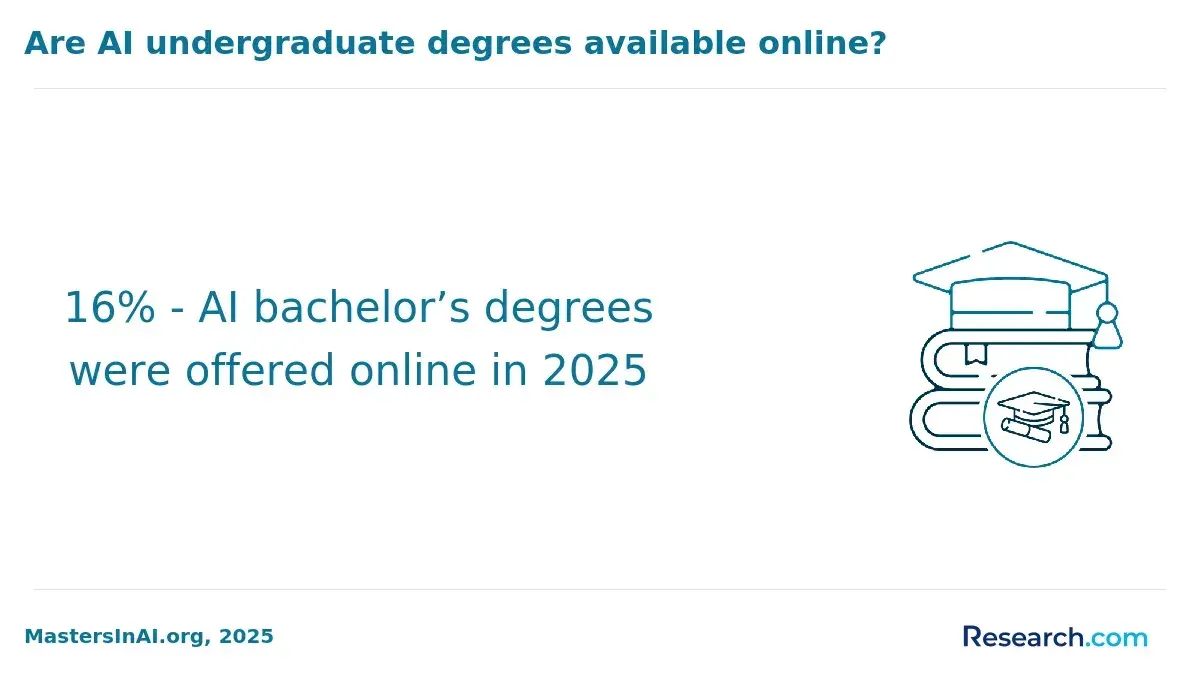
Online AI bachelor's programs with generative AI specialization offer significant flexibility, supporting working professionals and remote learners through asynchronous coursework and digital collaboration. This model allows students to balance education with employment or personal commitments. In contrast, campus-based AI bachelor's degrees focused on generative AI often provide hands-on learning via in-person labs, direct faculty interaction, and peer networking, which can enhance practical and professional skills.
Many top universities now integrate advanced generative AI topics such as large language models, prompt engineering, and ethical considerations in their programs, regardless of delivery method. Online programs increasingly use cloud-based platforms to simulate lab environments and promote project-based learning comparable to traditional labs. Prospective students should evaluate faculty expertise, technical support, and available resources when choosing between formats.
Campus students benefit from immediate access to physical resources like GPUs and AI research groups, which can speed skill development. However, the rapid growth in online STEM enrollments-34% growth in AI and machine learning fields-reflects rising quality and acceptance of virtual education. Students interested in combining flexibility with an online cybersecurity degree or AI specialization will find expanding options.
Choosing between online or campus study depends on priorities: structured environments and campus life favor onsite programs, while flexibility and geographic independence favor online degrees. Confirming program accreditation and dedicated AI faculty is crucial regardless of format.
What are the typical admission requirements and prerequisites for AI bachelor's programs emphasizing generative AI?
Applicants to AI bachelor's programs focused on generative AI need strong foundations in mathematics and computer science. Proficiency in calculus, linear algebra, probability, and statistics is essential since these subjects support machine learning algorithms and neural network design. High school completion of advanced math courses like pre-calculus or calculus, paired with programming experience in languages such as Python or Java, is commonly required.
Competitive programs also look for problem-solving abilities and analytical thinking. These skills can be demonstrated through SAT or ACT math and science scores, coding competitions, or portfolios highlighting relevant projects. Candidates without a formal computer science background often must complete preparatory bridge courses. Many universities provide pre-college or summer boot camps that emphasize programming fundamentals and discrete math to satisfy entry requirements.
Entrance interviews and personal statements are increasingly used to assess motivation and conceptual understanding of AI, allowing faculty to gauge readiness for complex generative AI coursework involving model training and data manipulation. According to a 2024 Glassdoor analysis, students with strong math skills earn 18% higher starting salaries in AI roles, underscoring the importance of quantitative proficiency for both admission success and career advancement.
How long does an AI bachelor's degree take, and what is the average tuition cost?
An AI bachelor's degree usually requires four years of full-time study at most U.S. universities. The curriculum combines foundational subjects such as computer science, data structures, and mathematics with specialized courses in machine learning, natural language processing, and robotics, reflecting the evolving integration of AI technologies into academic programs.
Costs vary widely depending on the type of institution. Private universities typically charge between $120,000 and $180,000 in tuition over four years for computer science degrees, which closely align with AI-focused programs. Public universities offer more affordable tuition, with in-state students paying between $40,000 and $60,000 total, while out-of-state fees tend to be higher but generally remain below private school rates.
Alternative formats like part-time study, online degrees, or accelerated three-year programs exist. These can reduce time and cost but may limit the depth of AI specialization or access to research opportunities. Students should weigh tuition expenses alongside financial aid options, curriculum content, and institutional ties to the AI industry before deciding.
Graduates from research-intensive universities often face higher tuition but benefit from access to advanced labs and internship programs, enhancing their career readiness. In contrast, lower-cost programs deliver solid AI fundamentals but might require additional certifications or graduate education for competitive advantage in rapidly advancing fields.
What career roles and job titles do graduates with generative AI training pursue after graduation?
Graduates trained in generative AI often pursue careers such as AI engineer, machine learning engineer, data scientist, and research scientist. These roles involve designing and optimizing generative models for applications like natural language processing, computer vision, and automated content generation. AI engineers focus on building scalable systems, while machine learning engineers specialize in training algorithms. Data scientists apply generative AI to analyze data and develop predictive models, and research scientists work on advancing foundational AI technologies within academia or corporate labs.
Other career options include AI product manager, who guides AI project deployment, and AI software developer, responsible for implementing AI algorithms in applications. Some graduates become AI consultants, advising companies on effective adoption of generative AI. Specialized roles such as computational linguist or AI ethicist address language-specific challenges and ethical issues in AI systems.
The U.S. Bureau of Labor Statistics notes a 74% increase in AI and machine learning engineer job postings from 2022 to 2024, signaling strong demand. Employers seek professionals skilled in frameworks like GPT and diffusion models, cloud platforms, Python, TensorFlow, and PyTorch. Practical experience with project portfolios showcasing generative AI solutions is highly valued.
Understanding ethical implications and AI governance is essential, as responsible deployment gains priority. Those aiming for research roles should pursue advanced degrees or internships in AI labs for competitive advantage.
What is the salary outlook and job growth rate for AI graduates with generative AI expertise?
AI graduates skilled in generative AI enjoy a strong salary outlook and notable job growth. Payscale's 2024 Salary Report shows AI specialists earn an average of $164,000 annually, a 35% increase since 2022. This surge is driven by demand for expertise in generative models, such as large language models and advanced image generation. Industries including technology, healthcare, finance, and media actively recruit professionals to develop, fine-tune, and implement generative AI solutions.
The U.S. Bureau of Labor Statistics forecasts a 23% growth rate for computer and information research scientists between 2022 and 2032, fueled by AI advancements. Graduates trained in generative AI are well-positioned for growth in research, development, and deployment of cutting-edge AI tools. Emerging roles include generative model engineers, AI ethics consultants, and prompt engineering experts.
Students should gain hands-on experience with generative AI frameworks and contribute to open-source projects to boost their employability. Combining generative AI skills with domain expertise in natural language processing or computer vision enhances competitiveness. Keeping up with industry trends is vital, especially in responsible AI practices and model interpretability, which are increasingly important for compliance and trust.
What professional certifications or credentials complement a generative AI-focused bachelor's degree?
Professional certifications enhance the value of a generative AI-focused bachelor's degree by validating skills and boosting employability. A survey by the IEEE Computer Society found that 86% of AI professionals hold at least one credential beyond their undergraduate degree, underscoring their role in the job market.
Key certifications include the Certified Artificial Intelligence Practitioner (CAIP), which emphasizes AI implementation and ethics, and the TensorFlow Developer Certificate, focusing on hands-on deployment of machine learning models. The Microsoft Certified: Azure AI Engineer Associate credential targets cloud-based AI expertise, especially relevant for those working with natural language processing and generative models.
Additional credentials like the Certified Data Scientist or Machine Learning Engineer certifications from authorities such as the Data Science Council of America (DASCA) and Google strengthen foundational AI knowledge related to data management and algorithm optimization.
Choosing the right certification depends on career goals. Roles in AI research or software development benefit from credentials centered on algorithm design and cloud integration, while industry positions favor certifications highlighting AI ethics, compliance, and real-world deployment.
Graduates may face challenges demonstrating practical skills despite academic qualifications. Project-based certification assessments help bridge this gap by showcasing problem-solving and implementation abilities, making candidates more competitive in the AI job market.
How should prospective students evaluate and compare AI bachelor's programs based on generative AI curriculum quality?
Prospective students should assess AI bachelor's programs by examining the depth and practical focus of their generative AI curriculum. Prioritize those offering hands-on projects, labs, or capstone courses centered on generative models like transformers, GANs, and diffusion networks. This approach reflects findings from the National Association of Colleges and Employers (NACE), where 73% of hiring managers value practical skills and portfolios over credentials.
Compare programs for inclusion of contemporary generative AI frameworks such as TensorFlow, PyTorch, or Hugging Face. Strong curricula allow students to build real-world applications and often include interdisciplinary courses merging AI with natural language processing, computer vision, or ethics-key areas for generative AI mastery.
Evaluate faculty expertise by reviewing their research and industry engagements, as instructors involved in active generative AI research or consulting offer more current insights. Also, look for partnerships with AI companies or research labs that support internships or collaborative projects, enhancing experiential learning.
Beyond course titles, analyze syllabi and project scopes. Effective programs enable students to develop end-to-end generative AI systems with diverse applications, preparing graduates for varied employer demands. Lastly, verify alumni success through direct contacts or career services to confirm positive recruiter evaluations of graduates' portfolios.
Other Things You Should Know About Artificial Intelligence
In 2027, generative AI significantly influences AI bachelor's curricula by introducing courses focused on machine learning models, deep learning, and computational creativity. Programs emphasize practical applications like content creation and ethical implications, preparing students for careers in AI industries driven by generative technologies.
Many AI bachelor's programs combine computer science with fields such as mathematics, statistics, psychology, and even philosophy. This interdisciplinary approach helps students grasp the broader context of AI technologies, including human cognition and ethical decision-making. It equips students with diverse skills to tackle complex AI problems from multiple perspectives.
Hands-on experience in AI bachelor's programs usually includes projects involving machine learning, natural language processing, and robotics. Students often work with real datasets and use popular AI frameworks and programming languages like Python and TensorFlow. Internships and capstone projects provide practical exposure to industry applications and research.
Yes, many universities encourage AI bachelor's students to participate in research projects, often collaborating with faculty members on cutting-edge topics. These opportunities allow students to deepen their understanding, contribute to advancements in AI, and build a competitive academic or professional profile. Research experiences can also lead to presentations, publications, and further academic pursuits.
References
- Artificial Intelligence (procedure for non-EU students) https://apply.unipv.eu/enter/295
- These 14 colleges offer bachelor's degrees in AI—including one Ivy League school https://www.cnbc.com/2025/01/22/colleges-that-offer-bachelors-degrees-in-ai.html
- Generative AI Tools That Help Students Study Better https://www.eduailast.com/blogs/generative-ai-tools-that-help-students-study-better.php
- Best AI Certifications in 2025 https://cpoclub.com/career/best-ai-certifications/
- Best AI Bachelor's Degrees - AIDegreeProgams.org https://aidegreeprograms.org/rankings/best-ai-bachelor-degrees/
- What is Generative AI? | NVIDIA https://www.nvidia.com/en-us/glossary/generative-ai/
- Cost to Study Artificial Intelligence in 2026 https://checkmateittech.com/cost-to-study-artificial-intelligence-usa/
- Generative AI: The Top 7 BS and MS Programs Revolutionizing Education | Powerful Takeaways https://ivycrackers.com/top-7-bs-and-ms-programs-generative-ai/
- 40 Best Colleges in the U.S. for Artificial Intelligence (Undergraduate) https://www.greatvaluecolleges.net/artificial-intelligence-colleges/
- Artificial Intelligence admission requirements in detail https://www.srh-university.de/en/master/bls/information-technology-artificial-intelligence/artificial-intelligence-admission-requirements-in-detail/