
2027 AHIMA vs. AAPC Certifications: Explaining the Difference

Co-Founder and Chief Data Scientist
Health information management is essential to the success of patients and the healthcare industry. For instance, skilled medical coders or billers help ensure that patients are properly reimbursed for their medical expenses through insurance claims.
Earning reputable credentials, such as certifications offered by the American Health Information Management Association (AHIMA) and the American Academy of Professional Coders (AAPC), may prepare aspirants to become an effective health information management professional.
To help prospective professionals get started, I created this in-depth guide to the differences between an AHIMA certification and an AAPC certification. Explore types of certifications, the cost of getting certified, and the jobs you can be qualified for with these credentials.
Key Things You Should Know about AHIMA and AAPC Certifications
- Professionals in the field of health information management help reduce errors in medical records and support regulatory compliance. They also maintain reliable health information for research, policy development, and patient-outcome improvement.
- In May 2024, medical records specialists in the US, including those with an AHIMA certification and an AAPC certification, had a median annual wage of $50,250 [US Bureau of Labor Statistics (BLS), 2025].
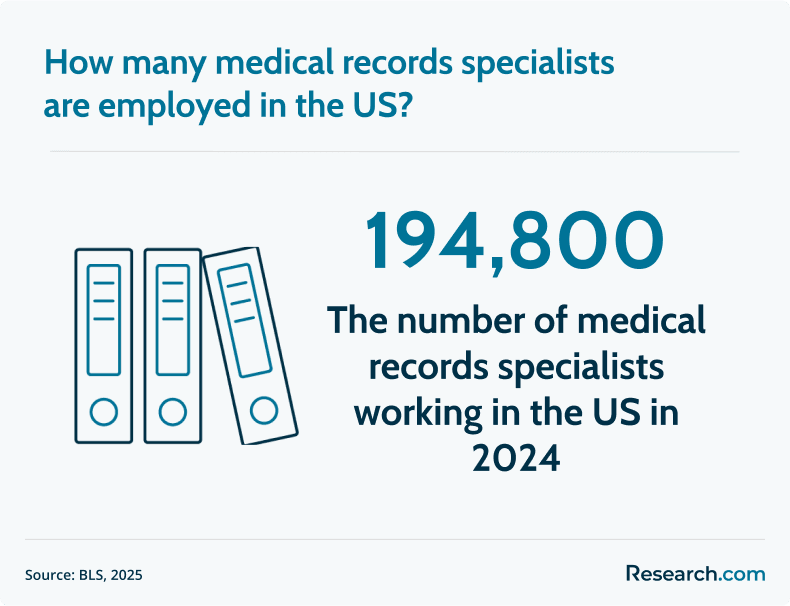
- From 2024 to 2034, employment for medical records specialists across the country is expected to increase by 7%, which is much faster than the average job outlook for all US occupations during the same period (US BLS, 2025).
- What is the difference between AHIMA and AAPC? AHIMA vs AAPC
- What certifications does AHIMA provide? AHIMA Certifications
- What certifications does AAPC provide? AAPC Certifications
- How do AHIMA certifications compare to AAPC certifications? AHIMA vs AAPC Certifications
- How much do AHIMA and AAPC certifications cost? Cost of Certification
- What are the differences between the examination formats of an AHIMA certification and a AAPC certification? What are the differences between the examination formats of an AHIMA certification and a AAPC certification?
- What jobs can I get with an AHIMA certification or an AAPC certification? Available Jobs
- How often do you need to recertify for an AHIMA certification vs an AAPC certification? How often do you need to recertify for an AHIMA certification vs an AAPC certification?
- What continuing education (CE) requirements do AHIMA and AAPC certifications have? What continuing education (CE) requirements do AHIMA and AAPC certifications have?
- Which certification do employers prefer: AHIMA or AAPC? Which certification do employers prefer: AHIMA or AAPC?
AHIMA vs. AAPC: Which Certification Path Should You Choose?
Choosing between AHIMA and AAPC is one of the first major decisions many future medical coders, billers, auditors, and health information professionals face. Both organizations are widely recognized in healthcare, but they are not identical. AHIMA is more closely tied to health information management, facility coding, data quality, privacy, and healthcare records governance. AAPC is especially known for physician-based coding, billing, auditing, compliance, and practice operations.
This guide explains how the American Health Information Management Association and the American Academy of Professional Coders differ, what each organization’s credentials are designed to prove, how exams and costs compare, and which option may better fit your career goals. It is written for students, career changers, and working healthcare staff who want a practical answer before investing time and money in a certification path.
Quick answer: AHIMA vs. AAPC
AHIMA is often the stronger fit for people interested in health information management, hospital coding, data integrity, medical records, privacy, and healthcare information systems. AAPC is often the stronger fit for people pursuing physician-office coding, medical billing, auditing, revenue cycle work, practice management, or compliance roles. Employers may value either credential, but the better choice depends on the setting, job title, and type of coding or health information work you want to do.
| Decision point | AHIMA may fit better if... | AAPC may fit better if... |
| Primary career goal | You want to work in health information management, facility coding, records quality, or healthcare data roles. | You want to work in physician coding, billing, auditing, revenue cycle, or practice operations. |
| Work setting | You are targeting hospitals, health systems, long-term care, mental health facilities, pharmaceutical companies, or data-focused healthcare organizations. | You are targeting physician offices, group practices, clinics, billing companies, payers, or compliance departments. |
| Credential focus | Medical coding, HIM, privacy and security, data analytics, and documentation. | Medical coding, billing, auditing, practice management, healthcare compliance, and documentation. |
| Best first question to ask | Do local employers request CCA®, CCS®, CCS-P®, RHIT®, or RHIA®? | Do local employers request CPC®, CPB®, CPMA®, CPPM®, or CPCO®? |
AHIMA credentials cover these major areas:
- Medical coding
- Health information management
- Privacy and security
- Data analytics
- Clinical documentation
AAPC credentials are centered on these areas:
- Medical coding
- Medical billing
- Medical auditing
- Practice management
- Healthcare compliance
What Certifications Does AHIMA Offer?
AHIMA’s certification portfolio includes credentials for medical coding, health information management, privacy and security, data analytics, and documentation-related roles. The best-known options include entry-level coding credentials, advanced coding credentials, and HIM credentials connected to records quality, information governance, and administrative leadership.
Certified Coding Associate (CCA®)
The CCA® is an entry-level coding credential that tests a candidate’s understanding of clinical classification systems, reimbursement concepts, patient health information, and related coding fundamentals. Candidates pursuing the CCA® need a high school diploma and must pass the CCA® examination.
Certified Coding Specialist (CCS®)
The CCS® is a more advanced coding credential than the CCA®. It is designed for professionals who can code both inpatient and outpatient records used by healthcare providers and facilities for reimbursement from insurance companies and government programs, including Medicare and Medicaid.
Certified Coding Specialist—Physician-based (CCS-P®)
The CCS-P® focuses on physician-based coding environments. Professionals who already hold a CCA® or CCS® may pursue this credential. CCS-P®-certified professionals support the financial operations of physicians’ offices, group practices, and multi-specialty clinics by helping connect documented care with payer and government reimbursement requirements.
Registered Health Information Technician (RHIT®)
The RHIT® credential is intended for professionals who help maintain the quality of medical records. RHIT®-certified workers review health records for accuracy, completeness, and proper entry. They may work in hospitals, physicians’ offices, nursing homes, mental health facilities, pharmaceutical companies, and other healthcare-related organizations.
Registered Health Information Administrator (RHIA®)
The RHIA® credential demonstrates preparation in health information management, operations, staff coordination, and budget-related responsibilities. RHIA® professionals often collaborate with clinical, financial, administrative, and information systems teams because health information affects nearly every part of a healthcare organization.
What Certifications Does AAPC Offer?
AAPC certifications span medical coding, billing, auditing, compliance, practice management, and documentation. AAPC is particularly well known among professionals who work with physician services, payer rules, claims, compliance reviews, and revenue cycle operations.
Certified Professional Coder (CPC)®
The CPC® is one of AAPC’s most recognized credentials for medical coding. The exam evaluates coding skills for services performed by physicians and non-physician providers. CPC®-certified professionals are expected to understand documentation review, professional provider encounters, CPT®, HCPCS Level II, ICD-10-CM, and regulatory compliance requirements.
Certified Professional Biller (CPB)®
The CPB® credential is built for professionals who handle medical billing and insurance claims. CPB®-certified workers support revenue-cycle management through patient billing, payer billing, collections, and compliance with government and private payer policies.
Certified Professional Medical Auditor (CPMA)®
The CPMA® is designed for professionals who review coding, documentation, and compliance risk. CPMA®-certified professionals help healthcare practices evaluate revenue-cycle accuracy, identify coding risks, and present findings from quality-assurance reviews and coding audits.
Certified Physician Practice Manager (CPPM)®
The CPPM® credential is intended for professionals who manage business operations in medical practices. It covers areas such as health information, revenue cycle, and compliance. Coders and billers who want to move into supervisory or practice leadership roles may consider the CPPM®.
Certified Professional Compliance Officer (CPCO)®
The CPCO® credential is for professionals focused on healthcare compliance. It signals knowledge of government regulations, fraud and abuse laws, and industry standards. CPCO®-certified professionals may help build compliance programs, identify risks in coding, billing, and documentation, recommend corrective actions, and monitor outcomes.
If you are still building basic coding and billing skills, an academic or career-training program can help you prepare before sitting for a credentialing exam. Many students start with fast online medical billing and coding certificate programs because these programs are designed to cover foundational terminology, coding systems, claims workflows, and exam preparation in a shorter format.
How Do AHIMA and AAPC Certifications Compare?
AHIMA and AAPC credentials overlap in several areas, especially medical coding, documentation review, billing-related knowledge, quality assurance, and healthcare compliance. The difference is not that one organization is “good” and the other is “bad.” The difference is that they tend to align with different job environments and professional tracks.
For example, AAPC’s Certified Professional Coder (CPC)® and AHIMA’s Certified Coding Associate (CCA®) and Certified Coding Specialist (CCS®) all require candidates to demonstrate coding knowledge. However, the practical emphasis may differ based on whether the role is connected to physician services, facility records, inpatient/outpatient coding, or broader health information management.
AHIMA’s Certified Coding Specialist (CCS®) also includes knowledge relevant to billing and reimbursement. By contrast, AAPC separates billing into a dedicated credential, the Certified Professional Biller (CPB)®, for professionals who want to specialize in claims, payer billing, collections, and revenue-cycle processes.
Both organizations also offer pathways beyond entry-level coding. For quality assurance and audit-focused work, AHIMA’s RHIT® can support records-quality responsibilities, while AAPC’s CPMA® is more directly tied to medical auditing. For leadership, AHIMA offers the RHIA®, while AAPC offers the CPPM®. These are among the most common medical billing and coding exam and certification options students compare when planning a healthcare administration career.
| Career direction | Relevant AHIMA credential examples | Relevant AAPC credential examples | How to choose |
| Entry-level medical coding | CCA® | CPC® | Review local job postings to see whether employers mention AHIMA or AAPC more often for entry-level coder roles. |
| Advanced coding | CCS®, CCS-P® | CPC® and related specialty credentials | Choose based on whether you want facility/inpatient-outpatient coding or physician/practice-based coding. |
| Medical billing | CCS® includes reimbursement-related knowledge | CPB® | AAPC may be more direct if your target job title includes “biller” or “billing specialist.” |
| Auditing and quality review | RHIT® | CPMA® | AHIMA may fit records-quality roles; AAPC may fit coding audit and documentation review roles. |
| Leadership and operations | RHIA® | CPPM® | RHIA® is more HIM-oriented; CPPM® is more practice-management-oriented. |
Timeline also matters. If you are asking, how long it takes to become a medical coder, the answer depends on your education level, preparation program, exam choice, transfer credits, study pace, and whether you pursue a short-term certificate or a longer degree pathway.
How Much Do AHIMA and AAPC Certifications Cost?
Certification cost is one of the easiest factors to compare, but it should not be the only factor. Candidates should also consider membership fees, exam retake policies, preparation materials, practice exams, continuing education costs, and the type of jobs available in their local market.
AHIMA certification exam fees range from $229 to $399, with lower prices for members. The Certified Coding Associate (CCA) exam costs $299 for non-members and $199 for members. Advanced AHIMA coding exams, including the Certified Coding Specialist (CCS) and Certified Coding Specialist–Physician-based (CCS-P), cost $399 for non-members and $299 for members.
The Registered Health Information Technician (RHIT) and Registered Health Information Administrator (RHIA) exams cost $299 for non-members and $229 for members.
AAPC’s core certification exams, including Certified Professional Coder (CPC), Certified Professional Biller (CPB), and Certified Professional Medical Auditor (CPMA), cost $399 for one attempt and $499 for two attempts. Student pricing is $375 for one attempt and $475 for two attempts.
| Organization | Credential or exam category | Cost stated | Cost note |
| AHIMA | Certified Coding Associate (CCA) | $299 for non-members and $199 for members | Membership status affects the exam fee. |
| AHIMA | Certified Coding Specialist (CCS) | $399 for non-members and $299 for members | Advanced coding credential pricing is higher than the CCA. |
| AHIMA | Certified Coding Specialist–Physician-based (CCS-P) | $399 for non-members and $299 for members | Designed for physician-based coding. |
| AHIMA | Registered Health Information Technician (RHIT) | $299 for non-members and $229 for members | Credential tied to health information and records quality work. |
| AHIMA | Registered Health Information Administrator (RHIA) | $299 for non-members and $229 for members | Credential tied to HIM leadership and administration. |
| AAPC | CPC, CPB, and CPMA core exams | $399 for one attempt and $499 for two attempts | Two-attempt pricing may reduce risk if you are unsure about passing on the first try. |
| AAPC | Student exam pricing | $375 for one attempt and $475 for two attempts | Student pricing can lower the upfront exam cost. |
Before paying for an exam, calculate the full cost of the pathway rather than the exam fee alone. Include coursework, books, coding manuals, practice tests, membership fees, retake costs, and continuing education. The decision is similar to comparing long-term educational investments such as a DBA and MBA salary comparison: the value depends on the specific credential, your career goal, and how employers in your target field view that credential.
The chart below visualizes AHIMA and AAPC certification costs based on current data from the organizations’ websites.
How Are AHIMA and AAPC Exam Formats Different?
Exam format can affect your preparation strategy. AHIMA and AAPC both test applied healthcare knowledge, but the testing experience differs in structure, timing, and proctoring requirements.
AHIMA exams are delivered through Pearson VUE. Before the timed portion begins, candidates must review and confirm the Confidentiality and Non-Disclosure Agreement and read the on-screen instructions. The number of questions and the time allowed vary by AHIMA exam, and there are no scheduled breaks. In-person test-takers may pause if needed, but the timer continues. Remote AHIMA examinees may not leave the camera’s view.
AAPC exams use 100 multiple-choice questions and allow 4 hours for completion. Candidates may test online with a live remote proctor or at a testing center. Online testing requires a quiet room, reliable internet, webcam visibility, and a distraction-free environment. In-person testing does not require the candidate to provide additional equipment.
| Exam factor | AHIMA | AAPC |
| Testing provider or setting | Administered through Pearson VUE | Available online with live remote proctoring or at a testing center |
| Question count | Varies by exam | 100 multiple-choice questions |
| Exam length | Varies by exam | 4 hours |
| Breaks | No scheduled breaks; in-person candidates may pause but the timer continues | Testing rules depend on online or in-person format |
| Remote testing considerations | Candidates may not leave the camera’s view | Candidates need a quiet room, reliable internet, and webcam visibility |
When choosing a credential, do not pick only based on exam format. Choose based on job fit first, then prepare for the specific test environment. A comparison like the difference between ABA and CBT shows why similar professional fields can still use different frameworks, methods, and assessment styles. AHIMA and AAPC are similar in purpose, but their exams reflect different professional emphases.
What Jobs Can You Get With AHIMA or AAPC Certification?
AHIMA and AAPC certifications can support careers connected to medical records, coding, billing, documentation, compliance, auditing, and healthcare data. Actual job titles depend on the credential, employer, prior experience, education level, and local hiring practices.
Medical Records Specialists
Medical records specialists organize, review, and maintain patient health information. They help ensure that records are complete, accurate, properly coded, and compliant with healthcare regulations. Their work also supports reimbursement, internal reporting, audits, and clinical documentation processes. In May 2024, medical records specialists in the US had a median annual wage of $50,250 (US BLS, 2025).
Medical Transcriptionists
Medical transcriptionists convert recorded notes from healthcare professionals into written clinical documents. Their work may include reports, discharge summaries, and clinical notes. Accuracy, medical terminology, confidentiality, and compliance with organizational documentation standards are central to the role. In May 2024, medical transcriptionists across the US had a median annual wage of $37,550 (US BLS, 2025).
Health Information Technologists and Medical Registrars
Health information technologists and medical registrars work with health databases, patient registries, and data-quality processes. They help maintain accurate healthcare information for reporting, research, quality improvement, and organizational decision-making. In May 2024, health information technologists and medical registrars in the US had a median annual wage of $67,310 (US BLS, 2025).
| Role | Relevant credential direction | Typical focus | Median annual wage stated |
| Medical records specialist | AHIMA or AAPC, depending on coding and records duties | Patient records, coding support, documentation quality, reimbursement data | $50,250 |
| Medical transcriptionist | Documentation-focused training may be helpful | Transcribing clinical notes and reports accurately | $37,550 |
| Health information technologist or medical registrar | AHIMA credentials may align closely with HIM and data work | Health databases, registries, data accuracy, reporting | $67,310 |
These positions overlap with many roles connected to a health information management degree, especially for students interested in coding, healthcare data, compliance, documentation quality, and administration.
For students comparing a short credential with a broader academic program, the trade-off is similar to choosing between a project management degree or certificate. A certificate may provide faster job-focused preparation, while a degree can support broader advancement depending on the employer and role.
The chart below summarizes 2024 median annual wages for selected health information-related occupations in the US, based on 2025 data from the US BLS.
How Often Must AHIMA and AAPC Certifications Be Renewed?
Both AHIMA and AAPC require certified professionals to maintain their credentials through continuing education. Renewal matters because coding rules, payer requirements, documentation standards, compliance expectations, and healthcare technology continue to change.
AHIMA credential holders must earn the required continuing education units within a 2-year recertification cycle. On the final day of the recertification period, accounts are reviewed automatically. If the required CEUs are approved and fees are paid, the credential holder moves into the next 2-year recertification cycle. If requirements are not completed, the account becomes inactive.
AAPC certifications must also be renewed every 2 years through CEUs. CEUs must be reported on or before membership due dates, and candidates must pay membership fees every year. Newly certified professionals receive prorated CEU requirements so their first submission aligns with their renewal month. CEUs earned before certification do not count.
What Continuing Education Requirements Apply to AHIMA and AAPC?
AHIMA and AAPC both use continuing education to keep certified professionals current. This is important because medical coding, reimbursement, compliance, documentation rules, and healthcare data practices are not static.
AHIMA credential holders must complete CEUs during the recertification cycle in activities relevant to Health Information and Informatics Management (HIIM) domains. CEUs are based on time: 0.5 CEUs are awarded for every 30 minutes of approved professional learning, such as a workshop, webinar, conference, or other qualified educational activity.
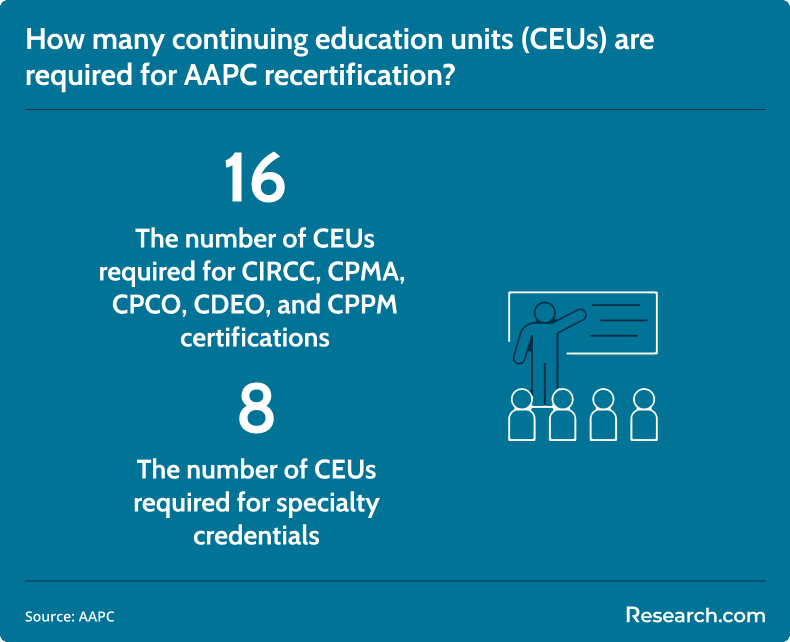
AAPC CEU requirements vary by credential and specialization. CIRCC, CPMA, CPCO, CDEO, and CPPM each require 16 CEUs tied directly to the credential’s subject area. Specialty credentials require 8 CEUs specific to the specialty field.
Continuing education should be treated as part of the long-term cost and responsibility of certification, not an afterthought. It can also help professionals move into adjacent roles, much like the career value of a graduate business certificate depends on how the credential strengthens practical skills and expands professional options.
Do Employers Prefer AHIMA or AAPC?
Employers may prefer AHIMA or AAPC depending on the job description, healthcare setting, and internal hiring standards. AHIMA credentials are commonly associated with hospitals, large healthcare organizations, health information management, coding, and data quality assurance. AAPC credentials are commonly associated with coding accuracy, physician services, medical billing, audits, compliance, and revenue-cycle work.
The best way to judge employer preference is to search current job postings in your target location and role. Look for exact credential names, not just broad phrases like “coding certification preferred.” A hospital inpatient coding role may name different preferred credentials than a physician-practice billing role. A compliance position may value a different credential than an entry-level records role.
Students who want a structured academic foundation before certification may consider accelerated associate programs in medical billing and coding. An associate pathway may be useful for learners who want both career training and a college credential before applying for coding, billing, or health information roles.
How to Choose Between AHIMA and AAPC
The right certification is the one that matches the jobs you are actually trying to get. Before enrolling in a course or paying for an exam, compare your target roles, preferred work setting, employer requirements, exam readiness, and long-term career plan.
- Start with job postings. Search for entry-level and intermediate roles in your area or remote job market. Track whether employers list AHIMA, AAPC, or either.
- Match the credential to the setting. Hospitals and HIM departments may lean toward AHIMA-aligned credentials, while physician practices and billing companies may lean toward AAPC-aligned credentials.
- Check the full cost. Include exam fees, memberships, study materials, manuals, retakes, CEUs, and renewal fees.
- Consider your education path. A short certificate may be enough for some entry-level roles, while broader HIM or administrative positions may benefit from an associate or degree pathway.
- Evaluate exam format honestly. If remote testing is difficult because of technology or home environment, a testing center may be more practical.
- Plan for recertification. Both organizations require ongoing CEUs, so choose a credential you are willing to maintain over time.
Common mistakes to avoid
| Mistake | Why it can hurt you | Better approach |
| Choosing a credential because it is popular online | Popularity does not guarantee it matches local employer requirements. | Compare job postings for your target role and region. |
| Looking only at exam fees | Prep materials, retakes, memberships, CEUs, and renewals add to the total cost. | Build a full budget before registering. |
| Assuming AHIMA and AAPC credentials are interchangeable | Some employers name specific credentials for specific roles. | Match the credential to the job description and work setting. |
| Skipping foundational training | Certification exams require working knowledge of coding systems, reimbursement, documentation, and compliance. | Complete a reputable training program or structured self-study plan before testing. |
| Ignoring continuing education | A credential can become inactive if renewal requirements are not completed. | Track CEUs throughout the 2-year cycle instead of waiting until the deadline. |
| Assuming certification guarantees a specific salary | Pay varies by role, employer, experience, location, and education level. | Use salary data as a benchmark, not a promise. |
Key Insights
- AHIMA and AAPC both matter, but they serve different career goals. AHIMA is more closely aligned with HIM, facility coding, records quality, data integrity, and healthcare information governance. AAPC is more closely aligned with physician coding, billing, auditing, compliance, and practice operations.
- The best credential depends on the job you want. Do not choose based only on brand recognition. Search job postings and identify which certifications employers actually request for your target roles.
- Costs are not limited to exam fees. AHIMA exams range from $229 to $399, while AAPC core exams such as CPC, CPB, and CPMA cost $399 for one attempt and $499 for two attempts, with student pricing of $375 for one attempt and $475 for two attempts. Study materials, memberships, renewals, and CEUs can also affect total cost.
- Exam format should influence preparation, not career direction. AHIMA exams vary by credential and are administered through Pearson VUE, while AAPC exams include 100 multiple-choice questions over 4 hours.
- Both organizations require ongoing professional education. AHIMA and AAPC credentials follow 2-year renewal cycles, so certification is a continuing commitment.
- Salary outcomes vary by occupation. In May 2024, medical records specialists had a median annual wage of $50,250, medical transcriptionists had a median annual wage of $37,550, and health information technologists and medical registrars had a median annual wage of $67,310 (US BLS, 2025).
- A practical path starts with research. Identify your preferred work setting, compare job postings, choose a credential aligned with those roles, calculate the full cost, and prepare for recertification from the beginning.
References
- US Bureau of Labor Statistics. (2025, August 28). Health Information Technologists and Medical Registrars. Occupational Outlook Handbook. https://www.bls.gov/ooh/healthcare/health-information-technologists-and-medical-registrars.htm
- US Bureau of Labor Statistics. (2025, August 28). Information Clerks. Occupational Outlook Handbook. https://www.bls.gov/ooh/office-and-administrative-support/information-clerks.htm
- US Bureau of Labor Statistics. (2025, August 28). Medical Records Specialists. Occupational Outlook Handbook. https://www.bls.gov/ooh/healthcare/medical-records-and-health-information-technicians.htm
- US Bureau of Labor Statistics. (2025, August 28). Medical Transcriptionists. Occupational Outlook Handbook. https://www.bls.gov/ooh/healthcare/medical-transcriptionists.htm
Other Things You Should Know About AHIMA and AAPC Certifications
AHIMA’s CCS exam is a computer-based test with multiple-choice and medical-coding scenarios, while AAPC’s CPC exam is fully multiple-choice and focused on outpatient coding. The CCS is administered by AHIMA, and the CPC by AAPC, with separate content outlines and scoring rules.
In 2027, AHIMA often requires candidates to have specific dedicated coursework or degrees related to health information management. Meanwhile, AAPC certifications typically prioritize professional experience in medical coding or billing, with less emphasis on formal education prerequisites.


