
2027 Fastest Online Associate in Medical Billing and Coding Programs

Co-Founder and Chief Data Scientist
As a specialist in career and education planning, I frequently assist individuals aiming for rapid entry into stable, in-demand fields within the healthcare industry. The pursuit of the fastest online associate degree in medical billing and coding is a popular and practical goal.
The digital landscape is filled with programs making bold claims about completion times, making it difficult to discern credible, accredited options from those that are merely well-marketed. The critical task is to evaluate a program's true value and rigor beyond its advertised speed. My purpose is to provide expert clarity, helping you identify a genuinely accelerated program that upholds academic standards and meets your career objectives.
What are the benefits of getting a qualification from the fastest online Associate in Medical Billing and Coding programs?
- Accelerated Career Entry: An associate degree can quickly qualify you for essential roles such as medical records specialist, billing coordinator, or coding specialist in various healthcare settings.
- Increased Earning Potential: Certified professionals can earn significantly more than their non-certified counterparts, with salaries for experienced coders reaching over $65,000 annually.
- Flexible Learning: The accelerated online format provides the convenience of earning a degree on a condensed timeline, allowing you to balance education with current personal or work commitments.
What can I expect from the fastest online Associate in Medical Billing and Coding programs?
- Focused Advanced Topics: Expect an intensive curriculum centered on key areas like medical terminology, anatomy and physiology, pharmacology, major medical coding systems (ICD-10-CM, CPT, HCPCS Level II), and healthcare reimbursement methodologies.
- Structured Curriculum: Delivery typically combines recorded lectures, live online seminars, practical coding assignments using industry-standard software, and virtual practicum experiences.
- Applied Strategic Knowledge: Emphasis is placed on solving real-world billing and coding challenges through accurate code assignment, claims processing, and compliance with healthcare regulations like HIPAA.
- Condensed Timeline: Programs are designed to be completed quickly, often in 12-18 months, through year-round, intensive 5- or 8-week course formats.
Where can I work with an online Associate in Medical Billing and Coding degree?
- Hospitals and Physician Offices: Secure entry-level roles as medical coders, billing specialists, or patient account representatives.
- Outpatient and Specialty Clinics: Work in settings like surgery centers, dental offices, or long-term care facilities, handling specialized billing and coding tasks.
- Insurance Companies: Analyze and process medical claims as a claims examiner, reimbursement specialist, or medical reviewer.
- Third-Party Billing Services: Work for companies that manage the entire revenue cycle for various healthcare providers, from small practices to large hospitals.
- Government Agencies: Find positions within federal or state health systems, such as Veterans Health Administration (VA) hospitals, managing patient records and billing.
- Remote Work Opportunities: Perform medical coding and billing functions from home for a variety of healthcare organizations and vendors.
How much can I earn with an online Associate in Medical Billing and Coding degree?
- Entry-Level Roles: Medical Coders and Billing Specialists with a new degree and certification typically earn between $40,000 and $55,000 annually.
- Experienced and Lead Roles: With several years of experience, professionals in lead coder or senior specialist roles can earn $55,000-$70,000.
- Supervisory-Level Roles: Billing Supervisors or Coding Managers can earn $65,000+, with salaries varying based on the size of the facility, team, and geographic location.
- Fastest Online Associate in Medical Billing and Coding Programs for 2027 List of Programs
- What is the average cost of an online Associate in Medical Billing and Coding? Program Cost
- How can accreditation and certification enhance program credibility? How can accreditation and certification enhance program credibility?
- What are the financial aid options for an online Associate in Medical Billing and Coding? Financial Aid
- What are the prerequisites for enrolling in an online Associate in Medical Billing and Coding? Requirements
- What courses are typically in an online Associate in Medical Billing and Coding? What courses are typically in an online Associate in Medical Billing and Coding?
- What types of specializations are available for Associate in Medical Billing and Coding graduates? What types of specializations are available for Associate in Medical Billing and Coding graduates?
- How do you choose the best among the fastest online Associate in Medical Billing and Coding programs? How do you choose the best among the fastest online Associate in Medical Billing and Coding programs?
- What career paths are available for graduates of online Associate in Medical Billing and Coding programs? Career Paths
- How much can I earn with an online Associate in Medical Billing and Coding degree? Salary
- What is the job market like for graduates of an online Associate in Medical Billing and Coding program? Job Market
- What are some current and future trends in medical billing and coding? What are some current and future trends in medical billing and coding?
- Can pursuing further education enhance my career opportunities in medical billing and coding? Can pursuing further education enhance my career opportunities in medical billing and coding?
- What is the return on investment for an accelerated online Associate in Medical Billing and Coding program? What is the return on investment for an accelerated online Associate in Medical Billing and Coding program?
Fastest Online Associate in Medical Billing and Coding Programs for 2027
Choosing an online associate degree in medical billing and coding is usually a speed-versus-quality decision. You may want to enter healthcare administration quickly, but you still need enough training in coding systems, reimbursement, medical records, compliance, and certification preparation to be employable. The right accelerated program can help you move toward entry-level billing, coding, revenue cycle, or health information roles without spending four years in school.
This guide is for students comparing fast online associate programs, working adults who need a flexible healthcare credential, military-affiliated learners, and career changers who want a practical route into the healthcare business side. You will learn which programs offer accelerated or flexible online formats, what they cost, how accreditation and certification affect credibility, what courses to expect, and how to evaluate career return on investment before enrolling.
If you are comparing accelerated degrees across fields, remember that a healthcare support program has a different purpose than a fast track geosciences degree online. Medical billing and coding programs are built around documentation accuracy, insurance rules, patient privacy, and standardized code sets used in healthcare reimbursement.
Quick Answer: What is the fastest online associate in medical billing and coding?
Among the programs listed here, the fastest stated associate-degree options include Ultimate Medical Academy at 18 months, Bryant & Stratton College at typically 20 months full-time, and several programs that can be completed in typically 2 years full-time. The best choice is not only the shortest program. Students should compare accreditation, total credits, certification exam preparation, tuition, online support, transfer policies, and whether the curriculum aligns with credentials such as CPC, CCS, or CCA.
| Program | Stated completion time | Credits | Best fit |
| Ultimate Medical Academy | 18 months | 63 | Students who want an online associate pathway with CPC exam preparation support |
| Bryant & Stratton College | Typically 20 months full-time | 60 credits | Learners seeking online, blended, or campus options aligned with AHIMA and AAPC standards |
| Huntington Junior College | 1.5-3 years | 90 credits | Students who want applied coding practice with a broader credit structure |
| Central Maine Community College | Typically 2 years full-time | 60-62 credits | Students comparing an associate degree with a one-year certificate option |
| Central Texas College | Typically 2 years full-time | 60 credits | Military personnel, veterans, spouses, and online learners seeking college-credit coursework |
How do we rank schools?
Because program choice affects tuition, time, certification readiness, and career options, Research.com uses a transparent review process based on institutional and public data. Our methodology considers sources that help students compare schools with more confidence, including:
- the IPEDS database
- Peterson's database, including the Distance Learning Licensed Data Set
- the College Scorecard database
- the National Center for Education Statistics
Below are the online associate programs that stand out for students who want a faster route into medical billing, coding, reimbursement, and health information support roles.
1. Bryant & Stratton College
Bryant & Stratton College offers a Medical Reimbursement and Coding associate degree for students preparing for entry-level work in healthcare revenue and coding operations. The program centers on converting patient care documentation into standardized medical codes so providers can receive accurate reimbursement.
The curriculum is designed around AHIMA and AAPC standards, which can help graduates prepare for industry credentials such as CPC or CCS. Students study electronic health records, diagnosis coding, patient data abstraction, chart audits for medical necessity, healthcare terminology, anatomy, ICD coding, CPT coding, and HCPCS Level II coding. The program is available on campus, in blended formats, and 100% online, giving working students more scheduling flexibility.
- Program Length: Typically 20 months (full-time)
- Tracks/Concentrations: Medical Reimbursement and Coding
- Tuition Cost: Not specified
- Required Credits to Graduate: 60 credits
- Accreditation: Middle States Commission on Higher Education (MSCHE)
2. Central Maine Community College
Central Maine Community College provides a Medical Coding & Electronic Health Records program that trains students to apply coding guidelines to diagnoses, procedures, and health records. Students can pursue either an associate in applied science degree or a one-year certificate, which makes the school useful for learners deciding between a shorter credential and a broader degree.
The associate degree is offered on campus and 100% online. Its coursework supports entry-level employment, career advancement, and possible continuation into upper-division study at a four-year institution. Graduates are prepared for specialized data entry and classification work in hospitals, clinics, insurance companies, consulting firms, and similar healthcare organizations.
- Program Length: Typically 2 years (full-time)
- Tracks/Concentrations: Medical Coding and Electronic Health Records
- Tuition Cost: In-state: $96/credit; New England regional rate: $144/credit; out-of-state: $192/credit
- Required Credits to Graduate: 60-62 credits
- Accreditation: New England Commission of Higher Education (NECHE)
3. Central Texas College
Central Texas College offers a fully online Medical Coding and Billing program for students seeking healthcare administrative roles. The program is particularly relevant for military personnel, veterans, and spouses because it provides online access from different locations and includes financial aid and scholarship options that may support military families.
Courses are taught by faculty with field experience, and credits can be applied toward additional college study. Students begin with health data content and medical terminology before moving into human diseases, pharmacology, and medical software applications. This structure works well for learners who want a practical foundation before entering billing and coding roles or continuing their education.
- Program Length: Typically 2 years (full-time)
- Tracks/Concentrations: Medical Coding and Billing
- Tuition Cost (per credit): Resident In-District $125; Resident Out-of-District $163; Nonresident International $250
- Required Credits to Graduate: 60 credits
- Accreditation: Southern Association of Colleges and Schools Commission on Colleges (SACSCOC)
4. Columbia Southern University
Columbia Southern University offers an Associate of Science in Health Information Technology – Medical Coding for students who want a foundation in health information science with focused medical coding preparation. The medical coding track covers current coding and insurance reimbursement concepts for students aiming to become medical billers and coders.
The school also offers a health care administration track for students who prefer entry-level administrative management preparation. Students learn how to collect and maintain medical records, apply best practices in health information, and evaluate information technology needs within a healthcare unit.
- Program Length: Typically 2 years (full-time)
- Tracks/Concentrations: Medical coding, health care administration, coding
- Tuition Cost: $278/credit
- Required Credits to Graduate: 60
- Accreditation: Southern Association of Colleges and Schools Commission on Colleges (SACSCOC)
5. Cowley County Community College
Cowley County Community College provides a Medical Coding program that teaches students to use CPT, HCPCS, and ICD systems for healthcare billing. Learners may choose an Associate of Applied Science degree or a professional certificate, depending on how much academic preparation they want before entering the workforce.
The program can be completed fully online. Kansas residents may qualify for support through the Kansas Promise Act scholarship. The curriculum emphasizes workforce-ready coding skills, professional behavior, flexibility, and computer programs used in medical coding. It also prepares students to sit for the AHIMA Certified Coding Associate (CCA) and Certified Professional Coder (CPC) exams.
- Program Length: Typically 2 years (full-time)
- Tracks/Concentrations: Medical Coding
- Tuition Cost (per credit hour): Cowley County Residents $160; Other Kansas Residents $170; Oklahoma Residents $180; Out of State Residents $220; International Students $270; Non-Destructive Testing Course - Online Program $250
- Required Credits to Graduate: 65
- Accreditation: Higher Learning Commission (HLC)
6. Huntington Junior College
Huntington Junior College's Associate’s Degree in Medical Coding prepares students to translate medical language into numeric and alphanumeric codes used for billing and documentation. The program combines technical coding courses with general education requirements such as composition and psychology.
Students build coding knowledge through coursework and complete applied outpatient coding practice. Graduates are expected to demonstrate entry-level job skills and professional conduct appropriate for healthcare environments.
- Program Length: 1.5-3 years
- Tracks/Concentrations: Medical Coding
- Tuition Cost: $10,050 (in-state and out-of-state online students)
- Required Credits to Graduate: 90 credits
- Accreditation: Higher Learning Commission (HLC)
7. Keiser University
Keiser University offers an online Associate of Science in Medical Administrative Billing & Coding for students preparing to assign codes for healthcare procedures and services. The curriculum includes administrative and clerical functions tied to claims, reimbursement, insurance processes, and compliance.
Students develop familiarity with medical language, classification systems, procedure coding, and diagnosis coding. The program is built for entry-level employment and prepares graduates to take the American Academy of Professional Coders (AAPC) credentialing exam as apprentices.
- Program Length: Typically 2 years (full-time)
- Tracks/Concentrations: Medical Administrative Billing & Coding
- Tuition Cost: Not specified
- Required Credits to Graduate: 60 credits
- Accreditation: Southern Association of Colleges and Schools Commission on Colleges (SACSCOC)
8. Northland Community and Technical College
Northland Community and Technical College offers an online Associate of Applied Science in Medical Coding Specialist. The program prepares students for billing procedures connected to medical services, patient accounts, and insurance claim processing.
Because accurate coding depends on understanding the human body and disease processes, students take courses in pathophysiology and medical terminology. They also learn to use national coding systems for diagnoses and procedures and study insurance programs such as Medicare, Medicaid, workers’ compensation, and third-party payers. Graduates may pursue roles in hospitals, clinics, insurance companies, government agencies, and related healthcare settings.
- Program Length: Typically 2 years (full-time)
- Tracks/Concentrations: Medical Coding Specialist
- Tuition Cost: $11,940.00 (total tuition)
- Required Credits to Graduate: 60 credits
- Accreditation: Higher Learning Commission (HLC)
9. Ultimate Medical Academy
Ultimate Medical Academy offers an online Associate of Science in Medical Billing & Coding that teaches students to convert healthcare diagnoses and procedures into universal codes. Core topics include medical terminology, insurance billing, coding systems, and the reimbursement process.
Students can choose between an 11-month diploma and an 18-month associate degree. The diploma focuses on essential entry-level skills, while the associate degree adds broader preparation, including soft skills employers may value. Both options prepare graduates to sit for the American Academy of Professional Coders (AAPC) Certified Professional Coder (CPC) exam, and UMA includes exam-focused materials and support at no additional cost. Graduates may seek entry-level work in physicians' offices, hospitals, insurance companies, and similar settings.
- Program Length: 18 months
- Tracks/Concentrations: Medical Billing & Coding
- Tuition Cost: $475/credit
- Required Credits to Graduate: 63
- Accreditation: Accrediting Bureau of Health Education Schools (ABHES)
10. University of Arkansas, Grantham
University of Arkansas, Grantham offers an online Applied Associate of Science in Medical Coding and Billing. Students study medical coding, insurance coding, patient data management, and confidentiality requirements for healthcare records.
The program is designed for learners exploring healthcare administration work in hospitals, doctors' offices, nursing care facilities, and similar organizations. Students learn the functions of healthcare environments, terminology and abbreviations used in health information management, HIPAA requirements, and healthcare regulations, law, and ethics through a capstone course.
- Program Length: 24 months (full-time)
- Tracks/Concentrations: Medical Coding and Billing
- Tuition Cost: $305/credit
- Required Credits to Graduate: 60 credits
- Accreditation: Distance Education Accrediting Commission (DEAC)
What is the average cost of an online Associate in Medical Billing and Coding?
The cost of an online Associate in Medical Billing and Coding depends on the school type, residency status, tuition model, fees, textbooks, coding manuals, and certification-related costs. Public community colleges are often the lowest-cost option for in-state students, while private universities and career colleges usually charge more.
| Cost factor | What to know before enrolling |
| Program credits | Most associate programs in this field require between 60 to 64 credit hours, though individual schools may require more. |
| Community colleges | For in-state students at public community colleges, total program costs typically range from $7,000 to $15,000. |
| Out-of-state tuition | Public colleges may become significantly more expensive when students do not qualify for resident tuition. |
| Private universities and career colleges | Total tuition at these institutions often ranges from $20,000 to over $35,000. |
| Extra expenses | Students should plan for technology fees, application fees, certification exam fees, digital textbooks, and coding manuals. |
Medical billing and coding training matters because errors can affect providers, insurers, and patients. Inaccurate medical billing costs the U.S. healthcare system billions annually, and some estimates suggest that up to 80% of medical bills contain errors. This creates demand for professionals who understand documentation, coding rules, reimbursement, and ethical billing practices.
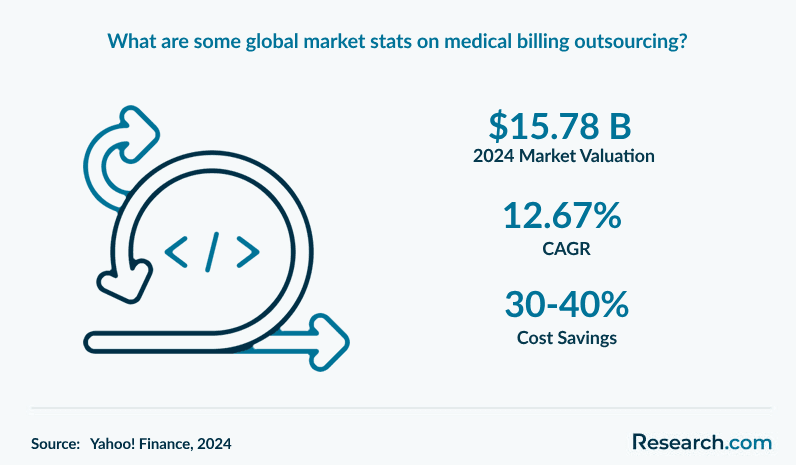
The medical billing outsourcing market is also expanding as healthcare organizations seek better financial and operational performance. The global market was valued at US$15.78 billion in 2024 and is projected to reach US$46.17 billion by 2033, growing at a compound annual growth rate of 12.67%, as shown in the graphic below.
Healthcare providers use outsourcing, automation, cloud computing, and AI-supported systems to reduce administrative burden, improve accuracy, and streamline revenue cycles. Some providers may save up to 30-40% in operational expenses. Students interested in broader healthcare finance and leadership planning can also compare this path with top online MHA programs.
How can accreditation and certification enhance program credibility?
Accreditation and certification preparation are two of the most important quality checks for online medical billing and coding programs. Institutional accreditation shows that a school has been reviewed by a recognized accreditor, while program design and certification alignment indicate whether the curriculum prepares students for real healthcare coding expectations.
Before enrolling, confirm the school’s accreditation status, ask which certification exams the curriculum supports, and verify whether credits can transfer if you plan to continue toward a bachelor’s degree. Programmatic accreditation from organizations such as the Commission on Accreditation for Health Informatics and Information Management Education (CAHIM) can be especially meaningful for Health Information Technology programs. Students can also use Research.com’s guide to accredited medical billing and coding schools to compare additional options.
Certification can strengthen a graduate’s profile because many employers prefer or require credentials for coding roles. Common options include CPC, CCS, CCA, CRC, and CPMA, depending on the work setting and specialization. Students exploring more advanced clinical or medication-related education should note that PharmD programs lead to a very different professional path and should not be treated as interchangeable with billing and coding credentials.
What are the financial aid options for an online Associate in Medical Billing and Coding?
Students should compare financial aid before choosing a program because the lowest advertised tuition is not always the lowest total cost. A school with stronger aid, transfer credit acceptance, or employer reimbursement support may be more affordable in practice.
- Federal Student Aid: Eligible students can complete the Free Application for Federal Student Aid (FAFSA) to be considered for federal Pell Grants and Direct Loans.
- Employer Tuition Assistance: Healthcare employers and administrative organizations may offer tuition reimbursement or tuition assistance for employees improving job-related skills.
- Scholarships and Grants: Professional groups, including the AHIMA Foundation and the American Academy of Professional Coders (AAPC), offer scholarships for students pursuing health information management and coding education.
- State-Specific Aid: Some states fund students in healthcare support fields. In certain cases, medical billing and coding online courses cost assistance may require graduates to work for in-state institutions after completion.
| Question to ask | Why it matters |
| Is the program eligible for federal aid? | Not every short-term or career program qualifies for the same aid options. |
| Are books, coding manuals, and exam fees included? | These costs can materially change the total price. |
| Can prior college credits transfer? | Accepted credits may reduce both time and tuition. |
| Does the school offer payment plans? | Payment flexibility may help students avoid unnecessary borrowing. |
| Does my employer reimburse tuition? | Working healthcare employees may be able to lower out-of-pocket costs. |
What are the prerequisites for enrolling in an online Associate in Medical Billing and Coding?
Admission requirements are usually accessible, but online medical billing and coding programs still require students to be ready for technical reading, healthcare terminology, and computer-based coursework.
- High School Diploma or GED: Associate programs generally require applicants to have completed high school or an equivalent credential.
- Minimum GPA: Some schools ask for a minimum high school GPA, often around 2.0 to 2.5, while others use open enrollment policies.
- Computer Literacy: Online students need to use email, learning platforms, web tools, word processing software, and digital course materials comfortably.
- Application Materials: Most schools request an application and official transcripts from high school or previous colleges. Some may also request a short personal statement.
Employment data also helps students understand where this training can lead. In 2023, medical records specialists held about 191,500 jobs. Hospitals operated by state, local, and private organizations were the largest employers, accounting for 28% of positions. Offices of physicians employed 19% of workers in this occupation.
Other employers included management of companies and enterprises at 9%, professional, scientific, and technical services at 8%, and administrative and support services at 8%. These healthcare workforce patterns may also be useful for students comparing related clinical and administrative pathways such as top BSN to MSN programs online.
The data shows that billing, coding, and medical records work is concentrated in traditional healthcare environments, especially hospitals and physicians' offices. Students who want remote work should still understand that many opportunities are tied to healthcare organizations with strict privacy, compliance, and productivity standards.
What courses are typically in an online Associate in Medical Billing and Coding?
Medical billing and coding coursework is different from software development or computer coding jobs. Instead of writing computer programs, students learn to interpret healthcare documentation and assign standardized medical codes for billing, reimbursement, reporting, and compliance.
| Common course | What students learn |
| Medical Terminology | Prefixes, suffixes, root words, abbreviations, and language used to describe diagnoses, procedures, and clinical documentation. |
| Anatomy & Physiology | Human body structure and function, which helps coders understand documentation and assign appropriate codes. |
| ICD-10-CM Coding | Diagnosis coding using the International Classification of Diseases, 10th Revision, Clinical Modification. |
| CPT/HCPCS Coding | Procedure and service coding using Current Procedural Terminology (CPT) and Healthcare Common Procedure Coding System (HCPCS) Level II. |
| Healthcare Reimbursement | Claims submission, payment processing, insurance models, Medicare, Medicaid, private insurance, and payer rules. |
| Medical Law and Ethics/HIPAA | Patient privacy, security, legal responsibilities, ethical standards, and the Health Insurance Portability and Accountability Act (HIPAA). |
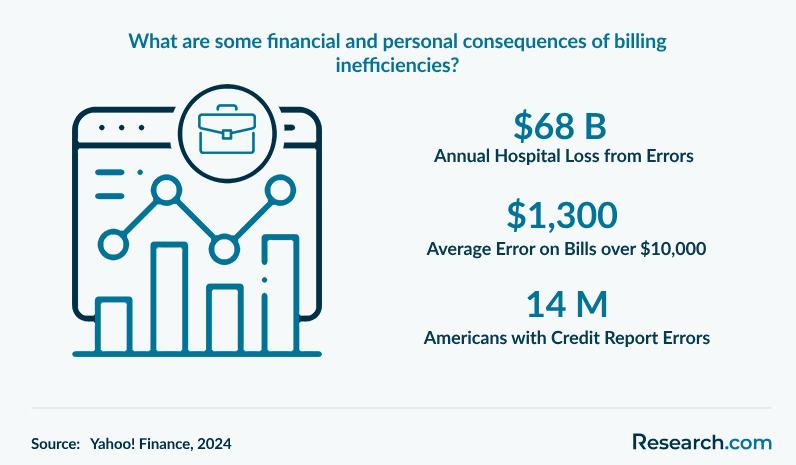
Strong training is important because coding and billing mistakes can create serious financial and personal consequences. Hospitals lose an estimated $68 billion annually due to billing mistakes, and errors on high-value bills of $10,000 or more average around $1,300. Billing inaccuracies also affect patients, with about 14 million Americans having credit reports damaged by billing errors, and they contributed to 48.3 million claim denials in 2021.
Security and system modernization are also major concerns. With 133 million medical records exposed in 2023 data breaches, healthcare organizations are evaluating secure, modern systems. Outsourced systems can cost as little as $300 per month compared with traditional systems costing up to $8,000 annually, making data protection and revenue cycle efficiency important considerations for employers.
What types of specializations are available for Associate in Medical Billing and Coding graduates?
Most associate programs provide broad preparation, but career growth often depends on certification, work setting, and specialization. Students should choose a credential path based on whether they prefer hospital coding, physician office coding, payer-side review, compliance, or auditing.
| Specialization | Typical focus | Common credential connection |
| Inpatient Coding | Hospital-based coding for complex diagnoses, procedures, and longer patient stays. | Certified Coding Specialist (CCS) |
| Outpatient/Ambulatory Care Coding | Coding for physician practices, outpatient clinics, and ambulatory surgery centers. | Certified Professional Coder (CPC) |
| Risk Adjustment Coding | Assigning codes that reflect patient health status and support insurance cost prediction. | Certified Risk Adjustment Coder (CRC) |
| Medical Auditing | Reviewing records and coding decisions for accuracy, reimbursement, and compliance. | Certified Professional Medical Auditor (CPMA) |
Medical auditing requires careful evidence review and documentation analysis. That investigative mindset is very different from writing careers such as the best online bachelors in journalism degree, but both fields reward accuracy, source evaluation, and attention to detail.
How do you choose the best among the fastest online Associate in Medical Billing and Coding programs?
The best fast program is the one that helps you finish efficiently without weakening certification preparation, employer credibility, or transfer options. Use speed as one factor, not the only factor.
- Verify accreditation first. Confirm institutional accreditation through the school and accreditor. If the program is in Health Information Technology, ask whether CAHIM accreditation applies.
- Match the curriculum to your target credential. If you want CPC, CCS, CCA, CRC, or CPMA later, ask how the coursework prepares students for that exam.
- Compare total cost, not just tuition. Include fees, books, coding manuals, exam fees, technology requirements, and retake policies.
- Check faculty qualifications. Look for instructors with current coding credentials and healthcare documentation experience.
- Assess online support. Ask about academic advising, tutoring, career services, technical support, and access to coding practice tools.
- Review pacing carefully. Accelerated programs can be efficient, but students working full time or managing family responsibilities should confirm weekly workload expectations.
- Ask about externships or applied practice. Hands-on coding exercises, chart review, and reimbursement simulations can strengthen job readiness.
- Confirm transfer policies. If you may pursue a bachelor’s degree later, ask which credits transfer and to which institutions.
Online associate degree, certificate, or short course: which should you choose?
Not every student needs the same credential. A short course may work for someone exploring the field, while a certificate can suit students who want focused job preparation. An associate degree may be better for learners who want broader general education, transfer options, and a stronger foundation for advancement.
| Option | When it may make sense | Potential limitation |
| Short online course | You want to explore the field or refresh a specific coding skill quickly. | It may not provide enough preparation for some entry-level jobs or certifications. |
| Certificate or diploma | You want focused medical billing and coding training in less time than a degree. | Transferability and general education breadth may be limited. |
| Associate degree | You want a recognized college credential, broader coursework, and possible transfer value. | It usually takes longer and may cost more than a certificate. |
| Bachelor’s or graduate healthcare administration path | You want leadership, management, analytics, or broader healthcare administration roles later. | It requires more time and a larger education investment. |
What career paths are available for graduates of online Associate in Medical Billing and Coding programs?
Graduates may work across healthcare providers, insurance organizations, billing companies, government agencies, and administrative service firms. Job titles vary by employer, and some coding positions may require certification in addition to a degree.
- Medical Coder: Reviews clinical documentation and assigns standardized diagnosis and procedure codes for billing, reporting, and data use.
- Medical Biller: Prepares and submits insurance claims, follows up on unpaid claims, and helps providers receive accurate reimbursement.
- Medical Records Specialist: Maintains patient health information and supports accuracy, access, and security of medical records.
- Health Information Technician: Works with health data, coding, record organization, quality control, accessibility, and information security.
- Insurance Claims Analyst: Reviews claims for accuracy, payer requirements, inconsistencies, and possible fraud indicators.
- Patient Account Representative: Helps patients understand billing questions, insurance coverage, balances, and payment arrangements.
- Revenue Cycle Specialist: Supports the full payment process, from intake and insurance verification to reimbursement and denial resolution.
- Compliance Officer (Entry-Level): Assists with monitoring billing practices, documentation standards, HIPAA rules, and payer requirements.
- Medical Office Administrator: Coordinates scheduling, billing, records, and front-office workflows in small practices or outpatient settings.
- Electronic Health Records (EHR) Specialist: Helps manage EHR systems, supports users, and checks that patient records are coded and stored correctly.
- Denials Management Specialist: Reviews denied claims, identifies causes, corrects issues, and works to secure reimbursement.
How much can I earn with an online Associate in Medical Billing and Coding degree?
Earnings depend on role, certification, employer, experience, location, productivity expectations, and specialization. An associate degree can support entry into the field, but professional credentials and hands-on experience often influence salary growth.
- Entry-Level Roles: New medical billers or coders can typically expect to earn between $38,000 and $48,000 annually.
- Experienced and Certified Roles: With several years of experience and credentials such as CPC or CCS, salaries often range from $50,000 to $65,000.
- Specialized and Supervisory Roles: Senior coders, medical auditors, and supervisors can often exceed $70,000, depending on employer, location, and expertise. Students interested in informatics advancement can also review what is a clinical informatics specialist.
Based on 2025 data, salary progression generally moves from administrative support roles into specialized and management positions. Patient access representatives average $31,428, while medical assistants average $34,262. Core roles such as certified professional coder (CPC) and medical biller earn around $40,000 to $41,000 annually.
Supervisory roles such as medical billing supervisor and coding supervisor rise into a range of $42,000 to over $52,000. Reimbursement and revenue cycle specialists earn between $54,000 and $57,000. Billing managers average $62,056, and coding specialists average $65,008. Director-level positions, including director of revenue cycle management, exceed $71,000, while senior business analyst roles average $85,830 (PayScale.com, 2025).
The salary pattern shows a clear career ladder: compensation tends to increase as professionals move from basic claims and records tasks into certification-backed coding, reimbursement expertise, analytics, supervision, and revenue cycle leadership.
What is the job market like for graduates of an online Associate in Medical Billing and Coding program?
Students often ask, is medical billing and coding in demand? The available labor market data shows steady need for medical records and health information specialists, especially as healthcare organizations rely on electronic records, accurate coding, compliance, and reimbursement operations.
- Projected Growth: The U.S. Bureau of Labor Statistics projected employment for medical records and health information specialists to grow by 10% from 2022 to 2032, much faster than the average for all occupations.
- Demand Drivers: Growth is supported by an aging population, higher use of medical services, and the continued expansion of electronic health records that must be coded and managed accurately.
- Employment Settings: Graduates may work in hospitals, physician offices, nursing care facilities, home healthcare services, government agencies, insurers, and third-party billing organizations.
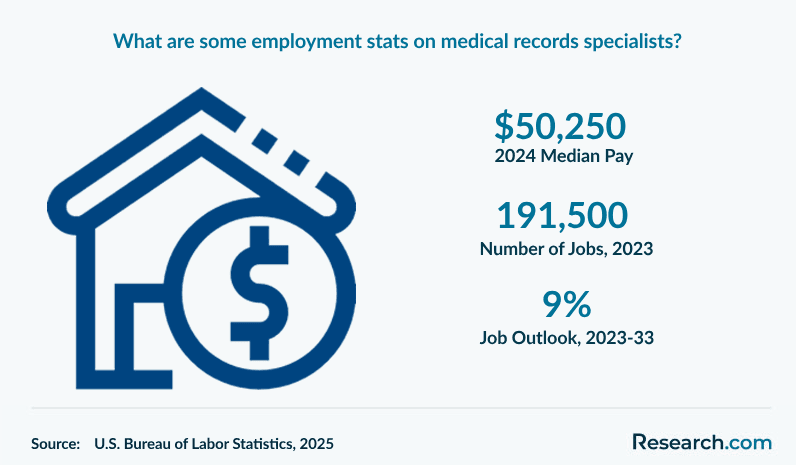
According to U.S. Bureau of Labor Statistics 2025 data, medical records specialists held 191,500 jobs in 2023. The profession is projected to grow by 9% from 2023 to 2033, which is much faster than average and is expected to create 16,700 new jobs. As of 2024, the median pay was $50,250 per year, or $24.16 per hour, as shown in the graphic below.
Entry into this occupation typically requires a postsecondary non-degree award, and no prior work experience or on-the-job training is listed as a prerequisite. For students seeking a healthcare career with accessible entry points, the combination of job growth, multiple employer types, and a solid median salary makes this field worth considering.
What are some current and future trends in medical billing and coding?
Medical billing and coding is changing because healthcare documentation, payer rules, telehealth, privacy requirements, automation, and data analytics are changing. Students should choose programs that teach both current coding skills and adaptability.
- Transition to ICD-11: The global shift to the International Classification of Diseases, 11th Revision (ICD-11) is underway. The U.S. has not set an implementation date, but coders should expect future training requirements when adoption moves forward.
- Artificial Intelligence in Coding: AI and computer-assisted coding (CAC) tools are increasingly used to support code suggestions and documentation review. This does not eliminate the need for coders; it shifts more value toward verification, auditing, exception handling, compliance, and complex cases.
- Telehealth and Remote Work: Telehealth has added billing and coding complexity while also supporting demand for secure remote workflows. Students can use medical billing and coding classes online to keep current with payer, coverage, and documentation changes.
- Data Analytics: Coded health information is used for reporting, population health, quality improvement, reimbursement analysis, and trend identification. Coders who understand data quality may have stronger long-term opportunities.
Can pursuing further education enhance my career opportunities in medical billing and coding?
Further education can help billing and coding professionals move toward health information management, compliance, revenue cycle leadership, healthcare analytics, or broader administration. A bachelor’s degree, specialized certificate, or management-focused program may be useful after gaining work experience and certification.
Students should choose further education based on the role they want next. A healthcare administration or health information program may fit revenue cycle leadership goals. A data-oriented program may fit analytics goals. An interdisciplinary healthcare degree, such as an online bachelor's degree in nutrition science, may broaden health knowledge but should be evaluated carefully to ensure it supports the student’s actual billing, coding, or administration career plan.
What is the return on investment for an accelerated online Associate in Medical Billing and Coding program?
ROI depends on more than program length. A fast associate degree is valuable only if it prepares you for certification, supports completion, provides credible training, and leads to realistic employment opportunities without excessive debt.
| ROI factor | What to review |
| Total program cost | Calculate tuition, fees, textbooks, manuals, technology, exam costs, and interest if borrowing. |
| Completion time | Compare the stated pace with your work schedule, family obligations, and ability to manage accelerated courses. |
| Certification outcomes | Ask whether the program reports certification exam preparation, pass support, or graduate credentialing results. |
| Career services | Look for resume support, interview coaching, employer connections, externship guidance, and job search help. |
| Transfer value | Confirm whether credits can apply to a bachelor’s degree if you later pursue healthcare administration or health information management. |
| Career ceiling | Consider whether you may need later education for supervisory, analytics, compliance, or revenue cycle management roles. |
Students who want long-term leadership roles may compare this associate pathway with a healthcare administration online degree. A billing and coding associate program can be a practical entry point, while healthcare administration education may support broader management responsibilities later.
Common mistakes to avoid when choosing a fast online medical billing and coding program
- Choosing only by completion time: A shorter program is not automatically better if it lacks certification preparation or student support.
- Ignoring accreditation: Unaccredited schools can create problems with financial aid, transfer credits, and employer recognition.
- Looking only at tuition: Fees, books, coding manuals, exam costs, and technology expenses can raise the real price.
- Assuming online means self-paced: Some online programs have fixed deadlines, live sessions, or accelerated course loads.
- Overlooking certification requirements: Many employers value CPC, CCS, CCA, or other credentials, so program alignment matters.
- Not checking career services: Online students should have access to advising, job search support, and technical help.
- Expecting guaranteed salary outcomes: Published salaries are useful benchmarks, but individual earnings vary by location, employer, certification, and experience.
- Failing to ask about transfer credits: If you may pursue a bachelor’s degree, transferability can affect long-term cost and time.
Here's What Graduates Say About the Fastest Online Associate in Medical Billing and Coding Program
- Rohan: "Finishing at an accelerated pace helped me move into a new field in 18 months. The coursework gave me the technical foundation I needed, and the practical assignments helped me feel more prepared for the job search."
- Ayla: "The online format made the program realistic for me as a full-time parent. I could plan coursework around my family responsibilities while still building skills that supported a career change."
- Zain: "The faculty support made a major difference. I felt guided throughout the program, and the certification preparation helped me feel ready when it was time to test and apply for roles."
Key Insights
- The fastest listed online associate options include programs with stated timelines of 18 months, typically 20 months, and typically 2 years full-time.
- Speed should not outweigh accreditation, certification preparation, curriculum depth, cost transparency, and online student support.
- Most associate programs require around 60 to 64 credit hours, though some schools in this list require 65, 90, or 63 credits.
- Public community colleges may offer lower in-state tuition, while private universities and career colleges often cost more; always compare total cost, not only tuition per credit.
- Credentials such as CPC, CCS, CCA, CRC, and CPMA can improve credibility and support specialization after graduation.
- The strongest programs teach medical terminology, anatomy and physiology, ICD-10-CM, CPT/HCPCS, healthcare reimbursement, HIPAA, compliance, and applied coding practice.
- BLS data shows 191,500 medical records specialist jobs in 2023, projected growth of 9% from 2023 to 2033, and median pay of $50,250 per year as of 2024.
- AI, computer-assisted coding, telehealth, EHR systems, data analytics, and future ICD-11 adoption are reshaping the role. Coders who can audit, verify, analyze, and manage complex documentation will be better positioned.
- A fast associate degree can be a smart entry route, but students should evaluate ROI using completion time, certification readiness, career services, transfer options, and realistic salary expectations.
References:
- PayScale. (2025). Associate of Applied Science (AAS), medical billing & coding salary. PayScale.
- U.S. Bureau of Labor Statistics. (2024, September 4). Medical records specialists. In Occupational outlook handbook. U.S. Bureau of Labor Statistics.
- U.S. Bureau of Labor Statistics. (2024, September 4). Medical records and health information technicians. In Occupational outlook handbook. U.S. Bureau of Labor Statistics.
- Yahoo Finance. (2024, May 8). Medical billing outsourcing market to hit US$ 30.2 bn by 2031. Yahoo Finance.
Other Things You Should Know About the Fastest Online Associate in Medical Billing and Coding Programs
In 2027, employers tend to view the fastest online associate degree programs in medical billing and coding favorably, as long as they are from accredited institutions. These programs provide essential skills and knowledge quickly, but employers often look for additional certification to ensure comprehensive expertise and increased employability.
In 2027, the fastest online associate programs in medical billing and coding typically require a high school diploma or equivalent. Some programs may ask for prerequisites like biology or anatomy. Most programs emphasize flexibility and accelerated coursework, allowing completion in as little as 12-18 months.


