
2027 What Does a Business Operations Manager Do: Responsibilities, Requirements, and Salary

Co-Founder and Chief Data Scientist
Becoming a business operations manager is a decision to work at the center of how an organization actually runs. The role is for people who can translate goals into budgets, workflows, staffing plans, performance measures, vendor expectations, and daily accountability.
Business operations managers are needed because strategy does not succeed on planning alone. Companies also need leaders who can reduce waste, improve service quality, coordinate departments, fix broken processes, and help teams adapt when priorities change. The work can be found in corporate offices, healthcare organizations, technology companies, nonprofits, logistics firms, hospitality businesses, consulting firms, and many other settings.
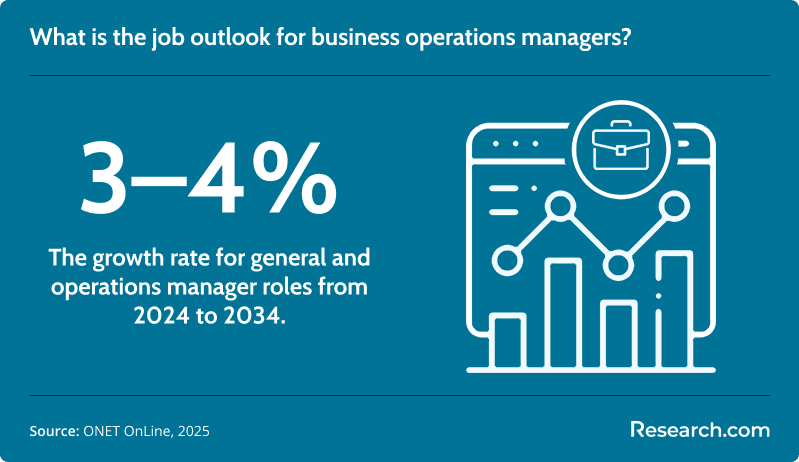
According to the U.S. Bureau of Labor Statistics (BLS), employment for business operations managers and related roles is projected to grow by about 3% to 4% from 2024 to 2034. This guide explains what business operations managers do day to day, the responsibilities and skills employers value in 2027, common education routes, salary context, job outlook, workplace challenges, and how this role can lead to senior leadership.
Key Things You Should Know About What a Business Operations Manager Does
- A business operations manager oversees daily operations to ensure efficiency and organizational performance.
- The role of a business operations manager bridges strategic planning and practical execution across departments.
- Employers often seek business operations managers with both analytical expertise and strong leadership skills to drive growth.
What does a business operations manager actually do on a day-to-day basis?
A business operations manager makes sure daily work supports the organization’s broader goals. Instead of owning one narrow function, this manager connects teams, processes, budgets, vendors, tools, and timelines so work happens consistently and efficiently.
On a typical day, the role may involve reviewing performance reports, identifying workflow delays, meeting with department heads, checking budget trends, resolving staffing or supply issues, and updating procedures that no longer work well. The manager often acts as the bridge between executive priorities and the employees responsible for delivering results.
Common day-to-day activities
- Reviewing operational data: Monitoring productivity, quality, cost, service levels, timelines, and other performance indicators.
- Coordinating departments: Helping finance, HR, IT, sales, customer service, supply chain, and leadership teams work from the same priorities.
- Improving workflows: Finding unclear, repetitive, slow, or expensive processes and replacing them with better systems.
- Managing projects: Assigning responsibilities, tracking milestones, removing barriers, and keeping initiatives aligned with business goals.
- Supporting leadership decisions: Turning operational findings into practical recommendations for executives and senior managers.
The work changes by industry. In healthcare, a business operations manager may focus on staffing, compliance, patient-flow processes, and service quality. In technology, the work may center on systems, vendors, scalable workflows, and service delivery. In nonprofits, the role may involve resource allocation, grant-related operations, program delivery, and mission accountability. If you are comparing mission-driven management paths with corporate roles, it may help to review what you can do with a master's degree in nonprofit management.
What are the main responsibilities of a business operations manager in 2027?
In 2027, a business operations manager’s main responsibility is to make performance visible, manageable, and repeatable. The role turns broad objectives into operating systems: who owns the work, what resources are needed, how progress is measured, and how problems are corrected.
The job usually combines analysis, supervision, planning, communication, and execution. In a small organization, one operations manager may handle many functions at once. In a larger organization, the role may focus on a specific department, region, business unit, service line, or operational system.
Core responsibilities
- Process management: Streamlining procedures, reducing bottlenecks, documenting workflows, and eliminating duplicated work.
- Project coordination: Keeping operational projects on schedule, clarifying ownership, and ensuring each initiative supports business goals.
- Budget oversight: Reviewing spending, identifying cost risks, supporting forecasts, and helping teams stay within approved budgets.
- Performance tracking: Defining key performance indicators, reviewing reports, and using metrics to guide decisions.
- Cross-functional collaboration: Working with finance, HR, IT, supply chain, customer service, and leadership teams to improve how work moves across the organization.
- Policy and procedure implementation: Helping employees adopt new standards, tools, systems, workflows, or compliance requirements.
- Problem escalation: Spotting issues early and bringing the right people together before problems affect customers, employees, revenue, or compliance.
What separates strong operations managers from average ones
Average operations managers keep work moving. Strong operations managers also question whether the current way of working is still the best approach. They look for the root cause of recurring problems, build simple reporting habits, document decisions, and make improvements that can survive beyond one person’s effort.
That same systems-focused mindset is valuable in fields such as employee training, learning systems, and performance improvement. Readers interested in those areas may want to compare this path with masters in instructional design jobs, where planning, measurable outcomes, and process design are also central.
What skills does a business operations manager need to succeed?
A business operations manager needs a practical mix of analytical ability, leadership, communication, financial awareness, and execution discipline. The role requires comfort with data, but it also requires the judgment to lead people through competing priorities, limited resources, and changing expectations.
According to a recent analysis of resume data, the most common skills among business operations managers include business operations (15.9%), project management (7.4%), and vendor or provider management (5.9%). Other frequently cited skills are customer service (5.6%), shared services (4.8%), financial reporting (4.5%), and process improvement (4.1%). Together, these skills show that operations management sits between planning, service delivery, finance, technology, and organizational execution.
Most important skill areas
- Analytical skills: Operations managers must interpret reports, notice patterns, identify root causes, and recommend changes that improve performance.
- Leadership and communication: They need to explain priorities clearly, handle conflict, and help teams understand how their work connects to the organization’s goals.
- Project management: Many roles require managing several initiatives at once, often with competing deadlines and limited resources.
- Financial awareness: Budget tracking, cost analysis, forecasting support, and financial reporting help managers make realistic decisions.
- Customer focus: Better operations should improve the customer, client, patient, or stakeholder experience, not just internal efficiency.
- Process optimization: Managers must simplify procedures, reduce waste, standardize work, and build systems that can scale.
- Vendor and provider management: Many organizations rely on outside partners, so operations managers often monitor contracts, service levels, timelines, risks, and performance issues.
Technical fluency is increasingly useful because many organizations rely on dashboards, workflow software, shared service platforms, and business intelligence tools. However, software knowledge is not enough. Employers value candidates who can use tools to make better decisions, communicate those decisions clearly, and guide teams through implementation.
Operations skills also transfer into fast-changing fields such as gaming, esports, and digital entertainment, where managers may support logistics, events, monetization, vendor coordination, and team operations. Students comparing those options can review game business and esports jobs to see how structured business skills apply in emerging industries.
What educational qualifications are required for a business operations manager role?
Most business operations manager roles require at least a bachelor’s degree, usually in a business-related field. Recent data shows that about 68% of professionals in this role hold a bachelor’s degree, while 16% have earned a master’s degree and 11% hold an associate degree. These figures point to a bachelor’s degree as the most common entry point, while graduate education may help candidates compete for senior, specialized, or strategy-heavy roles.
Common education pathways
- Bachelor’s degree: A degree in business administration, management, finance, economics, supply chain, or a related field is a common foundation for operations management. Students comparing flexible or lower-cost options can also review online colleges for business as part of their program search.
- Master’s degree: An MBA or a master’s in operations management can strengthen advanced skills in strategy, analytics, finance, organizational leadership, and decision-making.
- Associate degree: An associate degree can support entry into administrative, coordinator, office management, assistant operations, or support roles that may lead to management over time.
Education requirements vary by employer and industry. A corporate operations role may emphasize business analysis, budget tracking, reporting, and process improvement. A healthcare employer may prefer candidates who understand staffing models, clinical workflows, compliance, and patient-service operations. A technology company may look for experience with digital systems, vendor management, implementation work, and scalable processes.
What matters beyond the degree
Employers often give substantial weight to hands-on experience. Candidates can strengthen their profile by documenting evidence of process improvement, team coordination, performance reporting, budgeting, scheduling, vendor oversight, policy rollout, or project delivery. Internships, analyst positions, coordinator roles, administrative leadership, and supervisory experience can all help prepare someone for operations management.
For professionals pursuing leadership in specialized sectors, industry-specific credentials can help when they align with the role. For example, healthcare leaders may consider advanced options such as best online nurse leadership DNP programs, which combine leadership development with field-specific expertise.
What is the average salary of a business operations manager in 2027?
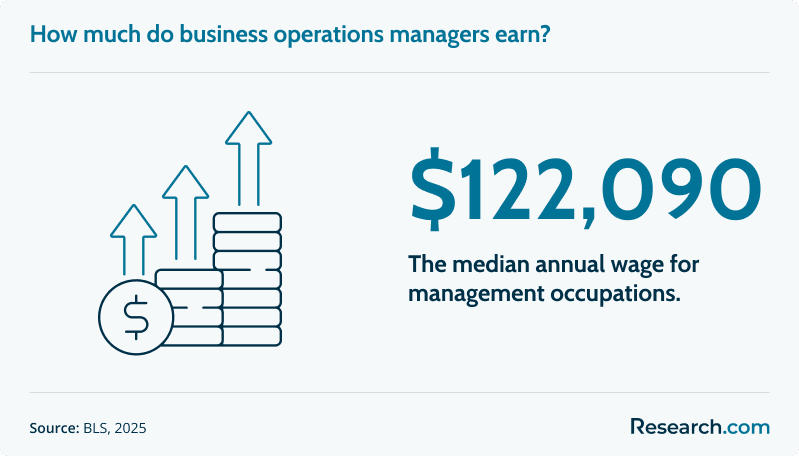
In 2027, business operations manager salary depends on industry, location, employer size, scope of authority, technical complexity, and experience. The BLS reported that the median annual wage for management occupations was approximately $122,090 as of May 2024. That figure is a useful management-level benchmark, but actual salaries for business operations manager roles can vary widely.
Many roles fall between the mid-five and low-six figures. Higher compensation is more common in larger organizations, high-cost labor markets, and industries where operations directly influence revenue, compliance, supply chain reliability, customer retention, or service quality. Senior operations roles may also include bonuses, performance incentives, broader benefits, or equity-related compensation, depending on the employer.
Factors that influence salary
- Industry: Technology, healthcare, consulting, finance, logistics, and large corporate environments may pay differently because operational complexity and business impact vary.
- Company size: Larger organizations often assign bigger teams, larger budgets, more vendors, and more complex reporting responsibilities.
- Experience level: Managers who can show measurable improvements in cost, cycle time, quality, revenue support, compliance, or service performance may have stronger earning potential.
- Geographic location: Salaries often reflect regional labor markets and cost-of-living differences.
- Technical and financial skills: Data analysis, financial reporting, systems implementation, dashboard use, and vendor management can make a candidate more competitive.
When comparing job offers, candidates should evaluate duties as closely as compensation. A “business operations manager” title at one employer may resemble an operations analyst lead, program operations manager, general and operations manager, business manager, or director-level role elsewhere. Candidates with cross-disciplinary leadership skills may also want to compare compensation in related technical management paths, such as those discussed in MBA in engineering management salary resources.
What is the job growth outlook for business operations managers?
The job outlook for business operations managers is supported by a simple business need: organizations must control costs, improve efficiency, manage change, and coordinate complex work. The BLS projects employment in management occupations, including this role, to grow faster than the average for all occupations between 2024 and 2034. On average, about 1.1 million management job openings are expected each year, driven by business expansion and the need to replace retiring leaders.
Demand is likely to be strongest for candidates who combine operational leadership with data literacy, financial judgment, technology adoption, and change management. As organizations digitize workflows, redesign supply chains, manage hybrid teams, and respond to disruption, operations managers who can create structure and accountability will remain valuable.
Where opportunities may be strongest
- Organizations undergoing digital transformation: These employers need managers who can help teams adopt new systems without disrupting service, productivity, or reporting.
- Healthcare and human services: Operational leadership matters where staffing, compliance, cost control, service quality, and patient or client experience must be managed carefully.
- Logistics and supply chain environments: Managers who improve reliability, vendor performance, workflow visibility, and response time are often in demand.
- Consulting and professional services: Firms may need operations leaders who can scale delivery, standardize internal processes, and improve client service.
- Emergency and risk-focused organizations: Planning, resilience, crisis coordination, continuity, and resource allocation can overlap with operations management responsibilities.
Professionals interested in roles that combine planning, crisis response, and organizational leadership may also compare this career with pathways connected to a masters in emergency management degree salary background.
What are the different types of business operations manager roles?
Business operations management is not one fixed job. The title can describe different responsibilities depending on the industry, employer size, business model, reporting structure, and level of authority. Some positions focus on staffing and service quality, while others emphasize financial controls, systems, facilities, vendors, logistics, compliance, or enterprise-wide process improvement.
Common types of roles
- Hospitality and food service operations managers: The restaurant and food service industry employs around 167,610 general and operations managers. These professionals typically manage service standards, staffing, scheduling, compliance, inventory, and customer experience.
- Consulting and professional services managers: About 145,750 professionals work in management, scientific, and technical consulting services. Operations managers in this area help firms deliver projects efficiently, manage utilization, standardize processes, and support client work.
- Corporate and enterprise managers: With approximately 122,870 positions, these managers help align operations across large corporations, business units, or subsidiaries. Their work may include reporting systems, shared services, business planning, policy rollout, and executive support.
- Technology and systems operations managers: In computer systems design and related services, where 87,170 managers are employed, these professionals often focus on digital workflows, systems integration, vendor performance, service delivery, and scalable processes.
- Construction and facilities operations managers: Around 79,630 managers work in building equipment contracting. These roles often involve project logistics, workforce coordination, safety or compliance processes, scheduling, procurement, and field operations.
How to read job postings carefully
Because titles vary, candidates should look for the real scope of the role. A strong job posting should clarify team size, budget responsibility, reporting line, performance metrics, travel expectations, software requirements, vendor responsibility, and whether the job is mostly tactical, strategic, or both. If those details are missing, they are worth asking about before accepting an interview or offer.
What are common challenges and stress-points for a business operations manager in the workplace?
Business operations managers often work where strategy, resources, and execution collide. That makes the role influential, but also stressful. A common pressure point is managing competing priorities: leaders may want lower costs, faster delivery, stronger service quality, better reporting, and easier employee workflows at the same time.
The job can be difficult because operations managers are often accountable for results that depend on several teams. They may not directly control every person, budget, system, or decision involved, yet they are expected to diagnose problems, coordinate action, and keep work moving.
Frequent workplace challenges
- Competing goals: Reducing costs while preserving quality, speed, employee morale, and customer satisfaction often requires careful trade-offs.
- Unclear ownership: Cross-functional work can stall when teams disagree about who is responsible for a decision, process, or outcome.
- Data quality problems: Inconsistent reports, unclear definitions, or incomplete data can make it hard to identify the real issue.
- Change resistance: Even a better process can fail if employees are not trained, consulted, or supported during implementation.
- Resource constraints: Operations managers are often asked to improve performance without additional staff, budget, or technology.
- Unexpected disruptions: Supply chain problems, staffing gaps, system outages, compliance issues, or sudden changes in demand can quickly affect operations.
Effective operations managers reduce stress by setting clear priorities, documenting decisions, using reliable metrics, communicating early, and separating urgent problems from long-term improvement work. Emotional intelligence is also essential because the role is not only about process design; it is about getting people to work differently and trust the change.
How can a business operations manager progress into senior leadership roles?
A business operations manager can progress into senior leadership by moving from managing workflows to shaping business strategy. Many professionals move into senior roles such as Director of Operations, Vice President of Operations, or Chief Operating Officer (COO) after building a record of leading teams, improving performance, managing budgets, and delivering complex projects.
Career growth usually depends on expanding scope. A manager who starts by improving one department may later oversee multiple teams, a region, a product line, an operating unit, or enterprise-wide systems. Each step requires stronger financial judgment, executive communication, change management ability, and comfort making decisions with incomplete information.
Practical steps toward advancement
- Build measurable wins: Track improvements in cost, cycle time, service quality, revenue support, compliance, customer satisfaction, or productivity.
- Develop financial fluency: Senior leaders must understand budgets, forecasts, margins, staffing models, and the financial impact of operational decisions.
- Lead larger initiatives: Volunteer for cross-functional projects, system implementations, reorganizations, process redesigns, or multi-team improvement efforts.
- Strengthen people leadership: Managing managers, resolving conflict, coaching teams, and communicating change become more important at higher levels.
- Learn the business model: Senior operations leaders must understand how the organization earns revenue, controls risk, serves customers, and competes.
- Consider further education: An MBA or specialized management degree can help when it fills gaps in strategy, finance, analytics, or executive leadership.
- Find mentors and sponsors: Mentorship can improve judgment and decision-making, while sponsorship can help high-performing managers access stretch assignments.
The strongest candidates for senior leadership can show more than operational responsibility. They can prove they improved the organization in ways executives can measure, understand, and trust.
What do employers look for when hiring a business operations manager?
Employers look for business operations managers who can diagnose problems, organize people, use data, and deliver measurable improvements. The strongest candidates combine strategic awareness with practical execution: they understand the organization’s goals and can build the workflows, reporting habits, routines, and accountability needed to reach them.
Hiring managers usually evaluate candidates through education, industry experience, leadership history, technical tools, communication skills, and evidence of results. A resume is more persuasive when it describes specific operational outcomes instead of listing duties only.
Qualities employers commonly prioritize
- Experience managing multiple projects under tight deadlines.
- Strong communication, judgment, and decision-making skills.
- Familiarity with business intelligence, reporting, project management, workflow, and process optimization tools.
- Experience working with cross-functional or global teams.
- A results-driven mindset focused on efficiency, scalability, quality, cost control, and service improvement.
- Evidence of budget oversight, vendor management, staffing coordination, performance reporting, or policy implementation.
- Ability to translate executive priorities into clear operating plans that teams can follow.
How to stand out as a candidate
Candidates should prepare examples that show how they solved real operational problems. Strong interview stories explain the problem, the data used, the stakeholders involved, the action taken, and the measurable result. Employers want to know what changed, why it changed, and how the candidate influenced the outcome.
Common mistakes include using vague phrases such as “improved efficiency” without evidence, focusing only on software tools, or failing to explain how teams were brought along during change. Operations management is not just analysis. It is execution through people, systems, and disciplined follow-through.
Here’s What Graduates Have to Say About What a Business Operations Manager Does
- : "My degree in business operations opened doors I didn’t even know existed. I started in logistics, but learning how systems connect across departments helped me transition into operations management quickly. The role challenges me daily to balance efficiency and innovation. It’s rewarding to see measurable results from the strategies I implement. — Jordan"
- : "As a recent graduate, I found the role of a business operations manager to be the perfect mix of analysis and leadership. Managing budgets, performance reports, and interdepartmental workflows allowed me to see the bigger picture of how a company runs. It’s a career that teaches you to think both strategically and practically. Every project feels like solving a new puzzle. — Taylor"
- : "Coming from a finance background, I initially underestimated how much collaboration goes into operations management. Now, I lead cross-functional teams that bridge communication between technical experts and executives. The impact you can make on organizational efficiency is incredible. It’s not just about numbers—it’s about creating a culture of continuous improvement. — Renee"
Other Things You Should Know About What a Business Operations Manager Does
Business operations managers commonly use ERP systems such as SAP or Oracle, CRM platforms like Salesforce, and data tools such as Excel, Power BI, or Tableau. These tools help track budgets, workflow, staffing, and performance metrics across departments.
Certifications like the Certified Business Operations Professional (CBOP) and Project Management Professional (PMP) are beneficial for business operations managers in 2027 as they enhance skills in planning, executing, and overseeing projects, making professionals more competitive and effective in their roles.
In 2027, a bachelor's degree in business administration, management, or a related field is typically required for a business operations manager. Some roles may prefer or require an MBA for advancement, highlighting the importance of developing strategic and analytical skills.
References
- BLS. (2025). Occupational Employment and wage Statistics Profiles. data.bls.gov.
- BLS. (2025, August 28). Management occupations. bls.gov.
- ONET OnLine (2025). 11-1021.00 - General and Operations Managers. onetonline.org.
- Zippia. (2025, January 8). Best Colleges and Degrees for Business Operations Managers. zippia.com.
- Zippia. (2025, January 8). Business Operations Manager skills for your resume and career. zippia.com.


