
2027 Most Affordable Online Anthropology Degree Programs

Co-Founder and Chief Data Scientist
Choosing an online anthropology degree is really a decision about value: Will the program be affordable, credible, flexible, and useful for the kind of work you want after graduation? Anthropology attracts students who want to understand people, cultures, language, history, human biology, migration, technology use, and social behavior—but many prospective students also worry that the degree may be too broad or difficult to translate into a career.
This guide is designed for high school students, transfer students, working adults, and career changers comparing affordable online anthropology programs for 2027. You will learn what online anthropology programs usually include, how much they may cost, how online study compares with campus study, which schools offer lower-cost options, what careers graduates pursue, and what questions to ask before enrolling.
Quick answer: Is an online anthropology degree worth considering?
An online anthropology degree can be worth considering if you want a flexible liberal arts degree that builds research, writing, cultural analysis, qualitative interviewing, data interpretation, and problem-solving skills. The degree is especially useful when paired with applied experience, internships, a specialization, or complementary skills in areas such as UX research, cultural resource management, public health, nonprofit work, market research, or government service.
It is not the right fit for every student. If you want a degree that leads directly to a licensed occupation, a highly technical role, or a clearly defined entry-level credential without additional experience, you should compare anthropology with more career-specific programs before committing.
What are the main benefits of earning an online anthropology degree?
- Flexible access to a humanities and social science degree: Online programs can make anthropology more manageable for students who work, care for family members, live far from campus, or need to avoid relocation.
- Transferable workplace skills: Anthropology develops skills in research, observation, interviewing, cultural interpretation, writing, and evidence-based reasoning.
- Broad career relevance: Graduates may pursue roles in consulting, scientific research, cultural resource management, government, nonprofit programs, UX research, market research, human resources, and community-facing work.
- Potential for solid earnings in specialized roles: Anthropologists and archaeologists earn an average annual salary of around $71,070, though actual pay depends heavily on job title, education level, experience, industry, and location.
What should you expect from an online anthropology degree?
An online anthropology degree introduces students to the study of humans across time, place, biology, language, and culture. At the bachelor’s level, the program usually provides a broad foundation across anthropology’s major subfields. At the master’s level, students often use anthropology to specialize, shift careers, or deepen research expertise.
Most reputable online programs cover archaeology, cultural anthropology, linguistic anthropology, and biological anthropology. Some also include applied anthropology, environmental anthropology, medical anthropology, museum studies, public anthropology, or cultural resource management. In an accredited program, online coursework should be academically comparable to the institution’s campus-based courses.
Students should expect heavy reading, writing, discussion, research design, case analysis, and independent work. Some programs also include virtual labs, digital archives, remote research projects, field school options, internships, or local applied learning experiences.
| What you study | What it helps you learn | Where it can be useful |
| Cultural anthropology | How communities organize meaning, identity, values, behavior, and social life | Nonprofits, public health, international work, DEI, market research |
| Archaeology | How past societies are studied through objects, sites, landscapes, and material evidence | Cultural resource management, museums, preservation, government |
| Biological anthropology | Human evolution, variation, biology, primates, and skeletal analysis | Forensics, public health, research, museums, graduate study |
| Linguistic anthropology | How language shapes culture, identity, power, and interaction | UX research, education, communication, community programs |
| Research methods | Interviewing, observation, qualitative analysis, ethics, and evidence-based interpretation | Consulting, user research, program evaluation, policy work |
Where can you work with an online anthropology degree?
Anthropology graduates are not limited to academic or museum careers. The degree is broad, so career outcomes depend on how students build experience around it. Students who add internships, fieldwork, data skills, portfolio projects, writing samples, or a focused specialization are typically better positioned than those who complete only general coursework.
- Management consulting: Anthropology can help organizations understand people, culture, systems, and behavior before designing strategies or interventions.
- Scientific research: Graduates may support studies involving human populations, communities, health, environment, or social systems.
- Government: Anthropology is relevant to policy, cultural resource management, historic preservation, public programs, and community engagement.
- UX and market research: Ethnographic observation, interviewing, and qualitative analysis can help teams understand users, consumers, and product behavior.
- Nonprofit organizations: Anthropology supports needs assessment, community outreach, program design, evaluation, and culturally responsive services.
- Human resources and DEI: Graduates may apply cultural analysis and communication skills to organizational culture, inclusion, training, and employee experience.
How much can you make with an online anthropology degree?
Salary varies by role, employer, education level, location, specialization, and experience. The U.S. Bureau of Labor Statistics reports that anthropologists and archaeologists earn an average annual salary of around $71,070. This figure is a benchmark for the occupation, not a guaranteed salary for every anthropology graduate.
Some industries report higher averages. For example, federal government roles can potentially exceed $90,000, and the Federal Executive Branch offers an average annual salary of $91,620 for anthropologists and archaeologists. Students interested in stronger earning potential should pay attention to specializations, applied experience, graduate school requirements, and the industries that hire for the roles they want.
- Most Affordable Online Anthropology Degree Programs for 2027
- How long does an online anthropology degree take?
- Online anthropology degree vs. on-campus anthropology degree
- Average cost of an online anthropology degree
- Financial aid options for online anthropology students
- Admission requirements for online anthropology programs
- Common courses in an online anthropology degree
- Anthropology specializations available online
- Anthropology and digital innovation
- Interdisciplinary approaches in anthropology education
- Challenges of studying anthropology online
- Collaborations that strengthen online anthropology learning
- Interdisciplinary career integration
- How to choose the right online anthropology program
- Career paths for online anthropology graduates
- Job market for anthropology graduates
10 Most Affordable Online Anthropology Degree Programs for 2027
How we rank schools
Affordability matters, but it should not be evaluated in isolation. A low tuition price is most useful when the institution is accredited, the curriculum matches your goals, and the program provides the academic and career support online students need.
This ranking draws on information from the IPEDS database, Peterson's database, the College Scorecard database, and The National Center for Education Statistics. These sources help evaluate DEGREE programs using consistent institutional and program data. You can review additional details on Research.com’s methodology page.
| Program | Best-fit student | Cost information listed | Accreditation listed |
| University of Alaska Fairbanks eCampus | Students interested in anthropology with Arctic, field-based, or regional research context | $289 per credit; approximately 120 credits × $289 = $34,680 | NWCCU |
| Thomas Edison State University | Adult learners and students seeking flexible pacing or prior-learning options | $427 for New Jersey residents; $556 out-of-state; estimated $51,240–$66,720 | MSCHE |
| Southern New Hampshire University | Students wanting a fully online BA with general anthropology or environmental sustainability options | $330 per credit; approximately 120 credits × $330 = $39,600 | NECHE |
| University of Maryland Global Campus | Students open to anthropology coursework within a broader social science degree | $250 UMGC Europe rate; approximately 120 credits × $250 = $30,000 estimate based on Europe rate | MSCHE |
| Oregon State University | Students who want BA or BS options and access to field school or research opportunities | $384 quarter credit rate; 180 quarter credits × $384 ≈ $69,120 | NWCCU |
| Western Illinois University | Students interested in online or hybrid study with applied learning and possible 4+1 options | $312 undergraduate rate; approximately 120 credits × $312 = $37,440 | HLC |
| Utah State University | Students looking for tracks such as environmental change, community engagement, biological anthropology, cultural/applied anthropology, or archaeology/CRM | $405 for out-of-state online students; approximately 60 major credits × $405 = $24,300 plus general education costs | NWCCU |
| Washington State University | Students seeking a global campus BA with anthropology core courses, electives, and optional fieldwork or internships | $450; approximately 120 credits × $450 = $54,000 tuition, fees extra | NWCCU |
| University of Florida | Florida residents seeking a lower listed in-state tuition option | $111.92 tuition + $17.26 fees = $129.18; approximately 120 credits × $129.18 ≈ $15,502 in-state | SACSCOC |
| Arizona State University | Students interested in flexible electives, research access, and an accelerated BA/MS pathway | Estimated $350-$400; 120 credits × approximately $350-$400 = $42,000-$48,000 | HLC |
1. University of Alaska Fairbanks eCampus – Bachelor of Arts in Anthropology
The online Bachelor of Arts in Anthropology through UAF eCampus covers archaeology, biological anthropology, cultural anthropology, and linguistic anthropology. Students may focus on one or more subfields, and the program combines online instruction with lab and field-based learning. Its Alaska setting gives students access to a distinctive Arctic context for anthropology study.
- Cost per credit: $289
- Total cost of program: Approximately 120 credits × $289 = $34,680
- Accreditation: Accredited by the Northwest Commission on Colleges and Universities (NWCCU)
2. Thomas Edison State University – Bachelor of Arts in Anthropology
Thomas Edison State University offers a fully online Bachelor of Arts in Anthropology that includes cultural, physical, and archaeological anthropology. Students complete 45 credits in general education and 45 credits in anthropology, with topics such as physical anthropology, cultural anthropology, ethnography, and New or Old World studies. The program may be especially relevant for adult learners because of its flexible structure and credit-for-experience options.
- Cost per credit: $427 (New Jersey residents); $556 (out-of-state)
- Total cost of program: Approximately 120 credits × per-credit rate (est. $51,240–$66,720)
- Accreditation: Accredited by the Middle States Commission on Higher Education (MSCHE)
3. Southern New Hampshire University – Bachelor of Arts in Anthropology
Southern New Hampshire University delivers its Bachelor of Arts in Anthropology fully online. Students study cultural, biological, archaeological, and linguistic anthropology and can choose a General Anthropology track or an Environmental Sustainability concentration. The program emphasizes applied assignments and multidisciplinary thinking about people, societies, and human-environment relationships.
- Cost per credit: $330
- Total cost of program: Approximately 120 credits × $330 = $39,600
- Accreditation: Regionally accredited by the New England Commission of Higher Education (NECHE)
4. University of Maryland Global Campus – Anthropology Courses within the Bachelor of Science in Social Science
UMGC does not list a standalone anthropology degree. Instead, students can take online anthropology courses within the Bachelor of Science in Social Science program. Course options include ANTH 101, ANTH 102, ANTH 345, ANTH 346, ANTH 350, ANTH 351, and ANTH 417. This route may suit students who want anthropology coursework inside a broader interdisciplinary social science program.
- Cost per credit: $250 (UMGC Europe rate)
- Total cost of program: Approximately 120 credits × $250 = $30,000 (estimate based on Europe rate)
- Accreditation: UMGC holds institutional accreditation from the Middle States Commission on Higher Education (MSCHE)
5. Oregon State University – Bachelor of Arts or Science in Anthropology
Oregon State University Ecampus offers an online Bachelor of Arts or Bachelor of Science in Anthropology. The curriculum includes archaeology, biocultural anthropology, cultural anthropology, and general anthropology. Students may access field school options, research opportunities, faculty mentorship, and global perspectives while completing the degree online.
- Cost per credit: $384 (quarter credit rate)
- Total cost of program: 180 quarter credits × $384 ≈ $69,120
- Accreditation: Accredited by the Northwest Commission on Colleges and Universities (NWCCU)
6. Western Illinois University – Bachelor of Arts in Anthropology
Western Illinois University offers a Bachelor of Arts in Anthropology in fully online or hybrid formats. Students examine cultural, biological, archaeological, and linguistic anthropology and may participate in virtual lectures, 3D modeling activities, field schools, research connected to NSF grants, and opportunities involving institutions such as the Field Museum. Embedded 4+1 master’s options may support students planning further study.
- Cost per credit: $312 (undergraduate rate)
- Total cost of program: Approximately 120 credits × $312 = $37,440
- Accreditation: Accredited by the Higher Learning Commission (HLC)
7. Utah State University – Bachelor of Science in Anthropology
Utah State University offers an online Bachelor of Science in Anthropology with tracks in Environmental Change, Community Engagement & Wellness; Biological; Cultural/Applied; Archaeology/CRM; and a General option. The program emphasizes applied learning through internships, practica, field schools, faculty mentoring, and research support.
- Cost per credit: $405 for out-of-state online students
- Total cost of program: Approximately 60 major credits × $405 = $24,300 (plus general education costs)
- Accreditation: Institutionally accredited by the Northwest Commission on Colleges and Universities (NWCCU)
8. Washington State University – Bachelor of Arts in Anthropology
Washington State University Global Campus offers a fully online Bachelor of Arts in Anthropology. Students study archaeology, cultural anthropology, linguistic anthropology, and biological anthropology through a 34-credit core plus electives. Optional internships, fieldwork, and online faculty engagement can help students connect coursework to career goals.
- Cost per credit: $450 (WSU Global Campus undergraduate rate)
- Total cost of program: Approximately 120 credits × $450 = $54,000 (tuition; fees extra)
- Accreditation: Institutionally accredited by the Northwest Commission on Colleges and Universities (NWCCU)
9. University of Florida – Bachelor of Arts in Anthropology
University of Florida Online offers a Bachelor of Arts in Anthropology that can be completed fully online. Students study cultural, archaeological, biological, and linguistic anthropology and develop research, data analysis, and critical-thinking skills. The program may also work for students who want to combine anthropology with another major or minor.
- Cost per credit: $111.92 (tuition) + $17.26 fees = $129.18 (Florida resident)
- Total cost of program: Approximately 120 credits × $129.18 ≈ $15,502 (in-state)
- Accreditation: Accredited by the Southern Association of Colleges and Schools Commission on Colleges (SACSCOC), via UF’s institutional accreditation
10. Arizona State University – Bachelor of Arts in Anthropology
Arizona State University offers an online Bachelor of Arts in Anthropology through ASU Online. The program covers biological, cultural, linguistic, and archaeological anthropology while emphasizing research, writing, and critical thinking. Students may use electives, research opportunities, and an accelerated BA/MS pathway to shape the degree around long-term goals.
- Cost per credit: Estimated $350-$400 (varies by residency; approx. $7,495 annual for in-state)
- Total cost of program: 120 credits × approx. $350-$400 = $42,000-$48,000 (tuition estimate)
- Accreditation: Accredited by the Higher Learning Commission (HLC)
How long does it take to complete an online anthropology degree?
A bachelor’s degree in anthropology typically requires 120 credits and often takes four years of full-time study. Online students may finish faster if they transfer credits, enroll year-round, or choose an accelerated structure. Part-time students may take longer, especially if they balance school with work or family responsibilities.
The best timeline depends on your existing credits, weekly availability, financial aid status, course load, and whether required courses are offered every term. Students who like compressed online formats sometimes compare anthropology with other accelerated options, such as the fastest online MBA programs in environmental management, to understand how intensive pacing works in different fields.
| Student situation | Likely timeline factor | What to ask before enrolling |
| First-time full-time student | Usually follows the standard four-year bachelor’s path | Are all major courses available online in the terms I need them? |
| Transfer student | May finish sooner if prior credits apply to general education or major requirements | How many credits will transfer, and will they count toward the major? |
| Working adult | May need part-time pacing to avoid overload | Can I take one or two courses per term without losing aid eligibility? |
| Accelerated learner | May complete faster through year-round or condensed courses | Are accelerated courses asynchronous, synchronous, or both? |
Anthropology remains a well-established academic field. In 2022 alone, U.S. institutions awarded over 11,000 degrees in anthropology, with undergraduate degrees representing the main entry point for many students. The chart below shows anthropology degrees awarded by academic level.
How does an online anthropology degree compare to an on-campus program?
An online anthropology degree and an on-campus anthropology degree can cover the same academic material, especially when both are offered by an accredited institution. The real difference is the learning experience: online programs prioritize flexibility, while campus programs provide more immediate face-to-face interaction and physical access to labs, libraries, campus events, and field activities.
Students drawn to online anthropology for flexibility may also recognize similar advantages in other online skill-building fields, including fast-track UX design programs online, where flexible study can support career movement without requiring campus relocation.
| Factor | Online anthropology degree | On-campus anthropology degree |
| Schedule | Often more flexible; may include asynchronous coursework | Usually requires attendance at fixed times and locations |
| Cost structure | May reduce commuting, housing, and meal-plan expenses | May include campus housing, transportation, and other in-person costs |
| Networking | Requires proactive participation in discussions, virtual events, faculty office hours, and internships | Offers easier informal interaction with classmates, faculty, and campus organizations |
| Fieldwork | May require local arrangements, summer field schools, virtual labs, or optional in-person experiences | May provide more direct access to campus-sponsored field sites, labs, and collections |
| Credential value | Can be equivalent when the institution is properly accredited | Can be equivalent when the institution is properly accredited |
When online study makes sense
- You need to keep working while studying.
- You cannot move near campus.
- You are comfortable with independent reading, writing, and discussion.
- You can be proactive about internships, research projects, and networking.
When campus study may be better
- You want regular in-person interaction with faculty and peers.
- You need easier access to physical labs, collections, or field sites.
- You learn best through structured schedules and face-to-face accountability.
- You want the full residential campus experience.
What is the average cost of an online anthropology degree program?
The cost of an online anthropology degree varies widely by school, residency status, fees, transfer credits, and financial aid. To compare online and campus costs, it helps to start with traditional college expenses. CollegeBoard data for the 2024-2025 academic year reports average annual tuition and fees at a public, four-year college of $11,610 for in-state students.
Students living on campus also pay an average of $13,310 more for room and board. Online students may avoid much of that cost if they study from home, which can make the online route financially attractive even when tuition rates are similar.
The same cost logic applies in other online programs where students want to reduce campus-related expenses, such as accelerated cinematography degrees online, where avoiding relocation may help students keep more resources available for equipment, projects, or portfolio development.
How to estimate your real cost
| Cost item | Why it matters | Question to ask |
| Tuition | This is the largest listed academic cost, but rates may differ by residency or online status | Is the online tuition rate different for in-state and out-of-state students? |
| Fees | Technology, distance learning, graduation, lab, or course fees can add up | What mandatory fees apply to online anthropology students? |
| Transfer credits | Accepted credits can reduce both time and cost | Will my prior credits satisfy general education, electives, or anthropology requirements? |
| Books and materials | Anthropology courses may require books, digital resources, or lab materials | Are open educational resources or library ebooks available? |
| Fieldwork or internships | Some programs offer optional or required in-person experiences | Will I need to travel for field school, labs, or applied learning? |
Thinking about return on investment
ROI should not be reduced to tuition divided by salary. A better approach is to compare total net cost, debt, time to completion, likely career pathways, graduate school needs, and the strength of your applied experience. The U.S. Bureau of Labor Statistics reports that the average annual salary for anthropologists and archaeologists was $71,070 in 2024, but many anthropology majors work in adjacent roles with different salary structures.
Before enrolling, estimate your total cost after grants and scholarships, then compare that number with realistic jobs you can pursue after graduation. If your target role requires a master’s degree, field school, language skills, data skills, or certification, include those costs in your plan.
What financial aid options are available for online anthropology students?
Online students at accredited institutions are often eligible for the same major categories of financial aid as campus students. Eligibility depends on the school, program, enrollment status, citizenship or residency requirements, academic progress, and financial need.
Grants and scholarships
Grants and scholarships are usually the most desirable forms of aid because they do not need to be repaid. Your first step should be to complete the Free Application for Federal Student Aid. The FAFSA is used to determine eligibility for federal aid, including grants such as the Pell Grant. Students should also check university scholarships, department awards, transfer scholarships, adult learner awards, and private scholarships from nonprofits or professional groups.
Federal student loans
Federal loans can help cover remaining costs, but they must be repaid with interest. They are often preferred over private loans because they typically provide fixed interest rates and federal repayment protections. Borrow only what you need, and compare your expected monthly payments with realistic entry-level earnings.
Work-study, assistantships, and paid experience
Eligible students may qualify for federal work-study or campus-based jobs. Some anthropology departments may offer undergraduate research or assistantship opportunities, though these are more common at the graduate level. Students interested in academic support work can review typical teaching assistant qualifications to understand how these roles may connect with long-term teaching, research, or graduate school goals.
Cost-reduction strategies
- Start at a lower-cost institution and transfer credits carefully.
- Ask whether online students pay different fees than campus students.
- Compare net price, not just advertised tuition.
- Use employer tuition assistance if available.
- Choose a program that accepts prior credits toward requirements rather than only electives.
What are the prerequisites for enrolling in an online anthropology degree program?
Admission requirements for online bachelor’s programs in anthropology are usually similar to requirements for campus-based programs. Each university sets its own criteria, so always verify requirements directly with the admissions office before applying.
Common admission requirements
- High school diploma or GED: A diploma or General Educational Development credential is usually required for bachelor’s admission.
- Official transcripts: Schools generally require high school transcripts and transcripts from any colleges previously attended.
- Minimum GPA: Some universities use a minimum GPA requirement, often around 2.5, while more selective programs may expect a 3.0 or higher.
- Standardized test scores: Many institutions are test-optional, but some may still request SAT or ACT scores.
- Personal statement or essay: Some programs ask applicants to explain their academic interests, career goals, and reasons for studying anthropology.
How to make your application more focused
A strong application connects your interest in anthropology to specific questions, populations, regions, methods, or career goals. If you are interested in cultural resource management, explain why archaeology and preservation matter to you. If you are drawn to public health, explain how culture and community context shape health outcomes. If you want to work in technology, discuss user behavior, ethnographic research, or human-centered design.
The U.S. Bureau of Labor Statistics identifies California, Arizona, Florida, New York, and Oregon as states with the highest employment levels for anthropologists. Applicants can use this type of labor market awareness to show that they have thought beyond the major itself and are already considering where their skills may apply.
Students who want to strengthen anthropology with quantitative skills may also compare related programs, such as the shortest online bachelor's programs in analytics, especially if they are interested in research, evaluation, market intelligence, or data-informed policy work.
What courses are typically in an online anthropology degree program?
An online anthropology curriculum usually blends broad survey courses with methods, writing, theory, and electives. The goal is to help students understand human behavior across cultural, historical, biological, and linguistic contexts while learning how to conduct ethical research.
The four-field foundation
- Sociocultural anthropology: Examines contemporary societies, cultural practices, institutions, identity, belief, kinship, power, and social change.
- Archaeology: Studies past societies through artifacts, settlement patterns, landscapes, and material remains.
- Biological anthropology: Focuses on human evolution, biological variation, primate behavior, and human adaptation.
- Linguistic anthropology: Investigates the relationship between language, culture, social identity, and communication.
Courses you may encounter
| Course type | Possible course topics | Skills developed |
| Introductory surveys | Cultural anthropology, biological anthropology, archaeology, language and culture | Conceptual foundations, comparative thinking, disciplinary vocabulary |
| Methods courses | Ethnographic methods, research design, qualitative analysis, field methods | Interviewing, observation, ethics, evidence collection, interpretation |
| Theory courses | Anthropological theory, culture theory, social theory | Argument analysis, critical reading, theoretical application |
| Applied courses | Medical anthropology, environmental anthropology, museum studies, public anthropology | Problem-solving in real organizations and communities |
| Capstone or project courses | Senior seminar, research project, portfolio, internship reflection | Synthesis, writing, presentation, career preparation |
Anthropology’s research and biological foundations may also overlap with adjacent science-oriented paths. For example, students interested in ecology, species, and human-environment relationships may want to compare anthropology with a wildlife biologist career path.
Where course skills show up in the labor market
According to the U.S. Bureau of Labor Statistics, “Management, Scientific, and Technical Consulting Services” is the top industry for anthropologists, with 2,570 anthropologists employed. This matters because consulting, research, product development, and organizational strategy often require people who can explain the human reasons behind observed behavior.
The chart below highlights top industries employing anthropologists, including architectural and engineering services. Students interested in the built environment may also compare anthropology with accelerated online architecture degree programs to understand different routes into environment, design, and community-centered work.
What types of specializations are available in online anthropology degree programs?
Specializations help turn a broad anthropology degree into a more focused academic and career plan. Not every online program offers every concentration, so compare electives, faculty expertise, internship options, and whether the specialization appears clearly on your transcript or degree plan.
| Specialization | Good fit if you are interested in... | Possible career direction |
| Cultural or sociocultural anthropology | Communities, identity, globalization, organizations, social behavior | Nonprofit work, consulting, market research, public programs |
| Archaeology | Material culture, historic sites, preservation, field methods | Cultural resource management, museums, government, graduate study |
| Biological anthropology | Human evolution, skeletal biology, primates, biological variation | Research, public health, forensics, museum or lab roles |
| Linguistic anthropology | Language, communication, identity, interaction, power | UX research, education, community work, communication research |
| Medical anthropology | Health beliefs, healthcare access, illness experience, community health | Public health, health programs, research, policy support |
| Environmental anthropology | Human-environment relationships, climate, sustainability, adaptation | Environmental programs, community planning, nonprofits, policy support |
Biological and forensic anthropology
Students interested in biological anthropology may explore human skeletal biology, evolution, genetics, primatology, or public health. Forensic anthropology is one applied route within this area, but it typically requires specialized training beyond a general bachelor’s degree. If that path interests you, review what it takes to become a forensic anthropologist.
Specialization and earning potential
Specialization can influence career options and compensation, but it does not guarantee a specific salary. Some higher-paying roles require graduate education, federal hiring eligibility, field experience, or technical skills. The Federal Executive Branch offers an average annual salary of $91,620 for anthropologists and archaeologists, which shows why students interested in archaeology, cultural resource management, and government work should plan their coursework and field experience carefully.
The chart below shows top-paying industries and illustrates why your specialization, employer type, and location can meaningfully affect salary outcomes.
Can an online anthropology degree support digital innovation?
Yes, anthropology can complement digital innovation because many technology problems are ultimately human problems. Product teams need to know why people adopt tools, abandon platforms, misunderstand interfaces, trust systems, resist change, or use products in unexpected ways. Anthropology’s ethnographic methods can help uncover those patterns.
Students interested in technology can combine anthropology with coursework or projects in UX, game design, data analysis, or digital media. For example, students comparing human-centered digital design options may review online schools for game design to see how anthropology’s cultural insight can pair with interactive media and user behavior.
How can interdisciplinary approaches strengthen online anthropology education?
Anthropology becomes more career-ready when paired with another field. Employers often value graduates who can combine qualitative insight with technical, scientific, managerial, or policy knowledge. This does not mean abandoning anthropology; it means choosing electives and projects that make your anthropology training easier to apply.
Possible pairings include anthropology plus public health, anthropology plus analytics, anthropology plus environmental studies, anthropology plus digital humanities, or anthropology plus biology. Students with science interests may also examine an online degree in biochemistry to compare how laboratory-oriented and culture-oriented programs approach human-related research questions.
What are the challenges of pursuing an online anthropology degree?
Online anthropology programs can be flexible, but they also require planning. The biggest risks are isolation, limited hands-on experience, weak networking, and choosing a program without checking whether it offers the fieldwork, methods training, or specialization you need.
| Common challenge | Why it matters | Better strategy |
| Limited in-person fieldwork | Some anthropology careers value field experience or applied research | Ask about field schools, local internships, virtual labs, and approved community projects |
| Less spontaneous networking | Career opportunities often come through faculty, peers, alumni, and projects | Attend virtual office hours, join professional groups, and build relationships intentionally |
| Too much general coursework | A broad degree without direction can be harder to market | Select a specialization, minor, certificate, or applied project that matches your target career |
| Weak online support | Distance learners need advising, tech support, library access, and career services | Ask whether online students receive the same services as campus students |
If you want to strengthen leadership, operations, or project-management skills after anthropology, comparing options such as the most affordable online masters in engineering management program can help you understand how graduate-level management training differs from social science training.
How can collaborations enhance your online anthropology education?
Interdisciplinary collaboration can make online anthropology more practical. Look for programs that support research with community organizations, museums, public agencies, design teams, healthcare organizations, environmental groups, or business partners. These projects help students move from theory to evidence-based problem-solving.
Students interested in health data, systems, and technology may compare anthropology with options such as fast masters in health informatics online. Anthropology can help explain human behavior in healthcare settings, while informatics focuses more directly on health data and information systems.
Can an online anthropology degree lead to interdisciplinary careers?
Yes, but students should be intentional. Anthropology alone provides a strong foundation in human behavior and cultural context. To compete for hybrid roles, students often need to add applied experience, technical fluency, writing samples, research portfolios, language ability, or graduate training.
For example, students interested in healthcare leadership may pair anthropology’s understanding of communities and patient experience with administrative training. Comparing a healthcare administration degree online accredited can help clarify whether a management-focused credential is a better fit than anthropology alone.
How do you choose the best online anthropology degree program?
The best online anthropology program is not automatically the cheapest or the highest ranked. It is the accredited program that fits your budget, schedule, academic interests, transfer-credit situation, and career plan.
Step 1: Verify accreditation before anything else
Confirm that the institution is properly accredited. Accreditation affects credit transfer, graduate school eligibility, employer recognition, and financial aid access. Do not choose a program solely because it is inexpensive if you cannot verify institutional accreditation.
Step 2: Match the curriculum to your career goal
Review required courses, electives, concentrations, and faculty expertise. A student interested in archaeology should not choose a program with few archaeology electives. A student interested in UX research should look for ethnographic methods, qualitative analysis, research design, and opportunities to build a research portfolio.
Step 3: Ask how online students get applied experience
Fieldwork, internships, research projects, and capstones matter. Ask whether you can complete applied learning locally, whether the school helps arrange internships, and whether online students can participate in research with faculty.
Step 4: Compare total net cost
Do not stop at tuition. Compare fees, transfer credit policies, financial aid offers, books, technology costs, field school costs, and time to completion. The real comparison is net price after grants and scholarships, not the advertised rate.
Step 5: Evaluate student support
Online students should have access to academic advising, library services, writing support, career counseling, disability services, technical help, and faculty office hours. Ask whether these services are designed for distance learners or mainly for campus students.
Common mistakes to avoid
- Choosing a program without checking accreditation.
- Comparing only tuition and ignoring fees, transfer credits, and required field experiences.
- Assuming every online anthropology program offers the same subfields or specializations.
- Waiting until senior year to think about internships or career direction.
- Assuming the average salary for anthropologists and archaeologists applies to every graduate.
- Relying only on rankings instead of reviewing curriculum, faculty, support, and net cost.
If your interests shift toward technology, media, business, health, or writing, compare anthropology with related paths before making a final decision. For example, students drawn to writing-intensive careers may also review the fastest online creative writing degree programs, while students focused on UX can revisit fast-track UX design programs online.
What career paths are available for graduates of online anthropology degree programs?
Anthropology graduates can pursue many careers, but the path is usually not automatic. The degree becomes more valuable when students can explain their research skills, show writing and analysis samples, and connect anthropology to a specific workplace problem.
| Career path | How anthropology helps | What may strengthen your candidacy |
| UX researcher | Ethnographic observation, interviewing, user behavior analysis, cultural context | UX portfolio, research methods, usability testing, digital tools |
| Consumer insights analyst | Understanding motivations, habits, cultural patterns, and decision-making | Market research experience, survey tools, qualitative coding, presentation skills |
| Cultural resource management specialist | Archaeology, preservation, field methods, historical context | Field school, GIS exposure, archaeology coursework, regulatory knowledge |
| Public health program specialist | Cultural competence, community assessment, program evaluation | Public health coursework, internships, data skills, community experience |
| Nonprofit program coordinator | Community engagement, needs assessment, qualitative research | Volunteer work, grant writing, evaluation skills, language skills |
| Museum or collections assistant | Material culture, interpretation, research, public education | Museum studies, collections experience, internships, cataloging skills |
| Government analyst or program support role | Policy context, community research, cultural analysis | Writing samples, statistics or analytics, internships, security or hiring eligibility where applicable |
Applied anthropology is the career bridge
Applied anthropology uses anthropological methods to solve real-world problems. Instead of studying culture only for academic knowledge, applied anthropologists help organizations design better programs, products, policies, services, and research strategies.
Career spotlight: UX researcher
UX researchers study how people interact with products, services, and digital systems. Anthropology is relevant because ethnographic methods help reveal what users actually do, not just what they say they do. Students interested in this path should build a portfolio that includes research questions, methods, findings, and recommendations.
Career spotlight: consumer insights analyst
Consumer insights analysts help organizations understand customer behavior. Anthropology graduates can be strong candidates when they can translate interviews, observations, cultural patterns, and qualitative evidence into practical business recommendations.
Career spotlight: public health specialist
Public health work often depends on understanding community trust, health beliefs, local barriers, and cultural practices. Anthropology can help students design or evaluate programs that fit real communities rather than assuming one solution works for everyone. Students planning healthcare leadership roles may also compare fast-track online healthcare management master's programs.
Pathways into science-related work
Anthropology’s biological, archaeological, and research components can connect with adjacent scientific fields. For example, students interested in fossils, deep time, and life history may compare anthropology with a paleontologist career path. Students interested in legal, wildlife, and forensic applications may also review information on wildlife forensics specialist salary to understand how niche expertise can affect career planning.
What is the job market for graduates with an online anthropology degree?
The job market for anthropology graduates is mixed in an important way: the official anthropologist and archaeologist occupation is relatively specialized, but anthropology skills also apply to many adjacent roles that may not have “anthropologist” in the job title. Students should therefore research both anthropology-specific positions and broader roles in research, consulting, public programs, UX, policy, and nonprofits.
Occupational outlook
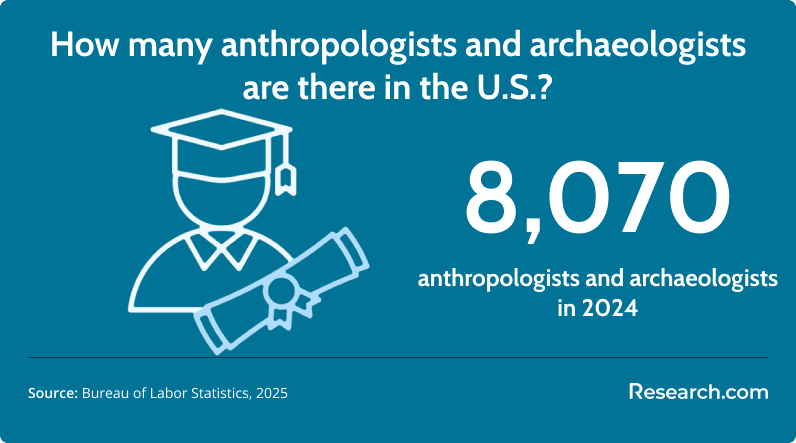
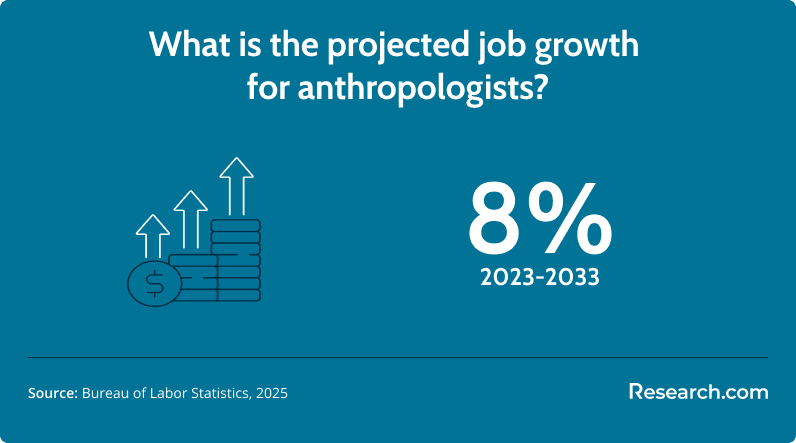
The U.S. Bureau of Labor Statistics projects employment for anthropologists and archaeologists to grow 8% from 2023 to 2033, much faster than the average for all occupations. The same source reports about 800 job openings each year for the 8,070 professionals currently in the field.
Why qualitative skills matter in an AI-shaped workplace
AI and data tools can process large volumes of information, but organizations still need people who can interpret context, meaning, trust, identity, motivation, emotion, and culture. Anthropology’s strength is not simply collecting information; it is explaining why human behavior makes sense within a particular setting. That “thick data” can complement quantitative analytics rather than compete with it.
Location and specialization affect opportunity
Geography matters. The U.S. Bureau of Labor Statistics reports Massachusetts as the highest-paying state for anthropologists, with an average annual salary of $105,190. Employment levels, salary averages, and role types differ by state and industry, so students should research the specific region and sector they want to enter.
What graduates say about earning an online anthropology degree
-
: "
People warned me that anthropology would be too risky, but online study let me explore the field without leaving my job or moving. I now work in cultural resource management, where I help protect historical sites and use the subject I cared about from the beginning. – David
"
-
: "
My nonprofit work with refugee families changed after this degree. I learned how to listen more carefully, ask better questions, and design services around people’s cultural backgrounds instead of assuming we already knew what they needed. – Ben
"
-
: "
I started the program unsure about my career goal, but the research process clicked for me. Online discussions made me write more clearly and defend my ideas with evidence. Those skills helped me move into qualitative research at a consulting firm. – Jackson
"
Key Insights
- An online anthropology degree is best for students who want flexible study and are willing to build applied experience around a broad human-centered discipline.
- Affordability should be measured by net cost, transfer credits, fees, fieldwork expenses, and time to completion—not tuition alone.
- Accreditation is the first filter. A low-cost program is only a good value if the institution is properly accredited and the curriculum fits your goals.
- Anthropology graduates can work in consulting, UX research, cultural resource management, public health, nonprofits, government, research, museums, and market insights, but many roles require targeted experience or additional skills.
- The U.S. Bureau of Labor Statistics reports an average annual salary of $71,070 for anthropologists and archaeologists, with higher averages in some sectors, including $91,620 in the Federal Executive Branch.
- Employment for anthropologists and archaeologists is projected to grow 8% from 2023 to 2033, with about 800 job openings each year for the 8,070 professionals currently in the field.
- Specialization matters. Archaeology, biological anthropology, medical anthropology, environmental anthropology, linguistic anthropology, and applied anthropology can lead to different career routes.
- Online students should proactively seek internships, research projects, field schools, faculty mentorship, and portfolio-ready work to make the degree more marketable.
References:
- Data USA. (2025). Data USA. https://datausa.io/
- National Center for O*NET Development. (2025). O*NET OnLine. https://www.onetonline.org/
- Projections Central. (2025). Long-term occupational projections. https://projectionscentral.org/longterm
- U.S. Bureau of Labor Statistics. (2025a). OES maps. https://data.bls.gov/oesmap/
- U.S. Bureau of Labor Statistics. (2025b). Occupational Employment and Wage Statistics. https://data.bls.gov/oesprofile/
- U.S. Bureau of Labor Statistics. (2025c). Occupational Outlook Handbook. https://www.bls.gov/ooh/
Other Things You Should Know About Most Affordable Online Anthropology Degree Programs
In 2027, community colleges and public universities are typically the most affordable options for online anthropology degree programs. These institutions often offer lower tuition rates compared to private colleges and provide financial aid opportunities to further reduce costs.
Many low-cost online anthropology programs accept up to 90 transfer credits toward a 120-credit bachelor’s degree. Schools usually require official transcripts, and upper-division anthropology courses must still be completed at the degree-granting institution.





