
2027 Most Affordable Online ESL Graduate Certificate Programs

Co-Founder and Chief Data Scientist
An online ESL graduate certificate can be a practical next step if you already have a bachelor’s degree, work in education, or want a focused credential for teaching English learners without committing immediately to a full master’s program. The decision matters because English learner enrollment, online instruction, and international language training continue to shape hiring expectations for teachers, tutors, curriculum specialists, and program coordinators.
According to the U.S. Department of Education, more than 5 million English learners were enrolled in public schools in 2024, which continues to create demand for educators who understand language acquisition, culturally responsive instruction, assessment, and multilingual student support.
This guide explains how affordable online ESL graduate certificate programs work, what they cost, how long they take, which schools offer low-cost options, and how to compare certificates against endorsements, TEFL/TESOL credentials, and master’s degrees. It also covers financial aid, admissions requirements, common courses, career paths, job market trends, and mistakes to avoid before enrolling.
Quick answer: Is an online ESL graduate certificate worth it?
An online ESL graduate certificate is usually worth considering if you want graduate-level ESL training in a shorter, lower-cost format than a master’s degree. It can help licensed teachers add specialized skills, support educators working with multilingual learners, and prepare graduates for roles in adult ESL, private language programs, online tutoring, curriculum development, and international teaching. However, it may not automatically lead to state licensure or endorsement, so students should confirm whether the program meets their state’s teacher certification requirements before enrolling.
What are the benefits of getting a degree in ESL?
- An ESL credential can prepare graduates for roles such as ESL teacher, curriculum developer, private tutor, adult education instructor, online English teacher, or language program coordinator.
- The median salary for an ESL teacher in the United States is approximately $77,400 per year, with salaries ranging from $44,300 to $130,000 depending on experience and education level.
- Online ESL study can be useful for working adults because courses may allow students to complete assignments from home, continue teaching, or balance graduate coursework with family, travel, or full-time employment.
What can I expect from an ESL degree?
An ESL program focuses on how people learn English as an additional language and how educators can teach reading, writing, speaking, listening, grammar, pronunciation, academic language, and communication skills effectively. At the graduate certificate level, the curriculum is usually narrower than a master’s degree and is designed to build targeted teaching competence rather than broad research preparation.
Students typically study second language acquisition, linguistics, classroom methods, assessment, bilingualism, cultural responsiveness, and curriculum design. Some programs emphasize K-12 English language learners, while others focus on adult learners, international TESOL, online instruction, or English for academic and professional purposes.
Where can I work with an ESL degree?
ESL graduates may work in public schools, private schools, language institutes, international schools, universities, community colleges, adult education centers, nonprofit organizations, government programs, corporate training settings, and online education platforms. The right setting depends heavily on whether the credential includes teacher licensure, an endorsement, supervised fieldwork, or a practicum.
Common job functions include teaching English learners, tutoring individuals or small groups, developing instructional materials, assessing language progress, coordinating ESL services, training teachers, or advising schools and organizations on multilingual learner support.
How much can I make with an ESL degree?
Salary outcomes vary by job title, employer, state, teaching license, education level, and years of experience. With an ESL degree, graduates can expect to earn an average salary of around $56,000 to $57,000 per year in the United States, or approximately $26 to $27 per hour. Some salary sources also report a median salary for ESL teachers of approximately $77,400 per year, with a range from $44,300 to $130,000 depending on experience and education level.
Local markets can differ substantially. For example, in Florida, the median annual salary for ESL teachers is about $52,900, with a range from roughly $45,780 to $76,710 depending on experience and metro area. Students should compare salary data for the exact role they want, because adult education, K-12 public schools, online tutoring, and international language teaching often follow different pay structures.
Most Affordable Online ESL Graduate Certificate Programs Table of Contents
- List of the Most Affordable Online ESL Graduate Certificate Programs for 2027
- How long does it take to complete an online ESL graduate certificate program?
- How does an online ESL graduate certificate program compare to an on-campus program?
- What is the average cost of an online ESL graduate certificate program?
- What are the financial aid options for students enrolling in an online ESL graduate certificate program?
- What are the prerequisites for enrolling in an online ESL graduate certificate program?
- What courses are typically in an online ESL graduate certificate program?
- What types of specializations are available in an online ESL graduate certificate program?
- What student support services are available in online ESL graduate certificate programs?
- What challenges do students face in online ESL graduate certificate programs?
- Can an online ESL graduate certificate pave the way for advanced academic pursuits?
- How to choose the best online ESL graduate certificate program?
- How does an online ESL graduate certificate compare with an online master’s degree?
- What career paths are available for graduates of an online ESL graduate certificate program?
- What is the job market for graduates with an online ESL graduate certificate?
- What strategies can help students succeed in an online ESL graduate certificate program?
List of the Most Affordable Online ESL Graduate Certificate Programs for 2027
How do we rank schools?
Research.com reviewed online ESL graduate certificate options using verified higher education data sources, program information, institutional accreditation details, and affordability factors. Readers who want more detail about the ranking process can review the Research.com methodology page.
The analysis draws from established education datasets and institutional information to help prospective students compare programs more efficiently.
- Integrated Postsecondary Education Data System, also known as the IPEDS database
- Peterson’s database, including the Distance Learning Licensed Data Set
- College Scorecard database
- National Center for Education Statistics
Affordable online ESL graduate certificate programs at a glance
| School | Best fit | Program length | Track or concentration | Cost per credit | Credits required | Accreditation |
| Northwestern State University of Louisiana | Students with an undergraduate degree who want TESOL preparation for settings outside the U.S. public school system, including private schools, businesses, government agencies, community programs, or international contexts. | 1 year | TESOL | $375 | 15 credits | Southern Association of Colleges and Schools Commission on Colleges (SACSCOC) |
| East Carolina University (ECU) | Educators seeking flexible graduate coursework in teaching bilingual and multilingual learners. ECU describes a 9 semester hours pathway, while the listed requirement is 15 credits, so applicants should confirm current catalog requirements. | 1 year | TESOL | $204 | 15 credits | Southern Association of Colleges and Schools Commission on Colleges (SACSCOC) |
| University of Cincinnati (UC) | Students who want a TESOL certificate with attention to both PreK-12 and adult or international teaching goals. | 1 year | TESOL | $582 | 18 credits | The Higher Learning Commission |
| Liberty University | Students looking for a fully online certificate covering applied grammar, linguistics, second language acquisition, lesson design, and culturally responsive activities. | 1 year | TESOL | $250 | 12 credits | Southern Association of Colleges and Schools Commission on Colleges (SACSCOC) |
| George Washington University (GWU) | Educators seeking graduate TESOL training with emphasis on instructional methods, language acquisition, cultural competence, leadership, and best practices for U.S. and international classrooms. | 1 year | TESOL | $1,220 | 12 credits | Middle States Commission on Higher Education (MSCHE) |
| Oklahoma State University | Students who want coursework in language acquisition theory, linguistics, TESOL methods, and a practicum component within a broader graduate education environment. | 1 year | TESOL | $381 | 12 credits | The Higher Learning Commission |
| Austin Peay State University (APSU) | Students seeking a shorter 6-month TESOL certificate for teaching children or adults through online platforms, private schools, ESL institutes, or international language training companies. | 6 months | TESOL | $303 | 12 credits | Southern Association of Colleges and Schools Commission on Colleges |
| University of Southern Mississippi (USM) | Students looking for online TESOL preparation in language acquisition, teaching methods, and cross-cultural communication for diverse international learners. | 1 year | TESOL | $578 | 12 credits | Southern Association of Colleges and Schools Commission on Colleges |
| Western Governors University (WGU) | Licensed teachers who want to add English Language Learning (ELL) or ESL preparation through a competency-based format covering assessment, pedagogy, language production, acquisition theory, grammar, and instructional planning. | 17 months | TESOL | $4,125 per term | 11 credits | Northwest Commission on Colleges and Universities (NWCCU) |
| Campbellsville University | Working teachers who want an online ESL endorsement graduate certificate with practical application and integrated field experience. | 1 year | TESOL | $460 per credit | 18 credits | Southern Association of Colleges and Schools Commission on Colleges |
How long does it take to complete an online ESL graduate certificate program?
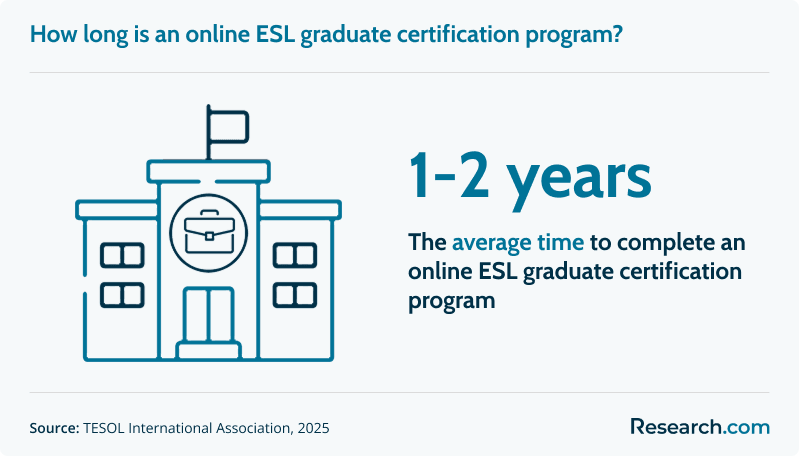
Most online ESL graduate certificate programs take about 6 months to 1 year, although the exact timeline depends on credit requirements, course length, start dates, and whether the student enrolls full time or part time. Many programs require around 12 credit hours and can be finished in as few as 10 months when courses run in about 7-week sessions.
Programs with 18 to 21 credit hours may take a year or more, especially for students who continue working while enrolled. Shorter TEFL or TESOL training courses may be completed in 6 to 12 weeks, but those are generally not the same as graduate certificates awarded by universities.
| Program format | Typical time commitment | Who it may fit |
| Accelerated graduate certificate | About 6 months | Students who can handle a faster pace and want a short route to specialized TESOL training. |
| Standard online graduate certificate | About 1 year | Working professionals who need a manageable schedule while completing graduate coursework. |
| Longer certificate or endorsement pathway | A year or more | Teachers completing fieldwork, licensure-related requirements, or 18 to 21 credit hours. |
| Short TEFL/TESOL course | 6 to 12 weeks | Students seeking a brief non-degree credential rather than a full university graduate certificate. |
If you are comparing online program lengths across fields before committing to ESL, Research.com also provides format and affordability guides such as affordable online jewelry design trade school programs.
How does an online ESL graduate certificate program compare to an on-campus program?
Online and campus-based ESL graduate certificates usually cover similar academic foundations: second language acquisition, linguistics, teaching methods, assessment, cultural responsiveness, and curriculum planning. The main differences are delivery format, schedule flexibility, interaction style, and access to in-person practice.
Online programs are often better for working teachers, parents, rural students, military-connected learners, and international students who cannot relocate. Asynchronous courses can make it easier to complete assignments around professional obligations. The same flexibility is one reason some students also compare remote options such as the fastest digital photography degree online when evaluating how online education fits their schedules.
Campus programs may offer more immediate face-to-face discussion, local networking, supervised practice, and real-time feedback. For students who learn best through live classroom interaction, an in-person program may feel more engaging.
Accredited online ESL graduate certificates from established universities can be academically comparable to campus programs, especially when they align with employer expectations, TESOL standards, or state licensure requirements. Still, students should check whether an online program includes the practicum, field hours, or supervised teaching experience required for their goals.
Some credentials, such as CELTA, are often associated with intensive formats and strong international recognition. By contrast, online university certificates vary widely in interaction level, fieldwork, and workload. This is similar to how an accelerated online graphic design degree may offer speed and convenience but differ from an in-person studio experience.
| Factor | Online ESL graduate certificate | On-campus ESL graduate certificate |
| Flexibility | Usually stronger for working adults and students who need location independence. | Less flexible because students must attend scheduled in-person classes. |
| Interaction | May rely on discussion boards, video meetings, recorded lectures, and written feedback. | Offers more direct classroom discussion and informal peer networking. |
| Field experience | May be arranged locally or built into current teaching employment, depending on the school. | May provide easier access to local supervised placements. |
| Recognition | Can be respected when offered by an accredited institution and aligned with licensure or employer needs. | Can be strong, especially when tied to local school districts or regional hiring networks. |
| Best for | Self-directed students who need convenience and already have access to teaching or tutoring settings. | Students who want in-person mentoring, campus resources, and structured classroom engagement. |
What is the average cost of an online ESL graduate certificate program?
The average cost of an online ESL graduate certificate program in the U.S. typically ranges from about $310 to $555 per credit hour, depending on the institution. Campbellsville University offers an affordable program at approximately $310 per credit hour, while Arizona State University charges around $555 per credit hour. Most programs require between 9 and 18 credit hours, so total tuition can range roughly from $3,000 to $10,000.
Western Governors University (WGU) uses a term-based tuition model costing about $4,125 per six-month term, which may lower total cost for students who move quickly through competency-based coursework.
Students who are also considering a longer graduate path can compare certificate prices with the most affordable online TESOL master's degree programs to decide whether a certificate or full degree offers the better long-term value.
What are the financial aid options for students enrolling in an online ESL graduate certificate program?
Financial aid for graduate certificates can be more limited than aid for degree programs, so students should confirm eligibility with each school before applying. Some certificates may qualify for federal loans, institutional scholarships, employer reimbursement, or payment plans, while others may not meet federal aid requirements.
Students comparing graduate education costs may also review related affordability guides, including cheap online EdD programs, to understand how tuition, aid eligibility, and credential level affect total investment.
- Direct Unsubsidized Loans: Eligible graduate and professional students may use these loans regardless of financial need, but interest accrues while enrolled, during grace periods, and during deferment or forbearance.
- Direct PLUS Loans (Grad PLUS): Graduate students may borrow up to the school-determined cost of attendance minus other aid received. A credit check is required.
- University Scholarships and Fellowships: Some institutions provide awards for graduate students based on academic merit, program enrollment, financial need, or professional goals.
- Departmental Awards: Education, linguistics, or TESOL departments may offer smaller grants, fellowships, project funding, or conference-related support.
- Payment Plans: Monthly or term-based installment plans can reduce the burden of paying all tuition at once, even though they are not financial aid.
- Banks and Private Lenders: Private loans may help close funding gaps, but they often have fewer borrower protections than federal loans. Students should usually review federal options first.
What are the prerequisites for enrolling in an online ESL graduate certificate program?
Admissions requirements vary by university, but most online ESL graduate certificate programs are intended for students who already hold a bachelor’s degree. Some programs are open to career changers, while others are designed specifically for licensed teachers seeking an ESL endorsement or added classroom specialization.
Applicants planning to work with young children should also understand broader teacher preparation expectations, including preschool teacher education requirements, because ESL coursework alone may not satisfy state licensing rules.
- Bachelor's Degree: Most programs require a bachelor’s degree from an accredited college or university. Education, English, linguistics, or humanities backgrounds may help, but they are not always mandatory.
- Official Transcripts: Applicants typically submit transcripts from all prior undergraduate and graduate institutions.
- Statement of Purpose or Personal Statement: Schools may ask applicants to explain their reasons for pursuing ESL training, relevant experience, teaching goals, and readiness for graduate-level study.
- Letters of Recommendation: Many programs request one to three recommendations from professors, supervisors, administrators, or professional colleagues.
- Teaching License or Experience: Endorsement-focused programs may require current teacher certification, while broader TESOL certificates may not.
- Minimum GPA: Some schools set a minimum undergraduate GPA or allow conditional admission for applicants who do not meet the standard requirement.
What courses are typically in an online ESL graduate certificate program?
Coursework teaches students how to plan instruction, support multilingual learners, assess language growth, and connect language learning with academic content. Students exploring teaching pathways may also want to understand whether alternative routes are possible, including how to become a teacher with an associate's degree.
- Foundations of Bilingualism and Teaching Emergent Bilinguals: Introduces bilingual language development, cognitive considerations, and instructional practices for emergent bilingual students.
- Cross-Linguistic Pedagogies: Examines how teachers can use students’ home languages as assets while building English proficiency.
- Academic Language in Dual Language Settings: Focuses on helping learners develop the English needed for school subjects, writing, discussion, and academic performance.
- Content Area Instruction for Emergent Bilinguals: Shows teachers how to support English learners while teaching math, science, social studies, literacy, or other academic content.
- Second Language Acquisition: Covers major theories about how learners acquire another language and how those theories shape classroom practice.
- TESOL Methodologies: Provides strategies for teaching listening, speaking, reading, writing, vocabulary, grammar, and pronunciation to English learners.
- Assessment of English Learners: Explores formal and informal tools for measuring language proficiency and academic progress.
- Practicum or Field Experience: Gives students structured opportunities to observe, teach, reflect, and receive feedback, when included in the program.
What types of specializations are available in an online ESL graduate certificate program?
Specializations help students match ESL training to a specific learner group, teaching setting, or career goal. Not every certificate offers a formal concentration, so students should read the curriculum carefully rather than relying on the program title alone.
- K-12 English Language Learning (ELL) or ESL: Prepares educators to teach English learners in elementary, middle, or high school settings. The University of Texas at El Paso offers a 12-credit program specifically designed to prepare certified teachers for state ESL supplemental certification in K-12 classrooms.
- TESOL Foundations and Methodologies: Centers on second language acquisition, lesson planning, classroom management, instruction, and assessment. Arizona State University’s "Teach English Now!" specialization is an example of this type of approach.
- Bilingual Education and Dual Language Instruction: Emphasizes bilingualism, biliteracy, cross-linguistic teaching, and academic language development in dual-language environments.
- Adult ESL and Workforce English: Supports educators who want to teach adults in community colleges, workplace programs, literacy centers, or corporate settings. This route may also interest professionals from business backgrounds, including students exploring an accelerated bachelor's in entrepreneurship online.
- English Language Learners (ELL) Leadership and Advocacy: Focuses on educational equity, policy awareness, culturally responsive leadership, and support systems for multilingual learners. Eastern Washington University’s Graduate Certificate in English Language Learners includes training in cultural humility and educational equity.
- Online ESL Teaching and Technology Integration: Covers virtual lesson design, digital learning tools, online assessment, learner engagement, and remote classroom management.
What student support services are available in online ESL graduate certificate programs?
Strong online ESL programs should provide more than recorded lectures. Useful support services may include academic advising, technical support, virtual tutoring, career services, library access, writing assistance, faculty office hours, peer discussion spaces, and help arranging fieldwork or practicum experiences. These services are especially important for students who are new to online learning or returning to school after several years away.
When comparing programs, look for the type of student support commonly expected in high-quality online education degree programs: responsive advisors, clear course navigation, accessible faculty, digital research tools, and transparent communication about deadlines and graduation requirements.
What challenges do students face in online ESL graduate certificate programs?
Online ESL certificate students often struggle with time management, limited live interaction, technology problems, delayed feedback, and the challenge of balancing coursework with teaching, family, or full-time work. Asynchronous courses offer convenience, but they also require students to set their own study rhythm and ask for help early.
Students pursuing additional education credentials may face similar workload concerns in other graduate programs, including the cheapest online masters in early childhood education degree. Before enrolling, applicants should ask how often instructors respond, whether live sessions are required, how group projects work, and what happens if they need to pause or slow down.
Can an online ESL graduate certificate pave the way for advanced academic pursuits?
An ESL graduate certificate can support future academic plans by giving students graduate credits, specialized language education training, and evidence of readiness for advanced study. Some universities allow certificate credits to transfer into a master’s degree, but this is not automatic and should be verified before enrollment.
Educators who want to move into leadership, research, policy, or higher education administration may later consider master’s or doctoral options. For example, a certificate may complement a future pathway such as a fast online EdD degree for professionals seeking broader educational leadership preparation.
How to choose the best online ESL graduate certificate program?
The best online ESL graduate certificate is the one that matches your teaching goal, licensure needs, budget, schedule, and preferred learner population. A low tuition rate is important, but it should not be the only deciding factor.
| Selection factor | What to check | Why it matters |
| Accreditation | Confirm regional or recognized institutional accreditation and any relevant education-specific recognition. | Accreditation affects credit transfer, employer trust, financial aid eligibility, and graduate school options. |
| Licensure or endorsement alignment | Ask whether the certificate meets your state’s ESL, ELL, or bilingual endorsement requirements. | A certificate may improve skills but still not qualify you for public school ESL positions without state approval. |
| Curriculum | Look for language acquisition, linguistics, TESOL methods, assessment, cultural competence, and practicum opportunities. | The course list should match the learners and settings you plan to serve. |
| Format | Review whether courses are asynchronous, synchronous, accelerated, term-based, or competency-based. | The format affects workload, pacing, interaction, and ability to continue working. |
| Total cost | Compare tuition, fees, books, technology charges, field placement costs, and payment plan options. | The cheapest per-credit rate may not produce the lowest total cost if credits or fees are higher. |
| Credit transfer | Ask whether certificate credits apply to a master’s degree at the same institution. | Transferable credits can improve long-term value if you plan to continue graduate study. |
| Student support | Check advising, career support, technical help, library access, and practicum coordination. | Online students need reliable support to stay on track and complete requirements. |
Questions to ask before enrolling
- Does this program lead to an ESL endorsement, or is it only a graduate certificate?
- Will the certificate meet requirements in the state where I plan to teach?
- Are field hours, observations, or a practicum required?
- Can I complete fieldwork in my current school or local community?
- Are classes fully online, or are there required live sessions?
- Can certificate credits transfer into a master’s degree later?
- What is the total cost after fees, books, and technology charges?
- What student support is available if I fall behind?
Common mistakes to avoid
| Mistake | Better approach |
| Choosing the lowest tuition without reviewing accreditation. | Verify accreditation first, then compare price among legitimate options. |
| Assuming every ESL certificate leads to public school licensure. | Contact your state education agency and the university before applying. |
| Ignoring practicum or field experience requirements. | Ask exactly where and how you will complete supervised teaching work. |
| Looking only at program length. | Consider workload, course intensity, teaching practice, and transfer value. |
| Assuming online courses are easier. | Plan weekly study time and confirm expectations for discussions, projects, and assessments. |
| Relying only on rankings. | Use rankings as a starting point, then compare fit, cost, licensure, and curriculum. |
If you are still deciding between ESL and other online graduate or professional paths, it can help to compare formats and costs across fields. Research.com also covers options such as cheap online MLIS programs and other career-focused online pathways.
How does an online ESL graduate certificate compare with an online master’s degree?
An online ESL graduate certificate is shorter, more focused, and usually less expensive than a master’s degree. It is best for students who already have a degree and want specialized ESL training, professional development, or an endorsement pathway. A master’s degree is broader and may include research, leadership preparation, advanced theory, electives, and more credits.
| Option | Best for | Main advantage | Main limitation |
| Online ESL graduate certificate | Teachers and professionals who need targeted ESL training quickly. | Shorter completion time and focused curriculum. | May not provide the depth, degree status, or advancement potential of a master’s. |
| Online ESL or TESOL master’s degree | Educators pursuing leadership, curriculum roles, higher education, or long-term specialization. | Broader academic preparation and stronger graduate credential. | Requires more time, credits, and financial investment. |
| TEFL/TESOL short course | Students seeking entry-level international or online English teaching preparation. | Can be completed quickly, sometimes in 6 to 12 weeks. | Not the same as a university graduate certificate and may not support licensure. |
Students comparing education paths should also understand how broader graduate credentials work, including what is a master of education degree.
What career paths are available for graduates of an online ESL graduate certificate program?
Graduates may pursue roles in K-12 schools, adult education, private language schools, international education, community programs, online teaching, curriculum development, and teacher support. The exact career options depend on prior education, licensure status, teaching experience, and local hiring rules.
Those researching classroom roles may also want to review what does an English teacher do to compare general English teaching responsibilities with ESL-specific instruction.
| Career path | Typical responsibilities | Credential considerations |
| ESL teacher | Teach English language skills, assess proficiency, adapt lessons, and support multilingual learners. | Public schools may require state certification or endorsement. |
| Online English teacher | Teach learners remotely through virtual platforms, lesson plans, conversation practice, or structured courses. | Requirements vary by platform and country. |
| Adult ESL instructor | Support adult learners in literacy, workplace English, citizenship preparation, or academic language. | Employers may prefer graduate coursework or TESOL training. |
| Curriculum developer | Create ESL lessons, assessments, instructional materials, and language learning resources. | Teaching experience and assessment knowledge are often valuable. |
| ESL program coordinator | Manage programs, support instructors, evaluate services, and improve learner outcomes. | Leadership experience or a master’s degree may help for advancement. |
| Private tutor | Provide one-on-one or small-group language instruction for children, adults, or professionals. | Business development and specialization can affect earning potential. |
| Corporate language trainer | Teach workplace English, presentation skills, writing, or professional communication. | Business, international, or industry experience may be useful. |
| Linguistics or language services role | Apply language acquisition knowledge in translation, research, assessment, or educational consulting. | Additional credentials may be required depending on the role. |
What is the job market for graduates with an online ESL graduate certificate?
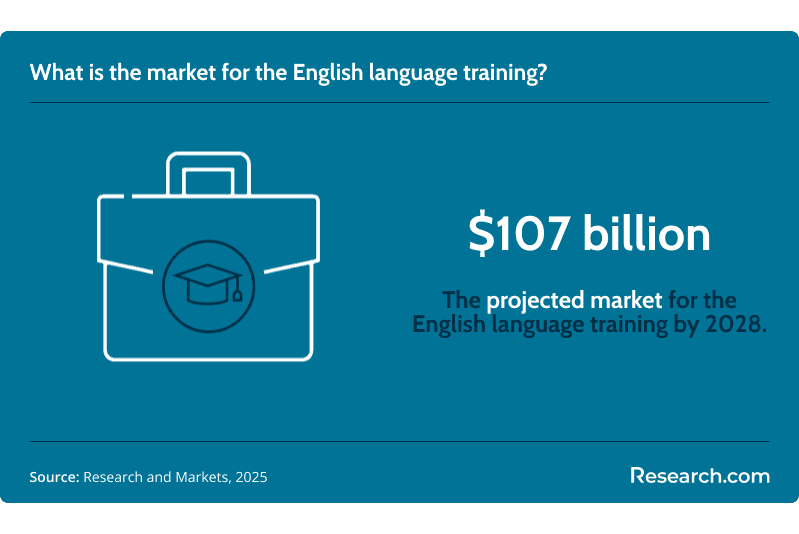
The ESL job market is shaped by English learner enrollment in U.S. schools, adult education needs, international mobility, corporate communication, and the growth of remote teaching platforms. The English language training market is projected to reach over $107 billion by 2028, reflecting significant growth in ESL teaching opportunities worldwide.
Online teaching has expanded access to international learners, but the market is not risk-free. Approximately 50% or more of online ESL jobs are based in East Asia, with growing opportunities worldwide as digital learning becomes more prevalent. Over half of online ESL jobs are concentrated in East Asia, particularly China, although recent regulations have affected some segments of this market.
Many entry-level online ESL jobs require a bachelor’s degree and a TEFL/TESOL certificate, while a graduate certificate may improve competitiveness for higher-responsibility roles, curriculum work, adult education, and school-based positions. Students should not assume a certificate guarantees employment or a specific salary; employer requirements vary widely.
What strategies can help students succeed in an online ESL graduate certificate program?
Success in an online ESL certificate depends on structure, consistency, and active participation. Students should create a weekly study schedule, log in frequently, contribute to discussions, request feedback early, and connect assignments to real teaching situations whenever possible.
- Set fixed weekly blocks for reading, discussion posts, lesson planning, and major assignments.
- Use a dedicated study space with reliable internet, a working webcam, and access to required learning platforms.
- Build relationships with instructors before problems arise, especially if fieldwork or practicum requirements are involved.
- Save strong projects, lesson plans, and assessments for a professional teaching portfolio.
- Apply course concepts immediately in tutoring, classroom teaching, volunteer work, or peer practice.
- Track licensure, endorsement, or transfer-credit requirements in writing.
- Ask classmates for peer feedback and observe how other educators approach multilingual learner support.
Students who want to strengthen quantitative reasoning, assessment analysis, or interdisciplinary problem-solving may also explore broader academic options such as the fastest online bachelors degree in mathematics programs.
Helpful Research.com resources for related education decisions
Students comparing teaching credentials, online formats, and career alternatives may find it useful to review related Research.com guides. These include rankings and explainers for education degrees, alternative credentials, and career preparation in fields beyond ESL.
- Online education degree programs
- Cheapest online masters in early childhood education degree
- Cheap online EdD programs
- Fast online EdD degree
- Preschool teacher education requirements
- How to become a teacher with an associate's degree
- Accelerated bachelor's in entrepreneurship online
- Fastest digital photography degree online
- Accelerated online graphic design degree
References
- Bureau of Labor Statistics. (2024). Adult literacy and GED teachers.
- EF Education First. (2024). EF EPI 2024 - English Proficiency Index.
- ICEF Monitor. (2023). US English language training providers reach 70% of pre-pandemic volumes.
- International TEFL Academy. (n.d.). TEFL & ESL teacher job market report.
- National Center for Education Statistics. (n.d.). Fast facts: English learners.
Key Insights
- An online ESL graduate certificate is best for students who want focused graduate-level TESOL or ESL training without the time and cost of a full master’s degree.
- Program costs vary widely. The average cost of an online ESL graduate certificate program in the U.S. typically ranges from about $310 to $555 per credit hour, and most programs require between 9 and 18 credit hours.
- Completion time is usually about 6 months to 1 year, although programs with 18 to 21 credit hours or fieldwork requirements may take longer.
- Accreditation and licensure alignment matter more than the program title. A certificate may not automatically qualify you for a state ESL endorsement or public school teaching role.
- Career options include ESL teacher, online English instructor, adult ESL educator, curriculum developer, program coordinator, private tutor, and corporate language trainer.
- The ESL market is global, but it is uneven. Approximately 50% or more of online ESL jobs are based in East Asia, and regulations in some countries can affect hiring conditions.
- Before enrolling, ask whether credits transfer into a master’s degree, whether a practicum is required, what student support exists, and what the total cost will be after fees.
Other Things You Should Know About the Most Affordable Online ESL Graduate Certificate Programs
Many online ESL graduate certificate programs require a supervised practicum or field experience of 30 to 100 hours, often completed in a K–12 classroom or approved ESL setting. Some programs waive licensure-style student teaching, but most still require documented evidence of instructional practice.
In 2027, admission requirements for online ESL graduate certificate programs generally include a bachelor's degree, a minimum GPA (often 2.75 or higher), letters of recommendation, and a personal statement. Some programs might also require a resume, TOEFL or IELTS scores for non-native speakers, and previous teaching experience.
The most affordable online ESL graduate certificate programs in 2027 typically last between 6 to 12 months. Program length can vary based on the institution and whether students study part-time or full-time, affecting the overall completion time.





