
2027 How to Become a Nurse with a Health Science Degree: Education, Salary, and Job Outlook

Co-Founder and Chief Data Scientist
Becoming a nurse with a health science degree is not only possible but also a strategic pathway into one of the most rewarding and in-demand careers in healthcare. With registered nurses earning a median annual salary of $93,600, this career offers both financial stability and long-term growth opportunities.
For students and graduates wondering how to transition their health science background into nursing, this guide will walk you through the essential steps, covering education pathways, salary expectations, job outlook, and career advancement, so you can make informed decisions and confidently plan your future in nursing.
Key things you should know about becoming a nurse with a health science degree
- Health science graduates can complete an accelerated nursing program in as little as 11 to 18 months of full-time study.
- A health science background gives you a strong foundation in subjects like anatomy and physiology, making the transition to nursing smoother.
- Choosing the right nursing pathway depends on your career goals, preferred work environment, and long-term advancement plans.
- Can I become a nurse with a health science degree? Degree Overview
- How long does it take to become a nurse if I already have a health science degree? Completion Time
- What prerequisite classes do nursing programs require for health science graduates? Educational Requirements
- Do I need to take the NCLEX to become an RN after a health science degree? Do I need to take the NCLEX to become an RN after a health science degree?
- How much can I earn as an RN with a health science degree? Average Salary
- What core clinical skills should health science graduates to succeed in their nursing career? Clinical Skills
- Are there scholarships for second-degree nursing students who already hold a health science degree? Are there scholarships for second-degree nursing students who already hold a health science degree?
- What are the top-paying industries for registered nurses in the U.S.? What are the top-paying industries for registered nurses in the U.S.?
- Which certifications improve job prospects for new nurses? Which certifications improve job prospects for new nurses?
- What is the job outlook for nurses who convert from a health science degree to an RN? Job Outlook
Can you become a nurse with a health science degree?
A health science degree can be a strong starting point for nursing, but it does not automatically qualify you to work as a registered nurse. To become an RN, you must complete an approved nursing program, meet your state board of nursing requirements, and pass the NCLEX-RN. Your health science background may help you move faster because many programs require coursework in anatomy, physiology, microbiology, chemistry, statistics, psychology, and nutrition.
This guide is for health science graduates, current health science majors, and career changers who are deciding whether nursing is the right next step. You will learn which nursing pathways are available, how long the transition can take, which prerequisites matter, what the NCLEX requires, how salaries compare, and how to avoid expensive mistakes when choosing a program.
Quick answer
Yes. You can become a nurse with a health science degree, but you still need a nursing credential that qualifies you for RN licensure. The most common routes are an accelerated BSN, a second-degree BSN, or a direct-entry MSN program. After completing the nursing program, you must pass the NCLEX-RN before you can practice as a registered nurse.
| Pathway | Best for | Typical timeline stated by programs | Main outcome |
| Accelerated BSN or second-degree BSN | Health science graduates who want the fastest RN route | 11–18 months of full-time nursing study | Eligibility to take the NCLEX-RN and apply for RN licensure |
| Direct-entry MSN | Graduates who want RN preparation plus graduate-level nursing study | About 2–3 years | RN licensure preparation and a master’s-level nursing credential |
| Traditional BSN | Students who need a slower pace or have many missing prerequisites | Varies by transfer credit and school policy | BSN preparation for RN licensure |
| ADN followed by BSN or MSN bridge | Students who want a community-college entry route before advancing | Varies by program and prior coursework | RN eligibility first, then possible degree completion later |
If you are still exploring majors, compare options with strong life science and public health foundations in this guide to the best health science majors for nursing-related pathways.
- A health science degree helps, but it is not a nursing license. Nursing boards require completion of an approved nursing program before NCLEX-RN eligibility.
- Accelerated BSN programs are often the quickest option. These programs commonly run 11–18 months for eligible second-degree students.
- Prerequisites can add time. Missing labs, expired science credits, or course mismatches may delay admission.
- The NCLEX-RN is required. Every RN candidate must pass it after completing an approved nursing program.
- Your background can shape your nursing niche. Health science graduates may be well prepared for bedside care, community health, research support, health education, quality improvement, or leadership tracks after gaining experience.
How long does it take to become a nurse if you already have a health science degree?
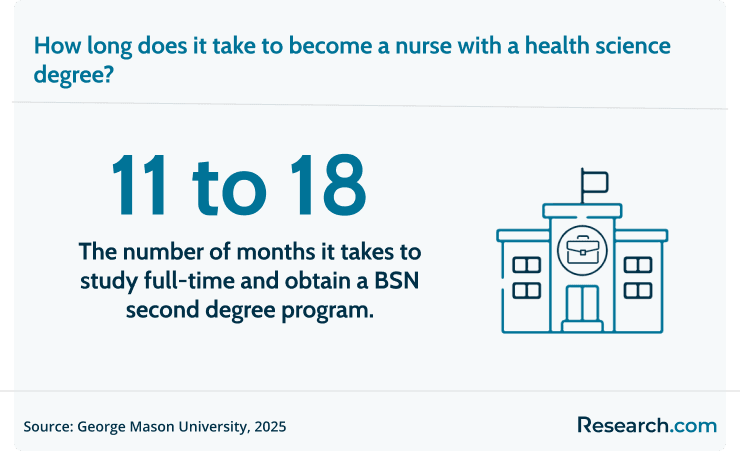
If you already have a bachelor’s degree in health science or another non-nursing field, the shortest common route is an accelerated BSN or second-degree BSN. These programs usually take 11–18 months of full-time study and include classroom instruction, labs, simulation, and supervised clinical rotations.
The full timeline depends on your transcript. Nursing schools often review whether you completed required science courses, whether those courses included labs, whether your grades meet the minimum standard, and whether the credits are still accepted under the school’s recency rules. Even health science graduates may need extra coursework before they can begin the nursing sequence.
Many students spend 6 to 12 additional months completing prerequisites before starting an accelerated nursing program. As a result, the realistic timeline from health science graduate to RN candidate is often 18 to 24+ months, depending on admissions cycles, prerequisite gaps, clinical placement availability, and NCLEX scheduling.
| Step | What you do | Why it matters |
| Transcript review | Ask nursing schools to evaluate completed health science courses | Confirms which prerequisites transfer and which must be repeated |
| Prerequisite completion | Finish required science, math, psychology, and nutrition courses | Required before admission or before starting core nursing coursework |
| Nursing program | Complete an accelerated BSN, second-degree BSN, direct-entry MSN, or approved equivalent | Provides the nursing education required for RN licensure eligibility |
| NCLEX-RN preparation | Use review plans, practice exams, and school resources | Builds readiness for the licensure exam |
| Licensure application | Apply through your state board of nursing and meet all requirements | Allows you to legally practice as an RN after passing the exam |
If your long-term goal includes advanced nursing roles, review bridge options such as RN to BSN to MSN online programs after you understand your initial RN pathway.
What prerequisite classes do nursing programs require for health science graduates?
Prerequisites vary by school, but most nursing programs expect applicants to show recent, college-level preparation in the biological, behavioral, and quantitative sciences. A health science degree often covers many of these areas, but nursing programs may still require specific course titles, lab components, minimum grades, or completion within a certain time frame.
| Common prerequisite | What nursing schools look for | Why it matters in nursing |
| Anatomy and Physiology | Often a lecture-and-lab sequence covering major body systems | Supports assessment, pathophysiology, medication understanding, and clinical reasoning |
| Microbiology | Usually includes infection, microorganisms, and lab work | Prepares students for infection prevention, isolation precautions, and patient safety |
| Chemistry | May include general chemistry and, in some programs, organic chemistry or biochemistry | Helps students understand metabolism, medication effects, and physiologic processes |
| Statistics | College-level quantitative reasoning or statistics coursework | Builds the foundation for evidence-based practice and research interpretation |
| Nutrition | Human nutrition with emphasis on health and disease | Used in patient teaching, chronic disease management, recovery, and prevention |
| Developmental or Lifespan Psychology | Human development from infancy through older adulthood | Helps nurses adapt communication and care to each stage of life |
Before applying, compare each school’s prerequisite list against your transcript instead of assuming your degree will satisfy every requirement. Two programs can treat the same health science course differently. If you plan to specialize later, options such as online FNP graduate certificate programs may eventually become relevant after you earn RN licensure and meet graduate-level requirements.
Do health science graduates need to take the NCLEX-RN?
Yes. A health science degree does not replace the NCLEX-RN. Anyone who wants to become a registered nurse must complete an approved nursing program and pass the National Council Licensure Examination for Registered Nurses before receiving RN licensure from a state board of nursing.
- Who must take it: All RN candidates, including students who previously earned a health science degree.
- When you become eligible: After graduating from an approved nursing program such as an accelerated BSN, second-degree BSN, direct-entry MSN, or another qualifying pathway.
- What it measures: Entry-level nursing judgment, safe care, pharmacology, infection control, prioritization, and patient management.
- How it is delivered: The exam is computerized and adaptive, meaning the test adjusts to your performance as you answer questions.
- Exam length stated: The NCLEX typically ranges from 85 to 150 questions and must be completed within five hours.
- How to prepare: Use targeted NCLEX review, practice questions, remediation plans, and school resources. A science background helps, but nursing judgment and exam strategy require focused preparation.
This requirement is the same for other career changers as well, including students following a biology degree to nursing route.
How much can you earn as an RN with a health science degree?
Registered nurses who enter the field after earning a health science degree have a median annual salary of $93,600. Your actual pay can differ based on employer, state, shift, specialty, years of experience, union status, certifications, and whether you work in a hospital, outpatient clinic, government setting, school, or long-term care facility.
The important point is that the health science degree itself does not usually create a separate RN salary category. Employers pay based on the nursing role, credentials, licensure, experience, and specialty. However, your health science background may help you compete for roles that value public health, research literacy, patient education, care coordination, or quality improvement.
| Career path | Salary figure stated | How it compares with RN work |
| Registered Nurse | $93,600 | Requires nursing education, NCLEX-RN passage, and state licensure |
| Athletic Trainer | $60,250 | Focuses on injury prevention, treatment, rehabilitation, and athletic performance support |
| Diagnostic Medical Sonographer | $89,340 | Uses imaging technology to assist with diagnosis and clinical decision-making |
| Medical Assistant | $44,200 | Provides clinical and administrative support, often in outpatient settings |
| Dietitian or Nutritionist | $73,850 | Develops nutrition plans and supports disease prevention and management |
| Physical Therapist | $89,678 | Helps patients restore mobility, strength, function, and independence |
Nursing is not the only healthcare option for health science graduates, but it is one of the more flexible clinical routes because RNs can work across acute care, outpatient care, community health, public health, home health, education, informatics, and leadership. If you later move into specialty nursing, programs such as online graduate certificate programs in nurse midwifery may be worth researching once you meet the required nursing background.
The chart below compares salary figures across selected health science-related careers.
What clinical skills do health science graduates need for nursing?
Health science graduates often understand anatomy, physiology, population health, research, and healthcare systems, but nursing requires direct patient care skills that are learned through nursing coursework, simulation, and clinical rotations. The transition can be demanding because students must move from studying health concepts to making safe decisions for real patients.
| Skill area | What new nurses must learn | Why it matters |
| Patient assessment | Collect health histories, monitor vital signs, perform focused and head-to-toe assessments, and recognize changes | Assessment findings guide nursing priorities and help identify deterioration early |
| Medication administration | Calculate doses, follow safety checks, understand drug actions, and monitor patient responses | Medication errors can seriously harm patients, so accuracy and judgment are essential |
| Infection control | Apply hand hygiene, isolation procedures, sterile technique, and environmental safety practices | Prevents healthcare-associated infections and protects patients, staff, and families |
| Communication | Give handoff reports, educate patients, document clearly, and communicate with interprofessional teams | Good communication reduces errors and improves continuity of care |
| Clinical judgment | Prioritize care, interpret changing data, escalate concerns, and use evidence-based reasoning | Nurses frequently make time-sensitive decisions in complex situations |
| Technical procedures | Practice skills such as IV starts, wound care, catheter care, specimen collection, and device monitoring | Hands-on competence is required for safe bedside practice |
Accelerated nursing programs often emphasize these skills heavily because students must convert prior academic knowledge into clinical competence quickly. If you are comparing accelerated options, review the value, length, cost, and salary considerations of an ABSN degree before committing.
Are there scholarships for second-degree nursing students with a health science degree?
Yes. Some scholarships and aid programs support students entering nursing as a second-degree or career-change pathway. Availability depends on your state, school, enrollment status, academic record, financial need, and willingness to work in underserved areas after graduation.
- Second Degree Nursing Success Scholarship: Provides $5,000 to students enrolled in an accelerated BSN program during their first semester.
- Helene Fuld Trust Scholarship: Offered through the Sigma Foundation for students in accelerated BSN and entry-level graduate nursing programs, including those whose first degree is outside nursing.
- Mary Cafolla Wallace Nursing Scholarship Program: Supports adult learners in Massachusetts pursuing nursing as a second career, with renewable funding of up to $20,000 per year for ADN or BSN students.
- HRSA Nurse Corps Scholarship Program: The HRSA Nurse Corps Scholarship can cover tuition, fees, and provide a monthly stipend for eligible nursing students who commit to working in underserved communities after graduation.
- State and university aid: Many schools and state agencies offer funding for accelerated, second-degree, or high-need nursing students. Ask each program whether second-degree students qualify for institutional aid.
How to lower the cost of your nursing transition
- Request a formal transcript evaluation before applying. This can prevent you from retaking courses unnecessarily.
- Compare total program cost, not only tuition. Include fees, uniforms, background checks, immunizations, equipment, transportation, parking, books, testing fees, and lost income if you cannot work full time.
- Ask whether prerequisites can be completed at a community college. This may reduce costs if the nursing program accepts those credits.
- Check scholarship restrictions. Some awards exclude second-degree students, while others are designed for them.
- Understand service commitments. Programs that cover major costs may require work in specific locations or shortage areas after graduation.
Students considering graduate-level nursing entry should also compare alternatives such as MSN programs without a BSN, especially if they want a route that combines RN preparation with graduate nursing study.
What are the top-paying industries for registered nurses in the U.S.?
RN pay varies by industry because work settings differ in patient acuity, staffing needs, schedules, risk level, specialization, and funding. The highest-paying industry is not always the best fit for every nurse. Some nurses prefer hospitals for specialty exposure, while others choose ambulatory care or education for more predictable schedules.
| Industry | Average annual wage stated | What to consider |
| Government, excluding state and local education and hospitals | $106,480 | May include federal agencies, correctional healthcare, military-related settings, or specialized public-sector roles |
| Hospitals; state, local, and private | $97,260 | Often offers broad specialty exposure, shift differentials, acute care experience, and advancement options |
| Ambulatory healthcare services | $83,780 | Includes outpatient clinics, surgical centers, and physician offices; schedules may be more predictable than hospital shifts |
| Nursing and residential care facilities | $81,820 | Focuses on long-term care, rehabilitation, chronic illness, and older adult populations |
| Educational services; state, local, and private | $74,360 | May appeal to nurses interested in school health, academic support, student services, or teaching-related environments |
If you are interested in teaching, staff development, or academic roles after gaining nursing experience, compare online nurse education graduate certificate programs with other graduate nursing options.
The chart below shows the stated wage differences across major RN employment industries.
Which certifications can help new nurses improve job prospects?
Some certifications are expected before hiring, while others become useful after you gain experience in a specialty. New nurses should prioritize certifications that match their first role rather than collecting credentials without a plan.
| Certification | Most useful for | Why it can help |
| Basic Life Support (BLS) | Most entry-level clinical nursing roles | Demonstrates readiness to respond to life-threatening emergencies using CPR and AED skills |
| Advanced Cardiovascular Life Support (ACLS) | Emergency, ICU, step-down, telemetry, and other higher-acuity settings | Builds preparation for cardiac emergencies, stroke, heart attack, and cardiac arrest response |
| Pediatric Advanced Life Support (PALS) | Pediatrics, emergency care, family-focused care, and units treating children | Shows training in emergency care for infants and children |
| Certified Emergency Nurse (CEN) | Emergency departments, trauma centers, and urgent care settings | Validates emergency nursing knowledge after a nurse is prepared for that specialty |
| Certified Critical Care Registered Nurse (CCRN) | ICUs, critical care units, and high-acuity step-down settings | Recognizes advanced knowledge in caring for acutely and critically ill patients through the American Association of Critical-Care Nurses (AACN) |
Certification planning should connect to your long-term goals. For example, a nurse aiming for advanced practice may eventually compare the difference between DNP and NP pathways, while a nurse focused on critical care may prioritize ICU experience and specialty credentials first.
What is the job outlook for nurses who move from health science to RN practice?
The outlook for registered nurses remains favorable for health science graduates who complete nursing education and licensure requirements. The U.S. Bureau of Labor Statistics projects registered nurse employment to grow 5% from 2024 to 2034, which is faster than the average for all occupations.
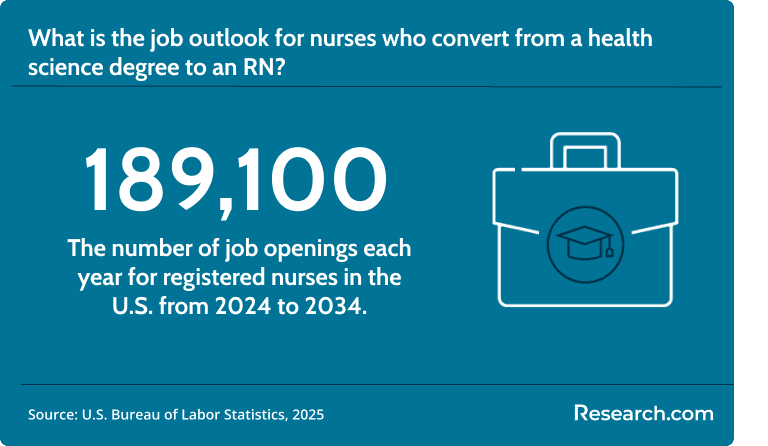
Demand is connected to the aging population, chronic disease care, hospital and outpatient staffing needs, and the continued need for licensed nurses across many healthcare settings. The field is also expected to generate an average of 189,100 openings for registered nurses each year, including both new roles and replacement needs.
A health science background may be especially useful in roles that blend clinical care with population health, prevention, research awareness, education, and care coordination. If you need healthcare experience before entering nursing school, entry-level options such as home health aide certificate jobs can help you understand patient care environments before committing to an RN program.
Is nursing the right next step after a health science degree?
Nursing can be a strong next step if you want direct patient care, a licensed clinical role, and multiple long-term career paths. However, it is not the best choice for every health science graduate. Accelerated programs are demanding, clinical schedules can be inflexible, and entry into nursing requires emotional resilience, physical stamina, and comfort with responsibility for patient safety.
| Nursing may be a good fit if... | Consider another path if... |
| You want a licensed clinical role with hands-on patient care | You prefer research, administration, policy, or public health work without bedside care |
| You are comfortable with shift work, clinical pressure, and fast decision-making | You need a highly predictable schedule from the start |
| You can commit to a rigorous full-time program or carefully planned part-time route | You cannot pause or reduce work enough to handle labs, clinicals, and studying |
| You want a career with many specialty options after licensure | You are mainly choosing nursing because it seems like the default healthcare option |
| You are prepared to meet state licensure, background check, immunization, and clinical placement requirements | You have not checked whether your target program is approved for RN licensure in your state |
How to choose the right nursing program after a health science degree
The best program is not simply the fastest one. It is the one that accepts your credits, prepares you for licensure, fits your finances, provides strong clinical training, and matches your career goals.
- Verify approval and accreditation. Confirm that the program is approved by the state board of nursing where you plan to seek licensure. Also review institutional and nursing program accreditation.
- Ask for a prerequisite audit. Do not rely on course titles alone. Nursing schools may require labs, minimum grades, or recent completion.
- Compare clinical placement support. Ask where students complete clinicals, whether placements are arranged by the school, and how far students typically travel.
- Review NCLEX preparation resources. Strong programs build exam readiness throughout the curriculum rather than treating it as a final add-on.
- Calculate total cost. Include tuition, fees, supplies, testing, transportation, childcare, lost work hours, and prerequisite courses.
- Match the format to your life. Accelerated programs can be difficult to combine with full-time employment. Online coursework may still require in-person labs and clinical rotations.
- Talk to recent students. Ask about faculty support, clinical quality, schedule intensity, advising, and job placement help.
Common mistakes to avoid
| Mistake | Why it creates problems | Better approach |
| Assuming a health science degree is enough for RN licensure | RN licensure requires approved nursing education and NCLEX-RN passage | Choose a program that explicitly prepares graduates for RN licensure |
| Choosing only by program length | The shortest route may be too intense, too costly, or poorly matched to your responsibilities | Compare pace, clinical support, cost, outcomes, and schedule demands |
| Ignoring prerequisite details | Missing labs or expired science courses can delay admission | Request transcript evaluations from each school before applying |
| Looking only at tuition | Fees, supplies, travel, testing, and reduced work hours can change affordability | Build a full budget before enrolling |
| Assuming online means fully remote | Nursing programs require clinical practice and often labs or simulations | Ask exactly which requirements must be completed in person |
| Not checking state licensure alignment | A program may not meet requirements in every state | Confirm eligibility with the program and the state board of nursing |
| Expecting salary outcomes to be guaranteed | Pay varies by location, employer, specialty, shifts, and experience | Research local RN job postings and compare pay by setting |
What graduates say about moving from health science into nursing
-
: "My health science coursework made the first part of nursing school feel less overwhelming. Anatomy and physiology were not brand-new subjects, so I could spend more energy learning assessments, procedures, and clinical judgment.
— Raye"
-
: "The switch to nursing was demanding, but it made sense because I already understood many of the science concepts behind patient care. The biggest change was learning how to apply that knowledge while caring for real people.
— Charlotte"
-
: "Health science helped me see healthcare beyond one patient at a time. As a nurse, I use that broader perspective when I think about prevention, education, public health, and the systems that shape patient outcomes.
— Louis"
Key Insights
- You can become a nurse with a health science degree, but you still need nursing education. RN licensure requires completion of an approved nursing program and NCLEX-RN passage.
- An accelerated BSN or second-degree BSN is often the fastest route. These programs commonly take 11–18 months, but prerequisites can extend the total timeline to 18 to 24+ months.
- Your transcript determines your next step. Anatomy, physiology, microbiology, chemistry, statistics, nutrition, and developmental psychology are common requirements, but each school evaluates credits differently.
- The NCLEX-RN is nonnegotiable. A health science degree may strengthen your academic foundation, but you still need nursing-specific preparation for licensure.
- RN salary depends on the nursing role, not just your prior degree. The stated median annual salary for registered nurses is $93,600, while industry wages vary widely.
- Program choice affects cost, timeline, and licensure eligibility. Check state approval, accreditation, clinical placement support, prerequisite rules, and total cost before enrolling.
- Nursing is a strong option for students who want direct patient care. If you prefer policy, research, administration, or public health without bedside responsibilities, another health science career may fit better.
References:
- George Mason University. (2025). Accelerated Second Degree BSN Program. GMU
- Indeed. (2025). Physical therapist salary in the United States. Indeed
- Texas Tech University Health Sciences Center. (n.d.). Accelerated Second Degree in Nursing. Texas Tech
- U.S. Bureau of Labor Statistics. (2025). Occupational Outlook Handbook: Healthcare Occupations. U.S. BLS
Other things you should know about becoming a nurse with a health science degree
In 2027, transitioning from a health science degree to a nursing career typically requires an additional one to two years of study to complete an accelerated Bachelor of Science in Nursing (ABSN) program.
They must pass the NCLEX-RN after graduating from an approved nursing program. Most candidates also need to meet state board of nursing requirements, which usually include a background check, official transcripts, and application approval before testing.
Yes, accelerated nursing programs are available for health science degree holders. These programs typically take 12 to 24 months and focus on core nursing courses. Admission requirements often include prerequisite courses and a minimum GPA, supporting completion in an expedited timeframe.


