
2027 How to Transition From Surgical Tech to RN

Co-Founder and Chief Data Scientist
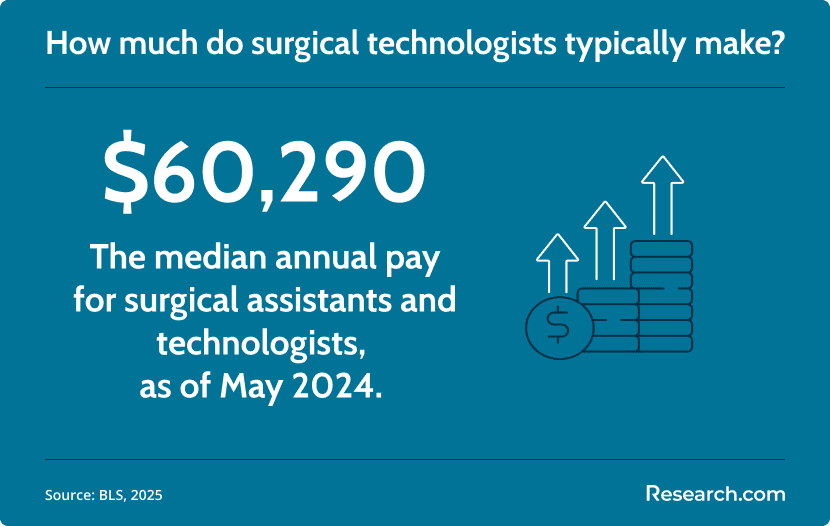
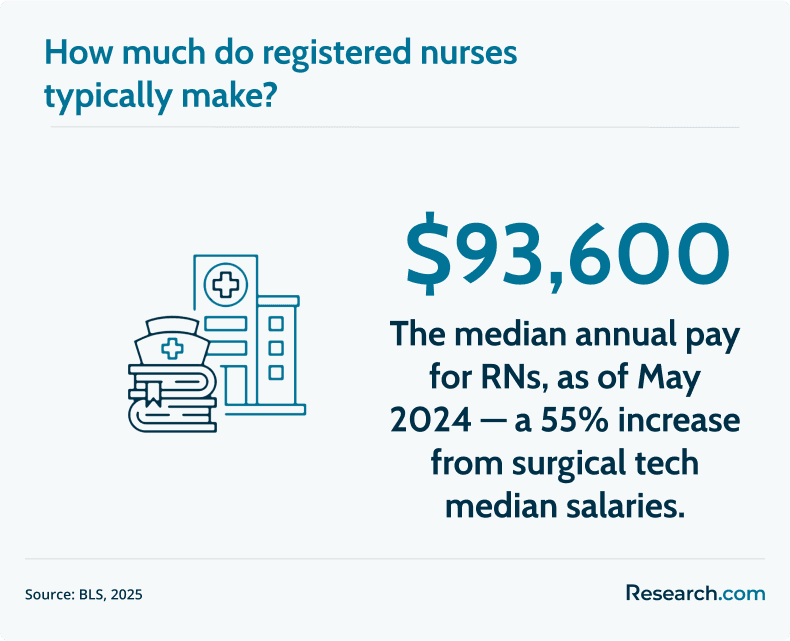
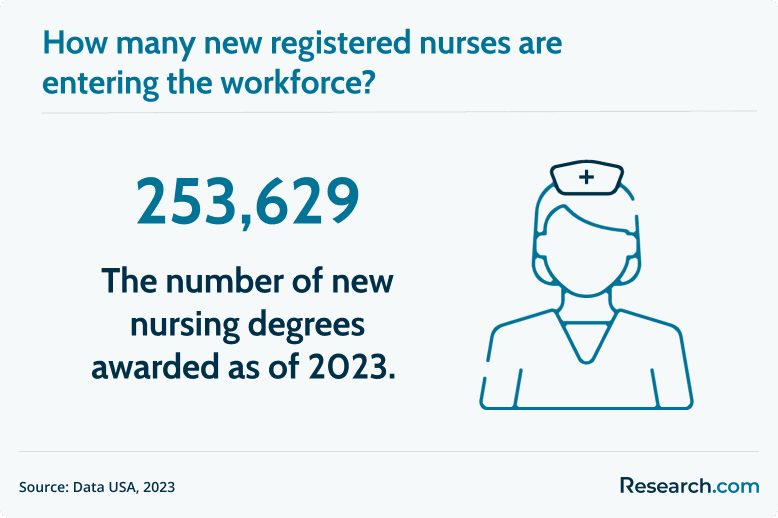
Registered nurses (RN) remain one of the largest healthcare occupations in the United States, with 3,391,000 jobs in 2024 (Bureau of Labor Statistics, 2025). By comparison, surgical assistants and technologists held 141,000 jobs in 2024 (BLS, 2025). The scale difference helps explain why many surgical techs consider the RN pathway for broader scopes of practice and long-term mobility.
Transitioning can unlock higher pay, expanded clinical responsibility, and advancement across inpatient, ambulatory, and community settings. Experience in the operating room gives applicants a strong clinical foundation to build on.
In this article, I will explain the main pathways from surgical tech to RN, compare bridge programs with traditional RN schooling, outline degree options, and review program length and costs.
What are the benefits of transitioning from Surgical Tech to RN?
- Surgical technologists can transition to registered nursing through ADN, BSN, bridge, or accelerated programs, with the right choice depending on prior education, career goals, and desired advancement opportunities.
- ADN and BSN programs remain the most common options for surgical techs, with ADN offering affordability and BSN positioning graduates for leadership and graduate-level study.
- Surgical techs can complete an ADN in about 2 years or pursue a BSN in 3–4 years with transfer credits, depending on program structure and requirements.
- What are the main pathways from surgical tech to RN? Main Pathways
- What are the most common surgical tech to RN bridge programs? Bridge Programs
- What are the differences between bridge program training and traditional RN school? What are the differences between bridge program training and traditional RN school?
- What degree options exist for surgical techs who want to become RNs? What degree options exist for surgical techs who want to become RNs?
- How long does it typically take to transition from surgical tech to RN? Program Length
- How much does a surgical tech to RN program cost? Costs
- What types of financial aid are open to surgical techs transitioning to RN? Financial Aid
- What prerequisites do surgical techs need before enrolling in RN programs? What prerequisites do surgical techs need before enrolling in RN programs?
- How does the NCLEX-RN exam compare with surgical tech certification? How does the NCLEX-RN exam compare with surgical tech certification?
- What job growth is projected for RNs compared to surgical techs? Job Growth
Surgical Tech to RN Bridge Programs: What Is the Best Path in 2026?
If you are a surgical technologist, becoming a registered nurse can expand your scope of practice beyond the operating room, open more clinical settings, and create a clearer path toward leadership, specialty nursing, and graduate education. Your operating room background is valuable, but it does not replace RN licensure. To practice as an RN, you must complete an approved nursing program, meet your state board’s requirements, and pass the NCLEX-RN.
This guide explains the main surgical tech to RN pathways, how bridge programs differ from traditional nursing school, what prerequisites and costs to expect, and how to compare programs before enrolling. It is designed for surgical technologists who want a practical, decision-focused roadmap rather than a generic list of nursing degrees.
Quick answer: Can a surgical tech become an RN?
Yes. A surgical technologist can become an RN by completing an approved Associate Degree in Nursing, Bachelor of Science in Nursing, surgical tech-to-RN bridge program, or accelerated BSN if they already hold a bachelor’s degree. Prior surgical technology coursework and clinical experience may help with admission or transfer credit, but RN eligibility still depends on completing required nursing courses, clinical hours, state board requirements, and the NCLEX-RN.
The most common routes are:
- Associate Degree in Nursing (ADN): A direct, often lower-cost route offered by community and technical colleges. Students comparing associate-level options should understand how an ADN differs from AAD and AAS nursing degrees before applying.
- Bachelor of Science in Nursing (BSN): A four-year nursing degree that supports broader professional mobility, especially in hospitals that prefer or encourage bachelor-prepared nurses.
- Surgical Tech-to-RN Bridge: A structured associate-level pathway that may award advanced standing for prior perioperative education and clinical experience.
- Accelerated BSN: A fast, intensive option for surgical techs who already have a non-nursing bachelor’s degree and want direct preparation for RN licensure.
- ADN followed by RN-to-BSN: A step-by-step route that lets graduates become licensed RNs first, then complete a BSN while working.
| Pathway | Best fit | Main advantage | Main trade-off |
| ADN | Surgical techs who want the most direct community college route to RN licensure | Often lower tuition and faster entry into RN practice | Some employers may prefer or later require a BSN |
| BSN | Students who want broader long-term career flexibility | Stronger foundation for leadership, specialty roles, and graduate study | Usually requires more time and a larger upfront investment |
| ST-to-RN bridge | Surgical techs with eligible prior coursework and clinical experience | May reduce repeated coursework through advanced standing | Availability is limited and requirements vary by school |
| ABSN | Surgical techs who already hold a non-nursing bachelor’s degree | Condensed full-time path to initial RN preparation | Intensive schedule can make working difficult |
| RN-to-BSN after ADN | Students who need to work as an RN before finishing a bachelor’s degree | Allows income and experience while completing the BSN | Takes longer overall than completing a BSN first |
What surgical tech to RN bridge programs are available?
A bridge program is not a shortcut around nursing education. It is a structured pathway that recognizes prior allied health training and places eligible students into the appropriate point in a nursing curriculum. For surgical technologists, the best bridge programs review prior surgical technology coursework, operating room experience, prerequisites, and general education credits before determining advanced standing.
The most common formats include:
- LPN/LVN-to-RN programs that accept surgical tech backgrounds: Some practical nursing bridge models allow entry from related allied health credentials or award limited credit for perioperative coursework. These programs can appeal to workers comparing multiple nursing ladders, including those researching the highest paid LPN specialties before deciding whether RN licensure offers better long-term mobility.
- Community college ADN bridge tracks: These programs usually focus on preparing students for RN licensure at the associate level while evaluating transfer credit from prior technical education.
- University BSN pathways for allied health students: Some universities allow transfer credit from health science coursework and may offer advising plans for students moving from technical healthcare roles into BSN study.
- Prior learning or competency review: A school may use exams, transcript evaluation, skills review, or portfolio assessment to determine whether a surgical tech can skip selected introductory requirements.
The important point is that every bridge must still meet nursing accreditation expectations, clinical education requirements, and state board standards. Before enrolling, confirm that the program leads to RN licensure eligibility in the state where you plan to practice.
How to tell whether a bridge program is legitimate
- It clearly states that graduates are eligible to apply for RN licensure and sit for the NCLEX-RN.
- It is approved by the relevant state board of nursing.
- It explains how surgical technology credits are evaluated before admission.
- It lists required clinical placements, not only online coursework.
- It publishes prerequisites, tuition, fees, and progression policies.
- It does not promise automatic licensure, guaranteed admission, or guaranteed employment.
Bridge program vs traditional RN school: What changes for surgical techs?
Traditional RN programs are built for students who may have little or no healthcare experience. They usually begin with foundational science, communication, and introductory nursing courses before moving into skills labs, simulation, and supervised clinical rotations. This structure is useful for beginners, but it may repeat material that experienced surgical technologists have already studied.
A bridge pathway is designed differently. It evaluates what you already know, then focuses on the nursing competencies you still need: patient assessment, nursing judgment, medication administration, care planning, documentation, patient education, interprofessional communication, and broader clinical decision-making across the lifespan.
The biggest shift is scope. Surgical technologists specialize in sterile technique, instrumentation, surgical procedures, and intraoperative support. Registered nurses are accountable for a wider range of patient care responsibilities, including assessment, prioritization, education, coordination, medication safety, and response to changing patient conditions.
| Comparison point | Traditional RN program | Surgical tech to RN bridge |
| Typical student profile | May include students new to healthcare | Built for students with prior allied health training |
| Starting point | Begins with introductory nursing and foundational courses | May grant credit or placement based on prior coursework |
| Clinical emphasis | Introduces patient care across multiple settings | Builds from existing operating room experience into broader nursing practice |
| Pacing | Often follows a standard sequence for all students | May be shorter or more compressed after prerequisites |
| Licensure outcome | Prepares graduates for NCLEX-RN eligibility | Also prepares graduates for NCLEX-RN eligibility if approved |
The same idea appears in other allied health fields: prior knowledge can support a more focused training plan, as seen in accelerated sterile processing technician online certificate programs. However, nursing bridge programs must still include the required clinical and licensure preparation components.
Which degree should a surgical tech choose to become an RN?
The right degree depends on your current education, transfer credits, finances, schedule, and long-term career goals. A surgical tech who wants the lowest-cost path to RN licensure may choose an ADN. A surgical tech aiming for hospital advancement, graduate school, or leadership may prefer a BSN. A student who already has a bachelor’s degree may save time through an ABSN.
Associate Degree in Nursing (ADN)
An ADN is often the most practical starting point for surgical technologists who want to become RNs without committing to a four-year university from the beginning. Community colleges such as Central Piedmont Community College in North Carolina and Tarrant County College in Texas provide ADN tracks that may accept transfer credits from surgical technology coursework.
This route is especially useful for students who need affordability, local clinical placements, and a direct path to NCLEX-RN eligibility. The trade-off is that some employers may encourage ADN-prepared nurses to complete a BSN later.
Bachelor of Science in Nursing (BSN)
A BSN provides broader preparation in nursing practice, leadership, population health, evidence-based care, and professional development. Schools such as the University of Texas at Arlington and Ohio State University offer BSN options that may recognize prior allied health experience through transfer evaluation.
This option makes sense for surgical techs who want more long-term flexibility, especially if they hope to work in competitive hospital systems, move into charge nurse or management roles, or eventually apply to graduate nursing programs.
Surgical Tech-to-RN Bridge at the Associate Level
A dedicated surgical tech-to-RN bridge is the most targeted option when available. Colleges such as Gwinnett Technical College in Georgia offer a formal bridge track for surgical technologists, using prior perioperative preparation to reduce unnecessary repetition.
This pathway can be efficient, but it is not offered everywhere. Applicants should verify admission rules, accepted surgical technology credentials, credit evaluation policies, clinical schedules, and state board approval before assuming their background will shorten the program.
Accelerated BSN (ABSN)
An ABSN is designed for students who already hold a non-nursing bachelor’s degree. Universities such as Johns Hopkins University and University of Miami offer ABSN programs that compress nursing study into 12–18 months.
This can be the fastest bachelor’s-level route for eligible surgical technologists, but it is academically demanding. Because ABSN schedules are intensive, students should be realistic about whether they can continue working while enrolled.
RN-to-BSN Completion After an ADN
Some surgical techs earn an ADN first, pass the NCLEX-RN, begin working, and then complete an RN-to-BSN program. Institutions such as Chamberlain University and University of Illinois Chicago offer RN-to-BSN tracks that are delivered primarily online.
This approach works well for students who want to start earning an RN salary sooner while continuing their education in stages. It may also reduce immediate financial pressure compared with paying for a full BSN before entering RN practice.
| If your priority is... | Consider this option | Why it may fit |
| Lowest upfront cost | ADN or ST-to-RN associate bridge | Community college tuition is often lower than university tuition |
| Fastest path with an existing bachelor’s degree | ABSN | General education coursework may already be complete |
| Long-term advancement | BSN | Better alignment with leadership, specialty, and graduate education goals |
| Working while advancing | ADN followed by RN-to-BSN | Allows RN employment before completing the bachelor’s degree |
| Avoiding repeated coursework | Dedicated ST-to-RN bridge | May award advanced standing for eligible surgical technology training |
Students who want a less test-heavy admission process can also compare the best nursing schools that do not require TEAS or HESI, while remembering that admissions flexibility does not remove licensure, clinical, or academic requirements.
How long does it take to go from surgical tech to RN?
The timeline depends on your degree choice, completed prerequisites, transfer credits, enrollment status, clinical availability, and state board requirements. Surgical technologists often save time when prior coursework transfers, but science prerequisites and nursing clinical sequences can still extend the total plan.
- ADN: Usually completed in about 2 years of full-time study after prerequisites at community or technical colleges.
- Traditional BSN: A standard BSN spans 4 years, though transfer credit from prior college coursework can reduce this to 3 years or less at schools such as the University of Texas at Arlington.
- Surgical Tech-to-RN Bridge: Programs such as the bridge track at Gwinnett Technical College in Georgia outline a three-semester nursing sequence after prerequisites, with a total timeline of roughly 2–3 years.
- ABSN: For surgical techs who already hold a non-nursing bachelor’s degree, accelerated BSN programs typically take 11–18 months of intensive full-time study.
- RN-to-BSN: After earning an ADN, nurses can complete a BSN in about 12–18 months through primarily online options such as the University of Illinois Chicago RN-to-BSN program.
Before choosing a program, ask for a written degree plan showing which credits transfer, which prerequisites remain, when clinical rotations occur, and whether courses are offered every term. A program that looks shorter on paper may take longer if required classes are only offered once per year.
After earning RN licensure, some nurses pursue specialty credentials such as RNC certification to document expertise in areas such as labor and delivery or neonatal nursing.
Planning tip for working surgical techs
If you plan to keep working while enrolled, compare full-time, part-time, evening, weekend, and hybrid formats carefully. Nursing programs often require daytime labs, simulations, and clinical rotations even when some lectures are online. The chart below shows the percentage of undergraduate students who were employed while enrolled, separated by full-time and part-time attendance and weekly hours worked.
How much does a surgical tech to RN program cost?
The cost of becoming an RN varies by school type, residency status, degree level, transfer credit, and whether you attend public or private institutions. Tuition is only one part of the total price. Nursing students should also budget for application fees, background checks, drug screenings, immunizations, CPR certification, uniforms, supplies, books, technology, lab fees, transportation to clinical sites, and licensure exam costs.
Students sometimes compare RN programs with other nursing entry points and ask how much an LPN program costs. That comparison can be useful, but surgical techs should focus on the total cost required to reach RN licensure, not only the cheapest credential available.
- ADN: Community colleges often charge $90–$300 per credit for in-district students, totaling about $7,000–$15,000 overall (National Center for Education Statistics, 2024, Table 330.20).
- BSN: Public universities average $350–$600 per credit, bringing four-year totals to $25,000–$40,000. Private universities may exceed $1,000 per credit, with totals ranging from $60,000 up to $155,000 (National Center for Education Statistics, 2024, Table 330.30; University of Texas at Arlington, 2025).
- Surgical Tech-to-RN Bridge at the ADN level: At schools such as Gwinnett Technical College in Georgia, bridge tuition aligns with community college pricing, with nursing coursework generally priced at $6,000–$10,000 (Gwinnett Technical College, 2024–2025).
- ABSN: Private programs such as the University of Miami publish ABSN cost-of-study pages in the mid-five to low-six figures, while out-of-state totals at some public universities, such as the University of Tennessee, Knoxville, fall in the $50,000–$70,000 range (University of Miami, 2025; University of Tennessee, Knoxville, 2025).
- RN-to-BSN: Programs such as the University of Illinois Chicago RN-to-BSN option charge $350–$450 per credit, with total costs averaging $12,000–$18,000 (University of Illinois Chicago, 2025).
| Cost factor | Why it matters | Question to ask |
| Transfer credit | Accepted credits can reduce the number of courses you must pay for | Which surgical technology and general education credits will count toward the nursing degree? |
| Residency status | In-state, out-of-state, and district rates can differ substantially | Do I qualify for in-district or in-state tuition? |
| Clinical expenses | Transportation, parking, uniforms, screenings, and health requirements add to the total | What required clinical costs are not included in tuition? |
| Program pace | Accelerated programs may reduce time but limit work hours | Can students realistically work while enrolled? |
| RN-to-BSN plans | An ADN may be cheaper upfront, but a later BSN adds cost | What is the combined cost of ADN plus RN-to-BSN? |
Always use the school’s current tuition and fee schedule when building your budget. The following table shows the top states ranked by the lowest average in-state tuition and fees for public two-year institutions.
What financial aid can surgical techs use for RN school?
Most surgical techs pay for RN education through a mix of federal aid, state aid, school scholarships, employer support, payment plans, and loans. The best strategy is to apply early and compare net cost after grants and scholarships, not only the published tuition price.
- Federal and general student aid: Eligible students may use the Federal Pell Grant, Federal Supplemental Educational Opportunity Grant, Direct Subsidized and Unsubsidized Loans, and Federal Work-Study through the Free Application for Federal Student Aid (Federal Student Aid, 2024).
- Nurse Corps Scholarship Program: The Health Resources and Services Administration Nurse Corps Scholarship Program pays tuition and fees and provides a monthly stipend in exchange for a service commitment at approved facilities after graduation (Health Resources and Services Administration, 2024).
- Institutional nursing scholarships: Nursing schools often offer internal awards for pre-licensure BSN, ABSN, ADN, and RN-to-BSN students. Examples include scholarship resources from the University of Illinois Chicago College of Nursing and the Johns Hopkins School of Nursing.
- Professional association awards: The American Association of Colleges of Nursing maintains scholarship and financial aid resources for nursing students, including prelicensure opportunities (American Association of Colleges of Nursing, 2025).
- Employer tuition assistance: Hospitals and surgical centers may offer tuition reimbursement or education benefits for employees who move into hard-to-fill nursing roles. Ask whether repayment is required if you leave the employer after graduation.
Prior surgical technology experience can strengthen scholarship essays because it demonstrates clinical exposure, patient care commitment, and understanding of healthcare team workflows. If you later plan to move into advanced practice, you may also want to explore options such as the best 1 year online PMHNP programs, but those programs require RN preparation and additional nursing education first.
What prerequisites do surgical techs need before RN admission?
Operating room experience helps, but RN programs still require academic and clinical readiness. Applicants coming from surgical technology programs, including those who completed a fast track surgical tech associate degree online, should confirm which credits transfer and which prerequisites must be completed before applying.
Common prerequisites and admission requirements include:
- Anatomy and physiology: Usually required because nurses must understand body systems, disease processes, and patient assessment findings.
- Microbiology: Important for infection control, immune response, and safe clinical practice.
- General chemistry: Required by many programs as part of the science foundation for pharmacology and physiology.
- College-level math: Supports dosage calculation, data interpretation, and safe medication administration.
- English composition and communication: Builds writing, documentation, patient education, and professional communication skills.
- Minimum GPA: Many programs require a minimum grade point average between 2.5 and 3.0 in prior college coursework.
- Entrance exams: Some schools use the TEAS or HESI to assess reading, math, science, and English readiness.
- Health and safety documentation: Nursing programs commonly require immunizations, CPR certification, background checks, and drug screenings before clinical placement.
- Course recency rules: Some schools require science courses to be completed within the past five to seven years.
Questions to ask before applying
- Will my surgical technology certificate, diploma, or associate degree transfer?
- Do you award nursing credit for operating room experience, or only for college coursework?
- Which prerequisites must be completed before application, and which can be in progress?
- Is admission competitive, waitlisted, or guaranteed after prerequisites?
- What GPA is used for ranking: overall GPA, science GPA, or prerequisite GPA?
- Are TEAS or HESI scores required, optional, or waived for allied health applicants?
- Do clinical placements require weekday availability?
- Does the program meet RN licensure requirements in my state?
How is the NCLEX-RN different from surgical tech certification?
The NCLEX-RN is the licensure exam required for registered nurses. Surgical technologists commonly pursue certification through exams such as the Certified Surgical Technologist exam or the Tech in Surgery–Certified exam. Both types of exams assess readiness for professional practice, but they measure different scopes of responsibility.
Surgical tech certification focuses on perioperative practice: sterile technique, instruments, surgical procedures, asepsis, and intraoperative support. The NCLEX-RN evaluates broader nursing judgment, including patient safety, pharmacology, care management, health promotion, infection control, prioritization, and response to changing patient conditions.
The formats also differ. The NCLEX-RN uses computer-adaptive testing, with up to 145 questions based on candidate performance. Surgical tech certification exams are fixed-form assessments, generally 175–200 multiple-choice questions.
The outcome is different as well. Passing the NCLEX-RN supports state licensure and legal authority to practice as a registered nurse. Surgical tech certification validates professional competence in surgical technology, but it does not grant RN licensure or the nursing scope of practice.
| Exam | Primary purpose | Main content focus | Professional result |
| NCLEX-RN | Licensure for registered nurses | Broad nursing judgment, safety, pharmacology, care coordination, and patient management | Eligibility for RN licensure after state board approval |
| Surgical tech certification | Certification for surgical technology practice | Operating room procedures, sterile technique, instruments, and perioperative support | Professional certification, not RN licensure |
What is the job outlook for RNs compared with surgical technologists?
Career outlook is one reason many surgical technologists consider RN licensure. Both roles remain important in healthcare, but registered nursing is a larger occupation with more employment settings, more advancement paths, and broader patient care responsibilities.
For students deciding between remaining in surgical technology, enrolling in one of the fastest surgical tech certificate programs online, or moving toward RN preparation, federal projections provide useful context.
- Registered Nurses: Employment is projected to grow 5% from 2024 to 2034, adding about 166,100 jobs and averaging 189,100 openings per year. Demand is tied to hospitals, outpatient care, home health, long-term care, and other healthcare settings.
- Surgical Technologists: Employment is projected to grow 4% from 2024 to 2034, increasing from 115,600 to 120,800 jobs. Surgical assistants and technologists combined are projected to grow 5%, with about 8,700 openings annually.
These projections do not guarantee an individual job offer, location, schedule, or salary. They do show that RN licensure connects surgical technologists to a larger labor market and more varied clinical roles than surgical technology alone.
Is moving from surgical tech to RN worth it?
For many surgical technologists, the RN pathway is worth considering if they want broader patient care responsibility, more career mobility, and access to nursing specialties beyond the operating room. It may be especially worthwhile for surgical techs who already have transferable credits, employer tuition support, or a clear plan to work in perioperative nursing, surgical units, emergency care, critical care, or another clinical area that values operating room experience.
It may not be the right move if you are mainly seeking a quick credential change, cannot commit to clinical schedules, or are not prepared for the academic demands of pharmacology, assessment, nursing judgment, and NCLEX-RN preparation.
| Choose the RN path if... | Think carefully if... |
| You want a broader legal scope of practice | You are satisfied with the surgical tech role and do not want bedside responsibility |
| You can complete prerequisites and clinical rotations | Your work schedule cannot accommodate labs or daytime clinicals |
| You want more options outside the operating room | You only want operating room work and do not want broader nursing coursework |
| You have a realistic financing plan | You would need heavy borrowing without understanding total cost |
| You are willing to prepare for the NCLEX-RN | You assume surgical tech experience alone will make RN school easy |
Common mistakes surgical techs should avoid
- Assuming every bridge program leads to RN licensure: Always confirm state board approval and NCLEX-RN eligibility.
- Choosing only by tuition: A low tuition rate may not include fees, clinical costs, transportation, books, supplies, or lost work hours.
- Ignoring transfer credit policies: Two schools may evaluate the same surgical technology coursework very differently.
- Overlooking accreditation and approval: Program approval and recognized nursing accreditation can affect licensure, transfer, employment, and graduate school options.
- Assuming online means fully remote: Pre-licensure RN programs require in-person labs, simulation, and clinical experiences.
- Not checking clinical schedules: Clinical placements may occur during weekdays, evenings, weekends, or at sites far from campus.
- Waiting too long on prerequisites: Science courses may have recency rules, and missing one prerequisite can delay admission by a full term or year.
- Relying only on rankings: A highly ranked program is not automatically the best fit if it is too expensive, poorly scheduled, or not approved for your state.
Real-world perspectives from surgical techs who became RNs
- : "Moving from surgical technology into nursing let me take a more active role in the full patient care process. My operating room background helped, but RN school pushed me to think more broadly about assessment, education, and care planning. The workload was heavy, yet the added responsibility and career options made the transition worthwhile. — Raquel"
- : "After years as a surgical tech, becoming an RN changed how I participated on the care team. I was no longer focused only on perioperative support; I became involved in treatment planning, patient teaching, and recovery. That broader role gave me a stronger sense of professional purpose. — Elaine"
- : "I chose a flexible program because I needed to keep working while studying. Balancing school, family, and clinical requirements was challenging, but the structure made the RN goal possible. After passing the NCLEX-RN, I moved into a surgical unit role with better benefits and more advancement potential. — Calvin"
Key Insights
- Surgical tech experience helps, but it does not replace RN education. You still need an approved nursing program, clinical requirements, state board eligibility, and a passing NCLEX-RN result.
- The ADN is often the most direct route. It can be a practical choice for surgical techs who want lower upfront cost and faster entry into RN practice.
- A BSN offers stronger long-term flexibility. It is often the better fit for students who want leadership, specialty nursing, graduate study, or broader hospital opportunities.
- Bridge programs can save time only when credits are accepted. Ask for a written transfer evaluation before assuming your surgical technology background will shorten the program.
- ABSN programs are fast but intense. They work best for surgical techs who already have a non-nursing bachelor’s degree and can handle full-time accelerated study.
- Total cost matters more than tuition alone. Compare fees, clinical expenses, supplies, transportation, lost work time, and any later RN-to-BSN costs.
- Licensure eligibility is nonnegotiable. Before enrolling, confirm state board approval, clinical requirements, and NCLEX-RN eligibility in the state where you plan to work.
- RN licensure opens a larger labor market. Registered nurses are projected to add about 166,100 jobs from 2024 to 2034, while surgical technologists are projected to increase from 115,600 to 120,800 jobs over the same period.
References:
- American Association of Colleges of Nursing. (2025). Accelerated programs. https://www.aacnnursing.org/students/nursing-education-pathways/accelerated-programs
- American Association of Colleges of Nursing. (2025). Scholarships and financial aid. https://www.aacnnursing.org/students/scholarships-financial-aid
- American Association of Colleges of Nursing. (2025). The Essentials: Core competencies for professional nursing education. https://www.aacnnursing.org/essentials
- Bureau of Labor Statistics. (2024). Registered nurses. U.S. Department of Labor, Occupational Outlook Handbook. https://www.bls.gov/ooh/healthcare/registered-nurses.htm
- Bureau of Labor Statistics. (2024). Surgical technologists. U.S. Department of Labor, Occupational Outlook Handbook. https://www.bls.gov/ooh/healthcare/surgical-technologists.htm
- Data USA. (2025). Registered Nursing. https://datausa.io/profile/cip/registered-nursing
- Johns Hopkins University School of Nursing. (2025). Financial aid and scholarships. https://nursing.jhu.edu/admissions/financial-aid/
- National Center for Education Statistics. (2023). College Student Employment. U.S. Department of Education, Digest of Education Statistics. https://nces.ed.gov/programs/coe/indicator/ssa/college-student-employment
- National Center for Education Statistics. (2024). Table 330.20. Average undergraduate tuition, fees, room, and board charges for full-time students in degree-granting postsecondary institutions, by control and level of institution and state. Digest of Education Statistics. U.S. Department of Education. https://nces.ed.gov/programs/digest/d23/tables/dt23_330.20.asp
- University of Illinois Chicago. (2025). RN to BSN online program. https://onlinenursing.uic.edu/online-programs/rn-bsn/
- University of Illinois Chicago, College of Nursing. (2025). Scholarships. https://nursing.uic.edu/about/college-insider/student-resources/scholarships/
- University of Miami. (2025). Accelerated BSN Program Overview. https://www.sonhs.miami.edu/academics/bachelors-programs/accelerated_bsn/index.html
- University of Tennessee, Knoxville. (2025). Undergraduate tuition and fees for nursing. https://nursing.utk.edu/undergraduate-tuition-fees/
Other Things You Should Know About Transitioning From Surgical Tech to RN
In 2027, surgical techs typically need a high school diploma or GED and must complete prerequisite courses in anatomy, physiology, and microbiology. Some RN programs may also require prior healthcare experience or a specific GPA. It's essential to verify requirements with each RN program as they can vary.
Yes. Many RN bridge and accelerated associate or bachelor’s programs accept surgical techs with a completed anatomy, physiology, microbiology, and English prerequisite set, plus verified clinical healthcare experience. Programs may also require a minimum GPA, CPR certification, and an active background check before admission.





