
2027 How to Become a Nurse Midwife in Louisiana – Midwife Schooling Requirements

Co-Founder and Chief Data Scientist
Becoming a certified nurse-midwife in Louisiana is not a short training route. It requires registered nursing licensure, graduate-level midwifery education, national certification, and approval to practice as an advanced practice registered nurse under Louisiana rules. For nurses who want to provide pregnancy, birth, postpartum, newborn, reproductive, and primary women’s health care, the path can be highly rewarding—but it must be planned carefully.
This guide explains the education, admissions, clinical training, licensing, cost, financial aid, accreditation, and career considerations for becoming a nurse midwife in Louisiana in 2026. It is designed for current nursing students, licensed RNs, BSN graduates, and advanced practice nurses comparing nurse-midwifery programs and deciding whether the CNM route fits their goals. Louisiana reports a growing demand for certified nurse midwives, with a 15% increase in maternal healthcare positions projected through 2030, making careful preparation especially important for nurses interested in maternal health and underserved communities.
Quick answer: How do you become a nurse midwife in Louisiana?
To become a certified nurse-midwife in Louisiana, you generally need to earn a BSN, become a licensed RN, complete an ACME-accredited graduate nurse-midwifery program, pass the American Midwifery Certification Board exam, and apply for advanced practice authorization through the Louisiana State Board of Nursing. The full path commonly takes six to eight years from the start of a BSN through certification, depending on program format, clinical placement timing, and licensing processing.
Key Points About Becoming a Nurse Midwife in Louisiana
- Graduate education is required. Louisiana CNM candidates must complete a graduate nursing program in nurse-midwifery that meets Accreditation Commission for Midwifery Education standards.
- National certification is essential. After graduation, candidates must pass the American Midwifery Certification Board exam to earn the CNM credential needed for practice.
- State rules still matter after graduation. Candidates must meet Louisiana Board of Nursing requirements, hold RN licensure, obtain APRN authorization, and follow state-specific practice rules, including collaborative practice expectations.
- Minimum degree required for nurse midwives in Louisiana
- Admission requirements for Louisiana nurse-midwifery programs
- Courses included in nurse-midwifery programs
- Clinical training requirements
- Timeline to become a certified nurse-midwife
- Cost of nurse-midwifery school in Louisiana
- Financial aid options
- Career prospects and salary expectations
- License renewal and continuing education
- Legal and ethical practice rules
- Accredited nurse-midwifery schools in Louisiana
- Advanced degrees for CNM career growth
- Accrediting organizations for nurse-midwifery programs
- How to choose the right program
- What to learn from nurse-midwife career experiences
- Can you be a midwife without a nursing degree in Louisiana?
- Nurse midwife vs. midwife in Louisiana
- Is a midwife higher than an RN?
- Is becoming a nurse midwife hard?
- References
What is the minimum degree requirement to become a nurse midwife in Louisiana?
The minimum degree for becoming a nurse midwife in Louisiana is a graduate nursing degree with a nurse-midwifery focus. For most students, that means earning a Master of Science in Nursing with a nurse-midwifery specialization. Some students may instead complete a Doctor of Nursing Practice in nurse-midwifery or a post-graduate nurse-midwifery certificate if they already hold an eligible graduate nursing degree.
The degree matters because CNMs are advanced practice registered nurses. Their education must go beyond general RN preparation and include advanced assessment, pharmacology, reproductive health, antepartum care, birth care, postpartum care, neonatal support, and primary care for women across the lifespan. This preparation is what allows graduates to pursue national CNM certification and state APRN authorization.
Students should also understand the difference between earning a nursing degree and becoming legally authorized to practice. A degree alone is not enough. Louisiana candidates also need RN licensure, graduation from an eligible accredited program, AMCB certification, and Louisiana Board of Nursing approval. RNs who are still evaluating the profession can review broader nursing career requirements to see how nurse-midwifery compares with other nursing paths.
| Credential path | Who it is usually for | How it supports CNM eligibility |
| MSN in Nurse-Midwifery | BSN-prepared registered nurses seeking the standard graduate route | Provides graduate clinical and academic preparation for AMCB certification and APRN licensure |
| DNP in Nurse-Midwifery | RNs who want the highest clinical nursing degree and broader leadership preparation | Combines nurse-midwifery preparation with doctoral-level practice, systems, and leadership coursework |
| Post-Graduate Certificate in Nurse-Midwifery | Graduate-prepared nurses or APRNs adding a nurse-midwifery specialty | Offers a focused route to nurse-midwifery certification without completing a second full graduate degree |
What are the admission requirements for nurse midwife programs in Louisiana?
Nurse-midwifery admissions are competitive because programs must confirm that applicants are ready for advanced clinical responsibility. Schools typically evaluate nursing education, RN licensure, academic performance, professional references, recent clinical experience, and readiness for graduate-level work.
| Requirement | What applicants should prepare | Why it matters |
| BSN or equivalent preparation | A Bachelor of Science in Nursing from a regionally accredited institution, or a BSN equivalent combined with a master’s degree | Confirms that the applicant has the nursing foundation needed for advanced practice study |
| Minimum GPA | A cumulative GPA of at least 3.0 on a 4.0 scale for undergraduate and graduate coursework | Helps programs assess academic readiness for rigorous graduate nursing courses |
| RN license | A current, unrestricted U.S. RN license at the time of application | Required because CNMs are advanced practice registered nurses |
| Clinical experience | At least one year of clinical nursing experience within the last three years, preferably in maternal or child health | Gives applicants patient-care judgment before beginning advanced midwifery training |
| Recommendations | Three letters, including at least one from a peer and one from a recent supervisor | Shows professional reliability, communication skill, and readiness for graduate practice |
| Graduate statistics | Completion of a graduate-level statistics course for post-master’s applicants | Supports evidence-based practice and research interpretation |
| Interview | A successful admissions interview | Allows faculty to assess motivation, professionalism, and fit for midwifery care |
| BLS certification | Current BLS for Healthcare Provider certification | Verifies basic emergency response preparation for clinical settings |
| International applicant documentation | TOEFL scores of at least 550 on the paper-based test or 79-80 on the internet-based test for non-native English speakers | Confirms English-language readiness for clinical communication and graduate coursework |
| Application fee | A non-refundable application fee, typically around $100 | Covers application processing |
| Louisiana practice consideration | Awareness that graduates must enter into a collaborative practice agreement with a licensed physician before practicing | This is not usually an admissions requirement, but it affects future practice planning in Louisiana |
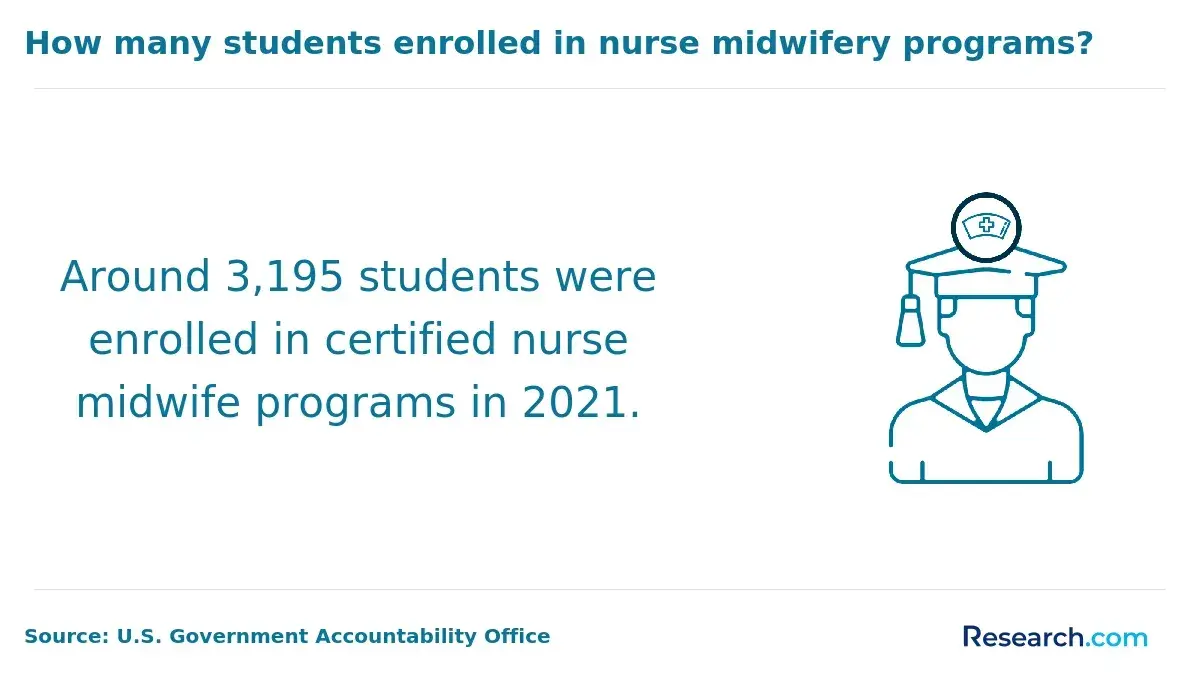
Applicants can strengthen their file by documenting relevant RN experience, explaining a clear commitment to maternal and reproductive health, and choosing references who can speak to clinical judgment rather than only general work ethic. The image below shows growing interest in nurse-midwifery education, with over 3,000 students enrolled in certified programs as of 2021.
What courses are included in nurse midwife programs in Louisiana?
Louisiana nurse-midwifery programs combine advanced nursing science with specialty training in pregnancy, birth, postpartum care, newborn care, reproductive health, and primary care for women. The goal is not only to teach normal birth support, but also to prepare students to identify complications, collaborate with physicians and other clinicians, prescribe safely within scope, and apply evidence-based care.
- Advanced Health Assessment: Builds the ability to perform comprehensive physical, emotional, and psychosocial assessments across the female lifespan.
- Advanced Pharmacology and Pharmacotherapeutics: Covers medication selection, prescribing considerations, and safe pharmacologic management relevant to women’s health and perinatal care.
- Gynecologic, Reproductive, and Sexual Health: Focuses on contraception, reproductive conditions, sexually transmitted infections, preventive care, and sexual health counseling.
- Primary Care of Women Through the Lifespan: Prepares students to provide preventive and primary care from adolescence through older adulthood.
- Antepartum Care: Teaches prenatal assessment, pregnancy monitoring, risk identification, counseling, and care planning.
- Intrapartum and Postpartum Care: Develops skills for labor management, birth support, immediate postpartum assessment, and maternal-newborn transition.
- Neonatal Care and Lactation: Covers newborn assessment, breastfeeding support, and consultation for normal and higher-risk newborn concerns.
- Evidence-Based Practice and Research Methods: Trains students to evaluate research and translate clinical evidence into patient care decisions.
- Midwifery Skills Practicum: Provides supervised clinical practice across antepartum, intrapartum, postpartum, neonatal, and women’s health settings.
- Advanced Integration of Nurse-Midwifery Care: Helps students manage complex cases, consult appropriately, and prepare for greater clinical independence.
- Nurse-Midwifery Transition to Professional Role and Practice: Addresses ethics, law, leadership, documentation, collaboration, and professional responsibilities in Louisiana’s regulatory environment.
Students comparing curricula should look beyond course titles. Ask how many births, women’s health visits, postpartum encounters, and newborn assessments students typically complete; whether clinical placements are arranged by the school; and whether the program prepares graduates for Louisiana APRN requirements. For a broader overview of the role, see this guide on certified nurse midwife how to become.
The chart below connects common CNM resume skills with the competencies developed in nurse-midwifery coursework. It is a useful reminder that program selection should be based on clinical readiness, not only tuition or convenience.
What are the clinical training requirements for nurse midwife programs in Louisiana?
Nurse-midwifery programs in Louisiana generally require between 600 and 1,000 supervised clinical hours within an ACME-accredited graduate or doctoral program. These hours are central to certification readiness because midwifery competence cannot be developed through classroom study alone.
Clinical placements may include labor and delivery units, postpartum units, neonatal care settings, birthing centers, OB/GYN clinics, community health centers, and women’s health practices. Students practice prenatal care, birth care, postpartum follow-up, routine gynecologic care, newborn assessment, patient education, risk recognition, and consultation. Preceptors may include nurse-midwives, women’s health nurse practitioners, and physicians who evaluate students’ clinical performance.
Louisiana students should pay close attention to clinical placement support. A program may offer online coursework, but students still need approved in-person clinical experiences. Before enrolling, ask whether the school secures placements, whether you must find your own preceptors, whether Louisiana clinical sites are available, and how the program verifies that preceptors meet board and accreditation expectations.
| Clinical setting | What students may learn there | Why it matters for Louisiana CNM practice |
| Hospital labor and delivery units | Labor assessment, birth management, emergency recognition, interprofessional communication | Prepares students for high-acuity maternity environments |
| Birthing centers | Physiologic birth support, patient-centered care, low-risk pregnancy management | Builds experience with midwifery-led care models |
| OB/GYN and women’s health clinics | Preventive care, contraception, reproductive health, prenatal visits | Supports full-scope women’s health practice |
| Community health centers | Care for diverse and underserved populations | Aligns with Louisiana’s need for maternal healthcare access in underserved areas |
| Postpartum and newborn care settings | Maternal recovery, newborn assessment, lactation support, family education | Strengthens continuity of care after birth |
How long does it take to become a certified nurse midwife in Louisiana?
The full timeline typically runs six to eight years if a student begins with no nursing degree. The process starts with a BSN, which typically requires four years at an accredited university. Graduates then pass the National Council Licensure Examination for Registered Nurses to become licensed RNs.
After RN licensure, aspiring CNMs complete graduate nurse-midwifery education, usually through an MSN or DNP pathway. These programs generally take between two and three years of full-time study and include both coursework and supervised clinical practice. Program pace can vary for part-time students, students who need additional prerequisites, and students who experience delays finding clinical placements.
After graduation, candidates take the AMCB national certification exam. The exam is a four-hour computer-based test with 175 questions. Passing it leads to the CNM credential, which is then used when applying for APRN licensure in Louisiana. State application review and administrative processing can add several weeks, so students should not schedule employment start dates too tightly around graduation.
| Stage | Typical time involved | Key decision point |
| Earn a BSN | Typically four years | Choose an accredited nursing program that prepares you for RN licensure |
| Pass the NCLEX-RN and become an RN | Varies by testing and licensing timeline | Secure an unrestricted RN license and begin building relevant clinical experience |
| Gain clinical nursing experience | At least one year of clinical nursing experience within the last three years is commonly required | Maternal, child health, labor and delivery, or related experience can strengthen applications |
| Complete graduate nurse-midwifery education | Generally two to three years full time | Confirm ACME accreditation, clinical placement support, and Louisiana eligibility |
| Pass AMCB certification and apply for Louisiana APRN authorization | Processing may add several weeks | Prepare documents early and verify current Louisiana Board of Nursing requirements |
How much does it cost to attend nurse midwife school in Louisiana?
Nurse-midwifery school in Louisiana is a major financial commitment. Program tuition typically ranges from approximately $43,000 to $53,100 for accredited options, with private institutions such as Loyola University New Orleans representing a major in-state pathway. Loyola charges $860 per credit hour for most courses and $885 for advanced or doctoral-level classes, with total credit requirements between 50 and 60 hours.
Louisiana nurse-midwifery programs do not always separate tuition by residency status, so students should verify whether in-state and out-of-state tuition are the same at each school. For comparison, Frontier Nursing University lists around $38,775 for its full 55-credit MSN nurse-midwifery degree, which can help students benchmark distance and hybrid options.
Tuition is only part of the total cost. Mandatory fees may add between $2,000 and $3,000 for application, enrollment, matriculation, technology, student resources, and graduation. Textbooks are estimated at between $3,000 and $4,000, clinical supplies add approximately $450, and testing and assessment fees total about $1,161. Students should also budget for licensure expenses, including the $100 fee to become a CNM through the Louisiana State Board of Nursing.
| Cost category | Amount stated | What students should verify |
| Program tuition in Louisiana | Approximately $43,000 to $53,100 | Whether the total includes all required credits and specialty courses |
| Loyola University New Orleans tuition | $860 per credit hour for most courses; $885 for advanced or doctoral-level classes | Which courses fall into each tuition category |
| Credit requirement | Between 50 and 60 hours | Whether part-time enrollment changes fees or total time to completion |
| Frontier Nursing University comparison | Around $38,775 for the full 55-credit MSN nurse-midwifery degree | Clinical placement rules and travel or residency requirements |
| Mandatory program fees | Between $2,000 and $3,000 | Whether fees are one-time, annual, or per term |
| Textbooks | Between $3,000 and $4,000 | Whether digital materials, exam prep, or clinical references are included |
| Clinical supplies | Approximately $450 | Whether uniforms, equipment, background checks, or immunizations are separate |
| Testing and assessment fees | About $1,161 | Which standardized exams are included |
| Louisiana CNM licensure application fee | $100 | Whether additional RN, APRN, certification, or transcript fees apply |
| Total estimated cost | $48,000 to $62,000 | Whether travel, lost work hours, childcare, and clinical commuting are included |
Because the total estimated cost ranges from $48,000 to $62,000, students should calculate return on investment before enrolling. Consider your current RN salary, expected work schedule during school, employer tuition benefits, loan repayment options, and whether you are willing to work in underserved settings after graduation. Nurses comparing advanced practice routes can also review advanced practice registered nurse how to become for broader APRN planning.
What financial aid options are available for nurse midwife students in Louisiana?
Financial aid can change the affordability of a nurse-midwifery program, but students need to read eligibility rules carefully. Some aid is need-based, some is tied to service in high-need communities, and some requires employment commitments after graduation. Graduate nursing students should complete the FAFSA when applicable and ask each school for a full cost-of-attendance estimate before borrowing.
| Financial aid option | Amount or feature stated | Important caution |
| Federal Pell Grants | Need-based grants up to $7,495 annually, requiring FAFSA completion and no repayment | Confirm eligibility because many CNM students are graduate students |
| Direct Unsubsidized Loans | Up to $20,500 per year with fixed interest, available regardless of financial need | Interest accrues, so compare repayment scenarios before borrowing the maximum |
| Graduate PLUS Loans | Borrowing up to the full cost of attendance with a credit check and 7.28% interest rate for 2025 | Can cover gaps but may substantially increase total repayment cost |
| Federal Work-Study | Part-time jobs earning $4,000–$8,000 annually for students with financial need | Clinical schedules may limit how much students can work |
| Louisiana State Loan Repayment Program | Up to $20,000 annually for nurse midwives serving three years in underserved areas | Service commitments should match your career and location goals |
| Institutional and private scholarships | Merit- and need-based awards from schools and organizations, with some requiring professional association membership | Deadlines may fall months before the academic term begins |
| Nurse Corps and NHSC Loan Repayment Programs | Federal programs offering substantial loan repayment for service in high-need facilities | Site eligibility and service contracts must be reviewed before accepting funds |
| Employer tuition assistance | Available through some Louisiana healthcare employers, often connected to service commitments | Ask whether funds are paid upfront, reimbursed later, or taxed |
A practical funding strategy is to combine smaller scholarships, employer support, federal loans, and service-based repayment rather than relying on one source. Before accepting aid tied to employment, ask what happens if you change jobs, move, fail to complete the program, or do not pass certification on the first attempt.
What are the career prospects and salary expectations for nurse midwives in Louisiana?
Nurse midwives in Louisiana may work in hospitals, birthing centers, OB/GYN practices, community clinics, public health settings, and women’s health programs. Demand is shaped by maternal healthcare access, rural and underserved community needs, hospital staffing models, insurance coverage, and whether employers support CNM-led care.
Salary expectations vary by employer, region, experience, call schedule, patient volume, and additional responsibilities such as leadership, education, quality improvement, or program development. Instead of relying on one statewide estimate, candidates should compare local job postings, hospital pay structures, benefits, call compensation, malpractice coverage, and loan repayment eligibility. Nurses comparing adjacent APRN options may find it useful to review the top nurse practitioner programs in Louisiana to understand how nurse-midwifery differs from broader nurse practitioner tracks.
Where CNMs may find opportunities
- Hospitals and health systems: Often involve labor and delivery coverage, prenatal care, postpartum follow-up, and collaboration with OB/GYN teams.
- Birth centers: May focus on physiologic birth, low-risk pregnancy care, and continuity of care.
- Community health centers: Can offer mission-driven work with underserved populations and may connect to loan repayment programs.
- Academic and clinical education settings: Experienced CNMs may teach, precept, or support program development.
- Women’s health clinics: May emphasize reproductive health, preventive care, contraception, and primary care services.
What are the licensing renewal and continuing education requirements for nurse midwives in Louisiana?
CNMs in Louisiana must maintain both the professional credentials that allow them to practice and the continuing education needed to stay current. Requirements may involve RN licensure, APRN authorization, national CNM certification, practice documentation, and continuing education tied to maternal, reproductive, pharmacologic, or advanced practice care.
Because renewal rules can change, CNMs should check the Louisiana State Board of Nursing and AMCB requirements directly before each renewal cycle. Do not assume that national certification renewal automatically satisfies every state requirement. CNMs should also keep organized records of continuing education, clinical practice, certification status, collaborative practice documentation, and any prescribing-related requirements. Nurses reviewing broader state rules can consult this guide on the requirements to be a nurse in Louisiana.
What legal and ethical guidelines govern nurse midwifery practice in Louisiana?
Louisiana nurse midwives practice within a legal and ethical framework that governs patient safety, informed consent, documentation, confidentiality, consultation, referral, prescribing, and collaboration. CNMs must understand where their scope of practice begins and ends, especially when managing risk, transferring care, or collaborating with physicians and other clinicians.
A key Louisiana-specific issue is the collaborative practice agreement with a licensed physician before practice. Students should learn how this requirement affects employment negotiations, clinical autonomy, malpractice coverage, and patient-care protocols. Ethical practice also requires honest communication with patients about risks, alternatives, referrals, and the CNM’s role in the care team.
Interdisciplinary accountability matters in every healthcare role. Even though CNA practice differs significantly from CNM practice, reviewing state credential expectations such as CNA requirements in Louisiana can help students see how Louisiana regulates healthcare workers across different levels of responsibility.
What are the top accredited nurse midwife schools in Louisiana?
The best nurse-midwifery program for a Louisiana student is one that is appropriately accredited, prepares graduates for AMCB certification, supports Louisiana clinical placement needs, and fits the student’s schedule, budget, and career goals. ACME accreditation or pre-accreditation is especially important because it affects certification eligibility.
- LSU Health New Orleans — DNP in Nurse Midwifery: This is Louisiana’s first in-state nurse-midwifery program and offers an 86-credit DNP curriculum with ACME pre-accreditation through 2027. Students may choose flexible full- and part-time study options, with a curriculum that combines clinical preparation and leadership development.
- Loyola University New Orleans — MSN, Nurse-Midwifery Concentration: This pre-accredited MSN pathway includes 910 hours of supervised practicum and blends advanced gynecologic, reproductive, and primary care for women across the lifespan. It is designed to prepare graduates for rural, urban, and community-based practice environments.
- LSU Health New Orleans — Post-Graduate Certificate in Nurse Midwifery: This certificate is intended for nurses who already hold graduate degrees and want a more focused route to nurse-midwifery certification. It follows the same ACME pre-accredited standards as the DNP program and draws on clinical partnerships and faculty expertise.
- Joint Nurse-Midwifery and Women’s Health Nurse Practitioner Programs with Hybrid or Online Options: Some Louisiana institutions work with out-of-state ACME-accredited partners to offer online coursework combined with local clinical rotations, which can help working nurses pursue dual preparation.
- Clinical partnerships with major Louisiana health systems: Accredited programs may affiliate with organizations such as Our Lady of Lourdes Women’s & Children’s Hospital, giving students exposure to maternity and women’s health practice in active clinical settings.
Students who are also considering doctoral-level nursing leadership, education, or systems roles can explore the best careers with a doctorate in nursing to compare how a DNP may support opportunities beyond direct midwifery practice.
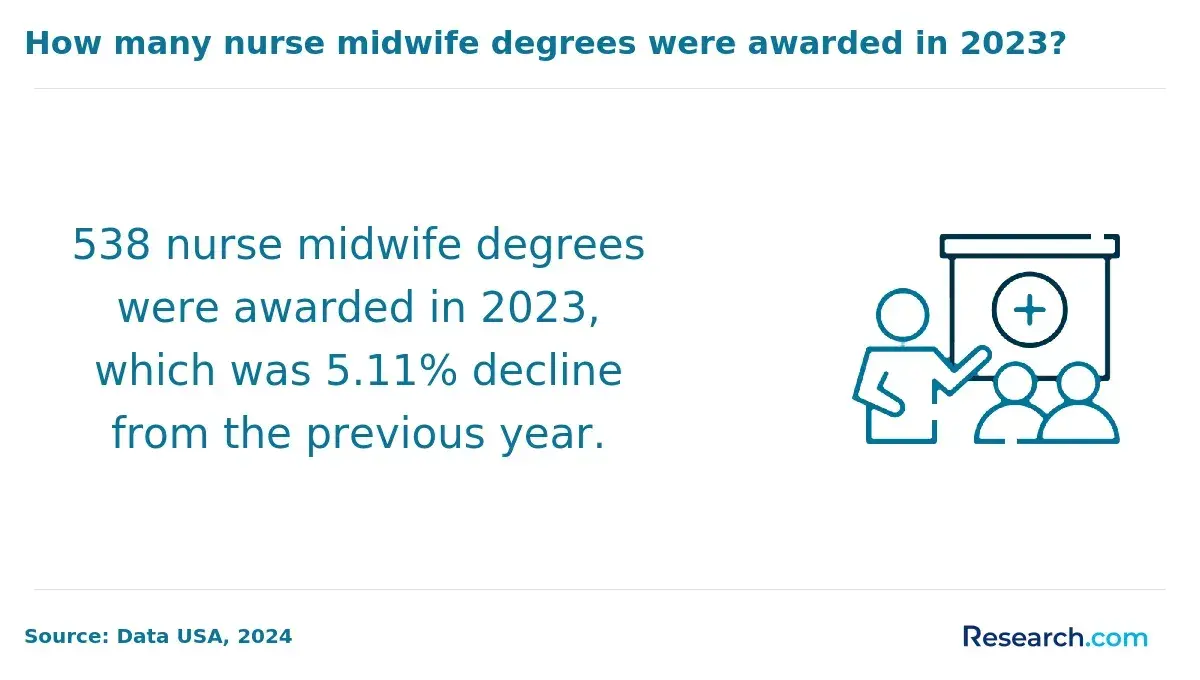
The image below shows that 538 nurse-midwifery degrees were awarded in 2023, a slight decline from the previous year. For students, that makes accreditation, clinical access, and graduate outcomes even more important when comparing programs.
Which advanced degrees support career advancement for CNMs in Louisiana?
CNMs can remain in direct patient care throughout their careers, but advanced education can also lead to leadership, teaching, policy, quality improvement, program management, and expanded women’s health roles. The right credential depends on whether the nurse wants initial CNM eligibility, a second specialty, or long-term advancement.
| Advanced credential | Best fit | Career value |
| MSN in Nurse-Midwifery | RNs seeking the core graduate credential for CNM practice in Louisiana | Provides advanced clinical education and eligibility for APRN licensure pathways |
| DNP in Nurse-Midwifery | CNM students or practicing nurses interested in clinical leadership, systems improvement, or policy influence | Supports roles in healthcare administration, clinical program leadership, and practice innovation |
| Post-Graduate Certificate in Nurse-Midwifery | APRNs or master’s-prepared RNs adding nurse-midwifery expertise | Allows qualified nurses to expand into midwifery without completing an entirely new degree |
| Nurse-Midwifery/Women’s Health Nurse Practitioner Programs | Students who want broader women’s health preparation in addition to midwifery | Combines midwifery and women’s health nurse practitioner preparation for wider clinical and educational options |
The visual below reinforces the importance of graduate education in the profession by showing the number of nurse-midwifery degrees awarded in 2023. Even with a slight decline, advanced education remains the required foundation for CNM practice and a key route to leadership in Louisiana maternal healthcare.
What organizations accredit nurse midwife programs in Louisiana?
Accreditation is one of the most important checks a student can make before enrolling. For nurse-midwifery, the key specialized accreditor is the Accreditation Commission for Midwifery Education. ACME is the sole specialized accrediting organization for nurse-midwifery programs recognized by the U.S. Department of Education nationwide.
ACME accreditation indicates that a program meets national standards for midwifery education and helps graduates qualify for the AMCB certification exam. ACME uses several accreditation statuses, including preaccreditation, initial accreditation, and continued accreditation. Programs with preaccreditation status, such as the Louisiana State University Health Sciences Center’s nurse-midwifery concentration, can still qualify graduates to take the national certification exam.
Students should also look for broader nursing accreditation and state approval. Louisiana nurse-midwifery programs may hold Commission on Collegiate Nursing Education accreditation and Louisiana State Board of Nursing approval. These layers do different things: ACME addresses midwifery-specific readiness, CCNE evaluates broader nursing education quality, and LSBN approval relates to state regulatory expectations.
| Organization | Role in program quality | Why students should care |
| Accreditation Commission for Midwifery Education | Specialized accreditation for nurse-midwifery education | Essential for AMCB certification eligibility and CNM licensure planning |
| Commission on Collegiate Nursing Education | Broader nursing program accreditation | Signals that the nursing program meets recognized academic and professional standards |
| Louisiana State Board of Nursing | State nursing regulatory oversight | Helps determine whether graduates can meet Louisiana RN, APRN, and practice requirements |
If you are comparing nurse-midwifery with other nursing pathways, this guide to nursing degrees key differences can help clarify how degree level, accreditation, and scope of practice fit together.
How should you choose a nurse-midwifery program in Louisiana?
Do not choose a program based only on name recognition or online convenience. The right program should lead to certification eligibility, fit your life realistically, and give you enough clinical support to graduate on time. A low advertised tuition can become expensive if you have to delay clinicals, travel frequently, or reduce work hours more than expected.
Questions to ask before enrolling
- Is the nurse-midwifery track ACME-accredited or pre-accredited?
- Does the program qualify graduates to sit for the AMCB certification exam?
- How many supervised clinical hours are required, and where are they completed?
- Does the school arrange clinical placements, or must students find preceptors?
- Are Louisiana clinical sites available for online or hybrid students?
- What is the total estimated cost, including fees, books, testing, supplies, travel, and licensure?
- Can students attend part time, and does part-time study affect clinical sequencing?
- How does the program prepare students for Louisiana collaborative practice requirements?
- What support is available for certification exam preparation?
- What are the program’s policies if a clinical placement falls through?
Common mistakes to avoid
| Mistake | Why it creates problems | Better approach |
| Choosing a program without checking ACME status | Graduates may face barriers to certification and licensure | Verify accreditation directly before applying |
| Looking only at tuition | Fees, clinical travel, books, testing, and reduced work hours can change affordability | Compare total cost of attendance and borrowing needs |
| Assuming online means fully remote | Clinical training must be completed in person | Ask how clinical placements work in Louisiana |
| Ignoring collaborative practice rules | State practice requirements can affect employment and autonomy | Discuss Louisiana practice expectations with faculty and potential employers |
| Relying only on rankings | A highly visible school may not be the best fit for your location, schedule, or clinical needs | Evaluate accreditation, clinical support, cost, and career fit together |
| Assuming salary outcomes are guaranteed | Pay varies by employer, region, experience, call schedule, and responsibilities | Research local job postings and benefits before borrowing heavily |
What do nurse midwives in Louisiana say about their careers?
When evaluating the CNM path, students should look for career feedback that explains the real work: call schedules, emotional intensity, collaborative practice, patient education, rural access issues, and the responsibility of making decisions during pregnancy and birth. First-person stories can be helpful, but they should not replace verification of accreditation, licensure outcomes, clinical placement support, and cost.
Useful alumni feedback often includes specific details about clinical preparation, preceptor quality, faculty support, certification exam readiness, and the transition from RN to APRN practice. Be cautious with vague testimonials that mention career satisfaction but do not explain whether the program helped graduates meet Louisiana requirements.
Related Articles for Nearby States
- 2027 How to Become a Nurse Midwife in Mississippi - Midwife Schooling Requirements
- 2027 How to Become a Nurse Midwife in Arkansas – Midwife Schooling Requirements
- 2027 How to Become a Nurse Midwife in Texas – Midwife Schooling Requirements
- 2027 How to Become a Nurse Midwife in Alabama – Midwife Schooling Requirements
- 2027 How to Become a Nurse Midwife in Tennessee – Midwife Schooling Requirements
- 2027 How to Become a Nurse Midwife in Missouri – Midwife Schooling Requirements
- 2027 How to Become a Nurse Midwife in Oklahoma – Midwife Schooling Requirements
- 2027 How to Become a Nurse Midwife in Florida – Midwife Schooling Requirements
- 2027 How to Become a Nurse Midwife in Kentucky – Midwife Schooling Requirements
- 2027 How to Become a Nurse Midwife in Georgia – Midwife Schooling Requirements
Can I be a midwife without a nursing degree in Louisiana?
This guide focuses on the certified nurse-midwife route, which requires nursing education and RN licensure because CNMs are advanced practice registered nurses. If you are interested in any non-nurse midwifery role, check Louisiana law and state regulatory guidance directly before enrolling in a program. Do not assume that a midwifery credential from another state or organization will authorize practice in Louisiana.
What is the difference between a nurse midwife and a midwife in Louisiana?
A certified nurse-midwife is an RN with graduate-level midwifery education, national certification, and advanced practice authorization. The term “midwife” can be used differently depending on state law, credential type, and practice setting. In Louisiana, students should verify exactly which credential a program prepares them for and whether that credential leads to legal practice authority.
Is a midwife in Louisiana higher than an RN?
A certified nurse-midwife has more advanced education and a broader advanced practice role than a registered nurse. However, “higher” is not the best way to think about it. RNs and CNMs have different scopes of practice, responsibilities, and licensing requirements. CNMs build on RN preparation and assume advanced responsibilities in maternal, reproductive, newborn, and women’s health care.
Is becoming a nurse midwife in Louisiana hard?
Yes, it is demanding. Students must complete nursing school, pass RN licensure, gain clinical experience, finish graduate nurse-midwifery education, complete hundreds of supervised clinical hours, pass national certification, and meet Louisiana APRN requirements. The hardest parts are often balancing work and school, securing clinical placements, managing birth-related schedules, and preparing for the responsibility of advanced practice.
Current trends affecting nurse midwives in Louisiana
- Maternal healthcare access remains a central issue. Louisiana’s projected 15% increase in maternal healthcare positions through 2030 highlights the need for clinicians prepared to serve both urban and underserved communities.
- Hybrid education is expanding, but clinical training remains local and hands-on. Online coursework can help working nurses, but students still need approved in-person clinical placements.
- Employers are emphasizing team-based care. Louisiana’s collaborative practice expectations mean CNMs must be comfortable consulting, referring, documenting, and communicating across disciplines.
- Cost and debt require more careful planning. With total estimated program costs ranging from $48,000 to $62,000, loan repayment, employer support, and service-based aid can be decisive.
- Credential verification is increasingly important. Students should confirm ACME status, AMCB eligibility, and Louisiana Board of Nursing requirements before committing to any program.
Key Insights
- The required route to CNM practice in Louisiana is graduate-level nurse-midwifery education, national certification through AMCB, and Louisiana APRN authorization.
- An MSN in nurse-midwifery is the common minimum graduate degree, while DNP and post-graduate certificate options may fit students with different career goals or prior education.
- ACME accreditation or pre-accreditation is non-negotiable for students who want a program that supports national certification eligibility.
- Clinical placement support is one of the biggest practical factors in choosing a program, especially for online or hybrid students who plan to train in Louisiana.
- The full path commonly takes six to eight years from BSN through certification, with graduate programs generally requiring two to three years of full-time study.
- Estimated total costs range from $48,000 to $62,000, so students should compare total cost, loan repayment options, employer aid, and expected local job opportunities before enrolling.
- Louisiana CNMs must understand collaborative practice expectations, renewal obligations, documentation standards, and ethical responsibilities before entering practice.
- The best program is not simply the cheapest or most convenient; it is the one that aligns accreditation, clinical access, cost, schedule, and Louisiana licensure readiness.
References:
- Accreditation Commission for Midwifery Education. ACME Accredited Programs.
- American Midwifery Certification Board. Certification.
- FMOLHS. Certified Nurse Midwife Program | Obstetrics & Maternity.
- Frontier Nursing University. Nurse-Midwifery Program (Certified Nurse-Midwife, CNM).
- Loyola University New Orleans. Master of Science in Nursing, Nurse-Midwifery.
- Loyola University New Orleans. Nurse-Midwifery Program Philosophy and Mission | College of Nursing and Health.
- LSU Health New Orleans School of Nursing. Accreditation.
- LSU Health Sciences Center. Applications Open for Only Nurse-Midwifery Program in Louisiana.
- Midwife Schooling. How to Become a Nurse Midwife in Louisiana | CNM Programs & License.
- Nurse.org. Top 10 Best Nursing Schools in Louisiana 2023.
Other Things You Need to Know About How to Become a Nurse Midwife in Louisiana
Louisiana nurse midwives must pass the American Midwifery Certification Board’s Certified Nurse-Midwife exam. To qualify, candidates need a graduate nurse-midwifery program accredited by the Accreditation Commission for Midwifery Education and an active registered nurse license before applying for certification.
Nurse Midwives in Louisiana must complete 30 hours of continuing education every two years to maintain their license. This includes mandatory courses on pharmacotherapeutics, ensuring they are up-to-date with state medical standards and practices.
Individuals with a non-nursing bachelor's degree can become Nurse Midwives in Louisiana by completing an accelerated Bachelor of Science in Nursing (BSN) program, obtaining licensure as a Registered Nurse (RN), and enrolling in a Master of Science in Nursing (MSN) or a Doctor of Nursing Practice (DNP) program with a specialization in midwifery.


