
2027 Forensic Psychologist Salary by State

Co-Founder and Chief Data Scientist
Forensic psychologists play a vital role at the intersection of psychology and the law. They assess criminal behavior, provide expert testimony in court, and help law enforcement and legal professionals understand the psychological factors behind crime and justice. As for those aspiring to enter this specialized field, understanding potential earnings is an important step in planning their career path. Salaries for forensic psychologists can vary widely depending on the state, cost of living, demand, and local job markets.
This article breaks down forensic psychologist salaries by state, helping you make informed decisions about where to work and how to maximize your earning potential in this rewarding profession.
What are the benefits of becoming a forensic psychologist?
- Meaningful Impact: Forensic psychologists contribute to public safety and justice by helping courts and law enforcement understand criminal behavior, competency, and rehabilitation needs.
- Diverse Career Paths: They can work in various settings such as prisons, courts, law enforcement agencies, hospitals, or private practice.
- Intellectual Challenge: The field demands critical thinking, problem-solving, and psychological analysis – making it ideal for those who enjoy complex, real-world cases.
- Competitive Salaries: Forensic psychologists often earn higher-than-average wages, especially those with advanced degrees or who serve as expert witnesses.
- Continuous Learning: The profession offers ongoing opportunities for research, professional development, and specialization in areas like criminal profiling or victim advocacy.
What can you do with a forensic psychology degree?
A forensic psychology degree opens doors to a wide range of career opportunities that bridge the fields of psychology, law, and criminal justice. Graduates can apply their understanding of human behavior to various professional settings where psychological expertise is essential for decision-making, evaluation, and rehabilitation. Here are some common career paths:
- Forensic Psychologist: Work directly with courts, correctional facilities, or law enforcement to assess offenders, provide expert testimony, and assist in criminal investigations.
- Criminal Investigator or Profiler: Use psychological insights to analyze crime patterns, understand offender motivations, and aid in solving cases.
- Victim Advocate: Support victims of crime by providing emotional assistance, helping them navigate the legal system, and connecting them with community resources.
- Correctional Counselor: Work within prisons or rehabilitation centers to guide inmates toward positive behavioral change and reintegration into society.
- Researcher or Academic: Conduct studies on criminal behavior, mental health in the justice system, or rehabilitation programs while teaching future psychologists and criminal justice professionals.
Whether pursuing hands-on forensic work or research-oriented roles, a forensic psychology degree provides the foundation for a meaningful and multifaceted career.
Where can you work with a forensic psychology degree?
A forensic psychology degree prepares graduates for diverse roles across both public and private sectors. Because the field blends psychology with criminal justice, professionals can find meaningful work in settings that address crime, rehabilitation, and legal processes. Here are some of the most common workplaces for those with a forensic psychology background:
- Correctional Facilities: Work with inmates to assess mental health, provide therapy, and support rehabilitation and reintegration programs.
- Courts and Legal Systems: Serve as expert witnesses, competency evaluators, or consultants who help judges and attorneys understand psychological evidence.
- Law Enforcement Agencies: Assist in criminal investigations, offender profiling, and the development of strategies for interviewing or crisis negotiation.
- Hospitals and Mental Health Centers: Provide treatment for individuals involved in the justice system or those with criminal behavior linked to mental health issues.
- Academic and Research Institutions: Teach psychology or criminology courses, conduct research on forensic topics, and contribute to policy development and reform.
These settings allow forensic psychology professionals to apply their expertise in ways that promote justice, improve rehabilitation, and enhance understanding of human behavior in legal contexts.
How much can you earn with a forensic psychology degree?
Earning potential in forensic psychology depends on several factors, including education level, experience, location, and type of employer. According to the U.S. Bureau of Labor Statistics (BLS, 2025), psychologists earn a median annual salary of around $94,310, though forensic psychologists often fall on the higher end of this range due to the specialized nature of their work. In fact, the BLS estimates that psychologists -- other than school psychologists, clinical and counseling psychologists, and industrial-organizational psychologists -- can earn an average median annual wage of $117,580.
Entry-level professionals with a bachelor’s or master’s degree may start in support or research roles, earning between $50,000 and $75,000 per year. Those with a doctoral degree (Ph.D. or Psy.D.) and licensure can earn $95,000 to $120,000 or more, especially when serving as expert witnesses or consultants.
Geographic location also plays a major role. States like California and Nevada tend to offer higher salaries due to strong demand and higher living costs. Additionally, forensic psychologists working in federal agencies, private practice, or consulting often command higher pay compared to those in academic or nonprofit settings.
In short, a forensic psychology degree offers strong earning potential, particularly for those who pursue advanced education and establish expertise in the legal or criminal justice system.
- What is a forensic psychologist and what do they do? Overview
- Median Annual Salary of Forensic Psychologists by State for 2027 Salary by State
- In what states do forensic psychologists earn the most money? In what states do forensic psychologists earn the most money?
- What factors affect forensic psychologist salary? Factors Affecting Salary
- How much do forensic psychologists earn based on experience level? How much do forensic psychologists earn based on experience level?
- How does forensic psychologist salary compare with similar occupations? How does forensic psychologist salary compare with similar occupations?
- What is the job outlook for forensic psychologists? Job Outlook
- Are there certifications for forensic psychologists that help boost salary? Are there certifications for forensic psychologists that help boost salary?
- What skills are essential for forensic psychologists? Core Skills
- How does continuing education and mentorship shape career success? How does continuing education and mentorship shape career success?
- What are the career advancement opportunities for forensic psychologists? What are the career advancement opportunities for forensic psychologists?
Forensic psychologist salary and career outlook: what to know before choosing this path
Forensic psychology attracts students who want to understand human behavior in legal settings, but the career is often misunderstood. This is not a crime lab job or a fast route into criminal investigation. Forensic psychologists use psychological assessment, clinical training, research, and legal knowledge to answer questions that may affect court decisions, correctional treatment, custody matters, public safety, and rehabilitation.
The career can pay well, but it usually requires significant preparation: graduate education, supervised clinical experience, state licensure, forensic training, and, for many advanced roles, doctoral-level credentials. This guide explains how forensic psychologist salary is measured, what affects earning potential, which states report the highest pay under the closest federal benchmark, how the field compares with related careers, and how to decide whether the time and cost are worth it.
Quick answer: how much do forensic psychologists make?
The U.S. Bureau of Labor Statistics does not list forensic psychologists as a separate wage category. The closest federal salary benchmark is “psychologists, all other,” a category that includes forensic psychologists and reports a median annual salary of $117,580. Actual pay can differ substantially based on location, employer type, licensure status, experience, specialization, and whether the psychologist works in government, corrections, hospitals, private practice, consulting, or expert witness services.
The highest-paying forensic psychology roles are generally tied to advanced training, state licensure, strong assessment skills, courtroom credibility, and specialized forensic expertise. Even then, salary is not guaranteed. Students should compare likely earnings in their state with tuition, living costs, debt, supervised training requirements, and the availability of forensic psychology jobs in their target region.
What does a forensic psychologist do?
A forensic psychologist applies psychological science to legal questions. Their work may involve evaluating a person’s mental health, risk level, competency, trauma history, treatment needs, or behavior in a legal context. They often work with courts, attorneys, correctional facilities, hospitals, law enforcement agencies, child custody systems, and public agencies.
Typical forensic psychologist responsibilities include:
- Conducting psychological evaluations: Forensic psychologists may assess defendants, victims, witnesses, incarcerated individuals, parents in custody cases, or people involved in competency and responsibility evaluations.
- Preparing forensic reports: They write reports that connect psychological findings to legal referral questions in language judges, attorneys, and agencies can use.
- Providing expert testimony: Some explain findings in court on matters such as competency, risk, trauma, criminal responsibility, treatment needs, or psychological functioning.
- Consulting with legal and justice professionals: They may advise courts, attorneys, law enforcement, correctional systems, or public agencies on assessment results, behavioral issues, interview strategy, or treatment planning.
- Supporting correctional and rehabilitation work: In jails, prisons, forensic hospitals, and community programs, they may help with treatment, reentry planning, risk reduction, and behavioral health services.
- Contributing to research and policy: Some forensic psychologists study offender behavior, assessment tools, mental health law, rehabilitation outcomes, violence risk, and justice-system reform.
Forensic psychology is different from forensic science. Students comparing whether forensic science is a good major should know that forensic science usually centers on physical evidence, laboratory analysis, and crime scene-related methods. Forensic psychology centers on behavior, diagnosis, assessment, testimony, mental health, and legal decision-making.
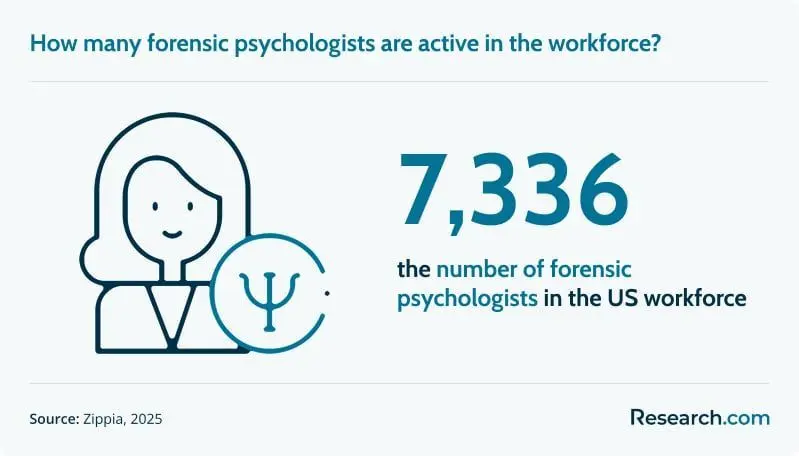
In the U.S., there are currently more than 7,300 forensic psychologists. Demand depends on how often courts, correctional systems, hospitals, and legal agencies rely on psychological expertise for evaluations, treatment recommendations, testimony, and risk assessment.
Median annual salary of forensic psychologists by state for 2027
Because federal wage data does not isolate forensic psychologists as a standalone occupation, the most useful government comparison is the BLS “psychologists, all other” category. The U.S. Bureau of Labor Statistics salary figures below can help readers compare pay by state, but they should not be treated as a guaranteed forensic psychologist salary for every job, employer, or career stage.
State-level pay differences may reflect cost of living, public agency budgets, demand for psychological evaluations, the number of courts and correctional facilities, and the availability of private consulting or expert witness work.
| State | Median annual salary | Bottom 10% | Top 10% |
| Alabama | $134,370 | $66,630 | $159,620 |
| Arizona | $128,040 | $49,610 | $160,330 |
| Arkansas | $118,600 | $46,320 | $150,240 |
| California | $147,650 | $41,600 | $191,730 |
| Connecticut | $132,040 | $42,010 | $153,880 |
| District of Columbia | $117,960 | $51,210 | $166,340 |
| Florida | $123,610 | $61,170 | $163,050 |
| Georgia | $113,730 | $53,500 | $161,600 |
| Idaho | $122,720 | $40,960 | $157,730 |
| Illinois | $81,270 | $32,830 | $162,330 |
| Indiana | $123,880 | $61,800 | $159,370 |
| Iowa | $123,740 | $44,420 | $156,750 |
| Kansas | $133,540 | $95,100 | $162,760 |
| Kentucky | $124,550 | $69,440 | $151,530 |
| Louisiana | $113,620 | $35,900 | $166,970 |
| Maine | $63,490 | $60,040 | $134,300 |
| Maryland | $123,490 | $52,170 | $181,210 |
| Massachusetts | $128,180 | $57,960 | $167,400 |
| Michigan | $78,670 | $38,430 | $148,240 |
| Minnesota | $110,190 | $54,840 | $141,130 |
| Mississippi | $111,430 | $33,470 | $157,210 |
| Missouri | $127,230 | $46,630 | $158,810 |
| Nebraska | $137,990 | $50,630 | $168,190 |
| Nevada | $144,390 | $44,450 | $164,550 |
| New Hampshire | $75,990 | $66,740 | $150,220 |
| New Jersey | $124,800 | $91,430 | $145,770 |
| New Mexico | N/A | N/A | N/A |
| New York | $113,730 | $47,490 | $157,910 |
| North Carolina | $137,130 | $48,570 | $167,590 |
| Ohio | $131,310 | $54,120 | $157,580 |
| Oklahoma | $147,010 | $38,000 | $174,600 |
| Oregon | $82,960 | $76,810 | $148,700 |
| Pennsylvania | $126,460 | $60,340 | $153,860 |
| Rhode Island | $111,310 | $30,510 | $163,090 |
| South Carolina | $135,950 | $54,570 | $161,450 |
| South Dakota | $128,560 | $33,470 | $165,280 |
| Tennessee | $135,570 | $72,280 | $156,330 |
| Texas | $81,830 | $60,210 | $161,180 |
| Utah | $90,270 | $42,610 | $150,110 |
| Vermont | $76,490 | $60,140 | $140,170 |
| Virginia | $125,630 | $50,170 | $167,630 |
| Washington | $120,080 | $62,350 | $150,530 |
| West Virginia | $41,900 | $29,180 | $142,690 |
| Wisconsin | $107,540 | $55,800 | $160,380 |
Which states pay forensic psychologists the most?
Based on the state median salary data shown above, the top five states under the closest BLS benchmark are California, Oklahoma, Nevada, Nebraska, and North Carolina. These figures are useful for comparing geographic markets, but they do not tell the full financial story.
A higher salary can be offset by higher housing costs, taxes, commuting expenses, professional liability coverage, student loan payments, and the concentration of jobs in expensive metro areas. A lower-paying state may still offer a better quality of life or stronger entry-level opportunities if licensing pathways, supervised placements, and public-sector hiring are more accessible.
Students considering a forensic psychology degree should compare state salary data with the places where they can realistically complete practicum hours, internships, postdoctoral experience, licensure requirements, and early-career employment. Location-driven salary variation is not unique to psychology; similar comparisons appear in specialized fields such as cyber intelligence and cyber security salary, where compensation often depends on employer demand, specialization, and regional labor markets.
According to the BLS, California, Illinois, and Texas employ the largest numbers of psychologists, followed by Florida and Minnesota. Larger states may provide more job settings, but they may also bring stronger competition, more complex licensing logistics, and higher living costs.
What affects a forensic psychologist’s salary?
Forensic psychologist earnings are shaped by more than the word “forensic” in a job title. The strongest pay factors include degree level, licensure, employer type, geographic location, experience, specialty area, and whether the work involves evaluations, testimony, supervision, consulting, or leadership.
| Salary factor | Why it affects pay | Decision point for students and professionals |
| Degree level | Many independent practice, forensic assessment, and expert evaluation roles require doctoral preparation. | Compare the time, tuition, research expectations, and licensing value of a Ph.D. or Psy.D. before enrolling. |
| Licensure | State licensure is usually necessary for independent psychological practice and can expand job options. | Verify that your degree program, internship, and supervised experience match the requirements in the state where you plan to work. |
| Experience | Pay often rises as professionals build credibility in assessment, testimony, report writing, supervision, and complex legal cases. | Prioritize practicum, internship, and postdoctoral placements that provide real forensic assessment and report-writing experience. |
| Work setting | Government agencies, correctional systems, hospitals, universities, nonprofits, private practices, and consulting firms may follow different pay structures. | Ask whether compensation is salaried, contract-based, fee-for-service, or tied to expert witness work. |
| Specialization | Skills in competency evaluations, violence risk assessment, trauma, juvenile forensics, and expert testimony can improve marketability. | Choose training experiences and continuing education that match the populations and case types you want to serve. |
| Location | State and metro wages vary widely, and salary alone does not show purchasing power. | Compare pay with housing costs, taxes, commuting, loan repayment, and job availability. |
Education is one of the biggest long-term decisions. Students comparing doctoral paths can review the differences between a Psy.D. and Ph.D. in psychology, including training emphasis, research expectations, clinical preparation, and career fit.
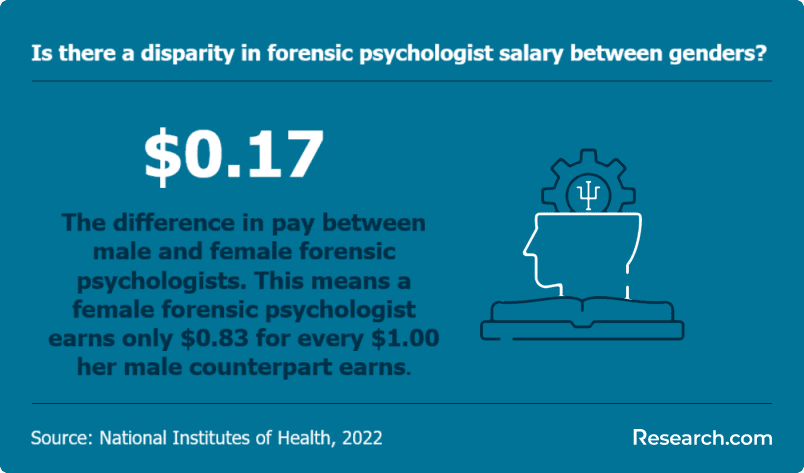
Gender may also affect salary patterns in forensic psychology, as shown in the image below.
How much do forensic psychologists earn by experience level?
Payscale reports that forensic psychologist pay generally increases with experience. An entry-level forensic psychologist with less than one year of experience earns average total compensation of $63,578. A professional with one to four years of experience earns $76,940. A mid-career forensic psychologist with five to nine years of experience earns $87,674. Those with 10-19 years of experience earn $109,994, while late-career professionals with 20 years or more earn $122,084.
These are total compensation figures and may include tips, bonus, and overtime pay. They are best used as broad benchmarks, not exact predictions. Individual earnings can vary by state, employer, licensure status, job duties, caseload, consulting work, and courtroom involvement.
| Experience level | Average total compensation | What this stage usually involves |
| Less than one year | $63,578 | Developing supervised clinical judgment, assessment skills, report-writing habits, and familiarity with legal referral questions. |
| One to four years | $76,940 | Building a broader case record, gaining confidence with forensic evaluations, and strengthening professional credibility. |
| Five to nine years | $87,674 | Taking on more complex evaluations, refining specialty interests, and moving toward higher-responsibility work. |
| 10-19 years | $109,994 | Handling senior-level assessment, testimony, consulting, supervision, or leadership responsibilities. |
| 20 years or more | $122,084 | Using advanced expertise for leadership, expert consulting, training, private practice, or specialized casework. |
Graduate credentials can open doors to higher-level roles, but they also require time, tuition, and delayed full-time earnings. Some students compare advanced-degree trade-offs across fields, such as Ph.D. and MBA salary considerations, to understand how credential-heavy paths may affect mobility and long-term return on investment.
The chart below shows how pay changes across experience levels.
How does forensic psychologist pay compare with related careers?
Forensic psychology can be financially competitive because the work combines psychological assessment, clinical judgment, legal knowledge, ethics, and high-stakes communication. The closest BLS category, “psychologists, all other,” reports a median annual salary of $117,580, with earnings ranging from $51,410 for the bottom 10% to $163,570 for the top 10%.
The BLS reports a median annual salary of about $94,310 for psychologists overall. Selected psychology salary figures include:
- Industrial-organizational psychologists: $109,840
- Clinical and counseling psychologists: $95,830
- School psychologists: $86,930
- Psychologists, all other, including forensic psychologists: $117,580
Related legal, investigative, and forensic occupations report the following salaries:
- Detectives and criminal investigators: $93,580
- Forensic science technicians: $67,440
| Occupation | Reported salary | How to interpret the comparison |
| Psychologists overall | $94,310 | A broad benchmark that includes multiple psychology specialties and work settings. |
| Psychologists, all other | $117,580 | The closest BLS wage category for forensic psychologists. |
| Industrial-organizational psychologists | $109,840 | A specialized psychology career with strong earning potential; students can compare duties through organizational psychologist jobs. |
| Clinical and counseling psychologists | $95,830 | Often more treatment-focused, though clinical training can overlap with forensic preparation. |
| School psychologists | $86,930 | Primarily focused on student assessment, learning needs, school-based mental health, and educational support. |
| Detectives and criminal investigators | $93,580 | A law enforcement route centered on investigation rather than clinical psychology, diagnosis, and psychological testing. |
| Forensic science technicians | $67,440 | A laboratory and evidence-focused forensic role, not a psychological assessment career. |
The salary potential of forensic psychology should be considered alongside the cost of doctoral study, supervised experience, licensure exams, continuing education, professional liability, and the responsibility of work that may influence legal outcomes.
What is the job outlook for forensic psychologists?
The forensic psychology career outlook must be interpreted through broader psychology employment data because the BLS does not publish a separate projection for forensic psychologists. The BLS projects employment of psychologists overall to grow about 6% from 2024 to 2034, which is faster than the average for all occupations.
The BLS also projects about 12,900 job openings per year for psychologists in the U.S. during that period. These openings are expected to come from new positions as well as replacement needs when workers retire, change occupations, or leave the labor force.
Forensic psychology demand may be supported by ongoing attention to mental health in courts, correctional facilities, rehabilitation programs, competency evaluations, trauma-informed practice, and risk assessment. However, local hiring can depend heavily on public funding, court volume, correctional staffing, forensic hospital capacity, agency budgets, and the supply of licensed psychologists in the region.
Trends that may support demand
- More legal use of psychological evaluations: Courts may seek expert input on competency, trauma, risk, treatment, and mental functioning.
- Continued focus on mental health in justice settings: Reform efforts and diversion programs can increase the need for assessment and treatment expertise.
- Expansion of behavioral health services: As mental health systems grow, forensic specialists may find roles where clinical care intersects with safety, law, rehabilitation, and public agencies.
- Need for expert communication: Courts and agencies need psychologists who can translate assessment results into clear, legally relevant conclusions.
Challenges that can limit opportunity
- Some regions have few forensic employers: Smaller markets may not have large court systems, forensic hospitals, correctional facilities, or consulting networks.
- Licensure does not transfer automatically everywhere: Moving states can require documentation, board review, additional applications, or proof of supervised experience.
- The work can be emotionally and legally demanding: Evaluations may affect custody, liberty, sentencing, treatment, hospitalization, or public safety.
- Consulting income can be uneven: Expert witness and contract work may pay well but can depend on referrals, reputation, and case volume.
Can certifications increase forensic psychologist salary?
Specialized credentials can improve credibility and may strengthen access to higher-paying opportunities in forensic assessment, expert testimony, consulting, supervision, and leadership. Certification alone does not guarantee a raise, but it can signal advanced competence to courts, law firms, agencies, hospitals, and employers.
- Board certification in forensic psychology: The American Board of Professional Psychology offers a forensic psychology board certification that demonstrates advanced professional competence.
- State psychologist licensure: Licensure is typically required for independent psychological practice and can broaden the kinds of evaluations and services a psychologist may provide.
- Postdoctoral and continuing education in forensic assessment: Training in competency evaluation, risk assessment, criminal responsibility, juvenile forensics, trauma assessment, or related specialties can improve fit for advanced roles.
- Professional organization involvement: Groups such as the American Psychology–Law Society and the American Academy of Forensic Psychology can support networking, continuing education, and professional visibility.
- Expert witness preparation: Psychologists who testify need strong report defense, ethics knowledge, courtroom communication, and the ability to explain findings under cross-examination.
Many of the highest-paying psychology careers reward advanced preparation, licensure, specialization, and evidence of professional competence. In forensic psychology, the most useful credentials are usually those connected directly to the case types, populations, and legal settings a psychologist plans to serve.
What skills do forensic psychologists need?
Forensic psychologists need more than an interest in crime or psychology. Their work requires clinical accuracy, legal awareness, scientific reasoning, ethical discipline, and communication skills that hold up under scrutiny. A weak report or poorly supported opinion can have serious legal consequences.
- Psychological assessment skill: Forensic psychologists must choose, administer, interpret, and explain psychological tests appropriately.
- Legal literacy: They need to understand legal referral questions, court procedures, relevant terminology, and the limits of their professional role.
- Objectivity: Even when hired by one side, they must remain neutral and base conclusions on evidence.
- Precise writing: Reports must be detailed enough for professional review while remaining understandable to judges, attorneys, and agencies.
- Courtroom communication: Expert testimony requires calm, accurate, concise explanations during direct examination and cross-examination.
- Ethical judgment: Confidentiality, informed consent, dual relationships, bias, evaluator role boundaries, and assessment limits can be especially complex in legal settings.
- Emotional resilience: Cases may involve trauma, violence, incarceration, abuse, family conflict, or high-stakes legal decisions.
- Research literacy: Strong practitioners understand the evidence behind risk factors, assessment tools, diagnostic conclusions, and forensic opinions.
As with other advanced professional pathways, including graduate education options such as Ed.S. and Ed.D. degrees, forensic psychology rewards specialized preparation rather than general interest alone.
How do continuing education and mentorship affect career growth?
Continuing education is essential in forensic psychology because assessment methods, laws, ethics guidance, risk research, and professional standards change over time. Workshops, seminars, supervised consultation, and advanced training can help psychologists improve report quality, testimony skills, specialty knowledge, and forensic decision-making.
Mentorship can be just as important as coursework. A skilled mentor can help early-career psychologists select appropriate training cases, understand local court expectations, avoid ethical mistakes, evaluate job offers, and decide whether to pursue agency work, forensic hospitals, private practice, academic research, or expert consulting.
Cost should remain part of the decision. Professionals often compare affordable training routes in adjacent behavioral fields, such as the cheapest online BCBA programs, as a reminder that continuing education should be relevant, reputable, and financially realistic.
What are the main career advancement options for forensic psychologists?
Forensic psychologists can advance by developing deeper expertise, earning credentials, gaining testimony experience, publishing research, supervising others, leading programs, or building a consulting practice. The best route depends on whether the psychologist prefers assessment, treatment, law-related consulting, research, administration, or independent practice.
| Advancement path | Best fit | Trade-off to consider |
| Private practice or consulting | Experienced psychologists who want autonomy, specialized casework, and control over the types of referrals they accept. | Income may depend on reputation, referrals, contracts, scheduling, billing, and business management. |
| Expert witness work | Professionals with strong forensic credentials, assessment expertise, documentation skill, and courtroom communication ability. | The work can be adversarial and requires careful preparation, defensible opinions, and strong ethical boundaries. |
| Correctional or forensic hospital leadership | Psychologists who want to supervise staff, shape programs, manage services, and work at a systems level. | Administrative responsibilities may reduce time available for direct evaluation or therapy. |
| Academic or research career | Doctoral-level professionals interested in teaching, publishing, and studying psychology-law topics. | Academic hiring can be competitive and may require a strong publication and research record. |
| Niche specialization | Psychologists who want to focus on areas such as juvenile forensics, trauma, violence risk, competency, or correctional treatment. | A narrow specialty can improve credibility but may limit job options in smaller markets. |
Is becoming a forensic psychologist worth it?
Forensic psychology may be worth it for students who are prepared for graduate school, supervised practice, licensing requirements, detailed writing, legal scrutiny, ethical complexity, and emotionally difficult work. It is usually not the best fit for someone who wants a quick path into criminal justice, wants to avoid extensive schooling, or is mainly interested in crime scene evidence rather than mental health and behavior.
Before choosing this path, ask yourself:
- Am I willing to complete the graduate education and supervised experience required for licensure?
- Does my target state require specific practicum, internship, postdoctoral, or examination requirements for psychologist licensure?
- Do I want to work with courts, attorneys, correctional systems, victims, defendants, incarcerated individuals, or families involved in legal disputes?
- Can I review distressing case material while staying objective and evidence-based?
- Have I compared likely salary with tuition, debt, living expenses, relocation costs, and years spent in training?
- Are there forensic hospitals, courts, prisons, public agencies, consulting firms, or correctional employers in the region where I want to work?
Common mistakes to avoid
- Choosing a program before checking licensure fit: A psychology degree may not qualify you for licensure if it does not meet state requirements.
- Assuming every psychology program includes forensic training: Some programs offer little exposure to forensic assessment, legal psychology, correctional work, or expert testimony.
- Looking only at salary: Higher-paying roles may involve more education, legal liability, travel, testimony, difficult cases, or unpredictable consulting income.
- Undervaluing supervised experience: Practicum, internship, and postdoctoral placements can strongly influence job readiness and professional credibility.
- Confusing forensic psychology with forensic science: Both fields may involve the justice system, but they require different training and lead to different jobs.
- Relying only on national averages: Local demand, state licensing rules, public budgets, cost of living, and employer availability can matter more than national salary data.
What forensic psychologists say about salary and career value
- : "Forensic psychology has provided financial stability, but salary is only part of the decision. The work requires careful evaluations, court preparation, and the ability to make complex behavior understandable to legal professionals. The responsibility is substantial, which is why the compensation feels connected to the seriousness of the role. — Melissa"
- : "My income increased after I gained experience and completed board certification, but the bigger benefit was credibility. The education and training were demanding, so I would not recommend this career to someone focused only on pay. What we write and say can affect people’s lives and legal outcomes, and that weight is always present. — Adam"
- : "After more than a decade in the field, I see forensic psychology as stable but demanding. Reports take time, testimony can be stressful, and every opinion needs a strong foundation. The work remains meaningful because good evaluations can help courts make better-informed decisions. — Rebecca"
Key Insights
- Forensic psychologists apply psychological science to legal, correctional, and court-related questions; they are not the same as forensic science technicians.
- The BLS does not publish a separate salary category for forensic psychologists, so “psychologists, all other” is the closest federal wage benchmark.
- The reported median annual salary for “psychologists, all other” is $117,580, but state medians vary widely.
- In the state data shown above, California, Oklahoma, Nevada, Nebraska, and North Carolina have the highest median annual salaries.
- Experience can meaningfully affect compensation: Payscale reports average total compensation from $63,578 for less than one year of experience to $122,084 for 20 years or more.
- Doctoral training, licensure, board certification, forensic assessment experience, and expert witness credibility can improve career options, but they do not guarantee a specific salary.
- The BLS projects psychologist employment to grow about 6% from 2024 to 2034, with about 12,900 openings per year across psychology roles.
- The best decision is not based on salary alone. Compare program cost, licensure alignment, supervised training quality, local job markets, cost of living, and your tolerance for high-stakes legal work.
References:
- Neal, T. & Line, E.N. (2022, July 7). Income, Demographics, and Life Experiences of Clinical-Forensic Psychologists in the United States. National Library of Medicine - PubMed Central.
- Payscale. (2025). Average Forensic Psychologist Salary. Payscale.
- Psychology Jobs. (2025, January 6). Forensic Psychologist Salary Guide 2025. Psychology Jobs.
- United States Bureau or Labor Statistics. (2025). Occupational Employment and Wage Statistics Query System. BLS.
- United States Bureau of Labor Statistics. (2025, August 28). Occupation Outlook Handbook | Forensic Science Technicians. BLS.
- United States Bureau of Labor Statistics. (2025, August 28). Occupation Outlook Handbook | Police and Detectives. BLS.
- United States Bureau of Labor Statistics. (2025, August 28). Occupation Outlook Handbook | Psychologists. BLS.
- Zippia. (2025). Forensic psychologist demographics and statistics in the US. Zippia.
- ZipRecruiter. (2025, October 6). Forensic Psychologist Salary. ZipRecruiter.
Other Things You Should Know About Forensic Psychologist Salary
A doctoral psychologist license is required in every state, usually a PhD or PsyD plus supervised postdoctoral hours. Most states also require the EPPP exam, and some add a jurisprudence exam or state-specific background check before granting independent practice authority.
In 2027, California, New York, and Texas are among the states offering the highest salaries for forensic psychologists, with averages exceeding $95,000 annually. These states often offer higher pay due to demand and cost of living factors.


