2027 Fastest Online Alternative Teacher Certification Programs

Co-Founder and Chief Data Scientist
Many people think that getting certified to teach means earning a degree and landing a job, but the process is rarely that simple, especially if you’re changing careers. Between state requirements, licensing exams, and the pressure to find a flexible program, many would-be teachers get stuck or discouraged. What most don’t realize is that online alternative teacher certification options can be faster and more accessible than the traditional route.
Schools are responding to ongoing teacher shortages by hiring more people from non-traditional paths. In fact, a 2025 report from Teachers of Tomorrow shows that in some areas, 15–20% of new hires now come from alternative programs.
This guide will walk you through the fastest online options, explain how they work, and show you how to start teaching sooner, with expert advice to help you move forward with confidence.
What are the benefits of getting the fastest online alternative teacher certification program?
- These programs qualify you for full-time teaching roles in public, private, charter, and online K–12 schools.
- You build classroom-ready teaching skills faster, so you can enter the workforce while others are still in training.
- You can earn over $60,000 per year in many states, equal to traditionally certified teachers.
What can I expect from the fastest online alternative teacher certification programs?
The fastest online alternative teacher certification programs focus on getting you classroom-ready without going through a full bachelor’s or master’s degree in education. These programs are designed for individuals who already hold a bachelor’s degree in any field. You don’t need a background in teaching to qualify.
Most programs include 18 to 30 credit hours. That’s far fewer than a traditional degree. You’ll take courses in classroom management, lesson planning, instructional methods, and student development. Some allow you to choose a focus area, such as elementary, secondary, or a specific subject like math or science.
You’ll also complete a fieldwork component, which usually means student teaching or working under a mentor in a local school. Programs often help place you in a school near where you live.
The average cost per credit ranges from $250 to $600, depending on the school and the type of program. Public colleges usually offer lower rates than private ones.
Where can I work with an online alternative teacher certification program?
With an online alternative teacher certification, you can work in many of the same schools and classrooms as teachers who follow traditional routes. The certification meets state requirements for full-time teaching roles in both public and private schools. Most graduates go straight into teaching positions after finishing their program.
Here are the most common places you can work:
- Public Elementary and Secondary Schools: These are the top employers. About 80–85% of kindergarten, elementary, middle, and high school teachers work in public schools, depending on the grade level.
- Private Schools: These schools hire around 13–16% of teachers and often value flexible certification paths, especially in specialized subjects or faith-based settings.
- Charter Schools: Many charter schools accept teachers with alternative certification, especially in high-need areas.
- Childcare and Early Education Centers: Some programs lead to roles in pre-K and kindergarten settings, particularly in daycare centers or private preschools.
- Online K–12 Schools: Virtual schools have grown in recent years and often seek teachers who are trained in online teaching methods, which many online programs now incorporate.
Most jobs are full-time classroom roles. You could become a lead teacher, co-teacher, or subject specialist, depending on your certification area.
How much can I make with the fastest online alternative teacher certification programs?
If you complete the fastest online alternative teacher certification programs and start teaching, your salary will depend on what grade you teach, where you live, and whether you work in a public or private school. However, the good news is that teachers who enter the profession through online programs often earn about the same as those who have gone through traditional routes.
Here’s what you can expect to earn, based on 2025 data:
- Kindergarten Teachers: Around $61,400 per year, not including special education.
- Elementary School Teachers: About $62,300 annually, depending on the state and district.
- Middle School Teachers: Roughly $61,900 per year on average.
- High School Teachers: One of the higher-paying roles at about $64,600 a year, especially outside of special or technical education.
Private school salaries may be lower, while some public districts in high-need areas may offer higher pay or bonuses. You’ll also qualify for benefits like health insurance, retirement plans, and paid time off. Some districts offer loan forgiveness or tuition reimbursement for teachers with alternative certification.
- Fastest Online Alternative Teacher Certification Programs for 2027 Best Programs
- How long does it take to complete the fastest online alternative teacher certification program? Completion Time
- How does an online alternative teacher certification program compare to an on-campus program? How does an online alternative teacher certification program compare to an on-campus program?
- What is the average cost of an online alternative teacher certification program? Average Cost
- What are the financial aid options for students enrolling in an online alternative teacher certification program? Financial Aid
- What are the prerequisites for enrolling in an online alternative teacher certification program? Requirements
- What courses are typically in an online alternative teacher certification program? What courses are typically in an online alternative teacher certification program?
- What types of specializations are available in an online alternative teacher certification program? What types of specializations are available in an online alternative teacher certification program?
- How to choose the best and fastest online alternative teacher certification program? How to choose the best and fastest online alternative teacher certification program?
- What career paths are available for graduates of an online alternative teacher certification program? What career paths are available for graduates of an online alternative teacher certification program?
- What is the job market for graduates of the fastest online alternative teacher certification programs? Job Outlook
- Are these online alternative teacher certification programs accredited and state-approved? Are these online alternative teacher certification programs accredited and state-approved?
- Can online alternative teacher certification pave the way for advanced academic leadership? Can online alternative teacher certification pave the way for advanced academic leadership?
- Can online alternative teacher certification pave the way for specialized educational roles? Can online alternative teacher certification pave the way for specialized educational roles?
Fastest Online Alternative Teacher Certification Programs for 2027
Alternative teacher certification is designed for adults who already have a bachelor’s degree and want to become licensed teachers without completing a second undergraduate education degree. For career changers, paraprofessionals, substitute teachers, military veterans, and professionals in high-need subjects, the fastest online programs can shorten the route into the classroom while still requiring state approval, coursework, exams, and supervised teaching experience.
This guide explains how fast online alternative teacher certification programs work, which programs offer some of the shortest timelines, what they cost, how online and campus routes compare, and what to check before enrolling. It also covers prerequisites, specializations, financial aid options, job outlook, common mistakes, and the questions you should ask before choosing a program.
Quick Answer: What Is the Fastest Way to Earn Alternative Teacher Certification Online?
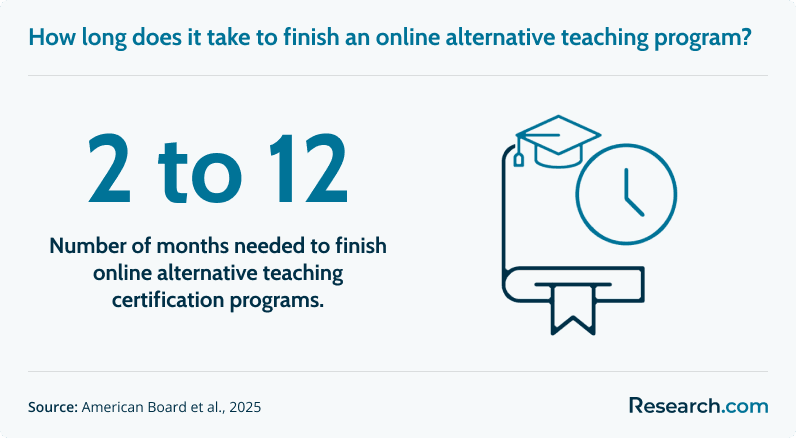
The fastest online alternative teacher certification programs can be completed in as little as 2 to 12 months, depending on the provider, state rules, exam timing, and required classroom experience. Self-paced programs are usually the shortest, while programs with structured practicums, paid internships, or student teaching often take 9 to 12 months or longer.
The right program is not simply the shortest one. It must be accepted by the state where you want to teach, prepare you for the correct licensure exams, include any required field experience, and match your intended grade level or subject area.
What Is an Online Alternative Teacher Certification Program?
An online alternative teacher certification program is a state-recognized pathway for people who already hold a bachelor’s degree but did not complete a traditional teacher preparation program. Instead of returning to college for a full education degree, candidates complete focused pedagogy coursework, classroom training, exams, and any state-required practicum or internship.
These programs are most useful for people who want to move into teaching from another field, fill shortage-area roles, or begin working while completing certification requirements. They are not the same as an online teaching degree. A degree program usually takes longer, includes broader academic coursework, and may be required for candidates who do not yet have a bachelor’s degree.
How We Rank Schools and Programs
Because teacher certification is a major career and financial decision, our ranking process is built around transparent, decision-useful information. Research.com’s ranking methodology considers data from reliable sources, including the IPEDS database, Peterson’s database and its Distance Learning Licensed Data Set, the College Scorecard, and the National Center for Education Statistics.
For alternative teacher certification, speed alone is not enough. State approval, accreditation status, cost transparency, required field experience, online delivery, and licensure alignment matter just as much as program length.
Fastest Online Alternative Teacher Certification Programs
| Program | Program Length | Cost | Best Fit |
| American Board | 2–10 months | $1,900–$2,800 | Self-paced candidates in participating states who want a low-cost route |
| Moreland University | 9 months | $7,200 | Candidates who want graduate-level coursework, mentorship, and a practicum |
| Teachers of Tomorrow | ~1 year | $4,700 | Students seeking a flexible online program approved in multiple states |
| University of West Florida TeacherReady® | 1 year | $5,400 total or $450 per lesson | Working adults who want flexible pacing and mentor placement |
| University of Colorado Denver ASPIRE to Teach® | 1 school year | $6,750 | Colorado candidates seeking coaching and mentorship across PreK–12 settings |
| Lamar University | As few as 12 months | $7,561 | Texas candidates choosing between student teaching and a paid internship |
| Seattle Pacific University | 12 months | $215–$670 per credit | Washington candidates seeking a one-year certification route |
| Texas State University | Flexible; varies by student pace | $4,400 | Future Texas PK–12 teachers who want clinical teaching or a paid internship |
| University of South Dakota | Varies by student | $484.10 per credit hour | Students pursuing South Dakota-focused graduate-level certification coursework |
| East Texas A&M University | 1.5–2 years | Varies; estimated ~$3,000–$5,000 plus testing fees | Candidates who want certification options with or without a master’s degree |
1. American Board
American Board provides a self-paced online route for career changers who want to prepare for K–12 teaching certification while continuing to work. The program can be completed in as little as two months and supports certification preparation in over 10 states and multiple teaching areas.
- Required Credits to Graduate: Not credit-based
- Program Length: 2–10 months
- Cost: $1,900–$2,800 (Standard and Premium options)
- Accreditation: Not regionally accredited; accepted by select state education departments
2. Moreland University
Moreland University’s TEACH-NOW® program combines online instruction with supervised teaching practice for professionals entering the classroom. Its structure includes graduate-level coursework, reading instruction, student-centered teaching methods, mentorship, and a 12-week practicum.
- Required Credits to Graduate: Not credit-hour based; graduate-level coursework
- Program Length: 9 months
- Cost: $7,200
- Accreditation: CAEP; Distance Education Accrediting Commission (DEAC)
3. Teachers of Tomorrow
Teachers of Tomorrow offers a fully online certification pathway approved in multiple states. The program is built for candidates who need flexibility and want coaching, classroom resources, and a streamlined path into high-need teaching areas.
- Required Credits to Graduate: Not credit-based
- Program Length: ~1 year
- Cost: $4,700
- Accreditation: Association for Advancing Quality in Educator Preparation (AAQEP)
4. University of West Florida
The University of West Florida's TeacherReady® program is an online, year-long certification option covering over 30 fields. It is designed for working adults who need flexible pacing, online lessons, and a mentor-supported classroom placement.
- Required Credits to Graduate: Not credit-hour based; lesson and module structure
- Program Length: 1 year
- Cost: $5,400 total or $450 per lesson
- Accreditation: Council for the Accreditation of Educator Preparation (CAEP)
5. University of Colorado Denver
ASPIRE to Teach® is a non-credit, one-year teacher preparation route that uses online modules, live coaching, and mentor support. It serves candidates across Colorado Department of Education licensure areas and PreK–12 educational settings.
- Required Credits to Graduate: Non-credit program
- Program Length: 1 school year
- Cost: $6,750
- Accreditation: Higher Learning Commission (HLC)
6. Lamar University
Lamar University’s Alternative Certification Program prepares Texas teaching candidates through online coursework and supervised school-based experience. Students may complete either a 14-week student teaching placement or a paid internship, depending on their situation and program requirements.
- Required Credits to Graduate: 21
- Program Length: As few as 12 months
- Cost: $7,561
- Accreditation: Southern Association of Colleges and Schools Commission on Colleges (SACSCOC)
7. Seattle Pacific University
Seattle Pacific University’s ARC program is a one-year online certification pathway for aspiring Washington teachers. The program includes a full year of student teaching and emphasizes leadership, character, and preparation for employment in Washington schools.
- Required Credits to Graduate: 37–47
- Program Length: 12 months
- Cost: $215–$670 per credit
- Accreditation: Northwest Commission on Colleges and Universities (NWCCU)
8. Texas State University
Texas State University’s ACE program gives future Texas PK–12 teachers an accelerated certification option with online coursework, mentoring, and a choice between clinical teaching or a paid internship.
- Required Credits to Graduate: 15
- Program Length: Flexible; varies by student pace
- Cost: $4,400
- Accreditation: Southern Association of Colleges and Schools Commission on Colleges (SACSCOC)
9. University of South Dakota
University of South Dakota’s Alternative Teacher Certification Certificate is a graduate-level online route for professionals moving into teaching. The curriculum is aligned with South Dakota licensure expectations and can be completed fully online.
- Required Credits to Graduate: 15
- Program Length: Varies by student
- Cost: $484.10 per credit hour
- Accreditation: Higher Learning Commission (HLC)
10. East Texas A&M University
East Texas A&M offers an alternative certification program for career changers preparing for K–12 classrooms through online coursework and supervised teaching practice. Candidates can pursue certification through several credit options, including routes with or without a master’s degree.
- Required Credits to Graduate: 18–36
- Program Length: 1.5–2 years
- Cost: Varies; estimated ~$3,000–$5,000 plus testing fees
- Accreditation: Southern Association of Colleges and Schools Commission on Colleges (SACSCOC)
How Long Does the Fastest Online Alternative Teacher Certification Program Take?
The quickest online alternative teacher certification programs may take 2 to 12 months, but the actual timeline depends on the program model and your state’s licensing rules. Self-paced options, including American Board, may be completed in 2 to 6 months by candidates who study consistently and meet testing requirements quickly.
Programs with set course sequences, required practicums, student teaching, or paid internships usually take longer. Moreland University, Lamar University, and TeacherReady-style pathways typically require approximately 9 to 12 months because they include more structured clinical preparation.
| Timeline Factor | How It Can Affect Completion Speed |
| Program format | Self-paced programs can move faster than cohort-based programs with fixed calendars and start dates. |
| Current classroom experience | Candidates already working in schools may be able to complete practicum expectations more efficiently, depending on program and state rules. |
| State requirements | Some states require a full academic year of supervised teaching or a paid internship before full certification is issued. |
| Credit or module load | Programs requiring 12–21 credits may take longer than non-credit or module-based options, though faster is not always better if support is limited. |
| Exam timing | Delays in basic skills, subject-area, or pedagogy exams can extend the certification timeline even after coursework is complete. |
Online Alternative Teacher Certification vs. On-Campus Programs
Online and campus-based alternative teacher certification programs can both lead to licensure when they are approved by the correct state education agency. The main difference is delivery. Online programs move coursework to digital platforms, while required classroom experience is usually completed in a local school setting.
The comparison is similar to other professional programs that use online delivery for working adults, although the subject matter and licensing rules are different. For example, accelerated online MHA programs show how career-focused education can be structured online, but teacher certification has its own state-specific approval and classroom practice requirements.
| Feature | Online Alternative Certification | On-Campus Alternative Certification |
| Course delivery | Uses online modules, recorded lessons, live sessions, discussion boards, and digital assignments. | Relies more heavily on in-person classes, campus meetings, and scheduled lectures. |
| Classroom experience | Usually completed in a local school through student teaching, internship, or practicum placement. | Often arranged through school partnerships near the campus. |
| Pacing | May offer self-paced or accelerated options, depending on the provider. | Often follows semester or cohort calendars. |
| Access | Useful for working adults, rural candidates, and students who cannot relocate. | May work better for students who prefer face-to-face instruction and local campus support. |
| Licensure outcome | Valid only if the program is accepted by the state where you plan to teach. | Also requires state approval and exam alignment. |
If your goal is to follow the steps to become a kindergarten teacher, either format can work if it includes early childhood development coursework, the correct licensure exams, and supervised practice with young learners. The deciding issue is not whether the program is online. It is whether the program is state-approved for the license you need.
How Much Does an Online Alternative Teacher Certification Program Cost?
Online alternative teacher certification programs commonly cost $2,000 to $7,500, based on the provider, delivery model, included support, and whether the program is credit-bearing. Candidates comparing certification-only options with advanced education should note that accelerated online PhD educational policy programs are different credentials and typically serve different career goals.
| Cost Category | Typical Examples | What to Watch For |
| Lower-cost programs | American Board charges $1,900–$2,800 for Standard and Premium options. | Confirm state acceptance, exam preparation, and whether mentoring or placement support is included. |
| Mid-range programs | TeacherReady-style options and Teachers of Tomorrow commonly fall between $4,500 and $5,500. | Review whether testing, coaching, and classroom placement support are included or billed separately. |
| Higher-priced programs | Lamar University and Moreland University can cost $6,000 to $7,500. | Higher cost may reflect mentoring, graduate-level coursework, practicum structure, or institutional support. |
Some candidates ask whether they should pursue a full online teaching degree instead. The answer depends on your starting point. If you already hold a bachelor’s degree, certification-only routes are usually faster than earning another degree. If you do not yet have a bachelor’s degree, reviewing whether you can earn a teaching degree online may be a more appropriate first step. A full teaching degree often costs $20,000 or more, while alternative certification is designed to be a shorter route for degree-holding adults.
When comparing prices, look beyond tuition. Add testing fees, background checks, fingerprinting, books or materials, technology fees, state application fees, and any charges for additional attempts at licensure exams.
The chart below lists the annual median salary of teachers at various education levels, as published by the BLS in 2025.
Financial Aid and Funding Options for Online Alternative Teacher Certification
Funding for certification-only programs can be more limited than funding for degree programs because many non-degree teacher certification routes are not eligible for federal financial aid through FAFSA. However, candidates may still find grants, scholarships, benefits, payment plans, or state incentives. If certification is embedded in graduate study, such as an accelerated online master's in educational leadership, funding options may differ.
- TEACH Grant: Eligible students in participating degree or certificate programs may qualify for up to $4,000 per year, with a service obligation to teach in a high-need field at a low-income school.
- State incentives: Some states offer grants, scholarships, stipends, or loan forgiveness to attract teachers to shortage fields. Examples cited include the Texas T-TESS Stipend for new teachers and Florida recruitment bonuses for high-demand subjects.
- AmeriCorps Education Award: AmeriCorps alumni may be able to apply the Segal Education Award toward eligible certification expenses.
- Private scholarships and discounts: Providers and organizations may occasionally offer partial scholarships or promotions, including opportunities from Teachers of Tomorrow and American Board.
- Military benefits: Veterans and qualifying family members may be able to use GI Bill® benefits if the program is approved.
- Employer or district support: Some school districts may help fund certification for paraprofessionals, substitutes, or emergency-licensed teachers, especially in shortage areas.
Prerequisites for Online Alternative Teacher Certification Programs
Most online alternative teacher certification programs require applicants to already have a bachelor’s degree in any field, along with a minimum GPA that is often around 2.5 or higher. An education major is usually not required, but the degree must typically come from an accepted college or university.
- Bachelor’s degree from a regionally accredited college or university
- Official transcripts documenting coursework and GPA
- Background check and fingerprinting, depending on state and placement requirements
- Passing scores on basic skills or subject-area tests in states that require them before admission or placement
- English proficiency documentation if the applicant earned a degree outside the U.S.
Applicants often ask whether they can become a teacher with an associate’s degree. For standard online alternative teacher certification programs, the answer is generally no. These pathways are built for candidates who already have a four-year degree.
If your highest credential is an associate’s degree, consider paraeducator roles, substitute teaching where allowed, or an associate-to-bachelor’s route that can later lead to certification. Before applying anywhere, confirm the program’s admission rules and your state’s licensure requirements because some programs require exam scores before enrollment while others help candidates prepare after admission.
Common Courses in Online Alternative Teacher Certification Programs
Alternative certification coursework focuses on the skills new teachers need immediately: planning lessons, managing classrooms, assessing learning, supporting diverse students, and meeting state standards. Some topics may overlap with advanced programs such as accelerated online master's in multilingual learner education programs, especially for candidates preparing to teach multilingual students.
- Lesson planning and instructional design: Candidates learn to build standards-aligned lessons with clear objectives, activities, and assessments.
- Classroom management: Coursework addresses routines, behavior expectations, student engagement, and safe learning environments.
- Educational psychology: Students study how children and adolescents learn, develop, and respond to instruction.
- Assessment and evaluation: Programs cover formal and informal methods for tracking student progress and adjusting instruction.
- Diverse learners and inclusion: Candidates learn strategies for supporting students with disabilities, English learners, and students from varied backgrounds.
- Reading and literacy instruction: Many programs include evidence-informed approaches to teaching reading and strengthening literacy skills.
- Educational technology: Students practice using digital tools to support instruction in online, blended, and in-person classrooms.
- Law, ethics, and professional responsibilities: Coursework introduces student rights, mandated reporting, confidentiality, state rules, and ethical teaching practice.
Some of this preparation can also be useful for candidates reviewing the requirements to be a substitute teacher, although substitute teaching rules vary by state and district.
Specializations Available in Online Alternative Teacher Certification
Specialization choice affects where you can teach, what exams you must pass, and how competitive you may be in the job market. Many alternative certification programs align offerings with shortage areas and state licensure categories.
| Specialization | What It Prepares You to Teach | Decision Consideration |
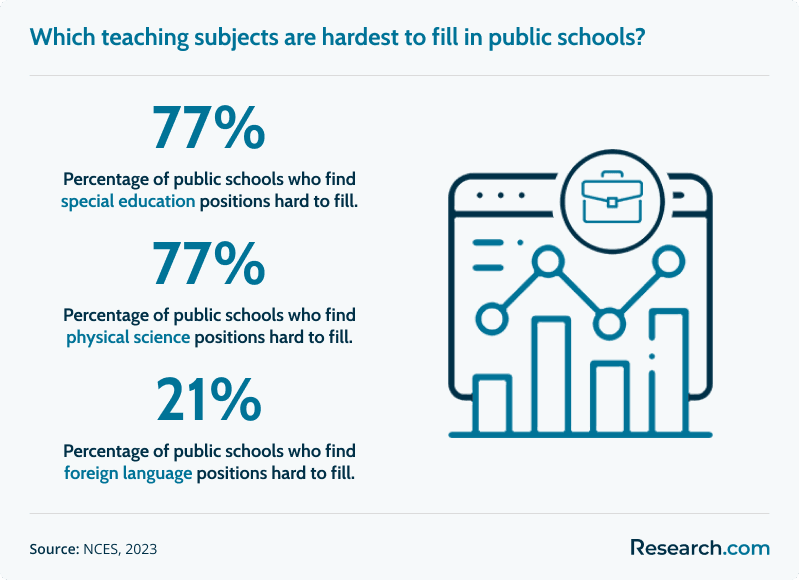
| Special Education | Students with disabilities in inclusive or specialized settings, including individualized education planning and behavioral support. | NCES reported that 77% of schools described staffing special education roles as “very difficult,” making this a high-need area. |
| STEM Subjects | Science, technology, engineering, math, and related subject areas such as physical science. | Often a strong choice for candidates with prior professional or academic experience in technical fields. |
| English as a Second Language | English language development for students whose first language is not English. | Especially relevant in diverse districts and schools serving multilingual learners. |
| Foreign Language Education | Languages such as Spanish, French, Mandarin, and other world languages. | Approximately 76% of schools report difficulty finding qualified foreign language teachers. |
| Early Childhood or Elementary Education | Young learners and foundational subjects such as reading, math, science, and social studies. | A good fit for candidates who want broad classroom responsibility and enjoy working with younger students. |
| Secondary Education | Grades 6–12 in subjects such as English, math, history, biology, or other content areas. | Usually requires strong subject-area knowledge and the correct content exam. |
The chart below compares the number of teachers who entered through alternative route programs to those who didn't, as reported by the NCES in 2023.
How to Choose the Best and Fastest Online Alternative Teacher Certification Program
The best program is the one that gets you licensed in the state, grade level, and subject area you actually plan to teach. A fast program that is not state-approved for your goal can waste time and money.
- Confirm state approval first. Check your state Department of Education website and verify that the program is recognized for your intended license.
- Review accreditation and institutional credibility. Look for relevant recognition from organizations such as the Council for the Accreditation of Educator Preparation (CAEP), AAQEP, or regional accreditors such as HLC or SACSCOC.
- Match the program to your subject and grade level. Do not assume an elementary pathway qualifies you for secondary math, special education, or ESL.
- Compare timelines realistically. American Board and Teachers of Tomorrow may be faster in some situations, while Moreland University and Lamar University may provide more structured support over a longer period.
- Ask how field experience works. Find out who secures placements, whether paid internships are allowed, and whether your current school employment can count.
- Calculate the full cost. Include tuition, testing, fingerprinting, state fees, materials, and retake costs.
- Evaluate support services. Mentoring, coaching, exam preparation, and placement assistance can matter as much as price.
- Check employment outcomes in your state. Reviews can help, but focus on whether graduates are hired in your target districts and licensure area.
| Question to Ask Before Enrolling | Why It Matters |
| Is this program approved for the state where I want to teach? | State approval determines whether your coursework can lead to the license you need. |
| Which license areas does the program support? | You need exact alignment with your grade band and subject area. |
| Are exams required before admission, during the program, or after completion? | Exam timing can affect both cost and completion speed. |
| Who arranges student teaching or internship placement? | Placement support can prevent delays, especially for online students. |
| What fees are not included in the advertised price? | Testing, background checks, and state licensure fees can change the total cost. |
| What happens if I move to another state? | Teacher certification transfer rules vary, and reciprocity is not automatic. |
Who Should Choose an Online Alternative Teacher Certification Program?
An online alternative certification route can be a strong fit if you already hold a bachelor’s degree, know where you want to teach, and need a flexible way to complete teacher preparation while working or managing other responsibilities.
- Career changers who want to move from business, science, technology, humanities, military service, or nonprofit work into teaching.
- Paraprofessionals and substitute teachers who already have school experience and want full certification.
- Professionals in shortage subjects such as STEM, special education, bilingual education, or foreign languages.
- Working adults who cannot attend daytime campus classes.
- Rural candidates who need access to certification without relocating.
Who Should Consider a Different Route?
Online alternative certification is not the right solution for every future teacher. You may need a different pathway if you do not yet have a bachelor’s degree, want a traditional campus experience, need extensive in-person support, or plan to teach in a state that does not accept your chosen provider.
- Students without a bachelor’s degree should usually complete an approved bachelor’s-level teacher preparation program first.
- Candidates seeking broad academic study may prefer a teaching degree rather than a certification-only option.
- Applicants unsure about their state or subject area should delay enrollment until they confirm licensure requirements.
- People who need federal financial aid should verify aid eligibility carefully because many certification-only programs do not qualify.
Career Paths After Online Alternative Teacher Certification
Graduates of online alternative teacher certification programs most often enter classroom teaching roles, but certification can also become the first step toward instructional leadership or specialized education careers.
- Preschool or Pre-K Teacher: Candidates who meet the correct state and subject requirements may teach young learners. The average preschool teacher salary is approximately $37,120, though pay varies by location and school type.
- Elementary School Teacher: Teach foundational subjects such as reading, math, science, and social studies, typically in grades K–5.
- Middle or High School Teacher: Teach a specific subject such as English, math, biology, history, or another content area in grades 6–12.
- Special Education Teacher: Support students with disabilities through individualized instruction, accommodations, and collaboration with families and specialists.
- ESL/ELL Teacher: Help multilingual learners build English proficiency and succeed in academic content areas.
- Instructional Coach or Lead Teacher: With experience, teachers may support colleagues in curriculum planning, classroom practice, or instructional improvement.
- School Administrator or Department Chair: Some educators move into leadership after gaining classroom experience and completing additional education or credentials.
Job Market for Graduates of Fast Online Alternative Teacher Certification Programs
The job market for alternatively certified teachers varies by state, district, grade level, and subject. National projections from the U.S. Bureau of Labor Statistics show a mixed outlook through 2033, but shortage areas continue to create hiring opportunities in many districts.
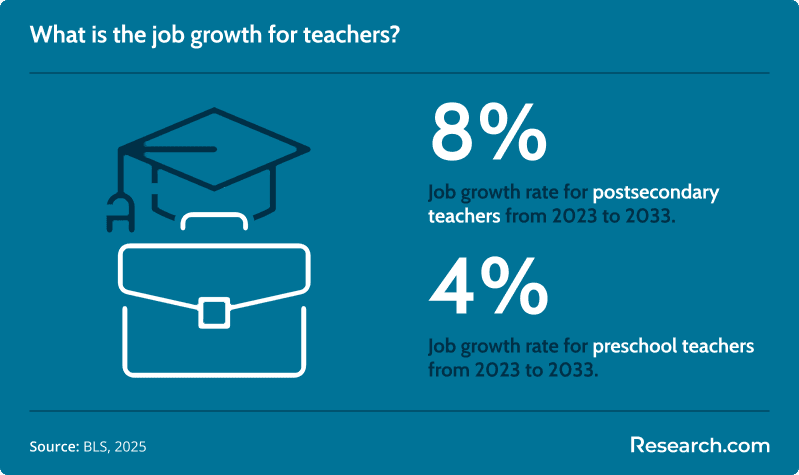
- Preschool teachers: Employment is projected to grow 4%, which is about average for U.S. occupations.
- Kindergarten and elementary school teachers: Employment is projected to decline by 1% nationally, although local shortages may persist in specific states and rural communities.
- Middle and high school teachers: Employment is also projected to decline by 1%, but demand remains stronger for teachers in math, science, special education, and bilingual education.
- Postsecondary teachers: These roles are projected to grow 8%, though they typically require graduate education or additional credentials beyond initial teacher certification.
The strongest strategy is to choose a licensure area with local demand. A candidate certified in a shortage subject in a district actively hiring may see better opportunities than a candidate with a more saturated certification area in a region with declining enrollment.
Current Trends Affecting Alternative Teacher Certification
- Shortage-area hiring remains important. Schools continue to report difficulty filling roles in special education, STEM, foreign language, and bilingual education.
- Online teacher preparation is now a common option for working adults. Many candidates need flexible coursework but still must complete in-person field experience.
- Employers are scrutinizing state approval. Districts need teachers whose credentials align with state licensing rules, not just program completion certificates.
- Technology skills matter more in classrooms. New teachers are expected to use learning management systems, digital assessment tools, accessibility tools, and classroom technology responsibly.
- Advanced credentials can shape long-term mobility. Teachers who later pursue leadership, policy, speech pathology, multilingual learner education, or doctoral study may expand career options beyond the classroom.
Common Mistakes to Avoid
| Mistake | Why It Can Hurt You | Better Approach |
| Choosing the fastest program without checking state approval | You may complete coursework that does not lead to the license you need. | Verify approval directly through your state education agency before applying. |
| Looking only at tuition | Testing, background checks, books, and state fees can raise the total cost. | Build a full budget before comparing programs. |
| Assuming online means no classroom placement | Most certification pathways still require supervised teaching experience. | Ask how practicum, student teaching, or internships are arranged. |
| Choosing a specialization without checking demand | Some subject areas may have fewer local openings. | Review district job postings and state shortage lists before selecting a license area. |
| Assuming certification transfers automatically across states | Reciprocity rules vary and may require additional exams or coursework. | Check rules in every state where you may want to teach. |
| Relying only on rankings | A highly ranked program may not match your state, schedule, subject, or budget. | Use rankings as a shortlist, then verify fit with advisors and state agencies. |
Graduate Experiences
- Anitra: "I completed my certification in under a year while still working full-time at a community center. The flexible structure helped me stay on track, and I began student teaching three months into the program. I now teach my own second-grade classroom."
- Gregor: "After years in technology, I wanted a practical way to move into teaching. The fast-track route helped me build classroom skills and earn the credential I needed without putting the rest of my life on hold. It was demanding, but it helped me change careers."
- Meilin: "Going back to school in my 40s felt intimidating at first. The accelerated pace kept me focused, and the mentoring made each step feel manageable. Passing the certification exam made the career change feel real."
Are Online Alternative Teacher Certification Programs Accredited and State-Approved?
Accreditation and state approval are not the same, and both deserve attention. State approval determines whether a program can lead to teacher licensure in a specific state. Accreditation speaks to institutional or educator-preparation quality, depending on the accrediting body.
Before enrolling, check the program website, the state education department website, and official program documentation. If you plan to continue into advanced credentials later, institutional credibility becomes even more important. Educators considering long-term leadership or doctoral study can compare pathways such as a 2 year EdD program after they understand their initial certification options.
Can Alternative Teacher Certification Lead to Academic Leadership?
Yes, but certification is usually only the first step. Online alternative teacher certification can get you into the classroom, where you build the experience often required for leadership positions. Later, educators may pursue graduate study, administrative licensure, or doctoral preparation to move into roles such as department chair, instructional leader, principal, district administrator, or higher education professional.
Teachers interested in leadership can explore options such as affordable online doctoral programs for educational leadership after gaining classroom experience and clarifying whether they want school administration, policy, curriculum leadership, or higher education roles.
Can Alternative Teacher Certification Support Specialized Education Careers?
Alternative certification can also be a foundation for specialized roles, especially when teachers later add endorsements, graduate certificates, or advanced degrees. Common next steps include educational technology, curriculum design, multilingual learner education, special education leadership, reading intervention, and student support services.
Some educators move toward related clinical or support professions after classroom experience. For example, teachers interested in communication development and student support may compare online speech pathology master's programs with other graduate-level education pathways.
Key Insights
- The fastest online alternative teacher certification programs can take as little as 2 to 12 months, but field experience, exam timing, and state rules can extend the timeline.
- State approval is the most important factor. A fast program is not useful if it does not qualify you for the license you need.
- Costs commonly range from $2,000 to $7,500, but candidates should also budget for testing, fingerprinting, state applications, and materials.
- Online programs can be just as viable as campus options when they include approved coursework, required classroom experience, and licensure exam preparation.
- Specialization matters. Areas such as special education, STEM, ESL, and foreign language education may offer stronger opportunities in districts facing staffing challenges.
- Certification-only routes are best for adults who already hold a bachelor’s degree. Candidates with an associate’s degree usually need to complete a bachelor’s pathway first.
- Before enrolling, ask about state approval, supported licensure areas, placement support, exam requirements, total cost, and transferability if you may move states.
References
- Bureau of Labor Statistics (BLS). (2025a). High School Teachers. Occupational Outlook Handbook. BLS.
- Bureau of Labor Statistics (BLS). (2025b). Kindergarten and Elementary School Teachers. Occupational Outlook Handbook. BLS.
- Bureau of Labor Statistics (BLS). (2025c). Middle School Teachers. Occupational Outlook Handbook. BLS.
- Bureau of Labor Statistics (BLS). (2025d). Postsecondary Teachers. Occupational Outlook Handbook. BLS.
- Bureau of Labor Statistics (BLS). (2025e). Preschool Teachers. Occupational Outlook Handbook. BLS.
- National Center for Education Statistics (NCES). (2023a). Number and percentage distribution of teachers in public elementary and secondary schools, by whether they entered teaching through an alternative route to certification program and selected teacher and school characteristics: School year 2020-21. Digest of Education Statistics. NCES.
- National Center for Education Statistics (NCES). (2023b). Most Public Schools Face Challenges in Hiring Teachers and Other Personnel Entering the 2023-24 Academic Year. Press Release. NCES.
- Teachers of Tomorrow. (2025). Certified vs Non-Certified Teacher – Main Difference in 2025. Education Insights. Teachers of Tomorrow.
Other Things You Should Know About the Fastest Online Teacher Alternative Certification Programs
Most fast alternative routes require a bachelor’s degree and 30 semester credits or more in the intended teaching subject, plus a minimum GPA, often 2.5 or higher. Many programs also require passing background checks and subject-area tests such as Praxis content exams before admission.
In 2027, Texas offers some of the fastest online alternative teacher certification programs, allowing aspiring teachers to complete certification in as little as six months. Some popular options include iteachTEXAS and Texas Teachers of Tomorrow, which offer flexible, self-paced courses tailored to individual needs.
The fastest programs in 2027 often include assessments like the Praxis exams or state-specific certification tests. These are designed to validate teaching competency. Some programs also require practical teaching assessments to ensure candidates can apply skills in real classroom settings.
Fast online alternative teacher certification programs may require candidates to complete a condensed field experience, often lasting 6-12 weeks. This typically involves supervised teaching and observation hours in a school setting to gain practical teaching skills, regulated by state education boards.